World

A year after it vanished, famed 'Guernica' tapestry returns to UN

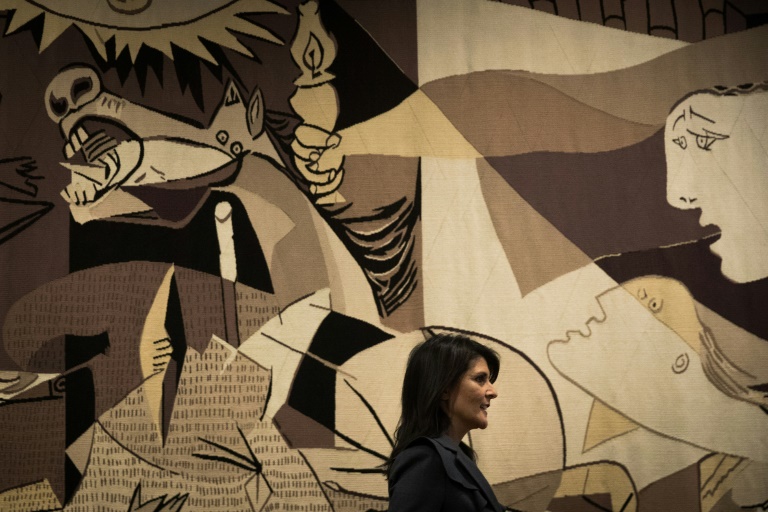
One year after its sudden and disconcerting disappearance from a wall at the United Nations, a vast tapestry representing Picasso’s iconic “Guernica” has been returned by owners the Rockefeller family to its prominent place at the global body.

The rehanging of the immense weaving was underway Saturday morning, a UN source said, as diplomats expressed relief about the return of the 25-foot-wide (7.5-meter) work which hung outside the Security Council chambers, where presidents, prime ministers and ambassadors would regularly pass.

The tapestry was commissioned by Nelson A. Rockefeller in 1955 and woven in a French studio in consultation with Picasso, who did his original “Guernica” painting during the Spanish Civil War. It represents the bombardment of the Spanish city of that name on April 26, 1937 by German Nazi and Italian fascist forces.

“The Guernica tapestry with its probing symbolism -– its depiction of horrific aspects of human nature — wrestles with the cruelty, darkness, and also a seed of hope within humanity,” Nelson Rockefeller Jr. said in a UN statement announcing the artwork’s return.

“I am grateful that the tapestry will be able to continue to reach a broader segment of the world’s population and magnify its ability to touch lives and educate.”

On loan to the UN by the Rockefellers, it was meant to serve as a powerful reminder to UN diplomats of the horrors of war. Screaming women, a dead baby and a dismembered soldier are rendered in ominous shades of brown and black.

But in February 2021, as the Covid-19 crisis was sweeping the globe and thousands of UN employees were forced to work from home, the tapestry vanished without explanation.

“It’s horrible, horrible, that it is gone,” said UN Secretary-General Antonio Guterres, himself surprised by the sudden disappearance.

In a letter to the Rockefellers in December, Guterres welcomed the upcoming reinstallment at the UN.

“We are honored to serve as careful stewards of this one-of-a-kind iconic work — as we draw inspiration from its message,” he wrote, according to the UN statement.

In an interview published Saturday in The New York Times, Nelson Rockefeller Jr. acknowledged a “miscommunication” — indicating that the tapestry had needed cleaning and preservation work.

“Guernica” is on loan to the UN with the provision that the family can reclaim it to be shown in exhibits in the United States or elsewhere for up to six months. 
In city near border, Ukrainians protest Russian threat

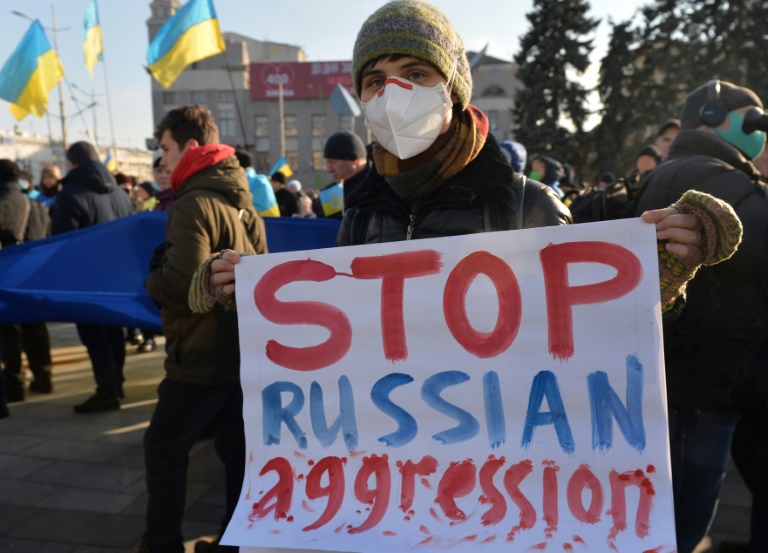
A Ukrainian flag wrapped around her shoulders, pensioner Iryna Gayeva had a simple message as she demonstrated in second city Kharkiv on Saturday, just 40 kilometres from the Russian border. 

“We do not want Russia,” she told AFP, as she joined several thousand people for a “Unity March” called by nationalist groups. 

“I was born in Crimea. That’s enough, they’ve already taken a homeland from me. I grew up here, I live here, my parents are from Russia but I don’t want to see any occupiers,” she said.

“This is my home, these are my rules.” 

Russiaseized  the Crimea peninsula in 2014 and began fuelling a separatist conflict in eastern Ukraine.

The Kremlin has now massed more than 100,000 troops across the frontier, sparking fears from the West that Russian President Vladimir Putin is planning a major incursion. 

Moscow denies it will invade and blames NATO for threatening its security by expanding into eastern Europe. 

Kharkiv, an industrial and university centre with a million and a half inhabitants, many Russian-speaking, is more than 400 kilometres east of the capital Kyiv and right next to the Russian border.

Ukraine’s President Volodymyr Zelensky has warned that, given the population’s strong links to Russia, the city could be a prime target for “occupation” if the situation escalates. 

– 2014 unrest –

There appear grounds for the concern. 

In 2014, as Russian-backed separatists took over two other eastern cities of Donetsk and Lugansk, fears swirled that Kharkiv could be the next domino to fall. 

Pro-Moscow protesters attacked the regional administration with molotov cocktails, as violence broke out with pro-Ukrainian activists. 

Eventually Ukrainian forces managed to stop Kharkiv slipping from Kyiv’s grasp, saving it from getting engulfed in a conflict that has cost 13,000 lives over the past eight years. 

And now, those demonstrating insisted that Russian forces would not be welcome in Kharkiv as pro-Ukrainian patriotism has rocketed.

“In 2014, it was panic,” recalled Gayeva. 

“This time there is no panic but anger.”

At her side, Nadia Rynguina is even more categorical. 

“The situation has changed, we have an army worthy of the name, we have citizens ready to defend the country,” she explained.

In the event of an intervention, Yury Shmylyov, 79, warned that “it will not be a walk in the park” for the Russian army. 

“In 2014, we were afraid to display a blue and yellow flag here, but now look,” he said, pointing at the gathered crowd. 

– ‘Constant threat’ –

Behind a large banner reading “Kharkiv is Ukraine”, the demonstrators marched between the city’s two main squares in sub-zero temperatures.

They chanted patriotic slogans, sang the national anthem and carried signs thanking Britain and the United States for ramping up arms deliveries to Ukraine. 

Galyna Kuts, a political scientist in Kharkiv and a member of the regional legislature, said Zelensky’s warning of potential “occupation” set nerves jangling. 

“Everyone was calling each other to ask what to do, where to flee,” she said as she attended the rally.  

But after years “living under constant threat of invasion”, she insists resident in Kharkiv have steeled themselves for anything. 

“People have changed, they know how to survive,” she said. 

Oleksandr Gerasimov has filled up his tank and is ready to evacuate his family if necessary. 

But the 39-year-old demonstrator, insists he is “calm” as he does not believe Moscow will risk an attack against Ukraine’s bolstered armed forces. 

“Russia would suffer intolerable losses,” he said. 

Canada protests against Covid measures gain steam

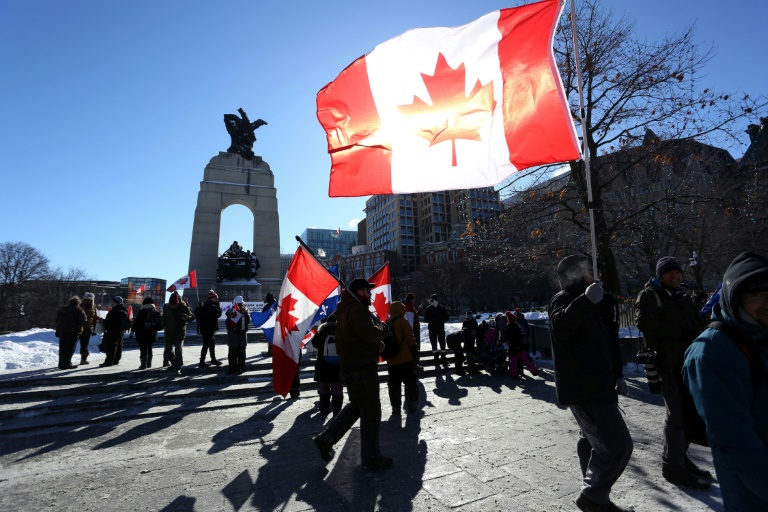
More demonstrators poured onto the streets of Ottawa and other Canadian cities on Saturday demanding an end to Covid vaccine mandates, as protests against pandemic restrictions entered their second week.

In the capital, demonstrators huddled around campfires in bone-chilling temperatures and erected portable saunas and bouncy castles for kids outside Parliament, while waving Canadian flags and shouting anti-government slogans.

Their chants of “freedom” were met with cries of “go home” by a smaller group of counter-protestors fed up with the takeover of the capital.

The atmosphere, however, appeared more festive than a week earlier, when several protesters waved Confederate flags and Nazi symbols and clashed with locals.

The demonstrations, which started out as protests by truckers angry with vaccine requirements when crossing the US-Canadian border, have morphed into broader protests against Covid health restrictions.

Police were out in force and put up barriers overnight to limit vehicle access to the city center, as many thousands of protestors — including two on horseback — joined truckers already jamming Ottawa streets.

Similar protests were happening in Toronto, Quebec City and Winnipeg — where a driver was arrested for slamming into demonstrators. Four people were treated for minor injuries, police said.

A man was also charged with assault for throwing a smoke bomb at the Toronto rally.

And in southern Alberta province, truckers continued to block a major border crossing to the US state of Montana.

– No end in sight –

“This remains an increasingly volatile and increasingly dangerous demonstration,” Ottawa police chief Peter Sloly told a news conference Friday.

With public anger rising — thousands of residents have complained of harassment by protesters, and an online petition demanding action has drawn 40,000 signatures — Sloly vowed to crack down on what he called an “unlawful” occupation of the city.

But he offered no timeline.

Reached for comment by AFP, protest coordinator Jim Torma said the protesters would not back down.

“They’re not going to hide us,” Torma said. “We’re going to be in (politicians’) faces as long as it takes” to force an end to public health restrictions aimed at slowing the spread of Covid-19.

Kimberly Ball, who with her husband drove five hours from a small town west of Toronto to join the Ottawa protest, told AFP, “It’s about our freedom.” 

Holding back tears, she said, “A couple of people we know, friends, lost their jobs because of these (vaccine) mandates” and her own parents have disowned her for not getting a jab.

Ball has had Covid and said she questions whether the vaccines are safe and effective.

She is, however, in the minority in Canada, where 90 percent of adults are fully vaccinated.

– A ‘fringe minority’? –

The Freedom Convoy started on Canada’s Pacific coast in late January and picked up supporters along the long trek to the capital — as well as more than 10 million Canadian dollars (US$8 million) in online donations.

The number of protesters in Ottawa had peaked last Saturday at several thousand before dwindling to a few hundred by midweek, officials said.

The protest has received support from tech magnate Elon Musk and former US president Donald Trump, who in a statement Friday called Prime Minister Justin Trudeau a “far left lunatic” for imposing “insane Covid mandates.”

The Canadian prime minister has said the protesters represent only a “fringe minority,” though polls show one-third of Canadians support the call to lift all Covid restrictions.

The leaders of two Western provinces, Jason Kenney of Alberta and Scott Moe of Saskatchewan, this week added their voices to the anti-mandate push.

“There are many jurisdictions around the world that have adopted more common-sense travel protocols than we have now in place in Canada,” Kenney said.

Moe, meanwhile, announced an imminent lifting of all pandemic restrictions in Saskatchewan, despite pushback from doctors.

Vaccine mandates for travelers are set by the federal government, but most other Covid measures are the responsibility of provincial authorities in Canada.

“What’s necessary is your freedom,” Moe said in a video address. “What’s necessary is getting your life back to normal.”

Ottawa residents, however, have had enough of the chaos the protests have brought to their streets. 

“The truckers have been terrorizing us for seven, eight days now,” said university student Saffron Binder. “The occupation must end.”

“I just want them to leave,” echoed Abby McKinnon at the counter-protest.

French far-right hope Zemmour attacks welfare handouts

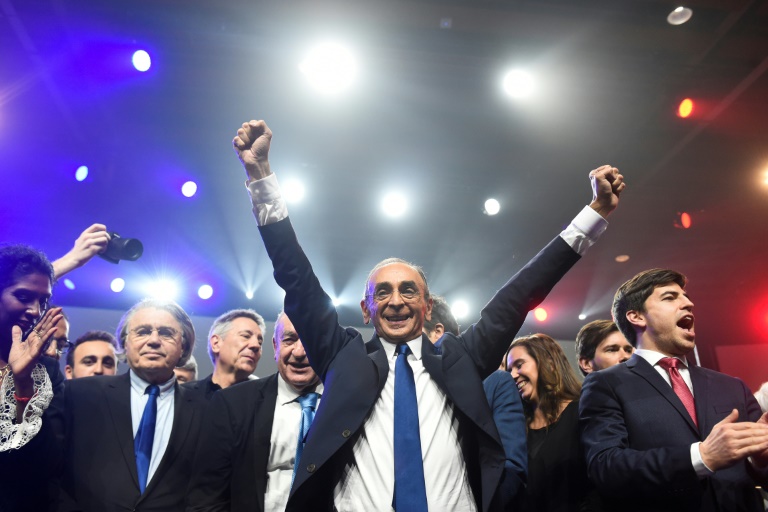
French far-right presidential candidate Eric Zemmour on Saturday used a meeting in the northern city of Lille to launch a tirade against welfare handouts.

Looking to outmanoeuvre fellow far-right rival Marine Le Pen in April polls, Zemmour told 6,000 supporters he was on the side of a “France that works”.

At her first campaign rally in Reims, northeast of Paris, Le Pen meanwhile spoke to a crowd of some 4,000 people, most of whom believed she represents a less “extremist” view of the world.

Choosing Reims, a city where numerous French kings were crowned down the centuries, Le Pen beamed as one backer, 58-year-old businesswoman Annick, said she would get her vote.

“I am doing well economically but with Marine Le Pen there are values — attachment to our French identity, an image of firmness,” said Annick.

She dubbed Zemmour “an extremist in his attitude and words” who “has no sincerity”.

Both far-right candidates are looking to sweep up support in their bid to reach a presidential run-off vote in the industrial north of the country which is a traditional hotbed of support.

The north is also a region, Zemmour suggested, where “handouts are an insult”.

Promising to tackle low salaries, he scoffed: “When you get up every morning to go and work… you don’t accept that your neighbour lives better than you do thanks to welfare without having to work.”

Lille’s Socialist mayor Martine Aubry had earlier said Zemmour was not welcome in the town and joined a peaceful demonstration against “hate” organised by anti-racism group SOS Racisme.

Police said a little over 1,000 people — including a few hundred from the hard left — staged another protest, during which security forces fired tear gas towards a handful of people dressed in black.

Among the protesters, Christian, a 68-year-old retiree, said he was there because he was worried his fellow French were being “deaf and blind” to far-right ideas he believes are dangerous.

During Zemmour’s rally, one journalist with private broadcaster LCI told AFP one of his supporters had spat in her face.

In a recent survey of voters by polling firm Ipsos, Zemmour and Le Pen both scored 14 percent.

The poll put President Emmanuel Macron in the lead with 24 percent, followed by right-wing contender Valerie Pecresse with 16.5 percent.

Marchers demand justice for Congolese migrant brutally killed in Rio

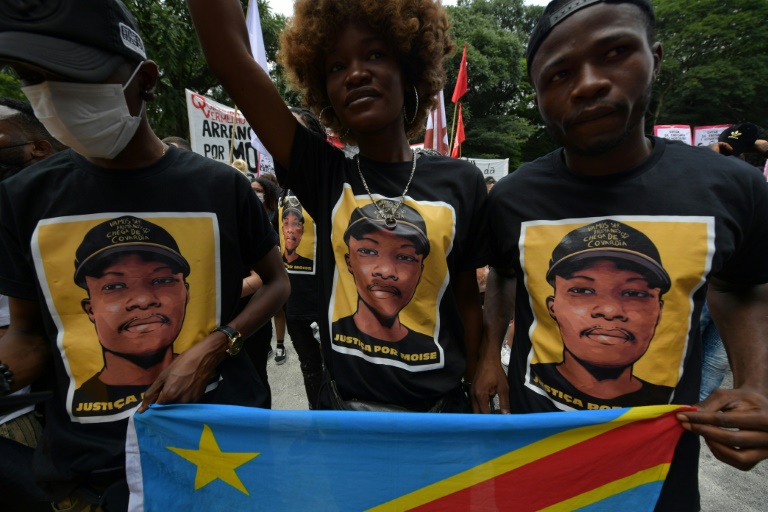
Hundreds of people marched Saturday in Brazil to demand justice for a young Congolese immigrant who was beaten to death in a bar on a Rio de Janeiro beach.

Moise Kabagambe, 24, died on the night of January 24 at the bar where he worked in the upscale Barra da Tijuca neighborhood, allegedly after demanding that his boss pay him overdue wages, according to authorities and family members.

Carrying placards with pictures of his face and messages against racism and xenophobia, the protesters gathered around the beach-front bar in western Rio. 

“This is about the death of a foreigner who was our brother — because he was Black. We are here to show our resistance, to show that we will not allow what happened to go unpunished,” 19-year-old student Bruna Lira told AFP.

Her T-shirt bore the word “Anti-racist.”

Congolese immigrants dressed in white sang and danced as part of the protest. Members of Kabagambe’s family were in attendance.

Other protests in his name were held in Sao Paulo, Salvador, Belo Horizonte and Brasilia.

Kabagambe arrived in Brazil in 2011, fleeing the armed conflict that has racked his native Democratic Republic of Congo.

Family members said the beating came after he insisted his manager pay him overdue wages for two days of work.

Brother Sammy Kabagambe told AFP that police showed family members security camera footage on which the manager could be seen calling in other assailants. At least three men brutally beat the victim with clubs and a baseball bat, relatives said.

Police have detained three suspects.

“Brazil only values light-eyed foreigners who speak English,” rights activist Douglas Alencar said at the Rio protest.  

Kabagambe’s death sparked a wave of indignation on social media, with artists, athletes and others demanding justice. 

“It’s a great injustice,” a Congolese friend of his, Chico Mayamba, told AFP. “The money that Moise earned working here was to help his family.”

Rio Mayor Eduardo Paes announced Saturday that the spot where Kabagambe was killed will be turned into a memorial honoring him and the Congolese culture.

In Brazil, a huge country of 213 million with the largest Black population outside of Africa, more than 50 percent of people identify as Black or mixed race — and they suffer disproportionately from violence, unemployment and poverty. 

Marchers demand justice for Congolese migrant brutally killed in Rio

Hundreds of people marched Saturday in Brazil to demand justice for a young Congolese immigrant who was beaten to death in a bar on a Rio de Janeiro beach.

Moise Kabagambe, 24, died on the night of January 24 at the bar where he worked in the upscale Barra da Tijuca neighborhood, allegedly after demanding that his boss pay him overdue wages, according to authorities and family members.

Carrying placards with his face and messages against racism and xenophobia, the protesters gathered around the beach-front bar in western Rio. 

“This is about the death of a foreigner who was our brother — because he was Black. We are here to show our resistance, to show that we will not allow what happened to go unpunished,” 19-year-old student Bruna Lira told AFP.

Her T-shirt bore the word “Anti-racist.”

A group of Congolese immigrants dressed in white sang and danced as part of the protest. Members of Kabagambe’s family were in attendance.

Other protests in his name were held in Sao Paulo and Brasilia.

Kabagambe arrived in Brazil in 2011, fleeing the armed conflict that has racked his native Democratic Republic of Congo.

Family members said the beating came after he insisted his manager pay him overdue wages for two days of work.

Brother Sammy Kabagambe told AFP that police showed family members security camera footage on which the manager could be seen calling in other assailants. At least three men brutally beat the victim with clubs and a baseball bat, relatives said.

Police have detained three suspects.

“Brazil only values light-eyed foreigners who speak English,” rights activist Douglas Alencar said at the Rio protest.  

Rio Mayor Eduardo Paes announced Saturday that the spot where Kabagambe was killed will be turned into a memorial honoring him and the Congolese culture.

Contact group urges resumed talks by Venezuela parties

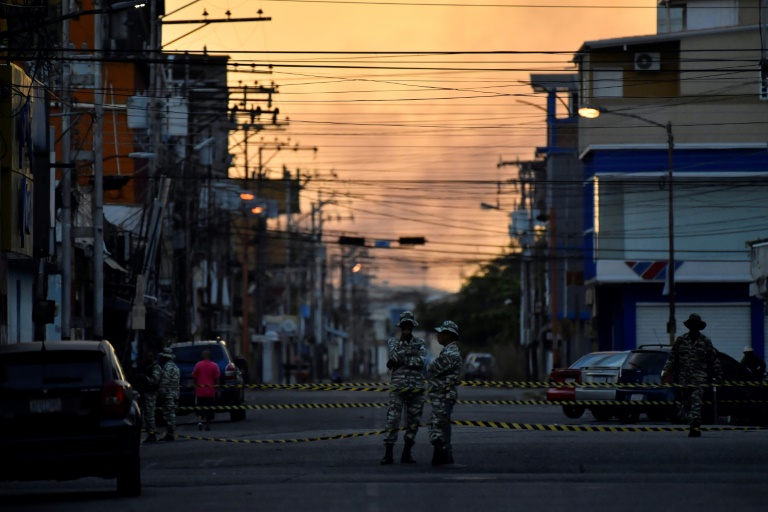
A group of European and Latin American countries on Saturday urged Venezuelan authorities and opposition leaders to resume their dialogue in Mexico aimed at resolving the country’s political and economic crises.

The International Contact Group (ICG), comprising European Union countries and several Latin American nations, issued its call in a statement a day after a “high-level” videoconference dealing with regional elections held in Venezuela on November 21.

Those elections saw the victory of the ruling party but also a return to participation by the opposition following years of electoral boycotts.

The talks began in August 2021 and continued through several rounds before the Venezuelan authorities suspended them in October. That followed the extradition by the African nation of Cape Verde to the United States of a Colombian businessman on money laundering charges.

The businessman, Alex Saab, is considered a confidant of Venezuelan leader Nicolas Maduro, though the opposition has described him as a frontman doing shady dealings with Maduro’s government. 

Venezuelan authorities have demanded Saab’s release and the unfreezing of Venezuelan assets held abroad before they resume dialogue with the opposition.

The United States — which along with some 50 other countries does not recognize Maduro as Venezuela’s legitimately elected president — has said he was putting Saab’s fate above the country’s future.

The contact group on Friday also reviewed a preliminary report by EU election monitors regarding the November elections.

Team chief Isabel Santos, who is Portuguese, said the group found “better conditions” than in previous elections.

But she cited problems with judicial independence, with the “arbitrary” exclusion of certain candidates, with illegal checkpoints run by Maduro’s party near polling sites, and with the transparency of the vote. 

Maduro has denounced the European observers as “enemies” and “spies.”  

Joe Rogan apologizes for his 'shameful' use of N word

US podcaster Joe Rogan apologized Saturday for his past use of racist language including the “N word” and said at least one offensive episode of his show has been deleted from streaming giant Spotify.

“My sincere and humble apologies,” Rogan said in a nearly-six-minute Instagram post addressing what he called “the most regretful and shameful thing that I’ve ever had to talk about publicly.”

Rogan’s incendiary language is the latest explosive development to roil Spotify and its flagship star, who have both faced a popular backlash over Covid-19 misinformation on his shows.

The 54-year-old acknowledged he had a particular podcast episode removed which referred to his seeing a movie in a Black neighborhood where he said “it was like we were in ‘Planet of the Apes’.”

The New York Times reported Saturday that as many as 70 episodes of “The Joe Rogan Experience” show had been quietly taken off Spotify. The streaming service had yet to respond to queries from AFP.

Rogan said his use of the “N word” over a 12-year period — highlighted in a recently uncovered compilation video of him using the term — looks “horrible, even to me.”

He said he believed at the time that as long as he was using the word in context that people would understand his actions.

“I never used it to be racist, because I’m not racist,” he said.

But there is “no context where a white person is ever allowed to say that word, nevermind publicly on a podcast,” he added.

“If a white person says that word it’s racist and toxic, but a Black person can use it and it can be a punchline, it can be a term of endearment, it could be lyrics to a rap song, it could be a positive affirmation.”

Rogan went on: “It’s a very unusual word, but it’s not my word to use. I’m well aware of that now.”

– ‘Teachable moment’? –

Spotify’s stock fell sharply Thursday amid controversy over Rogan’s show, which garners up to 11 million listeners per episode.

Music legends Neil Young and Joni Mitchell as well as other artists asked that their songs be removed from the platform in protest of Rogan, who has been accused of spouting misinformation about Covid-19 and vaccinations, either directly or through the guests he interviews on his show.

As for his racist language, Rogan said he aimed to do better.

“I can’t go back in time and change what I said…. but I do hope that this can be a teachable moment for anybody that doesn’t realize how offensive that word can be coming out of a white person’s mouth — in context or out of context,” he said.

Rogan went into detailed description of his remarks on the removed episode from 11 years ago in which he spoke about seeing “Planet of the Apes” with friends in a neighborhood of Philadelphia.

“I did not, nor would I ever, say that Black people are apes, but it sure… sounded like that,” he said on his Instagram post which already racked up 3.6 million views.

“And I immediately afterward said that’s a racist thing to say. ‘Planet of the Apes’ wasn’t even in Africa, I was just saying there were a lot of Black people there” in the neighborhood.

It sounded “terrible,” he acknowledged. “You can have clunky stories about anything, but not about race.”

UN's Guterres says expects China to let rights chief visit Xinjiang

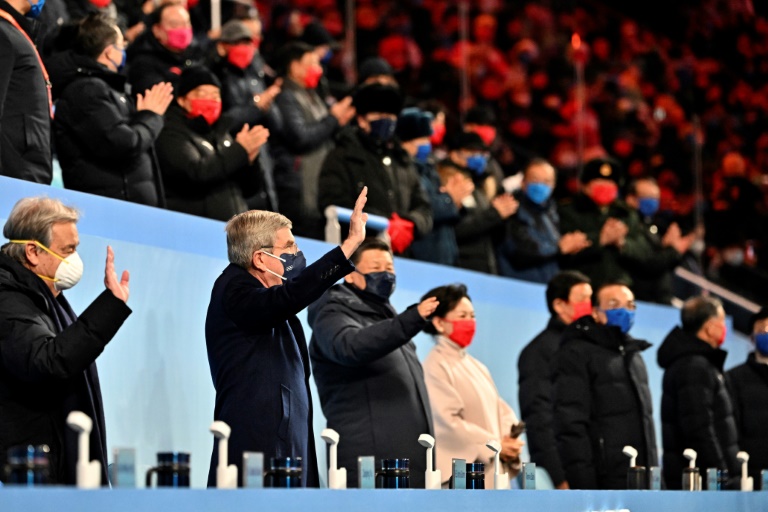
UN Secretary-General Antonio Guterres told leaders in Beijing he expects them to allow UN human rights chief Michelle Bachelet to make a “credible” visit to China including a stop in the troubled Xinjiang region, his spokesman said Saturday.

Guterres met with Chinese President Xi Jinping and Foreign Minister Wang Yi on the sidelines of the Winter Olympics, according to a readout of their talks.

The UN chief “expressed his expectation that the contacts between the office of the High Commissioner for Human Rights and the Chinese authorities will allow for a credible visit of the High Commissioner to China, including Xinjiang,” it said. 

A readout of the meeting from Chinese state news agency Xinhua made no mention of the rights issue.

Campaigners say that at least one million mostly Muslim minorities have been incarcerated in “re-education camps” in Xinjiang, a far-western region where China is accused of widespread human rights abuses including forced sterilizations of women and forced labor.

In the run-up to the Winter Olympics, China’s foreign ministry repeatedly emphasized Guterres’ support of the Games at daily briefings. 

The UN chief himself congratulated Xi on the organization of the Games in their talks in Beijing, the statement from the world body said.

But China has so far denied Bachelet, a former president of Chile, a long-sought independent visit to Xinjiang.

The US government and lawmakers in five other Western countries have declared China’s treatment of the Uyghurs in Xinjiang a “genocide” — a charge flatly denied by Beijing.

China has repeatedly exhorted its critics to stop “politicizing” the Olympics, which have been overshadowed by issues including rights, Covid-19 and fears of what will happen to athletes if they speak out at the Games.

But at the opening ceremony, it chose a young Uyghur athlete, 20-year-old cross-country skier Dinigeer  Yilamujiang, as one of the final Olympic torch-bearers — a move that had clear political overtones.

Activists and lawmakers have been eagerly awaiting a UN report on human rights in Xinjiang, and pressure had mounted for its release before the Beijing Games, but the world body said late last month it would not be forthcoming before the Olympics.

Hong Kong’s South China Morning Post newspaper indicated that Beijing had relented and agreed to a visit to Xinjiang by Bachelet — hinting that, in exchange, it expected her office to hold off publishing the report.

At the meeting with Xi, Guterres “expressed the wish for enhanced cooperation between the United Nations and the People’s Republic of China in all the pillars of the Organization’s work -– peace and security, sustainable development, including climate change and biodiversity, and human rights,” the UN statement said.

On climate change, the UN chief “recognized the important efforts China is making to address climate change but reiterated the appeal for additional efforts to accelerate the transition to the green economy to bridge the emissions gap.”

In city near border, Ukrainians protest Russian threat

A Ukrainian flag wrapped around her shoulders, pensioner Iryna Gayeva had a simple message as she demonstrated in second city Kharkiv on Saturday, just 40 kilometres from the Russian border. 

“We do not want Russia,” she told AFP, as she joined several thousand people for a “Unity March” called by nationalist groups. 

“I was born in Crimea. That’s enough, they’ve already taken a homeland from me. I grew up here, I live here, my parents are from Russia but I don’t want to see any occupiers,” she said.

“This is my home, these are my rules.” 

Russiaseized  the Crimea peninsula in 2014 and began fuelling a separatist conflict in eastern Ukraine.

The Kremlin has now massed more than 100,000 troops across the frontier, sparking fears from the West that Russian President Vladimir Putin is planning a major incursion. 

Moscow denies it will invade and blames NATO for threatening its security by expanding into eastern Europe. 

Kharkiv, an industrial and university centre with a million and a half inhabitants, many Russian-speaking, is more than 400 kilometres east of the capital Kyiv and right next to the Russian border.

Ukraine’s President Volodymyr Zelensky has warned that, given the population’s strong links to Russia, the city could be a prime target for “occupation” if the situation escalates. 

– 2014 unrest –

There appear grounds for the concern. 

In 2014, as Russian-backed separatists took over two other eastern cities of Donetsk and Lugansk, fears swirled that Kharkiv could be the next domino to fall. 

Pro-Moscow protesters attacked the regional administration with molotov cocktails, as violence broke out with pro-Ukrainian activists. 

Eventually Ukrainian forces managed to stop Kharkiv slipping from Kyiv’s grasp, saving it from getting engulfed in a conflict that has cost 13,000 lives over the past eight years. 

And now, those demonstrating insisted that Russian forces would not be welcome in Kharkiv as pro-Ukrainian patriotism has rocketed.

“In 2014, it was panic,” recalled Gayeva. 

“This time there is no panic but anger.”

At her side, Nadia Rynguina is even more categorical. 

“The situation has changed, we have an army worthy of the name, we have citizens ready to defend the country,” she explained.

In the event of an intervention, Yury Shmylyov, 79, warned that “it will not be a walk in the park” for the Russian army. 

“In 2014, we were afraid to display a blue and yellow flag here, but now look,” he said, pointing at the gathered crowd. 

– ‘Constant threat’ –

Behind a large banner reading “Kharkiv is Ukraine”, the demonstrators marched between the city’s two main squares in sub-zero temperatures.

They chanted patriotic slogans, sang the national anthem and carried signs thanking Britain and the United States for ramping up arms deliveries to Ukraine. 

Galyna Kuts, a political scientist in Kharkiv and a member of the regional legislature, said Zelensky’s warning of potential “occupation” set nerves jangling. 

“Everyone was calling each other to ask what to do, where to flee,” she said as she attended the rally.  

But after years “living under constant threat of invasion”, she insists resident in Kharkiv have steeled themselves for anything. 

“People have changed, they know how to survive,” she said. 

Oleksandr Gerasimov has filled up his tank and is ready to evacuate his family if necessary. 

But the 39-year-old demonstrator, insists he is “calm” as he does not believe Moscow will risk an attack against Ukraine’s bolstered armed forces. 

“Russia would suffer intolerable losses,” he said. 

Close Bitnami banner
Bitnami