
World

After eight years of war, Ukraine's army a tougher prospect
When he arrived at the front line as a volunteer to fight Russian-backed separatists in 2014, Pavlo Dolynskiy found Ukraine’s army in a desperate state.
Kyiv had just lost the Crimean peninsula to Moscow without a shot being fired and its regular forces — eaten away by years of neglect and corruption — couldn’t cope with the spiralling conflict in the east of the country.
“The army had reached the point where it couldn’t stand up to the enemy,” Dolynskiy, who now works at a veterans association, told AFP.
Soldiers struggled to get uniforms and boots, they had antiquated Soviet-era weapons, equipment often malfunctioned and the army relied on a ragtag mix of volunteers to plug the gaps.
“It really was in a lamentable condition,” he said.
But now, as tensions soar over a massive Russian military buildup on its border, Ukraine’s armed forces present a far tougher prospect.
Battle-hardened by nearly eight years of a simmering war that has claimed over 13,000 lives, the military has undergone reforms and been bolstered by Western arms and training.
“Eight years ago, the Ukrainian army did not exist. It was only on paper, and did not have the potential to fight,” said Mykola Beleskov, a defence analyst at the National Institute for Strategic Studies in Kyiv.
“Now they are the best armed forces that Ukraine has had in thirty years of independence. The best prepared and the best trained.”
– Drones, anti-tank missiles –
The conflict has forced Ukraine’s pro-Western leadership to try to turn their depleted Soviet legacy forces into a more modern military aligned closer to NATO standards.
Ukraine’s defence budget has tripled over the past decade in US dollar terms to around $4.2 billion in 2021 and reforms have looked to tackle rampant corruption and improve command and control.
The US has provided some $2.5 billion in military aid since 2014 and training from NATO allies — including also Canada and Britain — has helped bolster battle readiness.
As part of the modernisation drive, Ukraine’s President Volodymyr Zelensky this week signed a decree to add an extra 100,000 personnel to the armed forces over the next three years — taking its total to some 360,000.
The authorities have pledged to ramp up wages for those serving and professionalise the army by ending conscription by 2024.
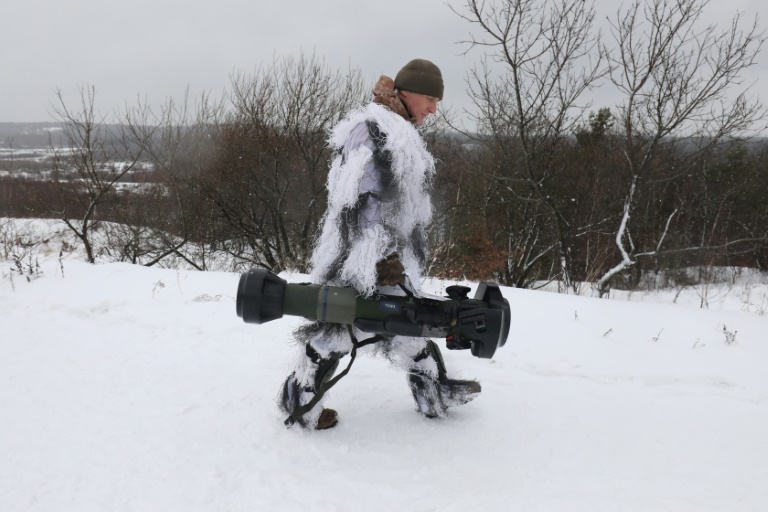
A crucial addition has also been the influx of foreign weaponry that has bolstered the military’s Soviet-era stockpile.
Ukraine has purchased Turkish Bayraktar TB2 combat drones — which proved pivotal in the 2020 Karabakh conflict between Azerbaijan and Armenia — and received shipments of anti-tank missiles from the US and Britain.
“Its forces probably are stronger than they have been for a long time,” said Sam Cranny-Evans, a research analyst at the RUSI think tank in London.
“Nonetheless, there are key deficiencies in Ukraine that have not been addressed.”
He pointed to its limited air defence systems, lack of assets able to carry out long-range strikes and doubts over its reconnaissance capabilities.
Ukraine’s airforce and navy also remain weak points.
Kyiv lost an estimated 70 percent of its vessels when Russia seized the strategic Crimean peninsula in the Black Sea, a recent report from the US Congressional Research Service said.
British minesweepers are on their way but more ambitious plans to rebuild are hampered by severe budget constraints as the economy struggles.
And graft remains a problem draining those tight resources.
“It is widely recognised that Ukraine’s path forward regarding reforms and building appropriate military capabilities is predicated upon eliminating corruption in its defence sector,” said an analysis from defence intelligence agency Janes.
Oleksandr Syrskyi, commander of Ukraine’s ground forces, insisted to journalists Thursday that the military “have taken a big step forward since 2014 — we increased our combat capacity and ability to repel an invasion”.
But he still listed a raft of hardware his troops require: anti-sniper gear, anti-tank weapons, air defence systems, anti-drone systems, reconnaissance systems.
“We are working on this and we have agreements in place to try to improve all this,” he said.
– Outgunned, outmanned –
After years of conflict, Ukraine’s forces are combat-experienced and highly motivated.
There are also hundreds of thousands of people in the reserves and volunteer fighters have been brought under government control.
Civilians too are preparing, with survival courses becoming increasingly popular among Ukrainians worried about a possible Russian attack.
Despite the improvements, Ukraine understands that its military remains massively outgunned and outmanned by Moscow’s vastly superior armed forces.
Russian President Vladimir Putin has pumped vast sums into turning his own creaking military into a well-equiped modern outfit able to impose the Kremlin’s goals in global hotspots like Syria.
Analysts said Ukraine would struggle if Moscow unleashed its missiles and aircraft in a major bombardment of critical infrastructure.
“It is no secret that the Russian army is bigger and stronger,” said analyst Beleskov.
But, he insisted, if there was a major invasion and Russia tried to hold territory then Ukraine’s forces could still turn it into a costly “war of attrition” — especially if Western arms kept flowing in.
“Let’s say it would be hard for us, very hard, but it would not be easy for the other side. It would not be easy for the Russians.”
Myanmar's Suu Kyi back in court after health no-show
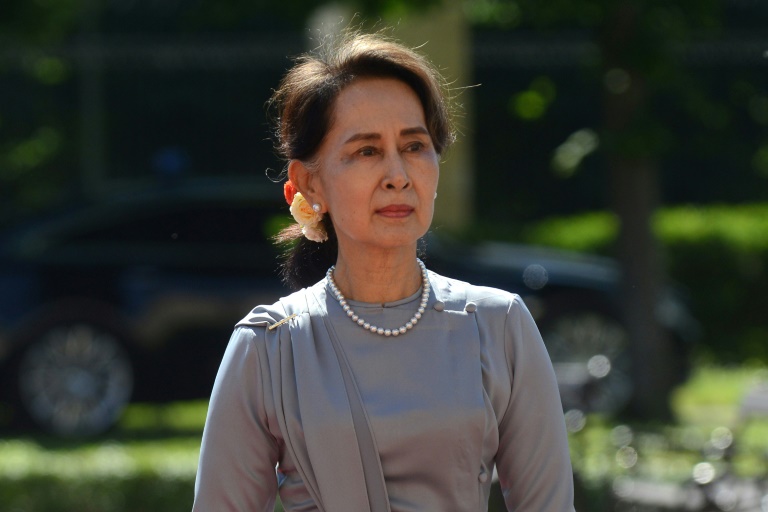
Ousted Myanmar leader Aung San Suu Kyi returned to a junta court on Friday after skipping a previous hearing because she felt unwell, a source with knowledge of the case said.
Suu Kyi has been detained since her civilian government was ousted in a coup last year that triggered mass protests and a bloody military crackdown, with more than 1,500 civilians killed, according to a local monitoring group.
Cut off from the world except for brief meetings with her legal team and court appearances, the Nobel laureate faces a raft of charges that could see her jailed for more than 150 years.
She skipped Thursday’s hearing in her trial on charges of breaching the official secrets act because she felt “dizzy”, a source with knowledge of the case said.
Detained Australian academic Sean Turnell is a co-defendant alongside Suu Kyi in that case.
Suu Kyi returned on Friday for the latest hearing in one of her corruption trials, related to the leasing of a helicopter, the source said.
“Now she is well,” the source added.
The 76-year-old Suu Kyi missed a hearing in September due to illness, and in October her lawyer said her health had suffered from her frequent appearances before the junta-run court.
Journalists are barred from the proceedings in the military-built capital Naypyidaw and her lawyers have been barred from speaking to the press.
On Thursday the junta announced it had filed an eleventh corruption charge against Suu Kyi for allegedly receiving $550,000 as a donation for a charity foundation named after her mother.
She has already been sentenced to six years in jail for incitement against the military, breaching Covid-19 rules and breaking a telecommunications law — although she will remain under house arrest while she fights other charges.
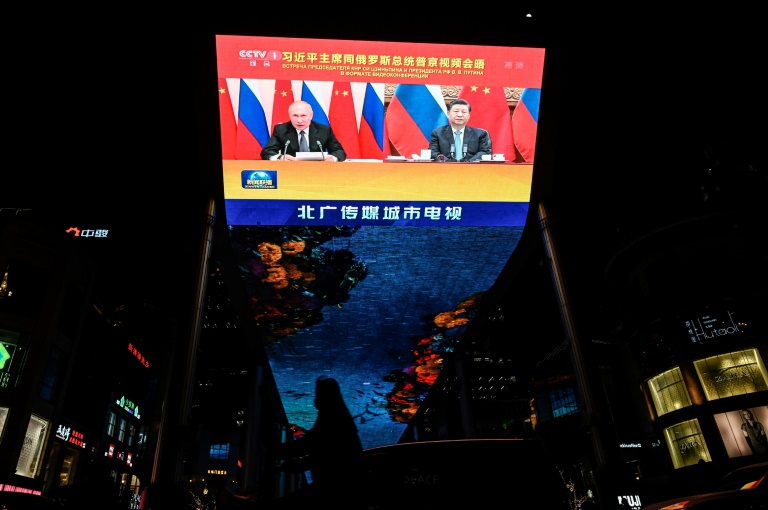
Xi meets Putin as tensions rise with West
China’s President Xi Jinping held his first face-to-face talks with a world leader in nearly two years on Friday, meeting Russia’s Vladimir Putin who hailed “unprecedented” ties between the neighbours as tensions grow with the West.
Xi has not left China since January 2020, when the country was grappling with its initial Covid-19 outbreak and locked down the central city of Wuhan where the virus was first detected.
He is now embarking on a sudden flurry of diplomatic activity as more than 20 world leaders fly in for the Winter Olympics, an event China hopes will be a soft-power triumph and a shift away from a build-up blighted by a diplomatic boycott and Covid fears.
The two leaders met in the Chinese capital as their countries seek to deepen relations in the face of increasing criticism from the West.
Xi said he believed the meeting would “inject more vitality into China-Russia relations,” according to CCTV.
A document agreed by the countries said they “oppose the further expansion of NATO” and called for the US-led defence bloc to abandon “Cold War era” approaches, the Kremlin said in a briefing afterwards.
Moscow is looking for support after its deployment of 100,000 troops near its border with Ukraine prompted Western nations to warn of an invasion and threaten “severe consequences” in response to any Russian attack.
Putin and Xi also criticised Washington’s “negative impact on peace and stability” in the Asia-Pacific region, according to the Kremlin.
In televised remarks at the start of their meeting, Putin described Russia and China as an “example of a dignified relationship”.
Russia has also prepared a new contract for the supply of 10 billion cubic metres of natural gas to China from Russia’s Far East, Putin said.
– Olympic host –
The two leaders will attend the Olympic opening ceremony on Friday evening.
While Russian officials are banned from attending international sporting competitions over a doping scandal, they may attend if invited by the head of state of the host country.
Spiralling tensions with the West have bolstered ties between the world’s largest nation and its most populous, and Putin was the first foreign leader to confirm his presence at the Olympics.
“I have known President Xi Jinping for a long time,” CCTV quoted Putin as saying in a report on Friday.
“As good friends and politicians who share many common views on solving world problems, we have always maintained close communication.”
China’s state-run Xinhua news agency also carried an article from Putin on Thursday in which the Russian leader painted a portrait of two neighbours with increasingly shared global goals.
He also hit out at the US-led Western diplomatic boycott of the Olympics that was sparked by China’s human rights record.
“Sadly, attempts by a number of countries to politicise sports for their selfish interests have recently intensified,” Putin wrote, calling such moves “fundamentally wrong”.
China enjoyed plentiful support from the Soviet Union — the precursor to the modern Russian state — after the establishment of Communist rule in 1949, but the two socialist powers later fell out over ideological differences.
Relations got back on track as the Cold War ended in the 1990s, and the pair have pursued a strategic partnership in recent years that has seen them work closely on trade, military and geopolitical issues.
Those bonds have strengthened further during the Xi era, at a time when Russia and China find themselves increasingly at odds with Western powers.
Other leaders set to enjoy Xi’s hospitality during the Games include Egypt’s Abdel Fattah al-Sisi, Saudi Arabia’s Mohammed bin Salman, Kazakhstan’s Kassym-Jomart Tokayev and Poland’s Andrzej Duda.
Around 21 world leaders are expected to attend the Games.
A majority of those leaders rule over non-democratic regimes, according to the Economist Intelligence Unit’s Democracy Index.
After eight years of war, Ukraine's army a tougher prospect
When he arrived at the front line as a volunteer to fight Russian-backed separatists in 2014, Pavlo Dolynskiy found Ukraine’s army in a desperate state.
Kyiv had just lost the Crimean peninsula to Moscow without a shot being fired and its regular forces — eaten away by years of neglect and corruption — couldn’t cope with the spiralling conflict in the east of the country.
“The army had reached the point where it couldn’t stand up to the enemy,” Dolynskiy, who now works at a veterans association, told AFP.
Soldiers struggled to get uniforms and boots, they had antiquated Soviet-era weapons, equipment often malfunctioned and the army relied on a ragtag mix of volunteers to plug the gaps.
“It really was in a lamentable condition,” he said.
But now, as tensions soar over a massive Russian military buildup on its border, Ukraine’s armed forces present a far tougher prospect.
Battle-hardened by nearly eight years of a simmering war that has claimed over 13,000 lives, the military has undergone reforms and been bolstered by Western arms and training.
“Eight years ago, the Ukrainian army did not exist. It was only on paper, and did not have the potential to fight,” said Mykola Beleskov, a defence analyst at the National Institute for Strategic Studies in Kyiv.
“Now they are the best armed forces that Ukraine has had in thirty years of independence. The best prepared and the best trained.”
– Drones, anti-tank missiles –
The conflict has forced Ukraine’s pro-Western leadership to try to turn their depleted Soviet legacy forces into a more modern military aligned closer to NATO standards.
Ukraine’s defence budget has tripled over the past decade in US dollar terms to around $4.2 billion in 2021 and reforms have looked to tackle rampant corruption and improve command and control.
The US has provided some $2.5 billion in military aid since 2014 and training from NATO allies — including also Canada and Britain — has helped bolster battle readiness.
As part of the modernisation drive, Ukraine’s President Volodymyr Zelensky this week signed a decree to add an extra 100,000 personnel to the armed forces over the next three years — taking its total to some 360,000.
The authorities have pledged to ramp up wages for those serving and professionalise the army by ending conscription by 2024.
A crucial addition has also been the influx of foreign weaponry that has bolstered the military’s Soviet-era stockpile.
Ukraine has purchased Turkish Bayraktar TB2 combat drones — which proved pivotal in the 2020 Karabakh conflict between Azerbaijan and Armenia — and received shipments of anti-tank missiles from the US and Britain.
“Its forces probably are stronger than they have been for a long time,” said Sam Cranny-Evans, a research analyst at the RUSI think tank in London.
“Nonetheless, there are key deficiencies in Ukraine that have not been addressed.”
He pointed to its limited air defence systems, lack of assets able to carry out long-range strikes and doubts over its reconnaissance capabilities.
Ukraine’s airforce and navy also remain weak points.
Kyiv lost an estimated 70 percent of its vessels when Russia seized the strategic Crimean peninsula in the Black Sea, a recent report from the US Congressional Research Service said.
British minesweepers are on their way but more ambitious plans to rebuild are hampered by severe budget constraints as the economy struggles.
And graft remains a problem draining those tight resources.
“It is widely recognised that Ukraine’s path forward regarding reforms and building appropriate military capabilities is predicated upon eliminating corruption in its defence sector,” said an analysis from defence intelligence agency Janes.
Oleksandr Syrskyi, commander of Ukraine’s ground forces, insisted to journalists Thursday that the military “have taken a big step forward since 2014 — we increased our combat capacity and ability to repel an invasion”.
But he still listed a raft of hardware his troops require: anti-sniper gear, anti-tank weapons, air defence systems, anti-drone systems, reconnaissance systems.
“We are working on this and we have agreements in place to try to improve all this,” he said.
– Outgunned, outmanned –
After years of conflict, Ukraine’s forces are combat-experienced and highly motivated.
There are also hundreds of thousands of people in the reserves and volunteer fighters have been brought under government control.
Civilians too are preparing, with survival courses becoming increasingly popular among Ukrainians worried about a possible Russian attack.
Despite the improvements, Ukraine understands that its military remains massively outgunned and outmanned by Moscow’s vastly superior armed forces.
Russian President Vladimir Putin has pumped vast sums into turning his own creaking military into a well-equiped modern outfit able to impose the Kremlin’s goals in global hotspots like Syria.
Analysts said Ukraine would struggle if Moscow unleashed its missiles and aircraft in a major bombardment of critical infrastructure.
“It is no secret that the Russian army is bigger and stronger,” said analyst Beleskov.
But, he insisted, if there was a major invasion and Russia tried to hold territory then Ukraine’s forces could still turn it into a costly “war of attrition” — especially if Western arms kept flowing in.
“Let’s say it would be hard for us, very hard, but it would not be easy for the other side. It would not be easy for the Russians.”
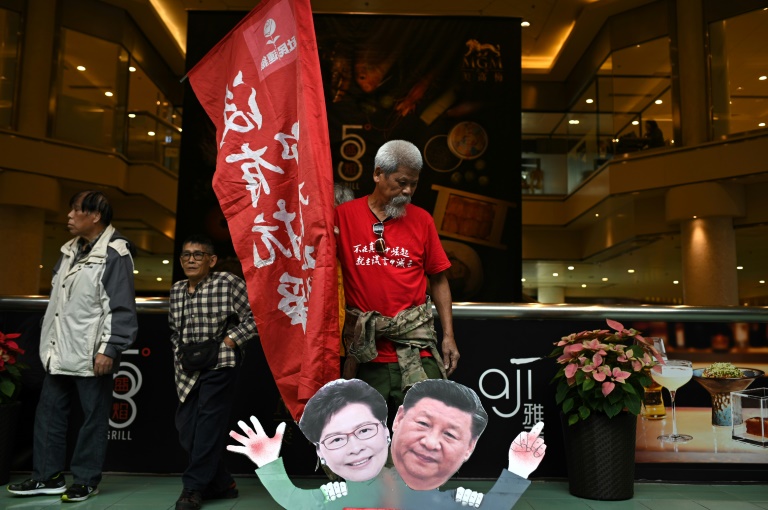
Hong Kong activist arrested ahead of planned Olympics protest
A veteran Hong Kong activist was arrested for “incitement to subversion” on Friday ahead of a planned protest against Beijing’s hosting of the Winter Olympics, hours before the opening ceremony was due to kick off.
China has embarked on a crackdown in Hong Kong following massive and at times violent pro-democracy protests, imposing a sweeping national security law that criminalised much dissent.
Wen Wei Po, a newspaper that answers to Beijing’s Liaison Office in Hong Kong, said Koo Sze-yiu was arrested on Friday morning by national security police.
A senior police source confirmed to AFP that Koo had been detained for “incitement to subversion” and that four others had been taken in to assist with their investigation.
The Hong Kong Police’s National Security Department said the 75-year-old’s arrest came after “in-depth investigation”, and the two men and two women also brought in by the police were between the ages of 59 and 76.
“Further arrests may be made,” the police said in a statement.
The arrest comes days after Hong Kong journalists received a media invitation bearing Koo’s name saying he was planning to protest on Friday outside Beijing’s Liaison Office in the city ahead of the start of the Olympics.
“Many political activists and Hong Kong citizens have been jailed and cannot spend Lunar New Year with their families because of abuses of Hong Kong’s national security law,” read the invitation, dated January 31.
“The central government is only concerned with hosting the Winter Olympics to whitewash the situation, and does not care about miscarriages of justice in Hong Kong.”
Koo could not be reached for comment to confirm if he had organised a protest, which was slated to be held at 10 am on Friday.
The septuagenarian activist, who is terminally ill with cancer, has been jailed multiple times — most notably in 2013 for burning China’s flag to protest against Beijing’s treatment of dissidents on the Chinese mainland.
Protest has been all but outlawed in Hong Kong since the 2019 unrest.
The national security law, enacted in 2020, criminalises “secession, subversion, terrorism and foreign collusion”, and carries a maximum sentence of life in prison.
Hong Kong police have arrested more than 160 people under the law, with about 100 formally charged. Most are denied bail until trial.
The city has also kept strict anti-coronavirus measures that ban gatherings of more than four people for the past two years.
The Olympics opening ceremony kicks off at 8 pm (1200 GMT).
Beijing’s hosting of the global sporting event has largely been overshadowed by a Western diplomatic boycott over China’s human rights record.
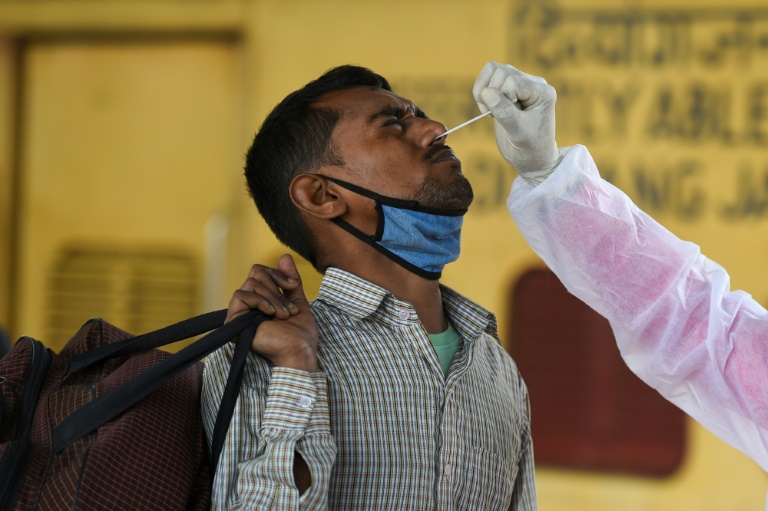
India's coronavirus death toll crosses 500,000
India’s official death toll from Covid-19 passed 500,000 on Friday, although many experts believe the real figure is likely much higher.
The daily update from the country’s federal health ministry showed the number of fatalities reaching 500,055, up 1,072 in the previous 24 hours.
Total infections stood at 41.9 million, according to the statistics, second only to the United States.
Case numbers have jumped in recent weeks due to the highly infectious Omicron strain but rates have slowed in recent days and the health ministry last week said there were indications of a plateau in virus cases in several parts of the country.
Experts said the Omicron wave would not cause many deaths or hospitalisations, but several states imposed restrictions on movement and have only now started easing them.
Authorities in the Delhi area that includes the capital on Friday announced high schools, colleges, restaurants and gyms would be allowed to open from next week.
After being shut for almost two years, first because of coronavirus and then again for pollution following a brief reopening, in-person classes for four- to 14-year-olds will restart on February 14, Delhi’s deputy chief minister Manish Sisodia tweeted.
India was hit by a devastating spike in cases last year due to the Delta variant that brought its health care system close to collapse.
Many analysts believe the country actually may have reached the 500,000-death mark last year itself.
The wave saw at least 200,000 deaths as hospitals ran out of oxygen and patients scrambled desperately to source medicines.
A study by a US research group last year suggested that anywhere between 3.4 million and 4.7 million people had died.
For months now, several states have been reconciling their death toll and adding “backlog” deaths as India’s Supreme Court ordered state authorities to provide compensation to families.
Kerala, Bihar and Prime Minister Narendra Modi’s home state of Gujarat are among those to have added thousands of old deaths to their existing tolls.
Last month, the Modi government asked states to stop mandatory testing of contacts of those who test positive, unless they had underlying health conditions.
But soon after the order the government told states to ramp up testing as numbers dropped.
Booming sales of home coronavirus self-test kits have also fuelled fears of underreporting of cases across the country.
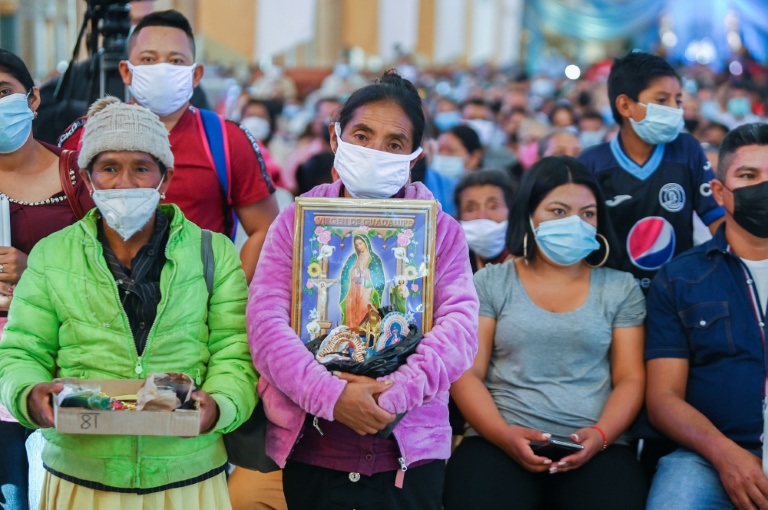
'Bless that woman': Hondurans look to tiny icon, and a new president, for hope
Thousands of Honduran believers descended on their country’s most famous religious icon Thursday, praying for an end to the Catholic nation’s crippling poverty and success for their newly elected leftist leader.
Accompanied by new president Xiomara Castro, the devotees flocked to the Virgen de Suyapa basilica to mark an annual celebration of the wooden statuette of the mother of Christ.
February 3 marks the date of the 1747 discovery of the 6.55 cm statue — the Patroness of Honduras — by a peasant on El Piliguin mountain near the capital.
“The virgin is going to bless that woman who sits in the presidency,” worshiper Maura Isabel said of Honduras’ new leader, who has promised profound social reforms to lift the country out of poverty after over a decade of right-wing rule. “God wants her to know how to govern us.”
Castro replaced right-wing President Juan Orlando Hernandez, who left power dogged by allegations of drug trafficking and corruption in a country where at least 60 percent of the 10 million inhabitants live in poverty.
Her husband, Manuel Zelaya, was ousted in a coup d’etat in 2009.
“God grant that (Castro) knows how to govern us — above all that she goes to remote places where there is no help from anyone,” said Maura Isabel Lopez, an indigenous mother of a police officer and two soldiers — dangerous work in a country plagued by murderous gangs that control drug trafficking.
Elected in November, Castro faces an uphill struggle to reform a country with one of the highest murder rates in the world from which thousands of its citizens have fled to the United States.
“We ask you with the words of Pope Francis: I beg the Lord to grant us more politicians who are genuinely disturbed by the state of society,” Cardinal Oscar Rodriguez said in the homily of the mass attended by the president.
“It is imperative that the rulers and financial powers raise their eyes and broaden their perspectives.”

