World

Sri Lanka calls for diaspora investment on independence day

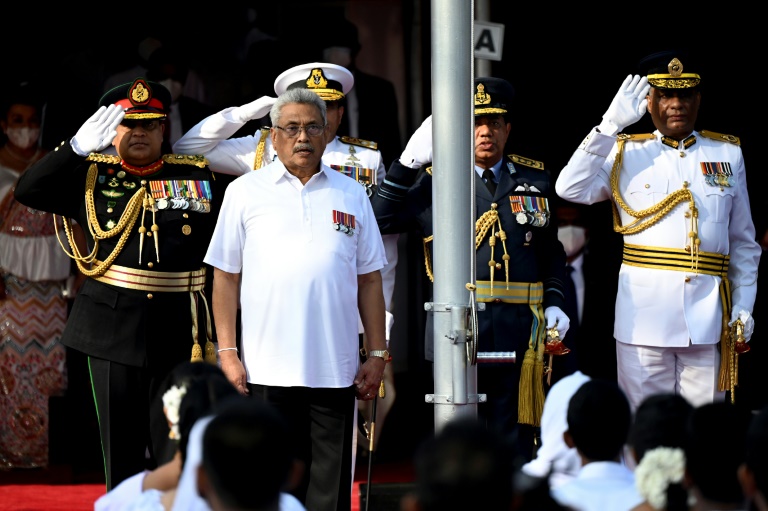
Sri Lanka marked its independence day on Friday with an appeal to its diaspora to send money home to overcome the island’s worsening economic crisis and a pledge to protect foreign investments.

President Gotabaya Rajapaksa urged millions of Sri Lankans abroad to invest their savings in their home country, which is facing its worst debt crisis since independence from Britain 74 years ago.

“Expatriate Sri Lankans who provide foreign exchange to the country are a major resource to us,” Rajapaksa said.

“I invite all expatriate Sri Lankans to invest in their homeland.”

Colombo’s foreign reserves, which stood at $7.5 billion when Rajapaksa took office in November 2019, have fallen by more than half, to $3.1 billion.

Worker remittances, Sri Lanka’s number one foreign currency source, fell nearly 60 percent in December. For 2021 as a whole, the figure dropped a record 22.7 percent, to $5.49 billion.

Tourism, another key source of income, has been battered by the coronavirus pandemic.

The government imposed a broad import ban in March 2020 in a bid to save foreign currency, leading to shortages of food and fuel as well as raw materials needed for manufacturing and export-oriented industries.

Rajapaksa, who came to power two years ago pledging to “retake” all state enterprises either leased or partly sold to foreign companies by the previous administration, called for greater foreign involvement in Sri Lanka’s economy.

“Foreign investment is especially important for large-scale projects, industries requiring modern technological know-how and new ventures that open up global market opportunities for us,” he said.

He criticised “those who attempt to propagate incorrect public opinion against foreign investments, based on political motives”.

His coalition cabinet is divided on a move to sell a stake in a state electricity utility to a US company.

– ‘Galloping corruption’ –

Faced with record inflation, falling reserves and warnings from international rating agencies about Sri Lanka’s ability to service its $35 billion external debt, Rajapaksa’s finance minister brother Basil announced Wednesday that he had sought technical advice from the International Monetary Fund.

The IMF responded by saying it was ready to discuss “options” if the government asked for financial support.

“While the IMF has not received a request for financial support from Sri Lanka, the staff stands ready to discuss options if requested,” mission chief Masahiro Nozaki said in a written statement to AFP in Washington.

In an address to the nation ahead of a military parade, Rajapaksa made no reference to seeking IMF help, but said he was focused on finding both short- and long-term solutions and called for an “optimistic approach”.

The country’s main opposition boycotted the military parade, which involved aircraft, gunboats and thousands of troops, saying Friday’s elaborate celebrations were a waste of money when people did not have enough to eat and prices were soaring.

The Archbishop of Colombo, Cardinal Malcolm Ranjith, who leads the country’s Roman Catholic minority, also stayed away to protest against the government’s alleged failure to investigate the 2019 Easter Sunday attacks that killed 279 people, most of them at churches. 

“Independence turns out to be a meaningless word,” the cardinal said, because of “galloping corruption” and manipulation of the rule of law by political leaders past and present “to suit their own interests”.
Mosque-goers pray for rain in drought-scorched Morocco

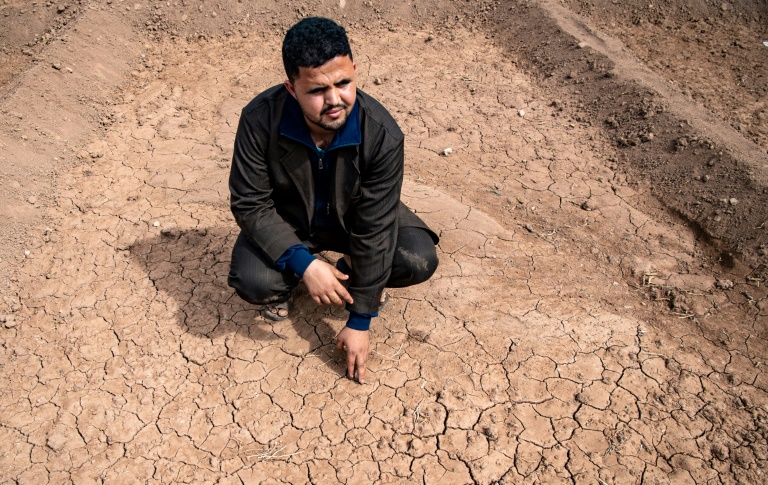
Mosques held prayers for rain on Friday across the parched North African kingdom of Morocco where farmers are battling an acute drought.

King Mohammed VI ordered all the country’s mosques to hold prayers “calling on God for rain”, the religious affairs ministry said in a statement carried by the official MAP news agency.

Such prayers, which also take place in other Muslim countries when rain is needed, are based on a verse from the Koran and on a saying of the Prophet Mohammed, who recommended an extra prayer “every time the rain is scarce”.

Morocco’s economy depends heavily on agriculture, but the country is in the midst of a severe drought. Reservoirs are at just 34 percent capacity, compared to 46 percent this time last year, according to official figures.

Despite improved harvests in 2021, the lack of water has battered the agricultural sector, which is responsible for about 14 percent of the country’s Gross Domestic Product.

The situation has sparked fears of spiralling prices for basic goods.

In January, tourist hotspot Marrakesh imposed tight restrictions on water usage, news website Medias24 reported.

That recalled 2020, when the Atlantic coastal city of Agadir cut off mains water supplies at night to rein in usage.

Agadir this month fired up the country’s first seawater desalination plant to meet the needs of desperately dry farmland nearby.

The agriculture ministry forecasts that average precipitation will drop by 11 percent by 2050, with the amount of water available for irrigation falling by a quarter.

Along with Morocco, the North African nations of Algeria, Libya and Tunisia are among the 30 most water-stressed countries in the world, according to the World Resources Institute.

Mosque-goers pray for rain in drought-scorched Morocco

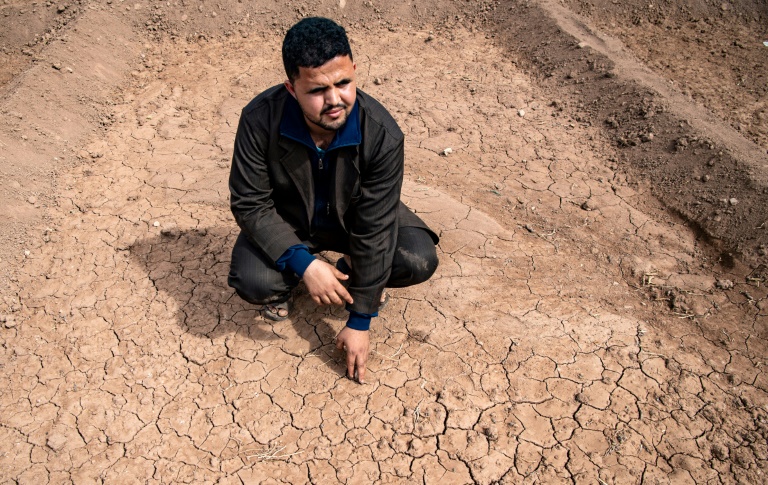
Mosques held prayers for rain on Friday across the parched North African kingdom of Morocco where farmers are battling an acute drought.

King Mohammed VI ordered all the country’s mosques to hold prayers “calling on God for rain”, the religious affairs ministry said in a statement carried by the official MAP news agency.

Such prayers, which also take place in other Muslim countries when rain is needed, are based on a verse from the Koran and on a saying of the Prophet Mohammed, who recommended an extra prayer “every time the rain is scarce”.

Morocco’s economy depends heavily on agriculture, but the country is in the midst of a severe drought. Reservoirs are at just 34 percent capacity, compared to 46 percent this time last year, according to official figures.

Despite improved harvests in 2021, the lack of water has battered the agricultural sector, which is responsible for about 14 percent of the country’s Gross Domestic Product.

The situation has sparked fears of spiralling prices for basic goods.

In January, tourist hotspot Marrakesh imposed tight restrictions on water usage, news website Medias24 reported.

That recalled 2020, when the Atlantic coastal city of Agadir cut off mains water supplies at night to rein in usage.

Agadir this month fired up the country’s first seawater desalination plant to meet the needs of desperately dry farmland nearby.

The agriculture ministry forecasts that average precipitation will drop by 11 percent by 2050, with the amount of water available for irrigation falling by a quarter.

Along with Morocco, the North African nations of Algeria, Libya and Tunisia are among the 30 most water-stressed countries in the world, according to the World Resources Institute.

Macron the mediator wades into Russia-Ukraine crisis

French President Emmanuel Macron will fly to Russia and Ukraine next week in an attempt to avert conflict between the neighbours, reprising his role as a crisis mediator that has produced limited results in the past.

The 44-year-old leader, who is facing elections in April, has repeatedly thrown himself into the search for solutions to some of the world’s most acute diplomatic problems from Iran’s nuclear programme to Libya’s civil war. 

His latest attempts to lower tensions between Russian President Vladimir Putin and Ukrainian counterpart Volodymyr Zelensky are consistent with the two main features of his thrusting foreign policy since coming to power in 2017.

He has always argued that Europe and the European Union should take greater charge of its own defence and security, and has sought to push France forward on the international stage with what he describes as “diplomacy of audacity.”

He laid out this philosophy in front of French ambassadors in 2019, telling them that Europe risked disappearing unless it stood up for itself and arguing that the only choice was “to take part in the game and use our weight”. 

“I believe in one thing: it’s a strategy of audacity and taking risks,” he said. 

– Setbacks – 

This approach has led to some highly public setbacks, particularly early in his term, which some critics think revealed his naivety and France’s limitations as a middle-ranking world power.

“France has a long tradition of mediating, but Emmanuel Macron in particular has wanted to be a sort of balancing power,” said Bruno Tertrais from the Foundation for Strategic Research think-tank in Paris. 

“It’s striking, however, how his efforts have rarely led to success.”

Some of his failures include an initiative to try to broker a solution to the Libyan civil war in 2017 which caused friction with EU partner Italy and led to criticism that France was secretly supporting a local warlord.

On the Iran nuclear crisis, Macron repeatedly tried to broker direct talks between former US president Donald Trump and Tehran, even flying the Iranian foreign minister unannounced to a G7 meeting in France in 2019 — in vain.

Following a huge port explosion in Beirut that brought down the government in Lebanon in 2020, Macron visited the disaster scene, sleeves rolled up, and promised to help bring about a “new political order.” 

There has been no radical reform since and Lebanon remains mired in crisis.

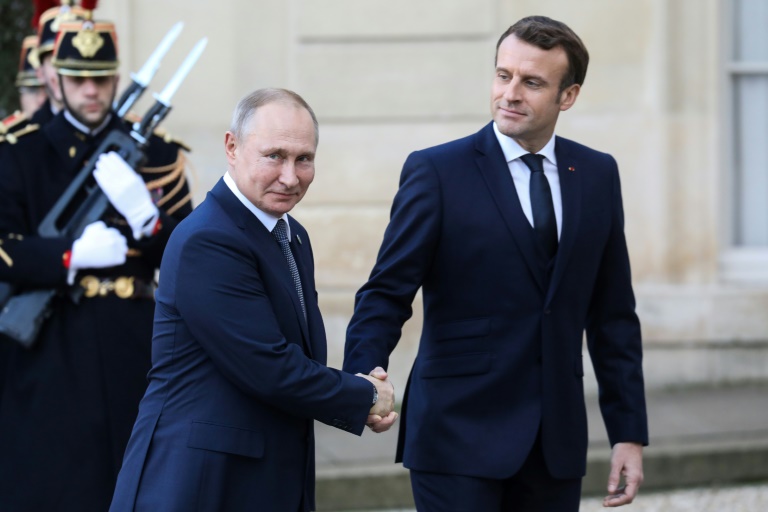
The summer before, in 2019, he invited Putin to his summer holiday residence in a surprise attempt to try to reset relations, which went down badly in eastern Europe where EU countries feel most threatened by the Kremlin.  

“You can’t criticise Emmanuel Macron for trying to launch mediation efforts, but you can criticise him in some situations for doing it on his own,” Tertrais added.  

He said one success was that Macron’s “quite spectacular” intervention in 2017 to free Lebanon’s then prime minister Saad Hariri after he was effectively detained in Saudi Arabia.

– Multi-track diplomacy –

Analysts are unsure what the French leader can achieve during his visits to Moscow and Kyiv on Monday and Tuesday to deescalate a crisis sparked by the massing of around 100,000 Russian troops on Ukraine’s border. 

Tatiana Kastoueva-Jean at the French Institute of International Relations (IFRI) said that Putin saw Macron as the de-facto leader of Europe after German chancellor Angela Merkel stepped down in December after 16 years in power.

“In Germany, the new coalition government is still getting up to speed,” she said. “So Macron is the voice of Europe in talks with Putin.”

France also currently holds the rotating presidency of the 27-member bloc.

Michel Duclos, a former ambassador at the Montaigne Institute, a Paris-based think-tank, said the French president had been wise not to build up expectations and appeared to be coordinating better with EU allies.

“You get the impression he has learned from his previous failures,” he told AFP. 

At home, political observers are unsure how the flurry of diplomacy will influence Macron’s re-election chances.

With the first round of the election looming on April 10, Macron will also have to decide in coming weeks whether to pull out a French force deployed in Mali in west Africa where relations with the ruling military junta have broken down. 

Macron’s attempted peace-making “reinforces his international stature” but brings with it the risk of failure which opponents would use, a French lawmaker close to Macron told AFP this week, asking not to be named. 

“He has to show that he can obtain concrete results.”

Russia wins Chinese backing in showdown over Ukraine

Russia won China’s backing in its showdown with the West over Ukraine on Friday, as Beijing agreed with Moscow that the US-led NATO military alliance should not admit new members.

The demand for NATO to stop expanding came after a meeting between Russian President Vladimir Putin and Chinese counterpart Xi Jinping in Beijing that saw Putin hail the two countries’ “dignified relationship”.

In a long strategy document, Moscow and Beijing hit out at what they said was Washington’s destabilising role in global security.

“The parties oppose the further expansion of NATO and call on the North Atlantic Alliance to abandon the ideological approaches of the Cold War era,” the document read, urging respect for the “sovereignty, security and interests of other countries.” 

The call echoes demands from Russia that have been at the centre of weeks of intensive negotiations between Moscow and the West, under the shadow of a potential conflict.

Western capitals have accused Russia of amassing some 100,000 troops on the borders of pro-Western Ukraine in preparation for an invasion and have vowed to impose devastating sanctions on Moscow if it attacks.

German Chancellor Olaf Scholz was the latest European leader to announce a visit to the region on Friday, saying he would go to Ukraine on February 14 and Russia the next day.

– ‘Delusional’ false flag claims –

French President Emmanuel Macron will visit Moscow on Monday and Kyiv on Tuesday for talks with his Russian and Ukrainian counterparts.

Putin’s meeting with Xi — hours ahead of the opening ceremony of the Winter Olympic Games — came after the United States said it had evidence of a plan by Moscow to film a fake Ukrainian attack on Russians to justify an attack on its neighbour.

Pentagon spokesperson John Kirby said the US had “information that the Russians are likely to want to fabricate a pretext for an invasion”, but did not provide evidence.

Russia, which has repeatedly denied any invasion plans, said the US claims were absurd.

“The delusional nature of such fabrications — and there are more and more of them every day — is obvious,” Foreign Minister Sergei Lavrov said in televised remarks.

Washington’s claim came on the back of visits from European leaders to shore up support for Kyiv, including from British Prime Minister Boris Johnson and Turkish President Recep Tayyip Erdogan.

Ukraine’s Foreign Minister Dmytro Kuleba on Friday welcomed the displays of support, saying they had prevented Russia from “further aggravating the security situation”.

– ‘Intimidation strategy’ –

“Our partners believe in Ukraine and that means Moscow’s intimidation strategy is not working. Russia has lost this round,” Kuleba said.

During Erdogan’s visit Thursday he and Ukrainian President Volodymyr Zelensky signed an agreement expanding the production of parts in Ukraine for a Turkish combat drone whose sale to Kyiv has angered Moscow.

Erdogan has tried to position Turkey, which is a member of NATO, as a neutral mediator close to both Moscow and Kyiv.

Following his trip, Erdogan accused the West of making the crisis “worse”.

“Unfortunately, the West until now has not made any contribution to resolving this issue,” he said in comments published by local media Friday.

“They are only making things worse,” Erdogan said, adding that Joe Biden “has not yet been able to demonstrate a positive approach”.

Russia’s relationship with the West was severely damaged in 2014 when it annexed the Crimean peninsula from Ukraine and threw its political weight behind armed separatists in the east the country. 

Nearly eight years of fighting between Kyiv and the pro-Moscow fighters has cost more than 13,000 lives and seen the West and Russia exchange waves of tit-for-tat sanctions.

In the most recent diplomatic flare-up, Putin has demanded guarantees that Ukraine will not join NATO and has implicitly threatened the former Soviet state with the massive military build-up.

Russia also wants NATO and the United States to foreswear the deployment of missile systems near Russia’s borders and to pull back NATO forces in eastern Europe.

These tensions have been aggravated by plans for joint military exercises between Russia and neighbouring Belarus, where Washington claims Moscow is preparing to send 30,000 troops.

Death of IS chief: what we know

A day after the death of Islamic State leader Abu Ibrahim al-Qurashi during a US raid in Syria, many questions remain on the operation and the jihadist group’s future.

How was he located?

Qurashi was killed in the town of Atme during a nighttime airborne operation on his house.

US officials said his location had been narrowed down last year. The building’s owner told AFP Qurashi had been living there for 11 months.

The raid came days after IS launched its biggest operation in years to spring fighters from a huge Kurdish-run prison in the northeastern city of Hasakeh.

“The timing of the operation suggests that there was intelligence linking Qurashi to the Ghwayran prison attack,” said Nick Heras, an analyst at the Newlines Institute.

“It would not be surprising that the US put pressure on Turkey to relinquish information.”

Turkey holds considerable sway over northwestern Syria and maintains a form of working relationship with Hayat Tahrir al-Sham (HTS), the jihadist that controls most of the Idlib area.

Large numbers of IS prisoners are thought to have broken out during the Hasakeh attack. Their subsequent trajectories and communications may have created intelligence opportunities.

“If Qurashi was planning to record a statement about the recent attacks, perhaps that created an opening,” said Aron Lund, a fellow with Century International.

Iraq’s prime minister on Thursday claimed credit for gathering the intelligence that led to one of the world’s most wanted men.

How did he die?

According to the White House and US defence officials, Qurashi died when he detonated a bomb to avoid capture.

“He killed himself and his immediate family without fighting, even as we attempted to call for his surrender and offered him a path to survive,” the head of US Central Command, General Kenneth McKenzie, said.

The visible damage to the three-level house — including burn marks and a collapsed part of the roof — tend to confirm at least one explosion occurred inside the house.

Neighbours told AFP they heard explosions but US official statements are at this time the only version of what happened inside the house.

US Pentagon spokesman John Kirby said Qurashi’s fingerprint identification was done on site but did not explicitly say whether US forces had taken the body away or left it behind.

A photo purporting to show the slain IS leader’s face that circulated on social media could not be authenticated by AFP and does not provide clear information as to how he died.

Who else was there?

US officials have said at least three civilians died during the raid, in addition to Qurashi and two others outside the house on whom the special forces returned fire.

The Syrian Observatory for Human Rights war monitor said it had reports of 13 dead, 12 of them killed inside the house.

Observatory head Rami Abdel Rahman said Qurashi had two wives, both of whom were killed in the raid, together with the IS leader’s sister and her adult daughter.

He also said the bodies of four children were recovered, as well as two other incomplete bodies that may have been children’s.

Save the Children said at least six children, including two infants, were killed during the raid.

Abdel Rahman said one of Qurashi’s senior associates was also killed.

One of Qurashi’s wounded children was treated by civil defence but then transferred to an unknown location by forces connected to HTS.

Why in Idlib?

Qurashi had been hiding in a town far from IS’s area of operations and under the control of HTS, a rival jihadist group.

Yet analysts argue it is hardly surprising he was tracked down to an area far from IS’s heartland, which covers the arid expanses straddling the Iraqi-Syria border between the Tigris and Euphrates rivers.

His predecessor Abu Bakr al-Baghdadi was also killed in Idlib province, about 15 kilometres (nine miles) away, in October 2019.

“Idlib is a messy war zone full of displaced people, with little proper policing and no real state structures or record-keeping,” said Lund.

Hassan Hassan, who authored a book on IS, said Idlib is safer for an IS leader than the regions in western Iraq or eastern Syria where anti-IS forces have acquired years of experience tracking down jihadists.

“It is a hostile area for IS because its rivals dominate that region of northern Syria, but it is precisely the right place to hide where nobody expects you to be there,” he said.

Hassan, who is also a Newlines analyst, said close Qurashi aides had been running the group’s operations and building businesses in the area for two years.

What next for IS?

The week-long attack on the Ghwayran prison IS launched two weeks earlier had raised fears of a resurgence, nearly three years after IS lost the last scraps of its “caliphate”.

For Hassan, however, the prison attack was “not part of a strategic comeback, nor an indication of recovery”.

“The group remains weak and exposed,” he said, adding that Thursday’s raid was further evidence of growing efficiency by the US and allied forces tasked with tracking down IS leaders.

Qurashi was largely invisible during his time at the helm but the group, which has not yet acknowledged his death, will nonetheless have to find a new “caliph”.

Experts say there are few obvious names for a successor but that the next IS leader will most likely hail from the same area. 

Qurashi was an ethnic Turkmen from the Iraqi city of Tal Afar who played a key role in the campaign of ethnic cleansing against the Yazidi minority in 2014.

Hippos and humans learning to live in peace in DR Congo

Just how do you calm down a rampaging hippopotamus? Or even a herd of angry hippos.

On the banks of the Ruzizi river that divides the Democratic Republic of Congo from Burundi, the villagers badly need to work it out after a spate of deaths — human and hippo. 

Despairing environmental activists arrived this week to try to help both sides to learn to live together in peace.

“In December, the hippos laid waste three hectares of fields that my neighbour had planted,” said Jeannette Chandazi, at Kamanyola, in DR Congo’s South-Kivu province.

Kamanyola and the neighbouring village of Katogota have seen seven people killed and six more injured by hippos since 2019, said David Wiragi, of a local civil society environmental group.

The problem, he told AFP, “is that people have encroached on the sides of the river”, in areas where the giant semi-aquatic mammals habitually forage for food.

“They attack people and in turn people hunt them,” Wiragi said.

The province’s environment bureau chief Innocent Bayubasire added: “These areas have been transformed into fields, there are even some structures that have been built.”

Officially it is illegal to occupy a 100-metre strip of land along the river banks, but the law is ignored.

“People have to be made aware that these hippopotamuses should not be treated as enemies, and understand that these places are opportunities for tourism and job creation,” said Josue Aruna, president of the environmental civil society for South-Kivu.

The Ruzizi plain has not escaped the plague of armed groups that have roamed Kivu for more than 25 years sowing death and destruction —  all the more reason to develop the area and provide jobs for youngsters tempted to take up arms and target tourists.

For now, Aruna notes, there is “a mass extermination of these animals, killed by the people here as well as by soldiers, looking for hippo hides and teeth to sell”.

Aruna said at least three hippos are killed every month on the Ruzizi and its outlet Lake Tanganyika.

Working with the provincial government in Bukavu, Aruna organised a “touristic” and awareness visit to the site on the occasion of World Wetlands Day on February 2.

“We’ve been working on this question for three years now,” trying to preserve the biodiversity of the Albertine Rift, the western branch of the East African Rift valley, and ensure it can be a “refuge for giant African hippopotamuses”.

Hippo observation points will be set up, and a test site is already under construction.

Close Bitnami banner
Bitnami