World

'Incredibly complex': the US raid that killed IS chief

By early December US intelligence was certain: the man occupying the top floor of a nondescript house in Atme, northern Syria — who never left the premises, emerging only to bathe on the roof — was the head of the Islamic State group.

In the White House Situation Room, a table-top model of the house was set up, and President Joe Biden was briefed on his options to neutralize Abu Ibrahim al-Hashimi al-Qurashi, one of America’s most wanted jihadist targets.

US officials say they could have easily killed Qurashi — whose location they had narrowed down last year before pinpointing it — with a precision missile.

Biden chose a riskier course, said a senior US official briefing reporters Thursday, to reduce the possibility of killing the civilians also living in the three-level cinderblock home, set amid olive trees near the Turkish border.

The Special Operations Forces assault launched early Thursday was “incredibly complex,” the official said, given several nearby homes and the presence of women and multiple children in the building.

In the end, as elite US troops surrounded the house calling for all inside to come out, Qurashi blew himself up along with his wife and two children — an outcome the Americans had prepared for but hoped against.

The “massive” explosion ejected multiple people from the building including Qurashi, who was found dead on the ground outside the building, according to General Kenneth McKenzie, head of US Central Command.

“Fingerprint and DNA analysis had confirmed that he was Haji Abdullah,” McKenzie said, using the Pentagon’s name for Qurashi.

The operation had been repeatedly rehearsed in detail. Special forces trained for everything from a surrender to a firefight, and one possibility was that Qurashi would blow himself up.

“One of our main concerns was that he would kill himself and the structure would collapse killing everyone else in the building,” said a senior military official.

The operation team consulted engineers on the strength of the concrete building, the official said. They concluded with “high confidence” that an explosion would only destroy the top floor.

The hideout’s location in Idlib province was just 15 kilometers (nine miles) north of where Qurashi’s IS predecessor, Abu Bakr al-Baghdadi, likewise killed himself in 2019 to avoid US capture.

The United States had placed a $10 million reward on Qurashi’s head when he took the IS helm.

Early this week Biden was briefed on the situation, and gave the operational go-ahead Tuesday.

– Questions on civilian deaths –

The raid went according to plan — almost.

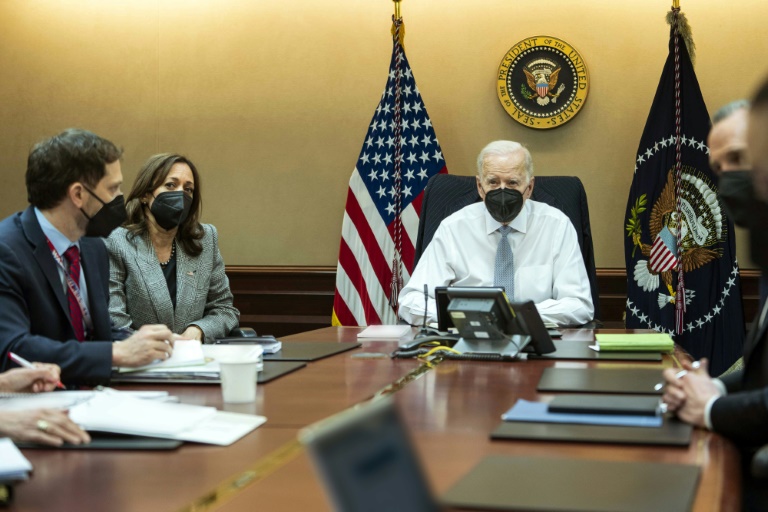
As Biden, Vice President Kamala Harris, and other officials monitored in real time in the Situation Room, helicopters flew in US commandos who surrounded the building and warned off neighbors.

The team called on everyone to exit the building, and a couple and their children living on the first level emerged and were taken to safety, the senior official explained.

Moments later, the top floor erupted with an explosion, tearing off half the structure but leaving the level below intact.

US forces began moving in, but a couple on the second floor barricaded themselves in their residence and began firing on them.

“The ISIS lieutenant and his wife were killed,” the official said, without offering details, adding that four children emerged to be taken to safety.

After the raid open questions remained about how many people died.

The Syrian Observatory for Human Rights said seven civilians were among at least 13 people killed, four of them children.

Pentagon spokesman John Kirby said at least three civilians died — Qurashi’s wife and their two children.

The US military official meanwhile said eight children and two adults were saved. But the official allowed it was not clear how many children were on the top floor when it exploded, and that a couple below may have had more children with them.

US forces took incoming fire from unknown local gunmen during the raid, the official said. The US troops fired back, killing at least two, with no Americans injured.

In operational terms, officials said, the only mishap was that one of the helicopters delivering commandos to the location developed mechanical problems and landed in a nearby field, where it was destroyed.

That echoed the 2011 raid on the Pakistan compound of Al-Qaeda leader Osama bin Laden, where a US helicopter crash-landed and had to be destroyed, due to sensitive technology onboard.
US raid on IS leader boosts Biden's foreign policy stature

The daring US helicopter raid deep in Syria that ended in the death of one of the world’s most wanted men gives Joe Biden the kind of dramatic military win presidents crave — and one the Democrat particularly needed.

“A major terrorist threat to the world” was extinguished, Biden said Thursday, unveiling details of the death of “horrible” Islamic State leader Abu Ibrahim al-Hashimi al-Qurashi.

Facing simultaneously a showdown with Russia over Ukraine, a flurry of North Korean missile tests, an ever-diminishing window of opportunity to control Iran’s nuclear program and Chinese saber-rattling over Taiwan, Biden’s foreign policy to-do list is daunting.

And Republican critics have worked hard to generate a narrative that Biden is weak, making the world a more dangerous place.

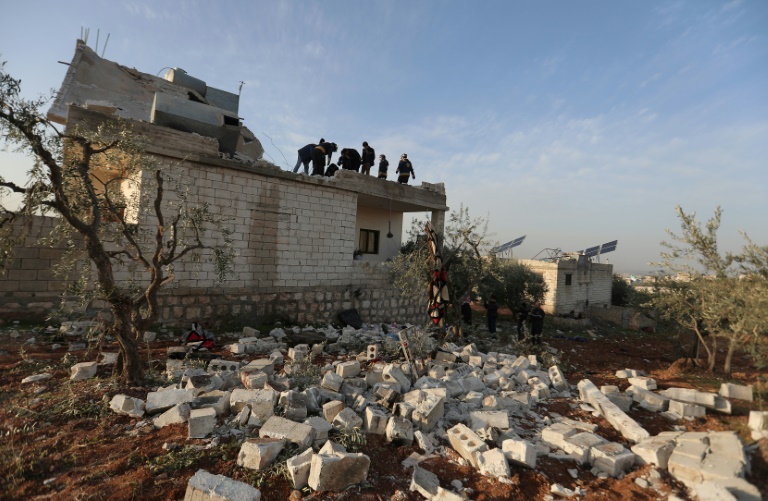
Biden’s answer? Pictures of the devastated house in Syria’s Idlib region, where Qurashi blew himself up, and a White House-issued photo of Biden and Vice President Kamala Harris in the Situation Room during the operation.

The raid, which saw no US losses, is “a strong message to terrorists around the world: We will come after you and find you,” Biden said.

In the post-9/11 world, killing far-flung jihadist leaders has become almost an expected display of strength for presidents.

Under Barack Obama, Americans cheered the riveting news in 2011 that Al-Qaeda founder Osama Bin Laden, the man behind the September 11, 2001 attacks on the United States, had finally been killed by US special forces in Pakistan.

Donald Trump, who repeatedly claimed to be the greatest president on many fronts, was if anything even more triumphant after the 2019 US operation in Syria killing Qurashi’s predecessor as head of IS — Abu Bakr al-Baghdadi.

In eyebrow-raising comments, Trump used a national address to describe how Baghdadi “died like a dog… in utter fear, in total panic and dread, terrified of the American forces bearing down on him.”

Biden’s record as commander in chief, until now, was associated mostly with the humiliating retreat from Afghanistan — even if the White House argues that the chaos was unavoidable in exiting a failed, 20-year war.

Now he has a clearcut victory.

“This operation is testament to America’s reach and capability,” he said in his own address to the nation.

– Grudging applause –

Even Republicans who have been pounding Biden over Russia, Iran and China, could not avoid applauding the apparently textbook military operation carried out in the dead of night.

“Very good news,” Senator Mitt Romney said.

Senator John Thune, the second highest ranking Republican, called the raid “a positive development” and a “model for how things work” in using special forces.

“I really appreciate the counterterrorism operation,” said Senator Lindsey Graham, although he tempered his appreciation by claiming the administration “is deaf, dumb and blind when it comes to the growing radical Islamic threats emerging from Afghanistan.”

Biden will next have to return to the higher-stakes tussles with the likes of Moscow and Beijing, which critics say are exploiting signs of American indecision.

“Is it any surprise that Chinese planes are flying over Taiwan? Or that North Korea is testing missiles again? Or that Iran is ramping up its nuclear program? They all sense Biden’s weakness,” Nikki Haley, who served as UN ambassador under Trump, tweeted this week.

Biden, who has decades of foreign policy experience from his time in the Senate, lays out a very different picture.

On Ukraine, for example, he is sending US troops to bolster NATO forces in Europe and leading intensive diplomatic efforts to maintain Western unity against Russia, with threats of “devastating” sanctions, levied in coordination with EU powers, should Moscow launch an invasion.

But whatever he does, he struggles to get support from opponents in a brutally divided Washington.

On one side, Republican hawks are hammering Biden for not imposing preemptive sanctions against Russia. At another extreme, the right’s isolationist wing is questioning why the United States should want to defend Ukraine from Russia at all.

Biden is doing a “pretty good job of balancing the competing demands,” said Kori Schake, director of foreign policy studies at the right-leaning American Enterprise Institute. 

Cyclone Batsurai injures 12, strands ship in France's La Reunion

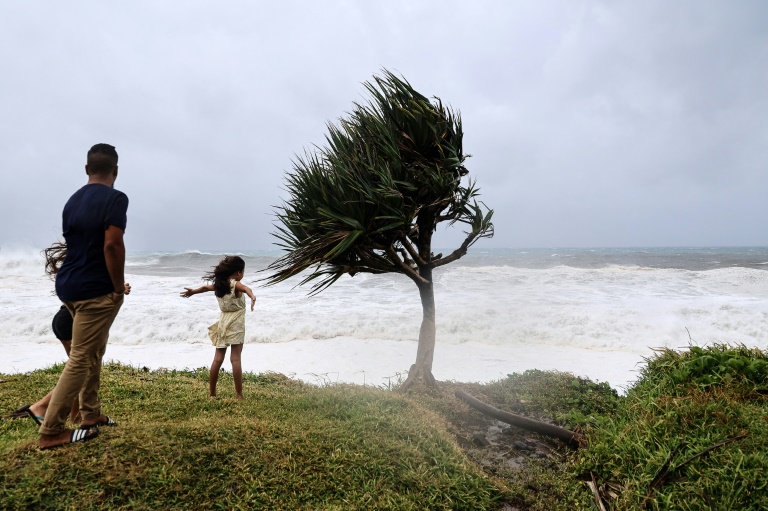
Tropical cyclone Batsirai skirted the French Indian Ocean territory of La Reunion Thursday, leaving at least 12 people injured and an empty oil tanker stuck aground in its wake.

La Reunion was placed on red alert on Wednesday, forcing its 860,000 inhabitants to barricade themselves indoors, with the eye of the intense cyclone passing nearly 200 kilometres (120 miles) from the coast early Thursday.

Emmanuel Cloppet, regional head of national weather agency Meteo-France, said in the early evening that the cyclone was heading away from the island.

But “we are facing the worst weather conditions since the start of the episode”, he warned, with winds of up to 150 kilometres (90 miles) an hour.

La Reunion’s Prefect Jacques Billant earlier said that the injured included 10 who “had carbon monoxide poisoning”, a firefighter who was electrocuted attending a roof fire and another who was injured after a fall from a roof.

A rescue team set out in the evening to help 11 Indian and Bangladeshi sailors stranded on an oil tanker that ran aground 30 metres (yards) off the coast, local and mainland authorities said in the evening.

The French minister in charge of overseas territories, Sebastien Lecornu, however said the tanker was travelling “empty”, and dismissed “any risk of serious maritime pollution”.

Many across the island suffered water and power cuts.

In Mauritius to the east, Batsirai on Wednesday also left thousands of homes without power but passed over the island without inflicting major damage despite cyclone winds bringing life to a standstill.

The cyclone passed within 130 kilometres (80 miles) of the popular holiday destination, bringing heavy downpours and winds of 120 kilometres per hour before it moved on with La Reunion in its sights.

Heavy rain has hit the island since midday Wednesday, with the majority falling to the south, including a metre within 24 hours in the uninhabited region of Piton de la Fournaise, Meteo-France said earlier.

The island is regularly threatened by tropical cyclones. One caused heavy flooding in 2018, while the last devastating cyclone to hit the island came in 2007, killing two people and causing extensive damage. 

After passing La Reunion, Batsirai is set to touch the east coast of Madagascar in southern Africa by the end of the week, Meteo-France forecast, potentially at the level of an “intense tropical cyclone” which could cause a “major” impact for the region.

Other tropical storms and torrential rains have wreaked havoc in southern Africa in recent days, leaving a trail of destruction in their wake.

Tropical Storm Ana claimed the lives of 86 people in Mozambique, Madagascar and Malawi last week.

str-burs/ah/har

Xi to meet Putin as tensions rise with West

China’s President Xi Jinping is poised for his first face-to-face meeting with a world leader in nearly two years on Friday when he hosts Russia’s Vladimir Putin, with the pair drawing closer as tensions grow with the West.

Xi has not left China since January 2020, when the country was grappling with its initial Covid-19 outbreak and locked down the central city of Wuhan where the virus was first detected.

He is now readying to meet more than 20 leaders as Beijing kicks off a Winter Olympics it hopes will be a soft-power triumph and shift focus away from a build-up blighted by a diplomatic boycott and Covid fears.

Xi and Putin will meet in the Chinese capital before their nations release a joint statement reflecting their “common views” on security and other issues, a top Kremlin adviser said at a Wednesday press briefing.

The two strongmen will then attend the Olympic opening ceremony on Friday evening.

Spiralling tensions with the West have bolstered ties between the world’s largest nation and its most populous, and Putin was the first foreign leader to confirm his presence at Friday’s opening ceremony.

He hailed Russia’s “model” relations with Beijing in a December phone call with Xi, calling his Chinese counterpart a “dear friend”.

For its part, China has called on the United States to respect Russia’s “reasonable security concerns” over Ukraine.

Moscow is looking for support after its deployment of 100,000 troops near its border with Ukraine prompted Western nations to warn of an invasion and threaten “severe consequences” in response to any Russian attack.

China enjoyed plentiful support from the Soviet Union — the precursor to the modern Russian state — after the establishment of Communist rule in 1949, but the two socialist powers later fell out over ideological differences.

Relations got back on track as the Cold War ended in the 1990s, and the pair have pursued a strategic partnership in recent years that has seen them work closely on trade, military and geopolitical issues.

Those bonds have strengthened further in the run-up to the Games with Moscow denouncing a diplomatic boycott by a group of Western nations and attempts to “politicise sport”.

The boycott by countries including the United States and Britain is over what Western governments argue are widespread rights abuses in China.

Other leaders set to enjoy Xi’s hospitality during the Games include Egypt’s Abdel Fattah al-Sisi, Saudi Arabia’s Mohammed bin Salman, Kazakhstan’s Kassym-Jomart Tokayev and Poland’s Andrzej Duda.

In total around 21 world leaders are expected to attend the Games.

A majority of those leaders rule over non-democratic regimes, according to the Economist Intelligence Unit’s Democracy Index, with 12 labelled either “authoritarian” or a “hybrid regime”.

Using military to end trucker protest 'not in the cards': Trudeau

Canadian Prime Minister Justin Trudeau on Thursday poured cold water on sending in the military to clear protestors opposed to Covid vaccine mandates, whose convoy of big trucks are clogging Ottawa’s downtown.

The city’s police chief, under pressure from local residents weary of harassment and incessant loud honking, had pitched the idea during a briefing the previous day.

“That is not in the cards right now,” Trudeau told a news conference, adding that governments must be “very, very cautious before deploying the military in situations against Canadians.”

Since Saturday, Canada’s capital has been beset by protestors led by truckers opposed to mandatory Covid vaccines for travelling between Canada and the United States.

By midweek, their numbers had dwindled from a peak of 15,000 over the weekend to several hundred, but they continued to make their case against public health measures loudly — by honking.

Trudeau said it was up to police to deal with the protestors and disruptions to the local community, but added that the federal government is ready to provide support, including with federal police and intelligence services.

At the same time he urged protestors to go home, saying locals had had enough of the “significant disruptions” caused by the protestors.

Residents, he said, have been “harassed for wearing masks” and “faced hateful rhetoric,” and just want to be able to go to work, to school, and go about their daily lives.

“The people of Ottawa deserve to have the lives back, deserve to have their neighborhoods back,” he said.

Organizers are planning to ramp up their protest again this upcoming weekend, while similar demonstrations are planned in other cities including Quebec City and Toronto.

Meanwhile in Alberta, a group of truckers and farmers protesting vaccine mandates at a border crossing to the US state of Montana allowed traffic to partially resume Thursday.

From Kansas school teacher to Islamic State battalion leader

On a scale of one to 10 of jihadist radicalization, an American woman alleged to have led an all-female Islamic State battalion in Syria was described by someone who knew her there as an “11 or a 12.”

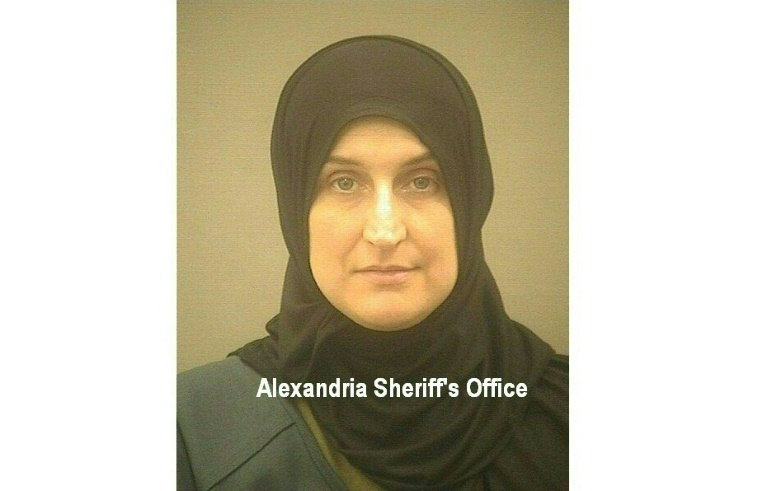
Allison Fluke-Ekren, 42, a school teacher who grew up on a farm in Kansas, made a brief appearance in a federal court in Alexandria, Virginia, on Thursday facing terrorism charges.

Fluke-Ekren, who was dressed in a black headscarf and a green T-shirt reading “Alexandria Inmate,” was ordered to be held in detention until trial.

The trajectory of the midwestern woman who was born Allison Brooks and came to be known by the nom de guerre Umm Mohammed al-Amriki has been outlined in court documents, her personal blog and newspaper articles.

While other Americans traveled to Syria and Iraq to join the now defunct Islamic Caliphate, most were men and Fluke-Ekren is the rare American woman who occupied a senior position in the ranks of the Islamic State.

Brooks grew up in Topeka, Kansas, and was remembered by one of her former teachers as a bright student who was “good at everything.” 

“Never would any of us who knew her back then ever thought she would end up as she has today,” Larry Miller, a retired science teacher, told the Topeka Capital-Journal. “That’s not the person I knew when I knew her.”

Miller served as the wedding photographer for Brooks’ marriage in a Methodist church to a local man named Fluke.

They had two children who are now adults and who have told prosecutors they do not want any contact with their mother.

Brooks went on to marry a man named Volkan Ekren with whom she had at least three more children.

Now known as Fluke-Ekren, she studied at the University of Kansas and then earned a master’s degree in teaching from a college in Indiana.

In a 2004 article in the Lawrence Journal-World, Fluke-Ekren is shown wearing a headscarf while home-schooling her two eldest children. Their studies included learning Arabic from a tutor three days a week.

Fluke-Ekren and her husband moved to Egypt in 2008. Her personal blog still available online shows pictures of the family celebrating birthdays, taking a cruise on the Nile and visiting the Pyramids.

The family moved to Libya in 2011 and lived there for a year, according to the criminal complaint against her.

A former friend identified only as Farouk told ABC News she believed Fluke-Ekren became radicalized while living in the Middle East.  

“She was very sympathetic toward the Islamic states, and how they were doing the right thing and how we needed to, you know, support the women and children,” Farouk said. “She really felt people were being harmed by a larger force.”

– ‘Engage in violent jihad’ –

In 2012, Fluke-Ekren moved to Syria along with several of her children because she “wished to engage in violent jihad” and live in the “land of Sharia,” according to the criminal complaint.

While in Syria, Fluke-Ekren, who is fluent in Arabic, translated speeches by Islamic State leaders to be disseminated online, the complaint said.

She also organized an all-female IS military battalion known as the Khatiba Nusaybah to train women in the use of AK-47 assault rifles, grenades, and suicide belts, it said.

An unidentified cooperating witness who interacted with Fluke-Ekren in Syria was asked how radicalized she was. “Off the charts,” they replied, — an “11 or a 12” on a scale of one to 10.

The same person said more than 100 women and young girls received military training from Fluke-Ekren in Syria.

According to the complaint, Fluke-Ekren sought to recruit operatives for an attack on a US college campus or a shopping mall using an explosives-packed vehicle.

“Fluke-Ekren allegedly considered any attack that did not kill a large number of individuals to be a waste of resources,” it said.

Fluke-Ekren’s husband, an IS sniper trainer, was killed in Syria in 2015 “attempting to conduct a terrorist attack on behalf of IS,” according to the complaint.

It is not clear from the charging documents whether this was Volkan Ekren or whether she had remarried.

In 2016, she married a Bangladeshi IS member who specialized in drones, according to the complaint. One of his projects was attaching chemical weapons on drones.

He died shortly afterward and four months after his death, Fluke-Erken married a “prominent IS military leader” who was responsible for IS’s defense of Raqqa, the former IS capital.

According to the Justice Department, Fluke-Ekren was “apprehended in Syria” and flown to the United States on January 28 from an undisclosed location on a US government plane.

If convicted of providing material support to IS, she faces a maximum sentence of 20 years in prison.

Four top aides desert UK's embattled Johnson

British Prime Minister Boris Johnson suffered four staff defections on Thursday as pressure intensified on the embattled leader over lockdown parties and his loose-lipped style of politics.

One of the departures was linked to an inflammatory remark made by Johnson, attacking opposition Labour leader Keir Starmer over a notorious paedophile.

“Being honest, I wouldn’t have said it and I’m glad the prime minister clarified it,” finance minister Rishi Sunak said in an extraordinary rebuke of his boss during a televised news conference.

Sunak is tipped as a leading contender to replace Johnson, if a brewing Conservative revolt against the prime minister develops further. 

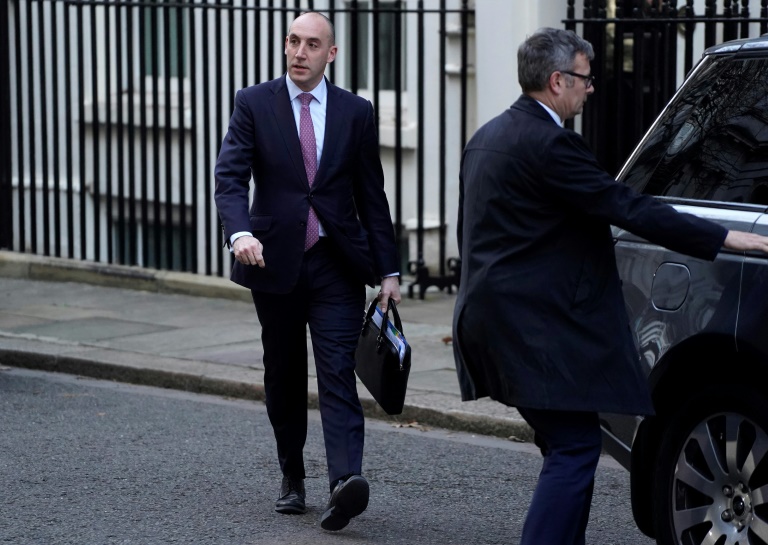
Downing Street confirmed that chief of staff Dan Rosenfield was leaving, just over a year after he took on the role with a brief to professionalise Johnson’s chaotic operation.

His resignation comes after a top civil servant, in a long-awaited inquiry, this week condemned “failures of leadership” in Downing Street over a series of parties held in violation of Covid restrictions.

Also going is Johnson’s “principal private secretary”, Martin Reynolds, who sent a now-notorious email in May 2020 urging Downing Street staff to “bring your own booze” to one lockdown gathering.

Johnson “thanked them both for their significant contribution to government and No 10, including work on the pandemic response and economic recovery”, a spokesperson said.

Their departures were confirmed not long after those of two other top advisors — director of communications Jack Doyle and head of policy Munira Mirza.

According to the Daily Mail, Doyle told colleagues as he left: “It was always my intention to do two years. Recent weeks have taken a terrible toll on my family life.” 

Doyle was implicated in the “partygate” affair after attending at least one Downing Street event that is under investigation by police.

Johnson’s long-term ally Mirza quit after the prime minister tried to link Labour’s Starmer to the failure by UK authorities to prosecute veteran TV host Jimmy Savile, who died in 2011 aged 84.

While alive, Savile was seen as a widely loved presenter. But after his death accusations emerged that he had been a serial abuser of hundreds of children, without facing prosecution. 

In parliament on Monday, Johnson shocked many on his own side when he aired a conspiracy theory prevalent among far-right groups that Starmer had personally failed to prosecute Savile when he was director of state prosecutions in England and Wales from 2008 to 2013.

– ‘Scurrilous accusation’ –

Under Starmer’s watch, police decided not to press charges against Savile despite widespread suspicions about his behaviour.

Starmer was not personally involved in the decision, and he accused Johnson of “parroting the conspiracy theories of violent fascists to try to score cheap political points”.

Johnson belatedly tried to backtrack late Wednesday, after strong criticism from some Tory MPs, sections of the media and a lawyer representing victims of Savile. 

But Mirza said that did not go far enough, according to her resignation letter reported by the Spectator magazine.

Johnson’s remark in parliament “was an inappropriate and partisan reference to a horrendous case of child sex abuse”, she said, noting that the prime minister had yet to apologise.

“You are a better man than many of your detractors will ever understand, which is why it is so desperately sad that you let yourself down by making a scurrilous accusation against the leader of the opposition.”

Mirza, who was once a member of the now-defunct Revolutionary Communist Party, worked with Johnson when he was mayor of London from 2008 to 2016, joining him in Downing Street from 2019.

Speaking to Channel 5 News on Thursday before news broke of the other resignations, Johnson said he was “sorry to lose” Mirza, crediting her for “an outstanding job”.

Dominic Cummings, Johnson’s former chief aide turned bitter foe, said Mirza’s resignation was an “unmistakable signal the bunker is collapsing” as the “partygate” allegations swirl.

Biden says IS leader killed, removing 'major terrorist' threat

President Joe Biden said Thursday that a “terrorist threat to the world” was removed when the head of the Islamic State blew himself up, as US special forces swooped on his Syrian hideout in an “incredibly challenging” nighttime helicopter raid.

Biden said he had ordered an assault by troops rather than an air strike in order to minimize civilian casualties, even though this meant “much greater risk to our own people.” There were no US casualties.

The death of Abu Ibrahim al-Hashimi al-Qurashi is the biggest setback to the IS jihadist group since his predecessor, the better-known Abu Bakr al-Baghdadi, was killed in a US commando raid in the same Syrian region of Idlib in 2019.

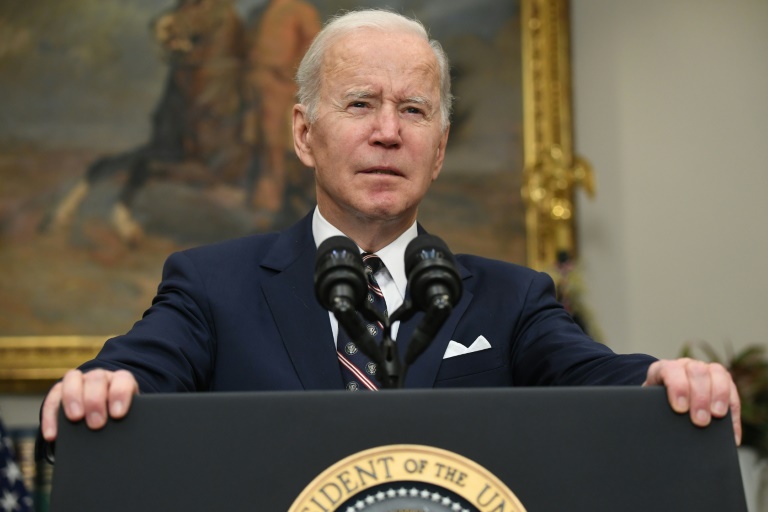
“Last night’s operation took a major terrorist leader off the battlefield and sent a strong message to terrorists around the world: we will come after you and find you,” Biden said in a brief, somber address from the White House’s Roosevelt Room.

Biden said the house targeted overnight in the town of Atme contained “families, including children.”

“As our troops approached to capture the terrorist, in a final act of desperate cowardice, with no regard to the lives of his own family or others in the building, he chose to blow himself up,” Biden said.

Qurashi detonated the entire top floor, Biden said, “taking several members of his family with him.”

General Kenneth McKenzie, head of US Central Command, said later that Qurashi “did not fight” the US soldiers, but set off the explosive “as we attempted to call for his surrender.”

The three-level building of raw cinder blocks bore the scars of an intense battle, with torn window frames, charred ceilings and a partly collapsed roof, AFP correspondents said. Inside, they saw a simple room with little more than foam mattresses, blankets, colorful clothes and children’s toys.

The US government had offered a $10 million reward for information leading to Qurashi, who was an Iraqi also known as Amir Mohammed Said Abd al-Rahman al-Mawla.

The Syrian Observatory for Human Rights, a war monitoring group, said seven civilians were among at least 13 people killed in the operation, four of them children. Pentagon spokesman John Kirby said at least three civilians died — Qurashi’s wife and their two children.

In a rare gesture of solidarity amid soaring East-West tensions, Russia’s foreign ministry said “we support” the US anti-terrorism stance.

– Rent paid –

Atme residents were shocked to hear that their neighbor in the modest house surrounded by olive trees was in fact the leader of the Islamic State. One of the world’s most wanted men, he lived with his family and sister. 

Even his landlord, Mohamed al-Sheikh, was perplexed, saying he thought he had leased the house to a cab driver.

“This man lived here for 11 months. I did not notice anything strange about him,” al-Sheikh said. “He would pay me rent and leave.”

A witness told AFP he woke to the sound of helicopters.

“Then we heard small explosions. Then we heard stronger explosions,” said Abu Ali, a displaced Syrian living in Atme, adding the United States blasted messages to reassure residents.

He heard American forces say “don’t worry. We’re just coming to this house… to rid you of the terrorists.”

The American helicopters took off from a military base in the Kurdish-controlled city of Kobani, according to the head of the Syrian Observatory for Human Rights.

However, McKenzie denied claims that members of the US-trained, Kurdish-led Syrian Democratic Forces, or SDF, were present. They made “invaluable” contributions but “did not accompany the force to the objective,” he said.

While the US side had no casualties, one of the helicopters had to be destroyed after developing mechanical problems, according to a senior US official. Its smoldering remains were photographed in the village of Jinderes in northern Aleppo province.

– Prison battle –

Atme is home to a huge camp for families displaced by the decade-old conflict and which experts have warned was being used by jihadists as a place to hide among civilians.

US special forces have carried out several operations against high-value jihadist targets in the area in recent months, with the military on October 23 announcing the killing of senior Al-Qaeda leader Abdul Hamid al-Matar.

The area, the last enclave to actively oppose the government of Bashar al-Assad, is mostly administered by a body loyal to Hayat Tahrir al-Sham, a group led by former members of what was once Al-Qaeda’s franchise in Syria.

The death of the IS leader comes two weeks after the group staged a huge attack to spring its fighters from a Kurdish-run prison in northeastern Syria.

Hundreds were killed in what was IS’s most high-profile operation since the demise of its “caliphate” nearly three years earlier.

bur-jmm-sms-ec/md

Facebook parent Meta sheds $200 bn in stock plummet

Facebook’s parent firm Meta on Thursday plunged over $200 billion in stock value — comparable to the size of New Zealand’s economy — after results that raised doubts about the troubled social media giant’s future.

In addition to costs of big investments on its metaverse vision for the internet and trouble for its core ads business, the firm predicted slower growth and even reported its first dip in daily users globally on the signature Facebook platform.

Facebook has long been marked by an insatiable push for growth, and now has nearly two billion daily users, but the results laid bare the challenges facing the social media giant on several fronts.

Shares have been down about 25 percent since shortly after the opening in New York, resulting in a more than $200 billion hit to the company’s market value.

“It was a disaster quarter for Facebook and clearly they have some major headwinds over the next year,” Wedbush’s Dan Ives said. 

Facebook founder Mark Zuckerberg had some $25 billion in value wiped from his personal holding by the rout on Wall Street, according to filings on the company stock he owns.

– Risk of not growing –

Meta, which also owns Instagram and WhatsApp, has noted that it faces fierce competition for young users from the likes of explosively growing short-form video platform TikTok.

Ahead of results, analysts expected 1.95 billion daily active users on Facebook, but Meta reported 1.93 billion — a key indicator for where the platform is headed.

On the financial side, Meta reported a turnover of $33.67 billion, in line with its forecasts, but it made $10.3 billion in net profit in the fourth quarter, eight percent less than last year.

Investors also recoiled at Facebook’s report of losing roughly one million daily users globally between the last two quarters of 2021 — a fraction of the total but a potential signal of stagnation.

“It’s the first time the user base is shrinking,” said analyst Adam Sarhan from 50 Park Investment. “If the company is not growing, then it’s a complete reset for investors.”

It is essential to note Meta is a still massive and growing on the whole — as 2021 closed, 2.8 billion people used one of its four platforms and messenger services at least once a day, and 3.6 billion at least once a month.

One way out of Meta’s troubles would be to acquire the next big thing in social media, as it has done previously.

But the company is under considerable scrutiny from US regulators after the damning allegations that emerged from its whistleblower crisis last year.

The internal documents leaked by ex-worker Frances Haugen highlighted accusations that executives prioritized growth over keeping their billions of users safe.

However, Thursday’s dramatic sell-off is the latest to confront a Big Tech firm after a similar liquidation of Netflix shares last month, though the streaming giant has somewhat rebounded since.

Other tech giants such as Apple and Google parent Alphabet have rallied after results — though they both recently posted excellent numbers that calmed jittery markets.

Stocks have risen the last four days as the markets try to rebound from a bruising January pressured by worries over shifting US Federal Reserve policy and uncertainty over the crisis in Ukraine.

But the sharp fall in Meta and some other tech names “is raising doubts about the sustainability of the broader rebound effort,” said Briefing.com analyst Patrick O’Hare.

Round-the-clock care for Peru's oil-stained sea birds

Hand fed fish and given gentle yet rigorous baths, penguins and other sea birds are slowly regaining their strength at a Peruvian zoo after a major oil spill that claimed many of their friends.

Of about 150 oil-stained birds rescued alive after the January 15 spill of some 12,000 barrels of oil, half later died.

The survivors — penguins, cormorants and pelicans — are being nursed back to health and independence at the Parque de Las Leyendas zoo in Lima. 

With oil on their wings, birds cannot fly or feed, and they lose the insulation they need to keep warm.

Even birds not directly contaminated with crude fell ill or died after eating fish that were.

– ‘Very stressed’ –

At the zoo, the rescued birds are fed fish — for the penguins it is their preferred prey of silverside and anchovies.

They are given a special rehydration mixture through a tube, bathed, and dried with a towel.

“Many of them arrived in very bad condition, which makes it difficult for us to handle them,” said Giovanna Yepez, one of the rescuers at the zoo.

“The animals were very contaminated… were very stressed,” she added. “It is a very hard job.”

But after two weeks of intensive care, the penguins at least “have tripled their food consumption,” said Yepez.

“I believe the penguins are on the right track, they are clean and waiting for the impermeability of their feathers to return so they can be released.”

Even when the feathers appear clean, the slightest vestige of crude inside the beak “can affect (the bird) through the digestive system, the liver,” added veterinarian Giancarlo Inga Diaz, hence the need for patience and thoroughness.

– ‘Disaster’ –

The spill, described as an “ecological disaster” by the Peruvian government, happened when an Italian-flagged tanker was unloading oil at a refinery off Peru’s coast.

Spanish oil company Repsol said the tanker was hit by freak waves triggered by a tsunami after a massive volcanic eruption near Tonga, thousands of kilometers away.

The oil slick was dragged by ocean currents about 140 kilometers (87 miles) north of the refinery, prosecutors said, killing countless fish and birds, polluting tourist beaches and robbing fishermen of their livelihood.

The Humbold penguin — a species classified as “vulnerable” by the International Union for Conservation of Nature — lives in colonies on the Peruvian and Chilean coasts, feeding in the cold, nutrient-rich waters of the Humboldt Current which flows north from Antarctica.

Some 9,000 of the black-and-white flightless birds are known to exist in Peru.

They stand about 50 centimeters tall.

Peru has demanded compensation from Repsol for the spill at its refinery.

Close Bitnami banner
Bitnami