World

US says IS leader 'taken off battlefield' in Syria raid

US special forces carried out a brazen nighttime airborne raid in northwestern Syria during which the head of the Islamic State group was “taken off the battlefield”, US President Joe Biden said on Thursday.

The operation, in which Kurdish forces also took part, was conducted in the Idlib region where his better-known predecessor Abu Bakr al-Baghdadi was killed in similar raid in 2019.

“Last night at my direction, US military forces in the northwest Syria successfully undertook a counterterrorism operation to protect the American people and our Allies, and make the world a safer place,” Biden said in a statement.

“Thanks to the skill and bravery of our Armed Forces, we have taken off the battlefield Abu Ibrahim al-Hashimi al-Qurashi — the leader of ISIS,” he said, using another acronym for IS.

A US official said Qurashi blew himself up during the raid.

Qurashi, who was also known as Amir Mohammed Said Abd al-Rahman al-Mawla, replaced Baghdadi after his death in a US raid in October 2019, had a reputation for brutality.

Initial reports that followed the operation near the town of Atme had suggested the target might have been a senior jihadist close to IS’ rival group Al-Qaeda.

The Pentagon had acknowledged the operation earlier but without providing details, describing it only as “successful”.

Biden, who said he would “deliver remarks to the American people”, only added that no US servicemen were wounded during the operation.

The Syrian Observatory for Human Rights war monitor said civilians were among at least 13 people killed in the operation, which saw elite US forces make a perilous helicopter landing near Atme.

– Children killed –

“Thirteen people at least were killed, among them four children and three women, during the operation,” Observatory chief Rami Abdel Rahman told AFP.

The Observatory later said a foreign woman blew herself up with an explosive belt inside the house.

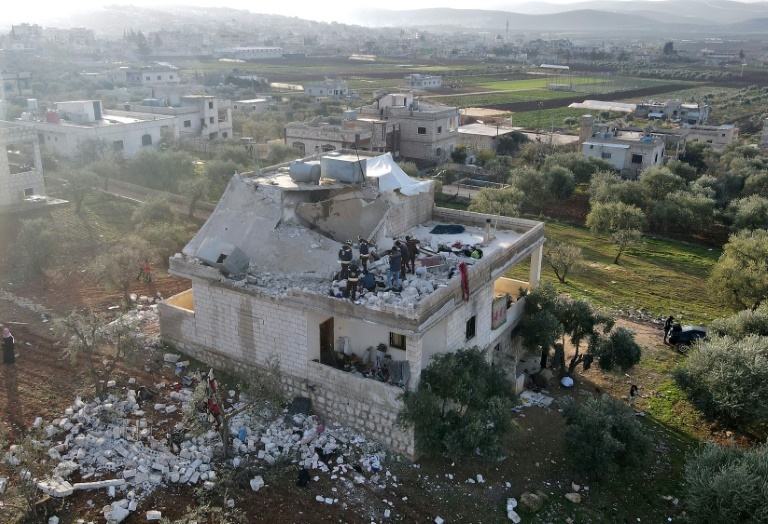
AFP correspondents were able to visit a home on the outskirts of Atme which appeared to be one of the main targets of the US special forces.

A witness told AFP he woke to the sound of helicopters.

“Then we heard small explosions. Then we heard stronger explosions,” Abu Ali, a displaced Syrian living in Atme said, adding that US forces told residents “not to worry”.

“We’re just coming to this house… to rid you of the terrorists,” the man quoted the US forces as saying in their loudspeaker messages.

The American helicopters took off from a military base in the Kurdish-controlled city of Kobani, Abdel Rahman said.

Elite, US-trained members of the Kurdish-led Syrian Democratic Forces joined the operation, he added.

Farhad Shami, who heads the media office of the US-backed SDF, said the operation targeted “the most dangerous international terrorists.”

Kurdish forces had also taken part in the raid against Baghdadi in 2019.

– Fierce battle –

The two-storey building of raw cinder blocks bore the scars of an intense battle, with torn window frames, charred ceilings and a partly collapsed roof.

In some of the rooms, blood was splattered high on the walls and stained the floor, littered with foam mattresses and shards from smashed doors.

US special forces have carried out several operations against high-value jihadist targets in the Idlib area in recent months.

The area, the last enclave to actively oppose the government of Bashar al-Assad, is home to more than three million people and is dominated by jihadists.

The region is mostly administered by a body loyal to Hayat Tahrir al-Sham, a group led by former members of what was once Al-Qaeda’s franchise in Syria.

Atme is home to a huge camp for families displaced by the decade-old conflict and which experts have warned was being used by jihadists as a place to hide among civilians.

On October 23, the US military announced the killing of senior Al-Qaeda leader Abdul Hamid Al-Matar.

“Al-Qaeda uses Syria as a safe haven to rebuild, coordinate with external affiliates, and plan external operations,” said Central Command spokesman Army Major John Rigsbee in a statement at the time.

Syrian government forces and their main military backer Russia have carried out repeated attacks against jihadist and other rebel groups in the Idlib region.

However a ceasefire deal which was brokered by Moscow and Ankara, the two main foreign powers in the area, almost two years ago is still officially in place.

Assad has long insisted his goal was to recapture the whole of Syria, including Idlib province, but the contours of the jihadist-run enclave have remained largely unchanged since early 2020.

Top India diplomat to boycott Beijing Games over torchbearer

India’s top diplomat in Beijing will skip the Winter Games after a Chinese soldier involved in a deadly Himalayan skirmish took part in the Olympic torch relay, officials said Thursday.

Qi Fabao, a regiment commander for the People’s Liberation Army, was among the troops present in 2020 during a high-altitude clash in the Galwan Valley, which is disputed between the world’s two most populous nations.

On Wednesday he was revealed as one of 1,200 torchbearers for the Games by Chinese state media, which feted him as a “hero”.

But his inclusion provoked consternation in India, and the foreign ministry said its senior representative at the Beijing embassy would sit out the opening and closing ceremonies as a result.

“It is indeed regrettable that the Chinese side has chosen to politicise an event like the Olympics,” ministry spokesman Arindam Bagchi told a press briefing. 

The Galwan Valley battle saw troops locked in hand-to-hand combat that left at least 20 Indians and four Chinese soldiers dead — though it took Beijing eight months to acknowledge the casualties on its own side.

Both countries poured tens of thousands of extra troops into the area after the clash, and high-level talks late last year failed to ease tensions in the region.

Qi was wounded in the incident but appeared on Chinese state broadcaster CCTV at the end of last year and said he was “ready to return to the battlefield and fight again”. 

The Winter Olympics open on Friday but have been dogged by politics and Covid-19 fears. 

The United States and several other nations are staging a diplomatic boycott of the Games over human rights concerns relating to the treatment of Uyghurs in the region of Xinjiang.

Skier Arif Mohammad Khan is India’s lone entry in the Winter Games, with spectators limited by Covid-19 protocols.

Kenya under fire over calls to 'weaken' forest protections

In his 15 years defending one of Nairobi’s last green spaces, Simon Nganga has seen off brazen attempts to seize what’s left of the lush forest bordered by highways and housing estates.

Persistent efforts by developers and powerful individuals to seize chunks of the bush as their own were defeated under historic laws enacted to protect Kenya’s dwindling forests from unchecked logging and environmental destruction.

But a proposal expected before parliament on Thursday seeks a major change to these protections, by allowing politicians to determine if public forest can be carved out and handed over to private interests.

Under the contentious amendment, anyone wishing to alter forest boundaries to claim ownership of land could lobby parliament directly, bypassing approval from the Kenya Forest Service (KFS), which is currently mandated to scrutinise such bids.

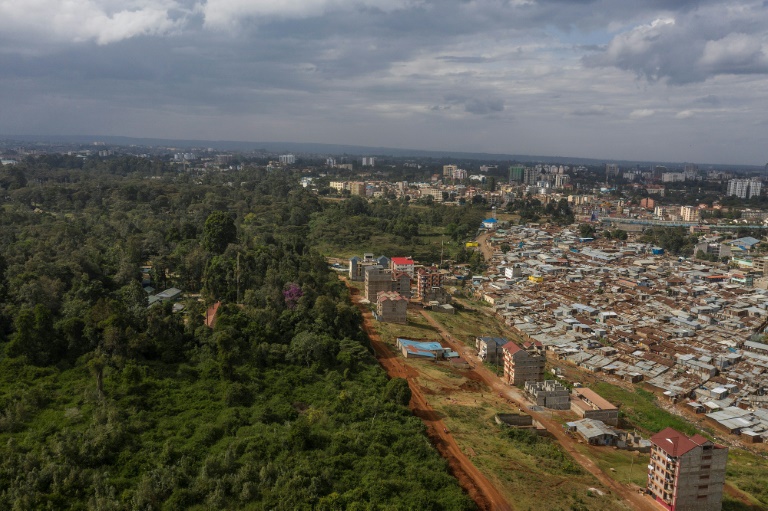
“If it goes through… that will open a Pandora’s Box,” Nganga told AFP beneath the canopy of Ngong Road Forest, a 1,224-hectare (3,025-acre) tract of indigenous woodland inhabited by bush bucks, Sykes monkeys and over 100 species of birds.

“Everyone will want a piece of the forest, which is very dangerous for our forests, and our future.”

The amendment to the Forest Conservation and Management Act –- reforms passed after decades of rampant land clearing — has been  opposed by the environment ministry and the KFS, and has roused significant community anger.

It has also drawn rare criticism from the United Nations, which headquarters its environment programme in Nairobi, and is just weeks away from staging the world’s highest-level decision-making assembly on nature and biodiversity in the Kenyan capital.

– Environmentalists blindsided –

The amendment argues that granting KFS primary authority over hearing and ruling on changes to forest boundaries “unnecessarily limits the right of any person to petition Parliament” as granted under the constitution. 

Environmentalists were blindsided by the proposal, which they say would shift power over Kenya’s forests from a dedicated government agency with a record of fighting land theft, to political elites trying to win a bitterly-contested election.

“Why do members of parliament want to condemn Kenya and the world to an unbearably hot future by weakening the Forest Act?” said conservation group Nature Kenya.

Nganga said the forest laws had proved a bulwark against encroachment — since first passing in 2005, no land within Ngong Road Forest had been legally hived off, keeping its boundary firmly intact.

It is a remarkable achievement for an urban forest pressed in on all sides by one of Africa’s fastest-growing cities, but it still bears the scars of battles won and lost.

A major highway slices through its interior, one unfenced side opens onto the vast Kibera slum, while forest doled out years ago to connected elites saw trees razed for apartments.

But it survived as a whole only because strong laws had kept land grabbers at bay, said Nganga, vice chairman of the Ngong Road Forest Association.

“It has been a success,” Nganga said at the forest edge overlooking Kibera, where men walked by carrying trees they had felled for firewood.

“We cannot talk about winding back success. We know what happened before the Act, when individuals could give out land. We don’t want to get back there.”

– ‘We’ll lose everything’ –

Parliament is considering the amendment as Nairobi this month prepares to host the UN Environment Assembly, where countries will be asked to commit to stronger protections for biodiversity.

In a letter to parliament, a top UN official in Nairobi warned the proposed changes threatened Kenya’s reputation and undermined its efforts to expand forest cover and tackle climate change.

“Unfortunately, we believe the proposed amendment takes us in a contrary direction, incompatible with Kenya’s laudable commitments and trajectory hitherto,” resident coordinator Stephen Jackson wrote in a February 1 letter seen by AFP.

Kenyan Environment Minister Keriako Tobiko said his office learned about the amendment through the press and regretted it had caused “panic and doubt in the international community”.

Land is extremely contentious in Kenya, and disputes over ownership can turn violent.

Environmental activist Joannah Stutchbury was shot dead outside her home in Nairobi in July 2021 after spearheading a vocal campaign to protect a forest near the city from developers.

The timing of this bill in a closely-fought election year has also raised eyebrows.

Electoral cycles have often spelled destruction for forests as land is promised to communities and political allies in exchange for votes, said Paula Kahumbu, the head of conservation group Wildlife Direct.

“Forests have always been up for grabs when it comes to elections,” she told AFP.

“It is kind of like the bribe that is not cash.”

Nganga has fought for the forest before, and knows what is at stake now.

“We will lose everything,” he said.

Pakistan says 7 troops killed in southwest, rebels claim dozens

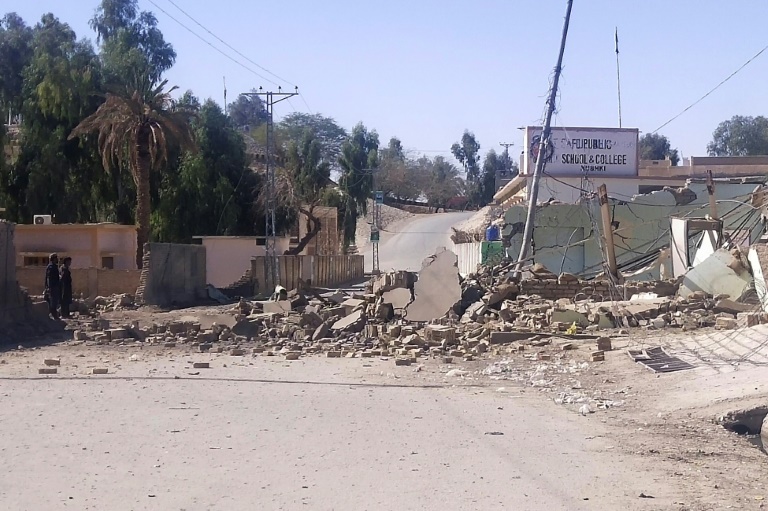
Seven Pakistani soldiers and at least 13 militants were killed in clashes in restive Balochistan province, the army said Thursday, while separatists claimed dozens more had died in fighting that was still ongoing.

Baloch separatists have stepped up attacks against Pakistan forces in recent weeks — including with a deadly bomb blast in the eastern megacity of Lahore last month.

Interior Minister Sheikh Rashid Ahmad said Pakistan forces came under attack late Wednesday in the Naushki and Panjgur districts of Balochistan, an oil- and gas-rich province bordering Iran and Afghanistan.

A total of seven soldiers and 13 militants were killed in the twin assaults, the army said.

In a statement on their Telegram channel, however, the Baloch Liberation Army (BLA) claimed to have killed dozens of Pakistani troops in attacks on security personnel camps.

Late Thursday afternoon the BLA said its assault on state forces in Naushki was “successfully completed” and had “eliminated at least 100 personnel of Pakistani military including an officer”.

A senior Pakistan army official called the claim “a lie”.

The BLA said nine of its members were killed “after several hours of continuous battle”, and clashes were still ongoing in Panjgur.

The army said it has encircled four or five militants there, and also released images showing dead fighters with assault rifles, grenades and night-vision goggles.

Baloch separatists frequently exaggerate their battlefield successes, while the Pakistan military’s public relations department also plays down losses, or delays reporting them.

Balochistan home minister Zia Lango told reporters that the death toll of state forces could be as high as 12, including paramilitary personnel.

At the site of the attack in Naushki shops were shuttered on Thursday morning, with streets deserted.

One local reporter told AFP the mobile phone network was also shut off as police and paramilitary patrols took place.

Prime minister Imran Khan said on Twitter that Pakistan “stands united behind our security forces who continue to give great sacrifices to protect us”.

The latest attacks come a week after ten Pakistani troops were slain in a checkpoint firefight in the Kech district of Balochistan.

Balochistan is the largest, least populous and poorest province in Pakistan.

It has abundant natural resources, but locals have long harboured resentment, claiming they do not receive a fair share of its riches.

Tensions have been stoked further by a flood of Chinese investment under Beijing’s Belt and Road Initiative, which locals say has not reached them.

China is investing in the area under a $54-billion project known as the China-Pakistan Economic Corridor, upgrading infrastructure, power and transport links between its far-western Xinjiang region and Pakistan’s Gwadar port.

Pakistani forces in Balochistan also face attacks from the domestic chapter of the Taliban, Tehreek-e-Taliban Pakistan.

Close Bitnami banner
Bitnami