World

EU reaches deal on major carbon market reform

EU member states and parliamentarians on Sunday announced an agreement for a major reform to the bloc’s carbon market, the central plank of its ambitions to reduce emissions and invest in climate-friendly technologies.

The deal aims to accelerate emissions cuts, phase out free allowances to industries and targets fuel emissions from the building and road transport sectors, according to a European Parliament statement.

The EU Emissions Trading System (ETS) allows electricity producers and industries with high energy demands such as steel and cement to purchase “free allowances” to cover their carbon emissions under a “polluter pays” principle.

The quotas are designed to decrease over time to encourage them to emit less and invest in greener technologies as part of the European Union’s ultimate aim of achieving carbon neutrality.

Negotiators representing member states and the parliament had spent more than 24 hours in intense talks before reaching an agreement on Saturday night that widens the scope of the carbon market.

The deal means emissions in the ETS sectors are to be cut by 62 percent by 2030 based on 2005 levels, up from a previous goal of 43 percent. Concerned industries must cut their emissions by that amount.

The agreement also seeks to accelerate the timetable for phasing out the free allowances, with 48.5 percent phased out by 2030 and a complete removal by 2034, a schedule at the centre of fierce debates between MEPs and member states.

The carbon market will be progressively extended to the maritime sector and intra-European flights. Waste incineration sites will be included from 2028, depending on a favourable report by the commission.

Climate Action Network, a coalition of NGOs, criticised the agreement, saying it would allow major polluters to continue to receive billions of euros in free quotas for another decade while households would receive little.

– ‘Ambitious carbon price’ –

French MEP Pascal Canfin, president of the European Parliament’s environment committee, said the carbon price for industries affected by the ETS would be around 100 euros per tonne.

“No other continent has such an ambitious carbon price,” he tweeted.

A “carbon border tax”, which imposes environmental standards on imports into the bloc based on the carbon emissions linked to their production, will offset the reduction of free allowances and allow industries to compete with more polluting non-EU rivals.

The agreement also aims to make households pay for emissions linked to fuel and gas heating from 2027, but the price will be capped until 2030.

The European Commission had proposed a second carbon market targeting building heating and road fuels, but the plan raised concerns as households grapple with soaring energy prices exacerbated by Russia’s invasion of Ukraine.

The second carbon market would have obliged suppliers of fuel and gas to buy quotas to cover their emissions, but MEPs argued the measure should be limited to offices and large vehicles.

If energy prices continue to spiral, the application of this part of the agreement will be delayed by a year. 

Funds from this second market will go to a “Social Climate Fund” designed to help vulnerable households and businesses weather the energy price crisis.

– ‘Moment of truth’ –

“This deal will provide a huge contribution towards fighting climate change at low costs,” European Parliament rapporteur Peter Liese said in the statement.

“It will give breathing space for citizens and industry in difficult times and provide a clear signal to European industry that it pays off to invest in green technologies.”

The conservative German MEP added the bloc would have until 2026 to invest in green sources and energy efficiency, after which it would be “the moment of truth: we must reduce our emissions by then, or pay dear”.

The commission first proposed the carbon market reform in July 2021 as part of plans to reduce the bloc’s greenhouse gas emissions by at least 55 percent by 2030 compared with 1990 levels.

The ETS was created in 2005 and applies to around 40 percent of EU emissions.
'Unforgettable' Peru holiday for tourists evacuated from Machu Picchu

“Machu Picchu was great, but we will remember longer the days of stress that followed. Unforgettable,” laughs Alex Lim, a 41-year-old Canadian among 200 tourists evacuated on Saturday from the Inca citadel due to unrest in Peru.

Lim and his wife Kate were among 500 mostly foreign but also Peruvian tourists stranded on Tuesday at the foot of the World Heritage Site in the small town of Aguas Calientes after the train line was blocked by demonstrators protesting the ouster and imprisonment of former president Pedro Castillo.

As the railway is the only way in or out of Aguas Calientes, the tourists found themselves stuck for five days in the village’s hotel rooms without their belongings, as most had been staying in the Inca imperial city of Cusco, located 110 kilometers (70 miles) away.

“I feel better now,” said Lim “We were kind of worried. I didn’t have my medication for hypertension at the beginning. We only had clothes for one day.”

He was finally able to obtain some medicine after a visit from a doctor sent by the authorities.

The couple who had started a “great post-Covid trip” have not yet decided whether to continue with their adventure or return home to Toronto.

“We are going to rest, de-stress and then we will decide,” said Alex, who stressed that, despite the protests, the Peruvians have been “welcoming”.

– ‘Relieved to get out’ –

On Saturday “with the support of the police and the armed forces”, authorities were able to send equipment and men to repair and clear the 29-kilometer track between Piscacucho and Aguas Calientes, said tourism minister Luis Fernando Helguero, who was at the site to monitor operations.

Piscacucho, one of the starting points of the Inca Trail trek to Machu Picchu, is the nearest hamlet reachable by road from Aguas Calientes.

“We found out by chance that there was this train that was leaving Machu Picchu and I and another friend managed to board 10 minutes before the train left,” said Brazilian Guilherme Bucco, a professor at the University of Porto Alegre.

“Aguas Calientes is very pretty, but after an hour you have nothing more to do! So five days… I had to cancel a lot of plans and I have to work again next week,” he said.

“But I’m relieved to get out of there.”

Another unpleasant surprise awaited the travelers.

While the railway workers did their best to repair the track, they could not remove a huge boulder that was thrown from the cliffs by demonstrators.

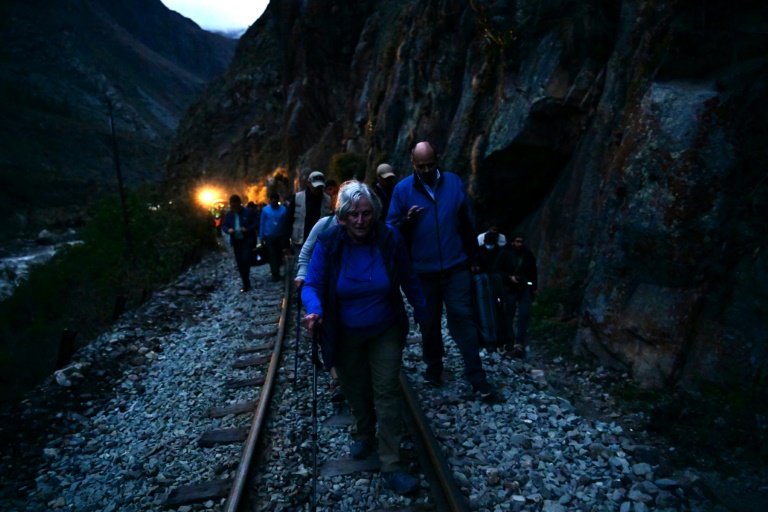
As a result, the tourists had to walk some two kilometers after dark along the railway line by the light of mobile phones to join the minivans waiting to transport them back to Cusco.

While police and railway workers helped to carry their bags, the steep journey was not easy, especially for the older tourists.

“They were hoping to get us out by helicopter but because of the weather they could not do that,” said American Avis Berney, 77, from Whidbey Island, near Seattle.

“The rock was as big as a car, a small Renault!” she said.

“My stick saved me! I’m retired and tired,” she joked.

After the headache of the evacuation, the tourism minister was hoping that the protests which have left at least 19 dead would subside so that “tourism can resume.”

Tourism represents three to four percent of Peru’s GDP and provides employment “to all strata of the economy,” Helguero said.

“We have calculated a loss of 200 million soles ($52 million),” in the sector due to the protests, he said.

The minister was worried about the damage to Peru’s image in the eyes of tour operators and tourists.

The country’s tourism industry has struggled to recover after Covid, attracting two million visitors in 2022, far short of the 4.4 million arrivals in 2019.

“The problem is not the damage of a week, the problem is to regain the level of tourism that we had in 2019 and to exceed it to reach five million,” Helguero said.

Iran urged to free top actor who backed protests

Iran on Sunday faced calls from celebrities and rights groups to free the actor Taraneh Alidoosti, one of the most prominent figures yet arrested in its crackdown on the three-month protest movement.

Alidoosti, 38, was arrested on Saturday, official media said, after a string of social media posts supporting the protest movement including removing her headscarf and condemning the execution of protesters.

The crackdown was sparked by the death in custody of Mahsa Amini, 22, which the morality police accused of violating the Islamic republic’s strict dress code for women.

Iran blames the United States and other “enemies” for trying to destabilise the country by fuelling the protests. 

Alidoosti has considerable international renown due to her performances in award-winning films by director Asghar Farhadi, including the Oscar-winning 2016 film “The Salesman”.

She attended this year’s Cannes Film Festival to promote the acclaimed movie “Leila’s Brothers” in which she starred.

“The brave actress of Iran got arrested,” fellow actor Golshifteh Farahani wrote on Instagram. 

Farahani began her career in Iran but now lives in exile after falling out with the authorities.

“Taraneh Alidoosti is one of Iran’s most talented and acclaimed actors… I hope she’s free to keep representing the strength of Iranian cinema soon,” Cameron Bailey, head of the Toronto International Film Festival, said on Twitter.

Prominent British actor of Iranian origin Nazanin Boniadi also took to social media in support of Alidoosti, saying she had been arrested for “posting a photo of herself without compulsory hijab in solidarity with the protestors.”

– ‘Power of women’s voices’ –

Iran last month arrested two prominent actors, Hengameh Ghaziani and Katayoun Riahi, who expressed solidarity with the protest movement and removed their headscarves in public. Both have now been released on bail.

Authorities also arrested the actors Soheila Golestani and Hamid Pourazari in November after they featured in a video where a group of film and theatre figures stood silently without headscarves. They have also been released.

The New York-based Center for Human Rights in Iran said “women are being arrested and jailed in Iran for refusing to wear forced hijabs, including prominent actress Taraneh Alidoosti. The power of women’s voices terrify the Islamic Republic’s rulers.”

During the street protests, banners of supreme leader Ayatollah Ali Khamenei have been set alight, women have openly walked down streets without headscarves, and demonstrators have at times sought to challenge the security forces.

Alidoosti’s most recent social media post was on December 8, the same day Mohsen Shekari, 23, became the first person executed by authorities over the protests.

“Your silence means the support of the oppression and the oppressor”, read a post on her Instagram account.

On November 9, she posted an image of herself without a headscarf, holding a paper with the words “Woman, life, freedom”, the main slogan of the protests.

She had vowed not to leave Iran and said she was prepared to “pay any price to stand up for my rights.”

Images have also circulated on social media of Alidoosti shopping in Tehran without a headscarf.

The judiciary’s Mizan Online news website said the actor was arrested “by order of the judicial authority” as she “did not provide documentation for some of her claims” about the protests.

Her Instagram account with more than eight million followers was no longer accessible on Sunday.

The Oslo-based monitor Iran Human Rights said Iran’s security forces had killed at least 469 people in the protests, in an updated toll issued on Saturday.

Iran’s top security body, the Supreme National Security Council, said on December 3 that more than 200 people had been killed in the street violence, including security personnel.

Iran’s security forces have arrested at least 14,000 people, according to the United Nations.

North Korea fires two ballistic missiles: Seoul's military

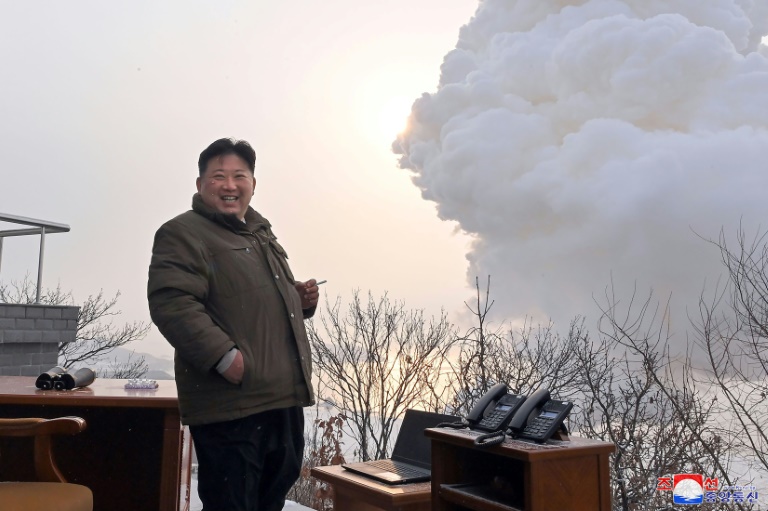
North Korea fired two medium-range ballistic missiles Sunday, Seoul’s military said, days after Pyongyang announced a successful test of a solid-fuel motor for a new weapons system.

Military tensions on the Korean peninsula have risen sharply this year as Pyongyang has carried out an unprecedented blitz of weapons tests, including the launch of its most advanced intercontinental ballistic missile ever last month.

South Korea’s Joint Chiefs of Staff said it detected two medium-range ballistic missiles that had been fired from the Tongchang-ri area in North Pyongan province.

The missiles were fired from 11:13 am (0213 GMT) to 12:05 pm into the East Sea, it said, referring to the body of water also known as the Sea of Japan.

They were fired on a “lofted” trajectory and flew around 500 kilometres (311 miles), JCS said in a statement, adding South Korean and US intelligence were analysing the launch “in consideration of recent trends related to North Korea’s missile development”.

Tongchang-ri is home to a major rocket launch site, where the North tested a “high-thrust solid-fuel motor” on Thursday, with state media describing it as an important test “for the development of another new-type strategic weapon system”.

“Given that the missiles launched today are medium-range ballistic missiles, it is assessed to be test-firings of a new ballistic missile equipped with the solid-fuel engine tested on December 15,” said Cheong Seong-chang, a researcher at the Sejong Institute.

The South’s military “strongly” condemned Sunday’s launch, calling it a “serious provocation” and a “clear violation” of UN Security Council resolutions.

“Our military will maintain a firm readiness posture based on the ability to carry out an overwhelming response to any provocations by North Korea,” it added.

– Kim’s wishlist –

Despite heavy international sanctions over its weapons programmes, Pyongyang has built up an arsenal of intercontinental ballistic missiles (ICBMs).

All its known ICBMs are liquid-fuelled, however, and North Korean leader Kim Jong Un has placed strategic priority on developing solid-fuel engines for more advanced missiles.

Liquid-fuel rockets are notoriously difficult to operate and take a long time to prepare for launch, making them slower and easier for the enemy to spot and destroy.

The more mobile solid-fuel missiles have a much shorter prep time, and are harder to detect before launch.

A wishlist Kim revealed last year included solid-fuel ICBMs that could be launched from land or submarines.

The latest motor test was a step towards that goal, but it is not clear how far North Korea has come in the development of such a missile, analysts said.

– Key party meeting –

The isolated country’s policy direction for next year will be laid out at a key party meeting later this month, and the official Korean Central News Agency earlier reported Kim saying that 2023 would be a “historic year”.

In past years, Kim had delivered a speech every January 1, but he recently dropped the tradition in favour of making announcements at the year-end plenary meeting.

In his most recent address to the meeting, which was released to the public last New Year’s Day, Kim focused on domestic affairs.

Experts say while Kim refrained from directly addressing the United States last year, he could change his tone this time around.

Kim said this year that he wants North Korea to have the world’s most powerful nuclear force, and declared his country an “irreversible” nuclear state.

The United States and South Korea have warned for months that the North is preparing to conduct its seventh nuclear test.

North Korea is under multiple UN Security Council sanctions over its nuclear and missile activity since 2006.

Iraqi conservators strive to preserve ancient manuscripts

In an annex of Iraq’s national museum, a conservator pores over a 17th-century manuscript, carrying out delicate restoration work as part of efforts to preserve and digitise 47,000 precious texts. 

“Some manuscripts date back almost 1,000 years,” said Ahmed al-Alyawi, who heads the House of Manuscripts body.

“There are writings in Arabic, Persian, Turkish, Hebrew and Kurdish,” he added, noting the texts’ “immense cultural diversity”.

In a country that bears the scars of decades of conflict and has seen antiquities and cultural heritage regularly plundered, the House of Manuscripts’ collection has managed to survive.

It was safely stashed away in the Baghdad suburbs, while the national museum was ransacked in the turmoil following the 2003 US-led invasion. Employees and residents prevented subsequent looting attempts at the “underground shelter” where it was stored, Alyawi said.

The collection, now ensconced in the national museum in the capital Baghdad, includes books, parchments and calligraphy boards, some of them damaged by humidity, pests and centuries of use.

Some manuscripts date from the early Abbasid era, while some seventh-century calligraphy boards in Kufic script were written on parchment “even before the manufacture of paper”, Alyawi said. 

– ‘To live longer’ –

A conservator wearing a white lab coat brushed dust from a gnarled board, as a colleague cut fine paper to repair a 17th-century Persian text dedicated to the Shiite religious commemoration of Ashura.

Each intervention must “preserve the old appearance” of a work, said Tayba Ahmed, 30, who has been doing restoration for three years.

But it also must reduce any damage to the work “so that it can live longer”, she added.

A text “may not have a cover, the pages might be detached, you may have to sew and make a leather cover”, she said.

“You can spend several months with the same book.”

Ahmed is one of seven Iraqi conservators who are currently undergoing training, funded by the Italian embassy, to help them carry out their colossal restoration mission.

The programme involves working with Italian expert Marco Di Bella, whose country has previously funded equipment for the House of Manuscripts’ offices, including lighting.

Peering over an 18th-century Ottoman astronomy book, its pages filled with elegant black ink calligraphy, Di Bella made comments in English that were translated into Arabic.

“The most complex process is… deciding what to do and how to intervene on the manuscript”, the Italian conservator told AFP.

“Every single manuscript is assessed… we describe the damage” and try “to understand… the origin” of each piece, he added.

The programme also helps reintroduce traditional conservation materials that are now coming “back into fashion”, Di Bella said, such as starch as an adhesive.

– ‘Heritage of our country’ –

While his team has just four scanners to digitise the entire archive, Alyawi decried a lack of funding that prevented purchasing other specialised equipment or hiring more staff.

Despite the obstacles, Alyawi expressed optimism that his teams could restore up to 100 works per year — making a slow dent in the potentially thousands of works requiring attention.

The House of Manuscripts archive “is a leading collection in Iraq and the region”, said Zakaria Haffar, Iraq project manager at the National Library of France (BNF). 

In October, the House of Manuscripts signed a partnership with the BNF, following financial support from the Aliph Foundation, which works to protect cultural heritage in conflict zones.

In addition to providing materials — such as specialist paper and leather — the cooperation will see an “exchange of skills” to assist with digitisation, restoration and cataloguing, Haffar said.

Mayassa Shehab, who has worked in restoration for half her life, said the preservation and digitisation mission is of immense importance.

“It is the heritage of our country”, the 52-year-old said. “As it has been handed down to us, we must pass it on to future generations.”

Haiti launching cholera vaccination effort hampered by crime gangs

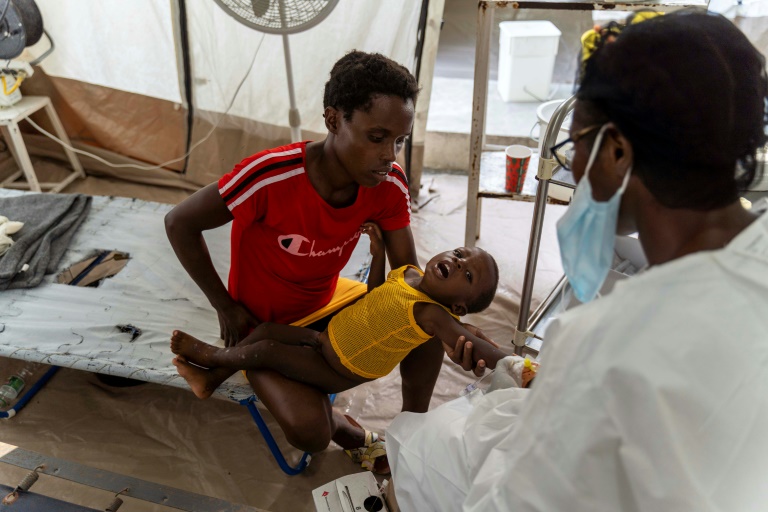
Haiti on Sunday is launching a campaign to vaccinate more than 10 percent of its population against cholera, but gang control of large swaths of territory will complicate the effort.

The Caribbean country has 1.17 million doses of oral vaccine on hand, with nearly 500,000 more coming.

The campaign will focus on Haitians aged one to five, with nearly half of confirmed cases affecting that age category.

Cholera has spread rapidly across the country since October. The national Department of Epidemiology, Laboratories and Research has registered more than 14,700 suspected cases, nearly 1,270 confirmed cases and over 290 deaths.

Vaccine supplies are an issue, said Jean Bosco Hulute, a health specialist with the UN children’s agency UNICEF.

“Many countries are currently experiencing cholera epidemics, causing a scarcity of vaccine,” he told AFP.

Hulute noted that a single dose offers six months’ protection, while a second dose can extend that to a full two years.

The vaccination campaign, scheduled to run from December 18 to 22 and then from 27 to 28, will focus on the hardest-hit neighborhoods and communes, including Cite Soleil, Delmas, Carrefour, Port-au-Prince and Mirabelais.

But with gang violence ravaging the impoverished country, the effort will not be easy.

“In unsafe areas, particularly where there have been abductions and gunfire, the vaccination and communications teams will not be totally protected,” according to Hulute.

He said UNICEF was appealing “where the gangs are in control for them to offer unlimited access to the teams, for that is what will permit the population to receive these protective drops of oral vaccine.”

In 2010, a first cholera epidemic swept through Haiti after United Nations peacekeepers from Nepal introduced the disease. In the ensuing decade cholera claimed more than 10,000 lives.

Today, Haitians are painfully aware of the dangers of cholera, but a chaotic political, economic and security situation seriously impedes public health efforts.

While the epidemic has not been as explosive as in 2010, it has hit “every part of the country,” with the crisis conditions “paving the way for outbreaks,” said Tristan Rousset of the Pan American Health Organization.

From battlefield to glampsite: the story of Saudi's Khaybar

A Saudi town best known for a fierce battle between the Prophet Mohammed and Jewish tribes is remodelling itself as an upscale tourist draw in line with the kingdom’s rebranding efforts.

Situated in an oasis amid a volcanic field north of Medina, the settlement of Khaybar was once home to thousands of Jews, who were defeated in a decisive seventh-century battle with the Prophet’s army as Islam expanded across the Arabian Peninsula.

The chant “Khaybar, Khaybar, o Jews, the army of Mohammed will return” can still sometimes be heard at present-day anti-Israel demonstrations, drawing objections from groups such as the Anti-Defamation League, which says it “can be perceived as a threat of armed violence”.

Last month, Saudi Arabia inaugurated a new visitors’ centre in Khaybar, which takes a longer view of the area’s history by highlighting references in ancient texts to its conquest by Babylonian-era King Nabonidus.

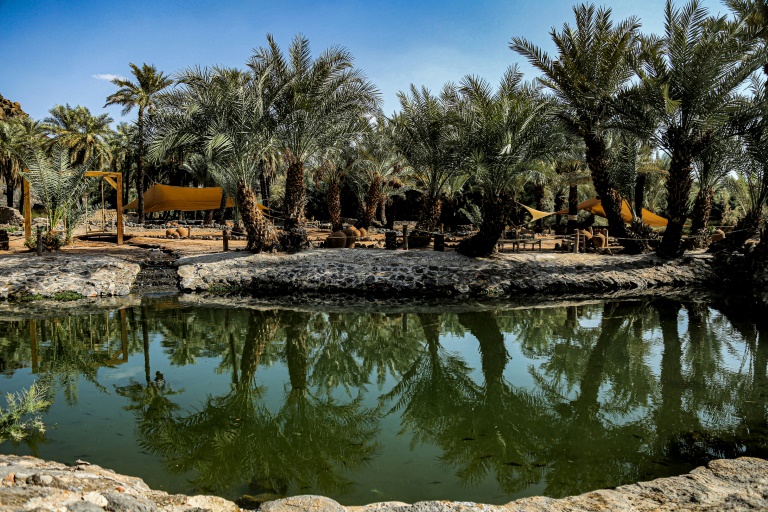
At the centre, displays avoid mentioning the seventh-century battle and tourists can arrange hikes to nearby volcanoes, strolls through lush palm springs or helicopter tours over ancient tombs and desert kites, which are dry stone walls that served as animal traps.

The project is part of a broader push in the conservative Sunni Muslim country, which only began issuing tourism visas in 2019, to attract some 30 million foreign visitors annually by the end of the decade, up from four million last year.

Khaybar tour guide Enass al-Sharif said it was important to shine a light on features of the area that go beyond its significance to Islam.

“Khaybar has a strong relationship with religion and it has a close relationship with the Prophet,” she told AFP.

However, “it also has a strong relationship with history and civilisation. All these things were collected in one place, which is why it is attracting many tourists.”

– ‘Quantum leap’ –

Archaeologists believe Khaybar has been inhabited for over 200,000 years, and it once served as a vital stop along the so-called Incense Route that linked it to Medina to the south, and the desert city of Al-Ula to the north.

But in the 1970s, the Saudi government began pushing residents to leave the old settlements for new structures with modern plumbing and electricity.

“We wanted some civilisation and development… so we left,” recalled Saifi al-Shilali, a Khaybar native who was in his early 20s when his family moved away.

Since then, the old settlements have been abandoned, and Shilali, now in his 60s, is among those who have been agitating for a revival.

The transformation of Khaybar into a potential tourism draw “is something we have been waiting for for a long time,” he told AFP.

“With my interest in research in Khaybar and in tourism… we have been waiting for this moment, so we consider it a quantum leap.”

Like other Saudi attractions such as Al-Ula, a budding arts hub located among ancient Nabataean tombs, Khaybar is largely geared toward well-heeled travellers.

The Khaybar Volcano Camp promises an “exclusive stay” that “takes glamping to another level”, with 10 rooms surrounded by imposing mountains.

The focus lies squarely on the setting rather than the historical events that took place there.

The camp even features a reiki energy healing master named Chamuel who conducts sound meditation sessions, inviting guests to enter “your own magical garden, a place beyond time and space”.

– Unsolved mysteries –

All the while, an archaeological survey and excavation project continues to unearth new details about human activity in the area as well as how its climate has evolved.

The project, backed by the French government and expected to last through the end of 2024, has already yielded a deeper understanding of neolithic campsites, canals and rock art.

Among the most intriguing finds are the “pendant tombs”, rock formations that when viewed from above resemble a pendant hanging from a chain.

The story behind them “remains a mystery”, according to the visitors’ centre, though archaeologists believe they date back 5,000 years.

Khaybar residents like Shilali are eager to learn more about the people who constructed them as part of rounding out a picture of the region’s past — including the Prophet Mohammed’s seventh-century victory, but also everything else.

“I think we are supposed to shed light on Khaybar as a historical region whose roots go back to prehistoric periods, including the Jewish period,” he said. 

“I believe that the history should be known in its true form, without any exaggerations.”

North Korea fires two ballistic missiles: Seoul's military

North Korea fired two ballistic missiles Sunday, Seoul’s military said, days after Pyongyang announced a successful test of a solid-fuel motor for a new weapons system.

Military tensions on the Korean peninsula have risen sharply this year as Pyongyang has carried out an unprecedented blitz of weapons tests, including the launch of its most advanced intercontinental ballistic missile ever last month.

South Korea’s Joint Chiefs of Staff said it detected two ballistic missiles that had been fired from the Tongchang-ri area in North Pyongan province.

The missiles were fired from 11:13 am (0213 GMT) to 12:05 pm into the East Sea, it said, referring to the body of water also known as the Sea of Japan.

“Our military has strengthened surveillance and vigilance while closely cooperating with the United States and maintaining a full readiness posture,” the JCS added in a statement.

The missile flew some 500 kilometres and reached a maximum altitude of around 550 kilometres, according to Japan’s defence ministry.

“It threatens the peace and security of our country, this region, and the international community, and it is absolutely unacceptable,” said senior vice defence minister Toshiro Ino.

Sunday’s launch came days after North Korea tested a “high-thrust solid-fuel motor”, with state media describing it as an important test “for the development of another new-type strategic weapon system”.

Despite heavy international sanctions over its weapons programmes, Pyongyang has built up an arsenal of intercontinental ballistic missiles (ICBMs).

All its known ICBMs are liquid-fuelled, however, and North Korean leader Kim Jong Un has placed strategic priority on developing solid-fuel engines for more advanced missiles.

Kim said this year that he wants North Korea to have the world’s most powerful nuclear force, and declared his country an “irreversible” nuclear state.

The wishlist he revealed last year included solid-fuel ICBMs that could be launched from land or submarines.

The latest motor test was a step towards that goal, but it is not clear how far North Korea has come in the development of such a missile, analysts said.

– Key party meeting –

The isolated country’s policy direction for next year will be laid out at a key party meeting later this month, and the official Korean Central News Agency earlier reported Kim saying that 2023 would be a “historic year”.

In past years, Kim had delivered a speech every January 1, but has recently dropped the tradition in favour of making announcements at the year-end plenary meeting.

In his most recent address, which was released last New Year’s Day, Kim focused on domestic affairs. 

Experts say while Kim refrained from directly addressing the United States last year, he could change his tone this time around.

The United States and South Korea have warned for months that North Korea is preparing to conduct its seventh nuclear test.

North Korea is under multiple UN Security Council sanctions over its nuclear and missile activity since 2006.

In Ukraine's Avdiivka, 'hope is all we have'

Looking pale and exhausted, a dozen of the few remaining residents of Ukraine’s frontline town of Avdiivka briefly come out of their shelters to pick up food parcels distributed by volunteers.

They barely flinch at the sound of the constant shelling that echoes across the town just 13 kilometres (8 miles) from the pro-Russian rebel stronghold of Donetsk in eastern Ukraine. 

Carrying boxes with stamps of the World Food Programme, they slowly retreat to the relative safety of their basements, where they have been sheltering without power, gas or water. 

“It’s very hard… (Volunteers) have offered for us to leave, to evacuate, but where can we go? We are too old,” says 74-year-old Svitlana, who shares a cold basement with five women and two men of a similar age who used to occupy the building above it.  

In their basic shelter, thick blankets and sleeping bags donated by volunteers are sprawled across eight beds.

A flashlight secured to the wall emits a pale white gleam — their only source of light.

“Basements are all the same, but this is our basement. It would be cold now wherever we go,” Svitlana tells AFP, wearing a hat and wrapped in a thick winter coat. 

“Here, at least, we can go upstairs and grab an extra jacket,” she adds.

Just over 2,000 of Avdiivka’s 30,000 residents remain in the town nearly 10 months into Russia’s invasion of Ukraine.

– Frequent shelling –

The head of the town’s military administration, Vitali Barabash, says Avdiivka is under frequent shelling from pro-Russian forces.

“From 7:15 am they started bombarding the old part of town with Grad rockets. At 9:30 there was a strike on the central part using artillery,” he says.

“Just seven minutes ago, they started a massive artillery strike, the central part of town again, apartment blocks,” he tells AFP in the middle of a cold winter day in mid-December.

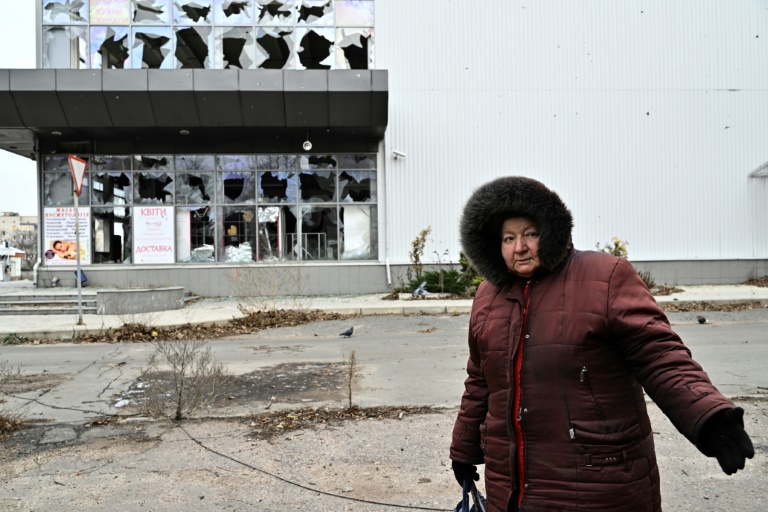
Many of Avdiivka’s buildings have been damaged, their walls blackened, their windows blown out by the impact.

To the north of the city, a large coke plant which used to employ 4,000 people has been the target of numerous strikes. 

Back in the basement of Svitlana’s home, a fire crackles inside a wood-fired stove in a small adjoining room. 

Mikola pulls out twigs and branches from a small pile of wood to fuel the fire. Two explosions ring out in the distance.  

“Who knows what it was. It looked like artillery or maybe mortars,” he says. 

“Here we keep food, potatoes… If it gets too cold, we will move in here”, Mikola adds, referring to the heated room. 

For Svitlana, “hope is all we have”. 

“Most of us are sick, like everyone here — strokes, the flu, some people get injured,” she says.

Located in Ukraine’s industrial Donbas region, Avdiivka was briefly captured by Russian-backed separatists in spring 2014 before coming back under Kyiv’s control some months later.

It has remained a hotspot of fighting ever since.

– ‘All civilians threatened’ –

The town has witnessed fierce battles over the past few months, as Russia’s forces attempt to advance around Avdiivka and the nearby town of Bakhmut.

North of Avdiivka, Moscow’s troops in June cut off one of the two main supply routes to the town. 

Russian forces are also positioned to the east and to the south, where they have recently pushed back Ukrainian forces. 

“Our troops withdrew from (the village) of Vodyane. They crossed the river because it was absolutely impossible to hold the previous positions which were completely destroyed,” Barabash says. 

According to him, Moscow has recently redeployed regular troops near Avdiivka that are “better trained” than separatist forces but morale is “high” among Kyiv’s soldiers.

“They do not even think of leaving the town,” Barabash says. 

But Avdiivka police officer Rasim Rustamov says the situation remains “really difficult”.

“We are suffering from repeated shelling of the town and surrounding areas. All civilians here are threatened,” he tells AFP inside a police station. 

Living in the darkness of their basement, Svitlana and her neighbours keep busy by decorating the walls with large colourful collages.

“There was nothing but old brick walls here. Now, you see, step by step, we are decorating the boring grey backdrop,” Svitlana says. 

“We know how to make it feel like home,” she adds.

Dam plans threaten China's migratory bird haven

Spooked by a historic drought, local authorities in China have renewed controversial plans to dam the country’s biggest freshwater lake.

But environmentalists warn damming Poyang Lake, a winter stopover for over half a million birds, would threaten the fragile ecosystem and the endangered birds and other wildlife it supports.

China is currently chairing UN biodiversity talks in Montreal, billed as the “last best chance” to save the planet’s species and their habitats from irreversible human destruction.

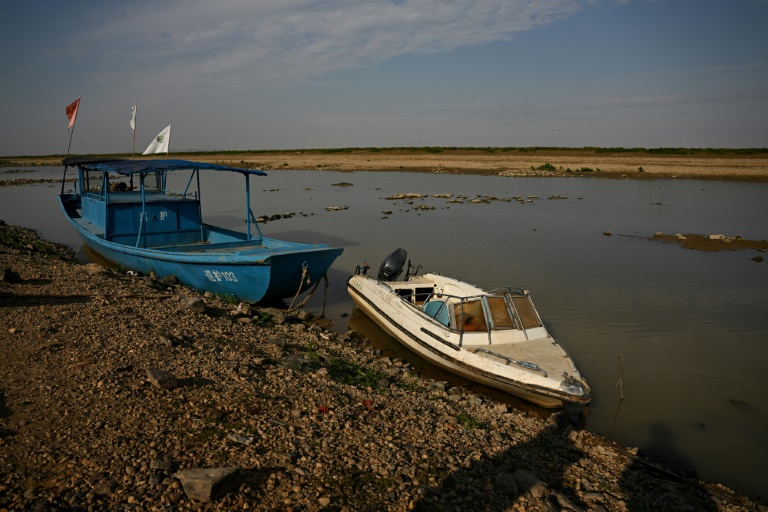
The Poyang dam, which is slowly recovering after shrinking to less than a third of its usual size, shows how fraught such efforts are in China.

Conservationist Zhang Daqian said that if realised, the 3,000-metre-long sluice gate across one of the lake’s channels would cut it off from the river Yangtze, “leaving Poyang a dead lake”.

China has built more than 50,000 dams in the Yangtze basin in the past 70 years — including the Three Gorges, which came in the face of widespread opposition from environmentalists.

Over the same period at least 70 percent of the river’s wetlands have vanished, according to data from the environment ministry.

When the project was initially proposed, complaints from ecologists succeeded in shelving it.

But the looming spectre of droughts — which are becoming ever more frequent and severe in the area thanks to climate change — has altered the calculus.

Poyang supplies water to Jiangxi province’s 4.8 million residents, and the local government says damming it will conserve water, irrigate more farmland and improve navigation.

An environmental impact assessment (EIA) published in May gave experts just two weeks to review 1,200 pages of documents and lodge complaints.

– Winter visitors –

In a normal wet season, Poyang can be three times the size of Los Angeles. 

Its mud flats are the primary winter feeding grounds for hundreds of thousands of birds flying south to escape the chill every autumn. 

They include the critically endangered Siberian crane, the population of which has shrunk to about 4,000.

This year’s drought was the worst in 70 years, with the region entering the dry season three months sooner than usual. 

Still, hundreds of birds were gathering at small pools of water left on the cracked riverbed when AFP visited a reserve in Yongxiu County in early November. 

“Migratory birds are still coming to Poyang, because it’s their habitual winter home,” said an employee surnamed Chen, looking across the dry expanse littered with empty mussel shells and fish skeletons. 

“But there are no fish or shrimp for them to eat. Many birds flock to nearby fields and farmers have been told to leave a bit of their paddy unharvested for the birds,” Chen said.

Officials have pumped water from nearby reservoirs to form small butterfly-shaped watering holes for the birds.

“There are no conflicts (between residents and birds), because migratory birds are nationally-protected animals, and people will not harm them,” He Fangjin, an employee at another wetland park, told AFP. 

At nearby Zhupao Hill, a popular bird-watching spot, about 90,000 migratory birds were spotted from October to early December, up from about 62,000 birds in the same period last year.

– Damage to ecosystem –

It’s not clear what stage of development the dam is currently in, and neither local authorities nor the environment ministry responded to questions put to them by AFP. 

But were they to go ahead, the sluice gate would disrupt the lake’s natural ebb and flow with the Yangtze, potentially threatening the tidal flats the birds feed on, said Lu Xixi, a geography professor at the National University of Singapore.

Losing its natural water circulation could also hurt Poyang’s ability to flush out nutrients, risking an algae build-up that could disrupt the food chain, Lu added.

The dam could also affect another critically endangered species that calls the lake its home — the Yangtze finless porpoise. There are just over 1,000 left in the wild.

During the drought, the porpoises took refuge in the same channel the dam would cut off, a ranger from the Beijing Environmental Protection Prairie League, who has patrolled the lake for over a month, told AFP.

Beijing-based Friends of Nature said the dam EIA failed to do a comprehensive evaluation of whether the porpoises’ migration would be blocked.

“Without comprehensive scientific evidence and before eliminating the environmental risks, the project should not be pushed forward,” the group said in a statement.

Close Bitnami banner
Bitnami