World

Asian stocks join global retreat as central banks see higher rates

Asian stocks fell Friday as investors contemplated interest rates going higher than expected for an extended period after central banks reaffirmed their commitment to bringing down inflation.

After a healthy rally in recent weeks fuelled by signs that price rises were slowing, the US Federal Reserve and European Central Bank this week crushed any Christmas spirit by hiking borrowing costs again and warning of more pain to come.

While inflation in most countries has started coming down from the highs seen earlier this year — helped by a drop in energy costs — they remain at multi-decade highs.

And observers have warned that economies could be heading for a period of stagflation where prices keep rising but growth stalls.

After a rough week for markets, anxiety was enhanced on Wednesday after the Fed hiked rates as expected but indicated they would likely have to go higher than had been expected, ramping up fears of a recession.

That was followed by similar moves by the ECB on Thursday, with its boss Christine Lagarde warning: “We have more ground to cover, we have longer to go and we are in for a long game.”

The Bank of England also lifted rates and said more hikes were on the cards.

The decisions came as data also showed that almost a year of monetary tightening was hitting the economy more and more, with US retail sales dropping in November as American consumers — the key driver of growth — began to feel the pinch.

– Recession on horizon? –

“With central banks on both sides of the pond suggesting they have more work to tame inflation, hiking interest rates into a dimming macro environment will undoubtedly trigger a recession,” said SPI Asset Management’s Stephen Innes.

“The question is just how profound. Forget inflation; Asia traders are now worried about a global recession.”

All three main indexes on Wall Street tumbled Thursday, with the Nasdaq losing more than three percent as tech firms took another blow, while Paris and Frankfurt were also off more than three percent.

And the losses carried through to Asia, where Tokyo gave up more than one percent while Sydney, Seoul, Singapore, Wellington, Taipei, Jakarta and Manila were also in the red.

However, the dollar eased back slightly after Thursday’s rally.

Hong Kong and Shanghai also sagged, though the losses were less severe, with traders supported by signs of progress in talks on allowing US officials to audit Chinese firms listed in New York, easing concerns about a possible delisting of some big names such as Alibaba and Tencent.

The news provided a little more help to Hong Kong traders, whose sentiment has been lifted by China’s shift away from the economically damaging zero-Covid policy as well as moves to open the city further to overseas visitors.

And a report in the city’s South China Morning Post said the border with mainland China would be fully reopened next month, providing another much-needed boost to the beleaguered economy.

However, the mood was soured a little by a US decision to put 36 Chinese companies including top producers of advanced computer chips on a trade blacklist, severely restricting their access to any US technology.

– Key figures around 0230 GMT –

Tokyo – Nikkei 225: DOWN 1.5 percent at 27,620.66 (break)

Hong Kong – Hang Seng Index: DOWN 0.2 percent at 19,327.32

Shanghai – Composite: DOWN 0.1 percent at 3,164.07

Euro/dollar: UP at $1.0648 from $1.0627 on Thursday

Dollar/yen: DOWN at 137.28 yen from 137.80 yen

Pound/dollar: DOWN at $1.2211 from $1.2175

Euro/pound: DOWN at 87.20 pence from 87.26 pence

West Texas Intermediate: UP 0.2 percent at $76.26 per barrel

Brent North Sea crude: UP 0.2 percent at $81.40 per barrel

New York – Dow: DOWN 2.3 percent at 33,202.22 (close)

London – FTSE 100: DOWN 0.9 percent at 7,426.17 (close)
Fire breaks out at historic Panama Canal lock

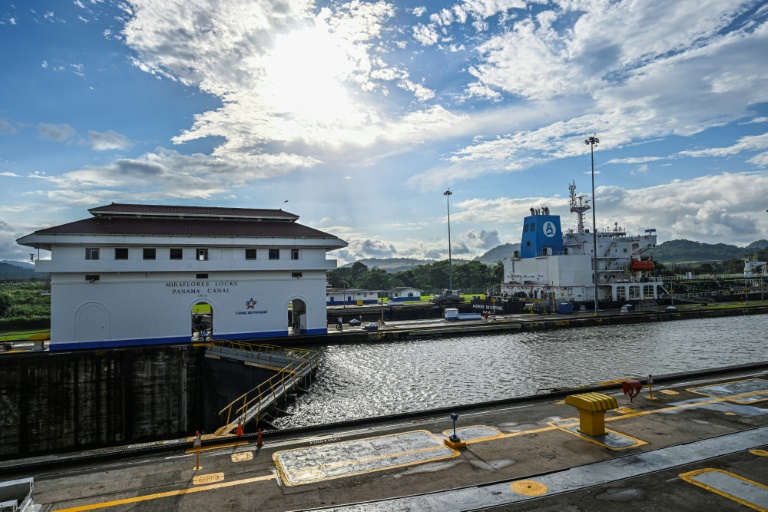
A small fire broke out Thursday in machines that operate the historic Miraflores Lock on the Panama Canal, which delayed the crossing of some ships but did not shut down interoceanic navigation.

The fire started in a tunnel where the machinery of the lock is housed, but the other locks continued working normally, said the Panama Canal Authority.

“A fire outbreak was recorded in one of the machinery tunnels in the upper chamber of the Miraflores locks,” the Authority said in a statement. 

“No injuries were reported. However, the transit of ships through this lock has been temporarily suspended as a security measure,” it added.

The locks are huge concrete chambers that are filled with, then emptied of, millions of liters of water to raise or lower ships as they pass through the Canal linking the Atlantic and Pacific oceans. Five percent of all global trade moves through the strategic waterway.

The Miraflores lock, more than a century old, is close to the Pacific and is visited daily by tourists from all over the world.

North Korea tests solid-fuel motor, aiming to build new weapon: state media

North Korea has successfully tested a “high-thrust solid-fuel motor” with the aim of developing a new weapon, state media said Friday.

Despite heavy international sanctions over its weapons programmes, Pyongyang has built up an arsenal of intercontinental ballistic missiles (ICBMs).

All its known ICBMs are liquid-fuelled, however, and North Korean leader Kim Jong Un said last year that developing solid-fuel engines for more advanced missiles was a strategic priority.

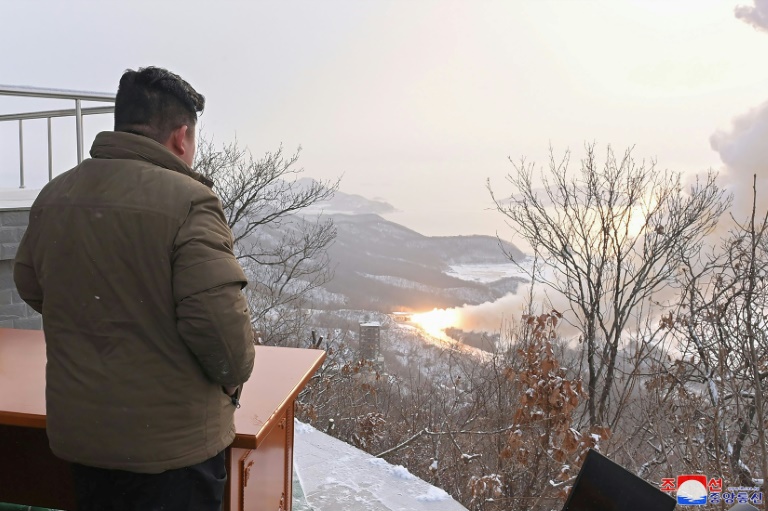
On Thursday, he oversaw the successful test fire of a “high-thrust solid-fuel motor”, the official Korean Central News Agency (KCNA) reported.

KCNA described it as an important test “for the development of another new-type strategic weapon system”.

Images released by state media showed Kim observing the test at the Sohae Satellite Launch Ground, as the horizontally placed motor spewed bright yellow exhaust flame.

Another image showed him grinning with a lit cigarette in his hand and a tower of white smoke from the test behind him.

Liquid-fuel rockets are notoriously difficult to operate and take a long time to prepare for launch, analysts say.

They are thus slower, and easier for an enemy to spot and destroy. 

Solid-fuel missiles are “more mobile, quicker to launch, and easier to conceal and use during a conflict,” said Leif-Eric Easley, a professor at Ewha University in Seoul.

“Once deployed, the technology would make North Korea’s nuclear forces more versatile, survivable and dangerous.”

Kim said this year that he wants North Korea to have the world’s most powerful nuclear force, and declared his country an “irreversible” nuclear state.

The wishlist he revealed last year included solid-fuel ICBMs that could be launched from land or submarines.

The latest motor test was a step towards that goal, but it is not clear how far North Korea has come in the development of such a missile, analysts said.

It is “difficult to assess the thrust output claimed by North Korea,” Joseph Dempsey, a researcher at the International Institute for Strategic Studies (IISS), told AFP.  

“What other technical challenges remain and how far away a flight test of such a system is remains unknown,” he added. 

Pyongyang has conducted an unprecedented wave of weapons tests this year, including the firing of its most advanced ICBM.

The United States and South Korea have warned for months that North Korea is possibly preparing to conduct its seventh nuclear test.

Ousted Peru leader ordered detained for 18 months amid protests

Peru’s Supreme Court on Thursday ordered ousted president Pedro Castillo to remain in detention for another 18 months after his arrest last week, which has sparked deadly unrest in the South American nation.

Castillo was removed from office and detained after he tried to dissolve the legislature and announced he would rule by decree, in what opponents say was a bid to dodge an impeachment vote, amid several corruption probes.

The leftist former school teacher stands accused of rebellion and conspiracy and could be jailed for up to 10 years if found guilty, according to public prosecutor Alcides Diaz.

A Supreme Court judge granted the request from prosecutors to keep Castillo in custody, saying he posed a flight risk after trying to seek asylum at the Mexican embassy in Lima. The detention order extends to June 2024.

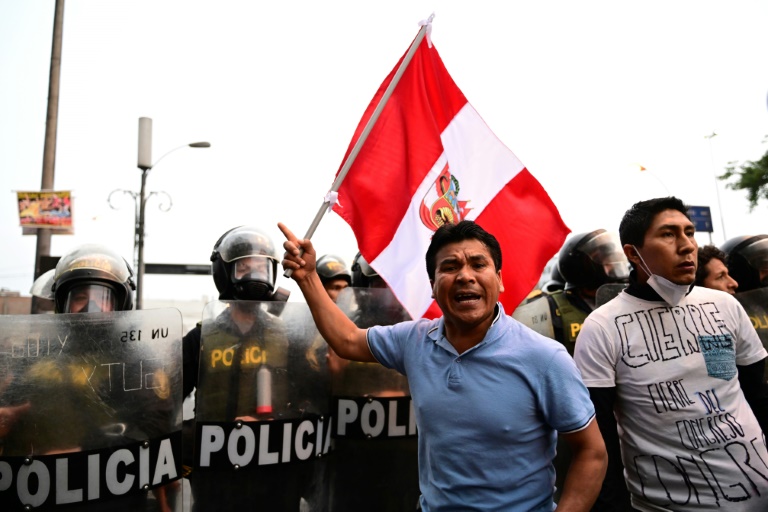
His removal from office has sparked protests across the country, with the death toll now at 10, according to the health ministry. Thousands rally daily nationwide despite a state of emergency, including in the capital Lima on Thursday.

The country’s ombudsman put the number of injured at 340, with the police saying at least half of that total are from their ranks. 

Castillo’s supporters — dozens of whom have camped outside the prison where he is being held in the capital — remain undeterred and unbowed.

“I am in total disagreement with the Peruvian justice system, because everything is for sale,” demonstrator Rolando Arana, 38, said in Lima after the court ruling on keeping Castillo detained. 

“The president has been kidnapped. There is no other word for it,”  41-year-old Lucy Carranza said earlier. 

On Thursday, a total of 300 people marched near the prison shouting “Freedom for Castillo” under the watchful eye of police.

Dina Boluarte, the former vice president who was quickly sworn in as president after Castillo’s arrest, on Wednesday declared a nationwide state of emergency for 30 days.

On Thursday, she exhorted congress to approve a constitutional reform that will allow her to bring forward elections slated for July 2026 to December 2023.

New elections are one of the main demands of pro-Castillo demonstrators, which have included Indigenous people from Peru’s Amazon jungle regions in the center and southeast.

– ‘They didn’t let him govern’ –

Four airports have been shut down due to the protests, while more than 100 roads throughout the country remain blocked.

Hundreds of tourists have been left stranded at Peru’s most popular attraction, the 15th-century Inca citadel Machu Picchu, after train service to the site was suspended.

Protest leaders have said they will stage new demonstrations again on Friday, demanding Castillo’s release, Boluarte’s resignation, Congress’s closure and new elections.

Castillo and his attorneys were not present at his virtual release hearing.

The judge said Castillo refused to accept the summons, so his case was assigned to a public defense lawyer.

The hearing was supposed to take place on Wednesday when Castillo’s initial seven-day detention expired but was postponed by 24 hours after the former leader’s lawyers argued they had not received the necessary documents related to his case from prosecutors.

Castillo has called his arrest unjust and arbitrary and called on the security forces to “stop killing” protesters.

Speaking outside the prison where Castillo is being held, his niece Vilma Vasquez complained that his political opponents had mounted a smear campaign against the ex-president even before he took office last year.

“From the first day that he took office and even during the (election) campaign, already we were (called) terrorists,” said Vasquez.

“They didn’t let him govern, we were thieves, we were corrupt. We’re going to stay here until he leaves” prison.

Before his election, Castillo’s detractors tried to paint him as a dangerous communist and sympathizer with the Shining Path rebels who sowed chaos in the 1980s and 1990s. Castillo says he fought against the Maoist guerrillas.

He was in power for only 17 months in Peru, which is prone to political instability and is now on its sixth president in six years.

His short period in office was marked by a power struggle with the opposition-dominated Congress, and six investigations into him and his family mainly for corruption.

'Work without limits': Japan's teachers battle for change

In one of his last diary entries, Japanese teacher Yoshio Kudo lamented workdays that started early and could last until nearly midnight. Two months later, he suffered “karoshi” — death from overwork.

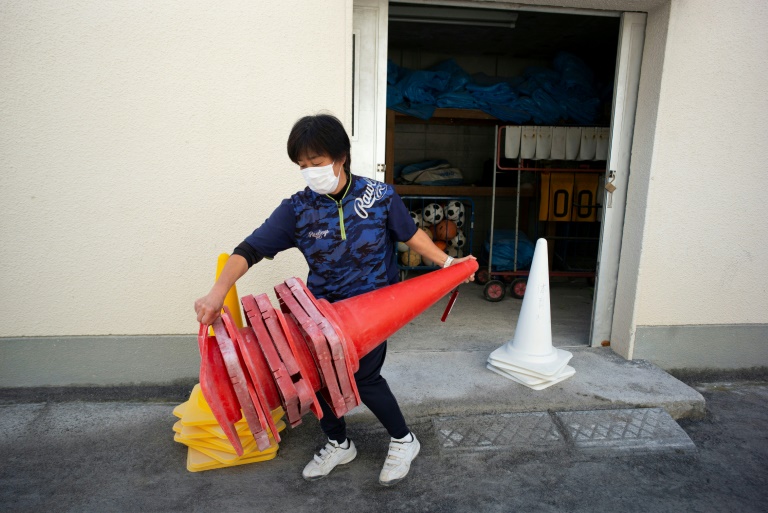
Kudo’s taxing schedule was far from an exception in Japan, where teachers work some of the longest hours in the world, saddled with tasks from cleaning and supervising school commutes to after-school clubs.

A 2018 OECD survey found Japanese middle school teachers work 56 hours a week, versus an average 38 hours in most developed countries.

But that still fails to account for astonishing amounts of overtime.

One probe by a union-affiliated think tank showed school teachers work an average 123 hours of overtime each month, pushing their weekly workload well beyond the so-called “karoshi line” of 80 hours.

Teachers say they are reaching the breaking point, and some have challenged the culture through lawsuits. This year, Japan’s ruling party established a task force to study the issue.

That came too late for Kudo, a middle school teacher, who died of a brain haemorrhage aged 40 in 2007.

At his funeral, stunned students told his wife Sachiko that the lively physical education teacher was the “furthest imaginable person from death”.

“He just loved working with kids,” Sachiko, 55, told AFP.

But in his final weeks, he was struggling with his hours.

“Towards the end, he was telling me that teachers should stop working like this and that he wanted to lead that change in the future,” his widow said.

– ‘Kiss your weekends goodbye’ –

Japanese authorities have ordered steps including outsourcing and digitalising some tasks.

“Our measures to reform work conditions for teachers are making steady progress,” education minister Keiko Nagaoka told parliament in October.

But she acknowledged that many “continue to work long hours” and “efforts need to be accelerated”.

Education ministry data shows a gradual decline in overtime, but experts see little fundamental change.

From reams of paperwork to tasks like lunch distribution, leading daily cleaning sessions with students and monitoring children on their way to and from school, teachers in Japan “have in a way become handymen”, school management consultant Masatoshi Senoo said.

“What should really be the responsibility of parents sometimes spills over onto teachers, who can even be sent to apologise to local residents when students misbehave at parks or convenience stores,” he said.

One of the most all-consuming tasks is the supervision of student sports and cultural “club” activities, typically conducted after school and on weekends.

“Being assigned as primary supervisor of one of these clubs usually means you have to kiss your weekends goodbye,” said Takeshi Nishimoto, a high school history teacher in Osaka. 

In June, Nishimoto, 34, won a rare lawsuit seeking compensation for stress from overwork.

He filed the suit after coming close to a nervous breakdown in 2017, when the then-rugby club supervisor worked 144 hours of overtime in a single month.

– ‘Sacred job’ –

Experts say teachers are particularly vulnerable to overwork because of a decades-old law that essentially prevents them from being paid for overtime.

Instead, the law adds eight hours’ worth of extra pay to their monthly salaries, a framework that Nishimoto says results in “making teachers work without limits for fixed pay”.

Masako Shimonomura, a middle school physical education teacher in Tokyo’s Edogawa district, says it can feel hard to take a proper break in her day.

“Not everything about this job is ‘black’ though,” she said, using a Japanese term for exploitative labour.

“There are some moments I live for, like watching students in my softball club shine and smile at tournaments,” said the 56-year-old, whose desk is covered with stacks of files and documents.

But she fears that if conditions don’t improve, “the image of our profession as ‘black’ will dominate for younger generations”.

An investigation by the Mainichi newspaper revealed that in the decade to 2016, there were 63 public school teacher deaths classified as caused by overwork.

But it took Kudo’s widow five years to get her husband’s death recognised as karoshi, a task complicated by the lack of records for his work hours.

She says teaching is often seen as a “sacred job” devoted to children, so anything viewed as selfish — including taking note of hours worked — can be frowned upon.

“So many teachers regret that they lived their lives without stopping to enjoy the growth of their own children,” she said.

A former schoolteacher herself, Sachiko now heads an anti-karoshi group in central Japan.

“I feel like my husband and I are working together to follow through on his last words — that he wants to change the working practices of teachers”.  

Twitter suspends accounts of journalists covering Musk

Twitter suspended Thursday the accounts of more than a half-dozen journalists who had been writing about the company and its new owner Elon Musk.

Some of the journalists had been tweeting about Twitter shutting down an @ElonJet account that tracked flights of the billionaire’s private jet and about versions of that account hosted at other social networks.

Twitter did not say why the reporters’ accounts were suspended.

“Nothing says free speech like suspending journalists who cover you,” Sarah Reese Jones of news commentary website PoliticusUSA said in a tweeted response to posts about the suspensions.

Checks at Twitter showed account suspensions included reporters from CNN, The New York Times, and The Washington Post as well as independent journalists.

An account for Twitter rival Mastodon was also suspended, according to a report by NBCNews.

Musk on Wednesday tweeted that a car in Los Angeles carrying one of his children was followed by “a crazy stalker” and seemed to blame the tracking of his jet for this alleged incident. In the tweet, he said legal action is being taken against the person who ran ElonJet.

The Twitter account that tracked flights of Musk’s private jet was shut down Wednesday despite the billionaire’s statement that he is a free speech absolutist.

“Well it appears @ElonJet is suspended,” creator Jack Sweeney tweeted from his personal @JxckSweeney account, which was subsequently suspended as well.

Twitter later sent out word that it updated its policy to prohibit tweets, in most cases, from giving away someone’s location in real time.

“Any account doxxing real-time location info of anyone will be suspended, as it is a physical safety violation,” Musk said in a tweet.

“This includes posting links to sites with real-time location info.”

Doxxing refers to revealing identifying information such as home address or phone number online, typically to target someone for abuse.

Tweets sharing a person’s location that are “not same-day” are allowed under the tweaked policy, as are posts about being at a public event such as a concert, Twitter said.

Sweeney attracted attention with his Twitter account that tracks the movements of Musk’s plane and even rejected Musk’s offer of $5,000 to shut down @ElonJet, which had hundreds of thousands of followers.

Musk had gone public saying he would not touch the account after buying Twitter in a $44 billion deal as part of his commitment to free speech at the platform.

Flight-following websites and several Twitter accounts offer real-time views of air traffic, but that exposure draws pushback ranging from complaints to equipment seizures.

US rules require planes in designated areas be equipped with ADS-B technology that broadcasts aircraft positions using signals that relatively simple devices can pick up.

Google rivals join forces in online maps

Google rivals on Thursday unveiled a project to make freely available data sets for map features to be built into online offerings.

Alphabet-owned Google dominates online mapping, selling its services to other companies or platforms and using location and navigation capabilities to enhance its other offerings, including online advertising.

Meta, Microsoft, TomTom and Amazon Web Services have now introduced what they call the Overture Maps Foundation, the goal of which is to make comprehensive mapping data openly available for use by whoever may need it, the nonprofit Linux Foundation said in a release.

“Mapping the physical environment and every community in the world, even as they grow and change, is a massively complex challenge that no one organization can manage,” said Linux Foundation executive director Jim Zemlin.

“Industry needs to come together to do this for the benefit of all.”

Google was notably absent from the list of companies teaming up in Overture, which said its goal is to expand membership to speed up progress.

The coalition expected to release its first mapping datasets by the middle of next year.

“Immersive experiences, which understand and blend into your physical environment, are critical to the embodied internet of the future,” Maps at Meta engineering director Jan Erik Solem said in the release.

“By delivering interoperable open map data, Overture provides the foundation for an open metaverse built by creators, developers, and businesses alike.”

Map data already underlies applications for search, navigation, logistics, games, autonomous driving and more, according to the Linux Foundation.

Overture map data will be open source, meaning developers are free to not only use it but to build on it, the Linux Foundation said.

Japan to approve major defence overhaul on China threats

Japan’s government is poised to approve a major defence policy overhaul Friday, including a significant spending hike, as it warns China poses the “greatest strategic challenge ever” to the country’s security.

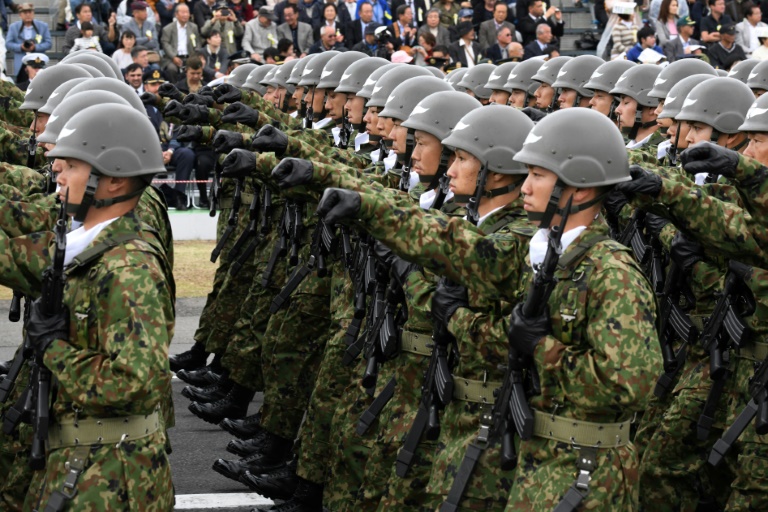
In its largest defence shake-up in decades, Japan is expected to up security spending to two percent of GDP by 2027, reshape its military command, and acquire new missiles that can strike far-flung enemy launch sites.

“Fundamentally strengthening our defence capabilities is the most urgent challenge in this severe security environment,” Prime Minister Fumio Kishida said last week.

Polls suggest Japan’s public largely backs the shift, worried by growing Chinese military power and geopolitical developments like the war in Ukraine.

But the changes could still be controversial as Japan’s post-World War II constitution does not officially recognise the military and limits it to nominally self-defensive capabilities.

The moves will be outlined in three defence and security documents the cabinet is set to approve later Friday.

They are expected to describe Beijing as “the greatest strategic challenge ever to securing the peace and stability of Japan” as well as a “serious concern” for Japan and the international community.

In response, the government plans to raise its defence spending to two percent of GDP by fiscal 2027, bringing Japan in line with NATO member guidelines.

That marks a significant increase from historic spending of around one percent and has sparked criticism over how it will be financed.

The money will fund projects including the acquisition of what Japan calls “counterstrike capacity” — the ability to hit launch sites that threaten the country.

The documents are expected to warn that Japan’s current missile interception systems are no longer sufficient and a “counterstrike capacity is necessary”.

– ‘Radically strengthen’ –

While Japanese governments have long suggested that counterstrikes to neutralise enemy attacks would be permissible under the constitution, there has been little appetite to secure the capacity.

That has shifted with the continued growth of Chinese military might and a record volley of North Korean missile launches in recent months, including over Japanese territory.

Still, in a nod to the sensitivity of the issue, the documents are likely to rule out preemptive strikes, and insist Japan is committed to “an exclusively defence-oriented policy”.

The counterstrike capacity will involve both upgrading existing Japanese weaponry but also buying US-made Tomahawk missiles, reportedly up to 500.

Other changes are expected to include the establishment of a permanent joint command for Japan’s armed forces as well as enhancement of the country’s coastguard.

Among the documents is the National Security Strategy, which is being updated for the first time since its 2013 launch.

Its language on relations with both China and Russia is expected to harden significantly.

The strategy document previously said Japan was seeking a “mutually beneficial strategic partnership” with Beijing, a phrase expected to disappear from this iteration.

And while the strategy once called for enhanced ties and cooperation with Russia, it is now expected to warn that Moscow’s military posturing in Asia and cooperation with China are “a strong security concern”.

Japan has joined Western allies in imposing sanctions on Moscow over its invasion of Ukraine, sending relations into a deep freeze.

The strategy contained in the documents represents a major evolution of Japan’s military posture, according to Chris Hughes, professor of international politics and Japanese studies at the University of Warwick.

“The Japanese government will depict these changes as necessary, moderate and wholly in line with previous defence posture,” he told AFP.

Still, “they are going to, in the words often used by the (ruling) Liberal Democratic Party itself in policy documents, ‘radically strengthen’ Japan’s military power,” added Hughes, author of the book “Japan as a Global Military Power”.

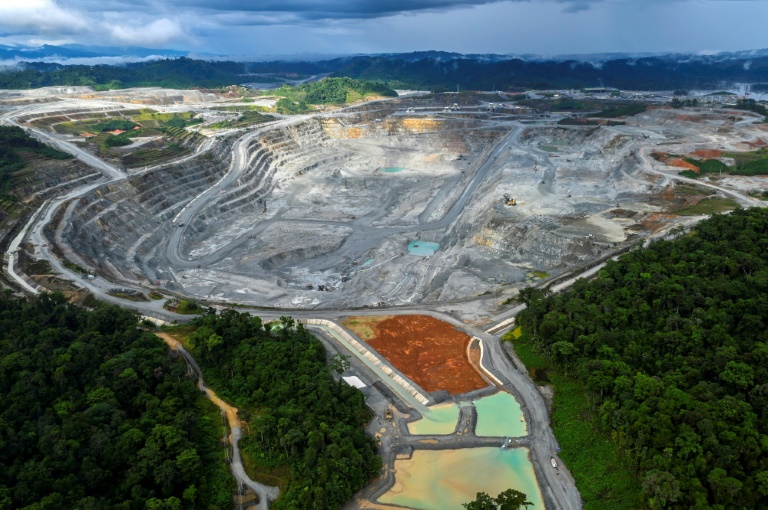
Panama shuts down huge copper mine in contract dispute

Panama ordered a halt Thursday to work at a copper pit that is the largest mine in Central America, after a deadline for a new contract with its Canadian operators expired.

President Laurentino Cortizo said he had ordered that only maintenance work continue at the huge mine operated by First Quantum Minerals.

This mining project is considered the largest private investment in Panama’s history, contributing four percent of its GDP and accounting for 75 percent of its export revenues.

Panama had given the company until Wednesday to agree to a new contract under which the amount it pays Panama for this mining concession would rise by a factor of 10, to $375 million a year.

Minera Panama, the local unit of First Quantum, “has not lived up to its commitment” to sign that new agreement, the president said.

“This is not acceptable for me as president, nor for the government, nor for the people of Panama,” Cortizo said in a televised speech.

First Quantum’s manager in Panama, Keith Green, who is Scottish, did not immediately respond to the announcement.

First Quantum, one of the largest copper miners in the world, began commercial copper production at the site in Donoso in 2019, through Minera Panama.

It has spent $10 billion on earthworks, construction buildings to house more than 7,000 employees, the purchase of heavy machinery, a power plant, a port for deep-draft merchant ships, access roads, and re-forestation plans.

Cortizo in January announced plans to toughen the terms of the mining contract.

“Panama has the inalienable right to receive fair income from the extraction of its mineral resources, because the copper is Panamanian,” he said then.

The deposit, discovered in 1968, lies on the Caribbean coast, 240 kilometers (150 miles) by road from the capital Panama City.

The mine is the biggest in Central America, producing 300,000 tons of copper concentrate per year, according to Green.

A week ago Green told AFP, “we intend to reach an agreement, but negotiations are a bit deadlocked.”

The company ran into trouble in 2017 when Panama’s Supreme Court, acting on a suit filed by environmental groups, said the mining contract it had was unconstitutional.

'Progress destroying nature': Brazil dam fuels fears for river

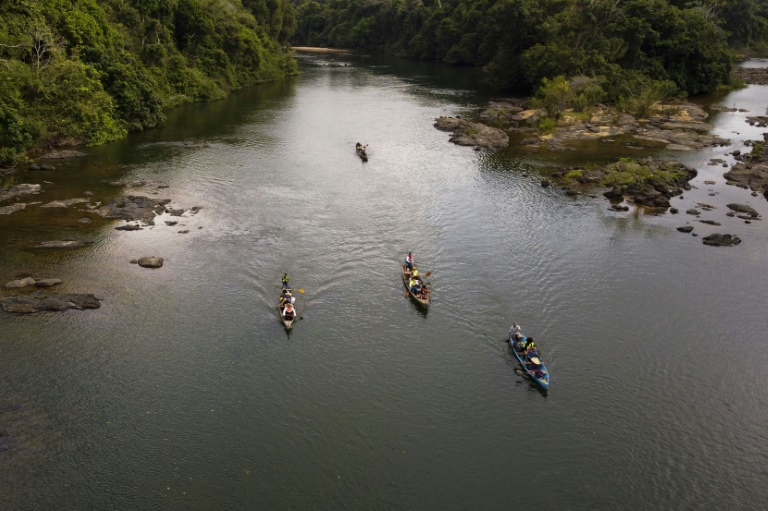
Holding a dead fish, Junior Pereira looks grimly at a puddle that used to be part of Brazil’s Xingu river, a mighty Amazon tributary that has been desiccated here by the massive Belo Monte hydroelectric dam.

Pereira, a member of the Pupekuri Indigenous group, chokes up talking about the impact of Belo Monte, the world’s fourth-biggest hydroelectric complex, which locals say is killing one of the most biodiverse regions on Earth and forcing them to abandon their way of life.

“Our culture is fishing, it’s the river. We’ve always lived on what the river provides,” says Pereira, 39, who looks like a man trapped between two worlds, wearing a traditional Indigenous necklace and a red baseball cap.

He gazes at the once-flooded landscape, which Belo Monte’s water diversion has made a patchwork of puddles dotted with stranded fish.

“We’ve lost our river,” he says.

“Now we have to buy food in the city.”

– ‘Like a permanent drought’ –

Stretching nearly 2,000 kilometers (1,250 miles), the Xingu ebbs and flows with the rainy season, creating vast “igapos,” or flooded forests, that are crucial to huge numbers of species.

They are also crucial to an estimated 25,000 Indigenous people and others who live along the river.

Belo Monte diverts a 100-kilometer stretch of the Xingu’s “Volta Grande,” or Big Bend, in the northern county of Altamira to power a hydroelectric dam with a capacity of 11,233 megawatts — 6.2 percent of the total electricity capacity of Latin America’s biggest economy.

Built for an estimated 40 billion reais ($7.5 billion) and inaugurated in 2016, the dam diverts up to 80 percent of the river’s water, which scientists, environmentalists and residents say is disastrous for this unique ecosystem.

“The dam broke the river’s flood pulse. Upstream, it’s like it’s always flooded. Downstream, it’s like a permanent drought,” says Andre Oliveira Sawakuchi, a geoscientist at the University of Sao Paulo.

That is devastating fish and turtle populations whose feeding and reproduction cycles depend on the igapos, he says.

Sitting by the Xingu’s breathtaking Jericoa waterfalls, which the Juruna people consider sacred, Indigenous leader Giliarde Juruna describes the situation as a clash of worldviews.

“Progress for us is having the forest, the animals, the rivers the way God made them. The progress white people believe in is totally different,” says Juruna, 40.

“They think they’re doing good with this project, but they’re destroying nature and hurting people, including themselves.”

– Lula under scrutiny –

Proposed in the 1970s, Belo Monte was authorized under ex-president Luiz Inacio Lula da Silva (2003-2010) — who just won a new term in Brazil’s October elections.

As Lula, 77, prepares to take office again on January 1, the project is drawing fresh scrutiny from those hoping the veteran leftist will fulfill his promise to do a better job protecting the Amazon than outgoing President Jair Bolsonaro, who presided over a surge in deforestation.

Touted as a clean-energy source and engine of economic development, Belo Monte has not exactly lived up to expectations.

According to the company that operates it, Norte Energia, the dam’s average output this year has been 4,212 megawatts — less than half its capacity.

A recent study meanwhile found its operations tripled the region’s greenhouse gas emissions — mainly methane released by decomposing forest that was killed by the flooding of the dam reservoir.

– A new plan –

In 2015, researchers from the Socio-Environmental Institute (ISA) conservation group teamed up with the Juruna to document the devastation.

They have devised a new, less-disruptive way for Belo Monte to manage water, the “Piracema” plan — named for the period when fish swim upriver to spawn.

Researchers say the plan is a relatively small tweak to the dam’s current water usage, adapting it to the natural flood cycles. 

Brazil’s environmental regulator is due to rule soon whether to order Norte Energia to adopt it.

The company declined to comment on the proposal, saying in a statement to AFP that it instead “recognizes the plan established in the plant’s environmental licensing.”

The decision is vital, says biologist Camila Ribas of the federal government’s National Institute for Amazon Research.

“When you completely alter the flood cycle, forests die,” she says.

“These are incredibly intricate, interlinked systems. If Belo Monte and other hydroelectric projects disrupt them too much, it could spell the end of the Amazon.”

Close Bitnami banner
Bitnami