World

Deadly Russian shelling cuts Kherson power

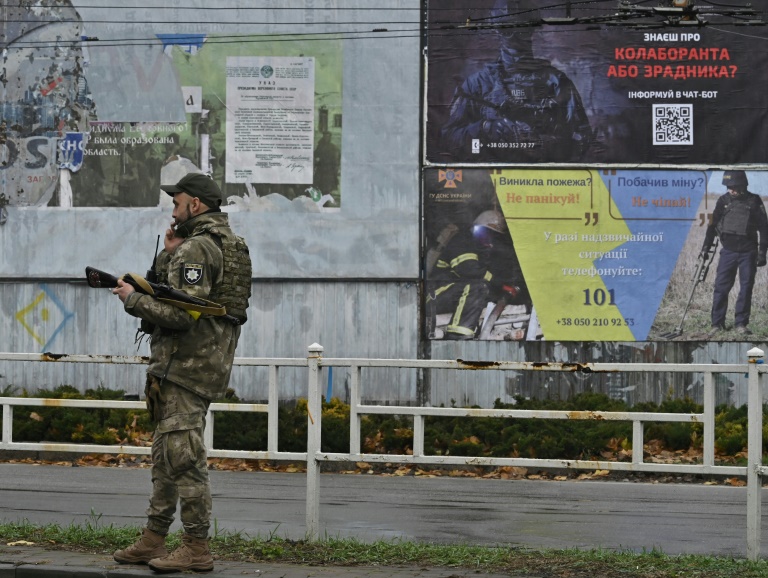
Russian shelling on Thursday killed two people in Kherson and left the southern city “completely without power”, Ukrainian officials said after the latest strikes on infrastructure as temperatures have plummeted.

Russia’s humiliating retreat from the city prompted joy for war-battered Ukrainians, but Kherson remains within the reach of Moscow’s weaponry and thus under constant threat.

The deadly toll of the invasion has grown steadily since Russia’s attack in February, and the UN rights chief said Moscow’s forces summarily killed hundreds of civilians in just the first weeks. 

Thursday’s strikes on Kherson killed two people, the deputy head of the president’s office Kyrylo Tymoshenko said. 

The city that was the only regional capital held by Moscow was also left “completely without power”, the regional governor Yaroslav Yanushevych said. 

Since being retaken by Kyiv, Kherson has seen an almost daily barrage of missiles, prompting local authorities to encourage evacuations. 

“Unfortunately, constant shelling prevents (Kherson city) from fully restoring normal life,” Ukraine’s ministry responsible for reintegrating recaptured territory Iryna Vereshchuk was cited as saying by the ministry.

Around 11,000 people have left Kherson since it was recaptured, Vereshchuk said.

– Explosions in Donetsk –

The strikes on infrastructure, leaving millions of Ukrainians without power, heating or water have become a regular strategy from Russia facing a tense situation on the ground.

Having retreated from parts of southern Ukraine, Moscow’s forces were engaged in fierce battles in the east, particularly in the Donetsk region.

In Donetsk, “the epicentre of the fighting remains the Bakhmut and Avdiivka directions,” deputy defence minister Ganna Malyar said during a briefing. 

Ukrainian soldiers speaking to AFP in the area acknowledged that “the enemy is hard to beat.”

“Staying on the frontline is very difficult. They sustain heavy losses, but so do we,” military unit chief Petro told AFP.

The Donetsk region has since 2014 been partly controlled by Moscow-backed separatists. 

On Thursday, separatist authorities reported “the most massive shelling since 2014” on the administrative centre of the region, also called Donetsk.

At least one person was killed and nine more injured in the strikes, Russian proxies said.

Along with Lugansk, Zaporizhzhia and Kherson, Donetsk is one of the regions Moscow claims to have annexed in votes denounced as a sham by Ukraine and the West. 

– Summary killings –

Regarding summary killings, UN rights chief Volker Turk said his office had documented the summary executions and direct killings of 441 civilians across just three regions of Ukraine from the time Russia’s full-scale invasion began on February 24 until April 6.

Noting that the “actual figures are likely to be considerably higher” he said “there are strong indications that the executions… may constitute the war crime of wilful killing.”

Beyond the period examined by the report, Turk said his team had continued to document ongoing gross violations affecting both civilians and combatants in the conflict, including arbitrary detention, enforced disappearances, torture and sexual violence.

But so far, he warned, “accountability remains sorely lacking.”
Macron defends World Cup trip amid Qatar graft scandal

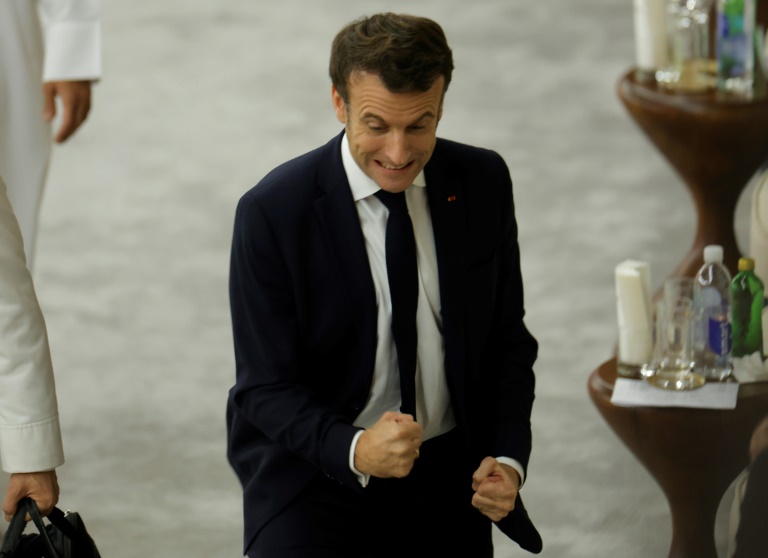
President Emmanuel Macron on Thursday stood by his decision to travel to Qatar to support France’s World Cup team, despite allegations linking the Gulf monarchy to corruption in the European Parliament.

Macron watched France’s semi-final victory over Morocco before flying to Brussels overnight to attend an EU summit.

Belgian police investigating allegations that Qatar has been paying bribes to European politicians have arrested an MEP and three associates and charged them with corruption. 

Qatar denies any wrongdoing.

“I’m totally comfortable with it,” Macron told reporters in Brussels who asked about the trip. “Four years ago I backed the French team in Russia, and I’m backing them in Qatar.”

Macron plans to return to Doha on Sunday to watch France play Argentina in the World Cup final.

Ahead of the tournament, Qatar’s labour laws and treatment of migrant labourers came under scrutiny as well as the number of deaths on World Cup-linked building sites. 

That led to calls to boycott the competition in France, including from French football legend Eric Cantona. Cities such as Paris said they would not show matches on public screens. 

“There was a lot of discussion with people saying ‘I’m not going to follow it, I’ll boycott it on television’, but the figures are there,” Macron said.

TV viewing figures showed more than 20 million people in France watched Les Bleus beat Morocco 2-0 on Wednesday night, almost a third of the population.

Macron’s trip to Qatar, which saw him sit in the VIP enclosure and then join the victorious team in the dressing room afterwards, drew criticism from his domestic opponents.

Some seized on his praise for Qatar after the game, when he said the Gulf monarchy was organising the cup “very well”.

“The compliments for Qatar at the same time as a serious case of corruption has exploded in Europe’s institutions seem to me to be particularly inappropriate,” far-right leader Marine Le Pen said.

– Politics in sport –

Leading French Greens party MP Sandrine Rousseau said she was shocked not by Macron’s presence in Qatar but “by the fact that he has never had the slightest critical thing to say about this World Cup.”

Left-wing MP Mathilde Panot called it “indecent that Emmanuel Macron and his government give their approval for this World Cup”.

The 44-year-old head of state had argued that “we must not politicise sport” before the competition.

France’s Sports Minister Amelie Oudea-Castera wore a sweater with rainbow-coloured sleeves to France’s quarter-final game on Saturday in a message of support for gay rights. 

The European Parliament, whose president Roberta Metsola declared the alleged bribes to MEPs as an attack on Europe’s democracy, will vote on a motion Thursday that could bar Qatari lobbyists from its premises.

Belgian police seized 1.5 million euros in cash last week and arrested a senior MEP and former European Parliament vice president, Eva Kaili.

vl-are-jed-lum/dc-adp/js/jj

ECB slows rate hike pace but warns of 'long game' to tame inflation

The European Central Bank opted for a smaller interest rate increase of half a percentage point on Thursday but warned of more hikes to come in the “long game” to tame red-hot inflation.

The ECB has been lifting borrowing rates at an unprecedented pace in recent months to bring down record-high consumer prices after Russia’s war in Ukraine sent energy and food costs surging.

Following two consecutive “jumbo” hikes of 75 basis points, the ECB’s governing council agreed to downshift to an increase of 50 basis points at its final meeting of 2022.

The move mirrors the half-point steps taken by the US Federal Reserve on Wednesday, and the Bank of England earlier on Thursday.

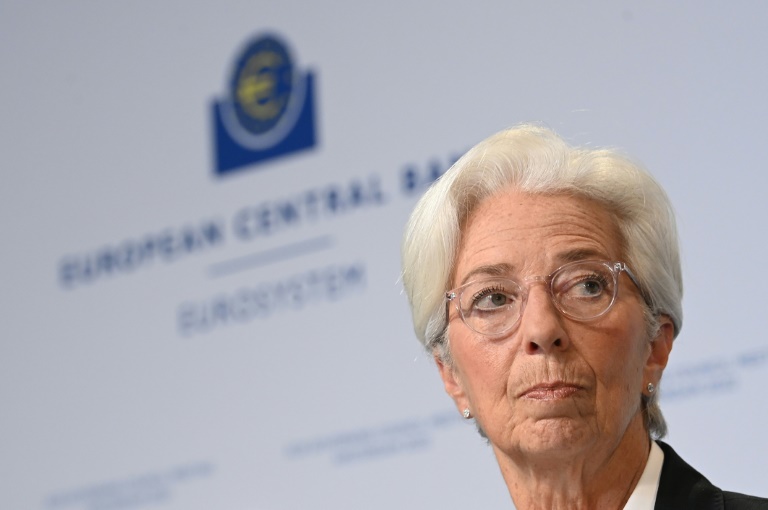
But ECB president Christine Lagarde warned that inflation in the 19-nation eurozone was still “far too high” and more action needed to be taken. 

“We have more ground to cover, we have longer to go and we are in for a long game,” Lagarde told reporters. 

Interest rates will still have to “rise significantly at a steady pace,” she said, adding that the eurozone should expect further rises “at 50 basis-point pace for a period of time”.

Eurozone inflation eased in November for the first time in 17 months, partly thanks to efforts by European governments to shield consumers from energy price shocks.

At 10 percent however, inflation remains five times higher than the ECB’s target.

ING bank economist Carsten Brzeski said the ECB’s comments were “surprisingly hawkish”.

The ECB’s closely-watched bank deposit rate — one of its three main rates — will now finish the year at 2.0 percent, the highest level since 2008.

– ‘Short-lived and shallow’ –

“The ECB is now more worried about tightening too little and would accept some short-term economic pain to bring inflation back to target,” said Berenberg Bank economist Salomon Fiedler.

Like other central banks, the ECB is walking a fine line as it seeks to raise borrowing costs enough to cool inflation without dampening demand so much it triggers a deep economic downturn.

The ECB’s latest quarterly projections on Thursday showed that the eurozone economy was expected to contract in the final quarter of 2022 and the first quarter of 2023.

But the ECB said the winter recession would likely be “relatively short-lived and shallow”, echoing analysts’ expectations as households and businesses feel the impact of government interventions and gas storage facilities are fuller than usual at this time of year.

The ECB however slashed its outlook for economic growth in 2023, from 0.9 percent previously to 0.5 percent. Stronger growth of 1.9 percent should then be achieved for 2024, it said. 

“The war against Ukraine and its people remains a significant downside risk to the economy,” Lagarde cautioned.

The Frankfurt institution also unveiled its first-ever inflation projection for 2025, set to come in at 2.3 percent.

While still above the ECB’s two-percent target, it’s a far cry from the 6.3 percent inflation projected in 2023, followed by 3.4 percent in 2024. 

Both are higher figures than previously forecast.

Lagarde acknowledged the “substantial upward revision” on inflation, the latest in a long line as the ECB faces criticism for having consistently underestimated price pressures in recent months.

Lagarde added that the bank was keeping a close eye on wage growth, as workers demand salary increases to keep up with higher prices for goods and services.

The ECB sees wages growing “at rates well above historical averages, and pushing up inflation”, Lagarde said.

– Bloated portfolio –

The ECB also opened up another front in its battle against high inflation, outlining for the first time when and how it plans to start slimming down its five-trillion-euro bond portfolio after years of hoovering up corporate and government debt.

The bank said it would stop reinvesting the proceeds from some maturing bonds from March, reducing its balance sheet by 15 billion euros per month on average though June.

Further details of the “quantitative tightening” plan will be announced in February.

US industrial output slips in November

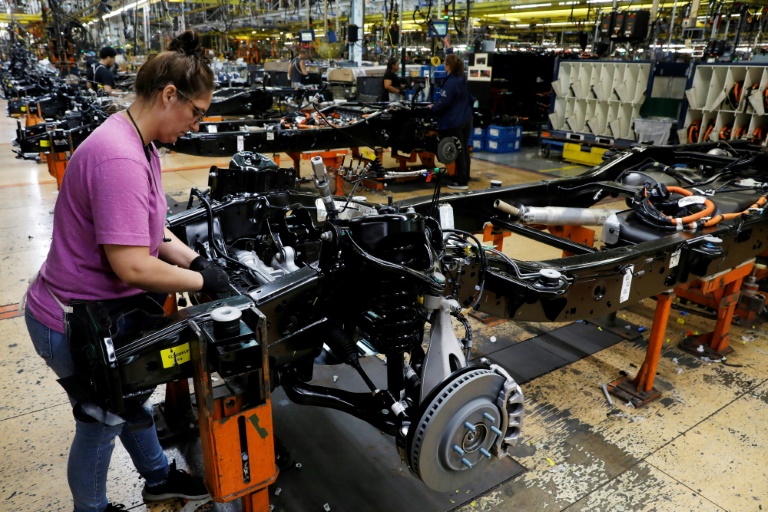
Industrial production in the US slumped in November with “broad based” decreases, the Federal Reserve said Thursday, as output for bigger-ticket consumer products and manufacturing fell.

While tangled supply chains and surging costs which weighed on businesses are easing, in a boost to production, firms are now contending with weakening demand as interest rates rise.

The Fed has raised its benchmark lending rate seven times this year in an effort to cool the world’s biggest economy, making borrowing more expensive with policy effects rippling across sectors.

Total output dropped 0.2 percent in November, with the first decline in months defying analysts’ expectations of an uptick, according to Fed data.

“Decreases were broad based across market groups,” the report said.

It added that the output of consumer durables fell about two percent, referring to products that do not have to be purchased very often. The decline was led by automotive goods.

Manufacturing output dropped 0.6 percent as well, while that of mining fell 0.7 percent, only partly offset by a rebound in utilities, the Fed added.

“Headline production was flattered by a weather-related 4.8 percent jump in utilities output, which is hugely volatile,” said economist Kieran Clancy of Pantheon Macroeconomics in a note.

The main factor bogging down manufacturing output is likely “softening capital spending, in the wake of higher borrowing costs,” he added.

“The next few months will be rough; the downturn in manufacturing output has further to run,” he said.

Last French troops leave Central African Republic

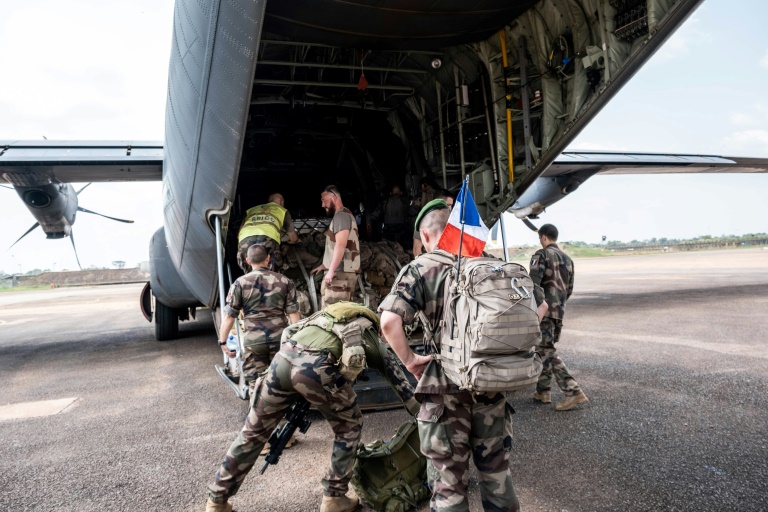
The last French troops deployed in the Central African Republic left on Thursday following a chill in relations caused by closer ties between Bangui and Moscow, an AFP reporter saw.

Forty-seven troops from a logistical support unit left Bangui airport aboard a C-130 transporter aircraft, becoming the last of a 130-person French contingent to leave the troubled country.

France, the former colonial power, dispatched up to 1,600 troops to help stabilise the country after a coup in 2013 unleashed a civil war along sectarian lines. 

The operation, named Sangaris, was France’s seventh military intervention in the CAR since the country gained independence in 1960.

It wound up in October 2016 after elections, leaving a residual French contingent.

Over the last few years, friction has grown between France and CAR over a mounting Russian military presence.

In 2018 Moscow sent instructors to the country, and in 2020 followed this with hundreds of paramilitaries to help President Faustin Archange Touadera defeat rebels advancing on the capital.

France, the UN and others say they are mercenaries from the Kremlin-backed Wagner group, who have been linked with atrocities and looting of resources.

Paris last year decided to suspend military cooperation, deeming Bangui complicit in an anti-French campaign allegedly steered by Russia.

“France decided that the conditions were no longer appropriate for us to continue working for the benefit of the Central African armed forces,” General Francois-Xavier Mabin, the commander of the MISLOG logistical force, told AFP.

French troops stationed at Bangui airport’s M’Poko base had been providing logistical support for the European Union Training Mission and a contingent of the UN peacekeeping mission in the Central African Republic (MINUSCA).

– Deadly fighting –

“It is with great regret that we note this unilateral withdrawal,” said Fidele Gouandjika, special adviser to President Touadera.

“Today we have a battle-hardened army — thank you, France, which has been training and equipping it for 62 years,” he said, adding: “Now we are going to do (it) with Wagner.”

Roland Marchal, a researcher at the Sciences Po school in Paris, called the French pullout a “very strong sign of discontent.”

But “from a military point of view, it won’t change much because the scope of the mission became more and more restricted,” he said.

Earlier this year Paris withdrew the last of its troops from former colony Mali.

They had been deployed since 2013 to help the country fight a jihadist insurgency.

Relations between France and Mali plummeted after the military seized power in Bamako in August 2020 and eventually brought in Russian paramilitaries.

CAR ranks among the poorest and most unstable countries in the world, and continues to bear the scars of the traumatic war. 

Violence has fallen back in intensity since 2018 although swathes of territory lie in the hands of rebel groups and civilians continue to pay a high price.

EU faces subsidy race with US in trade spat

EU leaders debated how to protect their industries from subsidised American competition, amid fears of a state spending race between the economic superpowers.

Arriving at an EU summit, French President Emmanuel Macron said a response was needed “to maintain fair competition”, one which “allows us to match what the Americans are doing”.

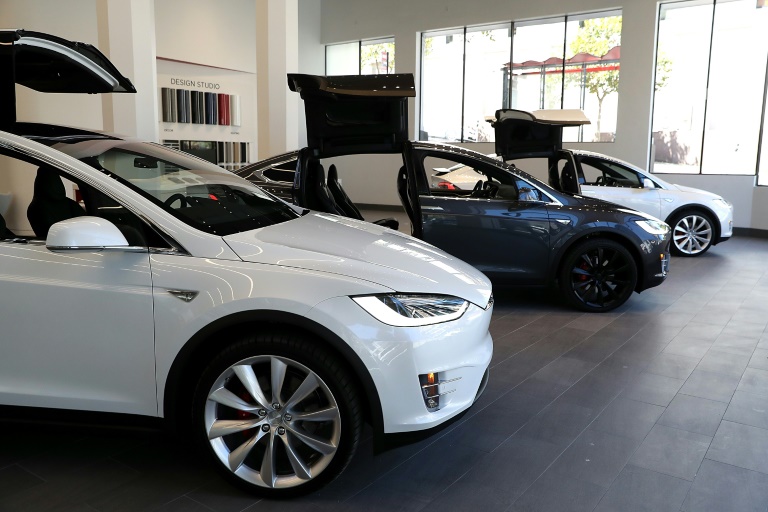
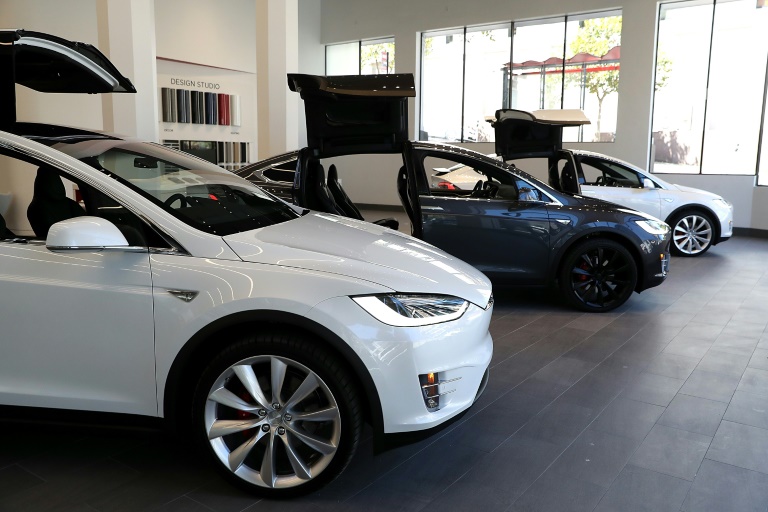
The European bloc is unsettled by parts of a multi-billion-dollar US Inflation Reduction Act (IRA) that lavishes subsidies and tax cuts for US purchasers of electric vehicles — if they “Buy American”.

The European Commission sees that as discriminatory against European car manufacturers, a breach of World Trade Organization rules, and a threat to investment in Europe.

It is urging EU leaders to sign off on a plan that would loosen state aid rules and boost public investment in cleaner energy.

In the summit room, leaders stressed “the strategic and deep ties between the EU and US across the full breadth of the relationship,” an EU official said.

But they agreed on the need “to safeguard Europe’s economic, industrial and technological base”.

They directed the European Commission to develop proposals next month “on mobilising relevant national and EU tools and improving conditions for investment”.

– ‘Delicate’ phase –

The commission was also told to come up with ways to boost competitiveness and productivity.

Commission chief Ursula von der Leyen said before the summit that such measures were needed because the IRA provisions “risk un-levelling the playing field and discriminating against European companies”.

Her Vice President Margrethe Vestager has warned: “We already have war in Europe (in Ukraine). The last thing we need is a trade war on top.”

Macron and the commission have tried to persuade US President Joe Biden to change the contentious parts of the IRA, to no avail apart from receiving promises of some “tweaks”. 

Biden and his administration believe the EU is free to come up with its own subsidy arrangement for electric vehicles — a sector in which China has outsized advantages when it comes to batteries and rare-earth supplies.  

There were some concerns among EU countries that the bloc’s main car-exporting nation, Germany, might go it alone with its own subsidies, as it already did with measures on energy.

European Council President Charles Michel, chairing the summit, said as he went in that economic ties between the United States and the EU were in a “delicate” phase.

– Migrant dispute –

The EU summit was also to study an internal dispute, between Austria and Bulgaria, over migrants.

Austria is blocking Bulgaria’s bid to join the border check-free Schengen zone encompassing most EU members and a couple of neighbouring countries. 

Vienna fears Bulgaria’s inclusion would further spur irregular migration onto Austrian territory. 

“We have more than 100,000 asylum applications in Austria, more than 75,000 of those who make these applications are not registered,” Austrian Chancellor Karl Nehammer said.

That “security problem” had to be solved before Bulgaria — and the linked bid by Romania — could be allowed into the Schengen club, he said. 

“They are countries that should protect the external border,” Nehammer said.

Bulgaria’s President Rumen Radev said as he went into the summit that his country was “highly committed to secure our border” but needed EU help.

“We request Bulgaria to be treated as a solid country,” he said. “Please don’t leave us alone.”

EU faces subsidy race with US in trade spat

EU leaders debated how to protect their industries from subsidised American competition, amid fears of a state spending race between the economic superpowers.

Arriving at an EU summit, French President Emmanuel Macron said a response was needed “to maintain fair competition”, one which “allows us to match what the Americans are doing”.

The European bloc is unsettled by parts of a multi-billion-dollar US Inflation Reduction Act (IRA) that lavishes subsidies and tax cuts for US purchasers of electric vehicles — if they “Buy American”.

The European Commission sees that as discriminatory against European car manufacturers, a breach of World Trade Organization rules, and a threat to investment in Europe.

It is urging EU leaders to sign off on a plan that would loosen state aid rules and boost public investment in cleaner energy.

In the summit room, leaders stressed “the strategic and deep ties between the EU and US across the full breadth of the relationship,” an EU official said.

But they agreed on the need “to safeguard Europe’s economic, industrial and technological base”.

They directed the European Commission to develop proposals next month “on mobilising relevant national and EU tools and improving conditions for investment”.

– ‘Delicate’ phase –

The commission was also told to come up with ways to boost competitiveness and productivity.

Commission chief Ursula von der Leyen said before the summit that such measures were needed because the IRA provisions “risk un-levelling the playing field and discriminating against European companies”.

Her Vice President Margrethe Vestager has warned: “We already have war in Europe (in Ukraine). The last thing we need is a trade war on top.”

Macron and the commission have tried to persuade US President Joe Biden to change the contentious parts of the IRA, to no avail apart from receiving promises of some “tweaks”. 

Biden and his administration believe the EU is free to come up with its own subsidy arrangement for electric vehicles — a sector in which China has outsized advantages when it comes to batteries and rare-earth supplies.  

There were some concerns among EU countries that the bloc’s main car-exporting nation, Germany, might go it alone with its own subsidies, as it already did with measures on energy.

European Council President Charles Michel, chairing the summit, said as he went in that economic ties between the United States and the EU were in a “delicate” phase.

– Migrant dispute –

The EU summit was also to study an internal dispute, between Austria and Bulgaria, over migrants.

Austria is blocking Bulgaria’s bid to join the border check-free Schengen zone encompassing most EU members and a couple of neighbouring countries. 

Vienna fears Bulgaria’s inclusion would further spur irregular migration onto Austrian territory. 

“We have more than 100,000 asylum applications in Austria, more than 75,000 of those who make these applications are not registered,” Austrian Chancellor Karl Nehammer said.

That “security problem” had to be solved before Bulgaria — and the linked bid by Romania — could be allowed into the Schengen club, he said. 

“They are countries that should protect the external border,” Nehammer said.

Bulgaria’s President Rumen Radev said as he went into the summit that his country was “highly committed to secure our border” but needed EU help.

“We request Bulgaria to be treated as a solid country,” he said. “Please don’t leave us alone.”

Equities sink as central banks hike rates further

Global stocks sank Thursday as central banks hiked interest rates again and signalled they needed to go higher to fight inflation.

Both the Bank of England and the European Central Bank mirrored the Fed’s half-point hike on Wednesday to tackle soaring inflation, after rate increases in Norway and Switzerland.

Sentiment was hammered after the Fed suggested that it saw US rates topping out next year at 5.1 percent, higher than markets had predicted. 

Meanwhile the BoE, which lifted its key rate to the highest level in 14 years, warned that labour market tightness and inflationary pressures justified “a further forceful monetary policy response”.

The ECB delivered a similar message.

“Inflation remains far too high and is projected to stay above the target for too long,” it said.

ECB president Christine Lagarde warned “we should expect to raise interest rates at a 50 basis-point pace for a period of time”.

Market analyst Patrick O’Hare at Briefing.com said “these policy moves were expected, but that still hasn’t helped matters given the understanding that higher rates will inevitably weigh on economic activity.” 

Wall Street opened with deeper losses than it posted on Wednesday following the Fed’s hikes. The Dow dropped 1.0 percent at the start of trading. 

The S&P 500 fell 1.2 and tech-heavy Nasdaq Composite 1.4 percent.

– Fresh recession fears –

In Europe, London shed 0.6 percent, while Frankfurt and Paris tumbled 2.4 percent.

The Fed also warned that the world’s biggest economy would grow less than expected next year, fuelling fresh recession fears.

Data released Thursday showing retail sales sliding by 0.6 percent in November from October, as well a drop in industrial output, fanned those fears.  

The BoE and ECB also had downbeat messages about growth.

Rising rates fan recession concerns because they push up loan repayments for consumers and companies, denting expenditure, investment and economic activity.

At the same time, however, the world’s major central banks are seeking to dampen red-hot inflation, which has been fuelled partly by fallout from Russia’s invasion of Ukraine.

Recent official data painted a picture of slowing inflation in Britain and the United States, although consumer prices remain elevated.

“The interest rate hikes keep on coming and this trend is almost certainly going to remain intact in early 2023,” noted AJ Bell investment director Russ Mould.

“Raising rates makes it more expensive for consumers and businesses to borrow money and theoretically causes a reduction in spending and investment which should help to ease the economy and bring down prices.

“This takes time to work its way through the system and so central banks will continue their rate hiking path until there is adequate evidence to support a shift in policy.”

Markets had rallied earlier this week after data showed the US consumer price index rose less than forecast in November, marking a fifth straight slowdown and the lowest level since December last year.

But the Fed appeared less inclined to accept that the recent figures were enough to indicate enough progress was being made.

“Fifty basis points is still a historically large increase, and we still have some ways to go,” Fed boss Jerome Powell told reporters after the announcement.

Oil prices slid on fears recession would dent crude demand.

– Key figures around 1430 GMT –

London – FTSE 100: DOWN 0.6 percent at 7,451.03 points

Frankfurt – DAX: DOWN 2.4 percent at 14,112.11

Paris – CAC 40: DOWN 2.4 percent at 6,566.64

EURO STOXX 50: DOWN 2.6 percent at 3,872.25

New York – Dow: DOWN 1.0 percent at 33,624.24

Tokyo – Nikkei 225: DOWN 0.4 percent at 28,051.70 (close)

Hong Kong – Hang Seng Index: DOWN 1.6 percent at 19,368.59 (close)

Shanghai – Composite: DOWN 0.3 percent at 3,168.65 (close)

Euro/dollar: UP at $1.0707 from $1.0684 on Wednesday

Dollar/yen: UP at 136.51 yen from 135.45 yen

Pound/dollar: DOWN at $1.2321 from $1.2424

Euro/pound: UP at 86.91 pence from 85.96 pence

Brent North Sea crude: DOWN 0.5 percent at $82.25 per barrel

West Texas Intermediate: DOWN 0.6 percent at $76.79 per barrel

burs-rl/jj

Swedish zoo shoots dead three chimps on the run

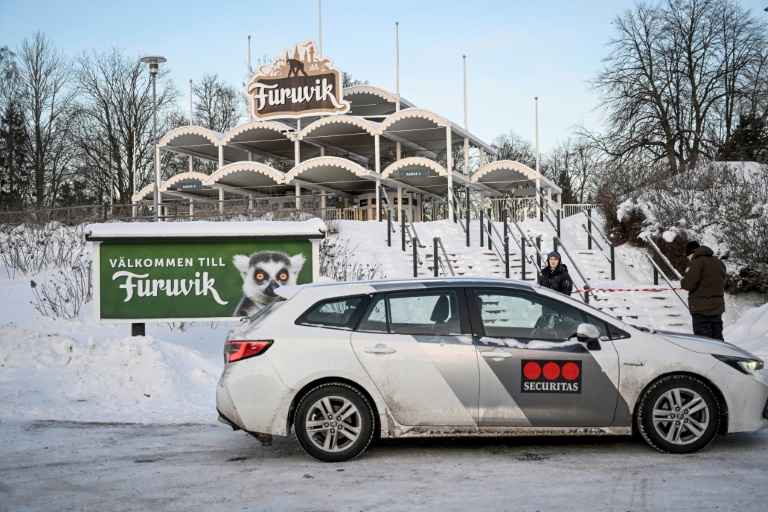
A Swedish zoo said Thursday it had to shoot dead three chimpanzees after they escaped from their enclosure, with the situation still not under control.

A fourth primate was injured by gunshot, according to the company that runs the Furuvik Zoo around 200 kilometres (125 miles) north of Stockholm.

“A chimpanzee is considered a high-risk animal. If this kind of animal gets out into the zoo, it can pose a threat to people’s lives”, Annika Troselius, a spokeswoman for Parks and Resorts, told AFP.

Five of the zoo’s seven chimps managed to escape from their enclosure on Wednesday shortly after noon (1100 GMT), and were roaming freely around the zoo.

It is not yet known how they escaped.

The zoo is currently closed to visitors for the season, but staff were either evacuated or ordered into safety indoors. 

The decision to shoot dead the chimps came in for harsh criticism on social media sites.

According to the zoo, tranquilising the animals “was not an alternative”.

“In order to fire an anaesthetic dart, you need to be very close to the animal. In addition, you have to wait up to 10 minutes for the tranquiliser to take effect”, the zoo said in a statement.

On Thursday afternoon, the zoo’s four surviving primates were in the monkey building but had not yet returned to their enclosure, Furuvik Zoo wrote in an update on Facebook.

“This means that we can’t let people move freely inside the zoo and we are still on high alert”, the zoo said.

The chimps’ escape comes on the heels of several other high-profile evasions in Sweden.

At the end of October, a king cobra slithered out of Stockholm’s open-air museum and animal park Skansen and was missing for about a week until it returned on its own.

A month later, two great grey owls escaped from the aviary at the same zoo but have since flown back.

ICC upholds conviction of Ugandan former child soldier

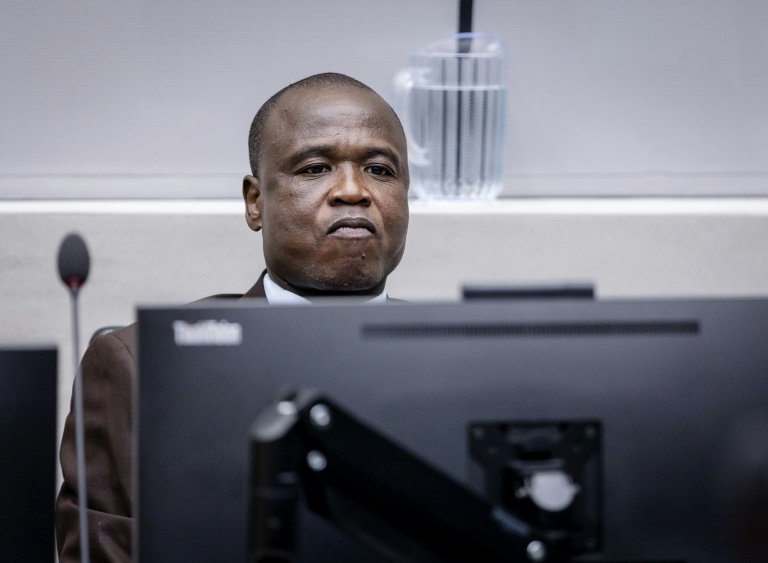
The International Criminal Court on Thursday threw out an appeal by Dominic Ongwen, a Ugandan child soldier-turned-commander in the Lord’s Resistance Army, against his conviction and 25-year sentence for war crimes.

Dominic Ongwen, who was himself abducted aged nine by the rebel group led by the fugitive Joseph Kony, was found guilty last year of murder, rape and sexual enslavement in northern Uganda during the early 2000s.

“The appeals chamber unanimously rejects all the grounds of appeal” against his conviction, said Judge Luz del Carmen Ibanez Carranza. One ground of appeal against his sentence was rejected by majority and the rest unanimously.

Dressed in a dark suit and tie, Ongwen briefly waved to the public gallery but otherwise remained impassive as he listened through headphones to the judgment.

Appeals judges said that although Ongwen had been kidnapped as a “defenceless child” it did not mitigate his guilt. They also rejected his arguments about mental illness, and said he had a key role in LRA atrocities as an adult.

The LRA was founded three decades ago by former Catholic altar boy and self-styled prophet Joseph Kony, who launched a bloody rebellion in northern Uganda against President Yoweri Museveni.

Defence lawyers argued earlier this year that Ongwen, who is believed to be in his mid-40s but whose birth date remains unclear, had been scarred by his own experience as a youth in the LRA.

“Dominic Ongwen was, and still is, a child,” Ongwen’s defence lawyer Krispus Ayena Odongo told the court in February, adding that Ongwen still believed he was “possessed” by the spirit of Kony.

ICC prosecutor Karim Khan said last month said he would ask judges to confirm charges against Kony despite his absence, as the rebel leader is still at large.

– ‘Scapegoat’ –

Ongwen surrendered to US special forces who were hunting Kony in the Central African Republic in early 2015 and he was transferred to the ICC to face trial.

The LRA’s bid to set up a state based on the Bible’s Ten Commandments killed more than 100,000 people and saw 60,000 children abducted, spreading to Sudan, the Democratic Republic of Congo and Central African Republic.

Ongwen, whose nom de guerre was “White Ant”, was found guilty on 61 charges of war crimes and crimes against humanity, which also included charges of himself turning young abductees into child soldiers.

Prosecutors portrayed Ongwen as leading a reign of terror by the LRA, personally ordering the massacres of more than 130 civilians at the Lukodi, Pajule, Odek and Abok refugee camps between 2002 and 2005.

Judges ruled that Ongwen had not suffered from mental illness despite his own history of being abducted on his way to school by the LRA, described by experts as one of Africa’s “most brutal militia forces”.

Ongwen’s lawyers had appealed the conviction on 90 different grounds and the sentence on 11, saying there were errors in “law, fact and procedure”.

“The trial was a proxy prosecution, a prosecution of the LRA using (Ongwen), a child soldier, as a scapegoat,” Krispus Ayena Odongo said in court papers.

Kony should be in the dock instead of Ongwen, since it was he who had decided on the distribution of women and children as sex slaves, he added.

“Kony remains unapprehended; he has escaped the tentacles of various states,” Odongo added.

Close Bitnami banner
Bitnami