World

Patriot missiles: crucial but limited help for Ukraine

The United States is expected to announce it will equip Ukraine with Patriot missile units, boosting its defenses against Russia’s assault on its infrastructure.

The move will also send a strong message to both Moscow and European allies that Washington is prepared to support Kyiv with some of its most advanced weaponry to battle Russian invaders.

Patriots are “far from a silver bullet,” against the low-flying cruise missiles and drone bombs that Russian forces have pummeled Ukraine with, according to Ian Williams of the Missile Defense Project at the Center for Strategic and International Studies in Washington.

But they will add a layer of protection on top of Ukraine’s current systems, and also defend against short-range ballistic missiles that Western officials think Russia is seeking from Iran, Williams said.

“Having layered defenses is helpful when you’re dealing with this kind of complex air attack,” he told AFP.

– What is the Patriot system? –

Made by Raytheon, the MIM-104 Patriot is a surface-to-air missile (SAM) system initially developed to intercept high-flying aircraft. It was modified in the 1980s to focus on the new threat of tactical ballistic missiles. Patriots proved themselves against Iraq’s Russian-made Scuds in the first Gulf War.

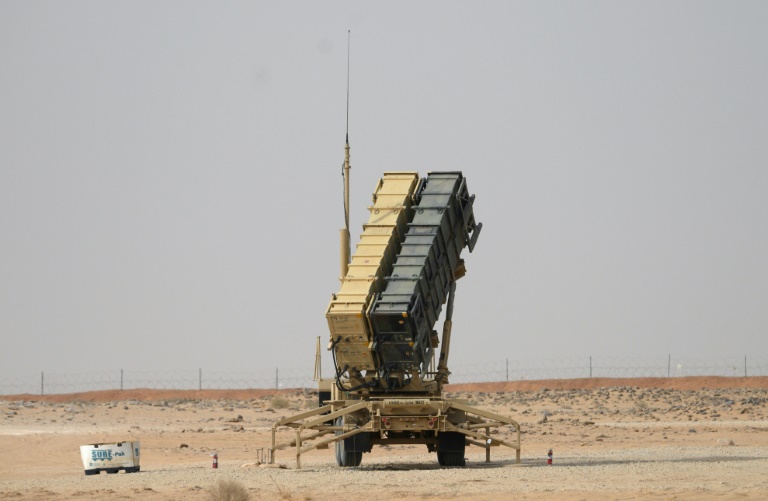
Patriot systems come in fully mobile batteries that include a command center, a radar station to detect incoming threats, and launchers.

The launchers can handle a pod of four PAC-2 missiles at a time, which have a 160 kilometer (100 mile) range, or 16 of the newer PAC-3, which have a range of 40 kilometers but greater precision with onboard radar.

– Why are Patriots needed? –

To battle Russia’s low-flying cruise missiles and bomb-like Shahed-136 drones, Ukraine has used a number of different short-range air defense systems, including Russian-made Buks and S-300s, old-generation US-made Hawk missiles,  and modern SAM systems from allies like Germany and Italy. 

The arrival of two US NASAM systems in October helped limit the damage from Russia’s massive November 17 barrage; they were reportedly 100 percent effective in hitting their incoming targets, said Williams.

But modern SAM system launchers and missiles are in extremely short supply. For example, the US can’t send any more NASAM systems until late next year. 

Meanwhile, Russia is expected to continue its air assault on Ukraine infrastructure.

Ukraine “needs capacity, they need volume” for air defense, said Williams.

The Patriot “allows them to layer their defenses a bit more.”

– What Patriots can do –

The Patriots’ biggest value is countering high-flying tactical ballistic missiles. Russia has not used many ballistic missiles in its war on Ukraine, but that could change if it does acquire them from Iran.

The Patriots have proven very effective in Saudi Arabia against Iranian-design ballistic missiles fired from Yemen.

Against cruise missiles and drones, Williams points out, Patriots have limited value because their radar systems only cover a 120 degree portion of the horizon, unlike the 360 degree coverage of NASAMs. 

“In the kind of environment we’re seeing in Ukraine, where threats can come in from multiple directions, you either have to have more radars or more batteries,” said Williams.

If the US gives Ukraine the longer-range PAC-2, he said, the likely target is the current cruise missile and drone threat. PAC-3s will indicate the focus is ballistic missiles.

The number of batteries the US will supply at first, he said, is likely to be just one or two. Training takes time, and US forces don’t have many if any spare systems. Washington might have to coax batteries from one of the 17 countries which have them. 

Then the question is where to put them: one battery could defend a city, or a power station, but not a broad swathe of territory.

“You have to decide what you’re going to defend. You have to prioritize. It’s not going to defend the whole country,” said Williams

Another limiting issue is the cost: an individual Patriot missile runs about $3 million, triple the price of a NASAM missile. 
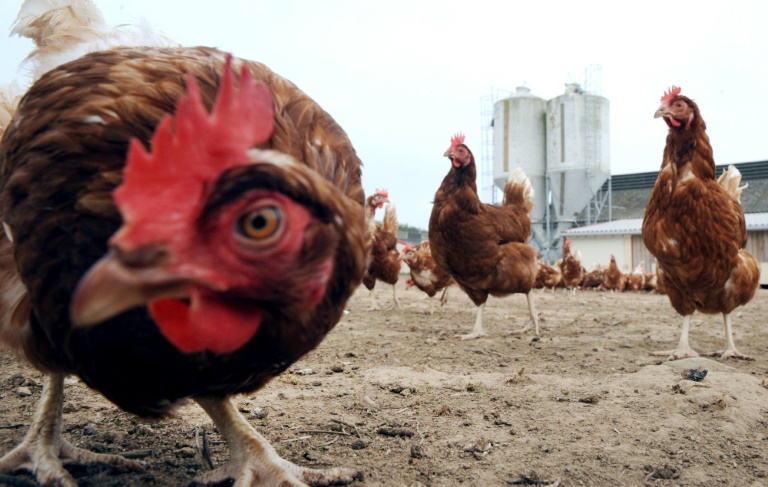
Israeli technology aims to curb male chick culling

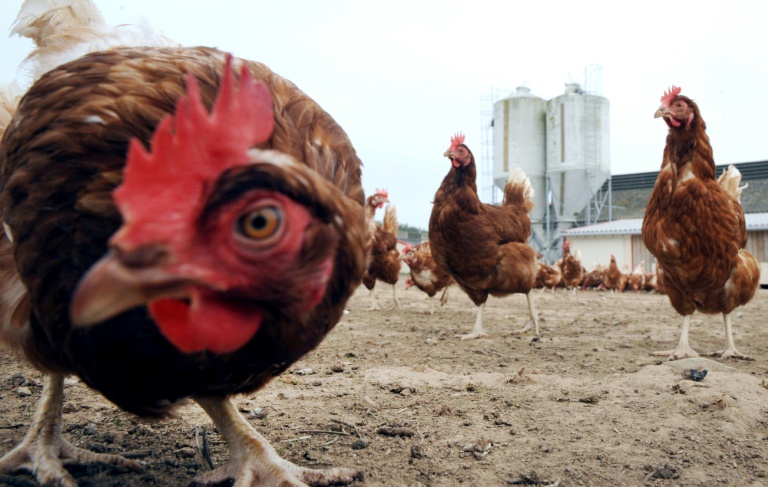
Israeli scientists have created a species of egg-laying hens that only produce females, a breakthrough that could help end the annual culling of around seven billion male chicks globally. 

The chicks, born from egg-laying, are destroyed en masse by suffocation or crushing because they are not suitable for meat production and do not lay eggs. 

Animal rights activists have denounced the practice as barbaric, and it has been banned in several European states. 

A German prohibition on male chick culling came into effect this year. French farmers have until year’s end to comply with new restrictions. 

A team at the Israeli Agricultural Research Organization-Volcani Center has used gene editing to develop a new species of hens that only gives birth to females. They say this is the only option to substantially curb mass male chick culling around the world. 

“This is a world first and the only solution that is easy for industry players to implement,” team leader Yuval Cinnamon, a Volcani Center embryologist, told AFP. 

He said technologies that seek to identify whether an egg is carrying a male or female embryo are not reliable.

The Volcani Center, based in the Tel Aviv suburbs, developed the species following seven years of research in partnership with the American-Israeli firm Huminn, which in part specialises in commercially viable sustainable food production. 

– ‘Most serious problem’ –     

The technology involves genetically modifying egg-laying hens so that, when carrying male embryos, those do not progress and hatch. 

“After fertilisation the male embryos do not develop, and the female embryos develop normally without being genetically modified and hatch normally,” Cinnamon explained. 

“This will provide a real answer to what is probably the most serious animal welfare problem in the world today,” he added.

Beyond the animal rights benefits, the technology could offer poultry producers huge savings in terms of the space and energy required to operate incubators while reducing the significant culling costs. 

“It costs a dollar to cull each male chick, so that’s seven billion in savings a year,” Cinnamon said.

Huminn has forecast that commercial benefits from the technology could emerge within two years. 

At a meeting in October, European Union agriculture ministers said they would consider a bloc-wide ban on culling male chicks from egg-laying hens, pending the results of an impact assessment. 

Israeli technology aims to curb male chick culling

Israeli scientists have created a species of egg-laying hens that only produce females, a breakthrough that could help end the annual culling of around seven billion male chicks globally. 

The chicks, born from egg-laying, are destroyed en masse by suffocation or crushing because they are not suitable for meat production and do not lay eggs. 

Animal rights activists have denounced the practice as barbaric, and it has been banned in several European states. 

A German prohibition on male chick culling came into effect this year. French farmers have until year’s end to comply with new restrictions. 

A team at the Israeli Agricultural Research Organization-Volcani Center has used gene editing to develop a new species of hens that only gives birth to females. They say this is the only option to substantially curb mass male chick culling around the world. 

“This is a world first and the only solution that is easy for industry players to implement,” team leader Yuval Cinnamon, a Volcani Center embryologist, told AFP. 

He said technologies that seek to identify whether an egg is carrying a male or female embryo are not reliable.

The Volcani Center, based in the Tel Aviv suburbs, developed the species following seven years of research in partnership with the American-Israeli firm Huminn, which in part specialises in commercially viable sustainable food production. 

– ‘Most serious problem’ –     

The technology involves genetically modifying egg-laying hens so that, when carrying male embryos, those do not progress and hatch. 

“After fertilisation the male embryos do not develop, and the female embryos develop normally without being genetically modified and hatch normally,” Cinnamon explained. 

“This will provide a real answer to what is probably the most serious animal welfare problem in the world today,” he added.

Beyond the animal rights benefits, the technology could offer poultry producers huge savings in terms of the space and energy required to operate incubators while reducing the significant culling costs. 

“It costs a dollar to cull each male chick, so that’s seven billion in savings a year,” Cinnamon said.

Huminn has forecast that commercial benefits from the technology could emerge within two years. 

At a meeting in October, European Union agriculture ministers said they would consider a bloc-wide ban on culling male chicks from egg-laying hens, pending the results of an impact assessment. 

US retail sales contract in November on auto and other goods

Retail sales in the US turned negative in November as the holiday shopping season got underway, dragged by auto, furniture and building supplies, according to official data released Thursday.

The contraction comes as American consumers contend with persistently high inflation that has bumped up the cost of many items ranging from groceries to clothing.

While consumer price increases have eased slightly in recent months, the pace of inflation remains around three times the pre-pandemic level.

Retail sales slumped 0.6 percent in November from October to $689.4 billion, more than expected, according to the latest Commerce Department figures.

The numbers, which follow a bounce in October, came as auto sales plunged 2.6 percent in November from the month before, while sales of goods related to furniture and building materials dropped by a similar rate.

Compared with November 2021, retail sales was 6.5 percent higher.

As costs remain elevated, the latest data suggests consumers are spending more on essential items like food and healthcare, with spending at food and beverage stores, as well as at grocery stores, jumping 0.8 percent from October to November.

Sales at restaurants and bars remained robust as well, rising 0.9 percent.

But with households squeezed by heightened costs, spending on other items slipped.

Sales at gasoline stations edged down 0.1 percent.

The data are seasonally adjusted but do not take into account changes in prices. This means that as costs rise, a shopping dollar does not stretch as far and consumers have had to use more of their earnings on staple goods while seeking bargains.

Despite the glum figures, which come as the year-end shopping season gets underway, analysts point to underlying resilience for now.

“Overall, consumption remains supported by strong job growth and rising nominal incomes and wages and a cushion from excess savings,” said Rubeela Farooqi of High Frequency Economics.

While higher borrowing costs as the Federal Reserve pushes on with hikes in the benchmark interest rate may bite, gradually easing inflation “should be supportive of households,” she said.

But Ian Shepherdson of Pantheon Macroeconomics cautioned that economists remain “alert for a sharp slowdown in the first quarter as a weakening labor market makes people less willing to draw down on savings accumulated during Covid.”

UK nurses stage unprecedented walkout

UK nurses on Thursday staged an unprecedented one-day strike in a fight for better wages and working conditions, despite warnings  patients could be put at risk.

Up to 100,000 members of the Royal College of Nursing (RCN) in England, Wales and Northern Ireland stopped work from 0800 to 2000 GMT after rejecting a pay deal.

The RCN’s industrial action — the first in its 106-year history — is part of a surging wave of stoppages by public and private sector employees as spiralling inflation outstrips wages growth.

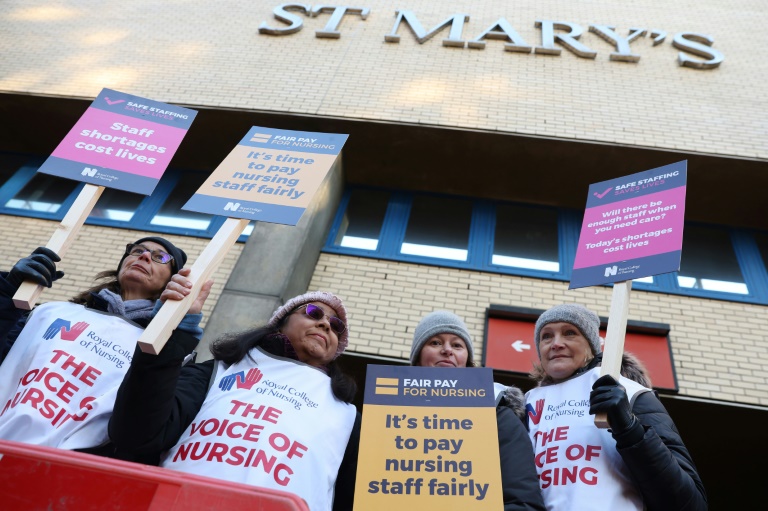
Outside St Thomas’ Hospital in central London, nurses on picket lines chanted slogans and held aloft placards urging “Pay us our worth” and “It’s time to pay nursing staff fairly”.

They were joined by England’s chief nursing officer Ruth May, according to The Times.

At Aintree University Hospital in Liverpool, northwest England, one nurse said striking was “the only way we can put our point across”.

“The public need to understand the pressures that everyone’s under,” said Pamela Jones, who has been a nurse for 32 years.

“You’ve only go to come to A&E (accident and emergency) to see the queues, there’s no beds.”

Another staff nurse, Kelly Hopkins, added: “There are more and more nurses using the food bank, which is just not acceptable.

“They’re coming in cold, they’re going without good food to feed their children. It’s just crazy.”

– ‘Tragic’ – 

Union leaders said nurses were overworked due to staff shortages, as the state-run National Health Service battles a growing backlog for appointments and treatment made worse by the pandemic.

RCN general secretary Pat Cullen said it was a “tragic day” for nurses, patients and the NHS that they had to take such action.

She said there were currently 50,000 vacant nursing posts and more needed to be done to stop staff leaving for better-paid jobs in supermarkets and retail.

“It’s up to the government. They have a responsibility to address those vacant nursing posts and stop the drain out of our profession,” said Cullen.

“They need to do that by paying nurses a decent wage.”

The RCN wants a pay rise significantly above inflation, which surged to a 41-year high of 11.1 percent in October, falling slightly to 10.7 percent last month.

Cullen said that would redress an effective 20-percent wage cut for nurses in real terms over the last decade. 

The government maintains the demands are unaffordable and Health Secretary Steve Barclay called the strikes “deeply regrettable”.

Barclay insisted he was open to talks on wider issues but not on the pay offer, which was recommended by an independent review body.

The NHS Pay Review Body recommended a pay rise of at least £1,400 ($1,740) on top of a 3.0 percent increase last year, he said.

“Further pay increases would mean taking money away from frontline services at a time when we are tackling record waiting lists as a result of the pandemic,” he added.

– Long hours –

The RCN has said chemotherapy, dialysis, intensive care and high-dependency units, as well as neonatal and paediatric intensive care will be protected.

But other services will be reduced to Christmas staffing levels during the walk-out.

Saffron Cordery, interim chief executive of NHS Providers, said NHS trusts were “pulling out all the stops” to lessen the impact on patients.

“The picture will vary across the country as (hospital) trust leaders work out service levels with unions locally,” she added.

Health minister Maria Caulfield said some 70,000 appointments, procedures and surgeries will be lost in England due to the walk-out, with thousands more elsewhere.

Caulfield — a qualified nurse and RCN member — accepted pay was an issue but told Times Radio it was “smaller” compared to others such as long working hours.

The main opposition Labour party leader Keir Starmer called the strike a “badge of shame” for the ruling Conservative government.

Another walk-out is due next Tuesday.

video-jwp-phz/bp

Bank of England lifts interest rate to 14-year high

The Bank of England on Thursday hiked its interest rate by half a point to 3.5 percent, the highest level in 14 years, in a bid to cool sky-high inflation.

The increase was the BoE’s ninth in a row, while the amount matches a hike Wednesday by the US Federal Reserve. The European Central Bank announces its latest rate decision at 1315 GMT.

“The labour market remains tight and there has been evidence of inflationary pressures in domestic prices and wages that could indicate greater persistence and thus justifies a further forceful monetary policy response,” the BoE said in a statement following its latest rate call.

The hike was less than in November when it lifted borrowing costs by 0.75 percentage points.

The Fed also slowed the pace of its tightening on Wednesday, as inflation eases on both sides of the Atlantic.

The BoE on Thursday added it expects the UK economy to contract 0.1 percent in the fourth quarter, better than its previous forecast for a contraction of 0.3 percent.

The UK government has said the British economy is in a recession that it expects to carry on into next year on fallout from rocketing energy and fuel bills.

UK inflation stands at 10.7 percent, the highest level for around 40 years, with prices surging on supply constraints caused by Russia’s invasion of Ukraine, the lifting of pandemic lockdowns and Brexit fallout, according to economists.

Soaring prices are eroding the value of wages, causing public and private sector workers to go on strike in an attempt to secure higher salaries. 

While boosting savers, rising interest rates are increasing loan costs for individuals and businesses.

“To make matters worse, higher mortgage payments will come on top of all the other soaring costs — from food to fuel,” noted Sarah Coles, senior personal finance analyst at stockbroker Hargreaves Lansdown.

– Strikes over pay –

UK nurses on Thursday staged an unprecedented one-day strike as a “last resort”, despite warnings it could put patients at risk.

It follows fresh walkouts by railway staff, while planned stoppages by passport control and postal workers spell Christmas misery for millions of Britons.

The UK consumer prices index eased in November from October’s annual inflation rate of 11.1 percent, official data showed on Wednesday. 

The BoE meanwhile began to raise its rate in December last year, when it had stood at a record-low 0.1 percent.

Paul Dales, chief UK economist at Capital Economics, said on Thursday that he expected the BoE to keep on hiking up to a peak of 4.5 percent early next year, as inflation remains at historically-high levels.

Family of dead activist take Palestinian Authority to ICC

The family of Palestinian activist Nizar Banat submitted a case Thursday to the International Criminal Court accusing top Palestinian officials over his death in custody, relatives told AFP.

Banat, a leading critic of the Palestinian Authority led by Mahmud Abbas, died in June 2021 after being dragged from his home in the occupied West Bank by security forces.

A post-mortem found he had been beaten on the head, chest, neck, legs and hands, with less than an hour elapsing between his arrest and his death.

“Our only hope is in the International Criminal Court,” the activist’s brother, Ghassan Banat, told AFP outside the tribunal in the Dutch city of The Hague.

“The time has come to achieve justice for the martyr Nizar Banat, after the authority has failed for more than a year and a half to achieve justice.”

Any person or group can file a complaint to  ICC prosecutor for investigation, but the court is not obliged to take them on.

The move marks the first time a Palestinian will lodge a complaint at the ICC against another Palestinian, according to the family’s lawyer.

“We demand justice for a man who was doing nothing but speaking the truth to power,” said the family’s lawyer Hakan Camuz said outside court.

– ‘No justice’ –

The ICC prosecutor’s office last year opened a full investigation into the situation in the Palestinian territories, including alleged crimes by Israeli forces and by Hamas and Palestinian armed groups.

The family’s case lodged at the ICC accuses seven Palestinian officials of responsibility for Banat’s death.

The decision to take the case to The Hague comes after 14 members of the Palestinian security forces were released on bail, pending their military trial in the West Bank over Banat’s death.

Ghassan Banat said the men’s release earlier this year left him believing “there is no justice enforcement”.

“At that time, we understood that the regime of the Palestinian Authority, the police, the security officers, have more authority than the court, that they were above the court,” he said.

“That is why we have decided to move on to the international arena”.

Banat’s death sparked rare protests in Ramallah, seat of the Palestinian Authority, with demonstrators shouting “Justice for Nizar” and pressing Abbas to quit.

A poll last year by the Palestinian Center for Policy and Survey Research found 63 percent of Palestinians believe Banat’s death was “a deliberate measure ordered by the PA political or security leaders”.

– ‘Telling people the truth’ –

The dissident’s brother said he was killed when he “challenged Mahmud Abbas and was telling people the truth about the real situation of the Palestinian Authority”.

Abbas has held office since 2005 and last year cancelled long-delayed elections.

The step by the Banat family follows the Al Jazeera broadcaster taking a case to the ICC last week over its slain reporter Shireen Abu Akleh, arguing she was deliberately shot dead by Israeli forces.

Abu Akleh was killed in May while covering an Israeli military raid in Jenin in the West Bank, which has been occupied by Israel since the 1967 Six-Day War.

Israel is not an ICC member and disputes the court’s jurisdiction to probe the situation in the Palestinian territory.

The probe will focus on the actions of all parties in the 2014 Gaza war, as well as other incidents such as the killing by Israeli forces of protesters in the coastal Palestinian territory.

Lithuanian firm makes stoves from car parts for power-starved Ukrainians

As winter temperatures plunge, a Lithuanian metal processing company has been turning used car parts into small stoves to keep war-weary and power-starved Ukrainians warm. 

The initiative comes as a godsend as months of Russian strikes on Ukraine’s power infrastructure have left people in the cold and dark for hours at a stretch. 

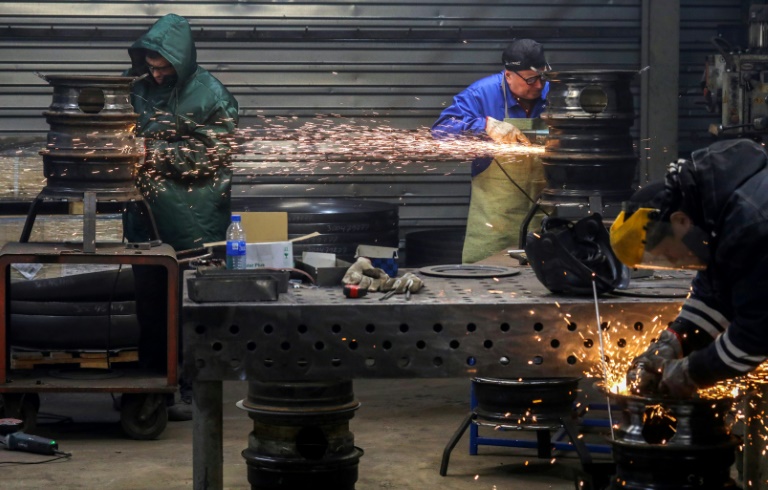
The Kalvis (Blacksmith) company has been sending the stoves — made from old wheel rims — to both civilians and soldiers. 

“We do what we do best just to make Ukrainians feel a bit better,” project co-author Rokas Utakis told AFP. 

So far the company has produced nearly 100 stoves, with half of them already in use in Ukraine, including as far as Bakhmut or Izyum near the front line.

Each stove consists of three rims stacked on each another and supported by legs.

It includes two chambers for firewood and ash, as well as a cast iron cover and chimney.

“It can be used as a stove, dryer, or simply as a heater,” Utakis said. 

A few dozen employees have been staying after hours to make the stoves in the northern city of Siauliai. Other residents have been lending a hand. 

“It’s nice to work with such an enthusiastic group of people,” said Utakis, who works as a craftsman at Kalvis.

“The emotions… of people enjoying the stoves make up for the fatigue you experience making them,” he added.

Lithuania and fellow Baltic states Estonia and Latvia have expressed staunch solidarity with Ukraine since Russia invaded it in February. 

The trio spent decades under Soviet occupation before declaring independence in 1991 and later joining NATO and the European Union. 

New Volkswagen boss eyes tapping the brakes on software drive

Volkswagen’s new boss Oliver Blume will seek to rally the board and shareholders at back-to-back meetings from Thursday to support his strategy on a crucial automotive software that felled his predecessor.

Blume had replaced Herbert Diess at the helm of the German giant in September, after problems dogged the development of the software and led to damaging vehicle recalls.

Under Diess, Volkswagen became the first legacy carmaker to try to follow US upstart Tesla by seeking to develop a centralised electronic architecture for its vehicles. 

This one-stop platform would replace the currently many different software systems for tasks such as controlling lights, the air conditioning, and the GPS.

But the drive has proved controversial, with critics warning that Diess had moved too fast, while underestimating how complicated it was to shift in-house an operation that was not among the carmaker’s core expertises.

At a press round-table on Tuesday, Blume hinted at plans to dial down the ambitious timetable.

The carmaker would refocus its software plans on “what has already been done”, he said.

But that also appeared to be a concession suggesting a delay to the new, centralised platform originally planned for 2026. 

That would have potentially serious knock-on effects — from delays on a flagship model to budget overruns — that Blume would need to talk the board and shareholders round to accepting.

– ‘Ripe and ready’ –

VW’s planned “Trinity” model, the centrepiece of its all new electric fleet and a project pushed by Diess, was set to operate on the new platform. 

But a delay in the new software could postpone Trinity. 

The vehicle was to be built at a planned new factory at Volkswagen’s headquarters in Wolfsburg — but this may not be built at all as, due to the software delay, there could be time to upgrade existing facilities, reports said.

In addition, development costs, carried by VW’s software unit Cariad, will exceed forecasts, according to several auto sector experts, who estimate them at several billion euros. 

Observers believe the group underestimated the complexity of coming up with a single software platform to operate across its different brands, ranging from family cars to high-end brands like Porsche and Audi. 

Automotive analyst Juergen Pieper said the group made a “mistake” in thinking that it could develop such a complex system alone and so quickly, “when car manufacturers are not IT specialists”.

Despite the considerable costs at going ahead, Pieper does not believe that Volkswagen would ditch its ambitions to develop its own software system. 

The delay could however drag until the end of the decade, he said. 

Matthias Schmidt, analyst at Automotive Research, said that Blume is likely “determined to bring the finished product to market when it is more or less fully ripe and ready for picking”.

“This could cause them market share losses in the short-term, as others bring their products to market quicker and snap away at the market share. 

“But Blume is likely more concerned about the long-term plans.”

ICC upholds conviction of Ugandan former child soldier

The International Criminal Court on Thursday threw out an appeal by Dominic Ongwen, a Ugandan child soldier-turned-commander in the Lord’s Resistance Army, against his conviction for war crimes.

Dominic Ongwen, who was himself abducted aged nine by the rebel group led by the fugitive Joseph Kony, was found guilty last year of murder, rape and sexual enslavement in northern Uganda during the early 2000s.

“The appeals chamber unanimously rejects all the grounds of appeal,” said Judge Luz del Carmen Ibanez Carranza, adding that the court would rule later Thursday on Ongwen’s appeal against his 25-year sentence.

Appeals judges dismissed Ongwen’s arguments about his own past as a child combatant and that he suffered from mental illness, saying that he had a key role in the LRA’s atrocities as an adult.

The LRA was founded three decades ago by former Catholic altar boy and self-styled prophet Joseph Kony, who launched a bloody rebellion in northern Uganda against President Yoweri Museveni.

Defence lawyers argued earlier this year that Ongwen, who is believed to be in his mid-40s but whose birth date remains unclear, had been scarred by his own experience as a youth in the LRA.

“Dominic Ongwen was, and still is, a child,” Ongwen’s defence lawyer Krispus Ayena Odongo told the court in February, adding that Ongwen still believed he was “possessed” by the spirit of Kony.

ICC prosecutor Karim Khan said last month said he would ask judges to confirm charges against Kony in his absence, as he remains at large.

– ‘Proxy prosecution’ –

The LRA’s bid to set up a state based on the Bible’s Ten Commandments killed more than 100,000 people and saw 60,000 children abducted, spreading to Sudan, the Democratic Republic of Congo and Central African Republic.

Ongwen, whose nom de guerre was “White Ant”, was found guilty on 61 charges of war crimes and crimes against humanity, which also included charges of himself turning young abductees into child soldiers.

Prosecutors portrayed Ongwen as leading a reign of terror by the LRA, personally ordering the massacres of more than 130 civilians at the Lukodi, Pajule, Odek and Abok refugee camps between 2002 and 2005.

Judges ruled that Ongwen had not suffered from mental illness despite his own history of being abducted on his way to school by the LRA, described by experts as one of Africa’s “most brutal militia forces”.

Ongwen’s lawyers had appealed the conviction on 90 different grounds and the sentence on 11, saying there were errors in “law, fact and procedure”.

“The trial was a proxy prosecution, a prosecution of the LRA using (Ongwen), a child soldier, as a scapegoat,” Krispus Ayena Odongo said in court papers.

Kony should be in the dock instead of Ongwen, since it was he who had decided on the distribution of women and children as sex slaves, he added.

“Kony remains unapprehended; he has escaped the tentacles of various states,” Odongo added.

Close Bitnami banner
Bitnami