World

Equities sink on Fed outlook, before Europe rate calls

Global stocks sank Thursday and the dollar rose after the US Federal Reserve hiked interest rates again and signalled they would go higher to fight inflation.

Markets were also on tenterhooks ahead of expected rate increases from the Bank of England and the European Central Bank.

Both are expected to mirror the Fed’s half-point hike to tackle soaring inflation, after rate increases also in Norway and Switzerland.

Sentiment was hammered Thursday after the Fed suggested that it saw US rates topping out next year at 5.1 percent, higher than markets had predicted.

“Equity markets are back in the red… as investors reel from the nasty shock delivered by the Fed and look ahead to central bank rate decisions on the agenda today,” said Oanda analyst Craig Erlam.

“The question now becomes whether other central banks will take a similarly hawkish position against the markets and ruin any hope of a Santa rally this year.”

The Fed also warned that the world’s biggest economy would grow less than expected next year, fuelling fresh recession fears.

Rising rates fan recession concerns because they push up loan repayments for consumers and companies, denting expenditure, investment and economic activity.

At the same time, however, the world’s major central banks are seeking to dampen red-hot inflation, which has been fuelled partly by fallout from Russia’s invasion of Ukraine.

Recent official data painted a picture of slowing inflation in Britain and the United States, although consumer prices remain elevated.

“The interest rate hikes keep on coming and this trend is almost certainly going to remain intact in early 2023,” noted AJ Bell investment director Russ Mould.

“Raising rates makes it more expensive for consumers and businesses to borrow money and theoretically causes a reduction in spending and investment which should help to ease the economy and bring down prices.

“This takes time to work its way through the system and so central banks will continue their rate hiking path until there is adequate evidence to support a shift in policy.”

Markets had rallied earlier this week after data showed the US consumer price index rose less than forecast in November, marking a fifth straight slowdown and the lowest level since December last year.

But the Fed appeared less inclined to accept that the recent figures were enough to indicate enough progress was being made.

“Fifty basis points is still a historically large increase, and we still have some ways to go,” Fed boss Jerome Powell told reporters after the announcement.

Oil prices rose on lingering concerns over slowing global energy demand, dealers said. 

– Key figures around 1120 GMT –

London – FTSE 100: DOWN 0.4 percent at 7,468.62 points

Frankfurt – DAX: DOWN 1.1 percent at 14,295.23

Paris – CAC 40: DOWN 1.1 percent at 6,655.77

EURO STOXX 50: DOWN 1.2 percent at 3,926.88

Tokyo – Nikkei 225: DOWN 0.4 percent at 28,051.70 (close)

Hong Kong – Hang Seng Index: DOWN 1.6 percent at 19,368.59 (close)

Shanghai – Composite: DOWN 0.3 percent at 3,168.65 (close)

New York – Dow: DOWN 0.4 percent at 33,966.35 (close)

Euro/dollar: DOWN at $1.0614 from $1.0684 on Wednesday

Dollar/yen: UP at 136.76 yen from 135.45 yen

Pound/dollar: DOWN at $1.2343 from $1.2424

Euro/pound: UP at 86.02 pence from 85.96 pence

Brent North Sea crude: UP 0.4 percent at $83.06 per barrel

West Texas Intermediate: UP 0.4 percent at $77.55 per barrel

burs/rfj/bcp/raz
Fiji opposition calls for halt to election count after 'anomaly'

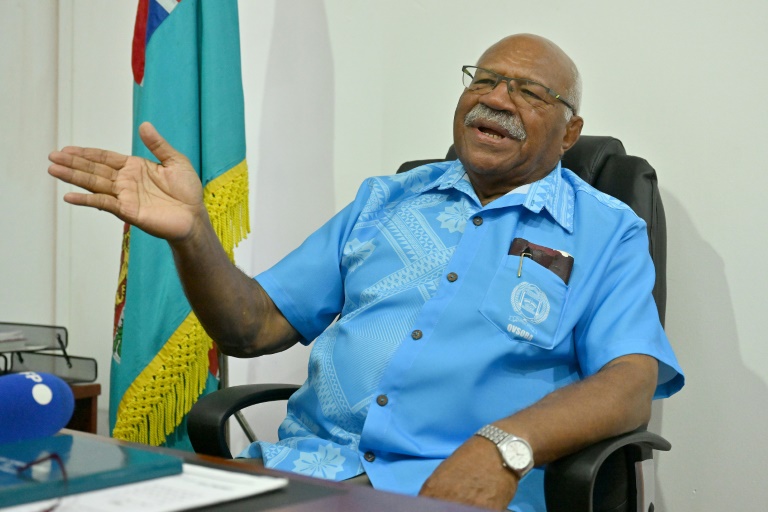
Fiji’s opposition on Thursday demanded counting stop in the coup-prone nation’s bitterly fought general election, alleging serious “anomalies” that put the poll’s legitimacy in doubt.

Fiji, a tropical archipelago of more than 300 islands in the South Pacific, held a general election Wednesday — a vote seen as a test of the country’s fledgling democracy.

Incumbent Frank Bainimarama, who seized power in a putsch 16 years ago, is challenged by former Prime Minister Sitiveni Rabuka, a two-time coup leader nicknamed “Rambo”. 

Voting day passed without major incident, but the count was marred by a late-night glitch that hid the tally from public view for four hours. 

Rabuka had led in the first batches of results, lifting supporters’ hopes of victory and raising the prospect of the first peaceful transition of power in two decades.

But when the system was restored just before dawn on Thursday, he was trailing Bainimarama by a significant margin.

Rabuka said the system had been compromised and ongoing counting should be scrapped.

In a joint statement, four opposition leaders said the incident “called into serious question the integrity of the entire system”. 

Rabuka said he was also considering writing to the military to ensure the election was fair — but sought to assure the country that there “will not be a coup”. 

“We will pursue every avenue available to us to make sure that the people are not denied their right of electing their government,” Rabuka told AFP earlier.

As he spoke, Rabuka thumbed through a copy of Fiji’s constitution, which gives the military broad licence to safeguard Fiji’s “well-being” and intervene if necessary.

– ‘Nothing to hide’ –

Vote organisers have called the incident an “anomaly”, and pointed to provisional results that most observers agreed were improbable. 

First returns showed a handful of little-known politicians gaining thousands of votes and polling well ahead of the major parties. 

Election supervisor Mohammed Saneem dismissed the concerns of vote rigging as “conspiracy theories” and invited media to view the national counting centre.

“I have nothing to hide,” he insisted, while ruling out an early stop to counting.

The clamour of objections became louder Thursday, with the leader of the Methodist Church — the largest Christian denomination in what is a deeply religious country — saying he had lost faith in the vote-counting system. 

“It is our hope that due prudence will be provided to those who seek justice,” Reverend Ili Vunisuwai said in a statement posted to Facebook.

Bainimarama, the media-shy ex-navy commodore who won elections in 2014 and 2018, has so far been silent on the controversy.

The 97 members of the Multinational Observer Group present in Fiji to oversee vote counting have also avoided weighing in.

– Nervous wait –

Fiji has endured four coups since 1987 and its institutions are again being tested.  

Pacific analyst Tess Newton Cain said the error “may undermine confidence in the elections as a whole”. 

“It will quite likely undermine confidence in the office of elections, and Saneem as supervisor,” added Newton Cain, from Griffith University’s Pacific Hub. 

Opinions were split among voters at the vast open-air market on Suva’s waterfront. 

Rabuka supporter Jone Nheamauto encouraged the challenge and said he did not “trust” the electoral system. 

Pravin Lal, 56, said he was happy to continue with the same government. 

Final results are not expected until Sunday and may be further delayed, but partial tallies showed the race is not yet over. 

Bainimarama’s Fiji First party held around 45 percent of the vote, with more than half of the country’s 2,071 polling stations counted.

Rabuka’s People’s Alliance and its coalition partner — the National Federation Party — had just under 42 percent between them. 

Another potential coalition party is polling just under the five percent threshold to take a seat in parliament. 

Bainimarama’s broad support among Indo-Fijians and the fracturing of the Indigenous Fijian, or iTaukei, vote, could once again deliver him victory. 

The result of the election holds significance well beyond Fiji. 

Rabuka has signalled that Fiji — one of the most prosperous and influential nations in the South Pacific — could loosen its ties with China if he is elected. 

Fiji has grown closer to Beijing under Bainimarama, who used a “look north” policy to stabilise the economy after Australia and New Zealand hit the country with heavy trade sanctions in retaliation for his 2006 coup. 

EU faces subsidy race with US in trade spat

EU leaders met in Brussels on Thursday at a summit focusing on a trade dispute with key ally the United States that threatens to trigger a subsidy race between the economic superpowers.

French President Emmanuel Macron said a European response was needed “to maintain fair competition”, one which “allows us to match what the Americans are doing”.

The European bloc is unsettled by parts of a multi-billion-dollar US Inflation Reduction Act (IRA) that lavishes subsidies and tax cuts for US purchasers of electric vehicles — if they “Buy American”.

The European Commission sees that as discriminatory against European car manufacturers, a breach of World Trade Organization rules, and a threat to investment in Europe.

It is urging the EU leaders to sign off on a plan that would loosen state aid rules and boost public investment in cleaner energy.

Commission chief Ursula von der Leyen said in a pre-summit letter to the leaders that the measures were needed because of the IRA provisions that “risk un-levelling the playing field and discriminating against European companies”.

While Thursday’s summit was also to examine Russia’s continuing war in Ukraine, and the fall-out in Europe, von der Leyen’s Vice President Margrethe Vestager warned: “We already have war in Europe. The last thing we need is a trade war on top.”

Macron and the commission have tried to persuade US President Joe Biden to change the contentious parts of the IRA, to no avail apart from receiving promises of some “tweaks”. 

Biden and his administration believe the EU is free to come up with its own subsidy arrangement for electric vehicles — a sector in which China has outsized advantages when it comes to batteries and rare-earth supplies.  

There were some concerns among EU countries that the bloc’s main car-exporting nation, Germany, might go it alone with its own subsidies, as it already did with measures on energy.

German Chancellor Olaf Scholz said he and his counterparts “will talk about the competitiveness and future viability of our economy” in light of the US IRA.

– ‘Delicate’ ties –

European Council President Charles Michel, chairing the summit, said economic ties between the United States and the EU were in a “delicate” phase.

He acknowledged that Washington was a key ally for Brussels in many other areas, not least in Europe’s efforts to “rebalance our economic relationship with China”.

But he said there was now a need to “adapt” EU state aid rules and possibly come up with “new tools” to protect Europe’s single market and trade.

The EU summit was also to study an internal dispute, between Austria and Bulgaria, over migrants.

Austria is blocking Bulgaria’s bid to join the border check-free Schengen zone encompassing most EU members and a couple of neighbouring countries. 

Vienna fears Bulgaria’s inclusion would further spur irregular migration onto Austrian territory. 

“We have more than 100,000 asylum applications in Austria, more than 75,000 of those who make these applications are not registered,” Austrian Chancellor Karl Nehammer said.

That “security problem” had to be solved before Bulgaria — and the linked bid by Romania — could be allowed into the Schengen club, he said. 

“They are countries that should protect the external border,” Nehammer said.

Bulgaria’s President Rumen Radev said as he went into the summit that his country was “highly committed to secure our border” but needed EU help.

“We request Bulgaria to be treated as a solid country,” he said. “Please don’t leave us alone.”

EU faces subsidy race with US in trade spat

EU leaders met in Brussels on Thursday at a summit focusing on a trade dispute with key ally the United States that threatens to trigger a subsidy race between the economic superpowers.

French President Emmanuel Macron said a European response was needed “to maintain fair competition”, one which “allows us to match what the Americans are doing”.

The European bloc is unsettled by parts of a multi-billion-dollar US Inflation Reduction Act (IRA) that lavishes subsidies and tax cuts for US purchasers of electric vehicles — if they “Buy American”.

The European Commission sees that as discriminatory against European car manufacturers, a breach of World Trade Organization rules, and a threat to investment in Europe.

It is urging the EU leaders to sign off on a plan that would loosen state aid rules and boost public investment in cleaner energy.

Commission chief Ursula von der Leyen said in a pre-summit letter to the leaders that the measures were needed because of the IRA provisions that “risk un-levelling the playing field and discriminating against European companies”.

While Thursday’s summit was also to examine Russia’s continuing war in Ukraine, and the fall-out in Europe, von der Leyen’s Vice President Margrethe Vestager warned: “We already have war in Europe. The last thing we need is a trade war on top.”

Macron and the commission have tried to persuade US President Joe Biden to change the contentious parts of the IRA, to no avail apart from receiving promises of some “tweaks”. 

Biden and his administration believe the EU is free to come up with its own subsidy arrangement for electric vehicles — a sector in which China has outsized advantages when it comes to batteries and rare-earth supplies.  

There were some concerns among EU countries that the bloc’s main car-exporting nation, Germany, might go it alone with its own subsidies, as it already did with measures on energy.

German Chancellor Olaf Scholz said he and his counterparts “will talk about the competitiveness and future viability of our economy” in light of the US IRA.

– ‘Delicate’ ties –

European Council President Charles Michel, chairing the summit, said economic ties between the United States and the EU were in a “delicate” phase.

He acknowledged that Washington was a key ally for Brussels in many other areas, not least in Europe’s efforts to “rebalance our economic relationship with China”.

But he said there was now a need to “adapt” EU state aid rules and possibly come up with “new tools” to protect Europe’s single market and trade.

The EU summit was also to study an internal dispute, between Austria and Bulgaria, over migrants.

Austria is blocking Bulgaria’s bid to join the border check-free Schengen zone encompassing most EU members and a couple of neighbouring countries. 

Vienna fears Bulgaria’s inclusion would further spur irregular migration onto Austrian territory. 

“We have more than 100,000 asylum applications in Austria, more than 75,000 of those who make these applications are not registered,” Austrian Chancellor Karl Nehammer said.

That “security problem” had to be solved before Bulgaria — and the linked bid by Romania — could be allowed into the Schengen club, he said. 

“They are countries that should protect the external border,” Nehammer said.

Bulgaria’s President Rumen Radev said as he went into the summit that his country was “highly committed to secure our border” but needed EU help.

“We request Bulgaria to be treated as a solid country,” he said. “Please don’t leave us alone.”

Iran blames US after being removed from UN rights body

Iran on Thursday accused the United States of orchestrating its removal from a UN women’s rights body over its response to protests triggered by death of Mahsa Amini.

The Islamic republic has seen waves of protests since the September 16 death in custody of Amini, a young Iranian Kurd who had been arrested for allegedly violating the country’s dress code for women.

Hundreds of people have been killed and thousands arrested in the street violence, leading to international condemnation and Iran’s removal Wednesday from the United Nations Commission on the Status of Women (UNCSW).

Iran pointed the finger of blame at the United States, saying the move was a result of its arch-foe’s concerted efforts and that it lacked “legal justification”.

“This one-sided action of the US… is an attempt to impose unilateral political demands and ignore electoral procedures in international institutions,” foreign ministry spokesman Nasser Kanani said.

“Removing a legal member of the commission is a political heresy which discredits this international organisation and also creates a unilateral procedure for future abuses of international institutions,” he added.

Iran, which was elected to the body in April for a four-year term, was stripped of its membership with immediate effect.

A simple majority was needed to adopt the move, which was approved after 29 members of the UN Economic and Social Council (ECOSOC) voted in favour, eight countries including Russia and China voted against and 16 abstained.

The text of the UN resolution said the Iranian authorities “continuously undermine and increasingly suppress the human rights of women and girls, including the right to freedom of expression and opinion, often with the use of excessive force.”

The head of Iran’s high council for human rights, Kazem Gharibabadi, said the motive of the United States for supporting the resolution was to protect its own interests.

The US “only pursues its inhumane and anti-human rights interests and goals” by issuing “false and hypocritical statements and comments” against Iran, he said in a Twitter post.

Iran said on December 3 that more than 200 people had been killed in the unrest, including security personnel. Human rights groups based abroad say the country’s security forces have killed more than 450 people.

Iran has handed down 11 death sentences in connection with the protests. It has carried out two executions in the past week. Campaigners say a dozen other defendants face charges that could see them also receive the death penalty.

Markets sink with Wall St on hawkish Fed outlook

Asian and European equities fell Thursday after the Federal Reserve signalled US interest rates would go higher than expected and warned the world’s biggest economy would grow less than expected next year, fanning fears a recession is on the way.

Traders took their lead from Wall Street, where a more hawkish statement than expected dented hopes the central bank could soften its approach to fighting inflation.

Markets had rallied after data on Tuesday showed the consumer price index rose less than forecast in November, marking a fifth straight slowdown and the lowest level since December last year.

But the Fed appeared less inclined to accept that the recent figures were enough to indicate enough progress was being made.

While it lifted rates by the expected 50 basis points — down from the previous four 75-point hikes — its “dot plot” of forecasts suggested it saw them top out next year at 5.1 percent, higher than markets had predicted.

“Fifty basis points is still a historically large increase, and we still have some ways to go,” Fed boss Jerome Powell told reporters after the announcement.

He added that he “wouldn’t see us considering” any cuts until officials were happy that inflation was on track to its two percent target.

“It will take substantially more evidence to give confidence that inflation is on a sustained downward path,” he said.

The Fed also cut its expectations for growth next year as it faced headwinds from the tighter monetary policies, stirring fresh warnings of a recession, which have weighed on equities for much of the year.

But Powell said: “I don’t think anyone knows whether we’re going to have a recession or not, and if we do, whether it’s going to be a deep one or not.”

– ‘Worried about a recession’ –

After Wall Street’s retreat, Asia fell into the red, with Hong Kong, Shanghai, Bangkok, Mumbai, Tokyo, Sydney, Seoul, Taipei, Manila and Jakarta all down.

London, Paris and Frankfurt all opened on the back foot.

The dollar rose against most other currencies, even the euro and pound ahead of expected rate hikes by the European and UK central banks later Thursday.

“The Fed did not welcome the disinflation trends that have just started to emerge and focused on robust job gains and elevated inflation,” said OANDA’s Edward Moya.

“Any hopes of a soft landing disappeared as the Fed seems like they are committed to taking rates much higher.”

Despite the tougher talk from the Fed, Tomo Kinoshita at Invesco Asset Management said: “US shares have seen limited falls, indicating that financial markets are not wholeheartedly believing in that hawkishness, perhaps because some Fed policymakers have talked about the possibility of rate cuts already.”

But he added: “Long-term bond yields appeared to have peaked out, which is a sign investors are now worried about a recession.”

The likelihood of rates going even higher outweighed hopes about China’s emergence from nearly three years of strict zero-Covid containment measures that have crippled its economy.

While the reopening is expected to provide a much-needed boost to growth, there is an immediate worry about the impact of soaring infection numbers on the healthcare system and firms’ ability to function.

And in a sign of the effect of the anti-Covid strategy, data on Thursday showed retail sales fell more than expected in November, industrial output growth slowed and investment weakened.

And analysts warned there would not likely be any improvement this month.

Oil prices sank after a three-day rally on news that a section of the US Keystone pipeline had been repaired after suffering a leak earlier in the week. 

– Key figures around 0820 GMT –

Tokyo – Nikkei 225: DOWN 0.4 percent at 28,051.70 (close)

Hong Kong – Hang Seng Index: DOWN 1.6 percent at 19,368.59 (close)

Shanghai – Composite: DOWN 0.3 percent at 3,168.65 (close)

London – FTSE 100: DOWN 0.5 percent at 7,457.73

Euro/dollar: DOWN at $1.0645 from $1.0684 on Wednesday

Dollar/yen: UP at 135.78 yen from 135.45 yen

Pound/dollar: DOWN at $1.2378 from $1.2424

Euro/pound: UP at 85.99 pence from 85.96 pence

West Texas Intermediate: DOWN 1.1 percent at $76.43 per barrel

Brent North Sea crude: DOWN 0.9 percent at $81.95 per barrel

New York – Dow: DOWN 0.4 percent at 33,966.35 (close)

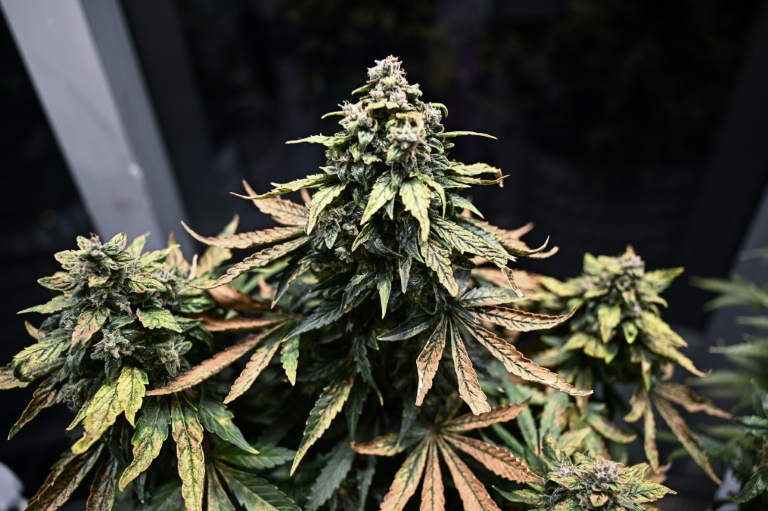
Let the good times roll? Bangkok becomes Southeast Asia's weed Wild West

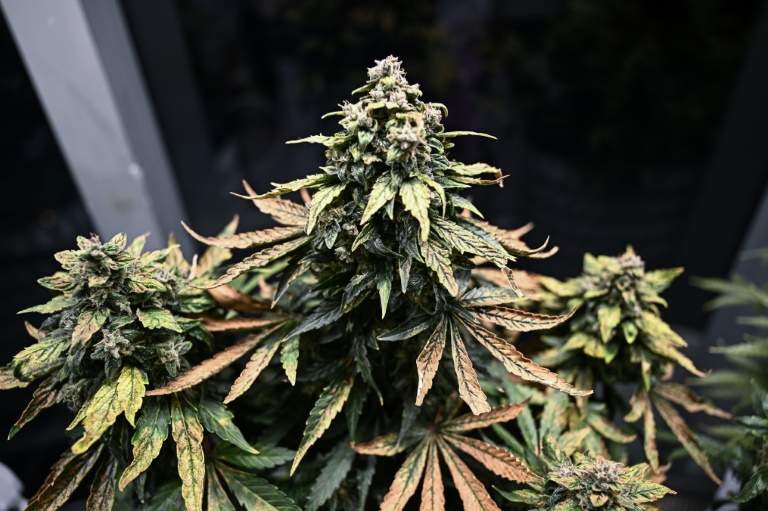
From sleek boutiques to rickety stalls, hundreds of cannabis dispensaries have sprouted across Bangkok following decriminalisation, but in a nation once infamous for tough drug laws, Thai vendors are asking: can the high times last?

In a Southeast Asian first, the kingdom removed parts of the marijuana plant from its narcotics list in June, effectively legalising the substance -– albeit with a confusing lack of detail.

It could be a lucrative change for a tourism-heavy economy badly dented by the pandemic, with the University of Thai Chamber of Commerce predicting the market may be worth $1.2 billion by 2025.

But in the absence of clear regulations, Thailand is fast becoming a free-wheeling weed Wild West, sparking jitters among some suppliers that the rush may send everything up in smoke.

“The barrier to enter the market is so low,” said Kajkanit “Gem” Sakdisubha, who started growing cannabis after his father was diagnosed with cancer.

His shop, named The Dispensary — which looks more like a luxury goods store — places an emphasis on locally sourced weed, administered by expert “bud-tenders”.

“I know there’s a lot of groups and other people that jump into the business because they see money in it, and there’s not much passion in it,” he said.

Online map firm WEED.in.th has registered 1,750 stores –- with another 450 awaiting approval.

But sellers like Gem are anxious about what the government may do next.

“We need to see that plan in five and 10 years, not month-by-month,” he said.

“I know some people that close down shops because they have no certainty.”

– Political games –

A hasty roll-out saw celebrations and condemnations, with many voicing concern over the legal grey areas.

Furious debate also erupted after a photo of a pre-teen Thai boy smoking pot in early December went viral.

While the government tightened some rules around retailers earlier this month –- outlawing sales online and to people under 20 and pregnant women — debate on further restrictions is still raging in the Thai parliament.

In Bangkok’s posh Thonglor district, Zaza Medical truck vendors nervously wait for clarity on their legal status.

“Hopefully we can keep selling,” said part-owner and rapper Guygeegee.

While there are some medicinal benefits of cannabis use, public education is needed to ensure people are aware of the drug’s potential harm, said Thongchai Lertwilairattanapong of the Department of Thai Traditional Medicine.

“We aim to regulate cannabis like liquor or cigarettes,” he said. 

“People need to know the drawbacks of overconsuming liquor and cigarettes as well as cannabis, which is the new player in Thailand.”

Health experts warn extensive over-use can lead to drug-induced psychosis, while long-term use has been linked to asthma, cancers, memory loss and learning problems.

Bangkok-based Gloria Lai, regional director at International Drug Policy Consortium, said decriminalisation had come without proper preparation.

“The government has a responsibility… given their push for this to be available, to educate the public,” she said.

“It is a vacuum at the moment.”

– Confusion, chaos and cops –

“It’s a little bit confused,” said tourist Sasha Leehorpertien, gesturing at the scene around him in a basement cannabis cafe on Khaosan Road.

Never known for its restraint, Bangkok’s backpacking and binge-drinking hotspot has fully embraced the change, with retailers popping up along the length of the grubby street.

“It shouldn’t be like this,” the 23-year-old said, adding that while he fully supported legalisation, he was unaware of exactly what Thailand’s laws had to say about the joint he was smoking.

“I am afraid of jail here,” he added, surreptitiously leaving as a rowdy group of young, imbibing Croatians lit yet another blunt.

And it may be that the boom times are already over for some.

Police and officials raided Khaosan Road twice in December, detaining vendors allowing indoor smoking and arresting stall-owners who they said were operating without a licence.

But despite the uncertainty, Teetat Wonykhan, whose brother owns Ganja Kingdom on Khaosan Road, remains optimistic — the siblings even plan to open a second store.

High customers were infinitely preferable to drunk ones, Teetat said.

“They are really chill,” he said. 

“Most just come in and are like, ‘hey bro’.”

Let the good times roll? Bangkok becomes Southeast Asia's weed Wild West

From sleek boutiques to rickety stalls, hundreds of cannabis dispensaries have sprouted across Bangkok following decriminalisation, but in a nation once infamous for tough drug laws, Thai vendors are asking: can the high times last?

In a Southeast Asian first, the kingdom removed parts of the marijuana plant from its narcotics list in June, effectively legalising the substance -– albeit with a confusing lack of detail.

It could be a lucrative change for a tourism-heavy economy badly dented by the pandemic, with the University of Thai Chamber of Commerce predicting the market may be worth $1.2 billion by 2025.

But in the absence of clear regulations, Thailand is fast becoming a free-wheeling weed Wild West, sparking jitters among some suppliers that the rush may send everything up in smoke.

“The barrier to enter the market is so low,” said Kajkanit “Gem” Sakdisubha, who started growing cannabis after his father was diagnosed with cancer.

His shop, named The Dispensary — which looks more like a luxury goods store — places an emphasis on locally sourced weed, administered by expert “bud-tenders”.

“I know there’s a lot of groups and other people that jump into the business because they see money in it, and there’s not much passion in it,” he said.

Online map firm WEED.in.th has registered 1,750 stores –- with another 450 awaiting approval.

But sellers like Gem are anxious about what the government may do next.

“We need to see that plan in five and 10 years, not month-by-month,” he said.

“I know some people that close down shops because they have no certainty.”

– Political games –

A hasty roll-out saw celebrations and condemnations, with many voicing concern over the legal grey areas.

Furious debate also erupted after a photo of a pre-teen Thai boy smoking pot in early December went viral.

While the government tightened some rules around retailers earlier this month –- outlawing sales online and to people under 20 and pregnant women — debate on further restrictions is still raging in the Thai parliament.

In Bangkok’s posh Thonglor district, Zaza Medical truck vendors nervously wait for clarity on their legal status.

“Hopefully we can keep selling,” said part-owner and rapper Guygeegee.

While there are some medicinal benefits of cannabis use, public education is needed to ensure people are aware of the drug’s potential harm, said Thongchai Lertwilairattanapong of the Department of Thai Traditional Medicine.

“We aim to regulate cannabis like liquor or cigarettes,” he said. 

“People need to know the drawbacks of overconsuming liquor and cigarettes as well as cannabis, which is the new player in Thailand.”

Health experts warn extensive over-use can lead to drug-induced psychosis, while long-term use has been linked to asthma, cancers, memory loss and learning problems.

Bangkok-based Gloria Lai, regional director at International Drug Policy Consortium, said decriminalisation had come without proper preparation.

“The government has a responsibility… given their push for this to be available, to educate the public,” she said.

“It is a vacuum at the moment.”

– Confusion, chaos and cops –

“It’s a little bit confused,” said tourist Sasha Leehorpertien, gesturing at the scene around him in a basement cannabis cafe on Khaosan Road.

Never known for its restraint, Bangkok’s backpacking and binge-drinking hotspot has fully embraced the change, with retailers popping up along the length of the grubby street.

“It shouldn’t be like this,” the 23-year-old said, adding that while he fully supported legalisation, he was unaware of exactly what Thailand’s laws had to say about the joint he was smoking.

“I am afraid of jail here,” he added, surreptitiously leaving as a rowdy group of young, imbibing Croatians lit yet another blunt.

And it may be that the boom times are already over for some.

Police and officials raided Khaosan Road twice in December, detaining vendors allowing indoor smoking and arresting stall-owners who they said were operating without a licence.

But despite the uncertainty, Teetat Wonykhan, whose brother owns Ganja Kingdom on Khaosan Road, remains optimistic — the siblings even plan to open a second store.

High customers were infinitely preferable to drunk ones, Teetat said.

“They are really chill,” he said. 

“Most just come in and are like, ‘hey bro’.”

UK nurses stage unprecedented walkout

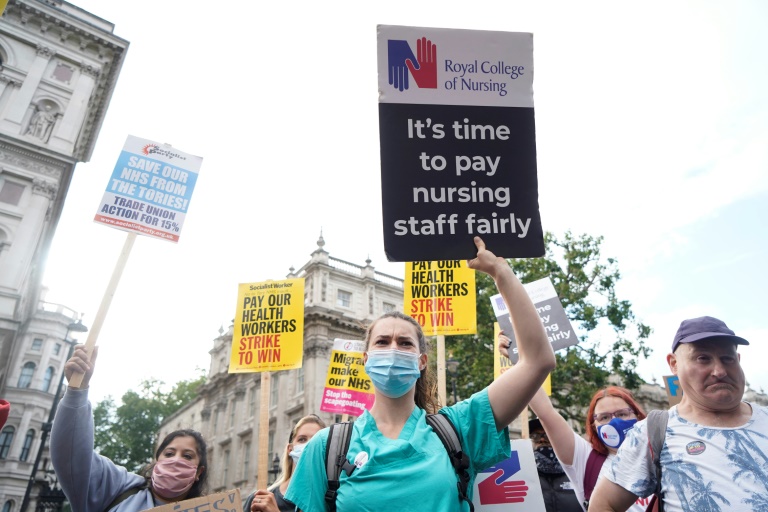
UK nurses on Thursday staged an unprecedented one-day strike as a “last resort” in their fight for better wages and working conditions, despite warnings it could put patients at risk.

Up to 100,000 members of the Royal College of Nursing (RCN) in England, Wales and Northern Ireland are stopping work from 0800 to 2000 GMT after rejecting a government pay offer.

The RCN’s industrial action is part of a growing wave of stoppages by public and private sector employees.

Picket lines were being set up at major state-run hospitals, including Guy’s and St Thomas NHS Foundation Trust in London.

Ameera, a senior nurse in London, told AFP that “we have not chosen industrial action lightly”.

The strike is the first in the Royal College of Nursing union’s 106-year history.

“We’re tired. We’re fed up,” added the nurse, who asked that her last name not be reported. “We need a pay rise now to make a living.”

The UK is currently grappling with a cost-of-living crisis as spiralling inflation outstrips wage growth.

Union leaders and health workers also said nurses were being overworked due to staff shortages, as the state-run National Health Service (NHS) battled a backlog in appointments made worse by cancellations during the pandemic.

Chemotherapy, dialysis, intensive care and high-dependency units, as well as neonatal and paediatric intensive care will be protected.

But other services will be reduced to Christmas staffing levels during the walk-out, the RCN said.

Saffron Cordery, interim chief executive of NHS Providers, said NHS trusts were “pulling out all the stops” to lessen the impact on patients.

“The picture will vary across the country as trust leaders work out service levels with unions locally,” she added.

– Care concern –

Health chiefs warned unions that care levels could suffer because of the walkout, just as seasonal respiratory conditions such as flu add pressure on already stretched services.

Cally Palmer, national cancer director for England, called on the union to exempt cancer surgery from the walkout, while England’s chief nursing officer expressed concern over the strike staffing plans. 

“We hear from our colleagues that they are concerned by the assumption, implied by the RCN, that night duty staffing on day duty is safe,” Ruth May wrote in a letter to the RCN. 

“Ward activities during the day are very different to those at night. 

“This decision has the potential to significantly impact on the safety of patient care (for example, by impacting delivery of intravenous antibiotics on time, patient observations and medication rounds),” she added.

Healthcare unions say their members are skipping meals, struggling to feed and clothe their families, and leaving the NHS in droves.

The RCN wants a pay rise significantly above inflation which surged to a 41-year high of 11.1 percent in October, falling slightly to 10.7 percent last month. 

The government maintains the demands are unaffordable and Health Secretary Steve Barclay called the strikes “deeply regrettable”.

– Struggle –  

RCN general secretary Pat Cullen has offered to “press pause” on the strikes if Barclay agreed to talks.

But Barclay insisted that while he was open to talks on wider issues, the pay settlement was recommended by an independent review body and would not be reopened.

The NHS Pay Review Body recommended a pay rise of at least £1,400 ($1,740) on top of a 3.0 percent pay rise last year, he said.

“Further pay increases would mean taking money away from frontline services at a time when we are tackling record waiting lists as a result of the pandemic,” he added.

The main opposition Labour party leader Keir Starmer called the strike a “badge of shame” for the ruling Conservative government.

Accident and emergency staff nurse Mark Boothroyd, 37, said the cost-of-living crisis had left nurses struggling to pay bills, transport and rent.

Poor pay meant newly qualified nurses now spend only a year or two before leaving the profession, said Boothroyd, who works at St Thomas’ Hospital in central London.

The resulting unfilled vacancies have put huge pressure on remaining staff, many of whom were reporting mental health problems from stress.

Conditions were “horrendous and cannot be allowed to go on”, he added.

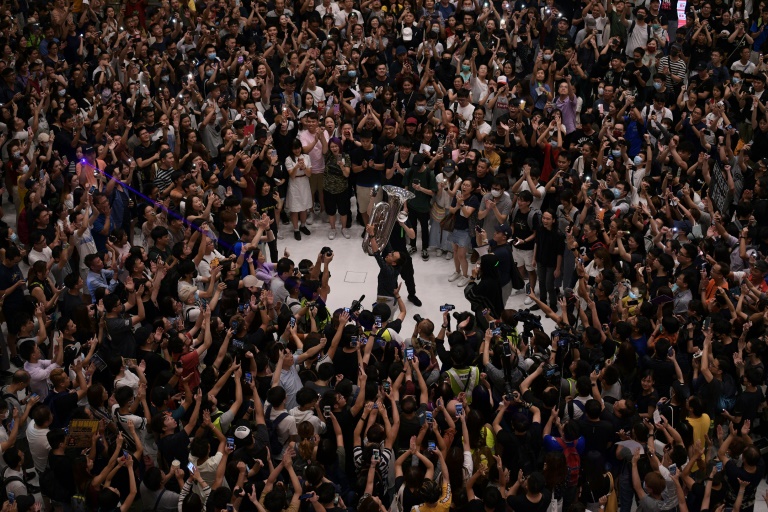
Google says does not change search results after Hong Kong anthem row

Google said Thursday it does not manipulate search results, after Hong Kong’s government said the tech giant had refused its demand to bury a popular protest song.

The controversy began after it emerged that links to the pro-democracy song “Glory to Hong Kong” appeared ahead of China’s official “March of the Volunteers” when people searched for the city’s anthem.

The song was accidentally played for Hong Kong athletes at two international sports events last month, prompting the demand from the Chinese city to delist it from search results.

“Google handles billions of search queries every day, so we build ranking systems to automatically surface relevant, high quality, and helpful information,” the tech giant told AFP in response to a query about the anthem request.

“We do not manually manipulate organic web listings to determine the ranking of a specific page,” it said in a statement.

Hong Kong’s security chief Chris Tang said Monday that Google had refused the city government’s request. He described the company’s explanation — that results were based on algorithms — as “evasive” and “inconceivable”.

Hong Kong leader John Lee said this week that Google had a “moral obligation” to respect a country’s national anthem, while the Chinese foreign ministry said internet companies “have a duty to deliver correct information to the public”.

Google told AFP it was in contact with Hong Kong’s government to explain “how our platforms and removal policies work”.

“We do not remove web results except for specific reasons outlined in our global policy documentation.”

Both Tang and Lee have argued that Google search results can be manipulated, citing the placement of ads and the deletion of certain results to comply with privacy laws in the European Union.

– ‘Streisand effect’ –

Police have been asked to investigate whether the anthem mix-up in South Korea was a violation of the city’s national security law, which Beijing imposed on Hong Kong in 2020 to crush dissent after democracy protests.

Ronny Tong, a government adviser and lawyer, told local radio on Thursday that Google may be committing the national security crime of “assisting secession”.

Hong Kong-based data scientist Wong Ho-wa told AFP that the government’s demands could be met in theory “if changes are forcibly made” but it would be extremely complicated to modify the whole search engine structure.

“Google would have to unindex certain search results but new content can be supplemented by third parties relentlessly,” Wong said.

The more Hong Kong officials brought up the issue, Wong added, the higher the protest song would go in search results.

Local journalists in Hong Kong have made a similar connection, with one asking Lee on Wednesday whether his administration was falling victim to the “Streisand effect” by which attempts to censor or hide something in fact draw more attention to the issue.

“We will send our letters to Google again, to pursue this matter,” Lee replied.

Google’s search engine is banned in mainland China but is freely accessible in Hong Kong, where the firm also has an office.

It was among tech companies that suspended cooperation with Hong Kong police on data requests after the security law came into effect.

This year, YouTube — a Google subsidiary — terminated Lee’s channel, citing US sanctions.

Lee was among officials sanctioned by the United States in 2020 for their role in curtailing civil liberties in Hong Kong.

Close Bitnami banner
Bitnami