World

Bulgarians stock up on firewood as energy costs surge

Winter is closing in but the sound of chainsaws still reverberates on the forest-covered slopes of the mountains in northern Bulgaria, while horses stand ready to transport the freshly cut wood down the steep paths.

Many in the EU’s poorest member of 6.5 million people have rushed to stock up on firewood as Europe struggles with an energy crisis triggered by the war in Ukraine.

“Firewood remains the cheapest means of heating, and demand has increased three times compared to last year,” farming minister Yavor Gechev said recently.

Gechev has pleaded for people not to buy more wood than they need as the usual coal deliveries from Ukraine’s Donbas region have largely failed to arrive in Bulgaria.

Over half of the households in Bulgaria use coal and wood for heating, especially in the rural areas, where frequent cuts make electricity unreliable.

Even before the current crisis, one in four Bulgarians was unable to heat their home properly in wintertime, the highest percentage across the European Union, according to Eurostat data.

– ‘Getting harder’ –

In the mountainous region around Teteven, 4,800 households have placed orders for firewood, compared to less than 2,000 households last year, said Stoycho Moskovski, a press officer for the municipality of 18,000 residents.

A lack of snow so far this year has allowed logging to continue well into December, said the chief of the local state forestry farm, engineer Docho Dochev.

After workers fell young beech trees high up over Teteven, the logs are cut into one-metre-long (3.3-feet-long) pieces for transportation, mostly by horses because of the mountainous terrain.

On a crisp day earlier this month, workers loaded the logs on the saddles of a dozen horses that waited patiently. 

Then they started their short journey down a steep forest path to a place from where the wood can be loaded onto trucks.

Ten horses can transport about three cubic metres of firewood at a time and usually make two trips per day, Dochev told AFP.

In the nearby villages on the way down to Teteven, piles of logs were seen lining fences, and stocks of firewood, cut and ready for the stove, filled sheds, balconies and staircases.

But not everyone has gotten their wood on time this year.

“Every year I use roughly the same amount of five cubic metres of firewood for heating. But this year I waited for quite some time — over two months — for the delivery,” pensioner Blagovesta Dogandzhiyska, 80, told AFP as a trucker unloaded logs outside her house in Teteven.

This year, she is also paying double the 90 leva (45 euros) per cubic metre that she spent last year.

“It’s very hard (to heat my home), and it’s getting even harder,” the pensioner shrugged.
'It all fell on me': Russian mothers alone as draft exiles dads

Wrapped up in brightly coloured snowsuits, Yekaterina Filimonova cycles through Moscow’s snow-blanketed streets with her three sons to their nursery.

Her husband used to drop them off but not anymore. Now living in exile abroad, he fled after President Vladimir Putin announced in September that Russian men were being drafted en masse to fight in Ukraine.

“He left and I got sick the next day. I was so stressed I didn’t recover for a month,” Filimonova, 34, told AFP.

Days after the call-up her husband Yaroslav Leonov grabbed his bike, took a train 1,500 kilometres (930 miles) to a city close to neighbouring Kazakhstan and cycled over the border. 

“He didn’t want to leave us,” Filimonova said.

But she is not the only one facing the new burden of raising children alone. The chaotic and hurried exodus of tens of thousands of military-aged men has torn apart families and piled pressure on mothers across Russia.

There are no figures on the numbers of families impacted, but one nursery employee in Moscow told AFP on the condition of anonymity that around a third of the fathers in one group were abroad.

“The first month was very sad of course. It was very hard for me and it was hard for the kids,” Filimonova said.

“When I’m upset, they get hysterical, they cry and they cry at night. And I realised that I have to pull myself together.”

– Looking to history – 

The splintering in her family has got her thinking about her grandmother, who was separated from her geologist husband when he was sent to Mongolia for work.

“I’m beginning to understand how she felt,” Filimonova said. “I’d never thought about it before.”

Now in the Serbian capital Belgrade — a hub for exiled Russian IT workers — Leonov is struggling too.

The software developer saw no other choice than to leave Russia in September, fearing he could be drafted.

“I didn’t want to play Russian roulette,” he said. “Most likely, you’ll win but there’s a small chance of quite a dramatic end.”

In Belgrade, he reunited with an old maths teacher who left Russia shortly after Putin sent troops to Ukraine on February 24. They are now renting an apartment together.

But the relief of being safe has not eased the pain of separation.

“Remote children are not the same as remote colleagues,” he said, half-joking. “You cannot play with children remotely.”

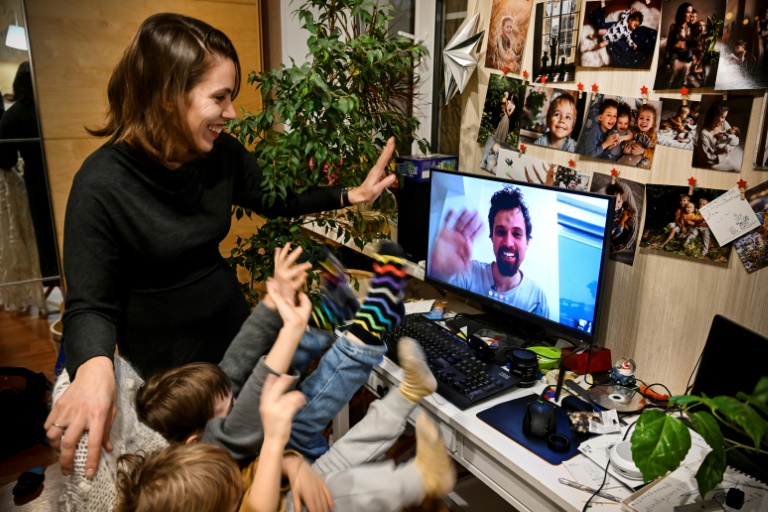
In their cosy family apartment in Moscow, Filimonova gathers her sons so their father can read them a bed-time story in a video call.

She sent him photos of pages to read, while their young offspring hold the book, making faces at the computer.

“I hope my children understand that their daddy is here, he loves them — even from Belgrade,” he told AFP.

Russia announced the end of mobilisation in late October but many abroad fear a second wave and Yaroslav sees “risks” in returning. 

He is also questioning if there’s “even anything to return to”, with authorities imposing controls over the tech sector and “all aspects of reality.”

– ‘Life and death’ choice –

Anastasia Arsenicheva, co-founder of a charity supporting mothers, said her organisation received a surge in calls after the mobilisation.

She said many women encouraged partners to leave, seeing it as a “choice between life and death”, but now are struggling.

“When a woman is in a vacuum completely alone, this is very scary,” Arsenicheva, a psychologist, said.

IT workers like Leonov can still support their families from abroad but this isn’t always the case, Arsenicheva added.

“There are some families where the man was the main breadwinner and it’s unclear how to support your life now,” she said. 

Alexandra, a 32-year-old full-time mother in Moscow, had to quickly find a way to get by after her husband, who works in cinema and advertising, left.

He first went to a small mountainous city in ex-Soviet Tajikistan and then onwards to neighbouring Uzbekistan, which has also become a centre for men evading the draft.

Alexandra previously did the occasional freelance knitting project that would cover the odd food shop while she looked after her seven-year-old daughter.

“When he left, it all fell on me,” she said, “and the family budget fell apart.”

She began to take on more projects and recently received an order to make more than 200 toys for the New Year, allowing her to employ several other women. She has also been restoring furniture and reselling it online.

She said she had “forgotten how to be self-sufficient… but when the guys left, we just had no choice!”

While she said she understood the decision of many men to leave — and even though the family’s future is uncertain — she is determined to stay put.

“I’m from Russia. I want to live in Russia. I never wanted to leave.”

Jubilation on Paris Champs-Elysees after France reach World Cup final

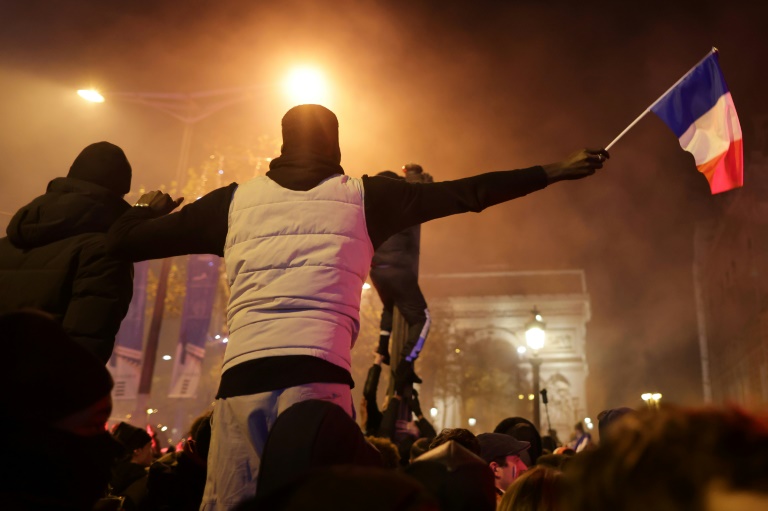
Waving tricolour flags and setting off flares, French supporters erupted in jubilation around the iconic Champs-Elysees avenue after France’s triumph over Morocco on Wednesday, which has put Les Bleus into the World Cup final. 

The celebrations were mostly peaceful around Paris, but there were some signs of unrest in other parts of the country, including a fatal post-match hit-and-run incident in the southern city of Montpellier.

About 10,000 police were mobilised across France, as authorities fretted over potential clashes between French supporters and those backing its one-time North African colony. 

As football lovers in Paris thronged to the end of the avenue leading to the Arc de Triomphe, the mood was impassioned but largely good-natured, with Moroccan supporters accepting defeat. 

“We are in the final. We are in the final,” hundreds of French supporters chanted as drivers sounded horns and anti-riot police lurked in vans lining the area.

A French anti-riot police van even used one of its sirens to mark the moment when Kolo Muani scored the goal to give France a 2-0 lead.

“What pleasure it will be to play Argentina in the final,” said Sylvain Badin, 24, clutching a French flag. “I came to share a moment of joy.”

Dozens of Moroccan fans also made themselves heard during the match in the area, swathing themselves in national flags as they followed the match on their phones.

“We lost but it’s only football and we made history by making the semi-finals. We are proud of our country and happy for France,” said Kamal Seddiki, a 22-year-old Moroccan student.

Some fans setting off fireworks around the Arc de Triomphe were dispersed by police.

And a group of about 40 people aligned with far-right groups were arrested for carrying prohibited weapons before they could get to the Champs-Elysees, a police source said.

“They clearly wanted to fight on the Champs,” the source said.

In total more than 100 arrests took place around the Paris area before 1:00 am on Thursday, the police said.

– Montpellier tragedy –

In the southern French city of Montpellier, tragedy struck after the game Wednesday night when a 14-year-old boy was killed by a “hit-and-run driver” who fled the scene, local authorities said in a statement.

French MP Nathalie Oziol expressed “immense sadness (that) a sporting event ends in absolute drama”.

“I offer my condolences to the family,” she said in a tweet.

In Nice, trash cans were set on fire after the game in the centre of the city where thousands had gathered, an AFP photographer said.

In France’s third-largest city Lyon, a concerto of horns also erupted after the match, but the scene of jubilation became tense when “a group of far-right youths approached fans”, said Lyon prefecture official. 

“There was a brawl and the police quickly intervened to push the group back,” the local source said. 

Police also used tear gas when supporters began to let off firecrackers in the central Place Bellecour.

The Lyon prefecture reported a total of seven arrests, including two from far-right groups. 

Nearby Annecy saw projectiles thrown at police, and a man was taken to the hospital after he was injured in a brawl.

And in the historic city of Avignon, there were 14 arrests — eight for firing mortars, according to a police report sent to AFP.

– ‘Happy for France’ –

France’s relationship with Morocco may not be as fraught as with Algeria, another former colony that fought a bloody seven-year War of Independence that scars both nations to this day.

But as in any post-colonial relationship, Morocco, which won independence in 1956, has its grievances with France, most notably over the question of visas.

More than a million Moroccans are believed to live in France and security forces had been on alert for any clashes like those in Brussels that marked Morocco’s shock win over Belgium in the group stages.

But 20-year-old Hossam Boutalah in the southwestern city of Bordeaux said he was “happy for France”.

The student donned a Moroccan flag on his back during the post-match celebrations in the port city’s central square.

“We are brothers after all, we are together. It is our second country,” Boutalah said.

Though “Morocco played well and would have deserved to score a goal.”

Fiji opposition calls for halt to election count after midnight 'anomaly'

Fiji’s opposition on Thursday demanded counting be stopped in the coup-prone nation’s bitterly-fought general election, alleging serious “anomalies” that put the legitimacy of the vote in doubt.

Voters across the chain of 300-plus South Pacific islands on Wednesday cast their ballots to elect a government for the next four years.

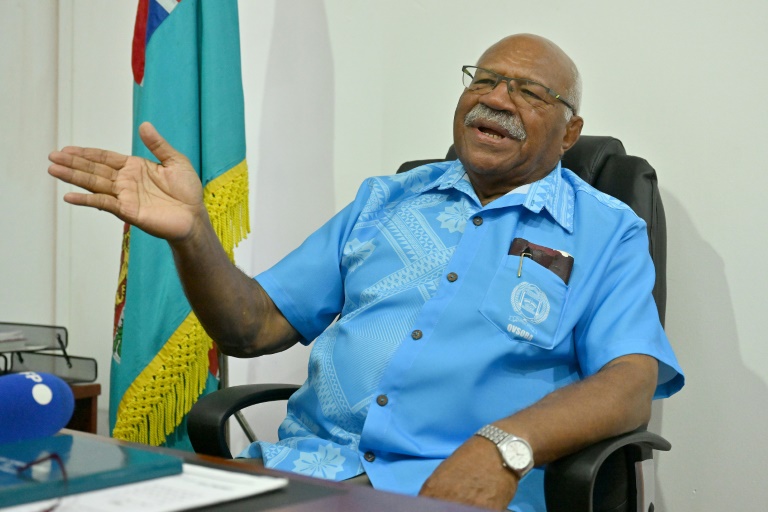
Two former military leaders are vying to be prime minister — incumbent Frank Bainimarama who came to power in a putsch 16 years ago, and Sitiveni Rabuka, a two-time coup leader nicknamed “Rambo”.

Fiji has endured four coups since 1987 and this year’s election was a test of its fledgling democracy.

Voting day passed without major incident, but the ongoing count has been marred by a late-night “glitch” that hid the tally from public view for four hours.

Rabuka had led the polls in very early results, lifting supporters’ hopes and raising the prospect of the first peaceful transition of power in two decades.

But when the system was restored just before dawn on Thursday, he was trailing Bainimarama by a significant margin.

After tense discussions with his staff at campaign headquarters, Rabuka told AFP he was planning a legal challenge.

“We will pursue every avenue available to us to make sure that the people are not denied their right of electing their government,” he said, with a copy Fiji’s constitution close at hand.

He and three other opposition leaders then raised the stakes further, threatening to boycott the next parliament if their demands for a halt to the count and an “urgent forensic audit” are not met.

Rabuka said he was also considering writing to the military to ensure the election was fair — but sought to assure the country that there “will not be a coup”.

Vote organisers have called the incident an “anomaly”, and pointed to provisional results that most observers agreed were improbable.

First returns showed a handful of little-known politicians gaining thousands of votes and polling well ahead of the major parties.

Fijian Elections Office boss Mohammed Saneem dismissed allegations of ballot rigging as “conspiracy theories”.

But Rabuka and the three other opposition leaders are not convinced.

“We are fed up with these rigged elections,” Fiji Labour Party leader and former prime minister Mahendra Chaudhry told reporters.

Bainimarama, the media-shy ex-commodore who won elections in 2014 and 2018, has so far been silent on the controversy.

The 97 members of the Multinational Observer Group present in Fiji to oversee vote counting have also avoided weighing in.

– Nervous wait –

Pacific analyst Tess Newton Cain said the glitch “may undermine confidence in the elections as a whole”.

“It will quite likely undermine confidence in the office of elections, and Saneem as supervisor,” added Newton Cain, who is Project Lead at Griffith University’s Pacific Hub.

Opinions were split among voters at the vast open-air market on Suva’s waterfront.

Rabuka supporter Jone Nheamauto encouraged the challenge and said he did not “trust” the electoral system.

Pravin Lal, 56, said he was happy to continue with the same government.

Final results are not expected until Sunday and may yet be further delayed, but partial tallies showed a tight race.

Bainimarama’s Fiji First party held around 45 percent of the vote, with more than half of the country’s 2,071 polling stations counted. 

Rabuka’s People’s Alliance and its coalition partner — the National Federation Party — had just under 42 percent between them.

Another potential coalition party is polling just under the five percent threshold to take a seat in parliament.

That fracturing of the opposition could once again deliver Bainimarama victory.

The result of the election holds significance well beyond Fiji.

Rabuka has signalled that Fiji — one of the most prosperous and influential nations in the South Pacific — could loosen its ties with China if he is elected. 

Fiji has grown closer to Beijing under Bainimarama, who used a “look north” policy to stabilise the economy after Australia and New Zealand hit the country with heavy trade sanctions in retaliation for his 2006 coup.

Family of dead activist to take Palestinian Authority to ICC

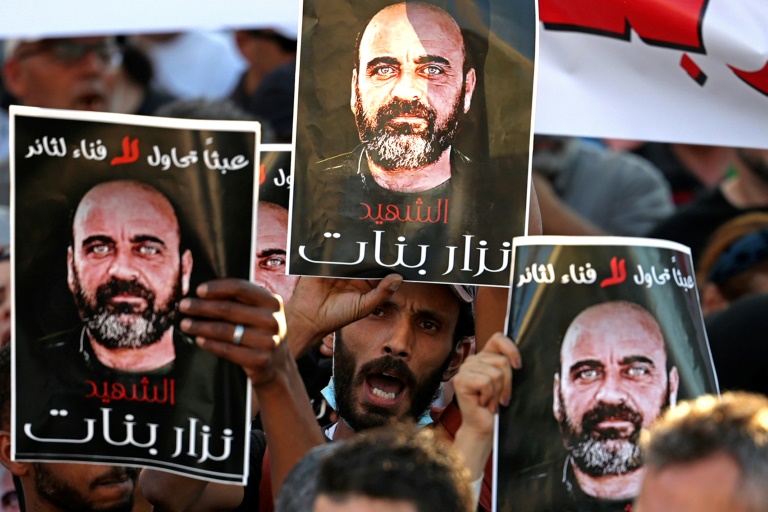
The family of Palestinian activist Nizar Banat will submit a case Thursday to the International Criminal Court accusing top Palestinian officials over his death in custody, relatives told AFP.

Banat, a leading critic of the Palestinian Authority led by Mahmud Abbas, died in June 2021 after being dragged from his home in the occupied West Bank by security forces.

A post-mortem found he had been beaten on the head, chest, neck, legs and hands, with less than an hour elapsing between his arrest and his death.

“We demand justice for a man who was doing nothing but speaking the truth to power,” said the family’s lawyer Hakan Camuz.

Any person or group can file a complaint to The Hague-based ICC prosecutor for investigation, but the court is not obliged to take them on.

The case to be lodged at ICC accuses seven Palestinian officials of responsibility for Banat’s death.

The decision to take the case to the ICC comes after 14 members of the Palestinian security forces were released on bail, pending their military trial in the West Bank over Banat’s death.

The activist’s brother, Ghassan Banat, said their release earlier this year left him believing “there is no justice enforcement.”

“At that time, we understood that the regime of the Palestinian Authority, the police, the security officers, have more authority than the court, that they were above the court,” he said.

“That is why we have decided to move on to the international arena”.

– Palestinians suspect officials –

The move marks the first time a Palestinian will lodge a complaint at the ICC against another Palestinian, according to the family’s lawyer.

Banat’s death sparked rare protests in Ramallah, seat of the Palestinian Authority, with demonstrators shouting “Justice for Nizar” and pressing Abbas to quit.

A poll last year by the Palestinian Center for Policy and Survey Research found 63 percent of Palestinians believe Banat’s death was “a deliberate measure ordered by the PA political or security leaders”.

The dissident’s brother said he was killed when he “challenged Mahmud Abbas and was telling people the truth about the real situation of the Palestinian Authority”.

Abbas has held office since 2005 and last year cancelled long-delayed elections.

The step by the Banat family follows the Al Jazeera broadcaster taking a case to the ICC last week over its slain reporter Shireen Abu Akleh, arguing she was deliberately shot dead by Israeli forces.

Abu Akleh was killed in May while covering an Israeli military raid in Jenin in the West Bank, which has been occupied by Israel since the 1967 Six-Day War.

Israel is not an ICC member and disputes the court’s jurisdiction.

More broadly, the court’s chief prosecutor announced last year that she has opened a full investigation into the situation in the Palestinian territories. 

The probe will focus on the actions of all parties in the 2014 Gaza war, as well as other incidents such as the killing by Israeli forces of protesters in the coastal Palestinian territory.

Let the good times roll? Bangkok becomes Southeast Asia's weed Wild West

From sleek boutiques to rickety stalls, hundreds of cannabis dispensaries have sprouted across Bangkok following decriminalisation, but in a nation once infamous for tough drug laws, Thai vendors are asking: can the high times last?

In a Southeast Asian first, the kingdom removed parts of the marijuana plant from its narcotics list in June, effectively legalising the substance -– albeit with a confusing lack of detail.

It could be a lucrative change for a tourism-heavy economy badly dented by the pandemic, with the University of Thai Chamber of Commerce predicting the market may be worth $1.2 billion by 2025.

But in the absence of clear regulations, Thailand is fast becoming a free-wheeling weed Wild West, sparking jitters among some suppliers that the rush may send everything up in smoke.

“The barrier to enter the market is so low,” said Kajkanit “Gem” Sakdisubha, who started growing cannabis after his father was diagnosed with cancer.

His shop, named The Dispensary — which looks more like a luxury goods store — places an emphasis on locally sourced weed, administered by expert “bud-tenders”.

“I know there’s a lot of groups and other people that jump into the business because they see money in it, and there’s not much passion in it,” he said.

Online map firm WEED.in.th has registered 1,750 stores –- with another 450 awaiting approval.

But sellers like Gem are anxious about what the government may do next.

“We need to see that plan in five and 10 years, not month-by-month,” he said.

“I know some people that close down shops because they have no certainty.”

– Political games –

A hasty roll-out saw celebrations and condemnations, with many voicing concern over the legal grey areas.

Furious debate also erupted after a photo of a pre-teen Thai boy smoking pot in early December went viral.

While the government tightened some rules around retailers earlier this month –- outlawing sales online and to people under 20 and pregnant women — debate on further restrictions is still raging in the Thai parliament.

In Bangkok’s posh Thonglor district, Zaza Medical truck vendors nervously wait for clarity on their legal status.

“Hopefully we can keep selling,” said part-owner and rapper Guygeegee.

While there are some medicinal benefits of cannabis use, public education is needed to ensure people are aware of the drug’s potential harm, said Thongchai Lertwilairattanapong of the Department of Thai Traditional Medicine.

“We aim to regulate cannabis like liquor or cigarettes,” he said. 

“People need to know the drawbacks of overconsuming liquor and cigarettes as well as cannabis, which is the new player in Thailand.”

Health experts warn extensive over-use can lead to drug-induced psychosis, while long-term use has been linked to asthma, cancers, memory loss and learning problems.

Bangkok-based Gloria Lai, regional director at International Drug Policy Consortium, said decriminalisation had come without proper preparation.

“The government has a responsibility… given their push for this to be available, to educate the public,” she said.

“It is a vacuum at the moment.”

– Confusion, chaos and cops –

“It’s a little bit confused,” said tourist Sasha Leehorpertien, gesturing at the scene around him in a basement cannabis cafe on Khaosan Road.

Never known for its restraint, Bangkok’s backpacking and binge-drinking hotspot has fully embraced the change, with retailers popping up along the length of the grubby street.

“It shouldn’t be like this,” the 23-year-old said, adding that while he fully supported legalisation, he was unaware of exactly what Thailand’s laws had to say about the joint he was smoking.

“I am afraid of jail here,” he added, surreptitiously leaving as a rowdy group of young, imbibing Croatians lit yet another blunt.

And it may be that the boom times are already over for some.

Police and officials raided Khaosan Road twice in December, detaining vendors allowing indoor smoking and arresting stall-owners who they said were operating without a licence.

But despite the uncertainty, Teetat Wonykhan, whose brother owns Ganja Kingdom on Khaosan Road, remains optimistic — the siblings even plan to open a second store.

High customers were infinitely preferable to drunk ones, Teetat said.

“They are really chill,” he said. 

“Most just come in and are like, ‘hey bro’.”

China recalls six diplomats over Manchester violence: UK

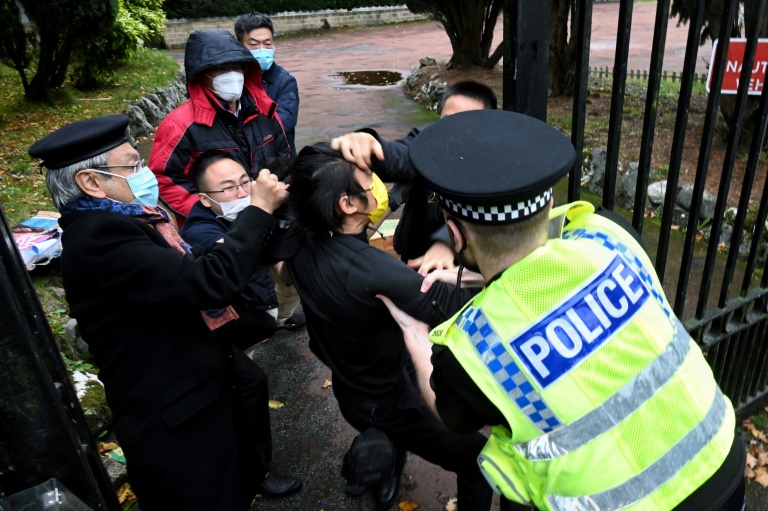
China has removed six diplomats from the UK, including its consul-general in Manchester, after they were accused of assaulting a Hong Kong protester in the northern English city, Britain said Wednesday.

UK Foreign Secretary James Cleverly said the six envoys had left the country by a Wednesday deadline imposed by London for them to waive their diplomatic immunity and be questioned by police over the October incident.

Greater Manchester Police launched a criminal probe after Hong Konger Bob Chan alleged Chinese diplomats subjected him to “barbaric” treatment — dragging him inside their compound to assault him — at an anti-Beijing protest.

“As part of that investigation, we requested that six Chinese officials waive diplomatic immunity so they can be questioned,” Cleverly said Wednesday.

He added that the Chinese embassy in London had been informed of the deadline for “them to take action”. 

“In response to our requests, the Chinese government has now removed from the UK those officials, including the consul-general himself,” Cleverly noted. 

Britain’s top diplomat said London’s response demonstrated its “adherence to the rule of law” as well as “the seriousness with which we take these incidents”. 

In response, China’s embassy to Britain issued a rebuke to Cleverly on Wednesday, saying he made “irresponsible comments by distorting facts”. 

“The British government failed to effectively prevent the intrusion and assault carried out by those rioters and to protect the premises and members of the Chinese Consulate General,” the Chinese embassy said in a statement posted on its website. 

“The UK side shows no respect for justice and the rule of law, and is being most irresponsible and disgraceful,” it said, adding that they had “launched solemn representations” with Britain over the issue.

– ‘Fled like cowards’ –

In October, the UK’s Foreign Office department summoned Yang Xiaoguang, China’s Charge d’Affaires in London, after footage emerged backing up the claims of the pro-democracy protester.

Senior ruling Conservative lawmakers had accused consul-general Zheng Xiyuan, one of China’s most senior UK diplomats, of being at the Manchester scene and ripping down posters during the peaceful protest.

The removal of the six Chinese envoys is likely to please hardliners on China in the Conservative party, who had demanded their expulsions and accused the UK government of appeasing Beijing.

MP Alicia Kearns, chair of parliament’s watchdog Foreign Affairs Committee, welcomed the development, saying the six had “fled the UK like cowards, making clear their guilt”.

“The Foreign Office must now declare those who have fled persona non grata, and make clear they are never again welcome in the UK,” she added in a statement.

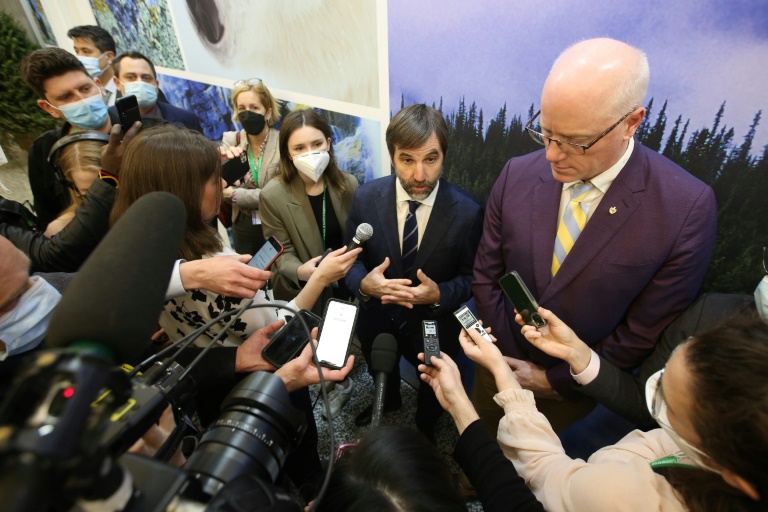
UN nature talks teeter on brink as ministers arrive for home stretch

Hopes of sealing a historic “peace pact with nature” at a United Nations biodiversity summit will soon rest on the world’s environment ministers, arriving in Montreal for the final phase of talks beginning Thursday.

Stark divisions remain to be bridged, foremost among them the subject of how much developed countries will pay the developing to help them save ecosystems, and whether there should be a new, dedicated fund for this purpose. 

At stake is the future of the planet and whether humanity can roll back habitat destruction, pollution and the climate crisis, which are threatening an estimated million species with extinction.

The draft agreement contains more than 20 targets, including a cornerstone pledge to protect 30 percent of the world’s land and seas by 2030, eliminate harmful fishing and agriculture subsidies, tackle invasive species and reduce pesticides.

“I hope what we would have at the end of this… is a Paris moment,” said Zakri Abdul Hamid, science advisor for the Campaign for Nature, referencing the landmark climate accord that agreed to hold long-term warming to 1.5 degrees Celsius.  

“Decades of study have also clarified what the world must do,” he added.

In the absence of heads of state and government, more than a hundred ministers will have to drag the text, three years in the making, over the finish line.

But its success still hangs in the balance after disagreements over the thorny issue of biodiversity financing led to a walkout by negotiators from developing nations overnight Tuesday and a temporary pause in talks.

– New fund sought –

The Global South, home to most of the world’s biological diversity, wants a new global biodiversity fund (GBF), something rich countries oppose — proposing instead making existing financial mechanisms more accessible. 

This debate mirrors a similar disagreement during recent UN climate talks in Egypt on creating a “loss and damages” fund for the most climate-vulnerable nations — though that demand was eventually met.

Dozens of nations, including Brazil, India, Indonesia and many African countries are also seeking funding of $100 billion yearly, or one percent of global GDP, until 2030. 

Current financial flows from high-income countries to lower income ones are in the order of $10 billion per year.

A crisis meeting of heads of delegations, organized on Wednesday by China, which is chairing the meeting, brought negotiators back to the table following the breakdown.

A Western negotiator who declined to be named told AFP: “The African group wants to reach an agreement with money in front, other developing countries too, but Brazil is using the financial question to derail the process.”

The source said the Brazilian delegation is still following the policies of outgoing far-right president Jair Bolsonaro, who is very close to the agricultural industry, which is hostile to reducing pesticide use.

Nevertheless, developing countries are angered by what they see as a lack of ambition.

“This has led to the negotiations now being on the edge of a full breakdown,” said Innocent Maloba of WWF International.

Beyond the moral implications, there is the question of self-interest: $44 trillion of economic value generation — more than half the world’s total GDP — is dependent on nature and its services.

The summit has failed to garner the same level of attention as the UN climate meeting held in Egypt in November, which brought together more than a hundred world leaders.

This meeting is being held in Canada after China declined to host because of its strict Covid rules, and Canada’s Prime Minister Justin Trudeau has been the only leader in attendance.

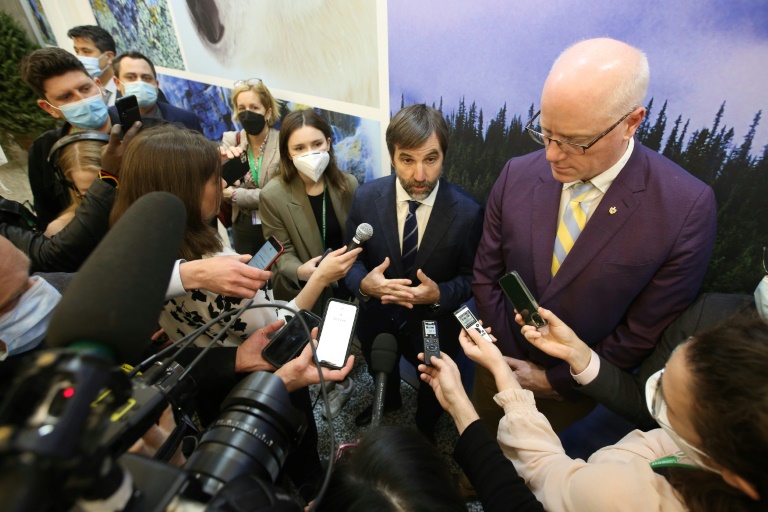
UN nature talks teeter on brink as ministers arrive for home stretch

Hopes of sealing a historic “peace pact with nature” at a United Nations biodiversity summit will soon rest on the world’s environment ministers, arriving in Montreal for the final phase of talks beginning Thursday.

Stark divisions remain to be bridged, foremost among them the subject of how much developed countries will pay the developing to help them save ecosystems, and whether there should be a new, dedicated fund for this purpose. 

At stake is the future of the planet and whether humanity can roll back habitat destruction, pollution and the climate crisis, which are threatening an estimated million species with extinction.

The draft agreement contains more than 20 targets, including a cornerstone pledge to protect 30 percent of the world’s land and seas by 2030, eliminate harmful fishing and agriculture subsidies, tackle invasive species and reduce pesticides.

“I hope what we would have at the end of this… is a Paris moment,” said Zakri Abdul Hamid, science advisor for the Campaign for Nature, referencing the landmark climate accord that agreed to hold long-term warming to 1.5 degrees Celsius.  

“Decades of study have also clarified what the world must do,” he added.

In the absence of heads of state and government, more than a hundred ministers will have to drag the text, three years in the making, over the finish line.

But its success still hangs in the balance after disagreements over the thorny issue of biodiversity financing led to a walkout by negotiators from developing nations overnight Tuesday and a temporary pause in talks.

– New fund sought –

The Global South, home to most of the world’s biological diversity, wants a new global biodiversity fund (GBF), something rich countries oppose — proposing instead making existing financial mechanisms more accessible. 

This debate mirrors a similar disagreement during recent UN climate talks in Egypt on creating a “loss and damages” fund for the most climate-vulnerable nations — though that demand was eventually met.

Dozens of nations, including Brazil, India, Indonesia and many African countries are also seeking funding of $100 billion yearly, or one percent of global GDP, until 2030. 

Current financial flows from high-income countries to lower income ones are in the order of $10 billion per year.

A crisis meeting of heads of delegations, organized on Wednesday by China, which is chairing the meeting, brought negotiators back to the table following the breakdown.

A Western negotiator who declined to be named told AFP: “The African group wants to reach an agreement with money in front, other developing countries too, but Brazil is using the financial question to derail the process.”

The source said the Brazilian delegation is still following the policies of outgoing far-right president Jair Bolsonaro, who is very close to the agricultural industry, which is hostile to reducing pesticide use.

Nevertheless, developing countries are angered by what they see as a lack of ambition.

“This has led to the negotiations now being on the edge of a full breakdown,” said Innocent Maloba of WWF International.

Beyond the moral implications, there is the question of self-interest: $44 trillion of economic value generation — more than half the world’s total GDP — is dependent on nature and its services.

The summit has failed to garner the same level of attention as the UN climate meeting held in Egypt in November, which brought together more than a hundred world leaders.

This meeting is being held in Canada after China declined to host because of its strict Covid rules, and Canada’s Prime Minister Justin Trudeau has been the only leader in attendance.

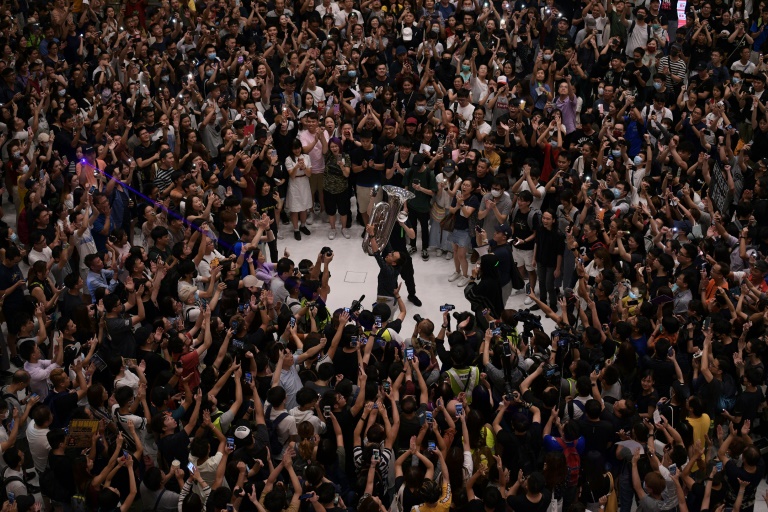
Google says does not change search results after Hong Kong anthem row

Google said Thursday it does not manipulate search results, after Hong Kong’s government said the tech giant had refused its demand to remove a popular protest song.

The controversy began after it emerged that links to the pro-democracy song “Glory to Hong Kong” appeared ahead of China’s official “March of the Volunteers” when people searched for the city’s anthem.

The song was accidentally played for Hong Kong athletes at two international sports events last month, prompting the demand from the Chinese city to remove it from search results.

“Google handles billions of search queries every day, so we build ranking systems to automatically surface relevant, high quality, and helpful information,” the tech giant told AFP in response to a query about the anthem request.

“We do not manually manipulate organic web listings to determine the ranking of a specific page,” it said in a statement.

Hong Kong’s security chief Chris Tang said Monday that Google had refused the city government’s request. He described the company’s explanation — that results were based on algorithms — as “evasive” and “inconceivable”.

Hong Kong leader John Lee said this week that Google had a “moral obligation” to respect a country’s national anthem.

The Chinese Foreign Ministry backed Lee, saying internet companies “have a duty to deliver correct information to the public”.

Google told AFP it was in contact with Hong Kong’s government to explain “how our platforms and removal policies work”.

“We do not remove web results except for specific reasons outlined in our global policy documentation.”

Both Tang and Lee have argued that Google search results can be manipulated, citing the placement of ads and the deletion of certain results to comply with privacy laws in the European Union.

Police have also been asked to investigate whether the anthem mix-up in South Korea was a violation of the city’s national security law, which Beijing imposed in 2020 to crush dissent after democracy protests.

Google’s search engine is banned in mainland China but is freely accessible in Hong Kong, where the firm also has an office.

It was among the tech companies that suspended cooperation with Hong Kong police on data requests after the security law came into effect.

This year, YouTube — a Google subsidiary — terminated Hong Kong leader Lee’s channel citing US sanctions.

Lee was among the officials sanctioned by the United States in 2020 for their role in curtailing civil liberties in Hong Kong.

Close Bitnami banner
Bitnami