World

'No space': German hospitals overwhelmed by sick kids

When Debora Zilz rushed her baby son Andreas to a Berlin hospital because of a serious respiratory illness, she got a shock. 

“There was no space,” she recalled. Medics desperately rang other hospitals in the German capital and neighbouring Brandenburg state in an effort to find a bed for the 13-day-old. 

“Finally, after a night in the accident and emergency department, we were able to stay here,” said the 33-year-old mother. 

Her son, whose weight at one point dropped to below his birth weight of 3.1 kilos (6.8 pounds) before recovering, is now in intensive care.

The baby is battling bronchiolitis, as Germany faces a winter wave of cases of the chest infection in infants, putting already strained hospitals under extra pressure.

After two years of the coronavirus pandemic which brought measures like face mask-wearing that shielded the country’s youngest from exposure to respiratory viruses, several European countries are seeing a surge in bronchiolitis. 

The situation is particularly bad in 2022 as newborns and infants are exposed to the respiratory syncytial virus (RSV), which commonly causes bronchiolitis, for the first time.

The paediatric care team at Saint Joseph’s in Berlin, where the youngster was being treated, is struggling to handle the surge with a smaller number of staff than ever before. 

“We are underwater,” Beatrix Schmidt, head of the hospital’s paediatric and neonatology department, told AFP.

A perfect storm of factors have contributed to the problem, Schmidt said — “an incredible number of sick children, infected caregivers, and all that at the same time as chronic staff shortages”.

– ‘Children pay the price’ –

In the down-at-heel neighbourhood of Tempelhof, close to central Berlin, Saint Joseph’s normally has 80 beds for sick children. But due to staff shortages, only 51 can currently be used. 

Even in the intensive care unit, beds have had to be closed — and all 18 that remain are occupied.

As in Andreas’s case, medics are frequently finding they have no space for new patients and have to call around to other hospitals. 

Many sick children have even had to be transported by helicopter to regions further afield, such as the northeastern state of Mecklenburg-West Pomerania, and the coastal state of Lower Saxony. 

According to figures from the Robert Koch health institute, 9.5 million people in Germany were last week affected by some sort of respiratory illness, across all age groups, in a country of 84 million.

The figure is well above that during the same period in 2021, and is higher than at the peak of the 2017-18 flu epidemic. 

Schmidt believes many problems are caused by cost-cutting.

“For years, we have made savings when it comes to our health system. And children are the first to pay the price,” said the 63-year-old. 

– Low salaries, underinvestment –

Currently there are 18,000 hospital beds for children in Germany, down from 25,000 in 1995, according to the federal statistics agency. 

Germany, with an ageing population and fewer children than even many of its European neighbours, has been investing little in paediatric care, according to Schmidt. 

Children “don’t vote and we don’t make money treating kids”, she said. 

Health care reforms aimed at reducing costs have been particularly damaging for paediatric care, while medical professions are struggling to attract new entrants, critics say. 

“Many paediatricians are going to retire in the coming years,” said Schmidt, who is herself preparing to leave her position.

The younger generation want to combine work and family, a challenge in a profession that often requires long and unpredictable hours, she said. 

And in an affluent country like Germany, salaries of caregivers often leave a lot to be desired. 

“In my opinion, they are underpaid,” said Schmidt. “They work a lot — at nights, on weekends.”
UK nurses begin unprecedented walkout

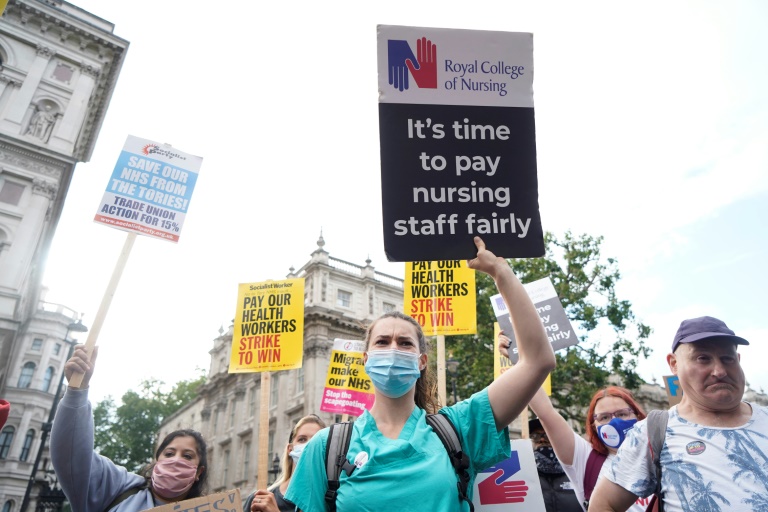
UK nurses on Thursday begin an unprecedented strike as a “last resort” in their fight for better wages and working conditions, despite warnings it could put patients at risk.

Up to 100,000 members of the Royal College of Nursing (RCN) in England, Wales and Northern Ireland are holding a one-day stoppage from 0800 to 2000 GMT after rejecting a government pay offer.

Ameera, a senior nurse in London, told AFP that “we have not chosen industrial action lightly”. The strike is the first in the Royal College of Nursing union’s 106-year history.

“We’re tired. We’re fed up,” added the nurse, who asked that her last name not be reported. “We need a pay rise now to make a living.”

The UK is currently grappling with a cost-of-living crisis as spiralling inflation outstrips wage growth.

Union leaders and health workers also said nurses were being overworked due to staff shortages, as the state-run National Health Service (NHS) battled a backlog in appointments made worse by cancellations during the pandemic.

Chemotherapy, dialysis, intensive care and high-dependency units, as well as neonatal and paediatric intensive care will be protected.

But other services will be reduced to Christmas staffing levels during the walk-out, the RCN said.

– Care concern –

Health chiefs warned unions that care levels could suffer because of the walkout, just as seasonal respiratory conditions such as flu add pressure on already stretched services.

Cally Palmer, national cancer director for England, called on the union to exempt cancer surgery from the walkout, while England’s chief nursing officer expressed concern over the strike staffing plans. 

“We hear from our colleagues that they are concerned by the assumption, implied by the RCN, that night duty staffing on day duty is safe,” Ruth May wrote in a letter to the RCN. 

“Ward activities during the day are very different to those at night. 

“This decision has the potential to significantly impact on the safety of patient care (for example, by impacting delivery of intravenous antibiotics on time, patient observations and medication rounds),” she added.

The RCN’s industrial action is part of a growing wave of stoppages by public and private sector employees.

Healthcare unions say their members are skipping meals, struggling to feed and clothe their families, and leaving the NHS in droves.

But successive below-inflation awards since 2010 have left experienced nurses worse off by 20 percent in real terms, they say.

The RCN wants a pay rise significantly above inflation which surged to a 41-year high of 11.1 percent in October, falling slightly to 10.7 percent last month. 

The government maintains the demands are unaffordable and Health Secretary Steve Barclay called the strikes “deeply regrettable”.

– Struggle –  

RCN general secretary Pat Cullen has offered to “press pause” on the strikes if Barclay agreed to talks.

But Barclay insisted that while he was open to talks on wider issues, the pay settlement was recommended by an independent review body and would not be reopened.

The NHS Pay Review Body recommended a pay rise of at least £1,400 ($1,740) on top of a 3.0 percent pay rise last year, he said.

“Further pay increases would mean taking money away from frontline services at a time when we are tackling record waiting lists as a result of the pandemic,” he added.

The main opposition Labour party leader Keir Starmer called the strike a “badge of shame” for the ruling Conservative government.

Accident and emergency staff nurse Mark Boothroyd, 37, said the cost-of-living crisis had left nurses struggling to pay bills, transport and rent.

Poor pay meant newly qualified nurses now spend only a year or two before leaving the profession, said Boothroyd, who works at St Thomas’ Hospital in central London.

The resulting unfilled vacancies have put huge pressure on remaining staff, many of whom were reporting mental health problems from stress.

Conditions were “horrendous and cannot be allowed to go on”, he added.

EU meets facing subsidy race with US in trade spat

EU leaders meeting in Brussels on Thursday will focus on a trade dispute with key ally the United States that threatens to trigger a subsidy race between the economic superpowers.

European Commission chief Ursula von der Leyen sent a letter ahead of the summit urging leaders to back a plan to compete with billions of dollars in new US subsidies and tax cuts for car makers.

Brussels views the “Buy American” condition for purchasers of electric vehicles mainly made in the United States as discriminatory against European car manufacturers.

It is also concerned Washington’s plan will drain investment from the EU to the United States and that they violate World Trade Organization (WTO) rules.

But, with US President Joe Biden refusing to change course beyond some promised “tweaks”, the commission is now looking to match the US move by loosening its own state aid rules and boosting public investment in cleaner energy.

Von der Leyen said the e-vehicle subsidies contained in a broader US Inflation Reduction Act (IRA) “risk un-levelling the playing field and discriminating against European companies”.

The EU emphasises its close cooperation with the United States — especially on supporting Ukraine and fighting climate change. 

But it is worried Washington is working up a trade advantage over it while it was going through an energy crunch, economic headwinds and was still recovering from the coronavirus pandemic.

– Against a ‘trade war’ –

German Chancellor Olaf Scholz, whose country is the EU’s main car exporter, said Wednesday that Europe was united in the dispute, but should solve it through talks “rather than a big conflict”.

Commission Vice President Margrethe Vestager told the European Parliament the US move was “counter-productive in terms of climate and sustainability… it’s also a violation of international trade rules”.

She added: “We already have war in Europe. The last thing we need is a trade war on top.”

Von der Leyen’s spokeswoman sought to calm the rhetoric, insisting the commission was avoiding any mention of “a subsidy race, or on anything linked to a trade war”.

She and other officials emphasised that talks were continuing with the US administration on the issue through a special task force, and preferred that route before resorting to the WTO.

The EU summit was to also examine the situation, and consequences in Europe, of Russia’s war in Ukraine, which European Council President Charles Michel said was at “the heart of our concerns”.

The gathering was set to be less fractious than initially feared, after EU member Hungary this week dropped its veto of 18 billion euros ($19 billion) in financial aid to cash-strapped Kyiv.

In exchange, the bloc’s other countries agreed to reduce the amount of EU funds frozen because of Hungary’s democratic backsliding to 6.3 billion euros, from 7.5 billion euros initially recommended by the commission. 

Another 5.8 billion euros from a post-Covid recovery fund was conditionally approved for disbursement next year — if Budapest showed progress in restoring EU rule of law.

EU meets facing subsidy race with US in trade spat

EU leaders meeting in Brussels on Thursday will focus on a trade dispute with key ally the United States that threatens to trigger a subsidy race between the economic superpowers.

European Commission chief Ursula von der Leyen sent a letter ahead of the summit urging leaders to back a plan to compete with billions of dollars in new US subsidies and tax cuts for car makers.

Brussels views the “Buy American” condition for purchasers of electric vehicles mainly made in the United States as discriminatory against European car manufacturers.

It is also concerned Washington’s plan will drain investment from the EU to the United States and that they violate World Trade Organization (WTO) rules.

But, with US President Joe Biden refusing to change course beyond some promised “tweaks”, the commission is now looking to match the US move by loosening its own state aid rules and boosting public investment in cleaner energy.

Von der Leyen said the e-vehicle subsidies contained in a broader US Inflation Reduction Act (IRA) “risk un-levelling the playing field and discriminating against European companies”.

The EU emphasises its close cooperation with the United States — especially on supporting Ukraine and fighting climate change. 

But it is worried Washington is working up a trade advantage over it while it was going through an energy crunch, economic headwinds and was still recovering from the coronavirus pandemic.

– Against a ‘trade war’ –

German Chancellor Olaf Scholz, whose country is the EU’s main car exporter, said Wednesday that Europe was united in the dispute, but should solve it through talks “rather than a big conflict”.

Commission Vice President Margrethe Vestager told the European Parliament the US move was “counter-productive in terms of climate and sustainability… it’s also a violation of international trade rules”.

She added: “We already have war in Europe. The last thing we need is a trade war on top.”

Von der Leyen’s spokeswoman sought to calm the rhetoric, insisting the commission was avoiding any mention of “a subsidy race, or on anything linked to a trade war”.

She and other officials emphasised that talks were continuing with the US administration on the issue through a special task force, and preferred that route before resorting to the WTO.

The EU summit was to also examine the situation, and consequences in Europe, of Russia’s war in Ukraine, which European Council President Charles Michel said was at “the heart of our concerns”.

The gathering was set to be less fractious than initially feared, after EU member Hungary this week dropped its veto of 18 billion euros ($19 billion) in financial aid to cash-strapped Kyiv.

In exchange, the bloc’s other countries agreed to reduce the amount of EU funds frozen because of Hungary’s democratic backsliding to 6.3 billion euros, from 7.5 billion euros initially recommended by the commission. 

Another 5.8 billion euros from a post-Covid recovery fund was conditionally approved for disbursement next year — if Budapest showed progress in restoring EU rule of law.

ECB tipped to follow Fed with smaller rate hike

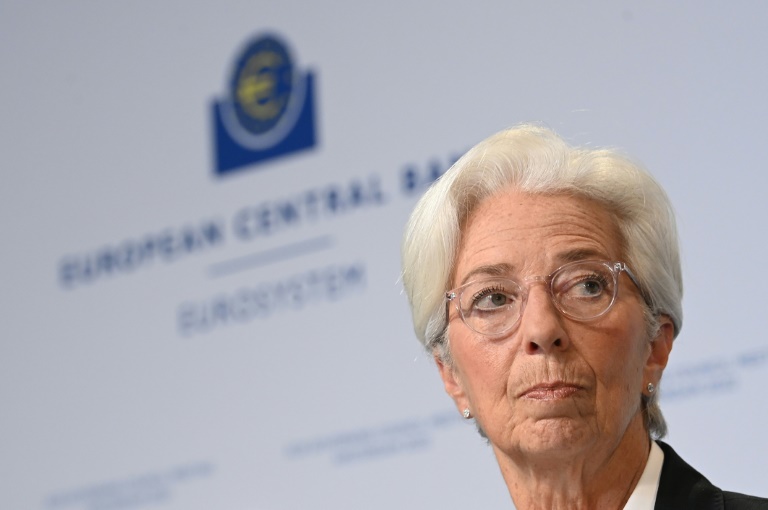
The European Central Bank is expected to follow the US Federal Reserve’s lead on Thursday and opt for a smaller interest rate hike, analysts said, on signs that red-hot inflation is finally easing.

The ECB has been hiking rates at what president Christine Lagarde has called “the fastest pace ever” to bring down record-high inflation after Russia’s war in Ukraine sent food and energy costs soaring.

But following two straight increases of 75 basis points, policymakers in Frankfurt are tipped to downshift to a 50 basis-point rate hike in their final meeting of 2022.

Analysts say policymakers may point to the latest inflation data to justify a slower pace, which showed eurozone consumer prices unexpectedly decelerating in November for the first time in 17 months, to 10 percent.

The early Christmas present could “take away some of the urgency to continue with jumbo rate hikes”, said ING bank economist Carsten Brzeski, even if a 75-basis-point hike is “still on the table”.

The ECB’s chief economist Philip Lane hinted at a slightly less aggressive pace last week when he said it was “likely we are close to peak inflation”. 

And although more rate increases would be needed to return inflation to the bank’s two-percent target, Lane said “a lot has been done already”.

A half-point move would mirror the action taken by the US Federal Reserve on Wednesday, after four previous 75-point hikes.

In a key week for central bankers, Ipek Ozkardeskaya, senior analyst at Swissquote Bank, predicted “a deluge of 50 basis-point hikes”, with the Bank of England likely opting for its own half-point rise on Thursday.

The BoE had in early November announced its biggest hike in 33 years to fight sky-high inflation that it warned was pushing Britain into a recession that could last until mid-2024.

– Recession fears –

Central bankers around the world are walking a fine line between raising borrowing costs to cool inflation, without dampening demand so much it triggers an economic downturn.

The ECB’s three main interest rates are currently sitting in a range of between 1.5 and 2.25 percent.

The bank’s next rate move will be guided by the latest economic forecasts, to be released on Thursday, including its first-ever inflation estimate for 2025.

The new forecasts are also expected to show the eurozone economy contracting in the final quarter of 2022 and first quarter of 2023 — meeting the technical definition of a recession.

But analysts say the winter recession could be a mild one, in part thanks to European governments unleashing massive support packages to steer households and businesses through the energy crisis.

Berenberg Bank economist Holger Schmieding urged the ECB not to “overdo its response to inflation”, warning that further aggressive rate hikes could make the recession “even more painful”.

ECB policymakers will also be taking a close look at wage growth in weighing their next steps, although analysts say the dreaded “wage-price spiral” has not yet materialised in the eurozone.

Lagarde however may face questions at her afternoon press conference on the ECB’s own rumbling pay dispute, after staff voiced unhappiness over a proposed below-inflation salary increase in January.

– Excess liquidity –

In line with its monetary policy tightening, the ECB will on Thursday shed more light on plans to slim down the bank’s massive balance sheet.

It has already toughened the terms of an ultra-cheap bank loan scheme, aimed at keeping credit flowing during the pandemic, in a bid to incentivise early repayment of so-called TLTRO loans.

The move appears to be paying off, with eurozone lenders handing back around 750 billion euros ($790 billion) in TLTRO cash since October.

Analysts are also eager to hear how and when the ECB plans to start shrinking its five-trillion-euro bond portfolio, after years of hoovering up government and corporate debt.

The ECB has already indicated that the process of “quantitative tightening” — letting the bonds mature or actively selling them — would be gradual and predictable to avoid spooking financial markets.

Asian markets sink with Wall St on hawkish Fed outlook

Asian equities fell Thursday after the Federal Reserve signalled US interest rates would go higher than expected and warned the world’s biggest economy would grow less than expected next year, fanning fears a recession is on the way.

Traders took their lead from Wall Street, where a more hawkish statement than expected dented hopes the central bank could soften its approach to fighting inflation.

Markets had rallied after data on Tuesday showed the consumer price index rose less than forecast in November, marking a fifth straight slowdown and the lowest level since December last year.

But the Fed appeared less inclined to accept that the recent figures were enough to indicate enough progress was being made.

While it lifted rates by the expected 50 basis points — down from the previous four 75-point hikes — its “dot plot” of forecasts suggested it saw them top out next year at 5.1 percent, higher than markets had predicted.

“Fifty basis points is still a historically large increase, and we still have some ways to go,” Fed boss Jerome Powell told reporters after the announcement.

He added that he “wouldn’t see us considering” any cuts until officials were happy that inflation was on track to its two percent target.

“It will take substantially more evidence to give confidence that inflation is on a sustained downward path,” he said.

The Fed also cut its expectations for growth next year as it faced headwinds from the tighter monetary policies, stirring fresh warnings of a recession, which have weighed on equities for much of the year.

But Powell said: “I don’t think anyone knows whether we’re going to have a recession or not, and if we do, whether it’s going to be a deep one or not.”

– ‘Worried about a recession’ –

After Wall Street’s retreat, Asia fell into the red, with Hong Kong, Shanghai, Tokyo, Sydney, Seoul, Taipei, Manila and Jakarta all down.

“The Fed did not welcome the disinflation trends that have just started to emerge and focused on robust job gains and elevated inflation,” said OANDA’s Edward Moya.

“Any hopes of a soft landing disappeared as the Fed seems like they are committed to taking rates much higher.”

Despite the tougher talk from the Fed, Tomo Kinoshita at Invesco Asset Management said: “US shares have seen limited falls, indicating that financial markets are not wholeheartedly believing in that hawkishness, perhaps because some Fed policymakers have talked about the possibility of rate cuts already.”

But he added: “Long-term bond yields appeared to have peaked out, which is a sign investors are now worried about a recession.”

The likelihood of rates going even higher outweighed hopes about China’s emergence from nearly three years of strict zero-Covid containment measures that have crippled its economy.

While the reopening is expected to provide a much-needed boost to growth, there is an immediate worry about the impact of soaring infection numbers on the healthcare system and firms’ ability to function.

And in a sign of the effect of the anti-Covid strategy, data on Thursday showed retail sales fell more than expected in November, industrial output growth slowed and investment weakened.

And analysts warned there would not likely be any improvement this month.

– Key figures around 0300 GMT –

Tokyo – Nikkei 225: DOWN 0.3 percent at 28,081.55 (break)

Hong Kong – Hang Seng Index: DOWN 1.9 percent at 19,309.24

Shanghai – Composite: DOWN 0.3 percent at 3,166.04

Euro/dollar: DOWN at $1.0655 from $1.0684 on Wednesday

Dollar/yen: UP at 135.57 yen from 135.45 yen

Pound/dollar: DOWN at $1.2392 from $1.2424

Euro/pound: UP at 85.98 pence from 85.96 pence

West Texas Intermediate: DOWN 0.8 percent at $76.66 per barrel

Brent North Sea crude: DOWN 0.7 percent at $82.17 per barrel

New York – Dow: DOWN 0.4 percent at 33,966.35 (close)

London – FTSE 100: DOWN 0.1 percent at 7,495.93 (close)

ICC to rule on appeal by Ugandan former child soldier

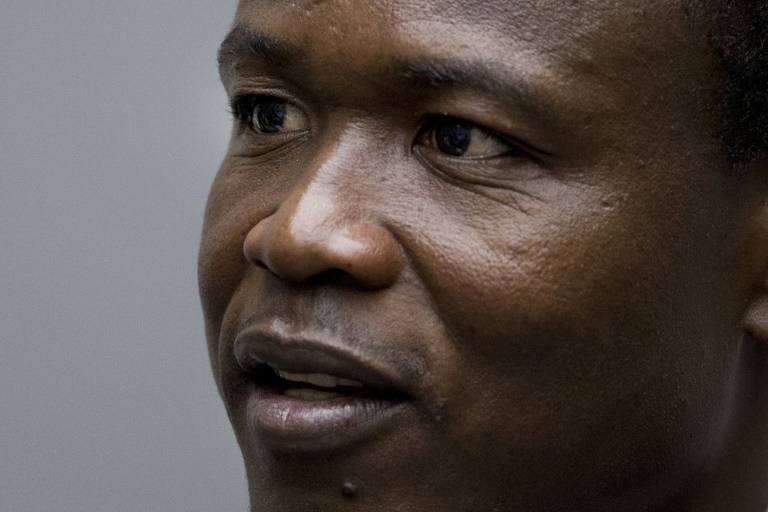
The International Criminal Court will decide Thursday on an appeal by a Ugandan child soldier-turned-commander in the Lord’s Resistance Army against his conviction and 25-year sentence for war crimes.

Dominic Ongwen, who was abducted aged nine by the rebel group led by the fugitive Joseph Kony, was found guilty last year of murder, rape and sexual enslavement in northern Uganda during the early 2000s.

The LRA was founded three decades ago by former Catholic altar boy and self-styled prophet Joseph Kony, who launched a bloody rebellion in northern Uganda against President Yoweri Museveni.

Judges will read the verdict from 1030 GMT at the ICC’s high-security headquarters in The Hague, where Ongwen’s trial had started six years ago, in what is expected to be a lengthy session.

Defence lawyers argued earlier this year that Ongwen’s conviction and sentence should be overturned as he had been scarred by his own experience as a child soldier.

“Dominic Ongwen was, and still is, a child,” Ongwen’s defence lawyer Krispus Ayena Odongo told the court in February, adding that Ongwen still believed he was “possessed” by the spirit of Kony.

ICC prosecutor Karim Khan said last month said he would ask judges to confirm charges against Kony in his absence, as he remains at large.

– ‘Proxy prosecution’ –

The LRA’s bid to set up a state based on the Bible’s Ten Commandments killed more than 100,000 people and saw 60,000 children abducted, spreading to Sudan, the Democratic Republic of Congo and Central African Republic.

Ongwen, whose nom de guerre was “White Ant”, was found guilty on 61 charges of war crimes and crimes against humanity, which also included charges of himself turning young abductees into child soldiers.

Prosecutors portrayed Ongwen as leading a reign of terror by the LRA, personally ordering the massacres of more than 130 civilians at the Lukodi, Pajule, Odek and Abok refugee camps between 2002 and 2005.

Judges ruled that Ongwen had not suffered from mental illness despite his own history of being abducted on his way to school by the LRA, described by experts as one of Africa’s “most brutal militia forces”.

But Ongwen’s lawyers have appealed the conviction on 90 different grounds and the sentence on 11, saying there were errors in “law, fact and procedure”.

“The trial was a proxy prosecution, a prosecution of the LRA using (Ongwen), a child soldier, as a scapegoat,” Krispus Ayena Odongo said in court papers.

Kony should be in the dock instead of Ongwen, since it was he who had decided on the distribution of women and children as sex slaves, he added.

“Kony remains unapprehended; he has escaped the tentacles of various states,” Odongo added.

Biden seeks principled Africa partnership as US businesses pour in

President Joe Biden called Wednesday for a long-term partnership with Africa rooted in good governance as US businesses unveiled billions of dollars led by tech investment for a continent where China has become a top player.

Addressing a summit that brought 49 African leaders to the Washington cold, Biden avoided uttering China’s name but made clear the United States would take a different approach.

At the first such gathering since Barack Obama invited African leaders in 2014, Biden said the United States sought “partnerships — not to create political obligation, to foster dependence, but to spur shared success and opportunity.”

“When Africa succeeds, the United States succeeds. Quite frankly, the whole world succeeds as well,” the president said.

The Biden administration is laying out more than $55 billion in support over the three-day summit and on Wednesday welcomed US and African businesses, which promised more than $15 billion in trade deals.

In an implicit contrast with China, which takes a hands-off approach in countries where it invests, Biden highlighted “the core values that unite our people — all our people, especially young people: freedom, opportunity, transparency, good governance.”

Africa’s economic transition, he said, “depends on good government, healthy populations and reliable and affordable energy.”

Biden stayed uncharacteristically brief, saying leaders likely wanted to see the World Cup, and watched a semi-final with the prime minister of Morocco, the first African nation to advance so far in the football tournament.

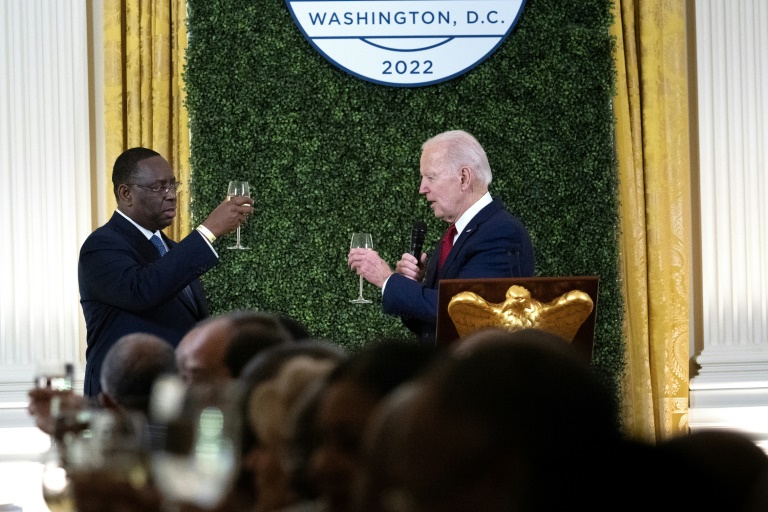
Biden later invited the leaders to the White House to a dinner of sea bass and black-eyed peas and a performance by Gladys Knight.

In a toast, Biden spoke of the “unimaginable cruelty” of “my nation’s original sin” — the enslavement of Africans — and hailed the contributions of the diaspora.

“Our people lie at the heart of the deep and profound connection that forever binds Africa and the United States together,” Biden said.

– Pushing tech investment –

China in the past decade has surpassed the United States on investing in Africa via highly visible infrastructure projects, often funded through loans that have totaled more than $120 billion since the start of the century.

Defense Secretary Lloyd Austin on Tuesday warned African leaders that both China and Russia were “destabilizing” the continent, saying Beijing’s mega-contracts lacked transparency.

Biden announced a $100 million aid package for clean energy and the White House unveiled another $800 million in public and private financing for digital development in Africa.

In one of the biggest corporate announcements, Visa said it would pump $1 billion into Africa to develop digital payments — an area in which China has emerged as a global leader.

Cisco and partner Cybastion said they would commit $858 million to bolster cybersecurity through 10 contracts across Africa, addressing a key vulnerability, and the ADB Group promised $500 million starting in Ivory Coast for cloud technology centers that can draw major US firms.

Microsoft said it would employ satellites to bring internet access for the first time to some 10 million people, half of them in Africa, starting in Egypt, Senegal and Angola.

In Africa, “there is no shortage of talent, but there is a huge shortage of opportunity,” Microsoft president Brad Smith told AFP.

– Putting standards on aid –

China denies US accusations it is imposing a “debt trap” in Africa and in turn has accused Washington of turning the continent into a geopolitical battlefield.

The United States has made much of its infrastructure aid conditional on democratic standards.

Biden announced that four nations — Gambia, Mauritania, Senegal and Togo — were selected to design future US grants through the Millennium Challenge Corporation, which funds projects in countries that meet key standards on good governance.

Secretary of State Antony Blinken took part in the signing of a $504 million infrastructure package through the corporation that will connect Benin’s port of Cotonou with landlocked Niger’s capital Niamey, with US officials estimating 1.6 million people will benefit.

“For a long time we’ve considered this to be our natural port,” Niger’s President Mohamed Bazoum said, as he promised “institutional reforms” to support trade.

Benin’s President Patrice Talon thanked the United States for addressing development, saying: “The attractiveness of Africa must be a part of the relationship with the US.”

Blinken said the deal will not “saddle governments with debt.”

“Projects will bear the hallmarks of America’s partnership,” Blinken said. “They’ll be transparent. They’ll be high quality. They’ll be accountable to the people that they mean to serve.”

Tunisia awaits languid election for powerless parliament

Tunisians are to vote Saturday on a parliament largely stripped of its powers, the final pillar of a hyper-presidential system installed by President Kais Saied after a power grab last year.

Over a decade since the country’s revolution that unseated dictator Zine El Abidine Ben Ali, opposition parties have urged a boycott of the poll, which they say is part of a “coup” against the only democracy to have emerged from the 2011 Arab Spring uprisings.

The election for the new 161-seat assembly comes after Saied froze its predecessor on July 25 last year, following months of political crisis exacerbated by the coronavirus pandemic.

He later dissolved the body, long dominated by his nemesis the Islamist-inspired Ennahdha party.

Saied on Wednesday defended his decision, saying: “Tunisian people wherever I went were all asking to dissolve the parliament.”

“The country was on the brink of civil war,” he told US Secretary of State Antony Blinken in Washington.

The previous legislature had far-reaching powers, in the mixed presidential-parliamentary system enshrined in the North African country’s post-revolt constitution.

In July this year, Saied used a widely shunned referendum to push through a new constitution, stripping parliament of any real clout and giving his own office almost unlimited powers.

– ‘Rump parliament’ –

Analyst Hamadi Redissi said the aim of Saturday’s polls was “to complete the process that started on July 25” last year.

The resulting parliament “won’t have many powers — it won’t be able to appoint a government or censure it, except under draconian conditions that are almost impossible to meet”. 

Saied’s new system essentially does away with political parties and electoral lists, meaning candidates will be elected as individuals with no declared affiliation.

The assembly’s final make-up is not expected to be determined until March next year, after any second-round run-offs have been completed.

The vote aims “to increase the legitimacy of the presidency”, Redissi said, adding that the result would be “a rump parliament without any powers”.

Almost all the country’s political parties, including Ennahdha, have said they will boycott the vote, labelling Saied’s moves a “coup”.

The powerful UGTT trade union federation, which did not openly oppose the initial power grab, has called the poll meaningless.

Most of the 1,058 candidates are unknowns.

The Tunisian Observatory for Democratic Transition says some 26 percent are teachers, and a further 22 are mid-level public servants.

The election result will likely see a drop in the representation of women, with just 122 female candidates.

– ‘Bad to worse’ –

Few of the country’s nine million registered voters expected to turn out.

Several young people told AFP they had little interest in the election or desire to know more about the candidates.

Marwa Ben Miled, a 53-year-old shopkeeper, told AFP the country was “going from bad to worse”.

“What happens on the political scene doesn’t interest me anymore,” she said. “I don’t trust anyone.”

Saied’s electoral law forbids candidates from speaking to the foreign press, a stance the North Africa Foreign Correspondents’ Club said would make it difficult for journalists to do their jobs.

Saied has made several public appearances, meeting market traders in the Old City of Tunis in the run-up to the vote.

Some social media users have posted satirical images ridiculing the vote.

In one video, a mock candidate appears with a cigar and smelling a posy of jasmine, before giving a donation to a pair of musicians who then shout pro-Saied slogans.

Several hundred tourists stranded at Machu Picchu amid protests

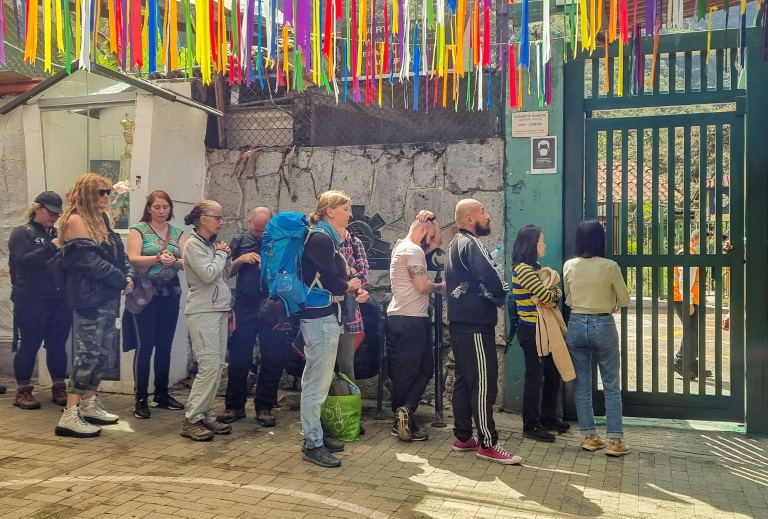
Hundreds of foreign tourists were stranded Wednesday in Peru’s renowned Machu Picchu region after train service was suspended due to violent protests following the ouster and arrest of ex-president Pedro Castillo.

A state of emergency was declared earlier Wednesday as Castillo’s supporters have taken to the streets and set up roadblocks countrywide in protests against new President Dina Boluarte that have left seven people dead and 200 injured. 

Officials said nearly 800 tourists of varying nationalities had become stranded since Tuesday. 

They were stuck in the town at the base of the mountain where Machu Picchu, the most important attraction in Peruvian tourism and a UNESCO World Heritage site, is located.

Israeli tourist Gale Dut was unable to return to Cusco to catch a flight out of the country.

“I’m with my kids. For me, it’s a problem,” Dut told AFP. 

One Belgian tourist, who identified himself as Walter, said it is “not clear” how he will be able to return home if he is not able to get back to Cusco in order to catch a flight to Lima.

The train service that connects the famed Incan temple with Cusco, the ancient empire’s capital city, is the only way to get to Machu Picchu, about 70 miles (110 kilometers) away. 

Trains were suspended Tuesday as Indigenous and agrarian organizations called for an indefinite strike as part of the protests that began Monday in Cusco, with marches, attacks on public spaces and attempts to take over the city’s international airport. 

The small town’s mayor Darwin Baca called for humanitarian help from the government, seeking helicopters to help evacuate tourists from the United States, Mexico and Spain. 

The country plunged into crisis last week when Castillo tried to dissolve Congress and rule by decree, but was quickly impeached by lawmakers and arrested.

The new president, Boluarte, has struggled to quell tensions, and has now called for the next election — normally due in 2026 — to be brought forward to December 2023, after an earlier bid to hold them in 2024 failed to halt the protests.

Close Bitnami banner
Bitnami