World

Far-right writer in Swiss court claims facing LGBTQ 'harassment'

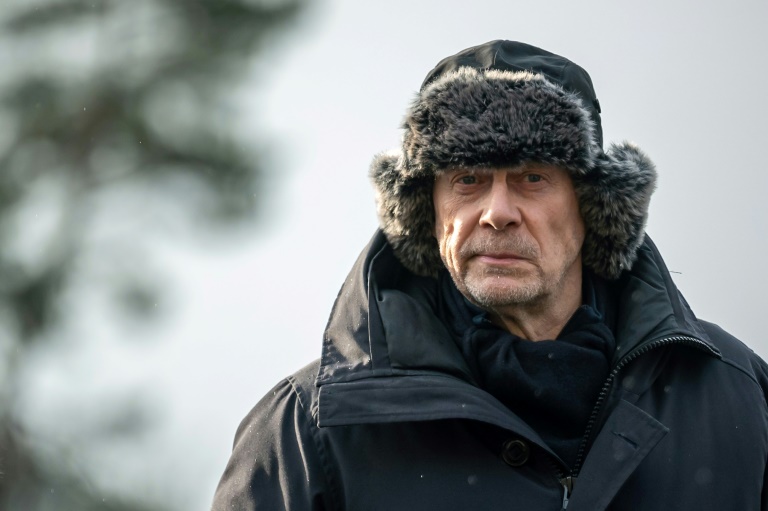
Far-right essayist Alain Soral, who appeared in court in Switzerland on Wednesday over homophobic remarks, told the hearing that he was himself the victim of “harassment” by the LGBTQ community.

The writer, a 64-year-old French-Swiss citizen now living in the western Swiss city of Lausanne, was sentenced in April by the regional attorney general to three months behind bars for “defamation, discrimination and incitement to hatred.”

That ruling came after Alain Soral — a pen name for the controversial writer whose real name is Alain Bonnet — appeared in an online video attacking Swiss journalist Cathy Macherel of the Tribune de Geneve newspaper, who had written an article about him in 2021.

Macherel had filed a complaint over the video, where Soral described her as a “fat lesbian activist for migrants” and as “queer” — a word he said was synonymous with “degenerate”.

The attorney general, who under Swiss law has the power to unilaterally impose sentences of up to six months in prison, ruled at the time that Soral’s comments were “profoundly homophobic” and amounted to an “incitement to discrimination”.

Soral, who has already faced around 20 convictions in France, mainly over charges of incitement to hatred and defamation, opposed the Swiss sentence, and the case was pushed to a Lausanne court for Wednesday’s one-day hearing.

Dressed in jeans and sneakers, Soral provided  lengthy responses to questions, with the judge repeatedly asking him to slow down.

“I have been the target of a smear campaign, of harassment, especially by the Tribune de Geneve and the LGBTQ community” in Switzerland, he charged.

He acknowledged his comments in the video had been made in a somewhat agitated state, but said he did not believe they were “injurious”.

Soral said Macherel’s article had been the last in a series “attacking me ever since I arrived in Lausanne” in 2019, and stressed the video should be seen as his “right to reply”.

He insisted that he had moved to Switzerland three years ago not to conduct a political battle but to write “in peace”.

Soral’s lawyer Pascal Junod told AFP it was a matter of freedom of expression and said the defence will request “an acquittal”.

Among his most recent convictions, the author was ordered by a French court in September to pay 15,000 euros ($15,750) in damages to anti-racism organisations over a rap video deemed anti-Semitic.

And last February, he saw the European Court of Human Rights reject his appeal of a 2016 conviction over a Holocaust-denying drawing on his website.
US Fed expected to slow pace of rate hikes as inflation eases

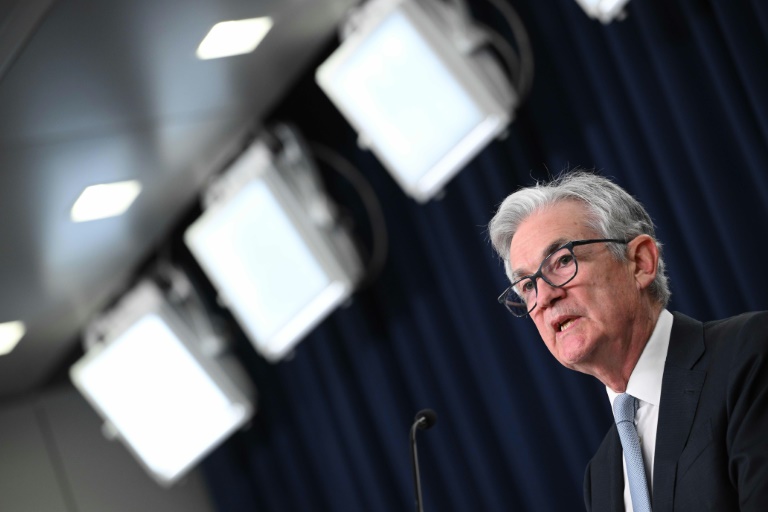
US central bankers opened the second day of a key policy meeting Wednesday, with growing anticipation of a smaller hike to the Fed’s benchmark lending rate as surging inflation shows signs of easing.

The Federal Reserve has embarked on an all-out campaign to cool demand in the world’s biggest economy, raising rates six times this year with interest-sensitive sectors like housing already reeling from tightening policy.

While it takes time for effects to ripple through sectors, there have been positive signs, with consumer inflation in the United States easing in November, according to government data released Tuesday.

The consumer price index, a key gauge of inflation, logged its smallest annual increase in nearly a year, fueling optimism that the Fed could soon moderate its efforts.

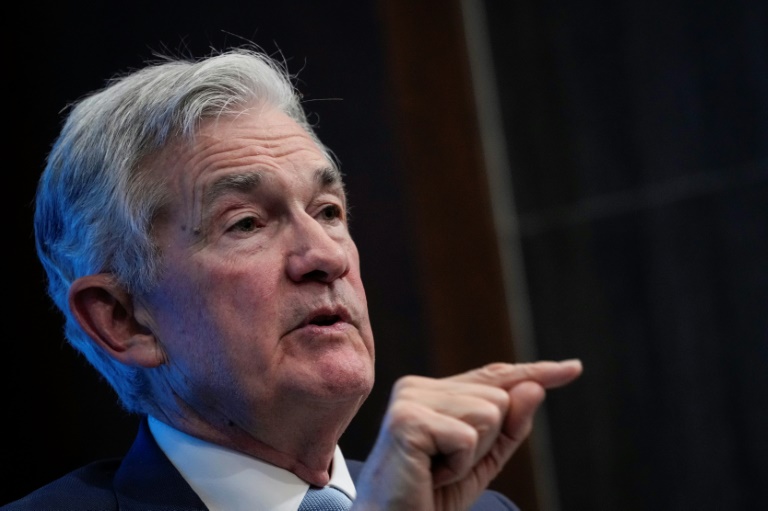
The figures nudged Wall Street stocks up, with Asian indices rising Wednesday as well, as all eyes turn to the Fed’s post-meeting statement and Fed Chair Jerome Powell’s comments for hints on the path to come.

Households have been squeezed by red-hot prices, with conditions worsened by surging food and energy costs after Russia’s invasion of Ukraine, and fallout from China’s zero-Covid measures.

To make borrowing more expensive, the Fed has raised interest rates six times, including four bumper 0.75-point increases, bringing the rate to between 3.75 percent and four percent.

Analysts widely expect the Fed to adopt a smaller, half-point hike on Wednesday, with Ian Shepherdson of Pantheon Macroeconomics calling it a “a done deal.”

While this marks a step down from earlier 0.75-point increases, it would still be a steep jump.

Shepherdson cautioned that Powell is “in no hurry to say what markets want to hear.”

“(Powell) is unlikely to deviate from his clear line that the Fed will do whatever is necessary to squeeze out inflation, and that some pain will be necessary,” Shepherdson added in an analysis.

– ‘Not yet proof’ –

Recent easing in data is welcome news to policymakers, but this is “not yet proof that inflation has sustainably cooled to levels consistent with the inflation target,” cautioned economist Edoardo Campanella of UniCredit Bank in a note.

The Fed has a longer-term target of two percent, while consumer inflation jumped 7.1 percent year-on-year in November.

“The Fed will likely further slow the pace of rate hikes early next year to 25 basis points,” Campanella added.

“However, with the labor market still very tight… and with broad financial conditions easing, the Fed will likely say that their job is not done,” he said.

Neil Saunders, managing director of GlobalData, added that the Fed is taking a “hawkish view on inflation” and will likely conclude further tightening is needed, based on the continued strength of underlying demand in the economy.

“As much as this action may have the desired effect, it will cool the economy at a time when it is already under pressure heading into 2023,” said Saunders.

The Fed’s further rate hike will also mark “a new phase” in its tightening cycle, said Nationwide chief economist Kathy Bostjancic in a note Monday.

This comes as officials look to adjust policy now that it is “within the range considered restrictive.”

Financial markets will be watching for signals of how high rates might go, and “the path for rates beyond that peak,” she added.

EU vows investment in push to boost SE Asia ties

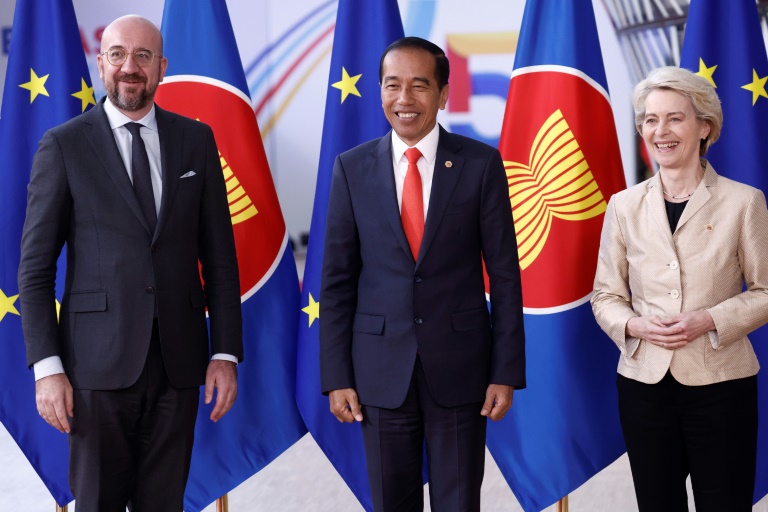
The EU vowed billions of dollars of investment in southeast Asia Wednesday, as leaders looked to bolster ties at a summit in the face of the Ukraine war and challenges from China. 

The European Union billed its first full summit with the Association of Southeast Asian Nations (ASEAN) in Brussels as a chance to push trade relations with the region’s fast-growing economies. 

“There might be many, many miles that divide us, but there are much more values that unite us,” European Commission President Ursula von der Leyen told the gathered leaders.

But different opinions over Russia’s war in Ukraine and concerns about tensions with China over a key shipping route for global trade loomed over the meeting. 

The EU has been on a diplomatic push to galvanise a global front against Moscow as its invasion has sent economic and political shock waves around the world. 

ASEAN’s 10 nations — nine of which were represented, after Myanmar’s junta was not invited — have been divided in their response to the Kremlin’s war on Ukraine.

Singapore has gone along with Western sanctions on Russia, while Vietnam and Laos, which have close military ties to Moscow, have remained more neutral. 

Along with Thailand, they abstained from a United Nations vote in October condemning Russia’s attempted annexation of regions of Ukraine seized since February.    

The diverging views led to intense wrangling over a final declaration from the summit as the EU pushed for stronger language to condemn Moscow.

A draft of the final statement said “most members” decried Russia’s war, but conceded there were also “other views and different assessments”. 

– China looms –

While Europe pressed for a tougher response to Russia, another global giant figured prominently at the summit. 

Chinese claims over the South China Sea have set it against some neighbours and sparked fears in Europe over trade flows through the key global thoroughfare. 

But China remains the biggest trade partner for ASEAN and many in the region are wary of distancing themselves from their giant neighbour.

The EU is keen to pitch itself as a reliable partner for southeast Asia’s dynamic economies amid the growing rivalry between Beijing and Washington. 

The EU and ASEAN are each other’s third-largest trading partner and Europe sees the region as a key source for raw materials and wants to increase access to its booming markets.

EU nations are pushing to diversify key supply chains away from China as the war in Ukraine has highlighted Europe’s vulnerabilities. 

Von der Leyen offered an investment package over the next five years worth 10 billion euros ($10.6 billion) under the EU’s Global Gateway strategy designed as a counterweight to China’s largesse.

“There is a battle of offers today in the geopolitical arena, not only a battle of narrative,” said EU foreign policy chief Josep Borrell. “We have to offer more.”

– Sex law furore –

ASEAN and the EU suspended their push for a joint trade deal over a decade ago — but the bloc’s top officials said they hoped to relaunch efforts for a broad agreement. 

So far deals with Vietnam and Singapore are in place, and the EU is looking now to make progress with ASEAN’s largest economy Indonesia and to resume talks with Malaysia, Philippines and Thailand.

One issue that risked clouding discussions was a new law in Indonesia criminalising sex outside marriage that has sparked fears for foreign visitors to country.

Indonesia’s President Joko Widodo insisted though that the EU-ASEAN relationship needed to be based more on “equality”. 

“There must be no imposition of views,” he said.  

“There must not be one who dictates over the other and thinks that my standard is better than yours.”

HSBC bank says to stop funding new oil and gas fields

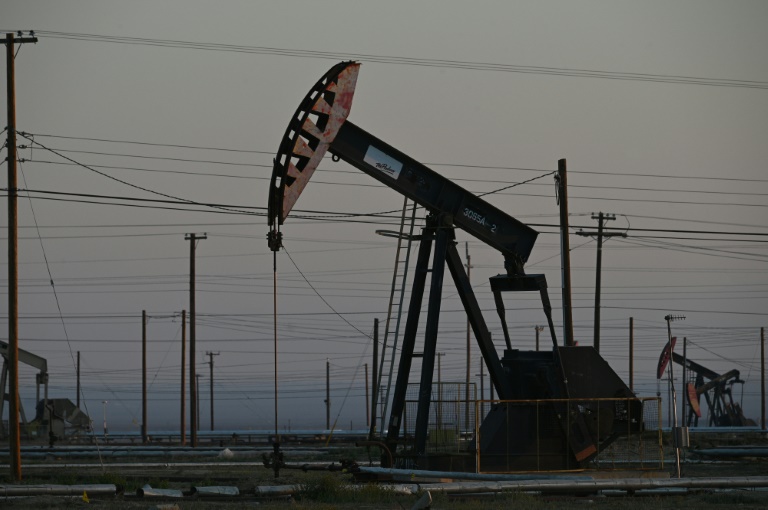
Banking giant HSBC on Wednesday said it would end financing for new oil and gas fields, a decision welcomed by environmentalists who nevertheless urged greater action from banks and government.

In an annual update of its climate transition plans, the London-headquartered bank said it “will no longer provide new lending or capital markets finance for the specific purpose of projects pertaining to new oil and gas fields and related infrastructure”.    

HSBC added in a statement that it was “committed to supporting and financing the transition to a secure net zero future”.

Responding, Greenpeace UK’s senior climate campaigner Charlie Kronick called the announcement “long overdue”.

He added in a statement: “Banks have been funding climate chaos to the tune of billions of pounds. Now one of the UK’s biggest banks has realised that there’s no place for new oil and gas in a world that is trying to tackle the climate crisis.”

Kronick called the announcement “an embarrassment for the UK government”, which is “pressing on with new oil and gas licences” as it looks to beef up energy security following the invasion of Ukraine by major fossil fuel producer Russia.

HSBC meanwhile said it would continue to provide finance and advisory services to energy sector clients at the corporate level, as long as their plans were in line with the bank’s targets to cut emissions.

– ‘Strong signal’ –

“HSBC’s announcement sends a strong signal to fossil fuel giants and governments that banks’ appetite for financing new oil and gas fields is diminishing,” said Jeanne Martin, head of banking programme at ShareAction.

“It sets a new minimum level of ambition for all banks committed to net zero. We urge major banks like Barclays and BNP Paribas to follow suit.”

Martin meanwhile stressed that “HSBC’s announcement only applies to asset financing, and doesn’t deal with the much larger proportion of finance it still provides to companies that have oil and gas expansion plans”.

Citing the International Energy Agency, the bank said “an orderly transition requires continued financing and investment in existing oil and gas fields to maintain the necessary output”.

HSBC “will therefore continue to provide finance to maintain supplies of oil and gas in line with current and future declining global oil and gas demand”.

The bank on Wednesday added it would “accelerate” activities in renewable energy and clean infrastructure following a previous announcement to provide between $750 billion and $1 trillion in sustainable finance and investment by 2030.

A year ago, the lender published a plan to stop financing thermal coal activities.

Ukraine downs swarm of attack drones over Kyiv

Ukraine said Wednesday it had shot down multiple Iranian-made drones launched at the capital by Russian troops in their latest attack on Kyiv. 

The Kremlin meanwhile said there no would be no let up in fighting over Christmas and the New Year while Ukraine President Volodymyr Zelensky urged European leaders to back a court to try Russian officials.

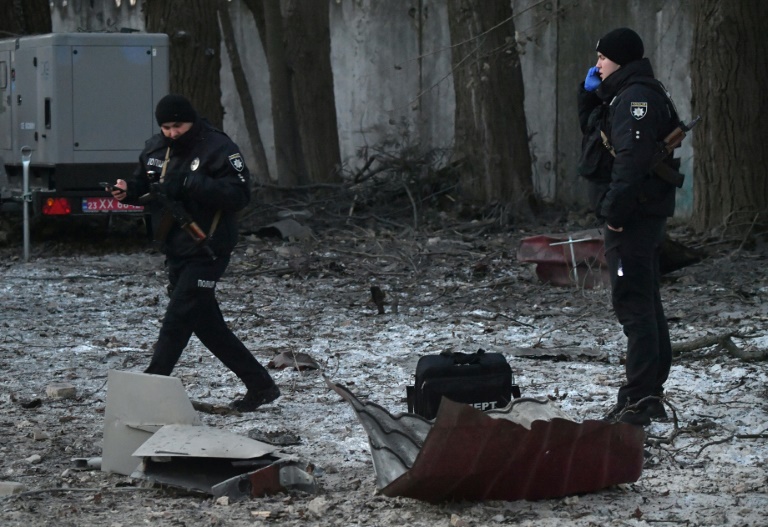
Explosions rang out over a central neighbourhood in Kyiv in the early hours and AFP journalists later saw law enforcement and emergency service workers inspecting metal fragments at a snow-covered impact site.

“The terrorists started this morning with 13 Shaheds,” Ukrainian President Volodymyr Zelensky said, referring to the Iran-made weapons.

“All 13 were shot down” he added, urging residents to heed air raid sirens.

Kyiv has been subjected to nearly ten months of air raid sirens and frequent aerial attacks since Russia invaded Ukraine in February and tried to capture the capital. 

But the attacks have increased up since October when Russia began systematically targeting critical infrastructure in Ukraine in attacks that have disrupted electricity, water and heat to millions in Ukraine.

Kyiv’s Western allies have been supplying Ukraine with more advanced air defence systems in response.

Ukrenergo, the national energy provider, said no energy infrastructure facilities were damaged in Wednesday’s drone attack, crediting Ukrainian air defences for their “brilliant” work.

– Civilian ‘suffering’ –

US ambassador in Ukraine Bridget Brink said on social media that Kyiv could continue to rely on Washington’s backing and that “more support is on the way”.

“It’s obvious that these attacks have just one aim: to increase the suffering of civilian population,” said Peter Stano, a spokesman for EU foreign policy chief Josep Borrel.

Mayor Vitali Klitschko announced that explosions were heard in the central district of Shevchenkivsky and city officials said debris from the downed drones had damaged residential homes and an local administrative building.

No one was reported injured or killed.

Since a series of key battlefield setbacks this summer and autumn, Russia has been pummelling critical infrastructure across Ukraine with missiles and drones.

Moscow most recently targeted Ukrainian energy infrastructure last week piling pressure on the country’s power grid, whose operators have for weeks been forced to implement rolling blackouts.

Prime Minister Denys Shmygal said this week that between 40 and 50 percent of the country’s grid was out of action because of Russia’s strikes.

The latest round of attacks on Wednesday came one day after Zelensky issued urgent appeals to around 70 countries and international organisations at a Paris conference to help Ukraine withstand Russian attacks this winter.

In a video message from Kyiv, Zelensky said Tuesday that Ukraine needed assistance worth around 800 million euros in the short term for its battered energy sector.

– ‘Fight through winter’ –

He also said that his country needs spare parts for repairs, high-capacity generators, extra gas and increased electricity imports.

Foreign Minister Dmytro Kuleba called on Ukraine’s allies to provide his country with more weapons to help it “fight through the winter” and sustain Kyiv’s military advances.

The Kremlin meanwhile said it had not received any proposals from Kyiv to pause fighting in Ukraine during the upcoming holiday period and that a ceasefire was not on Moscow’s agenda.

“No, no proposals have been received from anyone and no topic of this kind is on the agenda,” the Kremlin’s spokesman Dmitry Peskov. 

In nearly 10 months of fighting, Russia has yet to fulfil any of its stated key goals in what it refers to as its “special military operation” in Ukraine, including seizing the capital or the eastern Donbas region.

The Moscow-installed leader of Ukraine’s Donetsk region on Wednesday however called for Russia to widen its goals and annex two more areas of Ukraine, the Black Sea region of Odessa and Chernigiv in the north.

Separately, Ukraine’s SBU security service said it was carrying out raids at churches and monasteries across the country in its most recent searches on religious sites of the Russia-linked Ukrainian Orthodox Church.

Activists file case against Meta over Tigray hate posts

An Ethiopian man whose father was murdered during the country’s war has joined a lawsuit against Meta that is seeking $1.6 billion from Facebook’s parent company for allegedly fanning hate speech in Africa. 

The case filed in Kenya’s High Court on Wednesday by two individuals and a rights group says Meta responded inadequately to hateful content on its platform, especially in relation to the war in Ethiopia’s northern Tigray region.

One petitioner said his father, an ethnic Tigrayan, had been targeted by racist messages on Facebook before his murder in November 2021, and the social media giant had failed to move quickly to remove these posts.

“If Facebook had just stopped the spread of hate and moderated posts properly, my father would still be alive,” said Abrham Meareg, who is also Tigrayan and an academic like his father.

“I’m taking Facebook to court so no one ever suffers as my family has again. I’m seeking justice for millions of my fellow Africans hurt by Facebook’s profiteering –- and an apology for my father’s murder.”

His lawyer, Mercy Mutemi, said Facebook took a month to respond to Abrham’s appeals for the content to be taken down. 

“Why did it take over a month to take down a post that calls for the murder of somebody?” she said.

Mutemi said Facebook acknowledged the content violated community standards but a year later one of the violent posts was still online.

Another petitioner is Fisseha Tekle, an Ethiopian researcher for Amnesty International and a Tigrayan, who has written about the war and faced a torrent of online abuse.

The international community has condemned hate speech and dehumanising rhetoric during the two-year conflict, which has seen all sides accused of atrocities amid warnings of ethnic cleansing.

– ‘Inhumane’ working conditions –

Meta spokesperson Ben Walters said the company was yet to be served with the lawsuit, but had “strict rules which outline what is and isn’t allowed on Facebook and Instagram.”

“We’ve removed misinformation when there is a risk it may contribute to physical harm for a long time,” he told AFP in a statement. 

“In Ethiopia, we have identified and are removing a number of pre-reviewed harmful claims and out of context imagery that make false allegations about the perpetrators, severity or targets of violence in Ethiopia.”

The Katiba Institute, a Kenyan rights group and another petitioner to the lawsuit, is seeking changes to Facebook’s algorithm.

Inciteful, hateful and dangerous posts “spark conversation, attract reactions and shares as well as motivate back-and-forth discussion in the comments section,” read the petition seen by AFP.

It also accused Meta of “inhumane” working conditions for its overstretched content moderators in Nairobi tasked with overseeing eastern and southern Africa, a vast region covering 500 million people.

The petitioners claim this resulted in “systematic discrimination” against African Facebook users, citing the platform’s swift response by comparison to the attack on the US Capitol by supporters of former US president Donald Trump on January 6, 2021.

The petitioners are asking the court for the establishment of a 200-billion Kenyan shillings ($1.6-billion) compensation fund for victims of hate and violence incited on Facebook.

In late 2021, Rohingya refugees sued Facebook for $150 billion, claiming the social network failed to stem hate speech directed against them.

The Rohingya, a mainly Muslim minority, were driven from Myanmar in 2017 into neighbouring Bangladesh by security forces in a crackdown now subject to a UN genocide investigation.

AFP is involved in a partnership with Meta providing fact-checking services in Asia-Pacific, Europe, the Middle East, Latin America and Africa.

Microsoft seeks to bring internet to millions in Africa by satellite

Microsoft announced plans Wednesday to bring internet access via satellite to 10 million people, half of them in Africa, as part of efforts to bridge a digital divide with the developing world.

At a summit with African leaders in Washington led by President Joe Biden, the technology leader said it would start the satellite project immediately with a priority on bringing internet for the first time to parts of Egypt, Senegal and Angola.

Microsoft president Brad Smith said that the company has been impressed by its engineers in Nairobi and Lagos.

In Africa, “there is no shortage of talent, but there is a huge shortage of opportunity,” Smith told AFP.

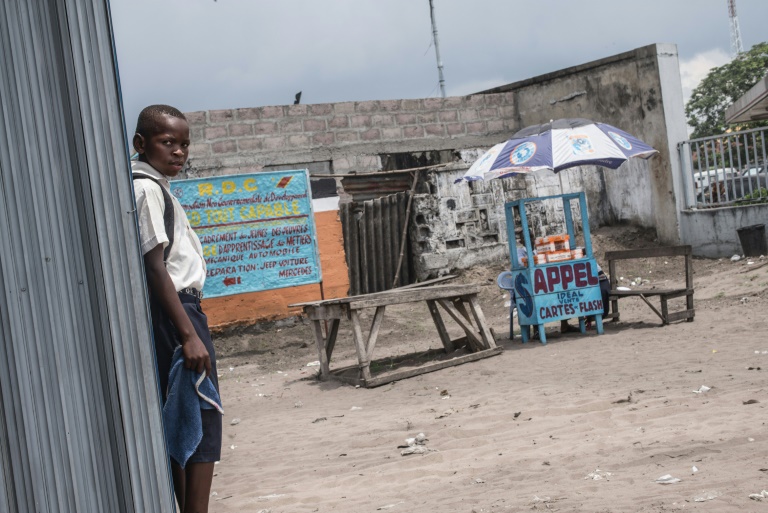
In the partnership with satellite provider Viasat, Microsoft said it would also provide internet in Guatemala, Mexico and more remote parts of the United States and also step up efforts in Nigeria and the Democratic Republic of Congo.

Smith said the biggest holdup to internet access has been the lack of electricity, which is not reliable for around half of Africans.

“For people who don’t go there or don’t spend time thinking about Africa, it’s hard for them to even to imagine that because electricity in my view is the greatest invention of the 19th century,” Smith said.

“When you think about broadband, you cannot have access to the internet at any speed without access to electricity,” he said.

He said Microsoft was focused on finding low-cost solutions in areas where both the internet and electricity are absent.

Smith said he saw wide support in Africa for bringing internet access, saying many governments have leapfrogged over their Western counterparts in ease of regulation as the continent did not have the same “extraordinary web of licensing regimes” in place from the past.

Ministries are often led by Africans with industry experience, “so they know how business works and they know how government works,” Smith said.

“Even in countries where we may find more authoritarian challenges, I think it’s more likely that governments are going to want to control what’s available on the internet rather than its availability,” he said.

The latest effort is part of Microsoft’s Airband Initiative, which aims to provide internet access to 250 million people, 100 million of them in Africa, by the end of 2025.

Despite rapid strides in the internet in developed nations and some major emerging economies, 2.9 billion people, or more than one-third of the world, have never gone online, according to the UN’s International Telecommunication Union.

Stocks diverge before expected US rate hike

Global stock markets diverged Wednesday, with Asia rising and Europe falling before an expected interest rate hike from the Federal Reserve, with inflation around the highest levels in decades despite moderate slowdowns.

London losses nearing the half-way mark were cushioned by news that UK inflation nudged lower in November.

Frankfurt and Paris also fell despite the Ifo research institute’s forecast that Germany’s recession could be milder than previously predicted.

Asian indices closed higher following Tuesday’s softer-than-expected US inflation data that could allow the Federal Reserve to slow its pace of interest rate hikes.

The Fed is forecast to increase borrowing costs 50 basis points Wednesday after four 75-point rises in a row.

The US central bank’s post-meeting statement and boss Jerome Powell’s comments are the main focus for traders, along with the Fed’s infamous “dot plot” chart of the rate outlook.

“At the end of the day, it’s Jerome Powell, and the Fed, who will either give a green light for a modest Santa rally (for equities), or tell investors that Santa is stuck in a snow storm this year,” noted SwissQuote analyst Ipek Ozkardeskaya.

It’s the turn of Europe on Thursday, with the Bank of England and European Central Bank expected to announce less aggressive rate hikes compared with their recent monetary policy decisions.

Wall Street rebounded Tuesday in reaction to data showing US consumer prices rose 7.1 percent last month, less than forecast and the slowest pace since December 2021.

The reading followed an October slowdown and fuelled hopes that inflation in the world’s biggest economy has finally peaked, after several months of Fed rate hikes.

Markets are also eyeing developments in China, which is continuing to roll back its strict zero-Covid strategy that has battered the world’s number two economy, though fears of a sharp surge in infections are causing some unease among dealers.

Oil extended recent gains as traders awaited the weekly US inventories report for clues on demand in the world’s top crude consuming nation.

– Key figures around 1200 GMT –

London – FTSE 100: DOWN 0.3 percent at 7,479.69 points

Frankfurt – DAX: DOWN 0.7 percent at 14,391.94

Paris – CAC 40: DOWN 0.6 percent at 6,702.55

EURO STOXX 50: DOWN 0.8 percent at 3,956.14

Tokyo – Nikkei 225: UP 0.7 percent at 28,156.21 (close)

Hong Kong – Hang Seng Index: UP 0.4 percent at 19,673.45 (close)

Shanghai – Composite: FLAT at 3,176.53 (close)

New York – Dow: UP 0.3 percent at 34,108.64 (close)

Euro/dollar: UP at $1.0653 from $1.0635 on Tuesday

Dollar/yen: DOWN at 134.96 yen from 135.59 yen

Pound/dollar: UP at $1.2377 from $1.2366

Euro/pound: UP at 86.04 pence from 85.96 pence

Brent North Sea crude: UP 0.9 percent at $81.40 per barrel

West Texas Intermediate: UP 1.0 percent at $76.15 per barrel

Greek MEP in EU parliament graft scandal awaits key ruling

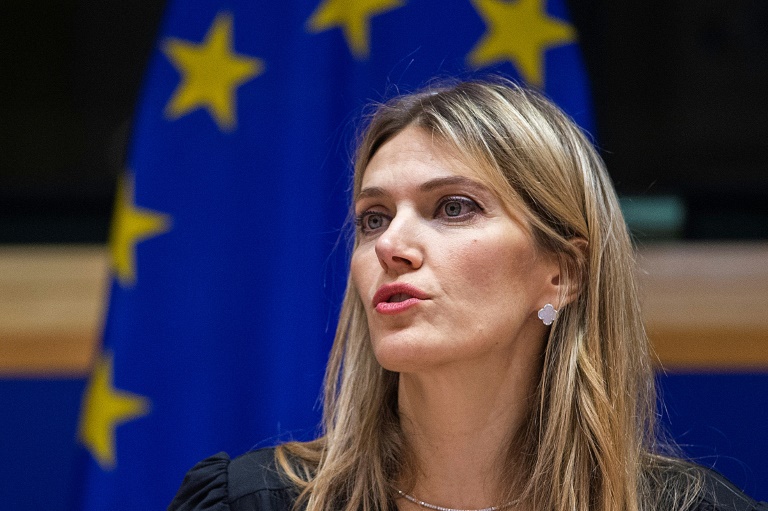
The Greek MEP central to an EU parliament graft scandal awaited a key ruling Wednesday that may keep her behind bars, as she argued innocence in a case allegedly tied to World Cup host Qatar.

A Belgian court is set to decide whether Eva Kaili, who was removed from her vice president post on Tuesday, and three co-accused will remain in custody pending trial in the corruption case.

Kaili’s arrest came during a series of police raids across homes and offices in and near Brussels in which at least 1.5 million euros ($1.6 million) in cash was seized. 

The government of Qatar has denied any connection to any wrongdoing in the case.

A Belgian judicial source told AFP that investigators believe that figures representing the Gulf nation’s monarchy had been paying off European politicians to burnish the country’s image.

Qatar is a key energy supplier to Europe, and plays an important intermediary role in several diplomatic tangles.

But it has also been criticised for the alleged mistreatment of migrant workers, most notoriously those who built the World Cup stadiums.

As Kaili sat in a Brussels jail cell, her colleagues in the Strasbourg parliament scrambled to distance themselves from the scandal.

The 44-year-old former television news presenter is the only serving MEP to have been charged. But several more have had their offices put under police seal while investigations continue.

She was arrested last week during a series of raids by Belgian graft investigators on the homes and offices of several MEPs and their assistants or associates.

– ‘False rumours’ –

A Belgian judicial source, confirming reports in Belgian newspapers Le Soir and Knack, said 600,000 euros were found at the home of Italian former MEP Pier Antonio Panzeri, 150,000 euros in Kaili’s flat, and 750,000 in her father’s hotel room. 

Kaili’s lawyer Michalis Dimitrakopoulos told AFP that she “did not know of the existence” of the cash found at her home.

Her lawyer said she was “innocent”, and he denied what he said were “false rumours” that she had received bribes from Qatar.

He said her partner, Francesco Giorgi, could have “answers about the existence of this cash”.

Qatar denies any involvement in European corruption. 

“Any claims of misconduct by the state of Qatar are gravely misinformed,” an official has told AFP.

Brussels has been rocked by the claims, and European Parliament President Roberta Metsola, defending the integrity of the EU legislature, has sought to portray the alleged bribes as an assault on democracy.

Kaili was one of six people detained. Four have been charged with “criminal organisation, corruption and money laundering” and two released.

One of those released was Luca Visentini, the general secretary of the International Trade Union Confederation, a global labour body that has pushed Qatar on labour rights. 

Hong Kong police wrong to ban Tiananmen vigil, court rules

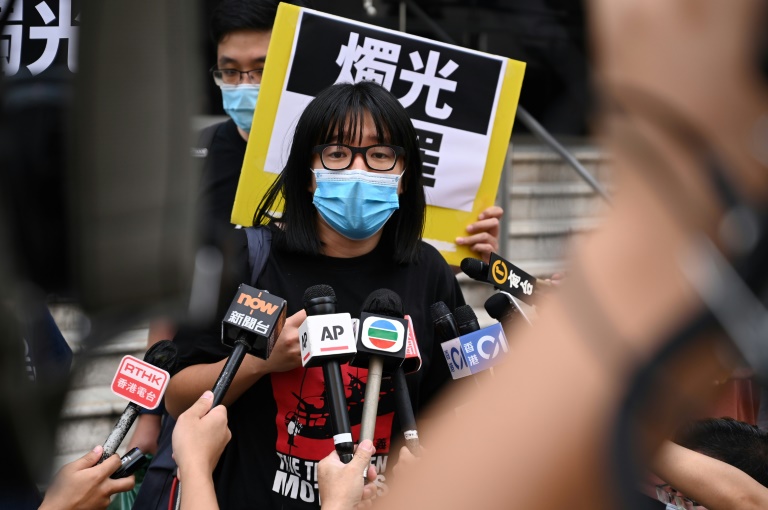
Hong Kong police’s decision to ban a Tiananmen vigil last year was unlawful, a court ruled on Wednesday, as it overturned the conviction of jailed democracy activist Chow Hang-tung.

The ruling is a rare rebuke of authorities in a city where the public commemoration of Beijing’s deadly 1989 crackdown has been virtually wiped out in recent years.

Chow, a 37-year-old lawyer and prominent democracy activist, led a now-disbanded group that used to organise the city’s annual candlelight vigils to mourn those killed in Tiananmen Square when China sent troops to crush democracy protests.

Police have banned the last three vigils citing the coronavirus and security fears and the courts have already jailed activists who defied those bans, including Chow.

Pro-democracy media tycoon Jimmy Lai is also among those behind bars for defying the various bans on the vigils, in his case for the 2020 event.

Chow was jailed for 15 months in January for writing articles urging the public to “light candles to seek justice for the dead”, which a lower court said amounted to inciting others to defy the ban.

But High Court judge Judianna Barnes on Wednesday said police wrongly banned the vigil in 2021 as they did not “proactively and seriously consider” ways to facilitate a public gathering, as was required by law.

As the government failed to prove the ban was legally valid, Chow’s articles would no longer constitute a crime and her conviction was scrapped on appeal.

Despite her court victory, Chow remains in custody as she faces further prosecutions including for national security charges which carry up to a decade in jail.

Hong Kong was formerly the only place in China where mass commemoration of Tiananmen was tolerated but Beijing has been remoulding the city in its authoritarian image after huge and sometimes violent democracy protests in 2019.

Chow was arrested on the morning of June 4, 2021 when her articles appeared on social media and in a newspaper calling on residents to mourn Tiananmen victims.

At the time, police warned that the vigil was banned due to the pandemic and that thousands of officers would be on standby to halt any “unlawful assemblies”.

But judge Barnes said on Wednesday that police failed to fulfil their duty under the law to take reasonable measures to facilitate public gatherings, such as imposing conditions on social distancing.

“Although the organisers expressed willingness to follow any reasonable demands by the police, the police only raised questions… and did not propose measures or conditions that could obviously be considered,” the judge said. 

The Department of Justice said it will study the court’s judgement before deciding next steps.

Hong Kong police did not immediately respond to AFP’s request for comment.

Commemoration of the Tiananmen crackdown in Hong Kong has largely been driven underground.

Last year, multiple statues marking the historical event were removed from university campuses while an activist-run museum was shut down.

Close Bitnami banner
Bitnami