World

Rich nations oppose new biodiversity fund

Creating a new global fund for biodiversity — a core demand of developing countries at UN talks in Montreal — “would take years” and be less effective than reforming existing financial mechanisms, Canada’s environment minister said Tuesday.

Ottawa’s position reflects the consensus among developed nations on the thorny issue, which has emerged as a key sticking point in negotiations to hammer out a new global pact for nature at the meeting, known as COP15. 

Delegates from around the world have gathered for the December 7-19 summit aiming to secure a new deal: a 10-year framework aimed at saving Earth’s forests, oceans and species before it’s too late. 

Draft targets include a cornerstone pledge to protect 30 percent of the world’s land and seas by 2030, eliminating harmful fishing and agriculture subsidies and tackling invasive species and reducing pesticides.

Dozens of countries, led by Brazil, India, Indonesia and African nations, are demanding financial subsidies of at least $100 billion a year until 2030, or one percent of global GDP, to protect ecosystems. The current figure is around $10 billion annually.

“The countries of the North understand that ambition must be accompanied by financial resources,” Canadian Minister of Environment and Climate Change Steven Guilbeault said at a press conference held halfway through the talks.

But “my concern is that the creation of new funding could take years, and during those years, countries in the South wouldn’t be receiving any money from that fund,” he added.

He recalled the Global Environment Facility, currently the main multilateral mechanism for biodiversity, took seven years to create. Donors have pledged $5.3 billion to this fund for its current cycle, 2022-2026.

“So I think it would be better to use existing funds” while pursuing reforms that would make money more accessible, he said.

“On the other hand, we have to agree on the fact that it cannot only be public money,” said Guilbeault, stressing that private and philanthropic contributions must come into play, as well as multilateral lenders such as the World Bank and IMF.

“We all need to push harder this week,” he concluded, after the first week of talks ended in stalemate.

– Yawning funding gap –

The divide between developed and developing nations on the issue of creating a new biodiversity fund mirrors a similar debate during recent UN climate talks in Egypt on creating a “loss and damages” fund for the most climate-vulnerable nations — though that demand was eventually met.

Given this precedent, Basile van Havre, co-chair of one of COP15’s working groups, did not rule out a similar decision for biodiversity. 

“The landscape or the context now is a lot more favorable,” he told AFP, acknowledging growing political momentum for such a move.

Whatever the final mechanism, the gap in expectations over resource mobilization that would allow lower income nations to hold up their side of the biodiversity deal remains a sore spot.

“The EU says it hears the needs of the Global South and the Africa Group, and recognizes that current finances are not enough. So what is the hold up?” said Greenpeace policy advisory Anna Ogniewska.
Rolling red carpet to Africans, US warns of 'destabilizing' China, Russia

The United States warned Tuesday that China and Russia were destabilizing Africa with their growing inroads as it rolled out the red carpet to the continent’s leaders and pledged billions of dollars in support.

Forty-nine African leaders flew into the Washington cold for the first continent-wide summit with the United States in eight years as President Joe Biden seeks to use personal diplomacy to win back influence.

Defense Secretary Lloyd Austin, at a panel with several African presidents at the start of the three-day summit, charged that US rivals had a different approach.

Austin said China was expanding its footprint in Africa “on a daily basis” through its growing economic influence.

“The troubling piece there is they’re not always transparent in terms of what they’re doing and that creates problems that will be eventually destabilizing, if they’re not already,” Austin said.

Russia is “continuing to peddle cheap weapons” and deploying “mercenaries across the continent,” he added.

“And that is destabilizing as well.”

But the Biden administration has been careful not to present Africans with an us-or-them choice, believing it is futile to try to turn the tide on China’s massive infrastructure spending.

– Health and space cooperation –

Biden plans to unveil $55 billion for Africa over three years. In one of the first announcements, the White House said the United States would invest $4 billion by the 2025 fiscal year to train African health workers, a rising priority for Washington since the Covid-19 pandemic.

The summit also brought in NASA, with Nigeria and Rwanda becoming the first African nations to sign the Artemis accords, a US-led bid for international cooperation on traveling to the Moon, Mars and beyond.

The Artemis accords, which already include European allies, Japan and several Latin American powers, come as China rapidly expands its own lunar program and as tensions with Russia threaten its post-Cold War work with the United States on space.

China has rejected criticism of its role in Africa, with its ambassador in Washington, Qin Gang, saying the continent should not be a place for “major powers’ competition.”

The US-Africa summit is the first since Barack Obama invited leaders in 2014, with his successor Donald Trump making no secret of his lack of interest in Africa.

Security remains a major focus of the United States, which has used the summit to focus on some of the continent’s hotspots.

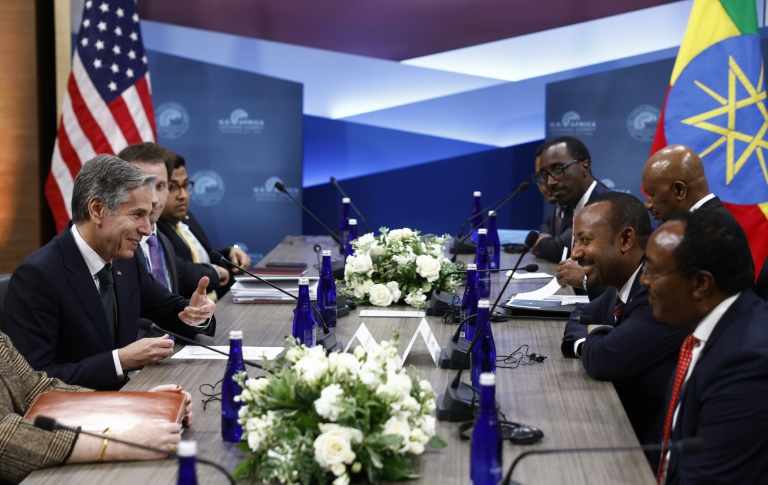
Ethiopian Prime Minister Abiy Ahmed, a onetime US ally whose relations with Washington soured sharply over the Tigray war that broke out two years ago, paid his first visit to Washington since the conflict.

Meeting him inside central Washington’s convention center, Secretary of State Antony Blinken voiced hope over an agreement signed last month in South Africa between Ethiopia’s government and Tigrayan rebels.

“We have, I think, a historic moment for the country,” Blinken told him.

– Climate and security –

The United States also announced another $411 million in assistance for Somalia where a new assessment found “catastrophic” hunger, even though the United Nations said aid has averted a full-blown famine.

The Horn of Africa has been devastated by five consecutive failed rainy seasons, with Somalia already struggling after decades of turbulence and the Al-Shabaab rebels.

“These climate shocks have weakened the society,” Somali President Hassan Sheikh Mohamud said, ahead of expected announcements by Biden on climate efforts in Africa.

Democratic Republic of Congo President Felix Tshisekedi, in talks with Blinken, blamed climate change for floods that have killed some 100 people in the capital Kinshasa.

In Somalia, Mohamud also claimed successes against the jihadists, days after Somali forces seized the key town held by jihadists since 2016 with the help of US air strikes and an African Union force.

But he warned that military means alone were insufficient.

“I have been telling my colleagues today that engaging with the society and the community is what makes these terrorists like a fish that has run out of water; they cannot exist without a community,” he said.

The Biden administration has stressed working with the African Union, both on the security and diplomatic fronts.

Biden during a speech Wednesday is expected to outline US support for the African Union to gain a formal berth in the Group of 20 club of major economies, months after he threw support behind a permanent African seat on the UN Security Council.

African Union chief Moussa Faki Mahamat hailed US support but warned that there was still far more focus on fighting extremists in the Middle East.

“This double standard has had disastrous consequences for Africa and for peace and democracy in the world,” he said.

United Airlines announces huge Boeing 787 order

United Airlines on Tuesday unveiled an order of 100 new Boeing 787 Dreamliners, with options for an additional 100 jets, as the company banks on rebounding demand for international travel following a years-long pandemic slowdown.

The huge order, the largest by an American carrier for this class of aircraft, marks a victory for Boeing after 346 people died in two major 737 MAX crashes that grounded the jet globally for more than a year and a half.

Boeing has targeted mid-decade to return to its pre-pandemic financial health after the 737 MAX scandal and other woes.

United Chief Executive Scott Kirby, who also announced a giant Boeing and Airbus order in June 2021 ahead of rivals, predicted the airline’s ambitious 787 plan would pay off for the carrier during a capacity-constrained period.

“United is really uniquely positioned to grow in a way that’s going to be a huge challenge for others,” Kirby told reporters.

Speaking at a signing ceremony, Kirby said that Boeing remained a vital company for the United States and that the order was a vote of confidence that the company had turned the corner after a difficult period.

“As much as anything, I trust you and I trust your company,” Kirby told a crowd of Boeing employees, most donning blue Boeing t-shirts.

United expects the jets to be delivered between 2024 and 2032, with the new aircraft targeted to replace the 767 fleet that will be removed from service by 2030. 

The Dreamliner saves 25 percent of the carbon emission compared with the jets being retired.

United executives did not offer an estimate of the total potential cost of the contracts, but projected that capital spending would rise to $9 billion in 2023 and $11 billion in 2024.

United said it also exercised options for an additional 44 737 MAX planes between 2024 and 2026, and ordered 56 more MAX jets for 2027 and 2028.

Stan Deal, head of Boeing’s commercial aviation division, said the United 787 contract supports some 120,000 jobs at the company and throughout its supply chain.

“It builds security around the rate,” Deal said of the United contract.

Boeing plans to lift 787 output from a monthly rate of low single digits now to 10 in the 2025 timeframe.

– Production ramp-up –

After the 737 MAX, the 787 Dreamliner — which flies transatlantic journeys and other international itineraries — has been Boeing’s other leading source of orders and deliveries.

United officials said beefing up the fleet of 787s made sense at a time when the carrier already flies the jet, making it an easy transition for pilots and helping the company add capacity quickly.

But United officials praised the A350, the rival wide-body offering from European aerospace giant Airbus, and said they still plan to take delivery of 45 of the Airbus jets from 2030.

For Boeing, the United order signals a victory for the 787, for which production was slowed to a trickle while the company halted deliveries of new jets for more than a year while addressing production problems.

Boeing resumed 787 deliveries in August after getting the green light from the Federal Aviation Administration, which has heavily scrutinized Boeing processes in the aftermath of the 737 MAX crisis.

“This is an opportunity for Boeing to ramp up at Charleston, perhaps with two production shifts,” said Michel Merluzeau, director of aerospace and defense analysis at AIR consultancy.

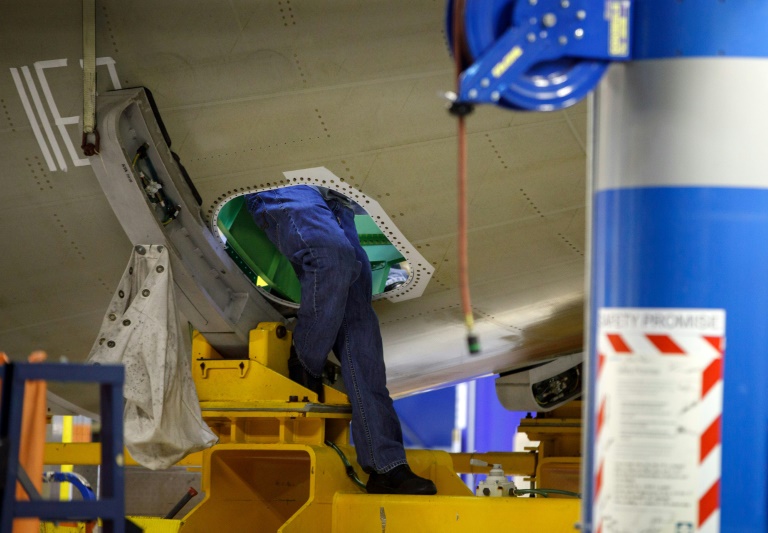
At the Charleston, South Carolina factory, Boeing fabricates composite materials that are then used to construct part of the fuselage at the plant. The facility also does final assembly of the jets, which includes major body parts built in other locales around the world.

In October 2020, Boeing consolidated assembly of the 787 to Charleston, after previously also assembling the wide-body jet in Washington state.

Boeing currently employs about 5,000 in South Carolina, down from peak levels. Deal expects “gradual” growth of the workforce at the factory, but did not project specifics. 

At its investor day in November, Boeing officials outlined a plan to restore 787 production to 10 passenger jets per month.

Shares of Boeing gained 0.5 percent to $187.13 Tuesday, while United rose briefly before dropping nearly 7 percent to $41.17.

United’s decline came as rivals such as American and Delta also tumbled after JetBlue said in a securities filing that it expects fourth-quarter revenues per available seat mile to be on the low end of its forecast due to weaker than expected demand in December.

United’s Kirby said he continues to see strong demand, but that the carrier is planning for a “mild recession” in 2023, citing Federal Reserve policies to slow the economy.

More financing needed for IMF climate change fund: director

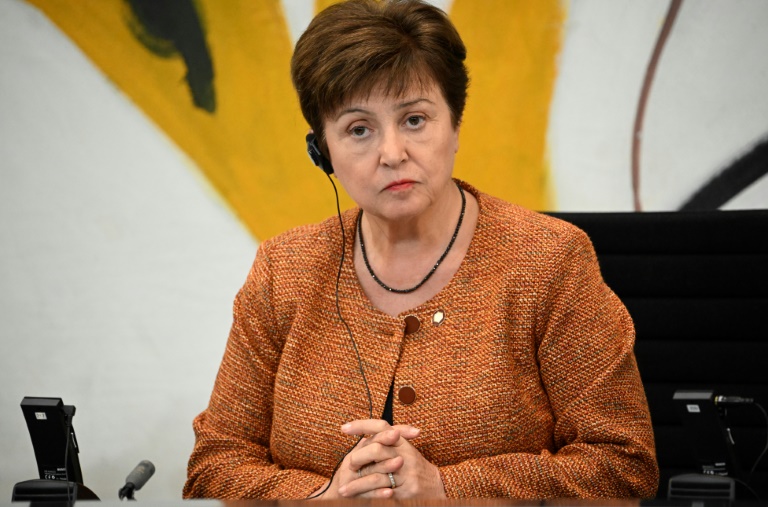
A new fund helping low-income countries tackle the impacts of climate change already has around $40 billion worth of commitments, but this is “nothing in comparison with the needs,” IMF chief Kristalina Georgieva said Tuesday.

Several countries have won loan deals from the International Monetary Fund’s Resilience and Sustainability Trust (RST), but global leaders are urging that more be done to aid nations grappling with the costly fallout from climate change.

“If we do nothing to move financing… by 2030, 66 percent of carbon emissions will come from the developing world,” Georgieva said in an interview with AFP.

“If we want to succeed in our fight against climate change, it is paramount to move financing to where it would make a difference,” she added, on the sidelines of a panel discussion on the RST.

For now, the three countries that have crossed the finish line with RST financing are Costa Rica, Barbados and Rwanda, while a deal with Bangladesh is headed for further approval.

“The interest is very significant from both low-income countries and vulnerable middle-income countries, especially small island states,” Georgieva said.

She added that the IMF expects more members to commit resources “so we don’t end up having to ration support for countries.”

At the panel in Washington, Barbados Prime Minister Mia Mottley said long-term capital is needed for many issues, adding that debt sustainability metrics could be revisited.

“Every dollar of debt is not equivalent. A dollar of debt to build a school does not give me the same rate of return as quickly as a dollar of debt to build a geothermal facility,” she said.

World Trade Organization Director-General Ngozi Okonjo-Iweala also stressed at the event the importance of supply chains when it comes to building resilience in developing countries.

“Supply chains for certain products are highly concentrated. Eighty percent of vaccines are exported from 10 countries,” she said, adding that similar situations may apply to items like solar panels and chips.

“Why can’t we… diversify manufacturing… so we have supply chains that are global, and diversified, and more resilient?” Okonjo-Iweala said.

Nuclear fusion: harnessing the power of the stars

US researchers have finally surpassed an important milestone for nuclear fusion technology: getting more energy out than was put in.

The US Department of Energy announced on Tuesday that it had made a historic breakthrough with what some consider to be the energy of the future.

Here is an update on how nuclear fusion — which produces no greenhouse gases and leaves little waste — works, what projects are underway and estimates on when they could be completed:

– Energy of the stars –

Fusion differs from fission, the technique currently used in nuclear power plants, by fusing two atomic nuclei instead of splitting one.

In fact, fusion is the process that powers the sun.

Two light hydrogen atoms, when they collide at very high speeds, fuse together into one heavier element, helium, releasing energy in the process.

“Controlling the power source of the stars is the greatest technological challenge humanity has ever undertaken,” tweeted physicist Arthur Turrell, author of “The Star Builders.”

– Two distinct methods –

Producing fusion reactions on Earth is only possible by heating matter to extremely high temperatures — over 100 million degrees Celsius (180 million Fahrenheit).

“So we have to find ways to isolate this extremely hot matter from anything that could cool it down. This is the problem of containment,” Erik Lefebvre, project leader at the French Atomic Energy Commission (CEA), told AFP.

One method is to “confine” the fusion reaction with magnets.

In a huge donut-shaped reactor, light hydrogen isotopes (deuterium and tritium) are heated until they reach the state of plasma, a very low density gas.

Magnets confine the swirling plasma gas, preventing it from coming into contact with the chamber’s walls, while the atoms collide and begin fusing.

This is the type of reactor used in the major international project known as ITER, currently under construction in France, as well as the Joint European Torus (JET) near Oxford, England.

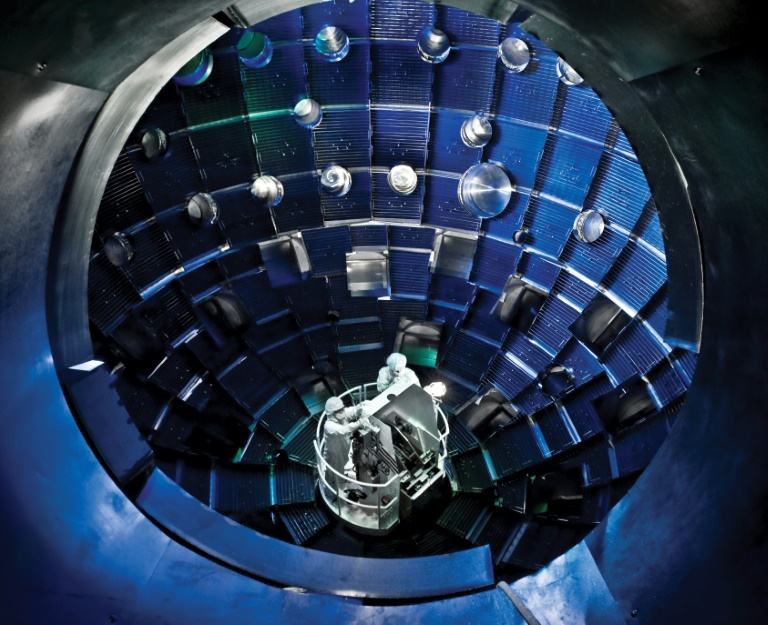
A second method is inertial confinement fusion, in which high energy lasers are directed simultaneously into a thimble-sized cylinder containing the hydrogen.

This is the technique used by scientists at the National Ignition Facility (NIF) at Lawrence Livermore National Laboratory (LLNL) in California who were behind Tuesday’s announcement.

Inertial confinement is used to demonstrate the physical principles of fusion, while magnetic confinement seeks to mimic future industrial-scale reactors.

– State of research –

For decades, scientists had attempted to achieve what is known as “net energy gain” — in which more energy is produced by the fusion reaction than it takes to activate it.

LLNL director Kim Budil cautioned that much remains to be done before it can be commercially viable.

“There are very significant hurdles, not just in the science but in technology,” Budil said. “A few decades of research on the underlying technologies could put us in a position to build a power plant.”

To get there, researchers must first increase the efficiency of the lasers and reproduce the experiment more frequently. 

– Fusion’s benefits –

The NIF’s success has sparked great excitement in the scientific community, which is hoping the technology could be a game-changer for global energy production.

Unlike fission, fusion carries no risk of nuclear accidents.

“If a few lasers are missing and they don’t go off at the right time, or if the confinement of the plasma by the magnetic field… is not perfect,” the reaction will simply stop, Lefebvre says.

Nuclear fusion also produces much less radioactive waste than current power plants, and above all, emits no greenhouse gases.

“It is an energy source that is totally carbon-free, generates very little waste, and is intrinsically extremely safe,” according to Lefebvre, who says fusion could be “a future solution for the world’s energy problems.”

Regardless of Tuesday’s announcement, however, the technology is still a far way off from producing energy on an industrial scale, and cannot therefore be relied on as an immediate solution to the climate crisis.

Hawaii volcano goes quiet after spectacular display

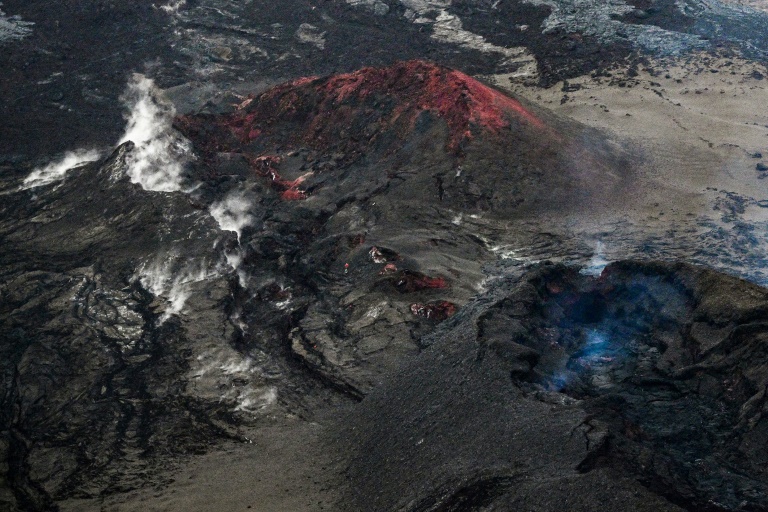
The world’s largest volcano, which has offered a spectacular weeks-long show in its first eruption for almost four decades, has gone quiet, scientists in Hawaii said Tuesday.

At the height of the flare-up, Mauna Loa spewed fountains of lava 200 feet (60 meters) into the sky, and sent rivers of molten rock gushing down its sides, wowing vulcanologists and helicopter-riding tourists.

Huge fissures on the volcano, which makes up the bulk of Hawaii’s Big Island, vented tons of gas, and sprayed slivers of volcanic glass — known as Pele’s Hair.

But on Tuesday, experts at the US Geological Survey said the show was largely over.

“Mauna Loa is no longer erupting,” an update said.

“Lava supply to the fissure 3 vent on the Northeast Rift Zone ceased on December 10 and sulfur dioxide emissions have decreased to near pre-eruption background levels.

“Volcanic tremor and earthquakes associated with the eruption are greatly diminished.”

But such is the volume — and intense heat — of the viscous rock that issued from the Earth’s belly, that hot spots could remain visible for weeks.

“Spots of incandescence may remain near the vent, along channels, and at the flow front for days or weeks as the lava flows cool,” the scientists said.

“However, eruptive activity is not expected to return based on past eruptive behavior.”

– ‘Long Mountain’ –

The biggest volcano on Earth by volume, Mauna Loa, whose name means “Long Mountain,” is larger than the rest of the Hawaiian islands combined.

The volcano’s submarine flanks stretch for miles to an ocean floor that is in turn depressed by Mauna Loa’s great mass — making its summit some 11 miles above its base, according to the USGS. 

One of six active volcanoes on the Hawaiian islands, Mauna Loa has erupted 33 times since 1843.

Before this one, its most recent eruption, in 1984, lasted 22 days.

Kilauea, a volcano on the southeastern flank of Mauna Loa, erupted almost continuously between 1983 and 2019, and a minor eruption there has been ongoing for months.

Growth downgrade for China 'very likely' on Covid surge: IMF chief

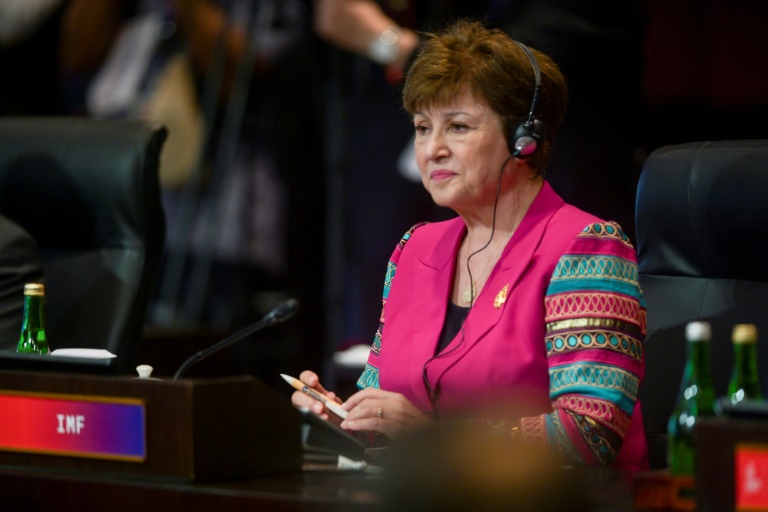
A lower growth forecast is “very likely” for China this year and next, with easing Covid-19 restrictions expected to bring a surge in infections and temporary difficulties, IMF chief Kristalina Georgieva told AFP Tuesday.

Her comments on the sidelines of a panel about a newly-created IMF fund come as the world’s second biggest economy grapples with soaring coronavirus cases, as it loosens virus controls after nearly three years.

While China’s zero-Covid policy has battered its economy, “the easing of restrictions is going to create some difficulties over the next months” as well, Georgieva said.

This is because a spike in infections will be inevitable, with more people temporarily unable to participate in the labor force.

“But it is likely that as China overcomes this in the second half of the year, there could be some improvement in growth prospects,” she said.

The zero-Covid policy, characterized by snap lockdowns, international travel restrictions and mass testing, took a heavy toll on consumers and businesses, with demonstrations against the measures eventually erupting in major Chinese cities.

The IMF earlier warned that tough virus restrictions have been especially hard on China’s residents.

Chinese officials said Monday that Covid cases are surging in Beijing, with a sharp spike in people visiting hospitals across the capital city. Rising infections in smaller cities were also discussed on social media.

The fund cut its growth projection for China in October to 3.2 percent this year — the lowest in decades — while expecting growth to rise to 4.4 percent next year.

But “very likely, we will be downgrading our growth projections for China, both for 2022 and for 2023,” Georgieva said.

– Adjusting policy –

For now, the country has to adjust its Covid policy, such as by being more targeted with restrictions and boosting vaccinations, especially to elderly populations. There is also a need to use more antiviral treatments, Georgieva added.

“In other words, retool the health system towards treating people rather than isolating, which has been the case for the last years,” she said.

Global economic leaders last week hailed China’s move away from its hardline virus strategy, with hopes that relaxation would also help to shore up a world economy struggling with fallout from the pandemic and Russia’s invasion of Ukraine.

With 2023 set to be a “very difficult year” as well, Georgieva reiterated that the likelihood of further downgrades in IMF growth projections will be “high.”

Apart from challenges in China, the US and European Union are also expected to slow simultaneously, with projections for half of the European Union to be in recession next year, she said.

While Washington-based fund earlier said there was a one-in-four chance global growth would fall below two percent next year, Georgieva added Tuesday that this probability has gone up.

EU energy ministers push gas price talks into next week

EU ministers meeting in Brussels on Tuesday narrowed differences over a proposed cap on natural gas prices, but kicked talks on the issue into next week to finalise “technical” details.

They did agree two other measures to mitigate Europe’s energy crunch, on joint gas purchases and speeding up authorisations for renewable energy installations, but their adoption was contingent on the price cap being settled.

“I was hoping to open a Champagne today to celebrate the agreement. But apparently, we still need to keep the bottles in the fridge for a while,” said Czech Industry Minister Jozef Sikela, who chaired the meeting under his country’s EU presidency.

He told journalists, “Our aim is to approve all three items in a package on Monday,” when energy ministers next meet.

The issue is urgent because Europe has entered a bitingly cold winter with fewer energy options because Russia has reduced gas supplies in retaliation for EU sanctions imposed over its war in Ukraine.

Gas prices are high, albeit lower than during the middle of the year, spurring worries that European homes and businesses could face blackouts or unpayable bills, if not this winter then next.

Sikela indicated the initial gas price-cap proposal, drawn up by the European Commission, would be modified to bridge a division between the bloc’s member states.

Several EU countries, including France, Poland and Spain, criticised the commission proposal as being designed so  the price cap could never be triggered.

The commission had suggested a price ceiling of 275 euros per megawatt hour, but only if the price remains above that level for at least two weeks, and then only if the price for liquified natural gas (LNG) goes above 58 euros for 10 days within that same two-week period.

Other EU countries including Germany, the Netherlands and Austria, viewed a too-rigid a price cap as a threat to supplies, carrying a risk that deliveries could be diverted from Europe to more lucrative markets in Asia.

Sikela said the price cap was “extremely sensitive” and had exposed a “fragile balance” in the European Union.

“Some of the countries believe that if we are wrong with the mechanism, it can basically cause like a much bigger problem that we want to prevent,” he said.

Some of those in favour of a viable price cap stressed the need for swift agreement.

“The time for consultation has run out,” the Italian minister for European affairs, Raffaele Fitto, said as he went into the meeting.

“European citizens are in agony, European businesses are closing…. All of us must heed to our responsibilities and agree without delay on the market correction mechanism and energy solidarity.”

EU leaders holding a summit in Brussels on Thursday had the option of taking up the issue themselves, but Sikela said that so far “nobody asked for it”.

He added: “We simply agreed that we will deal with the topic and we will finish the topic on Monday.”

Roma boy shot by Greek police dies

A 16-year-old Roma boy shot in the head by Greek police has died of his injuries, the hospital where he was being treated said Tuesday.

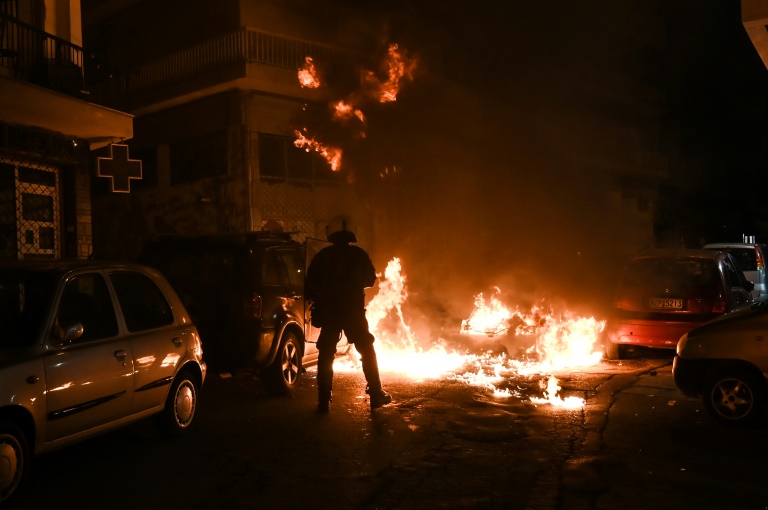
The December 5 shooting sparked running clashes between police and protesters in Greece’s second city Thessaloniki.

And police said an estimated 2,500 people marched Tuesday in Athens in memory of Kostas Fragoulis.

Skirmishes broke out with rocks and Molotov cocktails lobbed at police who fired teargas, the ANA news agency reported.

The latest shooting came a year after another Roma youth was killed by police near the port of Piraeus, on the eve of nationwide protests commemorating the police killing of 15-year-old Alexandros Grigoropoulos, whose death in 2008 shocked the nation.

“Today… despite the enormous efforts of staff in the intensive care unit, the patient died,” Thessaloniki’s Ippokratio Hospital said in a statement.

Despite calls for calm from Roma community leaders, incidents had continued in Thessaloniki for several days after the shooting with roads blocked by burning tyres.

The teenager was shot by a police motorcyclist after reportedly driving away from a service station without paying for 20 euros ($21) of petrol.

Police said he had “tried to ram police motorbikes” and made other “dangerous manoeuvres” as he fled. 

An officer has since been charged with attempted manslaughter.

Civil protection minister Takis Theodorikakos voiced “deep regret” after the death on Tuesday.

On Twitter, he urged people to allow the legal process to work saying it alone was “competent to weigh the facts and judge who was responsible”.

Greek police have faced growing criticism over their alleged heavy-handedness from the country’s ombudsman and a special investigative committee, which reported alarmingly high levels of police “impunity”.

The head of Greece’s Roma community condemned the “racism” with which they were treated and the “inertia” of the authorities in dealing with it.

Seven police are on trial for murder over last year’s killing of the Roma teenager in Piraeus and the attempted murder of his passenger.

In Peru, outside Castillo's prison supporters vow fight to the end

Tearfully, an emotional Ana Karina Ramos vows to stay “as long as is necessary” in front of the prison where Peru’s former president Pedro Castillo is being held after attempting to dissolve parliament and rule by decree.

“We have been sleeping here for four nights and we will stay here until the president returns to the palace,” says Ramos.

She is among about 100 Castillo supporters who have set up camp in front of the prison in the eastern suburbs of Lima.

Riot police with huge transparent shields guard the iron gates at the entrance.

– ‘The people are with you’ –

On December 7, leftist former rural school teacher Castillo, 53, ordered the dissolution of parliament just hours before the legislature was due to hold a third impeachment vote against him since he assumed office in July 2021.

Parliament, though, ignored him and went ahead with the vote, overwhelmingly deciding to impeach him for “moral incapacity,” a supposed political flaw that has been heavily criticized by international organizations who say it is too subjective a term.

Castillo was arrested a few hours later by his own security detail as he headed to the Mexican embassy hoping to claim political asylum.

Prosecutors have accused him of “rebellion” and “conspiracy.”

A trade unionist and outsider with no connection to the traditional political elites, Castillo is popular in rural Andean regions.

Many have made their way from there to the capital to show their support, shouting “Pedro friend!” and “Insurrection!” 

Dirty mattresses and cushions are piled up on the pavement alongside a small khaki-colored tent.

A piece of paper pinned to the tent reads: “If there is no freedom, there will be revolution! Chin up president Castillo.”

Ramos is convinced Castillo was unjustly jailed because he is “a peasant, a farmer, a teacher, an honest man.”

“We sleep here because we want to fight for dignity, for the homeland,” she adds.

“We are defending the homeland for our children, for those who will come next.”

– ‘Fight or be trampled’ –

When Castillo’s lawyers arrive to meet with him, they must cross a police cordon and pass through a crowd of journalists.

“Rubbish press! Liars!” shout the protesters.

Someone throws an orange that fails to hit anyone.

Another protester throws used tissues in a sign of disdain for the press they accuse of supporting right-wing politicians and the rich.

“It is time to fight! For our children, for our grandchildren,” says indigenous protester Mayra Llantoy. “Because if we give in now, we will always be trampled.”

Like most of the demonstrators, she says Castillo is the victim of a conspiracy and claims — along with the former president’s allies — that he had been drugged when he made his speech attempting to dissolve parliament.

“During the announcement he was shaking. I realized he was scared. His eyes were rolling,” says Llantoy, a young mother who works as a street vendor.

Miriam Castro, 52, is preparing a corn-based soup to distribute to protesters.

“We are here. I don’t want to stay for the whole year, or two, but we want president Castillo to be free,” says Castro.

Close Bitnami banner
Bitnami