World

Jin from BTS begins military service, marking end of an era

BTS star Jin started his mandatory South Korean military duty on Tuesday, the band’s first member to enlist since a hiatus announcement this year left fans heartbroken over the K-pop juggernaut’s uncertain future.

The septet is widely considered the country’s biggest-ever cultural phenomenon, selling out stadiums around the world and dominating the charts while raking in billions and building a global legion of fans known as ARMYs.

But all able-bodied men in South Korea must serve at least 18 months in the military and, while there was a years-long debate about whether BTS deserved an exemption, they confirmed in October that all members will enlist.

Jin — whose full name is Kim Seok-jin — reported to a frontline boot camp in Yeoncheon on Tuesday to begin his five-week training, kickstarting 18 months of military service.

He was riding one of the black vans that arrived in a row around 20 minutes before a 2:00 pm (0500 GMT) deadline, according to BTS’s agency HYBE.

Hundreds of media personnel and BTS fans packed an intersection in front of the boot camp’s main gate, where a sign reads “A cradle for top class combat soldiers”.

“We have mixed feelings today because on one hand, it’s normal that he does this enlistment because it’s an obligation anyway for any Korean men,” said Veronique, a 32-year-old fan from Indonesia.

“But on the other hand we cannot see him for a minimum of 18 months … Happy but also sad but also proud,” she said.

The location of Jin’s boot camp close to the border with North Korea, with which the South remains technically at war, has sparked local media speculation that he is expected to be deployed to a “frontline unit” after training.

– Fans stunned –

Fans were stunned in June when BTS revealed they were going on hiatus, citing exhaustion and pressure as well as the desire to pursue solo careers.

But analysts said the announcement was timed because of the compulsory military duty.

The group will reunite around 2025, when its seven members have completed their service.

“For a while, it’s true that there were many fans who would spend days just crying,” a South Korean fan, who runs the Twitter account @5heterotopia, told AFP.

Nimah Mustafa, a 20-year-old fan in Dubai, added: “(Jin’s absence) will be like a huge… void for me.”

South Korea exempts some elite athletes, such as Olympic medallists, and classical musicians from duty, but pop stars do not qualify.

However, BTS have already benefited from a 2020 revision to the conscription law that raised the enlistment deadline for some entertainers from age 28 to 30.

Jin, the oldest member of BTS, turned 30 on December 4.

– ‘They won’t be forgotten’ –

The seismic changes for BTS in 2022 have sparked feverish speculation among fans and K-pop watchers about what the future holds for the group — will they retain their fame or struggle to revive that success?

Some male K-pop stars have struggled to resume their careers after military service in a cut-throat industry where artists are easily replaceable.

“For the K-pop industry, the retreat of BTS will be a big deal,” Lee Taek-gwang, a communications professor at Kyung Hee University, told AFP.

However, other experts have pointed to the massive success of BTS and said they will be an exception to that trend.

They “obtained another level of popularity, influence and credibility”, said Lee Ji-young, a BTS expert and professor at Hankuk University of Foreign Studies.

Since their debut in 2013, BTS have been widely credited with doing more than any diplomat or other celebrity to boost the image and soft power of South Korea, today considered a global cultural powerhouse.

They have been invited to speak at the United Nations, and to meet US President Joe Biden at the White House. They are also official ambassadors to bring the 2030 World Expo to Busan, South Korea.

The South Korean government has credited BTS with bringing billions of dollars into the economy.

BTS “changed a lot of perceptions of ‘what is’ a pop star today,” Jeff Benjamin, Billboard’s K-pop columnist, told AFP.

– ‘Frontline’ deployment? –

But despite that success, a draft proposal to grant them service exemptions proved too controversial and never made it through parliament.

“In South Korea, the military service is the indicator of egalitarianism… (where) all men are equal,” Lee at Kyung Hee University told AFP, adding it was a “necessary” symbol of citizenship.

Jin will reportedly join a “frontline unit” stationed near the border.

“It shows the role of culture, and public opinion, in shaping international affairs. Is this ‘frontline’ role a combat role, or is it about public relations and media?” Sarah Keith, a senior lecturer in media and music at Macquarie University, told AFP.

On Monday, Jin posted a photo of himself with military-style cropped hair on the South Korean social media platform Weverse, with the caption: “It’s cuter than I expected.”

Decade on, wife of missing Laos activist says no closer to finding answers

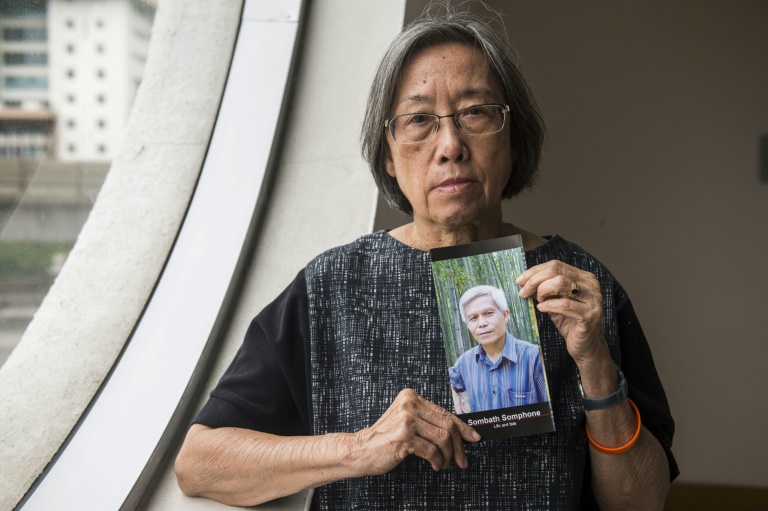
The wife of a missing Laos activist said Tuesday that a decade on she was still no closer to finding answers over his disappearance as more than 60 human rights groups condemned Vientiane’s inaction.

Sombath Somphone, an award-winning campaigner for sustainable development, vanished on December 15, 2012 after police pulled over his vehicle at a checkpoint in the capital.

The case shone a spotlight on the reclusive communist nation’s poor human rights record, but campaigners condemned on Tuesday the lack of significant progress on the case.

“I may not even get any answers by the end of my life,” his wife Shui-Meng Ng said, adding she last received an official update in 2017.

“But I just hope the memory of Sombath, especially what he has done, who he is, continues to live on,” the 76-year-old said, speaking in Bangkok on the 10th anniversary of his disappearance.

“I don’t want to keep dwelling on the sadness of what happened,” said Ng.

She recalled how her “farm boy” husband would bring her fruit freshly picked from their garden, telling her: “See what I found, let’s have some mango for breakfast.”

Ng, who worked for the UN children’s agency UNICEF in Laos and East Timor before publishing a book on Sombath’s life last year, said her husband’s mentorship of thousands was his most important legacy.

“This is what sustains me,” she said.

But she said in Laos, “you don’t hear his name being spoken much. People don’t want to talk about it because they are afraid they will invite the unnecessary attention of the government.”

Also speaking in Bangkok, Andrea Giorgetta, head of the International Federation for Human Rights’s Asia desk, said the Laotian government “has in fact engaged very actively in suppression of public discussion of Sombath.”

In a joint statement, 66 international rights groups characterised Vientiane’s lack of response as “a catalogue of apparent inaction, negligence, cover-ups, and misleading statements”.

They said there was “an overall lack of political will to effectively address Sombath’s enforced disappearance”.

Ng added that she hoped European leaders would raise the case with their Southeast Asian counterparts at a Brussels summit this week.

Laos has denied any connection to the case, raised directly with the government during United Nations human rights reviews in 2015 and 2020.

Vientiane did not respond to AFP’s requests for comment.

China launches WTO dispute over US chip sanctions

China has filed a dispute with the World Trade Organization over US restrictions on chip exports, Beijing’s commerce ministry said in a statement late Monday, accusing Washington of threatening global supply chains.

The United States in October announced new export controls aimed at restricting China’s ability to buy and manufacture high-end chips with military applications, complicating Beijing’s push to further its own semiconductor industry and develop advanced military systems.

The moves include export restrictions on some chips used in supercomputing as well as stricter requirements on the sale of semiconductor equipment.

The aim is to prevent “sensitive technologies with military applications” from being acquired by China’s military, intelligence and security services, the US Commerce Department said in October.

However, China’s foreign ministry claimed Tuesday that the United States has “repeatedly used national security as an excuse to interfere in the normal operation of international trade”.

“All countries should stand up and not let Washington’s unilateralism and protectionism go unchecked,” foreign ministry spokesman Wang Wenbin said at a routine briefing.

“This concerns the stability of the global trade system and more importantly, international justice.”

China’s Ministry of Commerce on Monday had accused the United States of “obstructing normal international trade in products including chips and threatening the stability of the global industrial supply chain”, as well as violating international trade rules and engaging in “protectionist practices”.

The WTO dispute is intended to defend China’s “legitimate rights and interests”, the ministry said in its statement, urging Washington to “give up zero-sum thinking”.

The two superpowers have long faced off over a range of issues including technology, trade, Hong Kong, Taiwan and human rights.

Chinese leader Xi Jinping and US President Joe Biden pledged to repair frayed relations at a summit in Bali, Indonesia last month.

Days before the latest chip controls, the Pentagon added 13 more Chinese firms including drone manufacturer DJI and surveillance firm Zhejiang Dahua Technology to a blacklist of military-linked entities.

Markets mixed ahead of inflation, Fed decision

Markets were mixed Tuesday as nervous investors sat tight ahead of key US inflation data and a Federal Reserve policy decision but fresh pledges by China to open up from zero-Covid offered support.

The region was given a positive lead after Wall Street’s three main indexes raced out of the traps Monday, with analysts citing a survey by the central bank that showed inflation expectations falling.

The November consumer price index figures later in the day follow Friday’s forecast-beating print on wholesale inflation, which dented hopes the Fed could take a more dovish tilt in its monetary-tightening campaign.

The central bank is then widely expected to lift interest rates 50 basis points on Wednesday — a slowdown from the previous four 75-point hikes — but its post-meeting statement and comments from boss Jerome Powell will be closely followed.

While the general view is that policymakers will stop increasing borrowing costs next year, there is debate about how high they will peak and when they will start to come down.

“I think CPI will be important but not necessarily for this meeting, for which a 50 basis point hike is well flagged, but rather it will help determine the extent of further tightening and give clues to the terminal rate,” Mitul Kotecha, of TD Securities, said.

“However, we think the risks are asymmetric in that a higher CPI print will likely have a bigger impact than a lower print.”

But the Wall Street Journal reported that there were disagreements within the policy board about the way forward, with doves trying to limit the economic pain as they bring inflation down, while hawks want a tougher line on fighting prices by weakening the jobs market.

“In this light, don’t expect clearcut signals from the Fed… on what they expect to be doing at early 2023 (policy) meetings after a widely expected 50 basis points fund rate hike this week,” said National Australia Bank’s Ray Attrill.

Hong Kong rose after authorities announced a further easing of the city’s Covid rules, while Tokyo, Sydney, Singapore, Wellington, Bangkok and Jakarta were all well up.

However, Shanghai dipped along with Seoul, Taipei, Manila and Mumbai.

London, Paris and Frankfurt edged up at the open.

“It’s been a do-nothing day as investors take stock before the onslaught of a series of high-risk events,” said SPI Asset Management’s Stephen Innes.

China’s shift away from its economically damaging zero-Covid policy continued to support sentiment as the world’s number two economy opens up.

Meanwhile, top Chinese officials are meeting this week to draw up their economic blueprint for re-emerging from Covid, with observers predicting more stimulus measures and pledges of support for the troubled property sector.

But there is also a worry among investors that the quick relaxation of containment measures such as mass testing and lockdowns might lead to a massive surge in infections that could overwhelm the healthcare system and weigh on the economy.

Still, the expected pick-up in demand in China boosted oil prices further, with both main contracts extending Monday’s strong gains.

“China’s reopening is coming, it won’t happen overnight, but it will provide a major boost to demand in the outlook next quarter,” said OANDA’s Edward Moya. 

– Key figures around 0820 GMT –

Tokyo – Nikkei 225: UP 0.4 percent at 27,954.85 (close)

Hong Kong – Hang Seng Index: UP 0.7 percent at 19,596.20 (close)

Shanghai – Composite: DOWN 0.1 percent at 3,176.33 (close)

London – FTSE 100: UP 0.1 percent at 7455.50

Euro/dollar: UP at $1.0551 from $1.0539 on Monday

Dollar/yen: DOWN at 137.46 yen from 137.66 yen

Pound/dollar: UP at $1.2274 from $1.2268

Euro/pound: UP at 85.96 pence from 85.87 pence

West Texas Intermediate: UP 1.4 percent at $74.21 per barrel

Brent North Sea crude: UP 1.6 percent at $79.21 per barrel

New York – Dow: UP 1.6 percent at 34,005.04 (close)

Seven dead as Peru's new leader fails to quell protests

Five more protesters died in Peru on Monday as violent demonstrations over the ousting of the former president showed no sign of calming, despite his successor’s efforts to quell the unrest.

Seven people, including three teenagers, have now died in escalating protests since the leftist Pedro Castillo was accused of an attempted coup, impeached and arrested last week.

New President Dina Boluarte tried to ease tensions on Sunday, announcing she would seek to hold elections two years early and declaring a state of emergency in flashpoint areas.

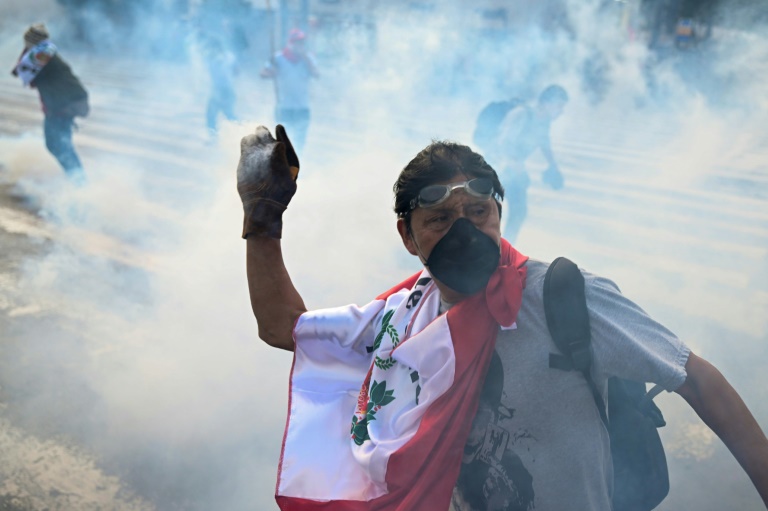
But that had little effect as protesters continued to demand her resignation, blocking roads in several cities around the country with logs, rocks and burning tires.

Some 2,000 protesters smashed runway lighting, burned security booths and forced the closure of the airport in Peru’s second-largest city Arequipa for several hours on Monday before police dispersed them with tear gas.

Around 100 Castillo supporters were camped out in front of the police facility in Lima where he is being held, demanding he be released and returned to office.

“We have been sleeping here for four nights and we will continue until we get the president back to the (presidential) palace,” protester Ana Karina Ramos told AFP, with tears in her eyes.

Also Monday in Apurimac, demonstrators torched the public prosecutor’s office and a police station.

In Arequipa, protesters occupied one of the largest factories in the country, owned by the dairy company Gloria.

Train services between Cusco and Machu Picchu, Peru’s best known tourist site, will be suspended from Tuesday to ensure passenger safety ahead of a national strike called for by Castillo supporters, the rail operator said.

Cusco’s international airport was also closed after protesters attempted to “violently enter” it on Monday, aviation authorities said.

Seven people have been killed since Sunday, a source from the public defender’s office told AFP on condition of anonymity.

UN Human Rights Office spokeswoman Marta Hurtado warned that “the situation may escalate further” and urged “all involved to exercise restraint.”

Hurtado also called on authorities to “allow people to exercise their rights to peaceful assembly and freedom of opinion and expression.”

– ‘Political prisoner’-

Castillo has been in detention since last Wednesday, and is facing charges of rebellion and conspiracy after he dissolved Congress and vowed to rule by decree.

The former president met with his lawyers in Lima ahead of a hearing Tuesday in which he will seek his immediate release.

Meanwhile, the leftist governments of Mexico, Argentina, Colombia and Bolivia released a joint statement in support of Castillo, saying he had been “the victim of antidemocratic harassment” since his election.

Castillo’s 17-month rule was overshadowed by six investigations against him and his family, mass protests demanding his removal, and a power struggle with the opposition-controlled Congress.

Boluarte, a former prosecutor who had served as Castillo’s vice president, was quickly sworn in to replace him following his impeachment and arrest.

On Sunday, she tried to appease citizens in a televised address saying she would seek “to reach an agreement” with Congress to bring forward elections from July 2026 to April 2024.

The country’s right-leaning Congress convened an emergency session on Sunday afternoon to discuss the crisis, but it had to be suspended after fighting broke out.

On Monday, the government fired the 26 regional prefects who had been appointed by Castillo, accusing them of “inciting protests.”

– ‘Indefinite strike’ –

With his background as a rural teacher and union leader, and with little contact among the nation’s elites, Castillo has always drawn his strongest support from Andean regions, while struggling to find backing in coastal Lima.

Rural unions and organizations representing Indigenous peoples have called for an “indefinite strike” beginning Tuesday in support of Castillo, himself the son of a peasant family.

They demanded the suspension of Congress, early elections and a new constitution, as well as Castillo’s immediate release, according to a statement from the Agrarian and Rural Front of Peru, which groups about a dozen organizations.

Peru is no stranger to political instability and is now on its sixth president since 2016.

US set to announce nuclear fusion breakthrough

The US Department of Energy is expected to announce Tuesday that its researchers have achieved a “major scientific breakthrough” regarding nuclear fusion, a technology seen as a possible revolutionary alternative power source.

Scientists have been working for decades to develop nuclear fusion — touted by its supporters as a clean, abundant and safe source of energy that could eventually allow humanity to break its dependence on the fossil fuels driving a global climate crisis.

The Energy Department has refused to give any specific details about what it will announce Tuesday, but a Financial Times report over the weekend has set the scientific community abuzz.

According to the UK-based outlet, researchers at the Lawrence Livermore National Laboratory (LLNL) in California have succeeded for the first time in producing a “net energy gain” from nuclear fusion, meaning more energy was produced in the reaction than was used to activate it.

If the achievement is confirmed, “that is a true breakthrough moment which is tremendously exciting,” said physicist Jeremy Chittenden with Imperial College London.

“It proves that the long sought-after goal, the ‘holy grail’ of fusion, can indeed be achieved.”

Nuclear power plants around the world currently use fission — the splitting of a heavy atom’s nucleus — to produce energy.

Fusion on the other hand combines two light hydrogen atoms to form one heavier helium atom, releasing a large amount of energy in the process.

That’s the process that occurs inside stars, including our sun.

On Earth, fusion reactions can be provoked by heating hydrogen to extreme temperatures inside specialized devices.

Researchers at the LLNL use the massive National Ignition Facility — 192 ultra-powerful lasers all pointed into a thimble-sized cylinder filled with hydrogen.

According to the Financial Times, LLNL scientists recently produced about 2.5 megajoules of energy in a nuclear fusion reaction, or about 120 percent of the 2.1 megajoules used by the lasers to initiate it.

– Decades to achieve –

That result would finally provide proof for the physical principles outlined decades ago by fusion researchers. It would be a “a success of the science,” said Tony Roulstone, a lecturer at Cambridge University.

Like fission, fusion is carbon-free during operation, but has many more advantages: it poses no risk of nuclear disaster and produces much less radioactive waste.

However, there is still a long way to go before fusion is viable on an industrial scale.

“To turn fusion into a power source we’ll need to boost the energy gain still further,” cautions Chittenden.

“We’ll also need to find a way to reproduce the same effect much more frequently and much more cheaply before we can realistically turn this into a power plant,” he added.

That could take yet another 20 or 30 years, Erik Lefebvre, project manager at the French Atomic Energy Commission, told AFP.

Climate experts however warn that the world cannot wait that long to reduce its greenhouse gas emissions, and limit the worst effects of global warming.

Other nuclear fusion projects are also in development around the world, including the major international project known as ITER, which is currently under construction in France.

Instead of lasers, ITER will use a technique known as magnetic confinement, containing a swirling mass of fusing hydrogen plasma within a massive donut-shaped chamber.

US set to announce nuclear fusion breakthrough

The US Department of Energy is expected to announce Tuesday that its researchers have achieved a “major scientific breakthrough” regarding nuclear fusion, a technology seen as a possible revolutionary alternative power source.

Scientists have been working for decades to develop nuclear fusion — touted by its supporters as a clean, abundant and safe source of energy that could eventually allow humanity to break its dependence on the fossil fuels driving a global climate crisis.

The Energy Department has refused to give any specific details about what it will announce Tuesday, but a Financial Times report over the weekend has set the scientific community abuzz.

According to the UK-based outlet, researchers at the Lawrence Livermore National Laboratory (LLNL) in California have succeeded for the first time in producing a “net energy gain” from nuclear fusion, meaning more energy was produced in the reaction than was used to activate it.

If the achievement is confirmed, “that is a true breakthrough moment which is tremendously exciting,” said physicist Jeremy Chittenden with Imperial College London.

“It proves that the long sought-after goal, the ‘holy grail’ of fusion, can indeed be achieved.”

Nuclear power plants around the world currently use fission — the splitting of a heavy atom’s nucleus — to produce energy.

Fusion on the other hand combines two light hydrogen atoms to form one heavier helium atom, releasing a large amount of energy in the process.

That’s the process that occurs inside stars, including our sun.

On Earth, fusion reactions can be provoked by heating hydrogen to extreme temperatures inside specialized devices.

Researchers at the LLNL use the massive National Ignition Facility — 192 ultra-powerful lasers all pointed into a thimble-sized cylinder filled with hydrogen.

According to the Financial Times, LLNL scientists recently produced about 2.5 megajoules of energy in a nuclear fusion reaction, or about 120 percent of the 2.1 megajoules used by the lasers to initiate it.

– Decades to achieve –

That result would finally provide proof for the physical principles outlined decades ago by fusion researchers. It would be a “a success of the science,” said Tony Roulstone, a lecturer at Cambridge University.

Like fission, fusion is carbon-free during operation, but has many more advantages: it poses no risk of nuclear disaster and produces much less radioactive waste.

However, there is still a long way to go before fusion is viable on an industrial scale.

“To turn fusion into a power source we’ll need to boost the energy gain still further,” cautions Chittenden.

“We’ll also need to find a way to reproduce the same effect much more frequently and much more cheaply before we can realistically turn this into a power plant,” he added.

That could take yet another 20 or 30 years, Erik Lefebvre, project manager at the French Atomic Energy Commission, told AFP.

Climate experts however warn that the world cannot wait that long to reduce its greenhouse gas emissions, and limit the worst effects of global warming.

Other nuclear fusion projects are also in development around the world, including the major international project known as ITER, which is currently under construction in France.

Instead of lasers, ITER will use a technique known as magnetic confinement, containing a swirling mass of fusing hydrogen plasma within a massive donut-shaped chamber.

US set to announce nuclear fusion breakthrough

The US Department of Energy is expected to announce Tuesday that its researchers have achieved a “major scientific breakthrough” regarding nuclear fusion, a technology seen as a possible revolutionary alternative power source.

Scientists have been working for decades to develop nuclear fusion — touted by its supporters as a clean, abundant and safe source of energy that could eventually allow humanity to break its dependence on the fossil fuels driving a global climate crisis.

The Energy Department has refused to give any specific details about what it will announce Tuesday, but a Financial Times report over the weekend has set the scientific community abuzz.

According to the UK-based outlet, researchers at the Lawrence Livermore National Laboratory (LLNL) in California have succeeded for the first time in producing a “net energy gain” from nuclear fusion, meaning more energy was produced in the reaction than was used to activate it.

If the achievement is confirmed, “that is a true breakthrough moment which is tremendously exciting,” said physicist Jeremy Chittenden with Imperial College London.

“It proves that the long sought-after goal, the ‘holy grail’ of fusion, can indeed be achieved.”

Nuclear power plants around the world currently use fission — the splitting of a heavy atom’s nucleus — to produce energy.

Fusion on the other hand combines two light hydrogen atoms to form one heavier helium atom, releasing a large amount of energy in the process.

That’s the process that occurs inside stars, including our sun.

On Earth, fusion reactions can be provoked by heating hydrogen to extreme temperatures inside specialized devices.

Researchers at the LLNL use the massive National Ignition Facility — 192 ultra-powerful lasers all pointed into a thimble-sized cylinder filled with hydrogen.

According to the Financial Times, LLNL scientists recently produced about 2.5 megajoules of energy in a nuclear fusion reaction, or about 120 percent of the 2.1 megajoules used by the lasers to initiate it.

– Decades to achieve –

That result would finally provide proof for the physical principles outlined decades ago by fusion researchers. It would be a “a success of the science,” said Tony Roulstone, a lecturer at Cambridge University.

Like fission, fusion is carbon-free during operation, but has many more advantages: it poses no risk of nuclear disaster and produces much less radioactive waste.

However, there is still a long way to go before fusion is viable on an industrial scale.

“To turn fusion into a power source we’ll need to boost the energy gain still further,” cautions Chittenden.

“We’ll also need to find a way to reproduce the same effect much more frequently and much more cheaply before we can realistically turn this into a power plant,” he added.

That could take yet another 20 or 30 years, Erik Lefebvre, project manager at the French Atomic Energy Commission, told AFP.

Climate experts however warn that the world cannot wait that long to reduce its greenhouse gas emissions, and limit the worst effects of global warming.

Other nuclear fusion projects are also in development around the world, including the major international project known as ITER, which is currently under construction in France.

Instead of lasers, ITER will use a technique known as magnetic confinement, containing a swirling mass of fusing hydrogen plasma within a massive donut-shaped chamber.

Jin from BTS begins military service, marking end of an era

BTS star Jin started his mandatory South Korean military duty on Tuesday, the band’s first member to enlist since a hiatus announcement this year left fans heartbroken over the K-pop juggernaut’s uncertain future.

The septet is widely considered the country’s biggest-ever cultural phenomenon — selling out stadiums around the world and dominating the charts while raking in billions and building a global legion of fans known as ARMYs.

But all able-bodied men in South Korea must serve at least 18 months in the military, and while there was a years-long debate about whether BTS deserved an exemption, they confirmed in October that all members will enlist.

Jin — whose full name is Kim Seok-jin — reported to a frontline boot camp in Yeoncheon Tuesday to begin his five week training, kickstarting 18 months of military service.

He was riding one of the black vans that arrived in a row around 20 minutes before a 2:00 pm (0500 GMT) deadline, according to BTS’s agency HYBE.

Hundreds of media personnel and BTS fans packed an intersection in front of the boot camp’s main gate, where a sign reads “A cradle for top class combat soldiers”.

“We have mixed feelings today because on one hand, it’s normal that he does this enlistment because it’s an obligation anyway for any Korean men,” said Veronique, a 32-year-old fan from Indonesia.

“But on the other hand we cannot see him for a minimum of 18 months … Happy but also sad but also proud,” she said.

The location of Jin’s boot camp close to the border with North Korea, with which the South remains technically at war, has sparked local media speculation that he is expected to be deployed to a “frontline unit” after training.

– Fans stunned –

Fans were stunned in June when BTS revealed they were going on hiatus, citing exhaustion and pressure as well as the desire to pursue solo careers.

But analysts said the announcement was timed because of the compulsory military duty.

The group will reunite around 2025, when its seven members have completed their service.

“For a while, it’s true that there were many fans who would spend days just crying,” a South Korean fan, who runs the Twitter account @5heterotopia, told AFP.

Nimah Mustafa, a 20-year-old fan in Dubai, added: “(Jin’s absence) will be like a huge… void for me.”

South Korea exempts some elite athletes, such as Olympic medallists, and classical musicians from duty, but pop stars do not qualify.

However, BTS have already benefited from a 2020 revision to the conscription law that raised the enlistment deadline for some entertainers from age 28 to 30.

Jin, the oldest member of BTS, turned 30 on December 4.

– ‘They won’t be forgotten’ –

The seismic changes for BTS in 2022 have sparked feverish speculation among fans and K-pop watchers about what the future holds for the group — will they retain their fame or struggle to revive that success?

Some male K-pop stars have struggled to resume their careers after military service in a cut-throat industry where artists are easily replaceable.

“For the K-pop industry, the retreat of BTS will be a big deal,” Lee Taek-gwang, a communications professor at Kyung Hee University, told AFP.

However, other experts have pointed to the massive success of BTS and said they will be an exception to that trend.

They “obtained another level of popularity, influence and credibility”, said Lee Ji-young, a BTS expert and professor at Hankuk University of Foreign Studies.

Since their debut in 2013, BTS have been widely credited with doing more than any diplomat or other celebrity to boost the image and soft power of South Korea, today considered a global cultural powerhouse.

They have been invited to speak at the United Nations, and to meet US President Joe Biden at the White House. They are also official ambassadors to bring the 2030 World Expo to Busan, South Korea.

The South Korean government has credited BTS with bringing billions of dollars into the economy.

– ‘Frontline’ deployment? –

But despite that success, a draft proposal to grant them service exemptions proved too controversial and never made it through parliament.

“In South Korea, the military service is the indicator of egalitarianism… (where) all men are equal,” Lee at Kyung Hee University told AFP, adding it was a “necessary” symbol of citizenship.

Jin will reportedly join a “frontline unit” stationed near the border.

“It shows the role of culture, and public opinion, in shaping international affairs. Is this ‘frontline’ role a combat role, or is it about public relations and media?” Sarah Keith, a senior lecturer in media and music at Macquarie University, told AFP.

On Monday, Jin posted a photo of himself with military-style cropped hair on the South Korean social media platform Weverse, with the caption: “It’s cuter than I expected.”

China protester detained for nine days: mother

A young protester has been held in police detention in southern China for nine days after taking part in rallies against Covid restrictions, her mother told AFP, expressing fear and anguish over her daughter’s safety.

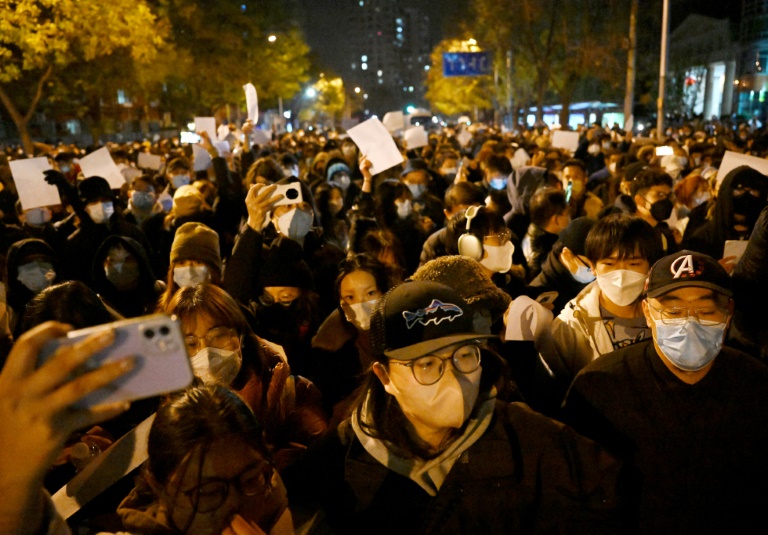
China last week effectively ended its harsh zero-Covid policy, following years of economic damage and simmering public discontent that erupted in nationwide demonstrations on a scale unseen in decades.

But while the decision to lift the hardline regulations sparked a wave of jubilation — and suggestions by state media that the government was responding to the changing mood of the people — police had already begun a crackdown.

Yang Zijing, 25, was detained on the evening of December 4 in the southern metropolis of Guangzhou after attending a protest the week before, her mother said.

“They detained so many people who were gradually released, why is she still in there?,” she said.

The woman, surnamed Gao, said her daughter’s roommate told her that a group of police asked to check the water meter and did not show identification when entering.

“They searched the apartment and took her away, along with her phone and laptop.”

AFP has learned of multiple cases of mostly young protesters detained for up to 24 hours in Beijing and Shanghai, with police deploying sophisticated technology to track them down and threaten them in phone calls and in-person interrogations.

– ‘No information’ –

Gao rushed to Guangzhou on December 8 upon learning of her daughter’s detention, but both she and a lawyer have been refused access to either her daughter or the police officer handling her case.

“They refused to give us any information,” she said.

Under Chinese law, when an individual is taken into custody and interrogated, police have 24 hours to decide whether to release them or formally detain them.

If a suspect is detained, they must then be transferred to a pretrial detention centre within 24 hours.

But Gao said police had still not transferred Yang to a detention centre — allegedly due to the “epidemic situation”.

A police officer at the Guangzhou station told AFP he could not comment on Yang’s case over the phone.

A lawyer offering pro bono advice to protesters said on condition of anonymity that the majority of detentions she was aware of had not exceeded 24 hours.

But at least six demonstrators in Shanghai and Guangzhou had been held for a week or longer with some likely to receive criminal charges, she said.

“There were no reports about (the protests) in Chinese media and I had no idea it happened… I didn’t know why they were holding up blank paper,” said Gao, a reference to the blank sheets of paper held at protests as a symbol of opposition to censorship.

Friends of Yang describe her as a bookish and introverted person who possessed a strong sense of social justice and advocated for marginalised groups.

But she had suffered during the pandemic as a recent graduate working in a tough economic climate, her mother said.

“She was struggling financially. She felt like she couldn’t do anything in the past two years, lockdowns were everywhere,” she said.

“Now everyone thinks about the benefits that China’s reopening will bring, but what about the people who are locked up for demanding reopening?”

Close Bitnami banner
Bitnami