World

Alleged Lockerbie bombmaker due in US court

The Libyan accused of making the bomb that destroyed a Pan Am flight over Scotland in 1988, killing 270 people, is to appear in a US court in Washington on Monday, Justice Department officials said.

Abu Agila Mohammad Masud, who allegedly worked as an intelligence agent for the regime of former Libyan dictator Moamer Kadhafi, was charged by the United States two years ago for the Lockerbie bombing, which killed 190 Americans. 

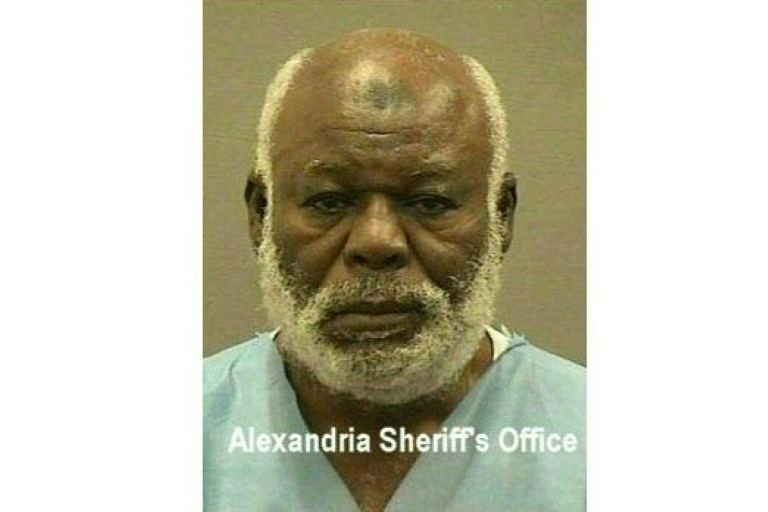
After arriving in the United States, Masud was taken to a facility in Alexandria, Virginia, for initial processing, where his mug shot was taken, the officials said.

He is to appear Monday afternoon in federal court in the nation’s capital for an initial hearing.

Scottish prosecutors announced on Sunday that Masud was in American hands, but provided no details on how he had been transferred to US custody.

Masud had been reportedly imprisoned in Libya for his alleged involvement in attacks on Libyan opposition figures in 2011.

Only one person has been convicted for the December 21, 1988 bombing of Pan Am Flight 103, which remains the deadliest terror attack ever on British soil.

The New York-bound aircraft was blown up 38 minutes after it took off from London, sending the main fuselage plunging to the ground in the town of Lockerbie and spreading debris over a vast area.

The bombing killed all 259 people on the jumbo jet and 11 people on the ground.

Two Libyans — Abdelbaset Ali Mohmet al-Megrahi, a former Libyan intelligence officer, and Al Amin Khalifa Fhimah — were charged with the bombing and put on trial in the Netherlands.

Megrahi spent seven years in a Scottish prison after his conviction in 2001 while Fhimah was acquitted.

Megrahi died in Libya in 2012, always maintaining his innocence.

His family lodged a bid for a posthumous appeal to clear his name in 2017, but Scotland’s High Court upheld his conviction in 2021.

– ‘Kadhafi thanked him’ –

Masud’s fate has been tied up in the warring factionalism of Libyan politics.

According to a September 2015 article in The New Yorker, Masud was sentenced that year to 10 years in prison in Libya after being accused of using remote-detonated bombs against Libyan opposition members in 2011.

The Lockerbie investigation was relaunched in 2016 when Washington learned of Masud’s arrest, following Kadhafi’s ouster and death in 2011, and his reported confession of involvement to the new Libyan regime in 2012.

According to an affidavit from an FBI agent involved in the probe, Masud worked as a “technical expert” for Libya’s External Security Organization (ESO), building explosive devices and earning the rank of colonel.

Masud confessed in a September 2012 interview with a Libyan law enforcement officer to assembling the bomb that brought down the Pan Am jet, the affidavit said.

“Masud confirmed that the bombing operation of Pan Am Flight 103 was ordered by Libyan intelligence leadership,” it said.

“Masud confirmed that after the operation, Kadhafi thanked him and other members of the team for their successful attack on the United States.”

According to the FBI agent’s affidavit, Masud also admitted to committing the April 1986 bombing of the LaBelle Discotheque in Berlin which killed two US service members and a Turkish woman.

Families of the Lockerbie victims thanked US and British law enforcement officials following the news of Masud’s arrest.

“Our loved ones will never be forgotten, and those who are responsible for their murder on December 21, 1988 must face justice,” they said in a statement.
Chinese, Indian troops injured in fresh border 'face-off'

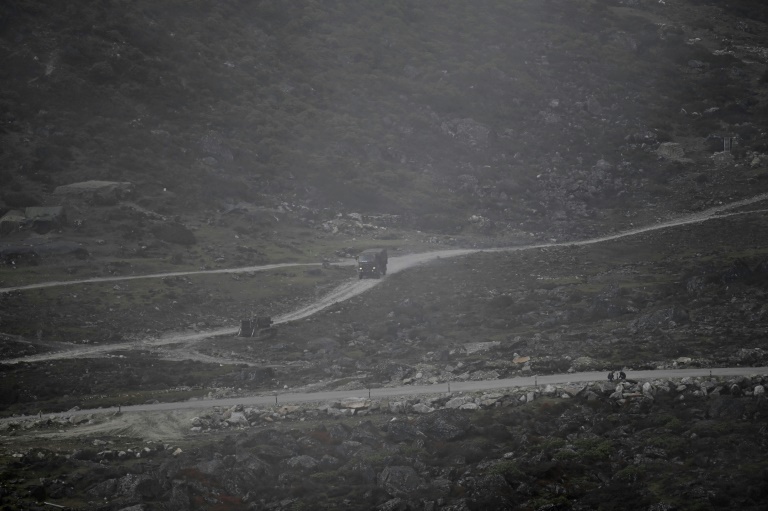
Indian and Chinese troops engaged in a fresh “face-off” on their disputed Himalayan border last week, leaving several injured on both sides, sources said Monday.

Relations have been at rock-bottom between the nuclear-armed Asian giants since a clash that left 20 Indian soldiers and at least four Chinese troops dead on their high-altitude frontier in June 2020.

The new incident on December 9, which followed recent joint US-India military exercises near the border, led to “minor injuries to (a) few personnel from both sides”, one source said. 

Another source, from the Indian army, said at least six Indian soldiers were hurt.

China was yet to comment officially.

Chinese soldiers came close to the area near the Line of Actual Control — the de facto border — where it had been agreed that neither side would patrol, the sources said.

This move was “contested by… (Indian) troops in a firm and resolute manner”, the first source said.

After the skirmish both sides “immediately disengaged from the area”, the source added. 

An Indian commander later held a meeting with a Chinese counterpart “to discuss the issue in accordance with structured mechanisms to restore peace and tranquility”.

The incident took place in the Tawang Sector of the northeastern Indian state Arunachal Pradesh, all of which is claimed by China. Beijing refers to the area as South Tibet.

The first source said that there are “areas of differing perception, wherein both sides patrol the area up to their claim lines. This has been the trend since 2006.”

Indian media reports quoted unnamed sources as saying that the incident involved around 300 members of China’s People’s Liberation Army, and that China suffered a greater number of injuries.

– US-India exercises –

Since the deadly hand-to-hand battle in 2020, both sides have sent thousands of troops to bolster the border. Multiple rounds of talks have failed to substantially ease tensions. 

The army source said there was another “face-off” between Indian and Chinese troops in the last week of November in the Demchok region of Ladakh, further to the north.

It was unclear if there were any injuries resulting from that incident, which was the first since September 2020.

The army source said that there has been increased activity in Ladakh by the Chinese military, as well as a “possible” airspace violation by the Chinese air force in the same area.

This follows joint military exercises which irked Beijing last month between India and the United States in the northern Indian state of Uttarakhand, which borders China.

The Chinese soldiers also displayed a banner objecting to the Indo-US military exercises, the source said.

– Undefined border –

China and India fought a war in 1962 over their long and disputed border. 

The exact path of the border, some of which is more than 4,000 metres (13,100 feet) above sea level, has never been demarcated.

Winter temperatures can plunge below minus 30 Celsius (minus 22 Fahrenheit), cracking gun barrels and seizing up machinery.

Even before the June 2020 clash, India was moving strategically closer to the West, deepening security cooperation with the United States, Japan and Australia in the Asia-Pacific region.

United by their concern about China’s increasing influence in the region, together they make up the so-called Quad alliance.

India has also embarked on a $130-billion modernisation of its armed forces — including ordering attack helicopters from the United States and a missile defence system from Russia.

In the aftermath of the 2020 clash, India banned hundreds of mobile applications of Chinese origin, including the popular social media platform TikTok. 

Chinese firms operating in India, including cellphone maker Xiaomi and Huawei, have been raided by the tax authorities. 

Bilateral trade remains brisk, however, at around $100 billion per year, but with India importing from China far more than it exports there.

Stock markets diverge ahead of key rate decisions

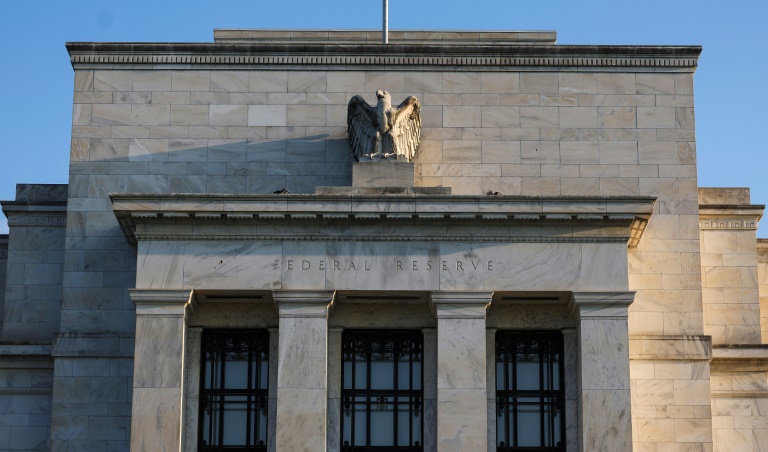
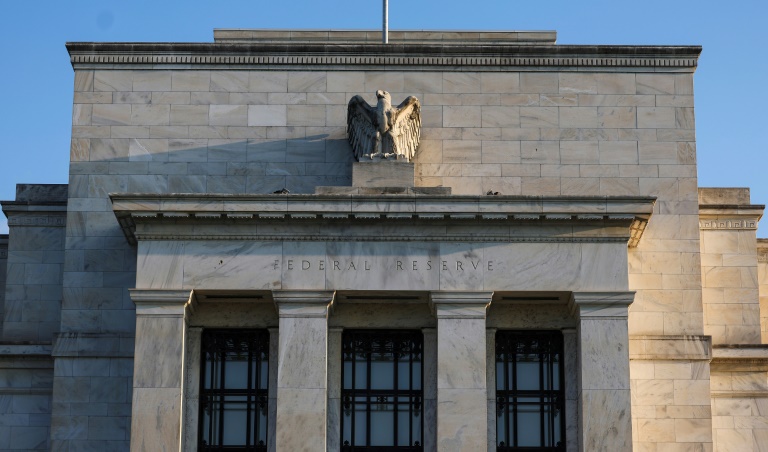
Wall Street pushed higher but European and Asian stock markets dropped Monday as investors looked ahead to interest rate decisions this week from major central banks including the Federal Reserve.

The dollar rose against its main rivals, while oil prices rebounded following sharp falls last week.

Analysts are forecasting the Fed and the European Central Bank to announce smaller rate hikes at their meetings this week compared with recent decisions.

The Bank of England is meanwhile on course for a ninth increase in a row as policymakers try to bring down inflation from the highest levels in decades.

“Following a softer session in Asia, European markets are on edge, opening the week lower ahead of a critical few days for central bank action,” noted Victoria Scholar, head of investment at Interactive Investor.

London, Frankfurt and Paris all closed lower. 

Wall Street pushed higher, however, as bargain hunters moved in following losses at the end of last week.

“The ECB, the Fed and the Bank of England are expected to raise rates by 50 basis points each as the pace of tightening looks set to slow,” Scholar added.

The half-point jumps will still be steep rises, however, as central banks struggle to cool the pace of price increases, particularly regarding energy and food.

Ahead of the Fed’s policy meeting, investors were set to digest US inflation data due Tuesday.

“It will be a fitting hump day on Wednesday, because the (inflation) data and the Fed decision are big humps the market needs to get over if it wants to make a run at a year-end rally,” said market analyst Patrick J. O’Hare at Briefing.com.

“If either, or both, disappoint in a meaningful way, then a year-end rally becomes a more challenging proposition,” he added.

Traders were keeping an eye also on developments in China as it moves away from the zero-Covid policy that has hammered its economy, the world’s second largest after the United States.

The shift comes after widespread protests against the near three-year strategy, though there is concern about the expected spike in infections.

Uncertainty surrounding the strength of China’s demand recovery has hit oil prices hard, with crude futures shedding more than 10 percent last week, but they rebounded on Monday.

“The gradual easing of Chinese Covid restrictions is… expected to lead to a further upswing in demand,” said Susannah Streeter, senior investment and markets analyst at Hargreaves Lansdown.

But investors are wary of whether the relaxation of restrictions will lead to a swift rebound as Covid cases are expected to boom.

“The recent volatility in crude oil highlights the ongoing questions over whether the Chinese economy is truly ready to return or on the cusp of yet another series of restrictions,” said Joshua Mahony, senior market analyst at online trading platform IG.

– Key figures around 1630 GMT –

New York – Dow: UP 0.8 percent at 33,742.91 points

EURO STOXX 50: DOWN 0.5 percent at 3,921.82

London – FTSE 100: DOWN 0.4 percent at 7,445.97 (close) 

Frankfurt – DAX: DOWN 0.5 percent at 14,306.63 (close)

Paris – CAC 40: DOWN 0.4 percent at 6,650.55 (close)

Tokyo – Nikkei 225: DOWN 0.2 percent at 27,842.33 (close)

Hong Kong – Hang Seng Index: DOWN 2.2 percent at 19,463.63 (close)

Shanghai – Composite: DOWN 0.9 percent at 3,179.04 (close)

Euro/dollar: DOWN at $1.0531 from $1.0534 on Friday

Dollar/yen: UP at 137.50 yen from 136.57 yen

Pound/dollar: UP at $1.2260 from $1.2262

Euro/pound: DOWN at 85.87 pence from 85.90 pence

West Texas Intermediate: UP 3.8 percent at $73.73 per barrel

Brent North Sea crude: UP 2.7 percent at $78.17 per barrel

burs-rl/pvh

Stock markets diverge ahead of key rate decisions

Wall Street pushed higher but European and Asian stock markets dropped Monday as investors looked ahead to interest rate decisions this week from major central banks including the Federal Reserve.

The dollar rose against its main rivals, while oil prices rebounded following sharp falls last week.

Analysts are forecasting the Fed and the European Central Bank to announce smaller rate hikes at their meetings this week compared with recent decisions.

The Bank of England is meanwhile on course for a ninth increase in a row as policymakers try to bring down inflation from the highest levels in decades.

“Following a softer session in Asia, European markets are on edge, opening the week lower ahead of a critical few days for central bank action,” noted Victoria Scholar, head of investment at Interactive Investor.

London, Frankfurt and Paris all closed lower. 

Wall Street pushed higher, however, as bargain hunters moved in following losses at the end of last week.

“The ECB, the Fed and the Bank of England are expected to raise rates by 50 basis points each as the pace of tightening looks set to slow,” Scholar added.

The half-point jumps will still be steep rises, however, as central banks struggle to cool the pace of price increases, particularly regarding energy and food.

Ahead of the Fed’s policy meeting, investors were set to digest US inflation data due Tuesday.

“It will be a fitting hump day on Wednesday, because the (inflation) data and the Fed decision are big humps the market needs to get over if it wants to make a run at a year-end rally,” said market analyst Patrick J. O’Hare at Briefing.com.

“If either, or both, disappoint in a meaningful way, then a year-end rally becomes a more challenging proposition,” he added.

Traders were keeping an eye also on developments in China as it moves away from the zero-Covid policy that has hammered its economy, the world’s second largest after the United States.

The shift comes after widespread protests against the near three-year strategy, though there is concern about the expected spike in infections.

Uncertainty surrounding the strength of China’s demand recovery has hit oil prices hard, with crude futures shedding more than 10 percent last week, but they rebounded on Monday.

“The gradual easing of Chinese Covid restrictions is… expected to lead to a further upswing in demand,” said Susannah Streeter, senior investment and markets analyst at Hargreaves Lansdown.

But investors are wary of whether the relaxation of restrictions will lead to a swift rebound as Covid cases are expected to boom.

“The recent volatility in crude oil highlights the ongoing questions over whether the Chinese economy is truly ready to return or on the cusp of yet another series of restrictions,” said Joshua Mahony, senior market analyst at online trading platform IG.

– Key figures around 1630 GMT –

New York – Dow: UP 0.8 percent at 33,742.91 points

EURO STOXX 50: DOWN 0.5 percent at 3,921.82

London – FTSE 100: DOWN 0.4 percent at 7,445.97 (close) 

Frankfurt – DAX: DOWN 0.5 percent at 14,306.63 (close)

Paris – CAC 40: DOWN 0.4 percent at 6,650.55 (close)

Tokyo – Nikkei 225: DOWN 0.2 percent at 27,842.33 (close)

Hong Kong – Hang Seng Index: DOWN 2.2 percent at 19,463.63 (close)

Shanghai – Composite: DOWN 0.9 percent at 3,179.04 (close)

Euro/dollar: DOWN at $1.0531 from $1.0534 on Friday

Dollar/yen: UP at 137.50 yen from 136.57 yen

Pound/dollar: UP at $1.2260 from $1.2262

Euro/pound: DOWN at 85.87 pence from 85.90 pence

West Texas Intermediate: UP 3.8 percent at $73.73 per barrel

Brent North Sea crude: UP 2.7 percent at $78.17 per barrel

burs-rl/pvh

Protesters block Peru airport over ousting of president

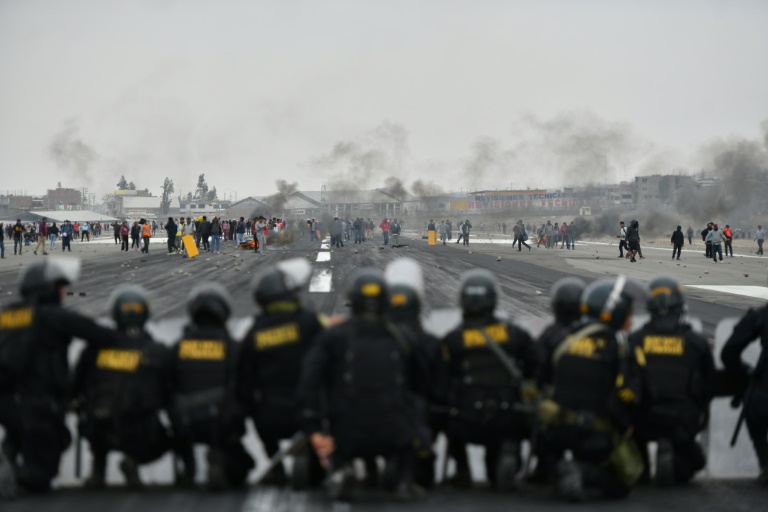
Hundreds of protesters on Monday used burning tires, wood and rocks to block the airport runway in Peru’s second-largest city, Arequipa, demonstrating against the ousting of former president Pedro Castillo.

Protesters have demanded fresh elections and the resignation of new President Dina Boluarte, following the arrest of her leftist predecessor Castillo last week after he attempted to dissolve Congress and rule by decree.

Police used tear gas to confront demonstrators who smashed runway lighting and forced the airport’s closure, an AFP photographer reported.

Boluarte tried to ease tensions following deadly weekend clashes, announcing on Sunday she would seek to hold elections two years early, while also declaring a state of emergency in flashpoint areas.

New road blocks were set up on Monday in several major cities such as Arequipa in the south, Cusco in the southeast and Libertad in the north.

It came despite Boluarte saying in her televised address that she would try “to reach an agreement” with Congress to bring forward elections from July 2026 to April 2024.

She said a bill on moving the poll forward would be submitted in the coming days, adding that she was also declaring a state of emergency in restive areas.

Boluarte, a former prosecutor who had served as Castillo’s vice president, was quickly sworn in to replace him following his impeachment and subsequent arrest last week.

On Sunday, clashes between protesters and police in the southern city of Andahuaylas left two dead and at least five injured — including a police officer — as demonstrators attempted to storm that city’s airport.

In her address, Boluarte expressed regret for the protesters’ deaths.

– Fracas in Congress  –

A police station in the Apurimac town of Huancabamba was also set on fire, RPP radio reported.

“I urge people to remain calm,” Interior Minister Cesar Cervantes told the station, as he announced the second death.

Clashes in Andahuaylas on Saturday saw 16 civilians and four police officers injured.

“No Peruvian’s life should be sacrificed for political interests,” Boluarte tweeted on Sunday evening before her speech, reiterating a call for “dialogue and the rejection of violence.”  

The country’s right-leaning Congress convened an emergency session on Sunday afternoon to discuss the crisis, but had to be suspended after physical altercations broke out.

In images posted on social media, a man punched another man and then members shoved each other in the center of the chamber.

Some 1,000 to 2,000 people rallied in Lima on Sunday shouting, “Castillo you are not alone, the people support you” and brandishing signs accusing “Dina and Congress” of being “corrupt rats,” before police dispersed the crowd with tear gas.

– ‘Indefinite strike’ –

Meanwhile, rural unions and organizations representing Indigenous peoples called for an “indefinite strike” beginning Tuesday in support of Castillo, himself the son of a peasant family.

They demanded the suspension of Congress, early elections and a new constitution, as well as Castillo’s immediate release, according to a statement from the Agrarian and Rural Front of Peru, which groups about a dozen organizations.

With his background as a rural teacher and union leader, and with little contact with the nation’s elites, Castillo has always drawn his strongest support from Andean regions, while struggling to find backing in coastal Lima.

The ousted president was arrested on Wednesday while heading to the Mexican embassy to seek asylum, and prosecutors have charged him with rebellion and conspiracy.

Peru is now on its sixth president since 2016.

Castillo’s 17-month rule was overshadowed by six investigations against him and his family, mass protests demanding his removal, and a power struggle with the opposition-backed Congress.

US biopharma firm Amgen to acquire Horizon Therapeutics for $28 bn

US biopharmaceutical firm Amgen said Monday it has reached agreement to acquire Horizon Therapeutics, which specializes in medicine for rare and auto-immune diseases, for $27.8 billion.

The California-based company said it will pay cash to the tune of $116.50 a share in Horizon Therapeutics, a 20 percent premium over Horizon’s closing price Friday on Wall Street, in what would be the biggest deal of the year in the health sector.

The bid will be financed through a bank lending facility. 

Founded in 2005, Horizon Therapeutics develops and markets drugs for rare, auto-immune and inflammatory illnesses. It is best known for making Tepezza, which is used to treat thyroid eye disease, the symptoms of which include eye pain, redness and swelling.

Amgen said the deal would strengthen its drug portfolio, while positioning Horizon’s products through its global commercial and manufacturing network.

“The acquisition of Horizon is a compelling opportunity for Amgen and one that is consistent with our strategy of delivering long-term growth by providing innovative medicines that address the needs of patients who suffer from serious diseases,” Amgen CEO Robert Bradway said.

The deal is subject to approval by antitrust regulators in the United States, Austria and Germany, as well as the approval of the Irish High Court. If all goes well, the deal should  be concluded in the first half of 2023, Amgen said.

Shares of Horizon surged nearly 15 percent to $111.70 in mid-morning trading, while Amgen dropped 1.2 percent to $275.44.

Horizon is based in Ireland, but trades in New York.

Responding to an article in The Wall Street Journal, Horizon Therapeutics said last month it was in preliminary talks with Amgen, but also with Johnson & Johnson and French company Sanofi.

Sanofi said Sunday it ended discussions with Horizon after concluding the transaction prices “do not meet our value criteria.”

J&J also said in early December that it had dropped its pursuit of the deal.

– ‘Solid portfolio’ –

The transaction shows “Big Pharma will pay top dollar for a solid portfolio and pipeline in therapeutics for rare diseases,” where the competitive landscape is “generally much less crowded,” said Derren Nathan, head of equity research at Hargreaves Lansdown in Britain.

“With AstraZeneca’s acquisition of Alexion still fresh in the mind, the trend for consolidation is clear but the universe of large specialists in the space is dwindling, so further deals may be more bite-sized and opportunistic,” Nathan added.

Sales of Tepezza came in at $491 million in the third quarter and $1.7 billion for all of 2021, more than half of Horizon’s total revenues.

Other major Horizon products include Krystexxa, which treats chronic gout; Ravicti, which treats urea disorders; and Uplizna, which treats an autoimmune disease.

“In nearly 15 years, we have built one of the fastest-growing and most respected companies in the biotechnology industry from the ground up,” said Horizon Chief Executive Tim Walbert.

“Amgen is aligned with that commitment and passion and will continue to maximise the value of the current portfolio and pipeline and accelerate the ability to reach more patients globally.”

Amgen’s portfolio also includes an autoimmune treatment, Enbrel, but sales have fallen in recent quarters.

Pharma analysts note that Amgen’s revenue outlook has been clouded by upcoming patent expirations for key drugs such as Prolia, which treats osteoporosis, and Otezla, which treats psoriasis and psoriatic arthritis.

“Our focus is on long-term growth,” Bradway said of the patent outlook. “We’re not trying to solve for the short- or medium-term, but rather we’re trying to invest capital in order to generate long-term returns for our shareholders.”

“And we think this transaction is consistent with that objective.”

Royals 'happy to lie' for William, claims Harry in new trailer

The trailer for the latest episodes of the docuseries on Prince Harry and his wife Meghan was released on Monday, with the royal feud set to escalate with a claim that Buckingham Palace was “happy to lie” for his brother William.

Meghan, 41, separately claims she was “fed to the wolves” after the pair quit royal life in early 2020 and moved to North America

In one excerpt, Harry, 38, accuses Buckingham Palace of “institutional gaslighting” and said “they” were “happy to lie to protect my brother but were never willing to tell the truth to protect us”.

The first three episodes of “Harry & Meghan” were released last Thursday, with the couple — also known as the Duke and Duchess of Sussex — criticising the royal family for failing to protect her and his mother Diana against tabloid excesses.

Most of the accusations were against the media and the palace press operation, although the couple did direct several barbs against the royal family, including of unconscious racial bias.

Direct mention of Harry’s brother, heir to the throne Prince William, 40, in the latest trailer confirmed suspicions that more pointed criticisms may have been saved for last.

“As we all suspected last week, the gloves are off,” wrote Daily Mail royal correspondent Rebecca English while her counterpart at ITV, Chris Ship, said: “It’s getting dirty”.

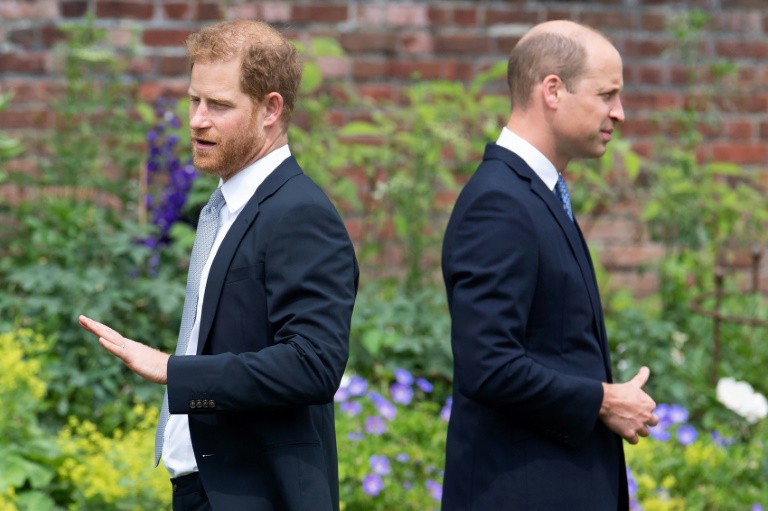
Harry in late 2019 all but confirmed a rift with his older brother and the pair have reportedly hardly spoken since, even at the unveiling of a statue of their mother last year and the September state funeral of their grandmother, Queen Elizabeth II.

“In previous trailers, Harry has spoken about a ‘dirty game’ and ‘planting’ stories,” ITV’s Ship assessed. 

“This clip suggests he is going to blame his brother, or at least the people around him, for some of the stories about the Sussexes which appeared in the press. That is a dramatic escalation.”

So far the palace has declined to respond to the programme but commentators suggested it may be forced to if criticism gets personal.

Key Ukraine naval base unbowed despite Russian onslaught

After enduring months of shelling by Russian forces, officials in the strategic Ukrainian port of Ochakiv hope it can serve to consolidate Kyiv’s gains in the southern Kherson region.

The strategic Ukrainian Black Sea naval base — which lies on the mouth of the Dnipro river and serves as a gateway to several other key ports — has been relentlessly targeted by Russia since its February 24 invasion.

After failing to seize the port and its naval base, Russian troops have been pummelling Ochakiv from the nearby Kinburn peninsula. 

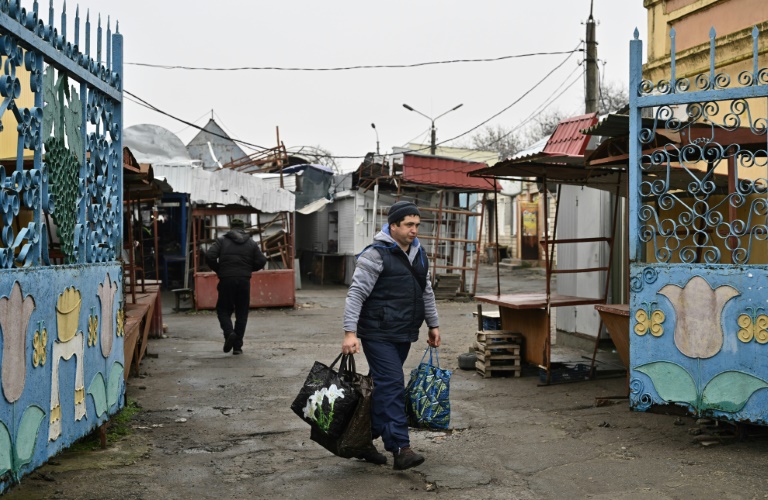
Formerly a popular resort with white-sand beaches and seafront hotels, Ochakiv bears the scars of a town under relentless attack.

Under a damp fog at the local market, 62-year-old Oleg Klyutshko paid tribute to the resilience of both the residents and local officials. 

“The town is functioning as well as the administration — they are doing all they can and we are protected by our soldiers,” he said. 

“I am not afraid of winter,” Klyutshko said. But I would like the strikes to stop. We will survive anything else.”

Just last week, a Russian missile hit a residential building but there were no casualties. 

Deputy mayor Oleksiy Vaskov gave AFP a tour of the city under close army supervision.

Vaskov said Ochakiv was the gateway to the southern regions of Kherson and Mykolaiv and Zaporizhzhia, where Europe’s biggest nuclear plant is located, as well as Kyiv.

“That’s why it is important strategically, both in commercial and in military terms,” he said.

The town with a pre-war population of 15,000 was a target for Russia in the very first hours of the war, launched on February 24.

– ‘False pretext’ –

Russian President Vladimir Putin claimed the naval base was controlled by Americans and attacked it.

Heavy bombardments killed 24 soldiers on the first day of the invasion. An amphibious assault followed.

“They organised landing operations on our coast. But our army and special forces stopped them,” Vaskov said. 

In September, a missile flattened a grain silo. 

“The point was to destroy our infrastructure, to destroy the grain depot used by our farmers,” Vaskov said.

“They used a false pretext by saying that (American rocket launchers) HIMARS and other weapons were stored there” to conduct strikes, he said.

But the grain depot was “100 percent civilian, there wasn’t even one soldier there,” the deputy mayor said.

After another bombardment in October, Russia said it was targeting a Ukrainian special services training centre. 

Moscow later accused those special services, “under the leadership of British specialists”, of being behind an attack on its Black Sea Fleet in November.  

Ukraine and the UK signed an agreement to build missile boats and infrastructure there in 2020. 

– The battle for Kinburn –

Russians are able to strike Ochakiv from their positions on the Kinburn spit — a peninsula they seized in June — just 4.5 kilometres (2.8 miles) away across the Dnipro river.

Regaining Kinburn would be a major gain for Ukraine and ensure a degree of safety for Ochakiv.

“Control of Kinburn would allow Ukrainian forces to reduce Russian strikes… and conduct potential operations” in the southern Kherson region, according to the Institute for the Study of War (ISW).

And Ukraine could consolidate its gains after retaking the right bank of the river last month.

With this goal in mind, Ukrainians are “using artillery and special forces. The goal is to clean up the place,” an official at Ochakiv’s naval base said on condition of anonymity. 

The Ukrainian army announced a “military operation” in the Kinburn peninsula in November, but details are scarce.

“We are recovering full control over the (Mykolaiv) region. There are only three settlements left on the Kinburn Spit before we are at peace again,” Mykolaiv governor Vitaliy Kim said.

Russian forces denied the claims, and said they still controlled the peninsula.

And to keep it that way, they have been striking Ochakiv. 

At the market, 72-year-old Volodymyr Kojevnykov hoped the “Russians are kicked out of the (Kinburn) Spit for these strikes to stop.”

Chinese, Indian troops injured in fresh border 'face-off'

Indian and Chinese troops engaged in a fresh “face-off” on their disputed Himalayan border last week, leaving several injured on both sides, sources said Monday.

The incident on December 9 led to “minor injuries to (a) few personnel from both sides”, one source said. Another source, from the Indian army, said at least six Indian soldiers were hurt.

China was yet to comment officially.

Chinese soldiers came close to the area near the Line of Actual Control — the de facto border — where it had been agreed that neither side would patrol, the sources said.

This move was “contested by… (Indian) troops in a firm and resolute manner”, the first source said.

After the skirmish both sides “immediately disengaged from the area”, the source added. 

An Indian commander later held a meeting with a Chinese counterpart “to discuss the issue in accordance with structured mechanisms to restore peace and tranquility”.

The incident took place in the Tawang Sector of the northeastern Indian state Arunachal Pradesh, all of which is claimed by China. Beijing refers to the area as South Tibet.

The first source said that there are “areas of differing perception, wherein both sides patrol the area up to their claim lines. This has been the trend since 2006.”

Indian media reports quoted unnamed sources as saying that the incident involved around 300 members of China’s People’s Liberation Army, and that China suffered a greater number of injuries.

China and India fought a war in 1962 over their long and disputed border. 

– Undefined border –

Tensions have simmered between the countries since a clash in 2020 that left 20 Indian soldiers and at least four Chinese troops dead.

The exact path of the border, some of which is more than 4,000 metres (13,100 feet) above sea level, has never been demarcated.

Winter temperatures can plunge below minus 30 Celsius (minus 22 Fahrenheit), cracking gun barrels and seizing up machinery.

Even before the June 2020 clash, India was moving strategically closer to the West, deepening security cooperation with the United States, Japan and Australia in the Asia-Pacific region.

United by their concern about China’s increasing influence in the region, together they make up the so-called Quad alliance.

India has also embarked on a $130-billion modernisation of its armed forces — including ordering attack helicopters from the United States and a missile defence system from Russia.

Moscow calls for 'diplomatic' solution to Kosovo tensions

The Kremlin on Monday called for a “diplomatic” resolution to a recent flare-up in tensions in Kosovo following attacks targeting the police.

“We are in favour of the parties making efforts of a peaceful nature and this situation being resolved through diplomatic means,” Kremlin spokesman Dmitry Peskov told reporters. 

“We stand for ensuring that all the rights of the Serbs are guaranteed,” he added. 

Russia’s foreign ministry vowed to stand by Belgrade. 

“We will continue to help Belgrade defend legitimate national interests with regard to Kosovo,” the ministry’s spokeswoman, Maria Zakharova, said in a statement.

She said Moscow was “alarmed” by the situation, accusing Pristina of “provocations” and “repressions against Serbs in Kosovo”. 

With historically close ties, Serbia is one of Russia’s few remaining allies in Europe after President Vladimir Putin ordered troops into Ukraine. 

Although Kosovo declared independence from Serbia in 2008, Belgrade does not recognise it and encourages the Serb majority in northern Kosovo to defy Pristina’s authority.

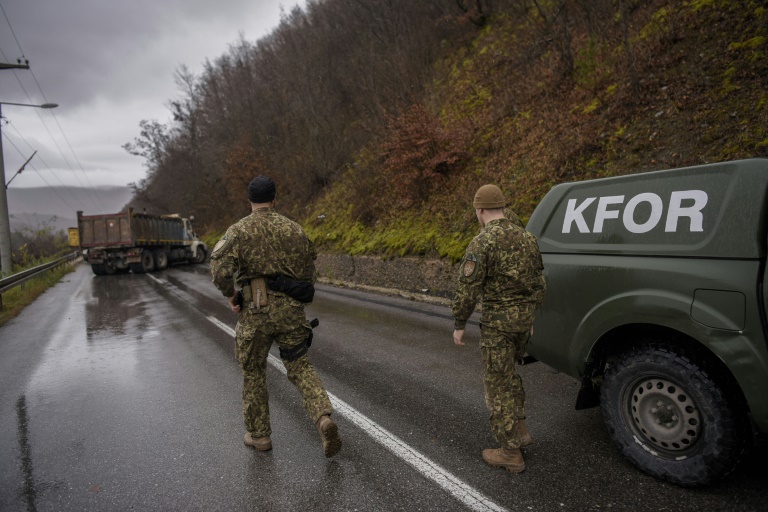
Tensions escalated this weekend in northern Kosovo after unknown attackers exchanged gunfire with the police and threw a stun grenade at EU law enforcers.

Hundreds of Serbs, outraged over the arrest of a former police officer, set up roadblocks, which paralysed traffic through two border crossings from Kosovo to Serbia. 

Pristina and Belgrade traded accusations over the latest incidents with Kosovo deciding to postpone local elections in Serb-majority municipalities scheduled for mid-December.

Close Bitnami banner
Bitnami