World

Britain stuck on recession path despite growth rebound

Britain’s economy remains on course for a long-lasting recession on fallout from the highest inflation in decades, analysts said on Monday, even if official data showed growth in October.

Gross domestic product rebounded 0.5 percent in the month, the Office for National Statistics (ONS) said. GDP had dropped 0.6 percent in September, in part owing to businesses closing for the funeral of Queen Elizabeth II.

ONS director of economic statistics, Darren Morgan, said the economy was helped in October especially by car sales which “rebounded after a very poor September, while the health sector also saw a strong month”.

Despite the rebound, Britain’s finance minister Jeremy Hunt spoke of “a tough road ahead”. 

“High inflation, exacerbated by (Russian President Vladimir) Putin’s illegal war, is slowing growth across the world, with the IMF predicting a third of the world economy will be in recession this year or next,” he said in a statement.

The UK government and Bank of England have each said they believe Britain is already in a recession that the BoE expects to last all next year. 

The main reason for the bleak outlook is fallout from British inflation, which at above 11 percent is the country’s highest level in more than 40 years.

Britons are seeing their wages squeezed, triggering mass strike action by public and private sector workers across the UK.  

Energy bills and food prices have rocketed this year on supply constraints caused by Russia’s invasion of Ukraine and the reopening of economies from pandemic lockdowns.

Britain’s economy has further been hit by recent political turmoil and surging interest rates to try and cool inflation.

– Rate hikes –

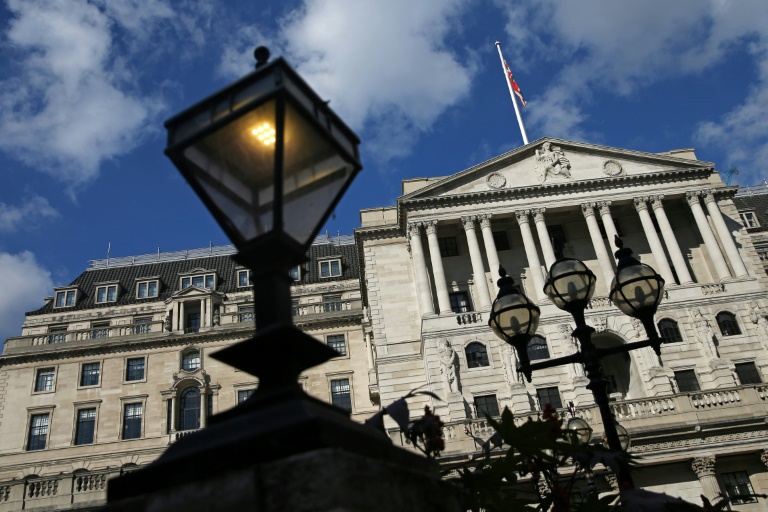
The Bank of England is on Thursday expected to raise its main interest rate for a ninth meeting in a row.

“The surprisingly strong rise (in October GDP) could tilt the Bank of England towards another bumper 75 basis-points interest rate hike… depending on the labour market and inflation data on Tuesday and Wednesday,” noted Ruth Gregory, senior economist at Capital Economics.

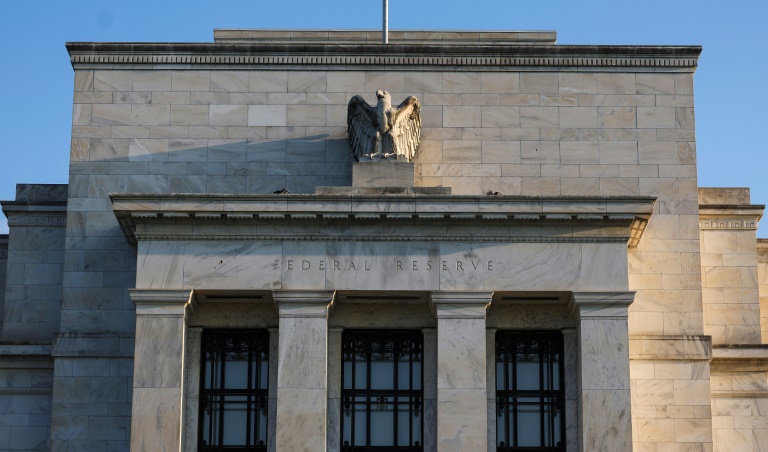
Analysts are forecasting the Federal Reserve and European Central Bank to announce smaller rate hikes at their meetings this week compared with recent decisions.

“Monetary policy conditions are set to tighten further, with the Bank of England likely to raise its policy rate by 50 basis points to 3.5 percent this week and then to a peak of 4.0 percent in February 2023,” forecast Raj Badiani, principal economist at S&P Global Market Intelligence.

“The return to growth in October was expected and supports our assessment that the anticipated recession is likely to be shallow at first before deepening in early 2023.” 

He added, however, that data showing “the economy faltering in the three months to October suggests the recession appeared to start in the third quarter of 2022, (and)… is expected to last for four quarters”.

The BoE has also said Brexit is hurting the UK economy, with the country’s departure from the European Union hitting trade.

burs-bcp/rfj/raz
Mongolians brave freezing nights in fight for justice

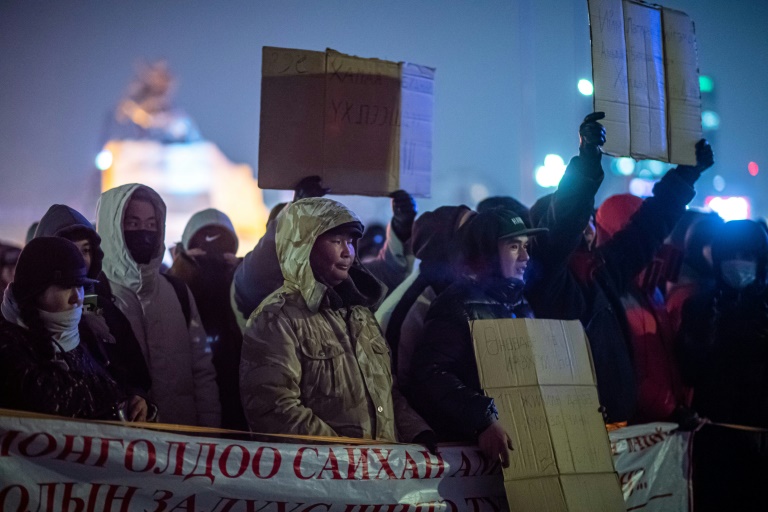
Bundled up in thick layers to battle temperatures below freezing, Mongolians are sleeping rough in the heart of their capital and say they will not leave until officials accused of corruption are punished.

Protests in the landlocked East Asian nation entered their eighth day Monday, with thousands rallying in central Ulaanbaatar furious over claims a faction of lawmakers and executives stole billions of dollars in coal.

Many have taken to spending the night in the central Genghis Khan Square, also known as Sukhbaatar Square, despite temperatures regularly dropping beneath minus 30 degrees Celsius (-22 degrees Fahrenheit).

Sporting sheepskin deel — a traditional long tunic-like garment — as well as wolfskin jackets and horseskin boots to keep warm, and sleeping on polystyrene foam and felt, they are determined to stay for as long as it takes to get justice.

“I will stay here until the thieves receive punishment,” a woman who had been sleeping in the square for four days told AFP. 

She declined to be identified and said she feared for her safety after some protesters were beaten by police last week. 

Demonstrators say they have been emboldened by public support, with residents sharing provisions and words of encouragement. Celebrities and social media influencers have even joined calls for action.

“So many people care about us. Ordinary people keep bringing hot food and drinks and donating warm clothes,” 22-year-old protester Ariunzaya Tsengelsaikhan told AFP.

“It’s warm if you sleep between two people and stick with each other and we change positions every two hours to make sure everybody is warm,” she said.

“Two days ago, after I gave an interview for public television, a man gave me a sleeping bag and a mat.”

Authorities have refused to allow protesters to erect ger — traditional Mongolian tents — in the north of the square, where they would face the imposing statue of national hero Genghis Khan and the parliament.

“Dogs sleep outdoors on felt. The government treats us like dogs. We are sleeping on felt,” said the protester, who asked to remain anonymous.

“We want to build a ger to stay warm and continue our protest.”

The government has announced the arrest of Gankhuyag Battulga, former CEO of Erdenes Tavan Tolgoi — one of Mongolia’s largest coal-mining firms — along with more than a dozen others accused of laundering money from embezzled coal.

Those arrests have failed to quell the public anger. 

“We want the big fish,” said Bayaraa Damiran, a 30-year-old protester who has been sleeping on the square.

“They arrested seven or eight officials who were on the bottom. We want to know the big fish at the top.”

Four children 'critical' in hospital as UK hit by Arctic weather

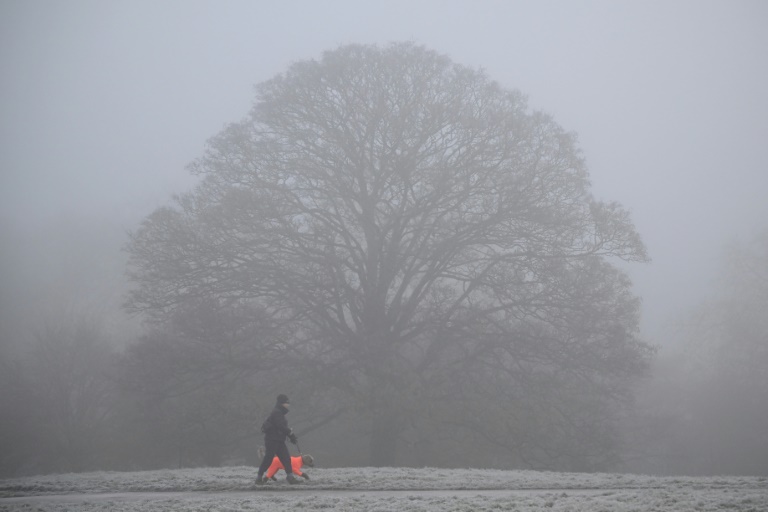
Four children were fighting for their lives on Monday, after being pulled from an icy lake as an Arctic blast sent temperatures tumbling across the UK.

The youngsters were reported to have been playing on frozen ice near Birmingham, central England, on Sunday afternoon, when it gave way and they fell in.

Emergency services said the children went into cardiac arrest when they were rescued and were taken to hospital in a critical condition.

The incident came as the UK was hit by heavy snow and freezing conditions, causing major travel disruption, on the eve of a national rail strike Tuesday that was already expected to bring the country to a grinding halt.

London Stansted airport warned of disruption. 

“Our runway is temporarily closed whilst we undertake snow clearing,” it added, with many flights cancelled early Monday.

The airport is a main hub of budget airline Ryanair, which also cautioned about disruption to its flights at Gatwick, south of London.

“Due to ongoing severe snowy weather across the UK, runaways at both Stansted and Gatwick have been temporarily closed tonight (11 December),  disrupting all flights scheduled to depart Stansted/Gatwick during this temporary closure period,” it said.

Both airports were open on Monday, but passengers were told to brace for delays.

Dozens of stranded passengers posted videos on social media showing snow-covered runways and planes stuck on the ground.

More than 50 flights were also cancelled on Sunday at Heathrow, the UK’s largest airport, due to freezing fog. 

Train and bus services in London were also severely affected after the dump of around four inches (10 centimetres) of snow overnight, which also forced the closure of parts of the M25 orbital route around the capital, the country’s busiest motorway.

Some schools were also shut.

The UK has been experiencing a cold snap for several days, with temperatures dropping to -10 Celsius degrees (14 Fahrenheit) in some areas, although the Met Office said the temperatures were “not unusual for this time of year”. 

The service has issued yellow alerts for snow, fog and frost in several areas, including southeast and southwest England, and the north of Scotland.

Four children 'critical' in hospital as UK hit by Arctic weather

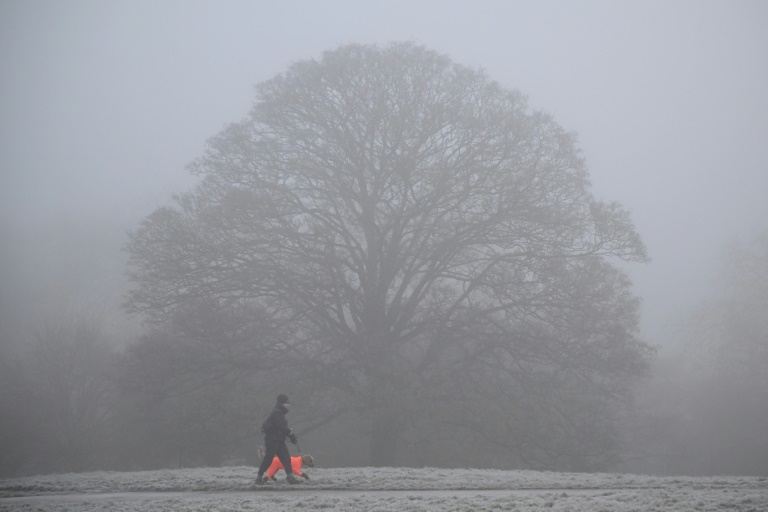
Four children were fighting for their lives on Monday, after being pulled from an icy lake as an Arctic blast sent temperatures tumbling across the UK.

The youngsters were reported to have been playing on frozen ice near Birmingham, central England, on Sunday afternoon, when it gave way and they fell in.

Emergency services said the children went into cardiac arrest when they were rescued and were taken to hospital in a critical condition.

The incident came as the UK was hit by heavy snow and freezing conditions, causing major travel disruption, on the eve of a national rail strike Tuesday that was already expected to bring the country to a grinding halt.

London Stansted airport warned of disruption. 

“Our runway is temporarily closed whilst we undertake snow clearing,” it added, with many flights cancelled early Monday.

The airport is a main hub of budget airline Ryanair, which also cautioned about disruption to its flights at Gatwick, south of London.

“Due to ongoing severe snowy weather across the UK, runaways at both Stansted and Gatwick have been temporarily closed tonight (11 December),  disrupting all flights scheduled to depart Stansted/Gatwick during this temporary closure period,” it said.

Both airports were open on Monday, but passengers were told to brace for delays.

Dozens of stranded passengers posted videos on social media showing snow-covered runways and planes stuck on the ground.

More than 50 flights were also cancelled on Sunday at Heathrow, the UK’s largest airport, due to freezing fog. 

Train and bus services in London were also severely affected after the dump of around four inches (10 centimetres) of snow overnight, which also forced the closure of parts of the M25 orbital route around the capital, the country’s busiest motorway.

Some schools were also shut.

The UK has been experiencing a cold snap for several days, with temperatures dropping to -10 Celsius degrees (14 Fahrenheit) in some areas, although the Met Office said the temperatures were “not unusual for this time of year”. 

The service has issued yellow alerts for snow, fog and frost in several areas, including southeast and southwest England, and the north of Scotland.

Iran publicly executes second man over protests, defying outcry

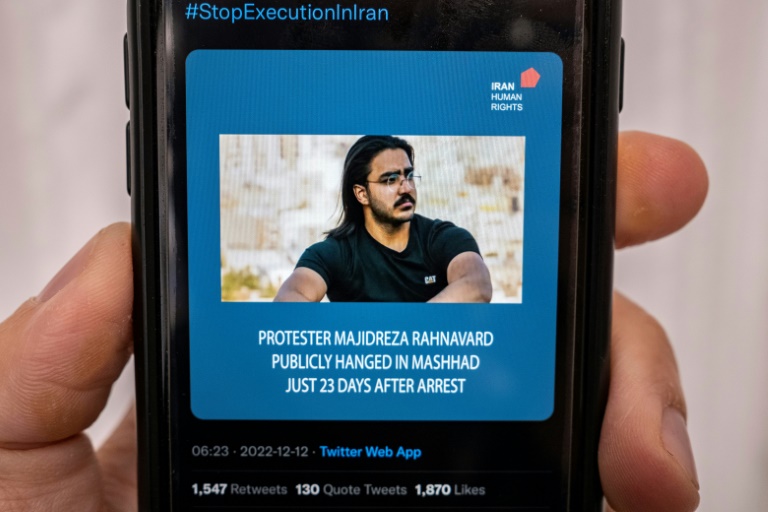
Iran on Monday executed a second man convicted in connection with protests that have shaken the regime for almost three months, defying an international outcry over its use of capital punishment against those involved in the movement.

Majidreza Rahnavard had been sentenced to death by a court in the city of Mashhad for killing two members of the security forces with a knife, and wounding four other people, the judiciary’s Mizan Online news agency reported. 

It said he was hanged in public in the city, rather than inside prison.

The execution came despite global outrage after Iran on Thursday carried out the first execution linked to the protests. Mohsen Shekari, 23, was hanged after his conviction for wounding a member of the security forces. 

Iran calls the protests “riots” and says they have been encouraged by its foreign foes.

Mizan published images of Rahnavard’s execution, showing a man with hands tied behind his back hanging from a rope attached to a crane.

He was put to death after rights groups at the weekend warned that several other people arrested over the demonstrations were at imminent risk of being executed.

“The public execution of a young protester, 23 days after his arrest, is another serious crime committed by the Islamic Republic’s leaders and a significant escalation of the level of violence against protesters,” Oslo-based Iran Human Rights (IHR) director Mahmood Amiry-Moghaddam told AFP.

“Majidreza Rahnavard was sentenced to death based on coerced confessions, after a grossly unfair process and a show trial,” he added.

The weeks of protest were sparked by the death in custody of Mahsa Amini, a Kurdish-Iranian arrested by the morality police for allegedly breaching the Islamic republic’s strict dress code for women.

The protests represent the biggest challenge to the regime since the shah’s ouster in 1979. They have been met with a crackdown that activists say aims to instil public fear.

– New sanctions –

Prior to the two executions Iran’s judiciary said it had issued death sentences to 11 people in connection with the protests, but campaigners say around a dozen others face charges that could see them also receive the death penalty.

“No due process. Sham trials. That’s how they want to stop the nationwide protests,” said Omid Memarian, a senior Iran analyst at Democracy for the Arab World Now (DAWN) after the latest execution.

After Shekari was put to death, German Foreign Minister Annalena Baerbock said it showed a “boundless contempt for human life”.

Washington called Shekari’s execution “a grim escalation” and vowed to hold the Iranian regime to account for violence “against its own people.”

Britain and Canada imposed additional sanctions on Iran after Shekari’s execution.

But activists want the international reaction to go much further, starting with a recall of European Union ambassadors from Tehran.

“Majidreza Rahnavard’s crime was protesting the murder of Mahsa Amini. The regime’s method on dealing with protests is execution. EU recall your ambassadors,” said US-based dissident Masih Alinejad.

Iran’s use of the death penalty is part of a crackdown that IHR says has seen the security forces kill at least 458 people. 

In early December Iran’s top security body said more than 200 people had been killed since the protests erupted.

According to the UN, at least 14,000 have been arrested.

Iran is already the world’s most prolific user of the death penalty after China, Amnesty International says.

– ‘Risk of mass execution’ –

Public executions are highly unusual in the Islamic republic. 

In July a man who had been convicted over the murder of a police officer in the southern city of Shiraz was hanged in public, marking what IHR said was the first such public execution in two years.

Amnesty said Saturday Iran was now “preparing to execute” Mahan Sadrat, 22, just a month after his “grossly unfair” trial. He was convicted of drawing a knife in the protests, an accusation he strongly denied in court.

Amnesty warned the life of another young man arrested over the protests, Sahand Nourmohammadzadeh, was also at risk “after a fast-tracked proceeding which did not resemble a trial”.

He was sentenced to death in November on accusations of “tearing down highway railings and setting fire to rubbish cans and tires”, the group said.

Amiry-Moghaddam warned of “a serious risk of mass execution of protesters” and urged a strong international “response that deters the Islamic Republic leaders from more executions.”

Before the second execution was announced, Oscar-winning Iranian film director Asghar Farhadi on his Instagram account urged the authorities to halt the executions.

“Killing and executing defenceless young people and the oppressed will only bring you more anger and more hate,” he said.

Stock markets track Wall St down on inflation fears

Equity markets dropped and the dollar edged up Monday after a forecast-beating US inflation reading dampened hopes for a more dovish tilt by the Federal Reserve in its battle against soaring prices.

The producer price index reading for November followed data showing the jobs market remained tight, suggesting the central bank would likely need to keep hiking interest rates.

Investors are now looking to the release later on Monday of key consumer price index figures, which comes ahead of the Fed’s next policy meeting.

A below-forecast print for October’s CPI sparked a rally on markets last month as investors bet on a shorter pace of rate hikes, though concerns about a recession continue to weigh on sentiment.

“An ominous feeling is consuming markets ahead of this week’s crucial CPI report and (Fed policy) meeting,” said Stephen Innes at SPI Asset Management.

“While headline inflation continues to drop, the top-side beat on PPI expectations suggests that while inflation might climb down the mountain, the slope remains very uncertain.”

Policy decisions in the United Kingdom, the European Union and several other economies are also due this week.

All three main indexes on Wall Street fell Friday, and Asia followed suit.

Hong Kong led the way down — shedding more than two percent — having surged last week, while Tokyo, Shanghai, Sydney, Seoul, Singapore, Taipei and Wellington were also in the red.

London opened lower even as data showed the UK economy grew more than expected in October. Paris and Frankfurt also slipped.

The dollar extended Friday’s gains against most of its peers, having surged for much of the year owing to the Fed’s sharp rate hikes.

Chris Weston, at Pepperstone Group, added that should core consumer prices go above 6.3 percent “then the US dollar should rally hard, and equity should find decent sellers”. 

“Conversely, a read below six percent would be a surprise and the US dollar bears should find comfort in that.”

Investors are also keeping an eye on developments in China as it moves away from the zero-Covid policy that has hammered its economy, the world’s second-largest.

The shift comes after widespread protests against the near three-year strategy, though there is concern about the expected spike in infections.

“One official was quoted as saying the mortality rate from Omicron is around 0.1 percent, similar to the common flu and that most people recover within 7-10 days,” said National Australia Bank’s Tapas Strickland.

“The change in language continues the tentative pivot from China over the past few weeks, both in rhetoric around the virus, and also in the easing of restrictions.”

– Key figures around 0820 GMT –

Tokyo – Nikkei 225: DOWN 0.2 percent at 27,842.33 (close)

Hong Kong – Hang Seng Index: DOWN 2.2 percent at 19,463.63 (close)

Shanghai – Composite: DOWN 0.9 percent at 3,179.04 (close)

London – FTSE 100: DOWN 0.3 percent at 7,353.72

Euro/dollar: DOWN at $1.0526 from $1.0534 on Friday

Dollar/yen: UP at 136.74 yen from 136.57 yen

Pound/dollar: DOWN at $1.2243 from $1.2262

Euro/pound: UP at 85.94 pence from 85.90 pence

West Texas Intermediate: UP 0.7 percent at $71.53 per barrel

Brent North Sea crude: UP 0.5 percent at $76.47 per barrel

New York – Dow: DOWN 0.9 percent at 33,476.46 (close)

Britain's GDP grows 0.5 percent in October: statistics office

Britain’s economy grew 0.5 percent in October, official data showed Monday, after a sharp fall the previous month in part because of the national holiday for Queen Elizabeth II’s funeral.

Gross domestic product fell 0.6 percent in September after businesses closed for the royal funeral, and Britain’s economy shrank by 0.2 percent in the third quarter, according to the Office for National Statistics (ONS).

Darren Morgan, ONS director of economic statistics, said the economy was helped especially by car sales which “rebounded after a very poor September, while the health sector also saw a strong month”.

The ONS said in its statement Monday that in the three months to October, the economy contracted by 0.3 percent.

Britain’s finance minister Jeremy Hunt said in a statement that despite the figures showing growth, “there is a tough road ahead”. 

“High inflation, exacerbated by (Russian President Vladimir) Putin’s illegal war, is slowing growth across the world, with the IMF predicting a third of the world economy will be in recession this year or next,” he said.

British inflation stands above 11 percent, the highest level in more than 40 years.

The Bank of England has predicted the UK economy would contract in the final quarter of 2022, meaning the economy was in a recession.

The technical definition of recession is two quarters of contraction in a row.

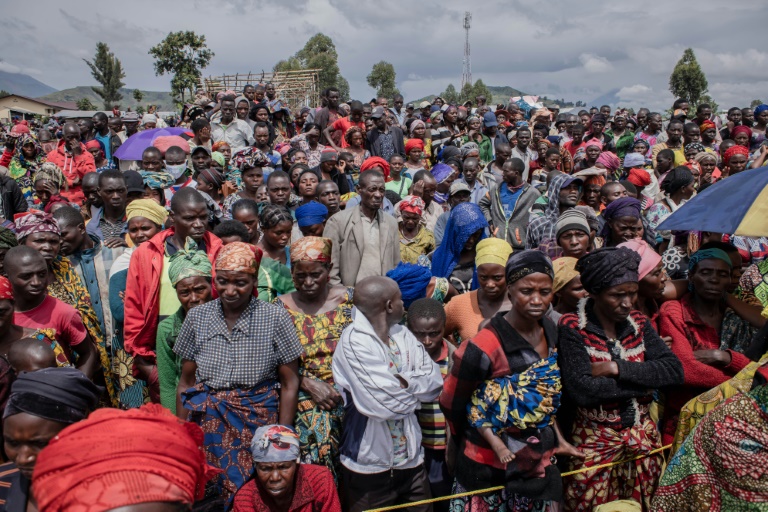
DR Congo Tutsis face threats, prejudice amid rebel crisis

Sitting in a small courtyard in Goma, eastern DR Congo, a 55-year-old Tutsi woman joked darkly that she would be killed if she spoke under her real name. 

She fled to the city last week after a militia leader known as General Janvier, an opponent of the Tutsi-led M23 rebel group, arrived in her town of Kitschanga.

“We saw children with machetes and guns saying they’d come to kill the Tutsis,” said the woman, in a poor Goma neighbourhood of clapboard houses on the Rwandan border. 

The M23 has advanced across North Kivu province in recent weeks, winning victories over the army as well as other militias and forcing hundreds of thousands to flee in its wake. 

The Democratic Republic of Congo accuses its smaller neighbour Rwanda of backing the M23, something UN experts and US officials agree with — although Kigali denies it.

Knife-edge tensions have escalated pressure on Congolese Tutsis, whose history is contested in the central African nation. 

Many assume that Tutsis support the M23, for example, or perceive them as Rwandan implants rather than native Congolese.

The government in Kinshasa has repeatedly argued against tribalism and stressed that the Rwandan government alone is to blame for the M23 crisis. 

But the reality in the east of the country, about a thousand miles (1,600 kilometres) from the capital, is often different. 

AFP interviewed six Congolese Tutsis who had recently arrived in Goma, mostly from Kitschanga in North Kivu’s Masisi territory. 

Five said they had fled death threats from militias.

“It hurts me,” said the 55-year-old Tutsi woman, who explained that all her relatives were Congolese but her children were accused of being Rwandans at school. 

“Our children ask us: What’s Rwanda?”

– Cut off your nose –

The sense of injustice is widely shared. A 36-year-old Tutsi mother of two, who’d also recently fled to Goma, told AFP she wanted the same rights as everyone else. 

She fiddled nervously with her wedding ring as she described why she left Kitschanga. “Militiamen notice your nose and threaten to cut it off with a knife,” she said. 

Tutsis are often stereotyped as having straight noses.

The woman — speaking in the Kinyarwanda language native to Rwandans as well as many Congolese Tutsis and Hutus — said militiamen also looted her home after she fled. 

“They say every Tutsi is an M23,” she said. “It’s terrible.”

The M23 first leapt to international prominence in 2012 when it captured Goma, before being driven out and going to ground. 

But the rebels took up arms again late last year, claiming the DRC had failed to honour a pledge to integrate them into the army. 

They’ve since seized swaths of territory and come within about 20 miles (12 kilometres) of Goma, a key hub of over a million people. 

The M23 advance has also driven a wave of virulent anti-Tutsi hate speech on social media, with calls for them to depart for Rwanda and worse.

Emmanuel Runigi Kamanzi, the president of a North Kivu livestock farmers’ association, said his Tutsi ancestors arrived in the region in the middle ages. 

“This is our home,” he added, decrying extremist attitudes  fanned by Mai-Mai militias and so-called Nyatura armed groups that claim to represent Congolese Hutus.

Nyatura means “those who strike mercilessly” in Kinyarwanda.

– ‘Uproot us’ –

In public statements, the M23 has frequently accused other armed groups as well as government forces of targeting Tutsis. 

But Lieutenant-Colonel Guillaume Ndjike, the Congolese army spokesman in North Kivu, said soldiers have not attacked Tutsis and that the allegations are “excuses put forward by the Rwandan army”. 

M23 fighters have themselves committed alleged atrocities. 

The rebels killed 131 civilians and raped 27 women and girls in two neighbouring villages in late November, according to a preliminary UN probe. 

Congolese Tutsi leaders have also condemned the M23. 

David Karambi, the president of a North Kivu Tutsi association, told reporters in December that recent massacres could not even be “committed by animals,” for example.

Many Congolese Tutsis interviewed by AFP said they felt unfairly blamed, and in danger.

In a Goma district where many Tutsis recently fled, a 27-year-old woman said Mai-Mai and Nyatura members had threatened “to kill us as they did to Tutsis in Rwanda”. 

“This war, it’s to uproot us,” she said, eyes downcast.

China protests shine light on limits of Uyghur solidarity

Their deaths in a fire triggered China’s biggest protests in generations, but few people seemed to know the victims were Uyghur families torn apart by Beijing’s crackdown in Xinjiang.

On November 24, 10 people died in the apartment block blaze in Urumqi, the northwestern region’s capital, with many around China blaming a grinding Covid lockdown for scuppering rescue efforts.

The news unleashed long-simmering resentment over Beijing’s health curbs, setting off widespread demonstrations that helped tip the government into reversing its strict coronavirus measures.

For the protesters, those who died in the fire were martyrs of zero-Covid.

But AFP interviews with relatives of the victims show they felt the fire was only the latest tragedy to strike their community.

Abdulhafiz Maimaitimin, a Uyghur who left China in 2016 and now lives in Switzerland, lost his aunt Qemernisahan Abdurahman and four of her young children in the fire. 

Her husband and son, along with Maimaitimin’s father, were arrested by Chinese authorities in 2016 and 2017. 

Maimaitimin and his family believe they were spirited into a sprawling network of detention centres where China has been accused of detaining more than one million Uyghurs and other mostly Muslim minorities.

“My aunt waited several years for (her loved ones) to be released but died without seeing them again,” 27-year-old Maimaitimin said.

After allegations by Washington and others of genocide, a United Nations report said in August that torture claims were credible and that the detentions may constitute crimes against humanity.

Beijing says the facilities are voluntary vocational schools designed to eliminate extremist thought.

– ‘Doors locked from outside’ –

The mainly Uyghur area of Urumqi where the deadly fire erupted appeared to have been under strict Covid curbs since August.

“Perhaps if my aunt’s husband and son had been there, they could have used their strength to save them,” Maimaitimin said. “But maybe not, since the door was locked from the outside.”

Other residents and relatives of the deceased have made similar claims and alleged that lockdown barricades slowed the emergency response.

Authorities have denied the accusations.

Memmetli Abbas, a Uyghur living in Turkey, said his daughter and granddaughter only escaped by alerting a local official who let them out.

But the pair were later “questioned with regard to the fire”, he told AFP. “I don’t know where they are.”

Abbas said his family’s grievances also predate the blaze. 

His oldest son has been in prison since 2017 after returning from a trip overseas, and his nephew was taken away to a camp the same year, he said.

“I don’t know why he’s being held. But I believe he’s there because he’s Uyghur and he’s Muslim,” he said.

– ‘Too scared’ –

The deaths ignited fury in Urumqi and inspired action in other cities.

Notably, protesters in Shanghai gathered at Wulumuqi Road — named after Urumqi in Mandarin — as the wave of rallies peaked on the weekend of November 26 and 27.

Silent vigils, calls for solidarity and anti-lockdown slogans expanded into demands for freedom of speech and even President Xi Jinping’s resignation.

“We are all Xinjiang people!” chanted demonstrators in Beijing.

But awareness of the victims’ ethnic background remained limited in a country where the government strictly controls the press and censors social media.

The protests were fuelled largely by frustration over zero-Covid, experts said, rather than solidarity with the Uyghurs as such.

“It’s an attempt to avoid (a disaster) happening to them next, rather than an attempt to show… empathy or understanding with Uyghurs,” said David Tobin, a Xinjiang scholar at Britain’s University of Sheffield.

The demonstrations did not appear to address the “racialised dimension” of health restrictions in Xinjiang, he added.

He cited an enhanced security presence, heavier-handed measures, and a lack of essential supplies in Uyghur areas under zero-Covid as examples of the even heavier tactics deployed there.

Meanwhile, years of persecution deterred ethnic minority citizens from joining the protests themselves, Turkey-based Uyghur activist Jevlan Shirmemmet said.

“Why do you think no Uyghurs took part in the Urumqi demonstrations?” he asked. 

“Because they can’t go out. They’re either too scared or… they’ll be branded as terrorists if they do.”

– ‘Helpless’ –

Overseas protests have created some space for Uyghurs to inform Chinese nationals about the crackdown.

One participant at a New York vigil said he initially did not know the victims’ ethnicity at all, as he blamed the Chinese government’s limits on freedom of speech for his lack of information.

“I’ve heard their stories and tend to believe them. But I cannot verify them,” he said.

“And I feel super helpless, because I don’t feel we can possibly find any way to help them.”

When hundreds gathered in London last month, activist Rahima Mahmut unfurled a flag associated with Xinjiang independence.

While some attendees from China’s majority Han ethnicity — many of them students at British universities — bristled, many seemed receptive to hearing more, she said.

Many protesters “really didn’t know that these victims were Uyghurs… or what is happening to Uyghur people”, she told AFP.

“Nevertheless, this kind of unity and bravery is a baby step to learning more and demanding more.”

But a Uyghur attendee at another rally, who said some of her family were detained, was sceptical.

She said the protests were “too little too late” and might even provoke a backlash against her community. 

“For us, everything started in 2017,” she said, referring to the year Beijing intensified its crackdown on the Uyghurs.

“I once wrote on social media, ‘It’s been five years,’ and a non-Uyghur friend commented: ‘Why? Covid has only been here for three years.’ I was so angry.”

Peru's president moves to bring elections forward as protests turn deadly

New Peruvian President Dina Boluarte announced Sunday that she would seek to hold elections two years early, while also declaring a state of emergency in certain areas after protests following the arrest of her predecessor left two dead.

Demonstrators across the country — notably in northern and Andean towns — had been calling for fresh elections, along with a national strike and the release of leftist former president Pedro Castillo, who was removed from office on Wednesday for attempting to dissolve Congress and rule by decree.

“Interpreting the will of the citizens… I have decided to take the initiative to reach an agreement with the Congress of the Republic to advance general elections to the month of April of 2024,” Boluarte said in a televised address, noting that a bill on moving the poll forward from 2026 would be submitted in the coming days.

She added that, “with the same patriotic sentiment,” she was declaring a “state of emergency in areas of high social conflict in order to peacefully” restore order.

Boluarte, a former prosecutor who had served as Castillo’s vice president, was quickly sworn in to replace him following his impeachment and subsequent arrest last week.

On Saturday, she introduced her new cabinet, a group with an independent and technocratic profile and including eight women.

She named former prosecutor Pedro Angulo as prime minister.

On Sunday demonstrators in cities across the country’s interior — including Cajamarca, Arequipa, Huancayo, Cusco and Puno — demanded Castillo’s release.

New clashes broke out between protesters and police in the southern city of Andahuaylas, leaving two dead and at least five injured — including a police officer — as demonstrators attempted to storm the city’s airport, authorities said.

In her address, Boluarte expressed regret for the protesters’ deaths.

– ‘Remain calm’ –

Riot police were deployed to the airport to contain the thousands of demonstrators in Andahuaylas, which lies in Boluarte’s home region of Apurimac.

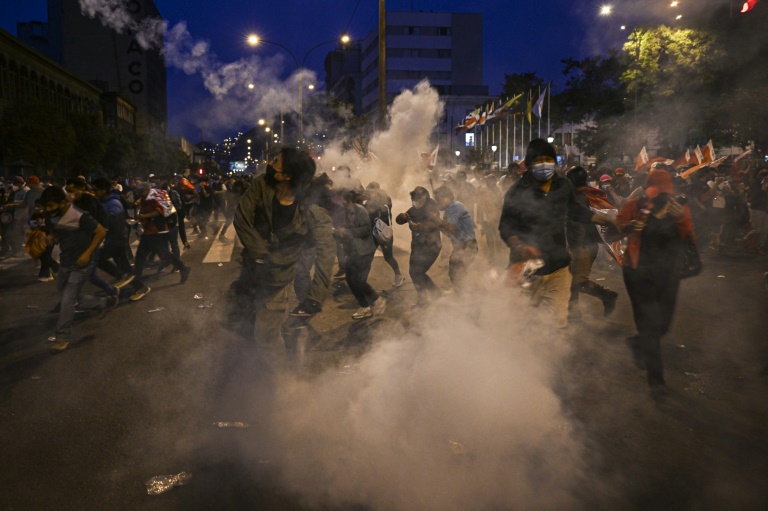
Protesters fired slingshots and hurled stones, while police responded with tear gas, images from the scene broadcast by local TV showed. A police station in the Apurimac town of Huancabamba was set on fire, RPP radio reported.

“I urge people to remain calm,” Interior Minister Cesar Cervantes told the station, as he announced the second death shortly after police confirmed the first — a teenager.

Clashes in Andahuaylas on Saturday saw 16 civilians and four police officers injured.

“No Peruvian’s life should be sacrificed for political interests,” Boluarte tweeted on Sunday evening before her speech, reiterating a call for “dialogue and the rejection of violence.”  

The country’s right-leaning Congress convened an emergency session Sunday afternoon to discuss the crisis, but had to be suspended after physical altercations broke out.

In images posted on social media, a man can be seen punching another man from behind and then members shoving each other in the center of the chamber.

Some 1,000 to 2,000 people rallied in Lima on Sunday shouting, “Castillo you are not alone, the people support you” and brandishing signs accusing “Dina and Congress” of being “corrupt rats,” before police dispersed the crowd with tear gas.

– ‘Indefinite strike’ –

Meanwhile, rural unions and organizations representing Indigenous peoples called for an “indefinite strike” beginning Tuesday in support of Castillo, himself the son of a peasant family.

They demanded the suspension of Congress, early elections and a new constitution, as well as Castillo’s immediate release, according to a statement from the Agrarian and Rural Front of Peru, which groups about a dozen organizations.

The Rural Front contends that Castillo “did not perpetrate a coup d’etat” on Wednesday when he announced the suspension of Congress and said he would be ruling by decree.

With his background as a rural teacher and union leader, and with little contact with the nation’s elites, Castillo has always drawn his strongest support from Andean regions, while struggling to find backing in coastal Lima.

The ousted president was arrested Wednesday while on his way to the Mexican embassy to seek asylum, and prosecutors have charged him with rebellion and conspiracy.

The pledge to hold new elections came as recent polls showed nearly nine in 10 Peruvians disapproved of the nation’s legislature.

Prior to Boluarte’s announcement, political analyst Giovanna Penaflor had told AFP that the president needed to make clear “that her role is to facilitate new general elections,” and that doing so would provide needed stability.

Peru is now on its sixth president since 2016.

Castillo’s 17-month rule was overshadowed by six investigations against him and his family, mass protests demanding his removal, and a power struggle with the opposition-backed Congress.

Close Bitnami banner
Bitnami