World

Sunlit Greece seeks to lure Europeans amid winter energy crisis

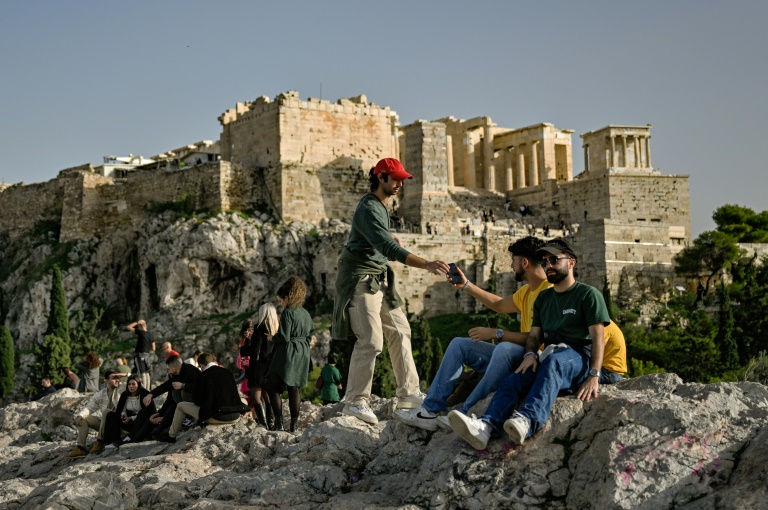
With most of Europe struggling with soaring energy costs, Greece has launched an initiative to put its mild winters to good use and attract sun-seeking travellers all year round.

The Mediterranean nation recorded November temperatures comfortably exceeding 20 degrees Celsius (68 degrees Fahrenheit) — quite a draw for Europeans eager to save on heating bills that have rocketed in the wake of the war in Ukraine.

The Greek government has earmarked 20 million euros ($21 million) for a poster campaign targeting mainly European pensioners that could boost an economy where the travel sector represents 25 percent of annual output.

“Wanna feel 20 again?” says the poster featuring an elderly pair nibbling watermelon and sipping drinks on a yacht.

“With warm winter temperatures up to 20 degrees Celsius, Greece is the place to be,” it adds.

Tourism Minister Vassilis Kikilias, fresh from a tour of several European capitals including Paris and Berlin to promote the initiative, told AFP the government was working “on a plan to campaign for Greece 12 months per year”.

With northern European countries facing much longer and bitterly cold winters, “energy-wise there are many more needs than here in the south where the winter is mild” and shorter, he added.

“You live a great one or two months here enjoying your vacation and spending less than you would have spent staying at home,” Kikilias said.

– The Florida of Europe? –

“In Greece, no German has to freeze,” top-selling German daily Bild wrote in September, while business daily Handelsblatt suggested the country could become “the Florida of Europe”.

Kikilias said there was a “tradition” among northern European travellers to winter in Spain and Portugal, but he urged holidaymakers eager for sun, sea and sand to “take a look at the eastern Mediterranean (too)”.

After two years of economically painful travel restrictions caused by the Covid-19 pandemic, arrivals in 2022 could finish near the all-time high of 33 million tourists recorded in 2019.

By the end of September, 23.7 million people had holidayed in Greece, and the number of French, German and British visitors even topped 2019 levels.

TUI, the world’s largest tourism operator, earlier this year brought forward the launch of the tourist season because of high demand.

But tour operators have yet to take the plunge in the winter months. 

For the time being, TUI does not offer organised trips to Greece from December to February, said Evangelos Georgiou, one of the company’s communications managers.

And German charter airline Condor only offers flights to Kalamata airport in the Peloponnese peninsula until the end of November.

Condor flights to Heraklion on the island of Crete and Rhodes will only resume at the beginning of April, according to spokeswoman Johanna Tillmann.
Sunlit Greece seeks to lure Europeans amid winter energy crisis

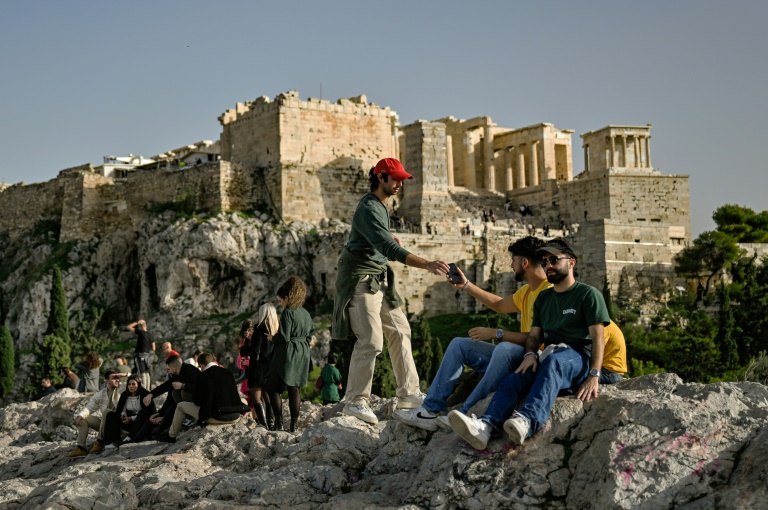
With most of Europe struggling with soaring energy costs, Greece has launched an initiative to put its mild winters to good use and attract sun-seeking travellers all year round.

The Mediterranean nation recorded November temperatures comfortably exceeding 20 degrees Celsius (68 degrees Fahrenheit) — quite a draw for Europeans eager to save on heating bills that have rocketed in the wake of the war in Ukraine.

The Greek government has earmarked 20 million euros ($21 million) for a poster campaign targeting mainly European pensioners that could boost an economy where the travel sector represents 25 percent of annual output.

“Wanna feel 20 again?” says the poster featuring an elderly pair nibbling watermelon and sipping drinks on a yacht.

“With warm winter temperatures up to 20 degrees Celsius, Greece is the place to be,” it adds.

Tourism Minister Vassilis Kikilias, fresh from a tour of several European capitals including Paris and Berlin to promote the initiative, told AFP the government was working “on a plan to campaign for Greece 12 months per year”.

With northern European countries facing much longer and bitterly cold winters, “energy-wise there are many more needs than here in the south where the winter is mild” and shorter, he added.

“You live a great one or two months here enjoying your vacation and spending less than you would have spent staying at home,” Kikilias said.

– The Florida of Europe? –

“In Greece, no German has to freeze,” top-selling German daily Bild wrote in September, while business daily Handelsblatt suggested the country could become “the Florida of Europe”.

Kikilias said there was a “tradition” among northern European travellers to winter in Spain and Portugal, but he urged holidaymakers eager for sun, sea and sand to “take a look at the eastern Mediterranean (too)”.

After two years of economically painful travel restrictions caused by the Covid-19 pandemic, arrivals in 2022 could finish near the all-time high of 33 million tourists recorded in 2019.

By the end of September, 23.7 million people had holidayed in Greece, and the number of French, German and British visitors even topped 2019 levels.

TUI, the world’s largest tourism operator, earlier this year brought forward the launch of the tourist season because of high demand.

But tour operators have yet to take the plunge in the winter months. 

For the time being, TUI does not offer organised trips to Greece from December to February, said Evangelos Georgiou, one of the company’s communications managers.

And German charter airline Condor only offers flights to Kalamata airport in the Peloponnese peninsula until the end of November.

Condor flights to Heraklion on the island of Crete and Rhodes will only resume at the beginning of April, according to spokeswoman Johanna Tillmann.
Sunlit Greece seeks to lure Europeans amid winter energy crisis

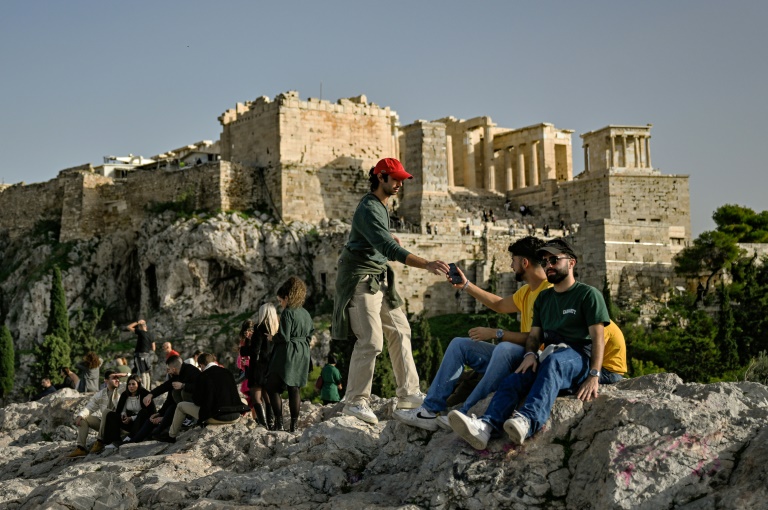
With most of Europe struggling with soaring energy costs, Greece has launched an initiative to put its mild winters to good use and attract sun-seeking travellers all year round.

The Mediterranean nation recorded November temperatures comfortably exceeding 20 degrees Celsius (68 degrees Fahrenheit) — quite a draw for Europeans eager to save on heating bills that have rocketed in the wake of the war in Ukraine.

The Greek government has earmarked 20 million euros ($21 million) for a poster campaign targeting mainly European pensioners that could boost an economy where the travel sector represents 25 percent of annual output.

“Wanna feel 20 again?” says the poster featuring an elderly pair nibbling watermelon and sipping drinks on a yacht.

“With warm winter temperatures up to 20 degrees Celsius, Greece is the place to be,” it adds.

Tourism Minister Vassilis Kikilias, fresh from a tour of several European capitals including Paris and Berlin to promote the initiative, told AFP the government was working “on a plan to campaign for Greece 12 months per year”.

With northern European countries facing much longer and bitterly cold winters, “energy-wise there are many more needs than here in the south where the winter is mild” and shorter, he added.

“You live a great one or two months here enjoying your vacation and spending less than you would have spent staying at home,” Kikilias said.

– The Florida of Europe? –

“In Greece, no German has to freeze,” top-selling German daily Bild wrote in September, while business daily Handelsblatt suggested the country could become “the Florida of Europe”.

Kikilias said there was a “tradition” among northern European travellers to winter in Spain and Portugal, but he urged holidaymakers eager for sun, sea and sand to “take a look at the eastern Mediterranean (too)”.

After two years of economically painful travel restrictions caused by the Covid-19 pandemic, arrivals in 2022 could finish near the all-time high of 33 million tourists recorded in 2019.

By the end of September, 23.7 million people had holidayed in Greece, and the number of French, German and British visitors even topped 2019 levels.

TUI, the world’s largest tourism operator, earlier this year brought forward the launch of the tourist season because of high demand.

But tour operators have yet to take the plunge in the winter months. 

For the time being, TUI does not offer organised trips to Greece from December to February, said Evangelos Georgiou, one of the company’s communications managers.

And German charter airline Condor only offers flights to Kalamata airport in the Peloponnese peninsula until the end of November.

Condor flights to Heraklion on the island of Crete and Rhodes will only resume at the beginning of April, according to spokeswoman Johanna Tillmann.
Restoring French West Africa's capital to its original splendour

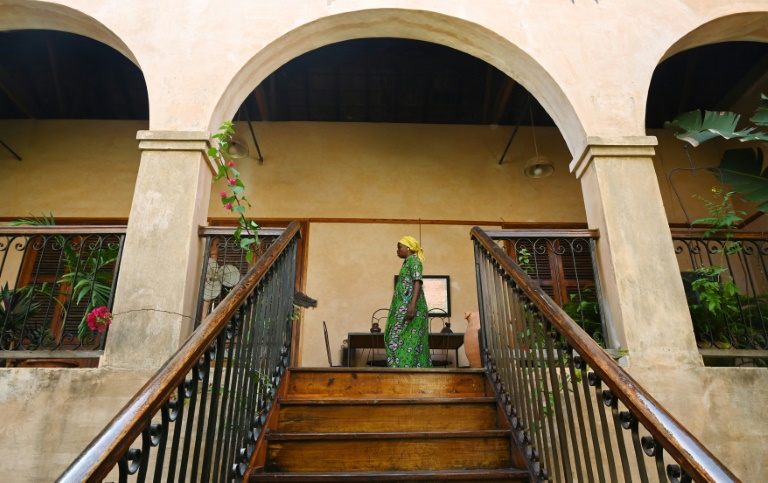
An intricately detailed balcony, a coat of fresh paint and large bay windows opening onto the street: this house, in Saint-Louis, northern Senegal, has regained its former glory. 

Next to it, one building has been gutted and another is about to collapse.

The house is one of several that have recently been refurbished, part of a movement to renew the face of Saint-Louis, the former colonial capital of French West Africa, which has been a UNESCO World Heritage Site since 2000.

It follows a long period of political and economic decline that has left the historic architecture and other cultural heritage in a state of disrepair.

Amadou Diaw, a local business magnate, is trying to help “revitalise the city while preserving its identity”. 

He buys up old, dilapidated houses to restore and transforms them into museums.

He has opened seven so far, including one on photography, and says he plans to continue.

“We have to put this city on the cultural map of the continent,” said Diaw, adding that he has already invested two million euros into the initiative. 

With its grid street plan, large, airy houses and metal bridge linking it to the mainland, the island of Saint-Louis — which sits in the Senegal River delta — still offers glimpses of a former era, when it was enriched by the trade of slaves, gum arabic and animal skins.

In 1957, the capital of Senegal was moved to Dakar. Soon neglected, Saint-Louis became a lethargic symbol of the past.

– Hopes and threats –

Now, Saint-Louis is facing a new threat: rising sea levels.

But a large gas deposit discovered off its coast — slated for exploitation by the end of 2023 — has given residents hope of a renaissance.

The conservation movement, which has been driven by private individuals and funded by public donors, is gaining momentum.

The city’s cathedral was refurbished in 2020. Then the French Development Agency (AFD) began renovating 16 privately-owned houses — a 2.2-million-euro endeavour, to which the homeowners are contributing about 15 percent.

Following those initiatives, the World Heritage Committee opted not to include the island of Saint-Louis on its list of endangered heritage sites.

That’s despite UNESCO having long highlighted the “extremely poor” state of many buildings in Saint-Louis, “endangering their occupants” and “affecting the integrity and authenticity” of the city.

Alpha Ndiaye, 69, a now-retired pharmacist’s assistant, says his house fell to ruin after years of neglect. 

“It was very nice — you would enter through the big door and then go up the stairs opposite”, he said, tracing a floor plan with a finger in the sand.

“When everything collapsed, I was very sad — I would have liked it to be rebuilt as it was before,” he said, standing in front of the ruined building, with large, rounded doors and vast rooms hinting at ancient splendour. 

– Succession problems –

One major problem when it comes to restoring the houses is the question of succession.

“Sometimes we don’t know who the heirs are and therefore who the owners are,” Deputy Mayor Aida Mbaye Dieng told AFP.

Fatima Fall, director of the Centre for Research and Documentation of Senegal, campaigns to raise awareness among Senegalese people about the wealth of their cultural heritage.

“There are also those who prefer modern comforts to the charm of old houses, those who do not respect standards because it is cheaper, and owners who have left the city and no longer want to invest,” she noted.

On a recent visit to the Bou El Mogdad, a restored former cargo ship that is now used for tourist cruises, AFP met students from Dakar’s Cheikh Anta Diop University learning about the city’s treasures.

“I’ve always heard about Saint-Louis without really knowing it”, said El Hadji Yadaly Ba, a student journalist, adding that the city could serve as a bridge between cultures and boost tourism.

“For me, this city was associated with France — it suffers from this image even though its history is very rich and complex,” he said.

The Russians helping Ukrainian refugees in Bulgaria

When Ukrainian Elena Bondarenko fled to Bulgaria after Russia invaded, she never imagined she would be taken in by a Russian there.

But that is exactly what happened to the bank clerk from Zaporizhzhia, one of many refugees fleeing the war who have been quietly sheltered by members of the country’s 17,500-strong Russian community.

Bondarenko and her mother and two small children were welcomed by a Russian who runs a children’s holiday camp near the Black Sea city of Burgas. 

At first “it was a shock”, Bondarenko, 36, admitted. But “I am happy that not all Russians are aggressors.”

“When you are without a roof, and you need to save your children, it does not matter who helps you,” said another refugee, 34-year-old Anaida Petrushenko, who fled from Pavlohrad in eastern Ukraine with her three children.

“I never hid the fact that I am Russian because people saw that I wanted to help,” said the camp’s co-owner, who did not want to be named.

He has taken in about 160 Ukrainian refugees, some of whom were shown the door at nearby hotels when the tourist season started.

While a number of Russians in Bulgaria are helping refugees, a large swathe of the Balkan nation remains resolutely pro-Russian. And the Bulgarian government has often been less than welcoming when it comes to providing accommodation and support, forcing many Ukrainians to leave.

Of the some 932,000, who fled to Bulgaria since the invasion, only some 51,000 remain with less than 10,000 put up by the state, according to official data.

Indeed, the Russian who runs the holiday camp only gets a daily allowance of 7.50 euros ($7.90) per refugee from the Bulgarian government, and even these meagre payments are often delayed.

With some 60 children and 50 elderly people to look after, the Russian and his Bulgarian partner are having to cover the extra costs themselves.

While they lambast the Bulgarian government for failing to provide language courses or help the refugees find work, with winter closing in they say they cannot close the camp.

– ‘Ashamed’ –

Volunteers have been the main driving force behind relief efforts for refugees, with Bulgaria woefully unprepared for the influx of Ukrainians following the Russian invasion in late February.

Despite their efforts, some of the Russians helping Ukrainians are uncomfortable about admitting who they are.

“I came up with this phrase, ‘I was born in Russia,'” a 47-year-old Russian translator, who lives in nearby Varna, told AFP.

“It was less painful for me to put it this way. I can’t describe this feeling of being ashamed of your own motherland,” she told AFP, fearing giving her name in case it got her mother back home into trouble.

Having driven hundreds of kilometres to fetch people from the border with Romania, she is still putting up several families in her and her sister’s Airbnb apartments in Varna.

– ‘Collective responsibility’ –

Another Russian in Varna, Viktor Bakurevich, told AFP that he had “decided to take some responsibility for these people who have suffered from the war.” 

“I do not believe in collective guilt but I do believe in collective responsibility,” said the father-of-three, who moved to Bulgaria 14 years ago and founded his Russian grocery chain Berezka.

Feeling “immense shame”, he publicly declared his opposition to the war from the outset and has hired about 50 Ukrainian refugees in addition to dozens of Ukrainians who already worked in his stores across Bulgaria.

Bakurevich is still providing daily food supplies and hot meals to support 100 refugees sheltered in a government recreation centre near Varna.

One of his Ukrainian refugee employees, Oksana Shurdova, 48, said the salary that provided for her family mattered more than the “Russian grocery” sign at the door. 

“My relatives know that not all Russians support the policy of the Russian government… They don’t generalise,” she said as a communist-era monument honouring Bulgarian-Soviet friendship looked down on the city from a nearby hill.

China retires major Covid tracking app as virus rules ease

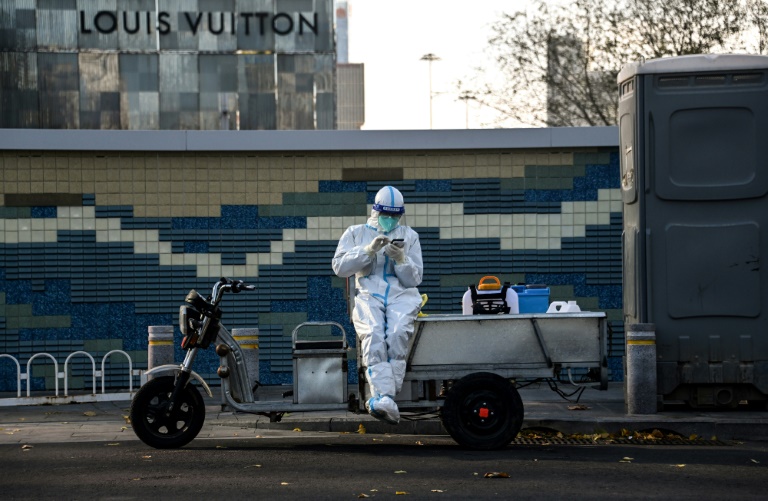
China said Monday it would retire an app used to track travel to areas with Covid-19 cases, a milestone in the country’s rapid turn away from its zero-tolerance coronavirus strategy.

Beijing has effectively thrown in the towel on zero-Covid, last week announcing an end to large-scale lockdowns, mandatory quarantine in central facilities, and a broad relaxation of testing measures.

And the central government is now beginning to unwind years of hardline policymaking, with the state-run “Communications Itinerary Card”, which tracks whether someone has been to a high-risk area based on their phone signal, to go offline at 12 am Tuesday.

The “Itinerary Card” was a central part of China’s zero-Covid policy, with millions of people required to key in their phone numbers to produce its signature green arrow to travel between provinces or enter events and some public places.

First rolled out in 2020 with a four-tier system that assigned different colours depending on users’ predicted level of Covid exposure, it was tweaked multiple times before a final change this year shortened the tracking period from 14 to seven days.

It is only one of a panoply of tracking apps that have governed everyday life in China throughout the pandemic, with most people still using local “health codes” run by their city or province to enter shops and offices.

The changes have been introduced despite a top health expert warning of a surge in Omicron cases that could tear through the country where millions of elderly are still unvaccinated. 

– ‘End of an era’ –

But social media users nevertheless hailed the Itinerary Card’s retirement, noting the symbolism of the central government shutting down its main tracking app.

Many posted screenshots of their “last” logins.

“Bye bye, this announces the end of an era, and also welcomes a brand new one,” one person wrote on the Twitter-like Weibo platform.

“Goodbye itinerary card, concerts here I come,” wrote another.

Others asked what would become of the mountains of data collected by the app.

“The Itinerary Card and other similar products mean vast amounts of personal information and private data,” wrote one Weibo user. 

“I hope there will be mechanisms and measures to log out and delete this.”

Kendra Schaefer, tech partner at research consultancy Trivium China, said the “political win of returning to normalcy is ginormous”.

“All the government actually loses by deleting those apps is a fast-track method of keeping certain people at home based on a public safety rationale,” she wrote on Twitter.

“As Covid controls disappear, the rationale disappears, and the benefits of removal outweigh the perks of keeping it,” she added.

– Covid ‘spreading rapidly’ –

But that return to normalcy means the country now faces a surge of cases it is ill-prepared to handle, with millions of elderly still not fully vaccinated and underfunded hospitals lacking the capacity to take on huge numbers of patients.

The country has one intensive care unit bed for 10,000 people, Jiao Yahui, director of the Department of Medical Affairs at the National Health Commission, warned last week.

Official reported cases in the country have dropped sharply from all-time highs last month, but top Chinese health expert Zhong Nanshan warned in state media Sunday that the prevailing Omicron variant was “spreading rapidly” through the country.

The easing of Covid restrictions has also released pent-up demand for domestic travel, with state broadcaster CCTV saying Monday that flights from Beijing’s two main airports were expected to soon return to 70 percent of 2019 levels.

China reported 8,626 domestic Covid cases Monday, but with testing no longer mandatory for much of the population the numbers are believed to be much higher.

France bets on tech and transparency to beat Chinese caviar

At the fish farm near Bordeaux, Christophe Baudoin is running an ultrasound device over the belly of a large sturgeon to check its eggs.

“Caviar!” he shouts as the monitor shows the right sparkle around each little round ball.

“Over-mature!” comes the next shout, indicating the fish’s pregnancy cycle has gone too far and the eggs have softened — losing the crucial crunch. It will go back in the lake to await another cycle in two years.

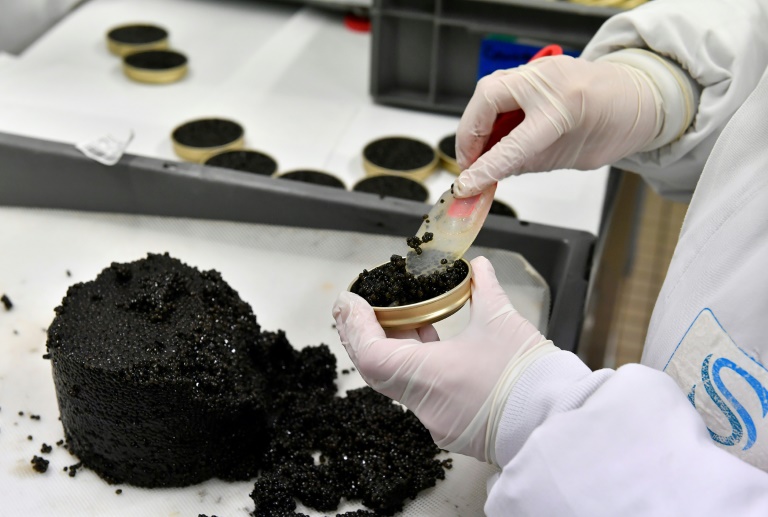
For the company, Sturia, it’s an incredibly laborious process — they ultrasound some 20,000 fish a year for a total of 300 tonnes of caviar — but climate change has made it vital.

Many fish are coming out “over-mature”, in part because warmer waters have accelerated the pregnancy cycle.

For the guys standing in the water, scooping up the huge fish for inspection, the winter days when 10 centimetres (four inches) of ice coated the lakes are not entirely missed. 

But the change is still shocking. 

“It’s been 10 years since we’ve seen any ice on these lakes,” said Baudoin.

One in five of the fish died in 2021 when water temperatures hit 30 degrees, five degrees above a sturgeon’s comfort zone. 

“You might not know each one by name, but it’s never nice to pull out a dead fish — and of course the cost for the group is enormous,” said Sturia boss Laurent Dulau. 

– Extinction threat –

Fished to the brink of extinction in the wild — including the once-rich Russian and Iranian waters of the Caspian Sea — sturgeon now exist almost exclusively in farms, most of them in China.

Sturgeon were fished in France’s Gironde river for centuries, but their eggs were given to children, old people and pigs until Russian nobles fleeing the Communist revolution a century ago showed locals their potential.

It became a delicacy in Paris after Armenian emigrants Melkoum and Mouchegh Petrossian convinced the Ritz Hotel in Paris to serve caviar in the 1920s. 

Farming only started in France in the 1990s, and since it takes up to a decade to raise a sturgeon, progress is painstaking. 

Unable to compete with China on quantity, French producers focus on sustainable and healthy farming. 

The ultrasound avoids unnecessary killing and Sturia sends the meat to be used for rillettes pate, the collagen-rich gonads for cosmetics, and the skin for leather and a specialist glue favoured by violin-makers.

– ‘Produce better’ –

Dulau said the focus on traceability and quality is rebuilding caviar’s image after the over-fishing crisis. 

“The idea is to produce less, but produce better,” he said. “People will eat less because it’s a lot more expensive, but it will be so good that they’ll be satisfied.”

But Michel Berthommier, of nearby Caviar Perlita, is frustrated that “nine out of 10, maybe 10 out of 10” French restaurants still source from China. He blamed middle-men for preferring the mark-up on foreign eggs.

“It’s bizarre at a time when restaurants are always saying they source their products locally. We sell more to Singapore than restaurants 10 kilometres down the road,” he said. 

But he said the transparency of French production will win over buyers. 

“There used to be a mystery around how these fish were raised and harvested. We have opened our books on how our fish live, how they are fed and selected. 

“We can’t be number one in production, but we can lead the way in creativity and science.”

France bets on tech and transparency to beat Chinese caviar

At the fish farm near Bordeaux, Christophe Baudoin is running an ultrasound device over the belly of a large sturgeon to check its eggs.

“Caviar!” he shouts as the monitor shows the right sparkle around each little round ball.

“Over-mature!” comes the next shout, indicating the fish’s pregnancy cycle has gone too far and the eggs have softened — losing the crucial crunch. It will go back in the lake to await another cycle in two years.

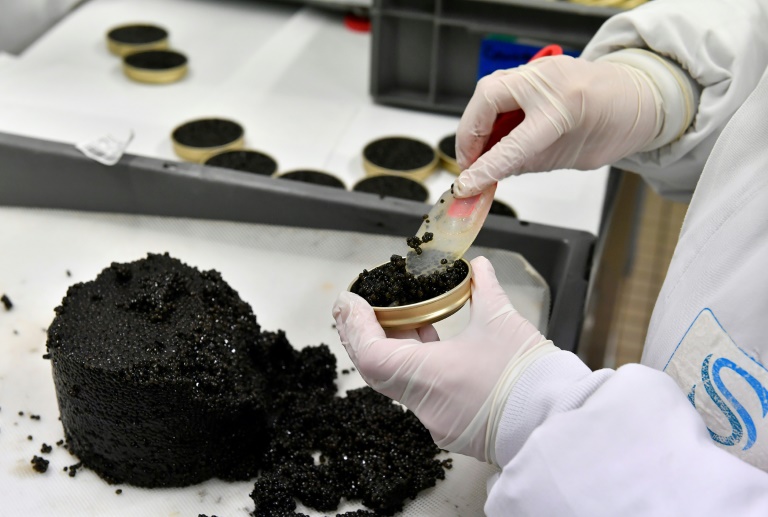
For the company, Sturia, it’s an incredibly laborious process — they ultrasound some 20,000 fish a year for a total of 300 tonnes of caviar — but climate change has made it vital.

Many fish are coming out “over-mature”, in part because warmer waters have accelerated the pregnancy cycle.

For the guys standing in the water, scooping up the huge fish for inspection, the winter days when 10 centimetres (four inches) of ice coated the lakes are not entirely missed. 

But the change is still shocking. 

“It’s been 10 years since we’ve seen any ice on these lakes,” said Baudoin.

One in five of the fish died in 2021 when water temperatures hit 30 degrees, five degrees above a sturgeon’s comfort zone. 

“You might not know each one by name, but it’s never nice to pull out a dead fish — and of course the cost for the group is enormous,” said Sturia boss Laurent Dulau. 

– Extinction threat –

Fished to the brink of extinction in the wild — including the once-rich Russian and Iranian waters of the Caspian Sea — sturgeon now exist almost exclusively in farms, most of them in China.

Sturgeon were fished in France’s Gironde river for centuries, but their eggs were given to children, old people and pigs until Russian nobles fleeing the Communist revolution a century ago showed locals their potential.

It became a delicacy in Paris after Armenian emigrants Melkoum and Mouchegh Petrossian convinced the Ritz Hotel in Paris to serve caviar in the 1920s. 

Farming only started in France in the 1990s, and since it takes up to a decade to raise a sturgeon, progress is painstaking. 

Unable to compete with China on quantity, French producers focus on sustainable and healthy farming. 

The ultrasound avoids unnecessary killing and Sturia sends the meat to be used for rillettes pate, the collagen-rich gonads for cosmetics, and the skin for leather and a specialist glue favoured by violin-makers.

– ‘Produce better’ –

Dulau said the focus on traceability and quality is rebuilding caviar’s image after the over-fishing crisis. 

“The idea is to produce less, but produce better,” he said. “People will eat less because it’s a lot more expensive, but it will be so good that they’ll be satisfied.”

But Michel Berthommier, of nearby Caviar Perlita, is frustrated that “nine out of 10, maybe 10 out of 10” French restaurants still source from China. He blamed middle-men for preferring the mark-up on foreign eggs.

“It’s bizarre at a time when restaurants are always saying they source their products locally. We sell more to Singapore than restaurants 10 kilometres down the road,” he said. 

But he said the transparency of French production will win over buyers. 

“There used to be a mystery around how these fish were raised and harvested. We have opened our books on how our fish live, how they are fed and selected. 

“We can’t be number one in production, but we can lead the way in creativity and science.”

France bets on tech and transparency to beat Chinese caviar

At the fish farm near Bordeaux, Christophe Baudoin is running an ultrasound device over the belly of a large sturgeon to check its eggs.

“Caviar!” he shouts as the monitor shows the right sparkle around each little round ball.

“Over-mature!” comes the next shout, indicating the fish’s pregnancy cycle has gone too far and the eggs have softened — losing the crucial crunch. It will go back in the lake to await another cycle in two years.

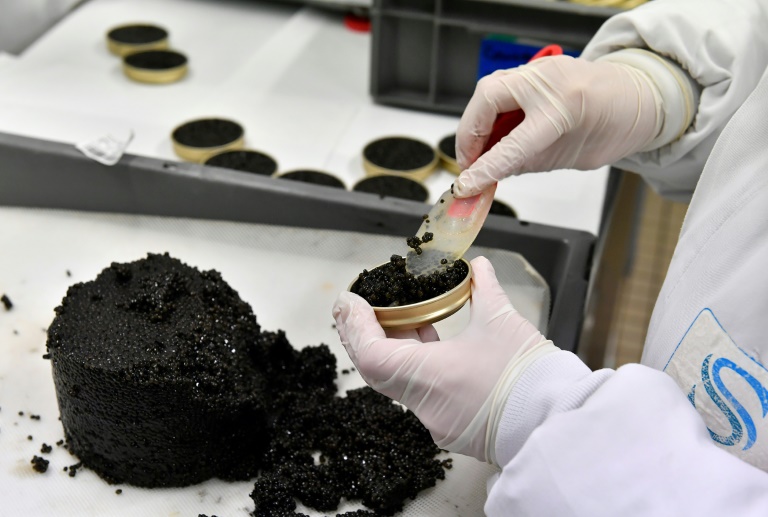
For the company, Sturia, it’s an incredibly laborious process — they ultrasound some 20,000 fish a year for a total of 300 tonnes of caviar — but climate change has made it vital.

Many fish are coming out “over-mature”, in part because warmer waters have accelerated the pregnancy cycle.

For the guys standing in the water, scooping up the huge fish for inspection, the winter days when 10 centimetres (four inches) of ice coated the lakes are not entirely missed. 

But the change is still shocking. 

“It’s been 10 years since we’ve seen any ice on these lakes,” said Baudoin.

One in five of the fish died in 2021 when water temperatures hit 30 degrees, five degrees above a sturgeon’s comfort zone. 

“You might not know each one by name, but it’s never nice to pull out a dead fish — and of course the cost for the group is enormous,” said Sturia boss Laurent Dulau. 

– Extinction threat –

Fished to the brink of extinction in the wild — including the once-rich Russian and Iranian waters of the Caspian Sea — sturgeon now exist almost exclusively in farms, most of them in China.

Sturgeon were fished in France’s Gironde river for centuries, but their eggs were given to children, old people and pigs until Russian nobles fleeing the Communist revolution a century ago showed locals their potential.

It became a delicacy in Paris after Armenian emigrants Melkoum and Mouchegh Petrossian convinced the Ritz Hotel in Paris to serve caviar in the 1920s. 

Farming only started in France in the 1990s, and since it takes up to a decade to raise a sturgeon, progress is painstaking. 

Unable to compete with China on quantity, French producers focus on sustainable and healthy farming. 

The ultrasound avoids unnecessary killing and Sturia sends the meat to be used for rillettes pate, the collagen-rich gonads for cosmetics, and the skin for leather and a specialist glue favoured by violin-makers.

– ‘Produce better’ –

Dulau said the focus on traceability and quality is rebuilding caviar’s image after the over-fishing crisis. 

“The idea is to produce less, but produce better,” he said. “People will eat less because it’s a lot more expensive, but it will be so good that they’ll be satisfied.”

But Michel Berthommier, of nearby Caviar Perlita, is frustrated that “nine out of 10, maybe 10 out of 10” French restaurants still source from China. He blamed middle-men for preferring the mark-up on foreign eggs.

“It’s bizarre at a time when restaurants are always saying they source their products locally. We sell more to Singapore than restaurants 10 kilometres down the road,” he said. 

But he said the transparency of French production will win over buyers. 

“There used to be a mystery around how these fish were raised and harvested. We have opened our books on how our fish live, how they are fed and selected. 

“We can’t be number one in production, but we can lead the way in creativity and science.”

Two killed in Peru as protests spread against new president

Protests against Peru’s new government turned deadly on Sunday, with two people killed as police clashed with angry demonstrators calling for a national strike, fresh elections and the release of detained former president Pedro Castillo.

The protests have swelled, notably in the northern and Andean towns, since the South American country’s legislature on Wednesday threw out the leftist Castillo after he tried to dissolve Congress and rule by decree.

Dina Boluarte, a former prosecutor who had served as Castillo’s vice president, was quickly sworn in to replace him.

On Saturday, she introduced her new cabinet, a group with an independent and technocratic profile and including eight women.

She named former prosecutor Pedro Angulo as prime minister.

After his impeachment, Castillo was quickly arrested, and on Sunday demonstrators in cities across the country’s interior — including Cajamarca, Arequipa, Huancayo, Cusco and Puno — demanded his release.

New clashes broke out Sunday between protesters and police in the southern city of Andahuaylas, leaving two dead and at least five injured — including a police officer — as demonstrators attempted to storm the city’s airport, authorities said.

– ‘Remain calm’ –

Riot police were deployed to the airport to contain the thousands of demonstrators in Andahuaylas, which lies in Boluarte’s home region of Apurimac.

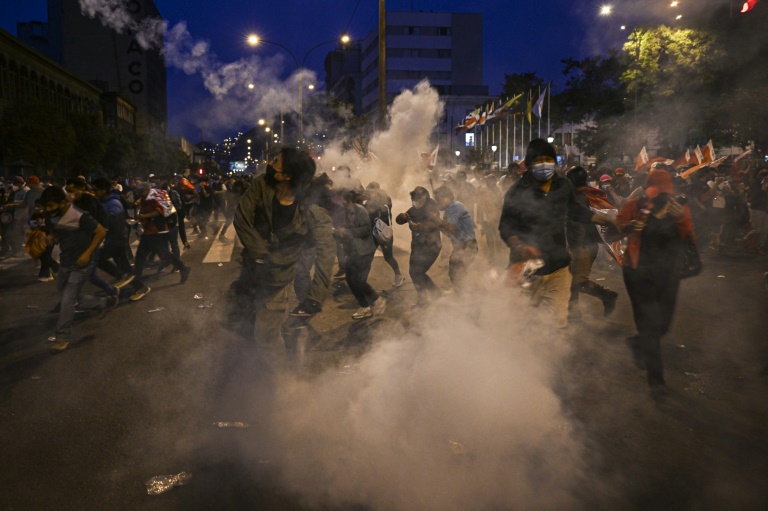
Protesters fired slingshots and hurled stones, while police responded with tear gas, images from the scene broadcast by local TV showed. A police station in the Apurimac town of Huancabamba was set on fire, RPP radio reported.

“I urge people to remain calm,” Interior Minister Cesar Cervantes told the station, as he announced the second death shortly after police confirmed the first — a teenager.

Clashes in Andahuaylas on Saturday saw 16 civilians and four police officers injured.

“No Peruvians life should be sacrificed for political interests,” Boluarte tweeted Sunday evening, reiterating a call for “dialogue and the rejection of violence.”  

The country’s right-leaning Congress convened in emergency session Sunday afternoon to discuss the crisis, but had to be suspended after physical altercations broke out.

In images posted on social media, a man can be seen punching another man from behind and then members shoving each other in the center of the chamber.

Some 1,000 to 2,000 people rallied in Lima on Sunday shouting, “Castillo you are not alone, the people support you” and brandishing signs accusing “Dina and Congress” of being “corrupt rats,” before police dispersed the crowd with tear gas.

– ‘Indefinite strike’ –

Meanwhile, rural unions and organizations representing Indigenous peoples called for an “indefinite strike” beginning Tuesday in support of Castillo, himself the son of a peasant family.

They demanded the suspension of Congress, early elections and a new constitution as well as Castillo’s immediate release, according to a statement from the Agrarian and Rural Front of Peru, which groups about a dozen organizations.

The Rural Front contends that Castillo “did not perpetrate a coup d’etat” on Wednesday when he announced the suspension of Congress and said he would be ruling by decree.

With his background as a rural teacher and union leader, and with little contact with the nation’s elites, Castillo has always drawn his strongest support from Andean regions, while struggling to find backing in coastal Lima.

The ousted president was arrested Wednesday while on his way to the Mexican embassy to seek asylum, and prosecutors have charged him with rebellion and conspiracy.

The demands for new elections come as recent polls show nearly nine in 10 Peruvians disapprove of the nation’s legislature.

Political analyst Giovanna Penaflor told AFP that Boluarte — who on Friday did not rule out calling early elections — needs to make clear whether she intends to lead a transitional government or to remain in power until 2026.

“She should be clear that her role is to facilitate new general elections,” Penaflor added, saying that doing so would provide needed stability and “allow this cabinet to not be like those in the past.”

Peru is now on its sixth president since 2016.

Castillo’s 17-month rule was overshadowed by six investigations against him and his family, mass protests demanding his removal, and a power struggle with the opposition-backed Congress.

Close Bitnami banner
Bitnami