World

NASA capsule Orion splashes down after record-setting lunar voyage

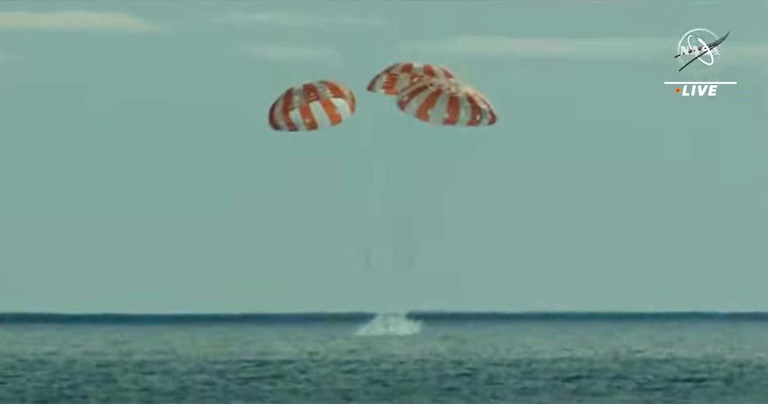
NASA’s Orion space capsule splashed down safely in the Pacific on Sunday, completing the Artemis 1 mission — a more than 25-day journey around the Moon with an eye to returning humans there in just a few years.

After racing through the Earth’s atmosphere at a speed of 40,000 kilometers per hour (25,000 mph), the uncrewed capsule floated down to the sea with the help of three large red and white parachutes, as seen on NASA TV. 

After a few hours of tests, the vessel will be recovered by a US Navy ship in waters off the coast of Mexico’s Baja California.

The capsule shaped like a gumdrop had to withstand a temperature 2,800 degrees Centigrade (5,000 Fahrenheit) — about half that of the surface of the sun — as it entered the Earth’s atmosphere.

The main goal of this mission was to test Orion’s heat shield — for the day when it is humans and not test mannequins riding inside.

Achieving success in this mission was key for NASA, which has invested tens of billions of dollars in the Artemis program due to take people back to the Moon and prepare for an onward trip, someday, to Mars.

A first test of the capsule was carried out in 2014 but that time it stayed in Earth’s orbit, coming back into the atmosphere at a slower speed of around 20,000 miles per hour.

– Choppers, divers and boats – 

The USS Portland was positioned to recover the Orion capsule in an exercise NASA has been rehearsing for years. Helicopters and inflatable boats were also deployed for this task.  

The falling spacecraft eased to a speed of 20 miles (30 kilometers) per hour as it finally hit the blue waters of the Pacific.

NASA will now let Orion float for two hours — a lot longer than if astronauts were inside — so as to collect data.

“We’ll see how the heat soaks back into the crew module and how that affects the temperature inside,” Jim Geffre, NASA’s Orion vehicle integration manager, said last week.

Divers will then attach cables to hoist Orion onto the USS Portland, which is an amphibious transport dock vessel, the rear of which will be partly submerged. This water will be pumped out slowly so the spacecraft can rest on a platform designed to hold it.

This should all take about four to six hours after splashdown.

The Navy ship will then head for San Diego, California where the spacecraft will be unloaded a few days later.

Upon returning to Earth, the spacecraft has traveled 1.4 million miles since it took off November 16 with the help of a monstrous rocket called SLS.

At its nearest point to the Moon it flew less than 80 miles (130 kilometers) from the surface. And it broke the distance record for a habitable capsule, venturing 268,000 miles (432,000 kilometers) from our planet.

– Artemis 2 and 3 –

Recovering the spacecraft will allow NASA to gather data that is crucial for future missions.

This includes information on the condition of the vessel after its flight, data from monitors that measure acceleration and vibration, and the performance of a special vest put on a mannequin in the capsule to test how to protect people from radiation while flying through space.

Some capsule components should be good for reuse in the Artemis 2 mission, already in advanced stages of planning.

This next mission planned for 2024 will take a crew toward the Moon but still without landing on it. NASA is expected to name the astronauts selected soon.

Artemis 3, scheduled for 2025, will see a spacecraft land for the first time on the south pole of the Moon, which features water in the form of ice.

Only 12 people — all of them white men — have set foot on the Moon. They did this during the Apollo missions, the last of which was in 1972.

Artemis is scheduled to send a woman and a person of color to the Moon for the first time.

NASA’s goal is to establish a lasting human presence on the Moon, through a base on its surface and a space station circling around it. Having people learn to live on the Moon should help engineers develop technologies for a years-long trip to Mars, maybe in the late 2030s.
Russia sought to swap ex-US Marine for 'assassin' held in Germany

US efforts to negotiate the freedom of a former Marine held in Russia as part of the swap involving basketball star Brittney Griner were thwarted by Moscow’s demand for the release of a convicted murderer held in Germany, according to a top US official and media reports.

The swap of Griner for convicted Russian arms dealer Viktor Bout raised questions as to why the US side had failed to secure the simultaneous release of Paul Whelan, a former Marine accused by Moscow of spying — a charge Washington flatly rejects.

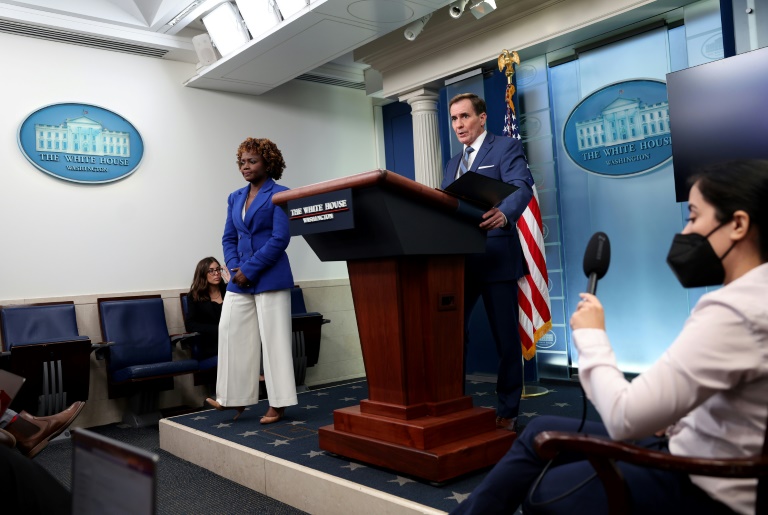
White House national security spokesman John Kirby was asked Sunday about reports negotiations stumbled over a demand for the release of Vadim Krasikov, a former colonel in Russia’s domestic spy organization serving a life sentence for murder in Germany.

Kirby acknowledged on ABC’s “This Week” that “there was a claim that they wanted a man named Mr Krasikov, that the Germans have held in custody.”

“That just wasn’t considered a serious offer,” said Kirby, who characterized Krasikov as “an assassin.”

Kirby had told CNN in late July that including Krasikov in any deal was “a bad-faith attempt (by Moscow) to avoid a very serious offer” from the US side.

On Friday, White House spokeswoman Karine Jean-Pierre declined to comment on the Krasikov matter.

Krasikov is serving a life sentence in Germany for murdering a Chechen fighter in a park in Berlin in 2019, a killing which German authorities say was ordered by Russian intelligence services.

Some US diplomats believe the demand for Krasikov’s release originated with President Vladimir Putin, who was wary of providing a political boost to President Joe Biden at a time of fierce hostility over Ukraine, The New York Times reported.

Roger Carstens, special US presidential envoy for hostage affairs, told CNN he had spoken to Whelan on Friday, the day after the Griner-Bout swap, and Whelan expressed his “frustration.” 

“Here’s what I told him. I said: ‘Paul, you have the commitment of this president. The president’s focused. The secretary of state’s focused.'”

“‘Keep the faith. We’re coming to get you.'”

Carstens also provided some of the first details of Griner’s demeanor during her flight back to the United States from the United Arab Emirates, following a flight from Russia.

After boarding, he said, he offered to give Griner space to “decompress” after her 10 months in captivity — but she was having none of it.

“Oh, no,” she told him. “I’ve been in prison for 10 months now listening to Russian, I want to talk,” — and Griner did so for perhaps 12 of the 18 hours the flight lasted, Carstens said, talking about “everything under the sun.”

But first, he said, she insisted on meeting the others on the plane. 

She “went to every member on that crew, looked them in the eyes, shook their hands and asked about them, got their names…. It was really amazing.”

He added: “I was left with the impression that this is an intelligent, passionate, compassionate, humble, interesting person, a patriotic person, but above all, authentic.” 

He said he “felt blessed having had a chance to get to know her.”

Alleged Lockerbie bombmaker in US custody

A Libyan man accused of making the bomb that destroyed a Pan Am flight over Scotland in 1988, killing 270 people, has been taken into US custody, authorities said on Sunday.

Abu Agila Mohammad Masud was charged by the United States two years ago for the Lockerbie bombing — in which Americans made up a majority of the victims. He had previously been held in Libya for alleged involvement in a 1986 attack on a Berlin nightclub.

The US Justice Department confirmed in a statement that Masud was in American custody, following an announcement by Scottish prosecutors, without saying how the suspect ended up in US hands.

A department spokesperson said Masud was expected to make an initial appearance in a federal court in the US capital. They did not specify a date but said details would be forthcoming.

According to The New York Times, Masud was arrested by the FBI and is in the process of being extradited to the United States to face prosecution.

Only one individual has so far been prosecuted for the bombing of Pan Am flight 103 on December 21, 1988 — which remains the deadliest terror attack on British soil.

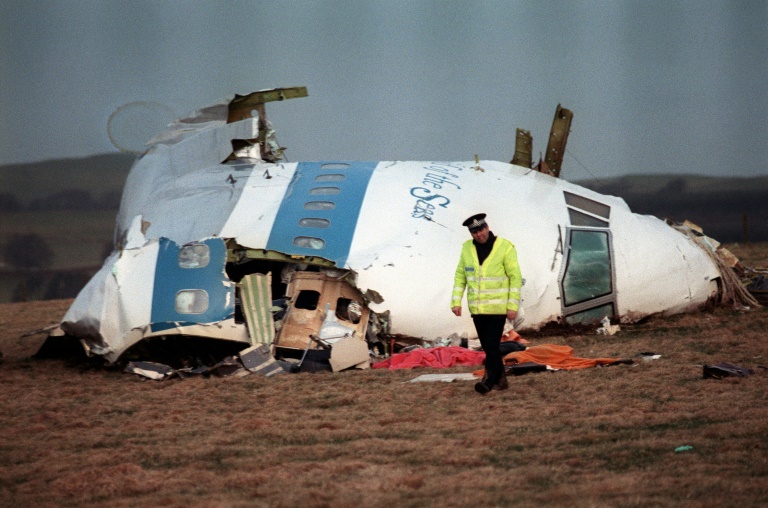
The New York-bound aircraft was blown up 38 minutes after it took off from London, sending the main fuselage plunging to the ground in Lockerbie and spreading debris over a vast area.

The bombing killed 259 people including 190 Americans on board, and 11 people on the ground.

Former Libyan intelligence officer Abdelbaset Ali Mohmet al-Megrahi spent seven years in a Scottish prison after his conviction in 2001. 

He died in Libya in 2012, always maintaining his innocence.

“The families of those killed in the Lockerbie bombing have been told that the suspect Abu Agila Mohammad Masud Kheir Al-Marimi … is in US custody,” a spokesperson for Scotland’s Crown Office and Procurator Fiscal Service said.

“Scottish prosecutors and police, working with UK government and US colleagues, will continue to pursue this investigation, with the sole aim of bringing those who acted along with al-Megrahi to justice.”

– Libyan connection –

Scottish officials gave no information on when Masud was handed over, and his fate has been tied up in the warring factionalism of Libyan politics.

He was kidnapped by a Libyan militia group, according to reports last month cited by the BBC, following his detention for the Berlin attack which killed two US soldiers and a Turkish citizen.

Masud was reputedly a leading bombmaker for Libyan dictator Moamer Kadhafi. According to the US indictment, he assembled and programmed the bomb that brought down the Pan Am jumbo jet.

The investigation was relaunched in 2016 when Washington learned of Masud’s arrest after Kadhafi’s ouster and death in 2011, and his reported confession of involvement to the new Libyan regime in 2012.

However, the Libyan connection to Lockerbie has long been disputed by some.

In January 2021, Megrahi’s family lost a posthumous appeal in Scotland against his conviction, following an independent review that said a possible miscarriage of justice may have occurred.

The family wants UK authorities to declassify documents that are said to allege that Iran used a Syria-based Palestinian proxy to build the bomb that downed flight 103.

In that narrative, the Lockerbie bombing was retaliation for the downing of an Iranian passenger jet by a US Navy missile in July 1988 that killed 290 people.

After the news of Masud being in US custody, lawyers for Megrahi’s son issued a statement again trying to cast doubt on the Libyan connection.

The US indictment says for instance that Masud bought clothes used to fill the suitcase containing the bomb that brought down the airliner, lawyer Aamer Anwar said in a statement.

But the owner of the store in Malta who sold those clothes said they were purchased by Megrahi — and this was central to the case against him.

“How can both Megrahi and Masud now be held responsible?,” the lawyer wrote.

Greek MEP held as Qatar graft probe expands

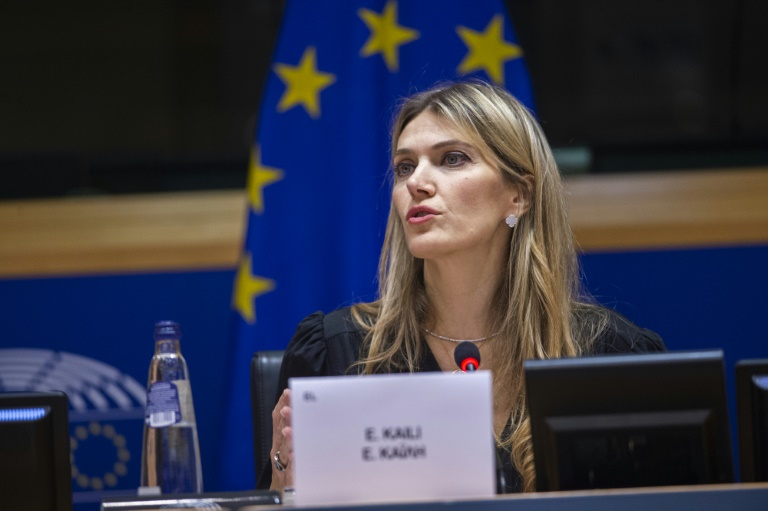
A European Parliament vice president, Greek socialist MEP Eva Kaili, was charged with corruption and remanded in custody on Sunday after Belgian investigators found “bags of cash” in her home.

Belgian police are investigating allegations that figures working on behalf of Qatar, the Gulf monarchy and World Cup host, have paid European politicians huge bribes to influence the Brussels policy debate.

Kaili, who has spoken publicly in support of Qatar’s recent labour reforms, was one of four suspects to have been charged and detained.

Two more have been released and the house of at least one more MEP has been searched by investigators.

The Belgian federal prosecutor’s office did not identify the four by name, but a judicial source confirmed to AFP that Kaili was among those charged.

“Four individuals have been arrested by the Brussels investigating judge who is leading the investigation,” the federal prosecutor’s office said in a statement.

“They are charged with participation in a criminal organisation, money laundering and corruption. Two persons have been released by the investigating judge.”

The arrests followed raids in Brussels which prosecutors said turned up 600,000 euros ($630,000) in cash. Police also seized computers and mobile phones.

– ‘Bags of cash’ –

The second search of an MEP’s house is understood to have involved a Belgian member, since the president of the parliament, Roberta Metsola, was invited to witness the raid. 

The judicial source identified him as Marc Tarabella, a Belgian socialist and vice-chair of the parliamentary delegation “for relations with the Arab peninsula”. He has not been charged.

Under the Belgian constitution the European Parliament president must attend if one of the country’s MEPs is targeted by a search, Metsola’s office confirmed.

A spokesman confirmed Metsola returned from Malta to Brussels on Saturday evening to be present at a house search of an MEP.

“The European Parliament and President Metsola stand firmly against corruption, are actively and fully cooperating with law enforcement and judicial authorities to assist the course of justice.”

The EU’s economy commissioner Paolo Gentiloni on Sunday said the case was “seriously damaging” to the parliament’s reputation.

The former Italian prime minister said during a show on Italy’s state broadcaster Rai that if the allegations were confirmed, “I think it would really be one of the most dramatic corruption cases in recent years”.

Kaili has been stripped of her responsibilities as a vice president of the parliament, notably that of representing Metsola in the Middle East, but she remains an MEP and would normally enjoy immunity from criminal prosecution.

But there is an exception in cases where a suspect is caught red-handed in the act of committing an alleged crime and, according to the judicial source, Belgian police detained Kaili in possession of “bags of cash” and thus she was brought before the judge.

Among the six arrested on Friday, after at least 16 police raids of premises in Brussels, were the former MEP Pier-Antonio Panzeri and his fellow Italian Luca Visentini, the general secretary of the International Trade Union Confederation (ITUC).

– ‘Strategic positions’ –

According to Belgian media, Kaili’s father is also implicated, caught transporting cash “in a suitcase”. 

“It is suspected that third parties in political and/or strategic positions within the European Parliament were paid large sums of money or offered substantial gifts to influence parliament’s decisions,” the prosecutor’s statement said, without pointing fingers at Qatar.

The scandal erupted during the 2022 football World Cup, an event Qatar had hoped would boost its reputation but which has been dogged by allegations of mistreatment of the migrant workers who built the host’s new stadiums.

Kaili visited Qatar just ahead of the World Cup and praised the country as a “frontrunner in labour rights” a sentiment she has repeated on the floor of the parliament, to the consternation of some MEPs.

Questions of corruption are now expected to hang over this week’s European Parliament plenary session in Strasbourg, where Kaili’s party grouping the Socialists and Democrats will be under pressure from opponents on the right and left.

Metsola, herself a Maltese conservative, has called a meeting of the leaders of the parliament’s political blocs on Monday to discuss the Belgian investigation, two parliamentary sources told AFP.

Some MEPs also now plan to oppose opening the debate on visa liberalisation for Qatari travellers, potentially derailing a key diplomatic goal of the gas-rich nation.

Volcano erupts in Guatemala, forcing airport closure

One of the most active volcanoes in Central America has erupted again, spewing lava and ash and forcing authorities in Guatemala City on Sunday to close the country’s largest airport and a major highway. 

The volcano named Fuego — Spanish for fire — rumbled into activity overnight Saturday into Sunday, with molten rock oozing down its slopes and ash belching two kilometers (more than a mile) into the sky. Winds carried the ash toward Guatemala City, 35 kilometers (22 miles) away.

La Aurora international airport, six kilometers south of the capital, was temporarily closed at mid-morning, the General Directorate of Civil Aeronautics said in a statement, citing the presence of ash near the runway.

At least two incoming flights had to be diverted, aviation sources said.

In addition, a road that connects southern and central Guatemala was closed as a precaution, said Carlos Aquino, a spokesman for the highway police.

The volcano is about 16 kilometers from Antigua, the country’s picturesque former capital and biggest tourist attraction. 

Fuego erupts every four to five years on average. In 2018, an eruption sent rivers of lava pouring down its sides, devastating the village of San Miguel Los Lotes, killing 215 people and leaving a similar number missing.

Authorities are monitoring the latest eruption closely, and so far no one has been evacuated, said Rodolfo Garcia, a civil protection spokesman.

Guatemala has two other active volcanoes — Santiaguito in the west of the country and Pacaya in the south.

Alleged Lockerbie bombmaker in US custody

A Libyan man accused of making the bomb that destroyed a Pan Am flight over Scotland in 1988, killing 270 people, has been taken into US custody, the Justice Department confirmed Sunday.

Abu Agila Mohammad Masud was charged by the US two years ago for the Lockerbie bombing. He had previously been held in Libya for his alleged involvement in a 1986 attack on a Berlin nightclub.

The Justice Department confirmed in a statement that Masud was in US custody, following an announcement by Scottish prosecutors, without saying how the suspect ended up in US hands.

A department spokesperson said Masud was expected to make an initial appearance in the US District Court for the District of Columbia, but did not specify when.

Only one individual has so far been prosecuted for the bombing of Pan Am flight 103 on December 21, 1988 — which remains the deadliest terror attack in British history.

Former Libyan intelligence officer Abdelbaset Ali Mohmet al-Megrahi spent seven years in a Scottish prison after his conviction in 2001. 

He died in Libya in 2012, always maintaining his innocence.

“The families of those killed in the Lockerbie bombing have been told that the suspect Abu Agila Mohammad Masud Kheir Al-Marimi … is in US custody,” a spokesperson for Scotland’s Crown Office and Procurator Fiscal Service said.

“Scottish prosecutors and police, working with UK government and US colleagues, will continue to pursue this investigation, with the sole aim of bringing those who acted along with al-Megrahi to justice.”

– Libyan connection –

Scottish officials gave no information on when Masud was handed over, and his fate has been tied up in the warring factionalism of Libyan politics.

He was kidnapped by a Libyan militia group, according to reports last month cited by the BBC, following his detention for the Berlin attack which killed two US soldiers and a Turkish citizen.

Masud was reputedly a leading bombmaker for Libyan dictator Moamer Kadhafi. According to the US indictment, he assembled and programmed the bomb that brought down the Pan Am jumbo jet.

The investigation was relaunched in 2016 when Washington learned of Masud’s arrest after Kadhafi’s ouster and death in 2011, and his reported confession of involvement to the new Libyan regime in 2012.

However, the Libyan connection to Lockerbie has long been disputed by some.

In January 2021, Megrahi’s family lost a posthumous appeal in Scotland against his conviction, following an independent review that said a possible miscarriage of justice may have occurred.

The family wants UK authorities to declassify documents that are said to allege that Iran used a Syria-based Palestinian proxy to build the bomb that downed flight 103.

In that narrative, the Lockerbie bombing was retaliation for the downing of an Iranian passenger jet by a US Navy missile in July 1988 that killed 290 people.

Russian shelling in Kherson kills two: governor

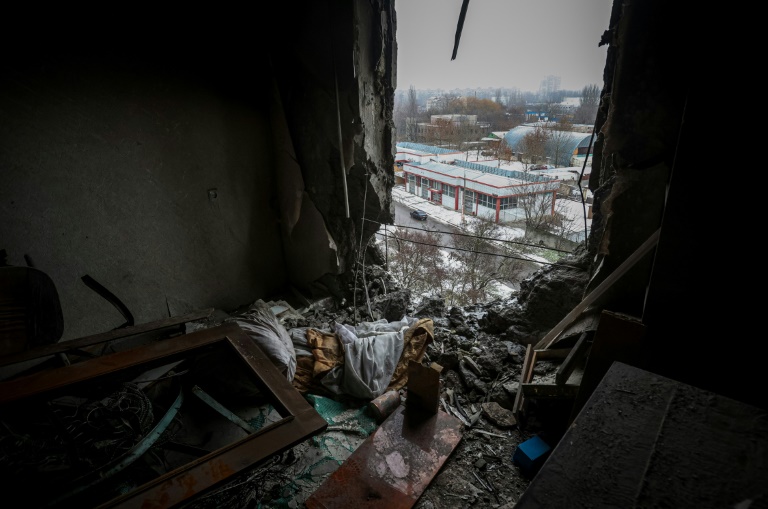
Two people were killed and another five wounded after Russian troops shelled the southern Ukrainian region of Kherson, the governor said on Sunday.

The city of Kherson was in November recaptured by Ukrainian forces during a Kyiv counter-offensive. 

“The enemy again attacked the residential quarters of Kherson,” the governor, Yaroslav Yanushevich, said on messaging app Telegram, adding the Russian forces hit a maternity ward, a cafe and apartment buildings on Saturday.

“Last night, two people were killed due to Russian shelling,” Yanushevich said, adding that five others had been wounded.

He said the region was attacked with artillery, multiple launch rocket systems, tanks and mortars.

Before their retreat in November Russian forces destroyed the city’s basic utilities infrastructure, and have since repeatedly shelled Kherson.

In the Black Sea city of Odessa, emergency shutdowns were continuing following Russian drone attacks, Sergiy Bratchuk, spokesman for the regional administration, said on Sunday.

On Saturday evening, Ukrainian President Volodymyr Zelensky said that more than 1.5 million people were left without power in the region of Odessa after Russia used Iranian drones to strike the city and surrounding territory.

On Sunday, regional governor Maksym Marchenko said power was “gradually” returning to Odessa and that 300,000 people had no electricity.

Authorities also said that “interruptions of water supply” had taken place due to power outages.

Odessa was a favourite holiday destination for many Ukrainians and Russians before President Vladimir Putin sent troops to pro-Western Ukraine on February 24.

The Institute for the Study of War, a Washington-based think tank, said on Saturday that Russian forces had targeted critical infrastructure in southern Ukraine, using “a significantly higher number of Iranian-made drones than in previous weeks”.

This could indicate “that Russia has recently received or expects soon to receive a new shipment of drones from Iran”, the think tank said.

Iran stands accused by Western powers of supplying drones to Russia, which has rejected the claims. 

Greek MEP held as Qatar graft probe expands

A European Parliament vice president, Greek socialist MEP Eva Kaili, was charged with corruption and remanded in custody on Sunday after Belgian investigators found “bags of cash” in her home.

Belgian police are investigating allegations that figures working on behalf of Qatar, the Gulf monarchy and World Cup host, have paid European politicians huge bribes to influence the Brussels policy debate.

Kaili, who has spoken publicly in support of Qatar’s recent labour reforms, was one of four suspects to have been charged and detained. 

Two more have been released and the house of at least one more MEP has been searched by investigators.

The Belgian federal prosecutor’s office did not identify the four by name, but a judicial source confirmed to AFP that Kaili was among those charged.

“Four individuals have been arrested by the Brussels investigating judge who is leading the investigation,” the federal prosecutor’s office said in a statement.

“They are charged with participation in a criminal organisation, money laundering and corruption. Two persons have been released by the investigating judge.”

The arrests followed raids in Brussels which prosecutors said turned up 600,000 euros ($630,000) in cash. Police also seized computers and mobile phones.

– ‘Bags of cash’ –

The second search of an MEP’s house is understood to have involved a Belgian member, since the president of the parliament, Roberta Metsola, was invited to witness the raid. 

The judicial source identified him as Marc Tarabella, a Belgian socialist and vice-chair of the parliamentary delegation “for relations with the Arab peninsula”. He has not been charged.

Under the Belgian constitution the president of the European Parliament must attend if one of the country’s MEPs is targeted by a search, Metsola’s office confirmed.

“We can confirm that EP President Metsola has returned from Malta to Brussels on Saturday evening to be present at a house search of a Member of European Parliament,” the spokesman said. 

“The European Parliament and President Metsola stand firmly against corruption, are actively and fully cooperating with law enforcement and judicial authorities to assist the course of justice.”

Kaili has been stripped of her responsibilities as a vice president of the parliament, notably that of representing Metsola in the Middle East, but she is still an MEP and would normally enjoy immunity from criminal prosecution.

But there is an exception in cases where a suspect is caught red-handed in the act of committing an alleged crime and, according to the judicial source, Belgian police detained Kaili in possession of “bags of cash” and thus she was brought before the judge.

Among the six arrested on Friday, after at least 16 police raids of premises in Brussels, were the former MEP Pier-Antonio Panzeri and his fellow Italian Luca Visentini, the general secretary of the International Trade Union Confederation (ITUC). 

– ‘Strategic positions’ –

According to Belgian news reports, Kaili’s father is also implicated, caught transporting cash “in a suitcase”. 

“It is suspected that third parties in political and/or strategic positions within the European Parliament were paid large sums of money or offered substantial gifts to influence parliament’s decisions,” the prosecutor’s statement said, without pointing fingers at Qatar.

The scandal erupted during the 2022 football World Cup, an event Qatar had hoped would boost its reputation but which has been dogged by allegations of mistreatment of the migrant workers who built the host nation’s new stadiums.

Kaili visited Qatar and its Labour Minister Ali bin Samikh al Marri just ahead of the World Cup and praised the Gulf nation as a “frontrunner in labour rights” a sentiment she has repeated on the floor of the parliament, to the consternation of some MEPs.

Questions of corruption are now expected to hang over this week’s European Parliament plenary session in Strasbourg, where Kaili’s party grouping the Socialists and Democrats will be under pressure from opponents on the right and left.

Metsola, herself a Maltese conservative, has called a meeting of the leaders of the parliament’s political blocs on Monday to discuss the Belgian investigation, two parliamentary sources told AFP.

Some MEPs also now plan to oppose opening the debate on visa liberalisation for Qatari travellers, potentially derailing a key diplomatic goal of the gas-rich nation.

Tensions soar after attacks on police in north Kosovo

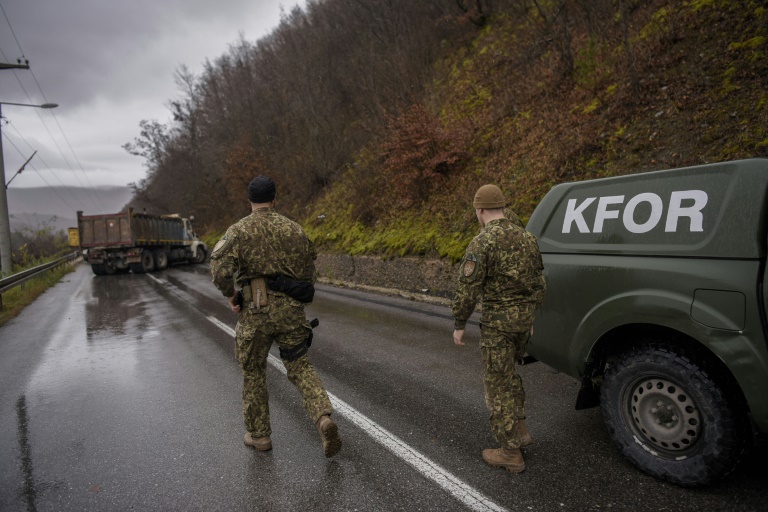
Tensions were high in northern Kosovo on Sunday after unknown attackers exchanged gunfire with the police and threw a stun grenade at EU law enforcers during the night.

Hundreds of Serbs, outraged over the arrest of a former police officer, gathered again early in the morning at the roadblocks erected Saturday and which have paralysed traffic through two border crossings from Kosovo to Serbia.

Although Kosovo declared independence from Serbia in 2008, Belgrade does not recognise it and encourages the Serb majority in northern Kosovo to defy Pristina’s authority.

Hours after the barricades went up, police said they suffered three successive firearm attacks on Saturday night on one of the roads leading to the border.

“The police units, in self-defence, were forced to respond with firearms to the criminal persons and groups, who were repelled and left in an unknown direction,” police said in a statement.

European Union police deployed in the region as part of the rule of law mission (EULEX) said they were also targeted with a stun grenade, but no officers were injured.

“This attack, as well as the attacks on Kosovo Police officers, are unacceptable,” EULEX said in a press release.

EU chief diplomat Josep Borrell condemned the attacks and called on Kosovo Serbs to “immediately” remove the barricades.

“Calm must be restored… all actors must avoid escalation,” Borrell tweeted.

NATO, which has deployed  4,000-strong peacekeeping mission in Kosovo under a UN Security Council mandate, blasted the “unacceptable” attacks.

“Our @NATO_KFOR mission remains extremely vigilant & fully capable of carrying out its @UN mandate in #Kosovo,” NATO spokesperson Oana Lungescu tweeted.

“We call on all parties to avoid provocative actions and rhetoric & to contribute to calm & stability.”

Tensions mounted after Kosovo scheduled local elections in Serb-majority municipalities for December 18, with the main Serb political party saying it would stage a boycott.  

Explosions and shootings were heard earlier this week as election authorities tried to prepare the ground for the vote, while an ethnic Albanian policeman was wounded.  

Shortly after the roadblocks appeared, Kosovo President Vjosa Osmani decided to postpone the elections for April 23.

The embassies of France, Germany, Italy, the UK and the US — along with the local EU office — welcomed the postponement, branding it a “constructive decision” which “advances efforts to promote a more secure situation in the north”. 

Pristina and Belgrade traded accusations over the latest incidents.

Serbian President Aleksandar Vucic said he will ask NATO peacekeepers to allow the deployment of Serbian military and police in Kosovo, although he said he believes there is “no chance of the request being approved”.

Kosovo Prime Minister Albin Kurti blamed Serbia for “threatening Kosovo with aggression”.  

“We do not want conflict, we want peace and progress, but we will respond to aggression with all the power we have,” Kurti warned on Facebook.   

Serbs make up around 120,000 of Kosovo’s roughly 1.8 million population, which is overwhelmingly ethnic Albanian.  

Iran strengthens political, economic hold over Iraq

Sanctions-hit Iran is consolidating its hold over neighbouring Iraq, an economic lifeline where pro-Tehran parties dominate politics, all to the chagrin of the United States, experts say.

For years, Iraq has been caught in a delicate balancing act between its two main allies Tehran and Washington, themselves arch foes.

After a 2003 US-led invasion toppled Iraqi dictator Saddam Hussein, Iran’s influence has grown through political links among both countries’ Shiite-Muslim majorities.

Pro-Iran parties now dominate Iraq’s parliament, and in October they named a new prime minister following a year-long tussle with their Shiite rivals.

Iraq has become an “economic lifeline” for Iran, said Ihsan al-Shammari, a political scientist at the University of Baghdad.

This is “even more so with sharpening Western economic sanctions and nuclear negotiations that do not seem to be leading to a favourable deal for Iran”, Shammari said.

“Iran’s role will be even more important than during previous (Iraqi) governments”

During a visit to Tehran late last month, Prime Minister Mohammed Shia al-Sudani and Iranian officials urged greater bilateral cooperation in all fields.

He thanked Iran which provides gas and electricity — around one-third of Iraq’s needs — and added this would continue until Iraq was self-sufficient.

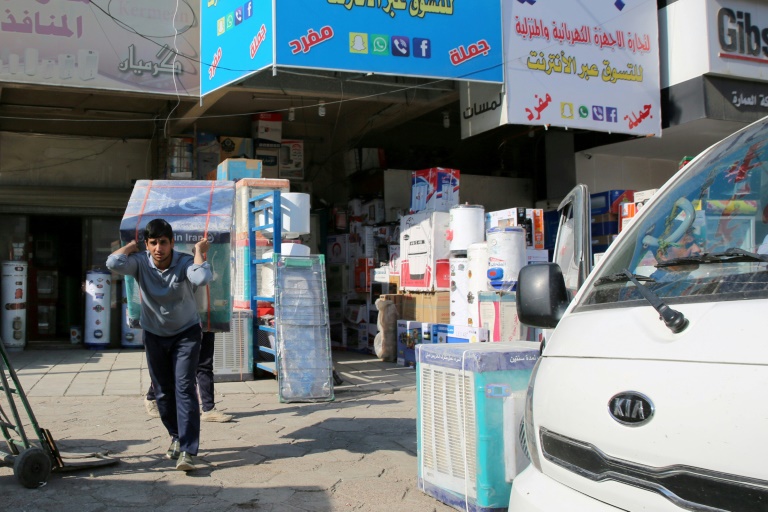
His country is already the number one importer of Iranian goods.

In Shammari’s view, Tehran has an “urgent need” to keep Iraq close. 

– ‘Contested’ –

Under a 2015 nuclear deal with world powers, Iran agreed to curbs on its atomic programme in exchange for relief from economically crippling sanctions.

The deal began unravelling in 2018 when then-president Donald Trump withdrew the United States, and reimposed financial penalties including a ban on Iran’s oil exports. Efforts to revive the nuclear deal since then have largely stalled.

Western countries have imposed additional sanctions following Iran’s crackdown on protests that have rocked the country since September. 

Iran accuses exiled Kurdish opposition groups of fomenting the unrest, and has carried out cross-border strikes in Iraq against them.

“Iraq is contested by the United States and Iran, with Turkey in third place in the north,” said Fabrice Balanche, from France’s Lumiere Lyon 2 university.

“With a pro-Iranian figure at the head of the government, Iran will be able to further take advantage of the Iraqi economy,” he added, referring to Sudani, who is close to pro-Iran former prime minister Nuri al-Maliki.

Iran’s influence can also be seen through its links with Iraq’s Hashed al-Shaabi, a former paramilitary force made up mainly of pro-Iran militias that have since been integrated into the regular forces.

The Hashed played a major role in defeating the Islamic State group in Iraq and now has a significant presence in the country’s politics.

Its representatives are part of the Coordination Framework parliamentary bloc, which controls 138 of the legislature’s 329 seats and is made up of pro-Iran factions, including that of Maliki.

– ‘Not fair’ –

Last month, Iraq’s government handed the Hashed control of a new public company, endowed with around $68 million in capital.

The Al-Muhandis firm’s mission in oil-rich but war-ravaged Iraq is “provincial rehabilitation and development: infrastructure, housing, hospitals, factories”, said a Hashed communications official on condition of anonymity, in keeping with the low profile officials have adopted over the project.

The company’s name is in homage to Hashed deputy commander Abu Mahdi al-Muhandis. He was killed in a US drone strike in Baghdad in 2020 along with Iranian General Qasem Soleimani, who headed that country’s Quds Force, the foreign operations arm of the Islamic Revolutionary Guard Corps.

In November, Iraqi Foreign Minister Fuad Hussein said it was “not fair” to consider his coalition government “an attachment” to Iran’s.

The Iraqi Kurdish diplomat pointed to its multi-party and multi-confessional make-up as showing “balance” between the different forces.

But pro-Iran parties appear to now have free rein, after rival Shiite leader Moqtada Sadr tried for months to name a prime minister and prevent Sudani’s appointment.

The standoff led to deadly clashes in late August that pitted Sadr supporters against Hashed members and the army.

As Iran’s influence grows, ally the United States still remains present, with around 2,500 US troops stationed in Iraq as part of ongoing efforts to combat the Islamic State group.

Sudani has held several meetings with the US ambassador Alina Romanowski since her appointment.

Balanche noted that Washington monitors Iraq’s banking system to ensure Iran is not using it to evade existing restrictions, and US influence is present via “the threat of financial sanctions”.

“The United States is staying in Iraq so as not to totally abandon the country to Iran,” he added.

Close Bitnami banner
Bitnami