World

Killer of S.African anti-apartheid hero Hani freed on parole

South Africa on Wednesday released on parole Janusz Walus, a far-right Polish immigrant who in 1993 assassinated anti-apartheid hero Chris Hani and nearly plunged the country into civil war.

His release — bitterly contested by groups that fought white-minority rule — had been postponed after he was stabbed by a fellow inmate inside prison.

Justice and Correctional Services Minister Ronald Lamola “has placed… Walus on parole under strict conditions with effect from Wednesday,” the government said in a statement. 

A spokesman confirmed that this meant the 69-year-old had been released, in line with a decision by the Constitutional Court.

“He will serve two years under community corrections in line with the parole regime upon which he is released,” the statement said.

Last month’s court decision was described as “diabolical” by Hani’s widow and unleashed angry protests by the ruling African National Congress (ANC) and its apartheid-era ally, the South African Communist Party, which Hani had led.

A week after the ruling, Walus was stabbed while queueing for food in the jail. 

His release, which according to the court order should have taken effect by December 1, was delayed while he received treatment.

Walus shot dead Hani, a hugely popular figure and fierce opponent of white rule, in the driveway of his home in eastern Johannesburg, and in front of his 15-year-old daughter. 

At that time, negotiations to end apartheid were entering their final phase. 

The murder led to protests and rioting in black townships, almost plunging South Africa into a race war. 

Then-ANC president Nelson Mandela appeared on national television to appeal for calm, a move that helped ease tensions and open the way to South Africa’s first multi-racial elections the following year.

“There is no question that offender Walus is a polarising figure in our budding constitutional democracy, and that his release has understandably re-opened wounds,” the ministry said.

His “actions sought to derail the democratic project at its most critical, formative stage,” it declared.

– ‘Sad day’ –

Hani’s widow, Limpho, declined to comment when contacted by AFP on Wednesday.

But a senior ANC official, Panyaza Lesufi, who is the premier of South Africa’s most populous province, Gauteng, said it was “a sad day” to hear that Walus had walked out of jail.

“That murderer doesn’t deserve to leave prison,” Lesufi told journalists. “He must go and rot where he will rot.”

Walus immigrated to South Africa from then-communist Poland in 1981 at the height of apartheid rule.

He and his accomplice Clive Derby-Lewis, who supplied the gun, were arrested soon after the attack.

The pair were sentenced to death but the punishment was later commuted to life imprisonment after the death penalty was abolished by the post-apartheid government.

Derby-Lewis was released in 2015 on medical parole after 22 years in jail. He died of lung cancer in 2016, aged 80.

Walus will serve his parole in South Africa, government declared. It is unclear if he will be allowed to return to Poland at the end of the two parole years. 

ANC has condemned “white supremacist and neo-Nazi groups in Poland” that had celebrated the parole decision.
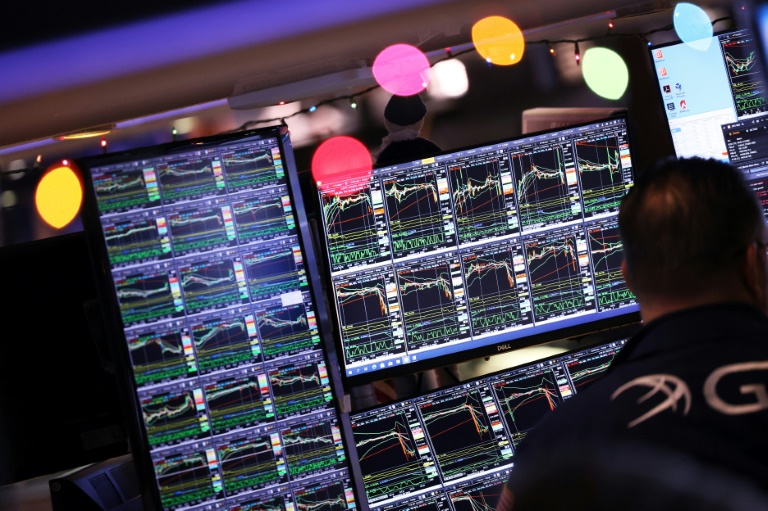
Stocks hesitant as recession fears overshadow China reopening hope

Major stock markets were hit by more selling Wednesday on growing fears that Federal Reserve monetary tightening will tip the US economy into recession.

Drops in Asia and Europe followed steep losses on Wall Street Tuesday after the heads of leading US banks warned of tough times ahead in 2023.

JPMorgan Chase chief Jamie Dimon tipped a “mild to hard recession” and Goldman Sachs’ David Solomon said jobs and pay would be hit, while Morgan Stanley and Bank of America were also uneasy about the outlook.

The comments added to the downbeat mood that has coursed through trading floors at the start of the week, after forecast-beating reports on jobs and the giant US services sector fanned worries the Fed would have to push interest rates higher than hoped.

Markets had been rising healthily after a weaker-than-expected inflation reading for October suggested the almost year-long tightening campaign was finally affecting prices.

“Any hopes that the Fed would turn more dovish in the months ahead have been dashed significantly as the vast US services industry is where sticky inflation hangs out,” said SPI Asset Management’s Stephen Innes.

He added that the latest readings suggest rates would go above five percent before the Fed stops hiking, while several observers have suggested they will not be reduced until 2024.

“It would appear the recovery in stocks — bear-market rally, or otherwise — has run out of steam, and investors are left wondering whether what follows next is another test of the lows or simply a correction of that impressive two-month surge,” said market analyst Craig Erlam at trading platform OANDA.

Major Asian markets ended the day down, while in Europe both Frankfurt and Paris were lower in afternoon trading, but London turned positive after Wall Street opened.

On Wall Street, the S&P 500 and Nasdaq Composite slid at the start of trading, while the Dow was flat. But they quickly pushed higher as bargain-hunters stepped in following days of selling.

– China easing on Covid –

The sombre outlook overshadowed China’s moves to wind back some of its harsh Covid rules that traders hope will kickstart the world’s number two economy, which has been battered this year by months of lockdowns and other containment measures.

In a sign of the impact the zero-Covid strategy has had, data Wednesday showed that imports and exports plunged far more than expected in November.

On Wednesday, officials announced a nationwide loosening of restrictions, including a reduction in mandatory PCR tests and allowing some positive cases to quarantine at home.

But while the country edges back to normality, Zhiwei Zhang, of Pinpoint Asset Management, warned that it would take time.

“The zero-Covid policy has been loosened, but mobility has not recovered much on the national level,” he said. “I expect exports will stay weak in the next few months as China goes through a bumpy reopening process.

“As global demand weakens in 2023, China will have to rely more on domestic demand.”

Other observers said the recent rally fuelled by the reopening may have gone too far and traders were now taking a step back as they contemplate a likely spike in infections in the country.

Oil prices remained stuck at lows not seen for around a year as demand expectations tumble.

Brent on Tuesday sank below $80 for the first time since January, while WTI struck its lowest since December, having plunged from the 14-year highs of around $140 touched in March after Russia invaded Ukraine. 

“The crude demand outlook is getting crushed as we are in a slowdown basically across all the major economies,” said OANDA’s Edward Moya.

“Supplies seem plentiful over the near term and that has everyone hesitating on what was one of the easiest trades of the year.”

– Key figures around 1430 GMT –

London – FTSE 100: FLAT at 7,519.98 points

Frankfurt – DAX: DOWN 0.4 percent at 14,291.81

Paris – CAC 40: DOWN 0.3 percent at 6,666.63

EURO STOXX 50: DOWN 0.3 percent at 3,926.83

New York – Dow: FLAT at 33,594.04

Tokyo – Nikkei 225: DOWN 0.7 percent at 27,686.40 (close)

Hong Kong – Hang Seng Index: DOWN 3.2 percent at 18,814.82 (close)

Shanghai – Composite: DOWN 0.4 percent at 3,199.62 (close)

Euro/dollar: UP at $1.0522 from $1.0470 on Tuesday

Dollar/yen: DOWN at 136.59 yen from 137.04 yen

Pound/dollar: UP at $1.2203 from $1.2133

Euro/pound: DOWN at 86.23 pence from 86.26 pence

Brent North Sea crude: UP 0.7 percent at $79.92 per barrel

West Texas Intermediate: UP 0.4 percent at $74.58 per barrel

burs-rl/rox

Barcelona-Marseille pipeline: an ambitious but risky project

A planned underwater hydrogen pipeline connecting Barcelona and Marseille is a risky project, but one that is key for the European Union’s energy independence.

Here’s what we know about the joint initiative by Madrid, Lisbon and Paris, which will be discussed on Friday on the sidelines of a summit of southern European Union nations in Spain:

– What is it? –

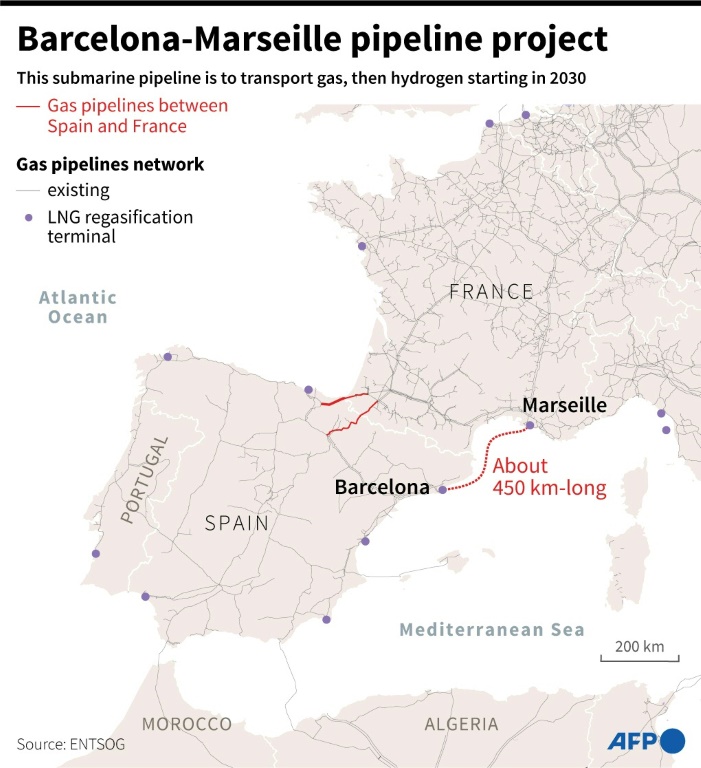
Dubbed “H2Med” or “BarMar” (from Barcelona and Marseille), the pipeline will connect the two ports that both have large oil and gas terminals, initially as a conduit for natural gas and later for green hydrogen, between Spain, France and the rest of Europe.

Announced at an EU summit in October, it offers an alternative to the defunct MidCat pipeline project launched in 2003 to carry gas across the Pyrenees from Spain to France that was eventually abandoned over profitability issues and objections from Paris and environmentalists.

– What are its goals? –

The pipeline aims to reduce Europe’s dependence on Russian energy by improving gas interconnections between the Iberian Peninsula and its neighbours.

Spain and Portugal account for 40 percent of Europe’s capacity to turn liquefied natural gas (LNG) that arrives in tankers back into gas form, but they are poorly connected to the rest of Europe.

The pipeline will also boost the decarbonisation of European industry, giving it access to clean energy on a large scale which Spain and Portugal hope to produce.

The two nations aim to become world leaders in green hydrogen thanks to their numerous wind and solar power farms.

– Why Barcelona and Marseille? –

According to the project’s backers, it is “the most direct and efficient way of linking the peninsula with central Europe”.

Barcelona “has one of the largest re-gasification plants in Europe” and occupies “a central place in Spain’s gas network,” said Jose Ignacio Linares, a professor at Madrid’s Pontificia Comillas University.

Marseille is also a key point in the French network and a gateway to the Rhone Valley, northern Italy and Germany — industrial regions that could become big consumers of green hydrogen.

– What route will it take? –

The route has not yet been decided, but “the most logical” option would be to run close to the shore to avoid deep waters, Linares told AFP.

If that’s the case, H2Med would extend some 450 kilometres (280 miles).

– When will it be ready? –

French Energy Minister Agnes Pannier-Runacher told Spain’s El Pais daily the pipeline could come online in 2030, while her Spanish counterpart Teresa Ribera said it could enter service in “five, six or seven years”.

– How much will it cost? –

The cost of the project has not been revealed. But the European Hydrogen Backbone (EHB), that groups European energy pipeline operators, estimates a two-billion-euro ($2.1-billion) price tag.

Madrid, Paris and Lisbon hope much of the project will be covered by EU funds.

– What are the obstacles? –

“An offshore hydrogen pipeline at this depth and distance has never been done before,” said Gonzalo Escribano, an energy expert at Madrid’s Real Instituto Elcano think tank. 

The innovative project faces certain technical challenges. 

One of the main problems is that hydrogen is made up of small molecules which can escape through the joints and cause corrosion, said Linares, an engineer by training.

But such problems could be overcome by “installing a membrane inside (the pipeline), a kind of plastic that prevents the hydrogen from escaping,” he said.

– What’s the outlook? –

The biggest risk is its economic viability, experts say.

“It is not clear when the green hydrogen market is going to take off and whether Spain will be in a position to produce enough to export it,” said Escribano.

But Linares said its construction would take so long “that we can’t afford to wait”. 

“If we do, we’ll end up with a huge volume of hydrogen that we won’t be able to export.”

Time magazine names Ukraine's Zelensky 'Person of the Year'

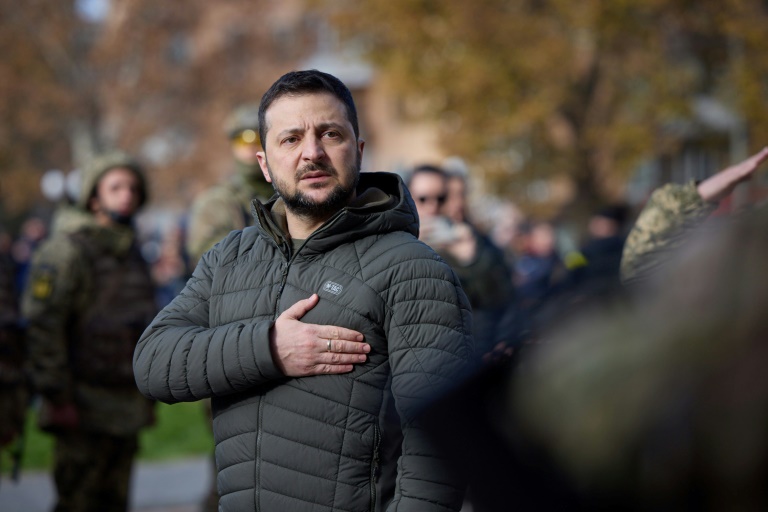
Time magazine named President Volodymyr Zelensky as well as “the spirit of Ukraine” as its 2022 person of the year on Wednesday, for the resistance the country has shown in the face of Russia’s invasion.

Calling Zelensky’s decision to remain in Kyiv and rally his country “fateful,” Time editor in chief Edward Felsenthal said this year’s decision was “the most clear-cut in memory.”

Since Russia’s February 24 invasion, Zelensky has delivered daily speeches that are followed not only by Ukrainians but by citizens and governments around the globe. 

He has appeared on the front lines and recently celebrated in the streets of Kherson when Ukraine pushed Russia from the critical southern city.

“His information offensive shifted the geopolitical weather system, setting off a wave of action that swept the globe,” Felsenthal wrote in announcing the winner.

“Whether the battle for Ukraine fills one with hope or with fear, Volodymyr Zelensky galvanized the world in a way we haven’t seen in decades,” Felsenthal added.

Zelensky’s response to the Russian invasion has transformed the 44-year-old former comedian from an embattled leader of a struggling European outlier to a global household name.

He has also become the standard-bearer of opposition to Russian leader Vladimir Putin, who himself was Time’s person of the year in 2007.

Zelensky, who was born in the southern industrial city of Kryviy Rig in the heart of a mainly Russian-speaking region, has presented his country as the front line in a broader conflict.

His appeals to the West for military and financial support, at times echoing the words of British wartime leader Winston Churchill, have helped Ukraine first halt Russia’s advance and then recapture swathes of territory.

Zelensky shares the 2022 title with “the spirit of Ukraine,” which Felsenthal said was embodied by the “countless individuals inside and outside the country” who are fighting behind the scenes, including everyday people such as chefs and surgeons.

Time’s cover artwork for the edition features Zelensky in his now iconic green fatigues, surrounded by dozens of individuals, including demonstrators bearing the Ukrainian flag, who together represent that spirit.

Among those depicted are Iryna Kondratova, who helped deliver babies during shelling, Kyiv chef Levgen Klopotenko, who turned his restaurant into a relief canteen, and Kyiv Independent editor in chief, Olga Rudenko.

“The Russians need to understand… They will have no forgiveness. They will have no acceptance in the world,” Zelensky says in an interview published in the issue.

Time first presented its Person of the Year award in 1927.

Last year’s honoree was Tesla and SpaceX chief Elon Musk, who has since made major headlines with his high-profile purchase of Twitter.

China's Xi arrives in Saudi Arabia for energy-focused visit

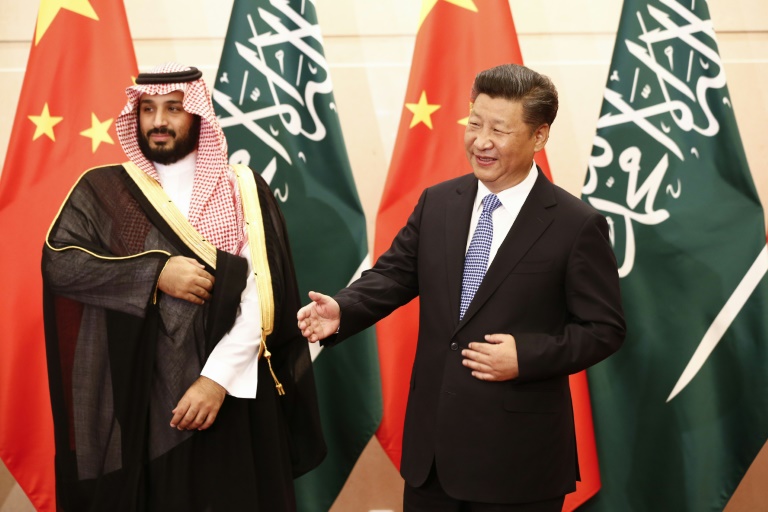
Chinese President Xi Jinping touched down in Saudi Arabia on Wednesday for a visit that is likely to focus on energy ties but also follows months of tensions with the United States.

Xi, recently reanointed as leader of the world’s second biggest economy, arrived in the capital Riyadh, Chinese and Saudi state media said, for a three-day visit that will include talks with the Saudi rulers and other Arab leaders.

Saudi Foreign Minister Prince Faisal bin Farhan and Riyadh Governor Prince Faisal bin Bandar were among those who welcomed Xi at the airport, where a ceremonial purple carpet was laid out from the steps of the plane. 

On major roads in Riyadh, the red-and-gold Chinese flag alternated with the green Saudi emblem. 

China is the top customer for oil from Saudi Arabia, the leading exporter of crude, and both sides appear keen to expand their relationship at a time of economic turmoil and geopolitical realignment.

The trip — only Xi’s third overseas journey since the coronavirus pandemic began, and his first to Saudi Arabia since 2016 — comes after US President Joe Biden’s visit in July, when he pleaded in vain for higher oil production.

It will feature bilateral meetings with Saudi King Salman and Crown Prince Mohammed bin Salman, the de facto ruler, as well as a summit with the six-member Gulf Cooperation Council and a wider China-Arab summit.

– Oil markets –

The programme represents the “largest-scale diplomatic activity between China and the Arab world since the founding of the PRC”, or People’s Republic of China, foreign ministry spokeswoman Mao Ning said on Wednesday.

The official Saudi Press Agency said the kingdom accounted for more than 20 percent of Chinese investment in the Arab world between 2005 and 2020, “making it the biggest Arab country to receive Chinese investments during that period”. 

Oil markets are expected to be a top agenda item for talks between China and Saudi Arabia, especially given the turbulence the markets have experienced since Russia invaded Ukraine in February.

The G7 and European Union on Friday agreed to a $60-per-barrel price cap on Russian oil in an attempt to deny the Kremlin war resources, injecting further uncertainty into the markets.

On Sunday, the OPEC+ oil cartel led jointly by Saudi Arabia and Russia opted to keep in place production cuts of two million barrels per day approved in October.

Saudi and Chinese officials have provided scant information about the agenda, though Ali Shihabi, a Saudi analyst close to the government, said he expected “a number of agreements to be signed”.

Beyond energy, analysts say leaders from the two countries will likely discuss potential deals that could see Chinese firms become more deeply involved in mega-projects that are central to Prince Mohammed’s vision of diversifying the Saudi economy away from oil.

They include a futuristic $500 billion megacity known as NEOM, a so-called cognitive city that will depend heavily on facial recognition and surveillance technology.

– Tensions with Washington –

The OPEC+ production cuts approved in October represented the latest blow to the longtime partnership between Saudi Arabia and the United States, which said they amounted to “aligning with Russia” on the war in Ukraine. 

Xi’s visit is expected to be closely watched in Washington, which entered into what is often described as an oil-for-security partnership with Saudi Arabia towards the end of World War II.

While the Biden administration has smarted over the production cuts, Riyadh has at times accused the United States of failing to hold up the security end of the bargain, notably after strikes in September 2019 claimed by Yemen’s Huthi rebels temporarily halved the kingdom’s crude output.

China and Saudi Arabia already work together on arms sales and production. 

Yet analysts say Beijing cannot provide the same security assurances Washington does — nor does it wish to. 

Nevertheless, if the Saudis are “looking to extract more security guarantees from the US… signalling that they have the opportunity of strengthening ties with China is something that suits them well,” said Torbjorn Soltvedt, of the risk intelligence firm Verisk Maplecroft.

The GCC-China summit will be held in Riyadh on Friday, the bloc said in a statement. 

China's Xi arrives in Saudi Arabia for energy-focused visit

Chinese President Xi Jinping touched down in Saudi Arabia on Wednesday for a visit that is likely to focus on energy ties but also follows months of tensions with the United States.

Xi, recently reanointed as leader of the world’s second biggest economy, arrived in the capital Riyadh, Chinese and Saudi state media said, for a three-day visit that will include talks with the Saudi rulers and other Arab leaders.

Saudi Foreign Minister Prince Faisal bin Farhan and Riyadh Governor Prince Faisal bin Bandar were among those who welcomed Xi at the airport, where a ceremonial purple carpet was laid out from the steps of the plane. 

On major roads in Riyadh, the red-and-gold Chinese flag alternated with the green Saudi emblem. 

China is the top customer for oil from Saudi Arabia, the leading exporter of crude, and both sides appear keen to expand their relationship at a time of economic turmoil and geopolitical realignment.

The trip — only Xi’s third overseas journey since the coronavirus pandemic began, and his first to Saudi Arabia since 2016 — comes after US President Joe Biden’s visit in July, when he pleaded in vain for higher oil production.

It will feature bilateral meetings with Saudi King Salman and Crown Prince Mohammed bin Salman, the de facto ruler, as well as a summit with the six-member Gulf Cooperation Council and a wider China-Arab summit.

– Oil markets –

The programme represents the “largest-scale diplomatic activity between China and the Arab world since the founding of the PRC”, or People’s Republic of China, foreign ministry spokeswoman Mao Ning said on Wednesday.

The official Saudi Press Agency said the kingdom accounted for more than 20 percent of Chinese investment in the Arab world between 2005 and 2020, “making it the biggest Arab country to receive Chinese investments during that period”. 

Oil markets are expected to be a top agenda item for talks between China and Saudi Arabia, especially given the turbulence the markets have experienced since Russia invaded Ukraine in February.

The G7 and European Union on Friday agreed to a $60-per-barrel price cap on Russian oil in an attempt to deny the Kremlin war resources, injecting further uncertainty into the markets.

On Sunday, the OPEC+ oil cartel led jointly by Saudi Arabia and Russia opted to keep in place production cuts of two million barrels per day approved in October.

Saudi and Chinese officials have provided scant information about the agenda, though Ali Shihabi, a Saudi analyst close to the government, said he expected “a number of agreements to be signed”.

Beyond energy, analysts say leaders from the two countries will likely discuss potential deals that could see Chinese firms become more deeply involved in mega-projects that are central to Prince Mohammed’s vision of diversifying the Saudi economy away from oil.

They include a futuristic $500 billion megacity known as NEOM, a so-called cognitive city that will depend heavily on facial recognition and surveillance technology.

– Tensions with Washington –

The OPEC+ production cuts approved in October represented the latest blow to the longtime partnership between Saudi Arabia and the United States, which said they amounted to “aligning with Russia” on the war in Ukraine. 

Xi’s visit is expected to be closely watched in Washington, which entered into what is often described as an oil-for-security partnership with Saudi Arabia towards the end of World War II.

While the Biden administration has smarted over the production cuts, Riyadh has at times accused the United States of failing to hold up the security end of the bargain, notably after strikes in September 2019 claimed by Yemen’s Huthi rebels temporarily halved the kingdom’s crude output.

China and Saudi Arabia already work together on arms sales and production. 

Yet analysts say Beijing cannot provide the same security assurances Washington does — nor does it wish to. 

Nevertheless, if the Saudis are “looking to extract more security guarantees from the US… signalling that they have the opportunity of strengthening ties with China is something that suits them well,” said Torbjorn Soltvedt, of the risk intelligence firm Verisk Maplecroft.

The GCC-China summit will be held in Riyadh on Friday, the bloc said in a statement. 

Iran youths rally and workers strike on Students' Day

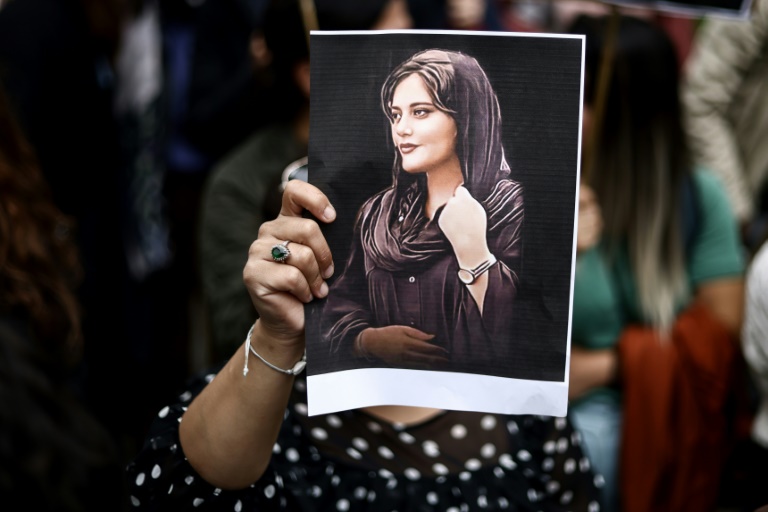
Many Iranian workers went on strike and students boycotted classes Wednesday, rights groups said, as a former president offered public support for the protests sparked by Mahsa Amini’s death. 

Demonstrations have swept Iran for nearly three months since Amini died after her arrest by the notorious morality police in Tehran for an alleged breach of the country’s strict hijab dress code for women.

The authorities, who have struggled to contain the protests, describe them as “riots” fomented by Iran’s arch foe the United States and its allies, including Britain and Israel.

Youth groups had called on people to take to the streets and turn the annual Students’ Day on Wednesday into a “day of terror for the state”.

Many shops were shuttered and youths were seen marching and chanting protest slogans across the country, at times defying a heavy security presence, in videos posted online by activists and rights groups.

“Be afraid, be afraid, we are all together,” students were heard shouting in a message aimed at the government, at Amirkabir University of Technology in Tehran, in a video published by the social media monitor 1500tasvir.

Oslo-based group Iran Human Rights (IHR) shared videos of shops closed in Tehran, Qazvin west of the capital, the northern city of Rasht, and Divandarreh in Amini’s home province of Kurdistan, among others.

BBC Persian published footage that appeared to show students protesting against the presence of ultra-conservative President Ebrahim Raisi at Tehran University, before they were pushed back by the security forces.

– Ex-president backs protests –

In a speech delivered on campus, Raisi praised students for their welcome, despite the demonstrations and street violence triggered by the September 16 death in custody of Amini.

“I thank the dear and insightful students who did not allow the atmosphere of the university to become an atmosphere of riots,” Raisi said on Students’ Day, which marks the 1953 killing by the shah’s security forces of three students.

“Those who are brutally and unjustly killing our loved ones are rioters,” he said. “Our people and the student community understand the difference between protests and riots.”

His speech came after Mohammad Khatami, a reformist who served as Iran’s president from 1997 to 2005 but has been effectively silenced by the establishment for years, voiced support for the protest movement.

The 79-year-old described the protest slogan “Woman, life, freedom” as “a beautiful message that shows movement towards a better future”.

“Freedom and security must not be placed against each other,” he said in a statement quoted by ISNA news agency on the eve of Students’ Day.

“Freedom must not be trampled on in order to maintain security,” said Khatami, who was barred from appearing in the media after mass protests triggered by the disputed 2009 re-election of former hardline president Mahmoud Ahmadinejad.

He added that “security should not be ignored in the name of freedom”.

– Hundreds dead –

Iran’s top security body, the Supreme National Security Council, said on Saturday that more than 200 people had been killed in the unrest, after an Iranian general last week put the figure at more than 300.

The Norway-based IHR rights group said on November 29 that at least 448 people had been “killed by security forces”. Thousands have been arrested, including prominent actors and footballers.

An Iranian court on Tuesday sentenced five people to death by hanging for killing a member of the Basij paramilitary force, a ruling condemned by rights activists as a means to “spread fear” and to stop the protests.

The rulings bring to 11 the number of people in Iran sentenced to death in connection with the protests, in what Amnesty International has branded “sham trials”.

Meanwhile, Iran’s central bank governor Ali Saleh-Abadi dismissed a lawmaker’s call for the blocking of bank accounts of women who fail to observe hijab rules.

Responding to a question on the lawmakers’ call, he insisted that the banking network, “as always, will offer all of its services to all compatriots,” Mehr news agency reported.

burs/str-dv/fz

Mozambique ex-president's son, ex-spy bosses jailed for 12 years for graft

A Mozambican court on Wednesday sentenced two ex-spy bosses and the son of a former president to 12 years each for their part in a corruption scandal in which the government concealed huge debts, triggering financial havoc.

Among 19 defendants accused in the country’s biggest graft scandal were ex-president Armando Guebuza’s son, Ndambi Guebuza; former head of security and intelligence, Gregorio Leao; and an ex-economic intelligence chief who headed three state-owned firms that illicitly borrowed billions, Antonio do Rosario.

Eight defendants were acquitted while the rest were handed terms ranging between 10 and 12 years.

“The crimes committed have brought consequences whose effects will last for generations,” said Judge Efigenio Baptista, addressing a packed courtroom in the grounds of a high-security jail in the capital Maputo.

The scandal arose after state-owned companies in the impoverished country illicitly borrowed $2 billion (1.9 billion euros) in 2013 and 2014 from international banks to buy a tuna-fishing fleet and surveillance vessels. 

The money went directly to three companies managed by Rosaro, who called himself a “super CEO” during the trial.

The government masked the loans from parliament and the public. 

When the “hidden debt” finally surfaced in 2016, the International Monetary Fund (IMF) and other donors cut off financial support, triggering a sovereign debt default and currency collapse. 

An independent audit found $500 million of the loans had been diverted. The money remains unaccounted for.

– ‘Desire for luxury’ –

Handing down the sentences Baptista said the scam had “aggravated the impoverishment of thousands of Mozambicans.” 

“The country became famous for the worst reasons,” he said. “As high officials of the state they should have been (its) guardians.”

Leao and do Rosario were found guilty of embezzlement and abuse of power, while Guebuza was convicted for embezzlement, money laundering and criminal association, among other charges. 

Ex-president Guebuza, who had been in office when the loans were contracted, testified at the trial. 

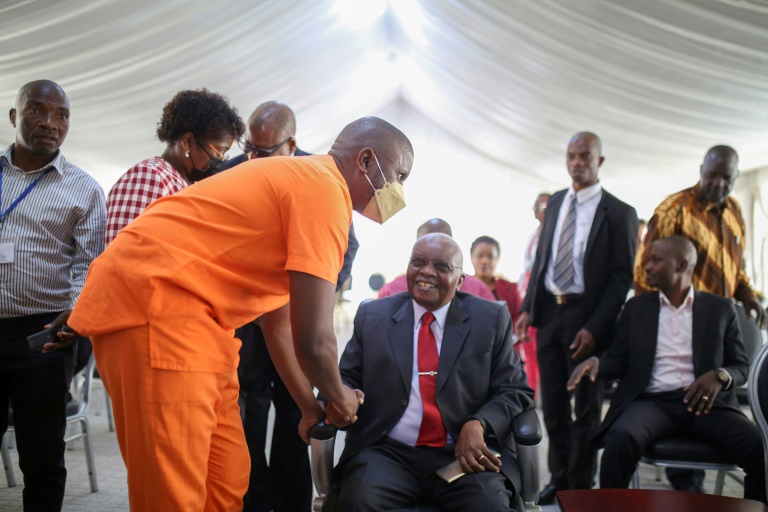
Wearing a black sweater over an orange prisoner jumpsuit, his son stood up as the judge read the verdict.

Baptista said Ndambi Guebuza acted deliberately “to exert influence on his father” and get the government to approve the purchase of the vessels. 

He took a $33-million bribe that went to satisfy his “desire for luxury”, the judge said, listing some of the assets the former president’s son acquired with the money. 

Among them were 15 luxury cars including Ferraris, Maseratis, BMWs and Rolls-Royces, and a 10-million rand ($590,000) mansion in a high-end suburb of Johannesburg, in neighbouring South Africa.

Besides being sentenced to jail, the younger Guebuza was ordered to pay a fine of 162,000 meticais ($2,500). 

Former presidential advisor Renato Matusse was also sentenced to 12 years in jail. 

– Global scale –

The ruling was welcomed by local civil society groups.

“It is a fair sentence,” said Borges Nhamirre, a researcher with anti-graft watchdog Public Integrity Center. 

The trial started in August last year and ran until March. It was broadcast live on local TV and radio stations. 

Dozens of people, including activists and civil campaigners, sat in the courtroom, a makeshift facility set up in a white marquee to accommodate defendants, their lawyers and other parties. 

The scandal exposed corruption on a global scale and sparked legal cases across three continents. Swiss bank Credit Suisse was fined $475 million last year over its part in issuing the loans.

Former finance minister Manuel Chang — who signed off the loans — has been held in South Africa since 2018, pending extradition to the US for allegedly using the US financial system to carry out the fraudulent scheme.

When the loans were taken out, Mozambique’s star was rising after two decades of democratic and market-led reforms and the discovery of huge gas reserves off its Indian Ocean coast.

But the scandal — which involved money equivalent to about 12 percent of the gross domestic product — tipped the nation into the worst economic crisis in its history. 

In March, the IMF awarded $456 million in credit to Mozambique, the first such aid awarded since the scandal erupted, to support economic recovery and public debt reduction programmes.

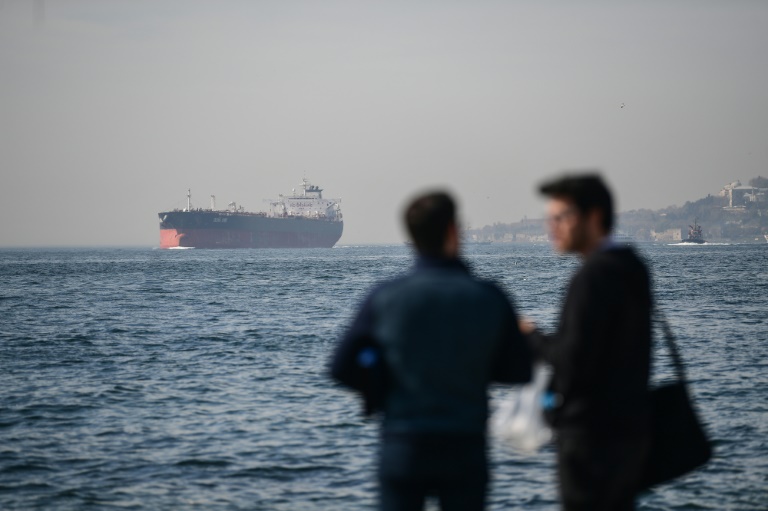
Turkey seeks proof of insurance from Russian oil tankers

Turkey said Wednesday it has started requesting proof of insurance from tankers loaded with Russian crude oil after Western powers imposed a price cap to punish the Kremlin for its war on Ukraine.

But a Turkish official denied that the measure was slowing the passage of oil ships to world markets through the Bosphorus and Dardanelle straits.

The European Union and the Group of Seven leading industrialised nations agreed last week to block Western insurers from covering ships that intend to sell Russian oil for more than $60 a barrel.

Australia has also joined the new sanctions aimed at depriving Russia of one of its main sources of revenue.

The TankerTracker.com industry monitor said early Wednesday that Russian seaborne crude oil exports had halved in the past 48 hours.

One source told AFP that Turkish officials began requesting proof of insurance from tankers passing from Russia at the start of the month.

An official source told AFP on condition of anonymity that authorities “want to be sure about the coverage” because Western insurers have started to cancel it.

An unnamed Turkish official told the Anadolu state news agency that “the majority of international insurers” no longer provide coverage for Russian crude.

“God forbid, if an accident happens in the straits, who would cover the damages that can reach billions of dollars? Who would be responsible?” the Turkish official asked.

But the official also rejected Western media reports suggesting that Turkey’s new rules have created a logjam of tankers in the two straits.

The official said there were no “significant” changes to marine traffic and that Turkey could take extra measures to “prevent congestion”.

– ‘Blanket promise’ –

A 1936 treaty guarantees the freedom of navigation to merchant vessels passing through Turkey’s two straits.

But it also gives Turkey the right to regulate security — a provision it is now using to make sure the oil ships are insured against spillage and other accidents.

The Financial Times reported that Russia has assembled a separate “shadow fleet” of more than 100 vessels that try to circumnavigate the Western sanctions regime.

These ships are reportedly using non-Western insurers and selling oil at higher prices to countries that have not subscribed to the new sanctions.

The Financial Times said Turkey was waving through these ships but holding up the ones with Western insurance coverage.

Turkish officials did not immediately respond to the report.

Istanbul-based marine traffic analyst Yoruk Isik said Turkey was now requesting physical proof of so-called “protection and indemnity” insurance from all ships departing Russian ports.

He said Western insurers balked at Turkey’s demand to provide a “blanket promise to cover everything that happens in the Bosphorus”.

“But Russian (protection and indemnity insurers) just started issuing the paper,” Isik said.

“So it became a de facto situation that more reputable honest merchants cannot mitigate the transit… but Russian (insurers) are issuing the papers and those ships are transiting,” he said.

Stocks fall as recession fears overshadow China reopening hope

Major stock markets suffered more selling Wednesday on growing fears that Federal Reserve monetary tightening will tip the US economy into recession.

The drop followed more steep losses on Wall Street Tuesday after the heads of leading US banks warned of tough times ahead in 2023.

JPMorgan Chase chief Jamie Dimon tipped a “mild to hard recession” and Goldman Sachs’ David Solomon said jobs and pay would be hit, while Morgan Stanley and Bank of America were also uneasy about the outlook.

The comments added to the downbeat mood that has coursed through trading floors at the start of the week, after forecast-beating reports on jobs and the giant US services sector fanned worries the Fed would have to push interest rates higher than hoped.

Markets had been rising healthily after a weaker-than-expected inflation reading for October suggested the almost year-long tightening campaign was finally affecting prices.

“Any hopes that the Fed would turn more dovish in the months ahead have been dashed significantly as the vast US services industry is where sticky inflation hangs out,” said SPI Asset Management’s Stephen Innes.

He added that the latest readings suggest rates would go above five percent before the Fed stops hiking, while several observers have suggested they will not be reduced until 2024.

– China easing on Covid –

The sombre outlook overshadowed China’s moves to wind back some of its harsh Covid rules that traders hope will kickstart the world’s number two economy, which has been battered this year by months of lockdowns and other containment measures.

In a sign of the impact the zero-Covid strategy has had, data Wednesday showed that imports and exports plunged far more than expected in November.

On Wednesday, officials announced for the first time a nationwide loosening of restrictions, including a reduction in mandatory PCR tests and allowing some positive cases to quarantine at home.

But while the country edges back to normality, Zhiwei Zhang, of Pinpoint Asset Management, warned that it would take time.

“The zero-Covid policy has been loosened, but mobility has not recovered much on the national level,” he said. “I expect exports will stay weak in the next few months as China goes through a bumpy reopening process.

“As global demand weakens in 2023, China will have to rely more on domestic demand.”

Other observers said the recent rally fuelled by the reopening may have gone too far and traders were now taking a step back as they contemplate a likely spike in infections in the country.

Oil prices remained stuck at lows not seen for around a year as demand expectations tumble.

Brent on Tuesday sank below $80 for the first time since January, while WTI struck its lowest since December, having plunged from the 14-year highs of around $140 touched in March after Russia invaded Ukraine. 

“The crude demand outlook is getting crushed as we are in a slowdown basically across all the major economies,” said OANDA’s Edward Moya.

“Supplies seem plentiful over the near term and that has everyone hesitating on what was one of the easiest trades of the year.”

– Key figures around 1145 GMT –

London – FTSE 100: DOWN 0.1 percent at 7,516.42 points

Frankfurt – DAX: DOWN 0.4 percent at 14,293.02

Paris – CAC 40: DOWN 0.4 percent at 6,661.54

EURO STOXX 50: DOWN 0.3 percent at 3,946.83

Tokyo – Nikkei 225: DOWN 0.7 percent at 27,686.40 (close)

Hong Kong – Hang Seng Index: DOWN 3.2 percent at 18,814.82 (close)

Shanghai – Composite: DOWN 0.4 percent at 3,199.62 (close)

New York – Dow: DOWN 1.0 percent at 33,596.34 (close)

Euro/dollar: UP at $1.0498 from $1.0470 on Tuesday

Dollar/yen: UP at 137.64 yen from 137.04 yen

Pound/dollar: UP at $1.2156 from $1.2133

Euro/pound: UP at 86.34 pence from 86.26 pence

Brent North Sea crude: UP 0.2 percent at $79.48 per barrel

West Texas Intermediate: UP 0.1 percent at $74.35 per barrel

Close Bitnami banner
Bitnami