World

Prime time or Netflix? Streaming wars come to Thailand

International streaming platforms were among the biggest pandemic winners, seeing subscriber numbers soar, but US giants have turned abroad as countries re-opened — with Thailand firmly in their sights.

The kingdom’s high internet penetration, long-standing and highly regarded film industry — as well as roughly six million active users of streaming services, according to 2021 data — present a golden opportunity.

Big players such as Amazon Prime and Netflix, who claim 200 million and 220 million subscribers worldwide respectively, have taken note as new sign-ups have levelled off in more established markets such as North America and Europe.

October saw the launch of Prime’s Thai-service Prime Video at almost the same moment Netflix announced six locally produced films and series for the coming months.

“The competition is everywhere,” said Malobika Banerji, director of content for Southeast Asia at Netflix, which has a regional hub in Singapore.

Nowhere is that more apparent than Thailand’s capital, where Prime’s “Lord of the Rings” spinoff mega-production “Rings of Power” jostles for attention with Netflix’s latest South Korean series on billboards.

“We do believe that Thailand will be a big part of our subscriber growth in the years to come,” said Prime Video’s director of international development Josh McIvor.

“Our goal is really to try to be the most local of the global streaming services,” he said, pointing towards their earlier expansion into Japan — where they outstrip Netflix.

However, their rival’s longer-term investment is apparent: Netflix saw a 20 percent growth in Asia-Pacific subscribers last year, according to a recent quarterly report by the firm.

– Seeking the next ‘Squid Game’ –

While big-ticket international series such as “Rings of Power” lead the publicity, the streamers see locally produced content — such as Prime’s hugely successful Indian crime-thriller “Mirzapur” — as the longer-term workhorses of their offering.

The two fundamental “pillars” to success are local originals -– “across scripted, unscripted and film” -– and licensed locally produced series, according to Amazon Studios’ director of local content Erika North.

It is the second that drew Prime to Thailand, she said: they hope to build on a long Thai film history with higher production values than elsewhere in the region.

Similarly, Netflix is betting big on local content going international, dreaming of the next “Squid Game”, the South Korean critical and commercial blockbuster.

Netflix’s Banerji said there were “more and more” examples of this, citing Thai mystery-thriller series “Girl from Nowhere”.

Streaming analysts have been watching the US firms — including Disney+ — to see if they can compete with local rivals.

A report from the consultancy Kantar this year found streaming had edged out traditional watching in the Philippines, Singapore, Malaysia, Vietnam, Thailand, and Indonesia.

But Thailand has a special appeal, said Vivek Couto, executive director and co-founder of Media Partners Asia (MPA), which monitors streaming platforms.

An analysis from MPA this year forecast the expected income from streaming in Thailand in 2022 at around $809 million.

Couto said the kingdom offered an established creative community, more advanced broadband infrastructure than other Southeast Asian countries — and a population with the “most propensity to pay for online video content”.

– Creative control –

Almost a third of Thai households already subscribe to an on-demand streaming service, according to their data, far ahead of Indonesia (12 percent) or Vietnam (four percent).

“If content really works locally and (is) sustainable, then it will travel anywhere,” Couto said.

“I think that’s why Amazon and Netflix are seeing the potential of Thai producers, Thai series.”

While Thai cinema has enjoyed occasional critical success — director Apichatpong Weerasethakul has won several prizes at the Cannes Film Festival, including the top award in 2010 — it has not become an established global force.

Local directors and producers are cautiously optimistic the new interest from deep-pocketed streaming giants could give the local industry a boost.

“Some content, you cannot even dream of doing it with a studio, but with streaming, it is possible,” said Wisit Sasanatieng, director and producer of upcoming Netflix crime film “The Murderer”.

Thai producer Cattleya Paosrijaroen, co-founder of the independent company 185 Films, welcomed the shift.

International firms could bring in better standards, she said, offering better conditions to crews currently expected to work 16-hour shifts.

But she struck a note of caution. 

“If your film is being produced by Netflix, they can control the content,” Cattleya said.
Honduras suspends rights in two largest cities to fight gangs

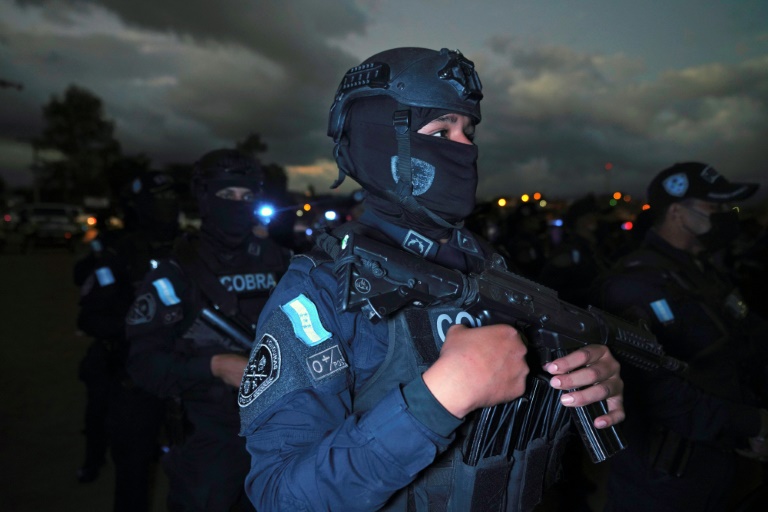
Honduran police on Tuesday moved en masse into poor urban areas to tackle criminal gangs “head on” after a decree by President Xiomara Castro to temporarily suspend certain rights.

The 30-day lifting of constitutional guarantees that began Tuesday allows police to make arrests without warrants in 89 districts of Tegucigalpa, the capital, and 73 districts of San Pedro Sula, the industrial capital.

President Castro, a leftist, declared last week the lifting of the constitutional rights due to what she called a “national emergency” over gang violence.

“We are going to go head on against organized crime,” national police director Gustavo Sanchez told some 600 security agents at a dusty soccer pitch in Aleman, a residential district south of the capital.

The crackdown, he said at a news conference, “is to deal with the criminal structures known as Gang 18 and MS-13,” a reference to the two largest transnational street gangs in Honduras. 

He said 20,000 police and military police in rotating shifts would take part in the dragnet. 

Public pressure has built on Castro to follow in the footsteps of El Salvador, where President Nayib Bukele has brought down gang violence by rounding up thousands of young people on suspicion of gang activity.

The decree that Castro enacted on the so-called state of exception said in part: “By virtue of the serious disturbance of peace and security prevailing in the main cities of the country caused essentially by organized criminal groups… it is resolved: to suspend the guarantees established in the constitution.”

Drug trafficking groups and gang members are largely responsible for a soaring rate of homicides. At 40 murders per 100,000 inhabitants, the rate in Honduras is four times higher than the world average.

One objective of the crackdown, Castro said, is to rein in rampant exortion by gangs, which she described as “one of the main reasons for migration and the shuttering of small and medium enterprises.”  

Germany's homegrown cannabis industry awaits legalisation

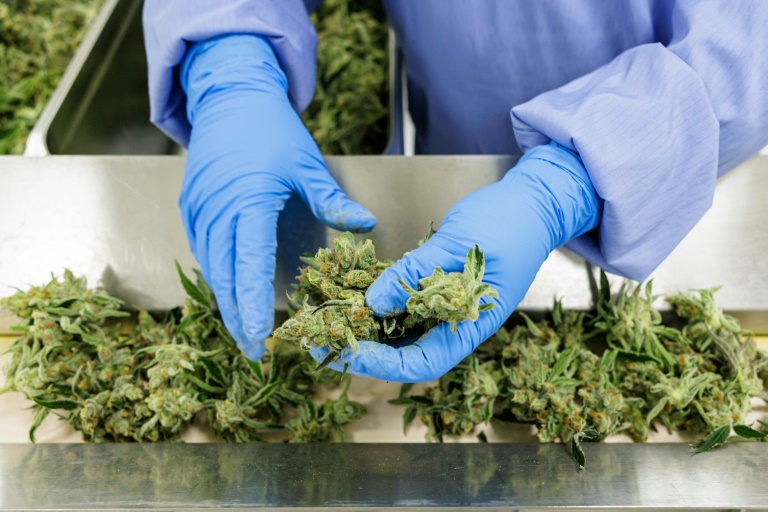
In the east German countryside, close to Dresden, a former abattoir is now home to the biggest indoor cannabis farm in Europe.

Behind the recently renovated concrete walls, the German startup Demecan has been growing marijuana in accordance with the law for the past year.

The company is one of only a handful in Germany to have a license for the production of this “green gold”, which has been legal in Germany for medicinal use since 2017.

But the budding industry is eyeing a bigger prize: Chancellor Olaf Scholz’s government plans to legalise the drug for recreational use as soon as 2024, which would leave it with one of the most liberal cannabis policies in Europe.

– ‘Tenfold’ –

Inside the building, the smell of the plants — lined up in their hundreds under yellow grow lamps — is overwhelming.

“We will have the option to expand the facility to cultivate recreational cannabis,” Demecan’s managing director Philipp Goebel tells AFP.

The government coalition, led by Scholz’s Social Democrats, has put forward a roadmap for the legalisation of cannabis with a target date of 2024.

Under the draft plans, adults would be allowed to hold a maximum of between “20 and 30 grams” of cannabis for private consumption, via a network of licensed stores and pharmacies.

Demecan’s massive complex, which covers around 120,000 square metres (1.3 million square feet), produces one tonne of cannabis a year, but it has yet to reach capacity.

The company could quickly increase production “tenfold” to meet growing demand, Goebel says.

Harvests at the farm happen every two weeks with workers plucking the flowers from the plant stems before they are dried.

“I like this job a lot, it is not like any other,” says 34-year-old Sven Skoeries, who studies horticulture alongside his responsibilities at the farm.

Demecan has no trouble recruiting for its growing business, in a region otherwise marked by its ageing population and lack of workers. 

“It’s a trendy product that generates a lot of interest,” Goebel says. 

“It’s a new industry, that’s interesting for me,” says Jana Kleinschmidt, 25, as she snips off leaves with a pair of scissors.

As well as its own production efforts, Demecan has a license for the import of another 20 tonnes of cannabis into the country from Canada annually.

“We are currently supplying 55 percent of the German market,” says Goebel, who notes his firm is in “pole position” to capitalise on legalisation.

– Snoop Dogg –

The recreational cannabis market in Germany is a potential four-billion-euro ($4.2 billion) business, according to a recent study by the Heinrich Heine University in Duesseldorf.

In recent months, fundraising in the sector has taken off as businesses await the green light from legislators.

Berlin startup Cantourage, a manufacturer of cannabis-based medicines, floated 15 percent of its shares on the Frankfurt stock exchange in November.

Cansativa, the only online platform for the sale of therapeutic cannabis products in Germany, raised $15 million in February with the help of US rapper Snoop Dogg.

Sanity Group, a German company that focuses on cannabis-derived products, likewise raised $37.6 million in September.

Legalisation looks like a good deal for the government, too. The same study from Heinrich Heine University estimated the move would boost the public finances by 4.7 billion euros per year.

But the idea remains controversial. 

At the end of October, Klaus Reinhardt, the head of the German Medical Association, called the plans “almost cynical”.

It was “shocking” to legalise a substance that could “lead to behavioural problems in adolescents, as well as addiction and psychological changes”, he said.

The conservative opposition to the government has also set itself against the move. 

The Bavarian state Health Minister Klaus Holetschek, who is part of the conservative Christian Social Union party, called the idea “a dangerous signal for all of Europe”. 

First, however, the government’s plans need to be approved by the European Commission — or they risk going up in smoke. 

Germany's homegrown cannabis industry awaits legalisation

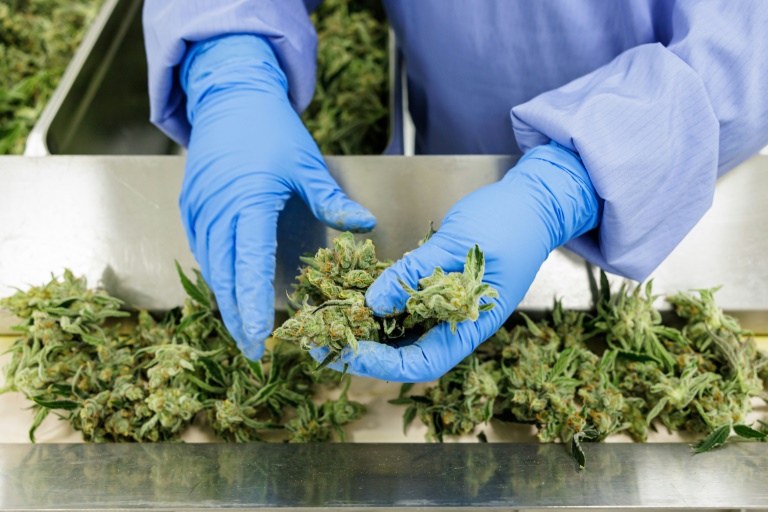
In the east German countryside, close to Dresden, a former abattoir is now home to the biggest indoor cannabis farm in Europe.

Behind the recently renovated concrete walls, the German startup Demecan has been growing marijuana in accordance with the law for the past year.

The company is one of only a handful in Germany to have a license for the production of this “green gold”, which has been legal in Germany for medicinal use since 2017.

But the budding industry is eyeing a bigger prize: Chancellor Olaf Scholz’s government plans to legalise the drug for recreational use as soon as 2024, which would leave it with one of the most liberal cannabis policies in Europe.

– ‘Tenfold’ –

Inside the building, the smell of the plants — lined up in their hundreds under yellow grow lamps — is overwhelming.

“We will have the option to expand the facility to cultivate recreational cannabis,” Demecan’s managing director Philipp Goebel tells AFP.

The government coalition, led by Scholz’s Social Democrats, has put forward a roadmap for the legalisation of cannabis with a target date of 2024.

Under the draft plans, adults would be allowed to hold a maximum of between “20 and 30 grams” of cannabis for private consumption, via a network of licensed stores and pharmacies.

Demecan’s massive complex, which covers around 120,000 square metres (1.3 million square feet), produces one tonne of cannabis a year, but it has yet to reach capacity.

The company could quickly increase production “tenfold” to meet growing demand, Goebel says.

Harvests at the farm happen every two weeks with workers plucking the flowers from the plant stems before they are dried.

“I like this job a lot, it is not like any other,” says 34-year-old Sven Skoeries, who studies horticulture alongside his responsibilities at the farm.

Demecan has no trouble recruiting for its growing business, in a region otherwise marked by its ageing population and lack of workers. 

“It’s a trendy product that generates a lot of interest,” Goebel says. 

“It’s a new industry, that’s interesting for me,” says Jana Kleinschmidt, 25, as she snips off leaves with a pair of scissors.

As well as its own production efforts, Demecan has a license for the import of another 20 tonnes of cannabis into the country from Canada annually.

“We are currently supplying 55 percent of the German market,” says Goebel, who notes his firm is in “pole position” to capitalise on legalisation.

– Snoop Dogg –

The recreational cannabis market in Germany is a potential four-billion-euro ($4.2 billion) business, according to a recent study by the Heinrich Heine University in Duesseldorf.

In recent months, fundraising in the sector has taken off as businesses await the green light from legislators.

Berlin startup Cantourage, a manufacturer of cannabis-based medicines, floated 15 percent of its shares on the Frankfurt stock exchange in November.

Cansativa, the only online platform for the sale of therapeutic cannabis products in Germany, raised $15 million in February with the help of US rapper Snoop Dogg.

Sanity Group, a German company that focuses on cannabis-derived products, likewise raised $37.6 million in September.

Legalisation looks like a good deal for the government, too. The same study from Heinrich Heine University estimated the move would boost the public finances by 4.7 billion euros per year.

But the idea remains controversial. 

At the end of October, Klaus Reinhardt, the head of the German Medical Association, called the plans “almost cynical”.

It was “shocking” to legalise a substance that could “lead to behavioural problems in adolescents, as well as addiction and psychological changes”, he said.

The conservative opposition to the government has also set itself against the move. 

The Bavarian state Health Minister Klaus Holetschek, who is part of the conservative Christian Social Union party, called the idea “a dangerous signal for all of Europe”. 

First, however, the government’s plans need to be approved by the European Commission — or they risk going up in smoke. 

Asian equities, oil prices dragged by recession fears

Asian investors extended a sell-off across global markets Wednesday while oil held losses on growing fears Federal Reserve monetary tightening will tip the US economy into recession.

The drop followed another day deep in the red for New York’s three main indexes after the heads of Wall Street’s leading banks warned of tough times ahead in 2023.

JPMorgan Chase chief Jamie Dimon tipped a “mild to hard recession” and Goldman Sachs’ David Solomon said jobs and pay would be hit, while Morgan Stanley and Bank of America were also uneasy about the outlook.

The comments added to the downbeat mood that has coursed through trading floors at the start of the week, after forecast-beating reports on jobs and the giant US services sector fanned worries the Fed will have to push interest rates higher than hoped.

Markets had been rising healthily ahead of Friday’s employment figures after a weaker-than-expected inflation reading for October suggested the almost year-long tightening campaign was finally affecting prices.

“Any hopes that the Fed would turn more dovish in the months ahead have been dashed significantly as the vast US services industry is where sticky inflation hangs out,” said SPI Asset Management’s Stephen Innes.  

He added that the latest readings suggest rates will go above five percent before the Fed stops hiking, while several observers have suggested they will not be reduced until 2024.

In early trade, Tokyo, Shanghai, Sydney, Seoul, Singapore, Manila and Jakarta were all down. However, Hong Kong, which has been the standout performer in recent weeks, clipped slightly higher.

But Lauren Goodwin, at New York Life Investments, saw further pain ahead for markets.

“We have not yet seen the bottom on equity prices,” she said, according to Bloomberg News. “While this phase of equity market volatility is likely to end in the next few months, earnings have not yet adapted to a recessionary environment.”

The sombre outlook overshadowed hopes that China’s moves to wind back some of its harsh Covid rules will kickstart the world’s number two economy, which has been battered this year by months of lockdowns and other containment measures.

It also kept oil prices at lows not seen for around a year as demand expectations tumble.

Brent on Tuesday sank below $80 for the first time since January, while WTI was at its lowest since December, having plunged from the 14-year highs of around $140 touched in March after Russia invaded Ukraine. Both contracts were barely moved in Asian trade.

“The crude demand outlook is getting crushed as we are in a slowdown basically across all the major economies,” said OANDA’s Edward Moya. 

“Supplies seem plentiful over the near term and that has everyone hesitating on what was one of the easiest trades of the year.”

– Key figures around 0230 GMT –

Tokyo – Nikkei 225: DOWN 0.5 percent at 27,756.94 (break)

Hong Kong – Hang Seng Index: UP 0.5 percent at 19,529.70

Shanghai – Composite: DOWN 0.3 percent at 3,201.71

Euro/dollar: DOWN at $1.0465 from $1.0470 on Tuesday

Dollar/yen: UP at 137.11 yen from 137.04 yen

Pound/dollar: UP at $1.2135 from $1.2133

Euro/pound: DOWN at 86.24 pence from 86.26 pence

West Texas Intermediate: DOWN 0.1 percent at $74.16 per barrel

Brent North Sea crude: UP 0.2 percent at $79.48 per barrel

New York – Dow: DOWN 1.0 percent at 33,596.34 (close)

London – FTSE 100: DOWN 0.6 percent at 7,521.39 (close)

Xi travels to Saudi for three days of Mideast outreach

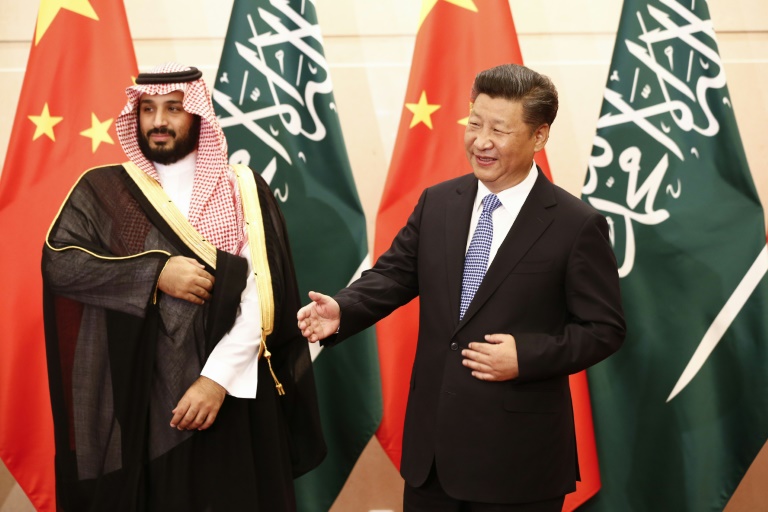
Chinese President Xi Jinping arrives in Saudi Arabia on Wednesday for three days of meetings with regional leaders likely focused on energy. 

The overseas trip is only Xi’s third since the coronavirus pandemic began in 2020, and his first to Saudi Arabia, the world’s biggest crude oil exporter, since 2016.

It will feature bilateral meetings with Saudi King Salman and Crown Prince Mohammed bin Salman, the de facto ruler, as well as a summit with the six-member Gulf Cooperation Council and a wider China-Arab summit, Saudi state media reported.

Oil markets are expected to be a top agenda item for talks between China, the world’s biggest crude consumer, and Saudi Arabia, especially given the turmoil the markets have experienced since Russia invaded Ukraine in February.

The G7 and European Union on Friday agreed to a $60-per-barrel price cap on Russian oil in an attempt to deny the Kremlin war resources, injecting further uncertainty into the markets.

On Sunday, the OPEC+ oil cartel led jointly by Saudi Arabia and Russia opted to keep in place production cuts of two million barrels per day approved in October.

Saudi and Chinese officials have provided scant information about the agenda, though Ali Shihabi, a Saudi analyst close to the government, said he expected “a number of agreements to be signed”.

Beyond energy, analysts say leaders from the two countries will likely discuss potential deals — that could see Chinese firms become more deeply involved in mega-projects that are central to Prince Mohammed’s vision of diversifying the Saudi economy away from oil.

Those projects include a futuristic $500 billion megacity known as NEOM, a so-called cognitive city that will depend heavily on facial recognition and surveillance technology.

– Tensions with Washington –

The OPEC+ production cuts approved in October represented the latest blow to the longtime partnership between Saudi Arabia and the United States, which said they amounted to “aligning with Russia” on the war in Ukraine. 

Xi’s visit is expected to be closely watched in Washington, which entered into what is often described as an oil-for-security partnership with Saudi Arabia towards the end of World War II.

While the Biden administration has smarted over the production cuts, Riyadh has at times accused the United States of failing to hold up the security end of the bargain, notably after strikes in September 2019 claimed by Yemen’s Huthi rebels temporarily halved the kingdom’s crude output.

China and Saudi Arabia already work together on arms sales and production. 

Yet analysts say Beijing cannot provide the same security assurances Washington does — nor does it wish to. 

Nevertheless, if the Saudis are “looking to extract more security guarantees from the US… signalling that they have the opportunity of strengthening ties with China is something that suits them well,” said Torbjorn Soltvedt, of the risk intelligence firm Verisk Maplecroft.

The GCC-China summit will be held on Friday in Riyadh, the bloc said in a statement. 

GCC chief Nayef al-Hajraf “stressed the importance of GCC-Chinese relations, as China is ranked first on the list of the GCC countries’ trade partners”, the statement added. 

Xi travels to Saudi for three days of Mideast outreach

Chinese President Xi Jinping arrives in Saudi Arabia on Wednesday for three days of meetings with regional leaders likely focused on energy. 

The overseas trip is only Xi’s third since the coronavirus pandemic began in 2020, and his first to Saudi Arabia, the world’s biggest crude oil exporter, since 2016.

It will feature bilateral meetings with Saudi King Salman and Crown Prince Mohammed bin Salman, the de facto ruler, as well as a summit with the six-member Gulf Cooperation Council and a wider China-Arab summit, Saudi state media reported.

Oil markets are expected to be a top agenda item for talks between China, the world’s biggest crude consumer, and Saudi Arabia, especially given the turmoil the markets have experienced since Russia invaded Ukraine in February.

The G7 and European Union on Friday agreed to a $60-per-barrel price cap on Russian oil in an attempt to deny the Kremlin war resources, injecting further uncertainty into the markets.

On Sunday, the OPEC+ oil cartel led jointly by Saudi Arabia and Russia opted to keep in place production cuts of two million barrels per day approved in October.

Saudi and Chinese officials have provided scant information about the agenda, though Ali Shihabi, a Saudi analyst close to the government, said he expected “a number of agreements to be signed”.

Beyond energy, analysts say leaders from the two countries will likely discuss potential deals — that could see Chinese firms become more deeply involved in mega-projects that are central to Prince Mohammed’s vision of diversifying the Saudi economy away from oil.

Those projects include a futuristic $500 billion megacity known as NEOM, a so-called cognitive city that will depend heavily on facial recognition and surveillance technology.

– Tensions with Washington –

The OPEC+ production cuts approved in October represented the latest blow to the longtime partnership between Saudi Arabia and the United States, which said they amounted to “aligning with Russia” on the war in Ukraine. 

Xi’s visit is expected to be closely watched in Washington, which entered into what is often described as an oil-for-security partnership with Saudi Arabia towards the end of World War II.

While the Biden administration has smarted over the production cuts, Riyadh has at times accused the United States of failing to hold up the security end of the bargain, notably after strikes in September 2019 claimed by Yemen’s Huthi rebels temporarily halved the kingdom’s crude output.

China and Saudi Arabia already work together on arms sales and production. 

Yet analysts say Beijing cannot provide the same security assurances Washington does — nor does it wish to. 

Nevertheless, if the Saudis are “looking to extract more security guarantees from the US… signalling that they have the opportunity of strengthening ties with China is something that suits them well,” said Torbjorn Soltvedt, of the risk intelligence firm Verisk Maplecroft.

The GCC-China summit will be held on Friday in Riyadh, the bloc said in a statement. 

GCC chief Nayef al-Hajraf “stressed the importance of GCC-Chinese relations, as China is ranked first on the list of the GCC countries’ trade partners”, the statement added. 

India at 75: Rising power finding its place on global stage

Three-quarters of a century after independence, India is a nuclear power about to become the world’s most populous country, and its economy has overtaken its former coloniser’s to become the globe’s fifth biggest.

But New Delhi has challenges to overcome if it is to secure a more central place on the world’s diplomatic stage, analysts say.

India wants a permanent seat on the UN Security Council, like the five victors of World War II, including its former colonial power Britain.

A democracy of 1.4 billion people, India stands as a potential counterweight to Xi Jinping’s increasingly assertive China and at the intersection of multiple geopolitical issues.

India is the only country to be a member of both the Shanghai Cooperation Organisation driven by Moscow and Beijing, and the US-led Quad initiative of democracies aimed at containing China.

It also co-founded the BRICS grouping that brings it together with Brazil, Russia, China and South Africa to challenge the dominant US- and European-led global governance structures. 

For decades, India marginalised itself diplomatically, content with a role within the Non-Aligned Movement, which professed equal distance from both Cold War superpowers, while India shared close ties with Moscow — still its biggest arms supplier. 

Now, a series of heads of government and foreign ministers have visited in recent months.

In the 21st century’s changing strategic landscape, India’s “ambition to be present, to be heard, to shape and to lead is getting stronger”, said Samir Saran, president of New Delhi-based Observer Research Foundation.

But he said the question remained: “Are we ready to bear the responsibility of being such an important actor?”

– India first – 

India has a mixed record on the world stage and some compare a non-committal New Delhi to Beijing’s actions during the Cold War, when China played both Washington and Moscow to its advantage.

India is the world’s second-biggest coal user and third-largest carbon emitter, and was blamed along with China for blocking an international commitment to “phase out” coal last year.

New Delhi insists the dirty fuel is essential for an economy attempting to lift millions out of extreme poverty, and it plans to increase domestic production by 50 percent in the next two years. 

Meanwhile, India says it will only aim to reach net-zero emissions by 2070 — 20 years later than a key global goal.

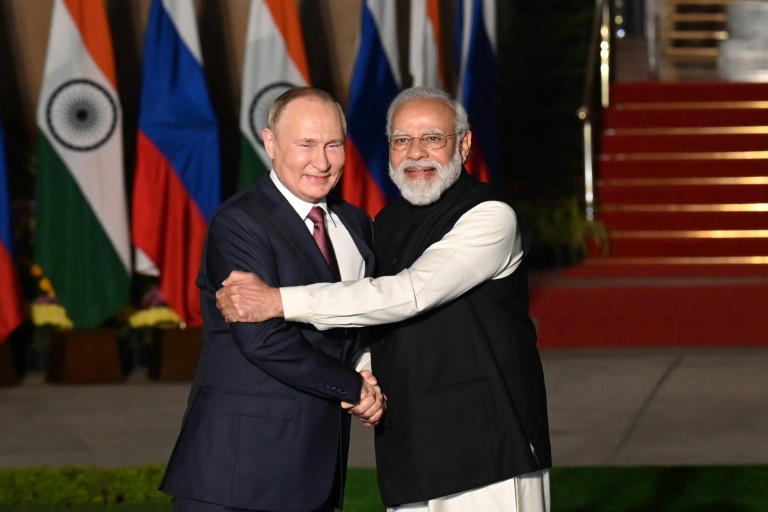
Three months after visiting Russian President Vladimir Putin lauded India as “a great power, a friendly nation and a time-tested friend”, his forces invaded Ukraine.

For months, New Delhi refused to criticise Moscow’s actions, abstaining from key UN votes, and as Europe turned away from Russian energy, paying a huge economic price, India upped its purchases six-fold, taking its two-way trade to an all-time high, according to official figures.

– Window of opportunity –

Several factors have come together to present India with a window of opportunity, said Tanvi Madan, Washington-based senior fellow with the Brookings Institution.

Among them are the increasingly fractious economic relationship between the United States and China, and Beijing’s decision to remain in self-imposed Covid isolation. 

“Countries like the US, some in Europe, others in the Indo-Pacific see India as a geopolitical counterbalance to China and an economic alternative or a democratic contrast,” Madan said.

“The big question” for India, she added, was whether it could “take advantage of this window before it closes”.

The International Monetary Fund projects that India’s economy will expand 6.8 percent this year, more than double the rate of China, and that it will be the world’s fastest-growing major economy in 2023.

But so far Vietnam, Taiwan and Thailand have proven more attractive than India as alternative investment destinations to China, despite its vast domestic market, young and growing population, and widely spoken English.

It also has a convoluted bureaucracy and tax regime, a legal system where cases can last for decades, and widespread corruption.

– ‘Louder, more present’-

The relationship between India and China themselves is strained by border, trade and technology disputes, and was sent into a deep freeze by a deadly frontier military clash in 2020.

Xi and Indian Prime Minister Narendra Modi have not met since, merely “exchanging courtesies” at the G20 meeting in Indonesia in November.

New Delhi has been building up its military, including its border defences and armaments industry, with a nuclear-powered submarine of its own, and recently unveiled its first locally made aircraft carrier.

Its low-cost space programme made it only the fourth nation to send an orbiter to Mars, and it has plans for a manned mission into orbit. 

But it remains well behind China, which has it outmanned and outgunned, having reached those milestones years ago.

“We’ve probably never had it as good,” India’s former ambassador to UAE and Egypt Navdeep Suri told AFP. 

Even so, “the transition to global power will come on the basis of economic and military strength”, he added. “We are still some distance away from that.”

But as those capacities increase, said Saran of the Observer Research Foundation, India will become a “more important and influential voice and a player” in pursuit of its own interests and values.

“It is not going to be in service of some other folks’ agendas,” he said. 

“We are going to be louder, more present, and we are going to be more India.”

The long road to bring Iraq's IS jihadists to justice

The horrors of the Islamic State group’s rule over northern Iraq may be in the past, but efforts to bring the jihadists to justice are still gathering pace.

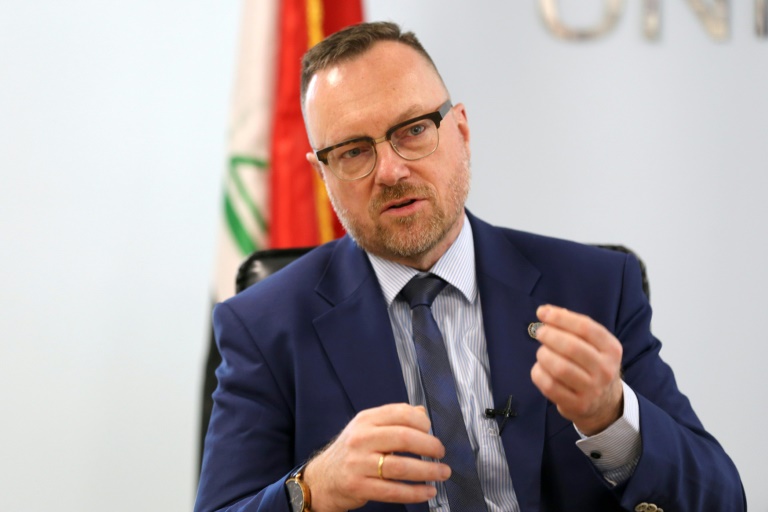
“A lot of work remains to be done,” said the UN’s chief investigator Christian Ritscher, who is looking into a slew of IS atrocities, from murder, torture and mass rape to slavery and genocide.

Five years after the group’s defeat in Iraq, with many thousands of their members in Iraqi jails, work is ongoing to probe their crimes, said Ritscher, who heads the dedicated UN investigative team (UNITAD) seeking to promote accountability. 

In a Baghdad interview, the German former prosecutor described the grim task — undertaken with the cooperation of Iraqi authorities — as “challenging” and diverse in scope. 

“We have just opened an investigation into the destruction of the cultural heritage of Iraq by IS — the destruction of mausoleums, churches, cultural sites, museums,” Ritscher told AFP.

A future investigation will focus on crimes committed in Mosul, a major city in Iraq’s north which IS occupied from 2014 until 2017, he added.

Iraq declared victory over IS on December 9, 2017, but the group kept its grip on territory in neighbouring Syria until March 2019, when it was defeated by US-backed, Kurdish-led forces.

The rise of IS and its self-proclaimed “caliphate” appeared meteoric. Its seizure of Mosul helped it to briefly hold roughly one-third of Iraqi territory, and for a time there were real fears of a major attack on the capital Baghdad.

Abuses against civilians, minorities and opponents became a hallmark of the group, whose ranks swelled with the arrival of thousands of foreign nationals.

The list of IS crimes is long, Ritscher said, and includes “genocide, crimes against humanity, war crimes”. 

– International justice –

UNITAD has supported local authorities that uncover mass graves and is working to prepare evidence for “any jurisdiction in the world that needs it… even within several decades”, Ritscher said. 

“In 20 or 30 years, the perpetrators of international crimes will still be able to be judged. There is no limitation period. This could be done in Canada, the Netherlands, Malaysia, and of course in Iraq.” 

In its latest report, presented to the UN Security Council on Monday, UNITAD highlighted IS’s production of chemical and biological weapons. 

The programme included “the development, testing, weaponisation and deployment of a range of chemical agents”, according to the report.

UNITAD also investigated the Speicher massacre — when up to 1,700 “predominantly Shiite” Iraqi army cadets were abducted from a base and executed in June 2014. 

Other atrocities examined were the deaths of hundreds of detainees from Badush prison, near Mosul, and crimes against the Yazidis, a religious minority many of whose men were executed and whose women were abducted for sexual slavery. 

In 2021, a German court sentenced former IS member Taha al-Jumailly, who had let a five-year-old Yazidi girl in chains die of thirst, to life in prison for genocide and crimes against humanity — the first verdict of its kind worldwide. 

The landmark trial was held under the principle of universal jurisdiction, which holds that any national court can prosecute such crimes no matter where they were committed.

“Maybe in the future there will be a tribunal on IS crimes,” Ritscher said, adding that the idea is subject to “ongoing discussions”. 

– ‘Fair trials’ –

Iraqi authorities do not release statistics on IS captives, but in 2018 the UN estimated more than 12,000 Iraqi and foreign “combatants” were being held in its prisons. 

Richter insisted UNITAD can only contribute to “fair trials”, where there is no room for “torture or any element contravening human rights”.

Previously, Iraq has been admonished over hundreds of so-called “speedy trials”, with human rights groups flagging confessions obtained under torture, ineffective legal representation and verdicts delivered after rushed hearings.

Iraq’s courts have handed down hundreds of death sentences and life imprisonment terms.

They have also sentenced several hundred foreign IS members, including women, to prison or even death, but no foreigners have been executed.

Ritscher said trials must be “fair and evidence-based, including witnesses who can testify in court, victims who can tell the whole story and tell the court what happened to them”.

“This is what we are aiming for, not trials based on confessions,” he added.

He expressed hope that the work could help achieve reconciliation in Iraq, a country where many years of war and insurgency have ripped apart its diverse social fabric.

“Reconciliation is always a result of investigations and of fair trials where the victims have a voice and can tell their story,” he said.

Iraq's Mosul healing slowly, five years after IS defeat

Five years after it emerged from the Islamic State group’s jihadist rule, Iraq’s once thriving cultural centre of Mosul has regained a semblance of normalcy despite sluggish reconstruction efforts.

However, like in much of oil-rich but war-ravaged Iraq, ramshackle public services and deep economic difficulties continue to hamper people’s daily lives.

Ghazwan Turki is just one of Mosul’s many residents who struggle to make ends meet in the former IS stronghold, where the jihadists declared the establishment of a “caliphate” in 2014.

Mosul urgently needs “job opportunities for families that have no income, to improve their living conditions”, Turki said.

The father of 12 and aged in his 40s, who lived for years in displacement camps, juggles shifts as a taxi driver and different odd jobs.

“We have to borrow money and get into debt to cover half of our family’s needs,” said Turki, who shares a single-storey house with his brother.

While acknowledging “progress” in rebuilding efforts, he described “overcrowded schools, where there are 60 or 70 students to a classroom”.

Iraqi forces with the help of a US-led coalition wrested back Mosul in July 2017 after gruelling street fighting, and Iraq claimed victory over IS on December 9 that year.

Signs of reconstruction dot the city of 1.5 million, with workers constructing a new bridge, and cafes and restaurants buzzing.

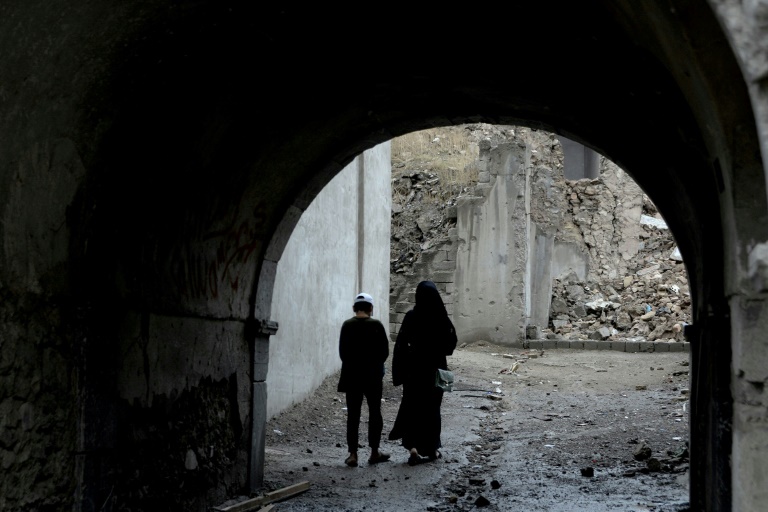
But many buildings and public hospitals are still in ruins, and in the Old City, some areas are still just piles of rubble.

– ‘Lack of jobs’ –

Mosul, Iraq’s second city, has historically been among the Arab world’s most culturally significant settlements — a hub for trade and home to mosques, churches, shrines, tombs and libraries.

Today, in the wider Nineveh province, a third of people are estimated to be unemployed and 40 percent live in poverty, according to local authorities.

The Norwegian Refugee Council, which has provided aid to some 100,000 Mosul residents, has noted “rising unemployment, high dropout rates (at schools), and limited economic opportunities across the city”.

NRC’s communication coordinator Noor Taher said that although reconstruction continues, many people are particularly worried about “under-resourced schools, overstretched teachers and lack of jobs”.

The International Rescue Committee says that “economic conditions in Mosul remain dire for many families”.

An IRC survey of over 400 homes reported “an alarming spike” in child labour rates, with around 90 percent of families sending at least one minor to work and some three-quarters toiling in “informal and dangerous roles” such as construction, or litter and scrap metal collection.

Mayor Amin al-Memari said the city was working on several “strategic projects”, but funding remained a key obstacle. 

Despite the construction of about 350 schools in just two years, Mosul still needs 1,000 more to end the “chokehold” in education, Memari added.

There is also “a significant shortage in the health sector,” he said, with more hospitals needed, including with oncology and cardiovascular surgery departments.

“Before, we had all of this in Mosul,” Memari said.

– ‘Spirit of Old Mosul’ – 

In Mosul’s war-damaged Old City — only steps from the iconic Al-Nuri mosque, where former IS leader Abu Bakr al-Baghdadi made his only confirmed public appearance — Bytna (“Our Home”) cafe is busy. 

But when co-founder Bandar Ismail opened it in 2018, people were sceptical.

“We tried to revive the spirit of Old Mosul by opening this cafe, to attract residents and draw them back to this neighbourhood,” 26-year-old Ismail said.

“At first… people mocked us and said ‘who will come here?’ The whole area was destroyed, there must have been just two families here.”

Today, customers sip coffee and smoke their hookahs in the cafe, which also hosts musical performances and art events.

Even French President Emmanuel Macron dropped by during a visit in 2021.

Nearby, bakeries and restaurants have reopened. 

“There is more stability, more security,” Ismail said.

Close Bitnami banner
Bitnami