World

UK pubs feel Christmas pressure as inflation bites

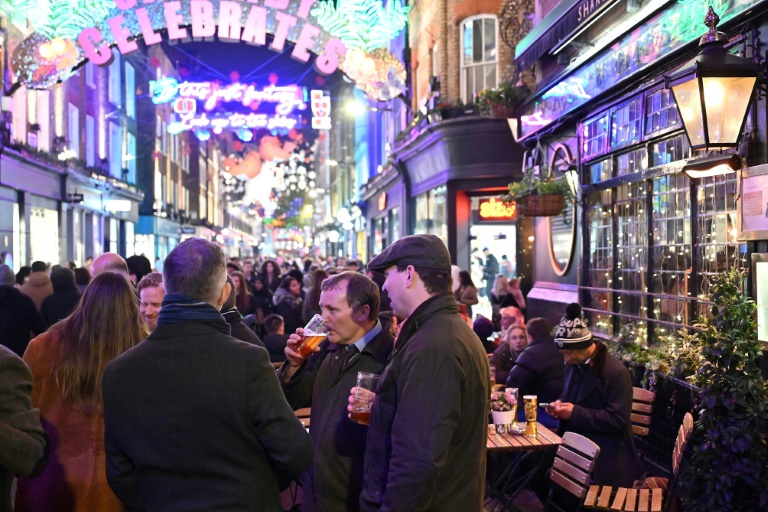
Inside the Mad Hatter pub in central London’s South Bank district, everything is ready: the big tree, the bright lights, the fun Christmas signage. 

Although the tone may be festive, the mood behind the bar and at similarly adorned pubs nationwide is far less upbeat. 

December represents a crucial month for the sector, accounting for as much as 10 percent of annual turnover thanks to Christmas parties — an institution in the UK — and other social gatherings.

After the pandemic ruined the festivities — and revenues — over the last two years, pubs, bars and other venues are relying on the coming season to help kickstart their longer-term recoveries. 

But it looks a tall order in the face of a worsening cost-of-living crisis, predictions the country is already in recession, widespread labour shortages and strikes, including in the key transport sector.

“We’re desperately looking forward to a very busy Christmas,” said Emma McClarkin, chair of industry body the British Beer and Pub Association (BBPA). The business is sorely needed “after three years of not having Christmas trade,” she explained.

McClarkin said bookings were currently about 20 percent below pre-pandemic 2019 levels.

Pubs have been central to British communities for centuries, but their number has been dwindling for years and has plunged to its lowest ever level, according to research published in July.

Despite being forced to close during the pandemic, government support schemes helped provide some financial respite.

But the post-pandemic picture is now mixed, with around 50 watering holes currently shutting down every month.

– ‘Consuming less’ –

Marston’s Brewery, which owns more than 1,400 pubs, described its Christmas bookings as “encouraging” and above 2019 levels so far.

Meanwhile, the first ever winter World Cup has boosted sales, particularly on days when England have played.

However, the company fears a difficult 2023 amid predictions of a deep recession.

The City of London, the financial hub in the heart of the capital, appears far less susceptible to the growing economic woes.

At The Globe pub, the taps are flowing freely amid a steady stream of Christmas parties, according to the manager. 

Budgets in the city can buck the broader economic trend: one office party at a local wine bar cost nearly £20,000 ($24,000), said one waiter, who asked not to be named.

But a few miles north, in the bustling Camden area, the small cocktail bar Crossroads is seeing a drop in business compared even to Covid-interrupted last year. 

“Sadly, we were forced to raise our prices in October due to the wholesale prices rising, but the takings have remained the same as last year around this time,” said manager Bart Miedeksza.

“Our regulars (are) spending just as much time by the table in our venues, but consuming less.”

– ‘Affordable’ –

Further north at The Stag, in middle class Hampstead, bookings are comparable to before the pandemic.

But the focus is on making offerings affordable for increasingly “budget conscious” customers.

“We’ve been experiencing inflation in terms of the food pricing, in particular butter or cooking oil, since (Russia’s) Ukrainian invasion,” said manager John Perritt.

Inflation is running at 11 percent in the UK and up to 60 percent for some food staples such as cooking oil and pasta, squeezing budgets and profit margins. 

The Stag, a local choice for groups of public sector workers at a nearby hospital, is trying to adapt to these new economic realities.

“We do packages as affordable as possible,” said Perritt, adding that this year it is offering a one-course Christmas menu for £20, which rises to £36.50 for more courses.

Back at the Mad Hatter, John Paul Caffery, the owner of a technology consulting company, noted this year’s Christmas party “is definitely more expensive than last year”.

“We’ve tried to overcome that by going to a place that’s fixed on cost,” he added.

Christopher Jones, a 54-year-old Welsh town planner on a business trip to the capital, is set to have a small party with his colleagues and clients at their local pub — where the price of a pint has gone up by £1. 

“Coming out of Covid, you’ve got to enjoy your life,” he explained. 

“But at the same time, just be a bit careful around budgets and about spending.”
UK pubs feel Christmas pressure as inflation bites

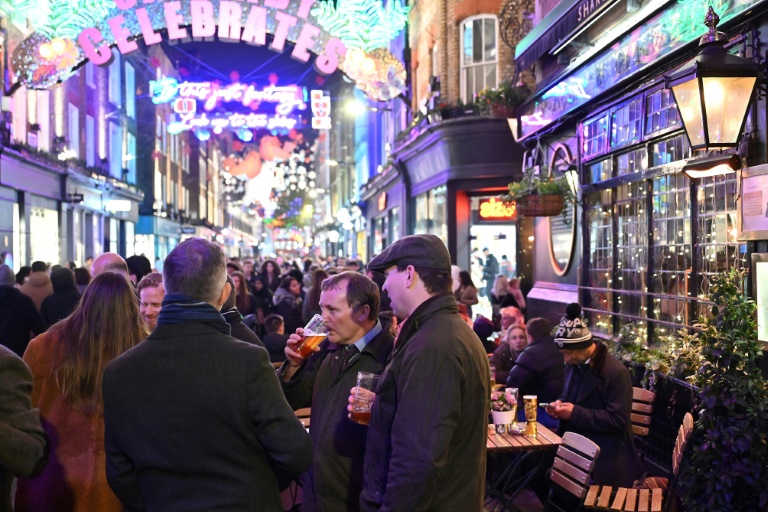
Inside the Mad Hatter pub in central London’s South Bank district, everything is ready: the big tree, the bright lights, the fun Christmas signage. 

Although the tone may be festive, the mood behind the bar and at similarly adorned pubs nationwide is far less upbeat. 

December represents a crucial month for the sector, accounting for as much as 10 percent of annual turnover thanks to Christmas parties — an institution in the UK — and other social gatherings.

After the pandemic ruined the festivities — and revenues — over the last two years, pubs, bars and other venues are relying on the coming season to help kickstart their longer-term recoveries. 

But it looks a tall order in the face of a worsening cost-of-living crisis, predictions the country is already in recession, widespread labour shortages and strikes, including in the key transport sector.

“We’re desperately looking forward to a very busy Christmas,” said Emma McClarkin, chair of industry body the British Beer and Pub Association (BBPA). The business is sorely needed “after three years of not having Christmas trade,” she explained.

McClarkin said bookings were currently about 20 percent below pre-pandemic 2019 levels.

Pubs have been central to British communities for centuries, but their number has been dwindling for years and has plunged to its lowest ever level, according to research published in July.

Despite being forced to close during the pandemic, government support schemes helped provide some financial respite.

But the post-pandemic picture is now mixed, with around 50 watering holes currently shutting down every month.

– ‘Consuming less’ –

Marston’s Brewery, which owns more than 1,400 pubs, described its Christmas bookings as “encouraging” and above 2019 levels so far.

Meanwhile, the first ever winter World Cup has boosted sales, particularly on days when England have played.

However, the company fears a difficult 2023 amid predictions of a deep recession.

The City of London, the financial hub in the heart of the capital, appears far less susceptible to the growing economic woes.

At The Globe pub, the taps are flowing freely amid a steady stream of Christmas parties, according to the manager. 

Budgets in the city can buck the broader economic trend: one office party at a local wine bar cost nearly £20,000 ($24,000), said one waiter, who asked not to be named.

But a few miles north, in the bustling Camden area, the small cocktail bar Crossroads is seeing a drop in business compared even to Covid-interrupted last year. 

“Sadly, we were forced to raise our prices in October due to the wholesale prices rising, but the takings have remained the same as last year around this time,” said manager Bart Miedeksza.

“Our regulars (are) spending just as much time by the table in our venues, but consuming less.”

– ‘Affordable’ –

Further north at The Stag, in middle class Hampstead, bookings are comparable to before the pandemic.

But the focus is on making offerings affordable for increasingly “budget conscious” customers.

“We’ve been experiencing inflation in terms of the food pricing, in particular butter or cooking oil, since (Russia’s) Ukrainian invasion,” said manager John Perritt.

Inflation is running at 11 percent in the UK and up to 60 percent for some food staples such as cooking oil and pasta, squeezing budgets and profit margins. 

The Stag, a local choice for groups of public sector workers at a nearby hospital, is trying to adapt to these new economic realities.

“We do packages as affordable as possible,” said Perritt, adding that this year it is offering a one-course Christmas menu for £20, which rises to £36.50 for more courses.

Back at the Mad Hatter, John Paul Caffery, the owner of a technology consulting company, noted this year’s Christmas party “is definitely more expensive than last year”.

“We’ve tried to overcome that by going to a place that’s fixed on cost,” he added.

Christopher Jones, a 54-year-old Welsh town planner on a business trip to the capital, is set to have a small party with his colleagues and clients at their local pub — where the price of a pint has gone up by £1. 

“Coming out of Covid, you’ve got to enjoy your life,” he explained. 

“But at the same time, just be a bit careful around budgets and about spending.”

UN biodiversity talks open, billed as 'last chance' for nature

High-stakes UN biodiversity talks open in Montreal Wednesday, in what is being billed as the “last best chance” to save the planet’s species and ecosystems from irreversible human destruction.

Delegates from across the world gathered for the December 7-19 meeting to try to hammer out a new deal for nature: a 10-year framework aimed at saving the planet’s forests, oceans and species before it’s too late. 

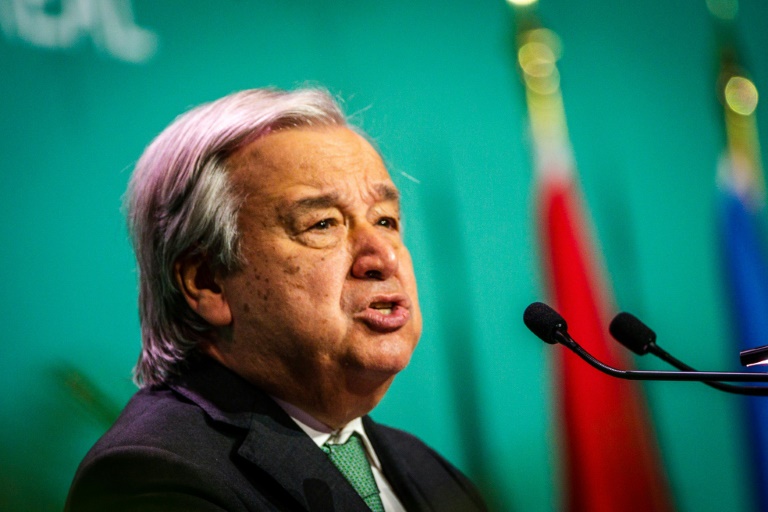
“With our bottomless appetite for unchecked and unequal economic growth, humanity has become a weapon of mass extinction,” UN chief Antonio Guterres warned Tuesday at a ceremony ahead of talks.

Before he took the dais, a group of around half a dozen Indigenous protesters interrupted a speech by Canadian Prime Minister Justin Trudeau, in a sign of the passions inflamed by biodiversity loss among the most impacted communities.

The official opening of the meeting, known as COP15, follows several days of pre-negotiations that saw very little progress on key issues, sparking fears parties may walk away without a good deal. 

Observers called for negotiators to urgently unblock sticking points on difficult items like finance and implementation, with only five out of more than 20 targets agreed so far. 

The summit “is probably the last best chance for governments to turn things around for nature, and to rescue our precious life support system,” Bernadette Fischler Hooper, head of international Advocacy at WWF, told reporters Tuesday.

– ‘Significant resistance’ –

Draft targets for the 10-year framework include a cornerstone pledge to protect 30 percent of the world’s land and seas by 2030, eliminating harmful fishing and agriculture subsidies and tackling invasive species and reducing pesticides.

Finance is among the most divisive issues as developing nations are demanding increased funding for conservation.

Earlier this year a coalition of nations called for wealthy countries to provide at least $100 billion annually –- rising to $700 billion a year by 2030 — for biodiversity. 

Some countries want to set up a separate funding mechanism for biodiversity, which wealthy nations have largely resisted.

The sticky issue of biopiracy is also causing roadblocks, as many mainly African countries demand that wealthy nations share the benefits of ingredients and formulas used in cosmetics and medicines derived from the Global South.

Implementation has emerged as another sticking point in recent days, with disagreements over how to ensure any final deal is put into practice — unlike its predecessor agreed in 2010. 

“There is significant resistance to having the robust monitoring and review mechanisms that we feel is necessary,” said a European source close to negotiations. 

– ‘Flexibility, compromise, consensus’ – 

The meeting, delayed two years because of the Covid pandemic, follows crucial climate change talks in Egypt last month that ended with little headway on reducing emissions and scaling down the use of planet-warming fossil fuels. 

China is chair, though it is being hosted in Canada because of Beijing’s long-standing zero-Covid policy. 

But China’s President Xi Jinping will be a no-show along with all other world leaders apart from Canada’s Trudeau — opting to visit oil-rich Saudi Arabia this week instead.

NGOs say the lack of world leaders at COP15 risks dampening momentum at the talks and could scupper an ambitious settlement. 

Elizabeth Mrema, the head of the UN’s Convention on Biological Diversity (CBD), which oversees the talks, on Tuesday urged “give and take” among negotiators, calling for “flexibility, compromise and consensus.”

The talks come amid dire warning from scientists that the world is facing its biggest mass extinction event since the dinosaur age, with more than one million species at risk. 

Human activity has decimated forests, wetlands, waterways and the millions of plants, animals and insects that live in them, with half of global GDP in some way dependent on nature. 

With so much on the line, observers are calling for a “Paris moment” for nature — an ambitious deal in line with the landmark climate accord. 

Polls close in Georgia runoff Senate vote, a new test for Biden

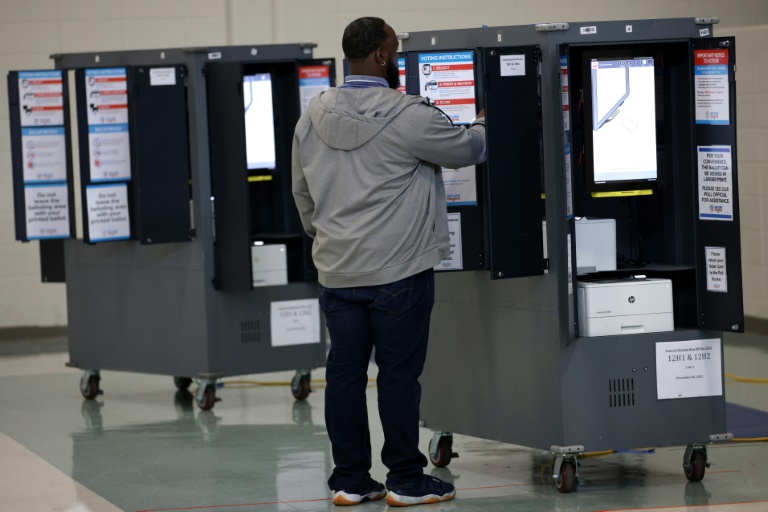
Election officials in the US state of Georgia on Tuesday began counting votes in a hotly contested Senate race between a pastor and a former American football star with high stakes for Joe Biden’s presidency.

A victory by incumbent Democratic senator Raphael Warnock would allow his camp to consolidate their paper-thin majority in the chamber and wield greater influence on key committees.

Republicans see the Georgia Senate seat as an opportunity to boost their ability to block Biden’s policies, having won back control of the House of Representatives in the November midterm election.

After opening at 07:00 am (1200 GMT) Tuesday, polling stations closed at 7:00 pm (0000 GMT Wednesday).

Warnock, pastor at the Atlanta church where civil rights icon Martin Luther King Jr once preached, is being challenged by Republican Herschel Walker, a former star running back at the University of Georgia who is backed by former president Donald Trump.

Warnock and Walker, who are both African American, are in a runoff election after neither earned more than 50 percent in the November 8 midterm vote.

With Warnock, 53, and Walker, 60, running neck and neck, Biden urged Georgians on Tuesday to turn out and vote.

“Georgia, today is Election Day — and the eyes of the nation are on you. Head to the polls and help send @ReverendWarnock back to the US Senate,” the president tweeted.

Democrats retained control of the Senate in last month’s vote — but just barely, winning 50 seats.

Vice President Kamala Harris’s tie-breaking vote gives Democrats the edge in the 100-seat chamber.

A Warnock win would give Democrats 51 seats and significantly curb the power of centrist Democratic senator Joe Manchin, who has already blocked several major Biden initiatives in the first two years of his term.

With 700 days to go before the 2024 presidential election, Republicans hope to stymie Biden’s momentum, after his party performed much better than expected in November.

– Obama to the rescue –

Determined to win the race, Democrats called on their top gun: charismatic former president Barack Obama, who campaigned alongside Warnock in Atlanta last week.

And in yet another sign of how high the stakes are, $400 million has been spent in the campaign, making the Georgia race the most expensive in all of the midterms.

Some 1.9 million people voted early, many of them likely Democratic voters, while Republicans were expected to turn out in force on Tuesday.

Polls have the race too close to call.

Historically a Republican state, Georgia took America by surprise when voters chose Biden over Trump in the 2020 presidential election and then sent two Democrats to the Senate two months later in another runoff.

– Polar opposites –

This time, while both of the candidates are natives of Georgia, the men are polar opposites.

Born the eleventh of 12 children to a former soldier and preacher father and a mother who worked in the cotton fields, Warnock grew up in poverty.

Even after his election, Warnock remained as a senior pastor at Martin Luther King’s Ebenezer Baptist Church. He holds a doctorate in theology.

Walker is a latecomer to politics with his 2022 Senate run.

The 60-year-old conservative is considered one of the best players in the history of American college football — a near-religious institution in the South — and went on to have a stellar career in the National Football League.

Walker, who is staunchly anti-abortion, even in cases of rape, has been the subject of several recent scandals, having been accused of paying for abortions for two women he had relationships with.

Hungary scraps petrol price caps amid fuel shortage

Hungary on Tuesday abolished petrol price caps after a fuel shortage led to “panic buying” at petrol stations with Hungarian energy giant MOL blaming the price limits. 

Hungarian media published images of hundred-metre-long queues at filling stations nationwide on Tuesday, while an AFP photographer saw most pumps out of order at several stations in Budapest.

Prime Minister Viktor Orban’s chief of staff, Gergely Gulyas, blamed EU oil sanctions over Russia’s invasion of Ukraine for the fuel problems.

“The government will abolish the petrol price cap at the suggestion of MOL” with immediate effect, Gulyas announced.

“What we feared came true: the oil sanction that entered into force on Monday caused perceptible disturbances in Hungary’s fuel supply. MOL can’t do without imported gasoline.”

An EU embargo on seaborne deliveries of Russian crude oil came into force on Monday.

MOL’s executive director Gyorgy Bacsa told AFP earlier on Thursday that the “supply situation is clearly critical, demand has skyrocketed, consumers are stocking up, and panic buying has begun.”

“A partial product shortage is present in our entire network and a quarter of our filling stations were completely empty,” said Bacsa.

The fuel shortage has been caused by a 30 percent drop in imported fuel, as well as maintenance at one of MOL’s refineries, and will take “several weeks” to resolve, he said.

The government-mandated price cap on vehicle fuel products has led foreign firms to cut fuel shipments to Hungary, according to the Association of Independent Petrol Stations.

In November 2021 Budapest decreed a fixed price of around 1.17 euros ($1.22) per litre of 95-grade fuel. 

Reviewed every three months, the cap was last extended in September and was valid until the end of the year.

The government said price caps — on a range of basic foodstuffs as well as fuel — were aimed at supporting the economy and curbing rampant inflation.

Annual inflation in Hungary reached 21.6 percent in October, its highest level since 1996, and the third highest in the EU, according to Eurostat.  

But Hungary’s central bank governor Gyorgy Matolcsy blamed fuel and food price caps for adding “three to four percentage points onto inflation”.

Matolcsy, usually seen as an ally of nationalist premier Orban, had also called for the caps to be withdrawn.

Adding to Orban’s economic woes, recession is looming with GDP contracting by 0.4 percent in the third quarter, while the local currency, the forint, has plunged to record lows against the euro this year.

Last week the EU’s executive also recommended that bloc funds totalling more than 14 billion euros be withheld over corruption and rule-of-law concerns.

“Hungary is in a near-crisis situation,” said Matolcsy.

Biden celebrates US manufacturing comeback at giant semiconductor project

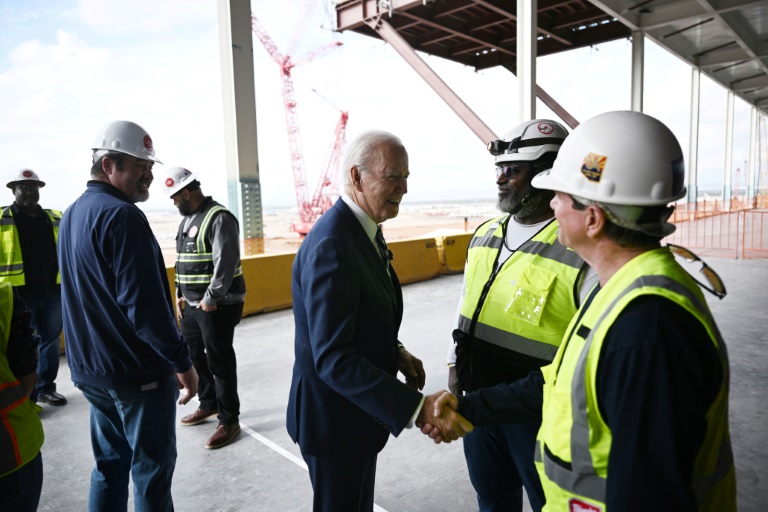
President Joe Biden declared the comeback of US manufacturing Tuesday at the site of a mammoth expansion to a Taiwanese-owned semiconductor plant aimed at breaking risky US dependency on foreign-based producers for the vital component.

“American manufacturing is back, folks. American manufacturing is back,” Biden said at the plant in Phoenix, Arizona, accompanied by senior political allies and titans of the corporate world, including Apple CEO Tim Cook and Micron CEO Sanjay Mehrotra.

The project by TSMC, the world’s biggest maker of leading-edge chips, would go a long way to meeting the US goal of ending reliance on foreign-located factories — particularly in Taiwan, which is under constant threat of being absorbed or even invaded by China.

TSMC, or Taiwan Semiconductor Manufacturing Company, announced it is building a second Phoenix plant by 2026, ballooning its investment in Arizona from $12 billion to $40 billion, with a target of producing some 600,000 microchips a year. 

About 10,000 high-tech jobs will be created once both plants are working, the company said.

White House National Economic Council Director Brian Deese said the “major milestone” is one of the largest foreign direct investments in US history, while TSMC chairman Mark Liu heralded “a giant step forward to help build a vibrant semiconductor ecosystem in the United States.”

Biden clearly hoped to get political credit for the investment influx, pointing to the effect of his signature CHIPS Act, which sets aside almost $53 billion for subsidies and research in the semiconductors sector.

It’s a message he’ll want to spread in Arizona, which was long a Republican-dominated state but has turned into a battleground where the president’s Democrats do increasingly well.

– Size matters –

Most of the current US supply of microchips comes from overseas. Although the companies are largely based in reliable US allies in Asia, the sheer distance and, especially, the geopolitical tensions around Taiwan, have the US government and companies like Apple nervous.

“Virtually every large tech firm, including automotive firms and any company that uses technology is sweating bullets that something’s going to happen between Taiwan and China. And so there’s a massive rush to shift manufacturing out of both countries,” technology analyst Rob Enderle said.

The miniscule, hard-to-make gadgets are at the heart of almost every modern appliance, vehicle and advanced weapon.

While sheer quantity matters, quality — sophistication and small size — is also increasingly important. Even typical smartphones require the higher-end semiconductors.

The new TSMC plant will produce state-of-the-art 3-nanometer chips, while the existing facility will start reducing the size of its current 5-nanometer chips to a more sophisticated 4 nanometers.

The twin plants “could meet the entire US demand for advanced chips when they’re completed. That’s the definition of supply chain resilience,” Ronnie Chatterji, National Economic Council deputy director for industrial policy, told reporters.

Biden framed the TSMC investment in a broader context of revitalizing US-based manufacturing — one of his presidency’s key themes.

“Over 30 years ago, America had more than 30 percent of the global chip production. Then something happened,” he said.

“American manufacturing, the backbone of our economy, began to get hollowed out. Companies moved jobs overseas. Today we’re down to producing only around 10 percent of the world’s chips, despite leading the world in research and design.”

Deese, one of Biden’s most senior advisors, said Biden’s signature public investment policies — the CHIPS Act and the giant Inflation Reduction Act — are revolutionizing the way the government works with private companies.

For almost four decades, the idea was “trickle down,” where government would “get out the way” and cut taxes for big companies to attract investment, he said.

Now the goal is to use the public money to kickstart activity and “crowd in” investors.

The goal is not to exclude “private companies, but in fact, encouraging private investment at historic scale,” Deese said.

Recession fears weigh on stocks as US oil prices hit 2022 low

Wall Street stocks fell again Tuesday, tumbling after leading bankers warned of rising recession risks, while worries of an oil-supply glut sent the US benchmark to its lowest level of 2022.

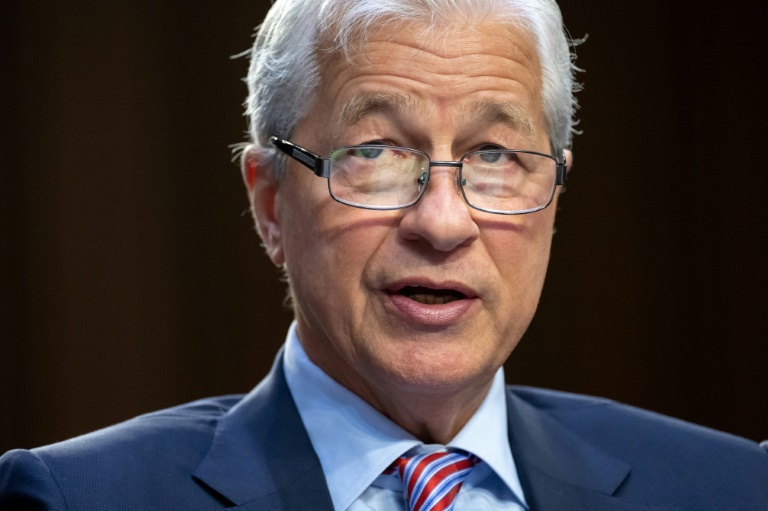
JPMorgan Chase Chief Executive Jamie Dimon said in an interview with CNBC that he saw the chance for a “mild to hard recession” next year, while Goldman Sachs chief David Solomon offered a similar appraisal in a public appearance.

“The outlook is clearly darkening and that has many traders scaling down their risky bets,” said Edward Moya at OANDA trading group.

All three major US indices finished decisively lower, with the S&P 500 losing 1.4 percent.

Tuesday’s losses added to the toll this week after major indices fell more than one percent on Monday, over worries that a recent batch of solid US economic data will prolong the Federal Reserve’s aggressive policies to counter inflation.

“The data looks increasingly like 2023 is going to include a recession,” said Merk Investment’s Nick Reece. “I don’t think a recession has been… adequately priced into the markets.”

Earlier, London, Frankfurt and Paris equity markets all closed lower after Asia mostly fell. 

Recession worries also weighed on the oil market, where US benchmark West Texas Intermediate finished at $74.25 a barrel, down 3.5 percent, in its lowest closing level of the year.

During the session, WTI slumped as low as $73.41 a barrel.

The drop has come despite signs that China at last appears to be retreating from its zero-tolerance policy to counter Covid-19.

But CMC Markets analyst Michael Hewson said traders were unsure how much of an economic boost Beijing’s shift will translate to. 

“Hopes of a demand boost from a China reopening have been tempered by the realization that while infection rates remain high any recovery will be muted at best,” he said.

Moreover, the oil market has “lost” its tightness compared with earlier this year, said OANDA’s Moya.

“It seems to have happened quickly but the crude demand outlook is getting crushed as we are in a slowdown basically across all the major economies,” Moya added.

“Supplies seem plentiful over the near-term and that has everyone hesitating on what was one of the easiest trades of the year,” he said.

– Key figures around 2150 GMT –

New York – Dow: DOWN 1.0 percent at 33,596.34 (close)

New York – S&P 500: DOWN 1.4 percent at 3,941.26 (close)

New York – Nasdaq: DOWN 2.0 percent at 11,014.89 (close)

London – FTSE 100: DOWN 0.6 percent at 7,521.39 (close)

Frankfurt – DAX: DOWN 0.7 percent at 14,343.19 (close)

Paris – CAC 40: DOWN 0.1 percent at 6,687.79 (close)

EURO STOXX 50: DOWN 0.4 percent at 3,939.19 (close)

Tokyo – Nikkei 225: UP 0.2 percent at 27,885.87 (close)

Hong Kong – Hang Seng Index: DOWN 0.4 percent at 19,441.18 (close)

Shanghai – Composite: FLAT at 3,212.53 (close)

Euro/dollar: DOWN at $1.0470 from $1.0491 on Monday

Dollar/yen: UP at 137.04 yen from 136.75 yen

Pound/dollar: DOWN at $1.2133 from $1.2190

Euro/pound: UP at 86.26 pence from 86.07 pence

West Texas Intermediate: DOWN 3.5 percent at $74.25 per barrel

Brent North Sea crude: DOWN 4.0 percent at $79.35 per barrel

burs-jmb/bys

'Humanity has become a weapon of mass extinction,' warns UN chief

UN Secretary-General Antonio Guterres on Tuesday slammed multinational corporations for turning the world’s ecosystems into “playthings of profit” and warned failure to correct course would lead to catastrophic results.

“With our bottomless appetite for unchecked and unequal economic growth, humanity has become a weapon of mass extinction,” he said, in a speech ahead of biodiversity talks in Montreal.

Since taking office in 2017, Guterres, a former Portuguese prime minister, has made climate change his signature issue. 

His fiery denunciations at the ceremonial opening of the conference, known as COP15, revealed the plight of the planet’s endangered plants and animals — an interconnected crisis — are equally close to his heart.

Before he took the dais, a group of around half a dozen Indigenous protesters interrupted a speech by Canadian Prime Minister Justin Trudeau, who is co-hosting the event with China.

They waved a banner that read “Indigenous genocide = Ecocide” and “To save biodiversity stop invading our land,” and chanted for a few minutes before they were escorted out, to a smattering of applause.

“As you can also see Canada is a place of free expression, where individuals and communities are free to express themselves openly and strongly, and we thank them for sharing their perspectives,” said Trudeau in response.

The meeting is not to be confused with another set of UN talks earlier this month, which were on climate and called COP27.

– ‘Paris moment’ for nature –

Nearly 200 countries have gathered for the December 7-19 meeting in an effort to hammer out a “Paris moment” for nature.

The challenges are daunting: one million species are at risk of extinction; one-third of all land is severely degraded and fertile soil is being lost; while pollution and climate change are accelerating degradation of the oceans.

Chemicals, plastics and air pollution are choking land, water and air, while planetary heating brought about by burning fossil fuels are causing climate chaos — from heatwaves and forest fires to droughts and floods.

“We are treating nature like a toilet,” Guterres said bluntly. 

“And ultimately, we are committing suicide by proxy” he added — with the impacts felt on jobs, hunger, disease and death.

Economic losses from ecosystem degradation, meanwhile, are estimated to stand at $3 trillion annually from 2030.

Ahead of the talks, AFP spoke to Elizabeth Mrema, the head of the UN’s Convention on Biological Diversity (CBD), who said failure was not an option.

“For the Paris agreement to succeed, biodiversity also has to succeed. For climate to succeed, nature has to succeed, and that’s why we have to deal with them together,” she said.

Draft targets for the 10-year framework include a cornerstone pledge to protect 30 percent of the world’s land and seas by 2030, eliminating harmful fishing and agriculture subsidies, tackling invasive species and reducing pesticides.

The new goal will rely heavily on the involvement of Indigenous peoples, who steward land that is home to around 80 percent of Earth’s remaining biodiversity.

Divisions have already emerged on the key issue of financing, with wealthy countries under pressure to funnel more money to developing nations for conservation.

Hopes have already been tempered by the absence of world leaders: Canada’s Trudeau will be the only in attendance. 

COP15 is currently chaired by China, but it is not hosting the meeting because of the Covid pandemic.

Meta expected to face new fines after EU privacy ruling

Meta is expected to face another large fine after Europe’s data watchdog on Tuesday imposed binding decisions concerning the treatment of personal data by the owner of Facebook, Instagram and WhatsApp. 

The European Data Protection Supervisor (EDPS) said in a statement that the rulings concerned Meta’s use of data for targeted advertising, but did not give details or recommend fines. 

Authorities in Ireland, where Meta has its European headquarters, have a month to impose the ruling.

Previous interventions by the EDPS have led to large fines on tech platforms, including a 405-million-euro fine on Instagram in September over a breach in the handling of children’s data.

The latest case follows complaints by privacy campaigning group Noyb that Meta’s three apps fail to meet Europe’s strict rules on data protection. 

Noyb says they flouted the landmark General Data Protection Regulation (GDPR) that came into force in May 2018 by failing to give users the option of holding back their personal data and blocking targeted advertising.

Facebook argues these are vital to its functioning.

“This is not the final decision and it is too early to speculate,” said a Meta spokesman, adding that EU law left open a possibility for targeted ads.  

In October 2021, the Irish Data Protection Authority (DPC) recommended a fine of just 28 to 36 million euros for lack of transparency. 

But this was rejected as far too low by France’s CNIL (the National Commission for Technology and Freedoms) and other national watchdogs, who asked the EDPS to investigate the case. 

“The EU regulators’ decision, if it is upheld, would have a dramatic impact on Meta’s revenue in Europe,” said Debra Aho Williamson, an analyst at Insider Intelligence.

The decision would be a “kneecapping” of Meta’s ability to sell targeted advertising and given the stakes, Meta will “fight vigorously to defend its business”, she said.

According to the Politico news site, internal documents show that Meta earmarked three billion euros for possible European fines in 2022 and 2023.

As well as the Instagram fine in September, Meta was fined a further 265 million euros last month over a data leak that saw half a billion users’ details published on a hacking website.

That adds to a 60-million-euro fine in France in January over its use of “cookies”, the digital trackers used to target advertising.

Pandemic treaty plans thrashed out at WHO

Negotiators are meeting in Geneva this week to thrash out a pandemic treaty aimed at ensuring the flaws that turned Covid-19 into a global crisis could never happen again.

As the third anniversary of the virus emerging rolls around, negotiators are raking over an early concept draft of what might eventually make it into an international agreement on how to handle future pandemics.

“The lessons of the pandemic must not go unlearned,” WHO chief Tedros Adhanom Ghebreyesus told the negotiating panel at the start of three days of talks, which conclude on Wednesday.

An intergovernmental negotiating body is paving the way towards a global agreement that would regulate how nations prepare for and respond to future pandemic threats.

They are huddled in Geneva for their third meeting, refining and going over their ideas so far.

A progress report will be put before WHO member states next year, with the final outcome presented for their consideration in May 2024.

The dense, 32-page early draft “is a true reflection of the aspirations for a different paradigm for strengthening pandemic prevention, preparedness, response and recovery,” said Tedros.

The so-called conceptual zero draft contains various notions, some of which will have to be developed and others thrown out as negotiators hone down the text ahead of the next meeting in February.

The trick will ultimately be finding the balance between something bold and with teeth, and something all countries can agree to.

– ‘Don’t blow this opportunity’ –

“There’s a lot of material currently that probably doesn’t belong in there,” said Pamela Hamamoto, the lead US negotiator.

“There’s a lot that needs to change before we’re going to sign onto it. That is the same for a lot of member states — probably most,” she told reporters.

Hamamoto said Washington wanted to see transparency fixed into the accord, along with better surveillance and rapid response, plus swift and comprehensive data sharing.

The United States also wants to see more equitable access to medical countermeasures, possibly through regional manufacturing.

“A pretty broadly-held view is that we need to make sure that the process is set up right so… we basically don’t blow this opportunity to put together an accord that is going to be meaningful and implementable,” Hamamoto said.

The Panel for a Global Public Health Convention, an independent coalition of statespeople and health leaders, said the conceptual draft did not go far enough, despite its bright spots.

The panel said more should be done to establish accountability and clear timelines for alert and response to avoid damaging consequences when an outbreak emerges.

– Negotiations at ‘crossroads’ –

The medical charity Doctors Without Borders said the negotiations must not overlook the role of clinical trials in any pandemic response.

Mohga Kamal-Yanni, of the NGO coalition People’s Vaccine Alliance, said the draft showed negotiations were “at a crossroads”.

“A treaty could break with the greed and inequality that has plagued the global response to Covid-19, HIV/AIDS and other pandemics. Or, it could tie future generations to the same disastrous outcomes,” she said.

“Governments must resist any attempts to turn a pandemic treaty into another obscene profit opportunity for pharmaceutical companies.”

Three years in, the pandemic still has power to disrupt lives and societies — as seen in the recent unrest in China over lockdowns.

Countries have reported 6.6 million deaths to the WHO, while around 640 million confirmed cases have been registered. 

But the UN health agency says this will be a massive undercount.

Global Fund executive director Peter Sands told reporters last month that “having a nice treaty… will have only a partial impact on how effectively we respond”.

He said the world was undoubtedly already better prepared for the next pandemic, but warned: “That doesn’t mean we are well prepared. It just means we’re not as badly prepared as we were before.”

Close Bitnami banner
Bitnami