World

Niger finance minister rebuffs pressure to drop oil drive

Niger’s finance minister says lack of support from rich countries makes it impossible for his impoverished nation to abandon revenue from oil.

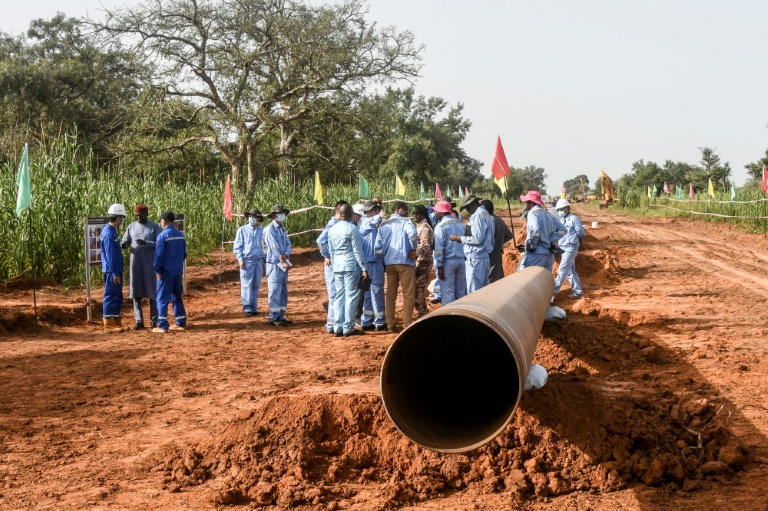
The landlocked Sahel state has launched a scheme to build Africa’s longest pipeline, shuttling crude oil over nearly 2,000 kilometres (1,250 miles) to a port in Benin.

Environmental campaigners are dismayed about initiatives that perpetuate the use of climate-damaging fossil fuels.

But in an interview with AFP, Finance Minister Ahmat Jidoud said Niger had no alternative.

“Right now it’s not possible,” he said.

“It is important for us to be able to exploit our own resources until the conditions are there for the climate transition to unfold,” he said.

Niger’s 26 million people are the poorest in the world, according to the benchmark of the UN’s Human Development Index.

The population is also one of the fast-growing in the world, expanding by 3.7 percent annually.

Without income from oil, “our development is compromised,” Jidoud said, warning of a “social (time-) bomb.”

Niger became an oil producer in 2011, with the China National Petroleum Corporation (CNPC) sending crude by pipeline to refineries in Zinder in the south-centre of the country.

The new $6-billion pipeline will connect wells in the eastern region of Agadem with the Beninese port of Seme.

Launched in 2019, the project was supposed to be completed in 2022, but was hampered by the Covid-19 pandemic.

More than 600 km of pipeline has already been laid, and Niger is on track to sell crude on the international market from next July, according to the ministry of petroleum and energy.

Jidoud spoke to AFP on the sidelines of a conference in Paris aimed at mustering public and private funds to support Niger’s 2022-26 $29.6-billion development plan.

The blueprint, unveiled on Monday by President Mohamed Bazoum, aims to reduce the poverty rate from 43 percent to 35 percent.

It says the state can count on $13.35 billion from its own resources, a figure that is crucially dependent on oil exports.

Thanks to the new pipeline, oil sales by the end of 2023 should rise from 20,000 barrels per day to 110,000, according to his plan.

Under this scenario, oil income would account for half of the country’s fiscal revenue and a quarter of GDP.

Income from oil compares starkly with the funds channelled by rich countries to help poorer nations move to a climate-friendlier path, said Jidoud.

“You can’t talk to us about the energy transition if the support promised by the G20 countries doesn’t show up,” he said.

He pointed to a promise, first made by rich economies at the 2009 Copenhagen climate summit, to muster $100 billion a year in support — a vow that remains unfulfilled.

In addition to entrenched poverty, Niger is battling climate extremes in a deeply arid region, and struggling with two jihadist insurgencies.

Jidoud said that in early commitments on Monday, the African Development Bank (AfDB) had promised 2.4 billion euros (dollars), the West African Development Bank (WADB) 680 million euros and France — Niger’s former colonial power and ally — 550 million.
Iran sentences five to hang over protest-linked killing

Iran sentenced five people to hang for killing a paramilitary member, the judiciary said Tuesday, a ruling condemned by rights activists as a means to “spread fear” and stop protests over Mahsa Amini’s death.

Another 11 people, including three children, were handed long jail terms over the murder, judiciary spokesman Massoud Setayeshi told a news conference, adding the sentences could be appealed.

Prosecutors said paramilitary member Ruhollah Ajamian, 27, was stripped naked and killed by a group of mourners who had been paying tribute to a slain protester, Hadis Najafi.

Najafi was killed on September 21, five days into the wave of protests that erupted across Iran after the death of Amini, following her arrest by the morality police for an alleged breach of the country’s hijab dress code for women.

Iran has struggled to quell the largely peaceful protests.

In a surprise move, Iran’s prosecutor general, Mohammad Jafar Montazeri was Sunday quoted as saying that the morality police units –- known formally as Gasht-e Ershad (“Guidance Patrol”) — had been closed down.

But his comments have yet to be followed up by an official announcement and have drawn widespread scepticism.

Ajamian had died on November 3 in Karaj, west of Tehran, after being attacked with “knives, stones, fists, kicks” and being dragged along a street, said the judiciary spokesman.

He belonged to the Basij, a state-sanctioned volunteer force that is linked to Iran’s powerful Islamic Revolutionary Guard Corps.

– Protesters again defy crackdown –

The five sentenced to death were convicted of “corruption on earth” — one of the most serious offences under Islamic sharia law in Iran.

The other 11, including a woman, were convicted for “their role in the riots” and received lengthy prison terms, said Setayeshi.

The rulings bring to 11 the number of people sentenced to death over the protests.

They were condemned by Norway-based non-governmental organisation Iran Human Rights.

“These people are sentenced after unfair processes and without due process,” IHR director Mahmood Amiry-Moghaddam told AFP. “The aim is to spread fear and make people stop protesting.” 

Despite a crackdown that has killed hundreds, images posted online showed shops closed in cities across the country on Tuesday, the second day of a strike that culminates Wednesday on Student Day.

“Freedom, freedom, freedom,” dozens of students from Tehran’s Allameh Tabatabai University were heard chanting in a video published by IHR.

At least 448 people have been “killed by security forces in the ongoing nationwide protests”, the Oslo-based rights group said in its latest toll issued on November 29.

Iran, which accuses the United States and its allies Britain and Israel of fomenting the rest, said on Saturday that more than 200 people have been killed since the protests began. A general had put the figure at more than 300 last week.

– Campaign of arrests –

Iran currently executes more people annually than any nation other than China, Amnesty International says.

The London-based rights group said on November 16 that, based on official reports, at least 21 protesters had been charged with crimes that could see them hanged in what it called “sham trials”.

The crackdown has also seen thousands of people arrested, including 40 foreigners and prominent actors, journalists and lawyers.

Among them are a dozen alleged members of an unnamed European-linked group accused of planning acts of sabotage.

The Revolutionary Guards in Markazi province, southwest of Tehran, said Tuesday they had arrested “a network with 12 members with links abroad”.

They had been “under the guidance of counter-revolutionary agents living in Germany and the Netherlands” and had “attempted to procure weapons and intended to carry out subversive acts”.

The Guards, referring to the nationwide protests, said that the “riots project has failed”.

It warned acts of sabotage would continue, however, and appealed for the “vigilance of loyal people… especially shopkeepers, students and workers” to foil them.

Iranian lawmaker Hossein Jalali called on the authorities to send women who fail to observe hijab text messages threatening to block their bank accounts, Shargh newspaper said.

Meanwhile police in Britain said a fire broke out overnight next to the London office of the People’s Mojahedin Organization of Iran (PMOI) opposition group. There was no evidence so far that it was a deliberate attack.

burs-dv/dwo

Markets drop as Fed worries offset China's Covid easing

Stock markets fell on Tuesday as investors were split between fears that the US Federal Reserve will maintain its aggressive anti-inflation measures and growing optimism over China’s economic reopening.

London, Frankfurt and Paris were down in afternoon trades after Asia mostly fell.

Wall Street extended losses as it opened lower following a sell-off the previous day.

Data showing a forecast-busting jump in activity in the US services sector last month raised the prospect that the Fed will not back down from sharp rate increases when it meets next week.

Monday’s data followed robust jobs figures last week and a jump in wages that give the central bank more room to cool the US economy, fuelling investor concerns that the Fed’s actions could cause a deep recession.

“Worries that the Fed could unwrap an unwelcome present of another super-sized rate hike when policymakers meet next week are sprinkling Christmas fear on indices,” said Susannah Streeter, senior investment and markets analyst at Hargreaves Lansdown.

“Speculation is swirling that central banks will have to be more Scrooge-like and make borrowing even more expensive to rein in inflation,” she said.

Markets had been running higher ahead of the jobs figures after a surprise drop in inflation and comments from Fed boss Jerome Powell that the bank was likely to raise rates at a slower pace.

Bets have increased on borrowing costs rising higher than five percent next year — from the current range of 3.75-4.0 percent — before the bank pauses, with no cuts seen until 2024.

“There is a prominent undercurrent of concern that the Fed is going to overtighten and trigger a deeper economic setback,” said Briefing.com analyst Patrick O’Hare.

Analysts said concerns over the Fed have overshadowed China’s easing of zero-Covid policies following nationwide protests over the measures, which have hammered the world’s second biggest economy.

Despite the prospect of higher Chinese demand for oil as the economy reopens, crude prices fell as an EU embargo on Russian oil and a G7-EU price cap on the country’s exports came into force on Monday.

“It seems that the only thing guaranteed in the oil market for now is volatility,” said OANDA trading platform analyst Craig Erlam.

The dollar lost ground against other major currencies after gains on Monday.

– Key figures around 1445 GMT –

New York – Dow: DOWN 0.3 percent at 33,837.66 points

London – FTSE 100: DOWN 0.3 percent at 7,545.95 

Frankfurt – DAX: DOWN 0.5 percent at 14,379.00

Paris – CAC 40: DOWN 0.2 percent at 6,683.24

EURO STOXX 50: DOWN 0.3 percent at 3,944.32

Tokyo – Nikkei 225: UP 0.2 percent at 27,885.87 (close)

Hong Kong – Hang Seng Index: DOWN 0.4 percent at 19,441.18 (close)

Shanghai – Composite: FLAT at 3,212.53 (close)

Euro/dollar: UP at $1.0510 from $1.0495 on Monday

Dollar/yen: DOWN at 136.49 yen from 136.78 yen

Pound/dollar: UP at $1.2193 from $1.2186

Euro/pound: UP at 86.19 pence from 86.06 pence

West Texas Intermediate: DOWN 0.7 percent at $76.40 per barrel

Brent North Sea crude: DOWN 0.7 percent at $82.08 per barrel

S.Africa's Ramaphosa future fragile despite party backing

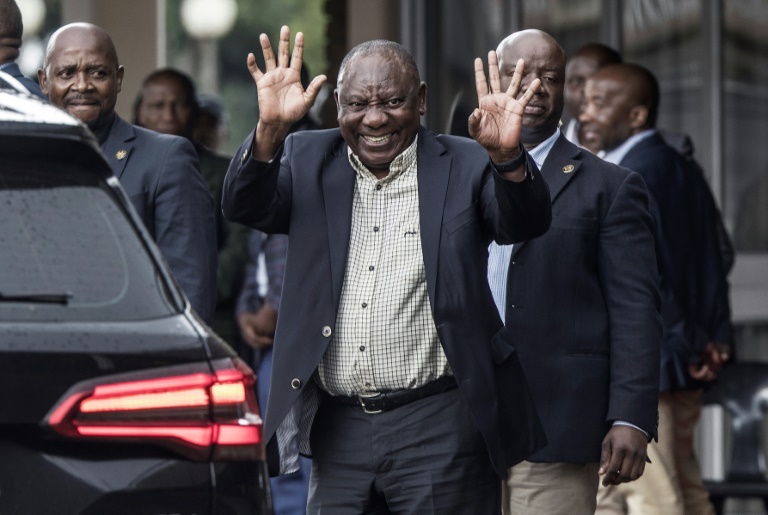
The threat of South African President Cyril Ramaphosa’s immediate exit from office over a cash-in-sofas scandal has temporarily faded after his party vowed to rally around him at next week’s impeachment vote, but his woes are far from over.

The next days are critical for the head of state who has been championed as a graft-busting saviour after the corruption-drenched tenure of predecessor Jacob Zuma.

Ruling African National Congress (ANC) party lawmakers vowed to close ranks around him at an impeachment vote in parliament next week, but Ramaphosa remains embroiled in the worst scandal of his career that could yet bring him down.

After a tumultuous week following a report by a parliament-sanctioned independent panel which found that he “may have committed” serious violations and misconduct, Ramaphosa appeared to have earned a respite.

The parliament sitting to vote on whether he should face impeachment, initially slated for Tuesday, was at the 11th hour pushed back by a week, prolonging the uncertainty around Ramaphosa’s future.

That vote will come just three days before the ANC meets for its five-yearly conference to elect a new president. Ramaphosa is the leading candidate of the two nominees named so far for the party leadership.

But that is no guarantee he will be re-elected, or serve out his full state presidential term which should run until April 2024.

ANC members facing criminal allegations or charges are expected to step aside.

Ramaphosa is not charged yet over the scandal dubbed “Phala Phala farm-gate”, after the name of the estate in northeastern South Africa.

That gives him room to still try his luck and contest the ANC leadership — a ticket to the national presidency.

“The step-aside rule doesn’t apply here, Cyril Ramaphosa is not charged with anything,” lawyer and ANC veteran Mathews Phosa told eNCA news at the weekend.

But scandals do not necessarily decide the fate of an ANC president and the party throughout its nearly three decades in power has exhibited a tendency to protect its own people.

“In the ANC you could be charged for rape and still become president, you could be charged for an international arms deal and still be a president,” said political analyst Sandile Swana.

– Undignified exit? –

Formerly a wealthy businessman, the president may follow the footsteps of two of his predecessors, Zuma and Thabo Mbeki, who did not complete their tenures and were forced out by the ANC.

“The presidency of Ramaphosa is going to be short,” said Swana, but “his chances of leaving in a dignified manner are minimal”.

The 70-year-old president found himself in hot water in June when South Africa’s former spy boss filed a complaint to the police alleging Ramaphosa had concealed a huge cash theft from his game and rare cattle farm in 2020.

He accused the president of having organised for the burglars to be kidnapped and bribed into silence. 

Ramaphosa has denied any wrongdoing, saying the cash — more than half a million dollars, stashed beneath sofa cushions — was payment for buffaloes bought by a Sudanese businessman.

But his explanations did not convince the special panel, which raised questions about the source of the cash.

On Monday Ramaphosa rushed to the country’s top court asking it to annul the panel’s report, but it is uncertain if his request will be granted.

The Constitutional Court case, which may take days or weeks to be concluded, “does not in itself stop the parliamentary (impeachment) proceedings from continuing”, said public law professor at the University of Cape Town Cathy Powell.

If the impeachment process is greenlighted it will take months of investigations and hearings before the final vote.

“The problem with this one is that it doesn’t seem to be completely frivolous,” the question whether it is serious enough to be fired for, said Powell.

When lawmakers meet next week a simple majority in the National Assembly, where the ANC has 230 out of 400 seats, will be required to initiate the impeachment process.

The impeachment vote itself would need a two-thirds majority to succeed.

If the impeachment proceedings go ahead, Ramaphosa risks being the first South African leader to be formally removed from office by parliament, said Swana.

The scandal has preoccupied South Africans who are already battling economic hardships, the inadequate provision of basic services such as electricity and a dizzying rate of unemployment.

Airlines to return to profit in 2023: IATA

Airlines are expected to return to profit next year for the first time since 2019 despite slowing global growth as they recover from a Covid-induced crisis, an industry group said Tuesday.

After cutting losses this year, airlines are forecast to make $4.7 billion in net profits in 2023, according to the International Air Transport Association (IATA).

This is still far off the $26.4 billion profit the industry reported in 2019, before Covid prompted countries to enact travel restrictions that have since been eased in most nations.

“Resilience has been the hallmark for airlines in the Covid-19 crisis,” IATA director general Willie Walsh said in a statement.

“As we look to 2023, the financial recovery will take shape with a first industry profit since 2019. That is a great achievement considering the scale of the financial and economic damage caused by government imposed pandemic restrictions,” he said.

Governments in numerous countries had to bail out airlines as travel was brought to a halt to slow the spread of the virus, and the industry suffered $137.7 billion in losses in 2020 at the height of the restrictions.

Airlines are expected to post $779 billion in revenues in 2023, meaning the $4.7 billion profit constitutes a razor-thin net profit margin of just 0.6 percent. 

Walsh said many airlines are “sufficiently profitable” to attract capital as the industry seeks to decarbonise its operations.

But many others are struggling due to “onerous regulation, high costs, inconsistent government policies, inefficient infrastructure and a value chain where the rewards of connecting the world are not equitably distributed,” he said.

Passenger traffic was slightly lower than forecast in 2022 due to slowing economies and China’s zero-Covid restrictions. 

– ‘Optimistic about 2023’ –

But the IATA expects passenger traffic to return to 85.5 percent of its pre-crisis level in 2023.

And that expected improvement comes as global GDP growth slows, according to IATA’s forecast, to 1.3 percent from 2.9 percent in 2022. 

“Despite the economic uncertainties, there are plenty of reasons to be optimistic about 2023,” said Walsh.

Airlines should not be as affected by rising jet fuel prices as they were in 2022, while continuing to benefit from pent-up travel demand.

A recent IATA poll found that more than two-thirds of travellers surveyed in 11 global markets are travelling as much or more than before the pandemic. 

And while 85 percent said they are concerned about the economic situation, 57 percent said have no intention to curb their travel habits.

But Walsh also warned that with such thin margins, “even an insignificant shift in any one of these variables has the potential to shift the balance into negative territory.”

IATA sees airlines squeaking out a profit thanks to revenues growing faster than costs next year. 

While rising interest rates may crimp demand for travel, IATA sees that as likely leading to lower oil prices, thus reducing costs for airlines.

– Help for green transition –

On a regional level, airlines in North America are expected to post $9.9 billion in profits this year, thanks to carriers benefitting from fewer and shorter-lasting travel restrictions in the region. For 2023, profits are seen as climbing to $11.4 billion.

European carriers are forecast to post $3.1 billion in losses as some airlines had to curtail operations due to Russia’s war in Ukraine while others faced limitations imposed by airports. IATA sees European airlines posting $621 million in profit in 2023.

Asia-Pacific airlines are expected to suffer $10 billion in losses this year, primarily due to China’s zero Covid policy. In 2023, they are expected to narrow that to $6.6 billion. 

But IATA noted it expects “strong pent-up demand to fuel a quick rebound in the wake of any” relaxation in Covid travel restrictions by China.

Walsh said that the airline industry remains committed to reaching net zero carbon emissions by 2050, but given its thin profit margins, pleaded for government help. 

“We’ll need all the resources we can muster, including government incentives, to finance this enormous energy transition,” said Walsh.

“More taxes and higher charges would be counter-productive,” he added.

Biden celebrates giant TSMC semiconductor project

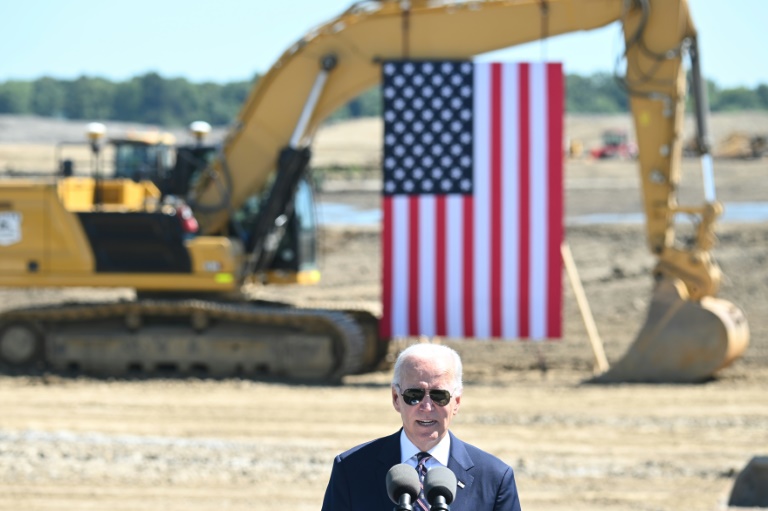
President Joe Biden flies Tuesday to Arizona to celebrate the mammoth expansion of a Taiwanese semiconductor plant, citing the project as proof the United States is finally breaking dangerous dependency on foreign manufacturers for the vital component.

TSMC announced it is building a second facility in Phoenix by 2026, ballooning its investment from $12 billion to $40 billion. About 10,000 high-tech jobs will be created once both plants are working, the company said.

With a target of producing some 600,000 microchips a year in the twin facilities, TSMC’s project would go a long way to meeting the US goal of ending reliance on factories based abroad — particularly in Taiwan, which is under constant threat of being absorbed or even invaded by China.

The “major milestone” adds up to “the largest foreign direct investment in Arizona history and it’s one of the largest in US history,” White House National Economic Council Director Brian Deese told reporters.

Biden will speak at the TSMC site, accompanied by senior political figures and titans of the corporate world, including Apple CEO Tim Cook, TSMC’s founder Morris Chang and Micron CEO Sanjay Mehrotra.

The Democrat will seek to take credit for the investment influx, pointing to the effect of his signature CHIPS Act, which sets aside almost $53 billion for subsidies and research in the semiconductors sector. 

It’s a message he’ll be especially keen to spread in Arizona, which was long a Republican-dominated state but has turned into a battleground where Democrats do increasingly well.

The plant expansion — coming on top of other significant microchip manufacturing projects dotted around the country — is part of an overall plan by the Biden administration to shift the center of gravity in the increasingly strategic, global industry.

Most supply currently comes from companies based in reliable US allies in Asia, but the sheer distance from producers and, especially, the geopolitical tensions around Taiwan are triggering a push to shrink the supply chain.

“Virtually every large tech firm, including automotive firms and any company that uses technology is sweating bullets that something’s going to happen between Taiwan and China. And so there’s a massive rush to shift manufacturing out of both countries,” technology analyst Rob Enderle said.

– Smaller the better –

In the high-stakes world of microchips, sheer quantity is important. The miniscule, hard-to-make gadgets are at the heart of almost every modern appliance, vehicle and advanced weapon.

But quality — and small size — is also increasingly important for sophisticated everyday devices like smartphones and on that front the White House says it has good news.

The new TSMC plant will produce tiny 3 nanometer chips, while the existing facility will start reducing the size of its current 5 nanometer chips to 4 nanometers.

Building a plant, or a “fab,” takes several years. But once “at scale, these two fabs could meet the entire US demand for advanced chips when they’re completed. That’s the definition of supply chain resilience,” Ronnie Chatterji, National Economic Council deputy director for industrial policy, told reporters.

Deese, one of Biden’s most senior advisors, said the broader message from the White House is that US industrial strategy is undergoing a rebirth.

For almost four decades, the idea was “trickle down,” where government would “get out the way” and cut taxes for big companies to attract investment, he said.

Instead, Biden’s policy — both through the CHIPS Act and the giant Inflation Reduction Act — uses public money to attract, or “crowd in” private investment.

The goal is not to exclude “private companies, but in fact, encouraging private investment at historic scale,” Deese said.

Scepticism greets Sudan's post-coup political deal

The signing of an initial deal by Sudan’s military regime and civilians has been widely hailed by the international community, but many at home eye it with deep scepticism.

Sudan, one of the world’s poorest countries, has been mired in deep turmoil since army chief Abdel Fattah al-Burhan carried out a military coup in October last year, derailing a transition to civilian rule. 

That power grab came just two-and-a-half years after enormous street protests had pressed the army into ousting long-time autocrat Omar al-Bashir.

Many dared believe the resultant power-sharing arrangement would guarantee freedoms and provide justice, but the coup extinguished those hopes, provoking donors into suspending funding and exacerbating a long-running economic crisis.

Events of the last year have also fed into worsening security crises in far-flung regions. 

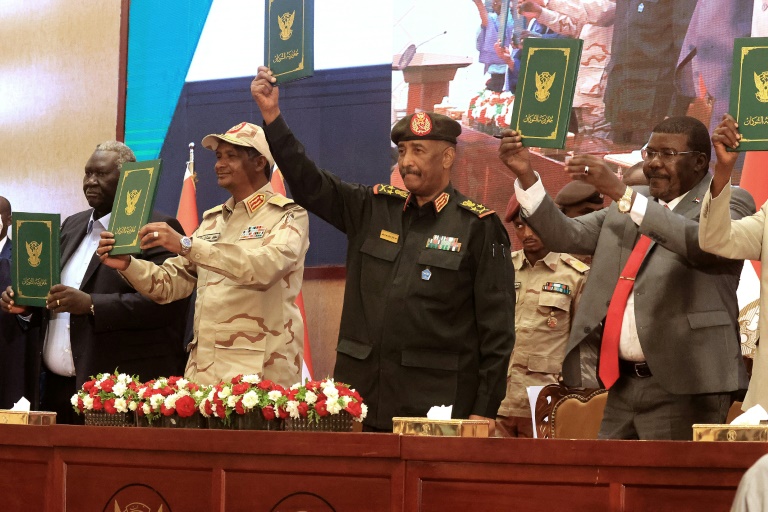
On Monday, senior military figures and civilian groups agreed an accord laying the groundwork for re-establishing a civilian authority — a move welcomed by the United Nations, Washington, London, Brussels, Riyadh and Abu Dhabi, among others.

The deal, phase one of a two-phase process, was signed by the main civilian bloc, the Forces For Freedom and Change, which had for months opposed engaging with the army in the wake of the coup.

It stipulates that non-military signatories will agree on a prime minister to steer the country through a new 24-month transition. 

“The soldiers will go to the barracks, and the parties to the elections,” Burhan promised during the signing ceremony, to loud applause.  

His deputy, paramilitary commander Mohamed Hamdan Dagalo, even admitted that the coup had been “a political mistake.” 

But Sudanese analysts, a senior cabinet minister and a regional governor caution that the deal risks being over-hyped.

– ‘Merely symbolic move’ –

Kholood Khair, founder of the Confluence Advisory, a Khartoum-based think-tank, notes that the agreement improves the international community’s perception of Burhan.

But “it works out less well for the civilians … who will have to do the hard work and sell it to the public.” 

And “it does not inspire confidence that it will lead to the kind of reforms that people want to see.”

Pro-democracy activists have voiced strong opposition to the deal.

Crowds of angry protesters took to the streets on Monday, chanting “no to the settlement” and “betrayal.” 

“It’s merely a symbolic move that should be developed further to a more concrete deal,” said Sudanese analyst Othman Mirghani. 

Otherwise, “it would be a meaningless step.”

Monday’s deal sets broad guidelines for a civilian-led transition that largely fell short on specifics and timelines. 

It pledges accountability, reforms to the security sector and bars the army from conducting non-military related businesses, in a country where this institution has wide-ranging commercial interests. 

Dagalo himself — head of a long-feared paramilitary group — has pledged justice to families of people killed by security forces over the years, a key demand of activists.

Signatories to the deal have pledged to hammer out the details of transitional justice, accountability and security reform “within weeks”. 

Mirghani says such complex issues could instead take months to thrash out.

– ‘No trust’ –

The deal “is also contingent on… public trust in the agreement and the protagonists,” Khair said. 

“And frankly that doesn’t exist,” she added. 

The deal was met by strong opposition from key ex-rebel leaders who two years ago signed a peace deal hammered out with the short-lived transition government.

Discussions over implementation of the 2020 peace deal have been slated for phase two of Monday’s agreement. 

Ex-rebel leader Mini Minnawi, who is also governor of the restive Darfur region, slammed the agreement as “exclusionary.” 

Finance minister and ex-rebel Gibril Ibrahim said it was “far from a national accord and does not lead to free and fair elections.” 

“It will be hard to proceed with a comprehensive deal without agreeing with armed groups, most notably those of Ibrahim and Minnawi’s,” said the analyst Mirghani. 

Croatia sets sights on Europe's border-free club

If Croatia gets approval this week to join the world’s largest visa-free area, the massive queues of vehicles at the borders with its European neighbours will become history.

European Union justice ministers meet on Thursday to decide whether to admit Croatia into the passport-free Schengen zone, which enables more than 400 million people to move freely around its 26 member nations.

One of the main sticking points has been questions over Croatia’s ability to police what is the 27-nation EU’s longest external land border, at a time when migration remains a key challenge for the country.

Zagreb’s application in 2016 to join Schengen has also come at a sensitive time for Europe.

Since 2015, millions of migrants, many from conflict zones, have risked their lives to enter the EU illegally and then the Covid 19 pandemic hit in 2020. 

Both prompted Schengen countries to reintroduce certain border controls.

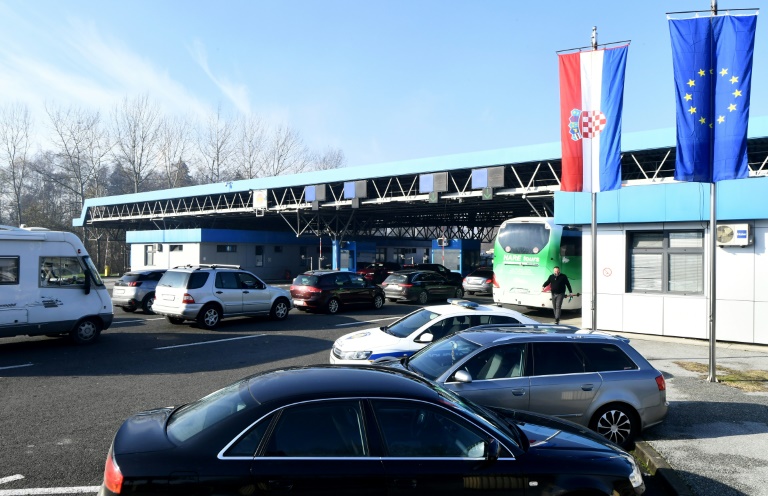
If on Thursday Croatia gets the green light to join Schengen — potentially alongside Bulgaria and Romania — the kilometres-long (miles-long) vehicle queues at the Bregana border crossing with Slovenia will become a thing of the past.

Bregana is one of 73 land crossings with EU neighbours Slovenia and Hungary that would cease to exist.

“On January 1, we will raise the barriers and border traffic will be free,” the head of the national border police service, Zoran Niceno, told AFP.

At airports, the change will kick in on March 26, due to technical issues.

– Tourists and trucks-

Croatia hopes joining Schengen would boost its lucrative tourism industry. 

This year, the country of 3.9 million people hosted four times as many visitors, most of them from other EU states.

Removing border controls would enable holidaymakers to reach Croatian destinations faster, the head of the national tourist board, Kristjan Stanicic, said recently.

“International carriers will be delighted,” said Vladimir Jurcec of the national road hauliers’ association.

Removing checks at borders will save them between six and 10 hours every week.

“No more crowds and hours of queueing,” noted truck driver Filip Svetlicic, whose Italy-bound lorry was stuck in a queue several kilometres long to exit Croatia via Bregana.

On January 1, Croatia will also join the EU’s single currency club, the eurozone.

– Illegal migration challenge –

Ever since the former Yugoslav republic became an EU member nearly a decade ago, it has had the onerous task of policing the bloc’s longest external land border.

The border — which rubs shoulders for more than 1,350 kilometres (about 840 miles) with Bosnia, Montenegro and Serbia — is an area notorious for trafficking in migrants, drugs and weapons.

The most challenging is the 1,011-kilometre border with Bosnia, which is not only the longest but also consists of difficult terrain dotted with rivers and craggy mountains.

At the Stara Gradiska crossing with Bosnia, police carefully scrutinise documents and waiting vehicles.

For Malik Safeta, a bus driver from Sarajevo, such strict controls are not unusual.

“It’s normal. This is the last line of defence for the EU and the Schengen zone before the eastern world, which is always a bit more problematic,” he said.

The situation at Croatia’s borders with its non-EU neighbours is not expected to change much after January 1 because Zagreb has already introduced the Schengen area’s rules for dealing with its external limits.

“Croatia has applied Schengen procedures for years and uses all the tools required for such border controls,” Niceno, the border police head, said.

Police say tackling illegal migration was and will remain the most challenging task for its force of around 6,500 border officers.

NGOs and the media have repeatedly accused Croatian police of forcing migrants back over its external borders, often violently. Zagreb strongly denies the allegations.

Croatia lies on the dangerous Balkans migrant route, which was traversed by hundreds of thousands of would-be asylum seekers from Asia, the Middle East and Africa during Europe’s 2015-2016 “migrant crisis”. 

After the route was officially shut down in 2016, migrants seeking to enter western Europe continued to use it, although in far lower numbers.

However, this year their numbers increased significantly.

Nearly 130,000 people, including women and children, have been detected on the route since the start of 2022. That is 170 percent more than in 2021, according to EU border force Frontex.

As of November, Croatia had registered some 30,000 illegal migrants, nearly 150 percent more than over the same period last year.

The Stara Gradiska region has become a hotspot for migrants trying to cross the Sava river in small boats or sometimes even swimming despite freezing temperatures.

Croatian police and their EU counterparts say two things are key to tackling the issue — combatting the human traffickers and cooperating between the countries the migrants are trying to pass through.

“The people we apprehend are the last ones in the (trafficking) chain — the drivers,” Niceno said.

“But with cooperation and analysis, we can catch gangs and organisers.”

Iran sentences five to hang over protest-linked killing

Iran has sentenced to death five people over the killing of a Basij paramilitary force member during nationwide protests sparked by Mahsa Amini’s death, the judiciary said Tuesday.

Another 11 people, including three children, were handed lengthy jail terms over the murder, judiciary spokesman Massoud Setayeshi told a news conference, adding the sentences could be appealed.

Prosecutors said Ajamian, 27, was stripped naked and killed by a group of mourners who had been paying tribute to a slain protester, Hadis Najafi.

Najafi had been killed on September 21, five days into the wave of protests that erupted across Iran after the death of Amini, following her arrest by the morality police for an alleged breach of the country’s hijab dress code for women.

Iran has struggled to quell the protests and street violence.

In a surprise move, Iran’s prosecutor general, Mohammad Jafar Montazeri, was Sunday quoted as saying that the morality police units –- known formally as Gasht-e Ershad (“Guidance Patrol”) — had been closed down.

But his comments have yet to be followed up by an official announcement and have drawn widespread scepticism.

Ajamian had died on November 3 in Karaj, a city west of Tehran, after being attacked with “knives, stones, fists, kicks” and being dragged on the street, said the judiciary spokesman.

He belonged to the Basij, a state-sanctioned volunteer force that is linked to Iran’s powerful Islamic Revolutionary Guard Corps.

– ‘War against God’ –

The five sentenced to death were convicted of “corruption on earth” — one of the most serious offences under Islamic sharia law in Iran.

The other 11, including a woman, were convicted for “their role in the riots” and received long jail terms, said Setayeshi.

The latest court rulings bring to 11 the number of people sentenced to death in Iran over the protests, described as “riots” by the authorities.

On November 20, the revolutionary court of Tehran handed down the death penalty for a person found guilty of “moharebeh”, which means waging “war against God”.

On November 16, the same court had sentenced three others to death in connection with the protests.

One was convicted of attacking police officers with his car, killing one of them, the second had stabbed a security officer and the third tried to block traffic and spread “terror”, Mizan said.

An Iranian general said on Monday that more than 300 people have been killed in the unrest, including dozens of members of the security forces.

Oslo-based non-government group Iran Human Rights said at least 448 people had been “killed by security forces in the ongoing nationwide protests”.

– Campaign of arrests –

Iran accuses the United States and its allies, including Britain, Israel, and Kurdish groups based outside the country of fomenting the unrest.

Amnesty International said on November 16 that, based on official reports, at least 21 people were charged with crimes that could see them hanged in what it called “sham trials”.

Iran currently executes more people annually than any nation other than China, according to the London-based human rights group.

Hundreds of people have been killed and thousands have been arrested, including 40 foreigners and prominent actors, journalists and lawyers.

Among them are 12 alleged members of an unnamed European-linked group accused of planning acts of sabotage.

In a statement quoted by Tasnim news agency, the Revolutionary Guards in Markazi province, southwest of Tehran, said they had arrested “a network with 12 members with links abroad”.

The statement alleged they had been “under the guidance of counter-revolutionary agents living in Germany and the Netherlands” and carried out “activities against national security”.

They had “attempted to procure weapons and intended to carry out subversive acts” but had been captured before being able to do so, it added.

The Guards statement said, about the nationwide protests, that the “riots project has failed”.

Oversight board slams Meta for special treatment of high-profile users

An oversight panel said Tuesday that Facebook and Instagram put business over human rights when giving special treatment to rule-breaking posts by politicians, celebrities and other high-profile users.

A year-long probe by an independent “top court” created by the tech firm ended with it calling for the overhaul of a system known as “cross-check” that shields elite users from Facebook’s content rules.

“While Meta told the board that cross-check aims to advance Meta’s human rights commitments, we found that the program appears more directly structured to satisfy business concerns,” the panel said in a report.

“By providing extra protection to certain users selected largely according to business interests, cross-check allows content which would otherwise be removed quickly to remain up for a longer period, potentially causing harm.”

Cross-check is implemented in a way that does not meet Meta’s human rights responsibilities, according to the board.

Meta told the board the program is intended to provide an additional layer of human review to posts by high-profile users that initially appear to break rules, the report indicated.

That has resulted in posts that would have been immediately removed being left up during a review process that could take days or months, according to the report.

“This means that, because of cross-check, content identified as breaking Meta’s rules is left up on Facebook and Instagram when it is most viral and could cause harm,” the board said.

Meta also failed to determine whether the process had resulted in more accurate decisions regarding content removal, the board said.

Cross-check is flawed in “key areas,” including user equality and transparency, the board concluded, recommending 32 changes to the system.

Content identified as violating Meta’s rules with “high severity” in a first assessment “should be removed or hidden while further review is taking place,” the board said.

“Such content should not be allowed to remain on the platform accruing views simply because the person who posted it is a business partner or celebrity.”

The Oversight Board said it learned of cross-check in 2021, while looking into and eventually endorsing Facebook’s decision to suspend former US president Donald Trump.

In a statement Tuesday, Facebook Vice President for Global Affairs Nick Clegg said the firm has agreed with the board to review its recommendations and respond within 90 days.

He said in the past year, Facebook has made improvements to the process, including widening eligibility for cross-check reviews while also implementing more controls on how users are added to the system. 

“We built the cross-check system to prevent potential over-enforcement… and to double-check cases where there could be a higher risk for a mistake or when the potential impact of a mistake is especially severe,” such as journalistic reporting from conflict zones, Clegg said.

Close Bitnami banner
Bitnami