World

Landslide in Colombia leaves three dead, 20 trapped

A landslide engulfed a road Sunday in Colombia, killing three people and leaving some 20 trapped in the mud, authorities said.

Crews were searching for people riding on a bus and a motorcycle that were caught up in the accident in a remote areas of a municipality called Pueblo Rico in northwest Colombia.

“Nine rescued, three fatalities and an estimated 20 who remain to be found. It is a tragedy,” President Gustavo Petro wrote on Twitter.

Civil defense officials said one of the dead was a girl aged about seven.

One survivor said the driver of the bus managed to dodge the worst of the landslide.

“Part of it was coming down and the bus was a little bit back from that. The bus driver was backing up when it all came crashing down,” Andres Ibarguen told radio station Lloro Stereo.

The bus had set out from the city of Cali with 25 passengers, civil defense officials said.

This rainy season that began in August is Colombia’s worst in 40 years, according to the government, causing accidents that have left more than 270 people dead.

US high court to review refusal to provide service to same-sex couple

Can a business owner cite her religious convictions in declining to provide service to a same-sex couple?

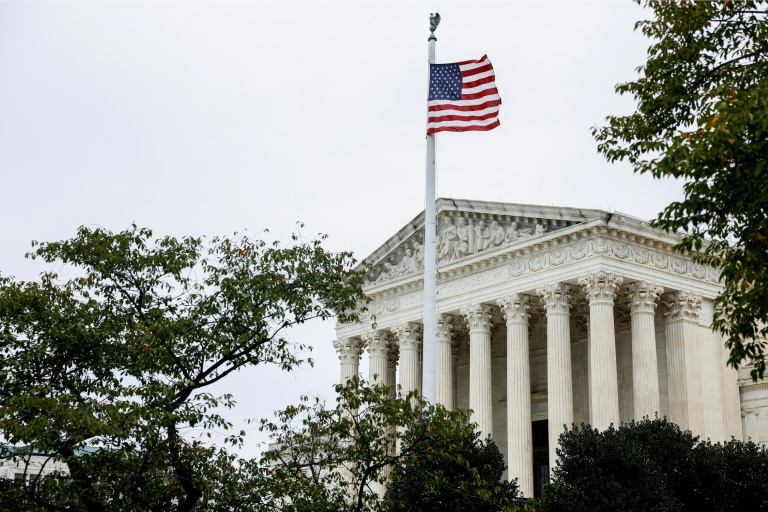
The conservative-dominated US Supreme Court is to examine the question on Monday in a case that closely resembles one from just a few years ago, pitting religious liberty and free speech rights against anti-discrimination laws.

In June 2018, the nation’s highest court partially ruled in favor of a Colorado baker who had refused to make a wedding cake for a gay couple.

The latest case involves a suit filed by Lorie Smith, owner of 303 Creative, a website design company also in Colorado.

Smith has said that as a devout Christian she cannot produce wedding websites for same-sex couples because it would be “inconsistent” with her religious beliefs.

Colorado’s anti-discrimination law prohibits businesses from refusing service to someone on the basis of sexual orientation. An appeals court ruled against Smith and she appealed to the Supreme Court.

– ‘To speak or stay silent’ –

In accepting the case, the court said it would examine whether Colorado’s law “to compel an artist to speak or stay silent violates the free speech clause of the First Amendment.”

In their brief to the court, lawyers for Smith said she is “willing to create custom websites for anyone, including those who identify as LGBT, provided their message does not conflict with her religious views.”

“Forcing artists like painters, photographers, writers, graphic designers and musicians to speak messages that violate their deeply held beliefs fails to comport with the First Amendment’s promise of ‘individual dignity and choice,'” they added.

Attorneys for Colorado said the law “simply requires that, once a business offers a product or service to the public, the business sells it to all.

“The company can define its service however it wants — including offering only websites that include biblical quotes describing marriage as the union of one man and one woman,” they said.

“But the company must sell whatever it offers to customers regardless of their race, religion, sexual orientation or other protected characteristic,” they said.

– ‘Replay of Masterpiece Cakeshop’ –

David Cole, national legal director of the American Civil Liberties Union, said the latest case is a “replay of Masterpiece Cakeshop,” the earlier case involving the baker.

“If the courts were to recognize a First Amendment right of the businesses that sell expressive services to discriminate, then architects could refuse to design homes for Black families,” Cole said.

“Bakeries could refuse to make custom birthday cakes for Muslim children. Florists could refuse to provide flowers for a gay person’s funeral.”

In the previous case, the justices voted 7-2 that the Colorado Civil Rights Commission had displayed anti-religious hostility toward the baker, thus violating his constitutional rights.

The court, however, did not squarely address the issue of whether a business can decline to serve gays and lesbians on religious grounds.

The Supreme Court has undergone a radical transformation since that ruling, with two conservative justices nominated by Donald Trump replacing two liberal justices, giving conservatives a 6-3 majority.

Trump’s Republican administration defended the position of the baker in the 2018 case, while this time the administration of President Joe Biden, a Democrat, is backing Colorado and its anti-discrimination laws.

The Supreme Court is expected to deliver its ruling before the end of June.

Blinken warns Netanyahu on annexation but holds fire on far-right cabinet

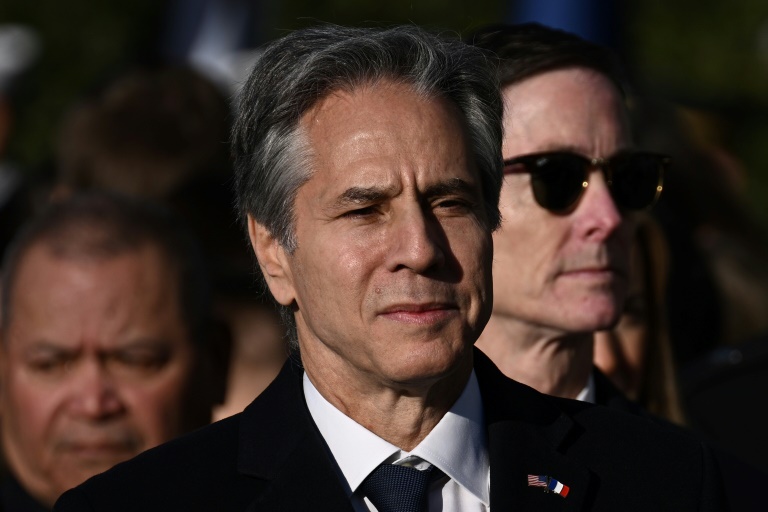
US Secretary of State Antony Blinken vowed Sunday to oppose Israeli settlements or annexation in the West Bank, but promised to judge Prime Minister Benjamin Netanyahu’s incoming government by actions and not personalities.

Netanyahu is expected within days to return to power after sealing a coalition deal with extreme-right movements including Religious Zionism, which is set for a post in charge of settlements in the occupied West Bank.

Speaking to J Street, a left-leaning pro-Israel US advocacy group, Blinken offered congratulations to the veteran Israeli leader, who has clashed with previous Democratic administrations in Washington.

“We will gauge the government by the policies it pursues rather than individual personalities,” Blinken said.

But he said President Joe Biden’s administration would work “relentlessly” to preserve a “horizon of hope,” however dim, for the creation of a Palestinian state.

“We will also continue to unequivocally oppose any acts that undermine the prospects of a two-state solution, including but not limited to settlement expansion, moves toward annexation of the West Bank, disruption to the historic status quo of holy sites, demolitions and evictions, and incitement to violence,” Blinken said.

He said that the Biden administration will insist on “core democratic principles, including respect to the rights of LGBTQ people and the equal administration of justice for all citizens of Israel.”

The far-right groups in Netanyahu’s coalition will include Noam, whose leader Avi Maoz is staunchly opposed to LGBTQ rights.

Netanyahu has said Jerusalem’s Pride march will continue, contradicting Maoz, who has vowed to cancel it.

“On the LGBT questions, I just won’t accept any of that,” Netanyahu said in an interview with NBC News.

Speaking before Blinken’s remarks, Netanyahu pointed out that the outgoing government led by Yair Lapid relied on support from an Arab Israeli party with Islamist roots and said he “didn’t hear a word from all the chorus of critics” about it.

Religious Zionism’s leader Itamar Ben-Gvir, who is expected to play a key role, is a staunch advocate of Jewish settlements. Until a few years ago, he had a portrait in his living room of Baruch Goldstein, who massacred 29 Palestinian worshippers at a Hebron mosque in 1994.

Jeremy Ben-Ami, the president of J Street, told reporters the State Department had a “strong case” to consider Ben-Gvir persona non grata and that the US administration should consider not dealing with other officials from extreme backgrounds.

– ‘No substitute’ for peace –

The November 1 election was Israel’s fifth in less than four years and came after the collapse of Lapid’s diverse coalition that tried to keep out the scandal-plagued Netanyahu.

Any fresh attempt by Israel to seize the West Bank could go against promises Netanyahu made in 2020 to the United Arab Emirates, which became the first Arab state in decades to recognize Israel. 

Netanyahu and the administration of then US president Donald Trump hailed the so-called Abraham Accords as a key achievement. 

Three other Arab nations quickly followed in discussing ties with Israel, whose commercial relationship with the UAE has soared over the past two years. 

Drawing some of the biggest applause from J Street, Blinken said, “For all of its benefits, normalization between Israel and its neighbors is not a substitute for building peace between Israelis and Palestinians.” 

“I know that many people are disillusioned; many people are frustrated,” Blinken said. 

“We’ve been trying to get to a two-state solution for decades and yet it seems that we’ve only gotten further away from that goal,” he said.

But he warned not to “succumb to cynicism” and to keep working for peace. 

The United States has made no major diplomatic effort to broker a two-state solution since the Barack Obama presidency, with Biden administration officials privately skeptical that they can reach any agreement with Netanyahu.

W.African leaders agree to create regional force

West African leaders agreed on Sunday to create a regional force to intervene against jihadism and in the event of coups, a senior official said.

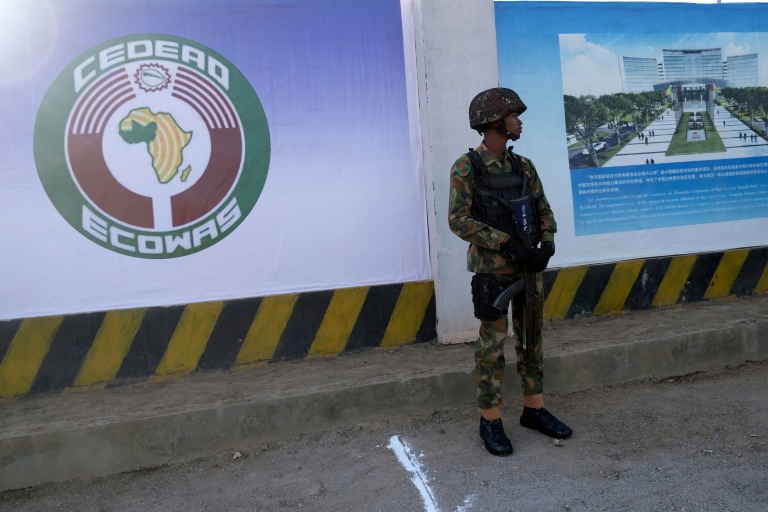
Leaders of the Economic Community of West African States had decided to act to “take care of our own security in the region”, Omar Alieu Touray, president of the ECOWAS commission, told journalists at a summit in Nigeria.

They are “determined to establish a regional force that will intervene in the event of need, whether this is in the area of security, terrorism and restore constitutional order in member countries,” he added.

Mali, Guinea and Burkina Faso have all been hit by military coups in the last two years.

Several countries in the region are also suffering from the spread of jihadism, including Mali, Burkina Faso and Niger, and southwards to the Gulf of Guinea. 

National armies, largely powerless against the jihadist forces operating across borders, have been cooperating with external actors such as the UN, France and Russia.

But Touray said this decision would “restructure our security architecture”.

The modalities of the planned regional force will be considered by defence chiefs in the second half of 2023, Touray said.

The funding of the force must also be decided, but the ECOWAS official stressed that such an operation could not be solely dependent on voluntary contributions.

– Pressure on Mali –

Addressing another regional problem, the West African leaders told Mali’s ruling junta to release 46 Ivorian troops it has held since July.

“We ask the Malian authorities to release the Ivorian soldiers by January 1, 2023 at the latest,” said Touray, at the Abuja summit.

The Gambian diplomat said the West African bloc reserved the right to act if the soldiers were not released by January 1.

If Mali fails to do so, ECOWAS will impose sanctions, a West African diplomat told AFP.

Togolese President Faure Gnassingbe, who has been mediating between Mali and Ivory Coast on the issue, will travel to Mali to “demand” the release of the soldiers, the diplomat added.

The Ivorian troops were arrested on July 10 on their arrival at the airport in Mali’s capital Bamako.

Ivory Coast says the troops were sent to provide backup for the UN peacekeeping mission in Mali, MINUSMA, and are being unfairly detained. 

Mali says the troops are mercenaries and has placed them in custody on charges of attempting to harm state security. 

ECOWAS had decided at an extraordinary summit in September to send a high-level delegation to Mali to try to resolve the crisis. But no progress was reported from this mission.

– Coup-hit nations –

The West African leaders, concerned about instability and contagion, have been pressing for months for the quickest possible return to civilian rule in the three countries which have undergone coups in recent years.

Mali and Burkina Faso have both been severely shaken by the spread of jihadism.

All three countries have been suspended from the decision-making bodies of ECOWAS.

Leaders of the military juntas have pledged, under pressure, to step down after two years, allowing for a transition period during which they all say they want to “rebuild” their state.

ECOWAS has been looking to see what progress each nation has been making towards restoring constitutional order.

In Mali, “it is essential that constitutional order returns within the planned timeframe”, said Touray.

If Mali’s military meets the announced deadline of March 2024 — after months of confrontation with ECOWAS and a severe trade and financial embargo that has now been lifted — the “transition” will in fact have lasted three and a half years.

Touray urged the junta in Guinea to involve all parties and civil society in dialogue “immediately” on the process of restoring civilian rule.

The main political parties and much of civil society there have been boycotting the authorities’ offer of dialogue.

As for Burkina Faso, Touray expressed ECOWAS’s “serious concerns” about the security situation and the humanitarian crisis there, while pledging support for the country. 

In El Salvador, soldiers patrol where gangs once ruled

Mauricio Gonzalez, an Evangelical pastor in a Salvadoran city overrun with violent street gangs, says life there used to be terrifying.

In his La Campanera neighborhood of the city of Soyapango, on the outskirts of San Salvador, gangsters threatened to kill him for preaching to young people.  

“The gang would not tolerate it. So I left and did not come back,” said Gonzalez, carrying a Bible in his hand. He said that for a decade now, no one from his church has dared venture into La Campanera, which is home mainly to factory workers.

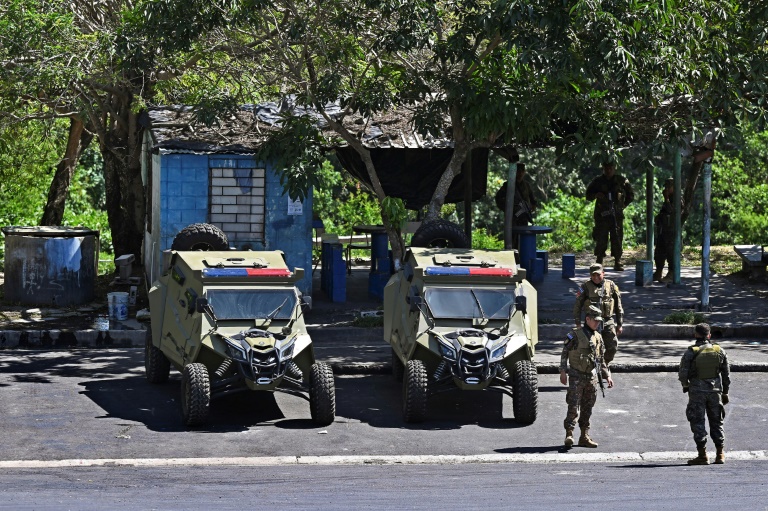
But that changed this weekend as 10,000 soldiers and police, many armed with assault rifles, surrounded the city and started patrolling its streets, going from house to house to arrest suspected gang members. 

Here, the gang that runs things is called Barrio 18, “barrio” meaning neighborhood. It is one of the most violent gangs in El Salvador. 

“Before, not even God cold save us from the gangsters. Today is different, said Gonzalez, who is 52.

Indeed, on Sunday, Gonzalez came to La Campanera with about 30 members of his church to preach. 

The huge security operation that began Saturday was part of a state of emergency declared by President Nayib Bukele this spring following a surge in gang violence.

The president had announced last month a plan to use troops to surround cities while house-by-house searches are conducted for gang members. Soyapango is the first city subjected to that approach.

– A big change for the better –

As of Saturday, the authorities reported only 12 arrests in the operation in Soyapango. 

But on Sunday police did say they had arrested a major Barrio 18 figure. They identified him as Guillermo Alexander Pineda, alias “Lazy,” and said he had ordered killings and extortions nationwide.

On Sunday, a group of soldiers took up position on the only street leading into La Campanera, searching everyone entering or leaving either on foot on in cars. Others patrol in armored cars rumbling through narrow streets of cement homes in this working class area.

Residents walked about looking relaxed, and shopped at sidewalk stands. Before, there were many fewer such vendors, as merchants could not afford the extortion payments that gangsters demanded.

“Only someone who has not lived here would not realize how different things are now,” said Etelvina Rosas, 36, who was selling fruit. “Today everything is safer. People are daring to do business. You don’t see the young guys in the streets,” she said, referring to gang members.

She said that several times she has had to pay off the gangs. 

Since Bukele declared the state of emergency in March, more than 58,000 suspected gang members have been arrested, the government says, although humanitarian groups have questioned what they say can be heavy-handed tactics.

The nationwide state of emergency, which allows detention without court order, followed a surge in violence that claimed 87 lives between March 25 and 27.

Despite opposition from humanitarian groups, the emergency order was extended by Congress to mid-December.

Soyapango Mayor Nercy Montano said last week that government actions in the city had brought a huge improvement in safety. 

– War zone –

On the road leading to La Campanera there is a settlement called Las Margaritas, which historically is controlled by a gang called Mara Salvatrucha, or MS-13, which is the arch enemy Barrio 18. 

On one of the streets in Las Margaritas, at least six armored cars were visible Sunday.

“Our orders are to not leave a single terrorist in Soyapango,” a soldier who declined to give his name told AFP. 

Gangs in El Salvador, called maras in Spanish, normally paint walls with distinctive graffiti to mark off territory, but in Las Margaritas the authorities have erased those writings.

Mirna Polanco, a 24-year-old university student, said as she walked along the road that connects Las Margaritas and La Campanera that this used to be a war zone because of the gun battles the two gangs would wage.

“All of that has been going away and let’s hope it stays that way from now on,” Polanco said.

“We will not leave Soyapango until we capture the last gang member,” said Defense Minister Rene Merino.

Blinken warns Netanyahu on annexation but holds fire on far-right cabinet

US Secretary of State Antony Blinken vowed Sunday to oppose Israeli settlements or annexation in the West Bank, but promised to judge Prime Minister Benjamin Netanyahu’s incoming government by actions and not personalities.

Netanyahu is expected within days to return to power after sealing a coalition deal with extreme-right movements including Religious Zionism, which is set for a post in charge of settlements in the occupied West Bank.

Speaking to J Street, a left-leaning pro-Israel US advocacy group, Blinken offered congratulations to the veteran Israeli leader, who has clashed with previous Democratic administrations in Washington.

“We will gauge the government by the policies it pursues rather than individual personalities,” Blinken said.

But he said President Joe Biden’s administration would work “relentlessly” to preserve a “horizon of hope,” however dim, for the creation of a Palestinian state.

“We will also continue to unequivocally oppose any acts that undermine the prospects of a two-state solution, including but not limited to settlement expansion, moves toward annexation of the West Bank, disruption to the historic status quo of holy sites, demolitions and evictions, and incitement to violence,” Blinken said.

He said that the Biden administration will insist on “core democratic principles, including respect to the rights of LGBTQ people and the equal administration of justice for all citizens of Israel.”

The far-right groups in Netanyahu’s coalition will include Noam, whose leader Avi Maoz is staunchly opposed to LGBTQ rights.

Netanyahu has said Jerusalem’s Pride march will continue, contradicting Maoz, who has vowed to cancel it.

“On the LGBT questions, I just won’t accept any of that,” Netanyahu said in an interview with NBC News.

Speaking before Blinken’s remarks, Netanyahu pointed out that the outgoing government led by Yair Lapid relied on support from an Arab Israeli party with Islamist roots and said he “didn’t hear a word from all the chorus of critics” about it.

Religious Zionism’s leader Itamar Ben-Gvir, who is expected to play a key role, is a staunch advocate of Jewish settlements. Until a few years ago, he had a portrait in his living room of Baruch Goldstein, who massacred 29 Palestinian worshippers at a Hebron mosque in 1994.

Jeremy Ben-Ami, the president of J Street, told reporters the State Department had a “strong case” to consider Ben-Gvir persona non grata and that the US administration should consider not dealing with other officials from extreme backgrounds.

– ‘No substitute’ for peace –

The November 1 election was Israel’s fifth in less than four years and came after the collapse of Lapid’s diverse coalition that tried to keep out the scandal-plagued Netanyahu.

Any fresh attempt by Israel to seize the West Bank could go against promises Netanyahu made in 2020 to the United Arab Emirates, which became the first Arab state in decades to recognize Israel. 

Netanyahu and the administration of then US president Donald Trump hailed the so-called Abraham Accords as a key achievement. 

Three other Arab nations quickly followed in discussing ties with Israel, whose commercial relationship with the UAE has soared over the past two years. 

Drawing some of the biggest applause from J Street, Blinken said, “For all of its benefits, normalization between Israel and its neighbors is not a substitute for building peace between Israelis and Palestinians.” 

“I know that many people are disillusioned; many people are frustrated,” Blinken said. 

“We’ve been trying to get to a two-state solution for decades and yet it seems that we’ve only gotten further away from that goal,” he said.

But he warned not to “succumb to cynicism” and to keep working for peace. 

The United States has made no major diplomatic effort to broker a two-state solution since the Barack Obama presidency, with Biden administration officials privately skeptical that they can reach any agreement with Netanyahu.

China astronauts return from Tiangong space station

Three Chinese astronauts safely returned to Earth on Sunday after six months aboard the Tiangong space station, state media quoted the country’s space agency as saying, with their mission deemed a “complete success.”

The team, which had been aboard the station since early June, touched down at the Dongfeng landing site in Inner Mongolia at 8:09 pm Beijing time (1209 GMT), Xinhua news agency said, citing the China Manned Space Agency.

Medical personnel said they were in good health, the report said.

The Tiangong space station is the crown jewel of Beijing’s ambitious space programme — which has landed robotic rovers on Mars and the Moon, and made the country the third to put humans in orbit — as it looks to catch up with the United States and Russia.

The three Shenzhou-14 astronauts — mission commander Chen Dong, China’s first woman astronaut Liu Yang and teammate Cai Xuzhe — had been tasked with overseeing the final stages of construction of the space station. 

The last module successfully docked with Tiangong’s core structure last month, state media said — a key step in its completion by year’s end.

“I am honored to witness the formation of our space station’s basic configuration,” said Chen, an air force pilot who became the first Chinese astronaut to stay in orbit for more than 200 days, according to Xinhua.

The team has handed the baton to the Shenzhou-15 crew — China’s first crew handover in orbit.

China has been excluded from the International Space Station since 2011, when the United States banned NASA from engaging with the country.

Once completed, the Tiangong space station is expected to have a mass of 90 tonnes — around a quarter of the ISS — or similar in size to the Soviet-built Mir station that orbited Earth from the 1980s until 2001.

Tiangong, which means “heavenly palace”, will operate for around a decade and host a variety of experiments in near-zero gravity.

China astronauts return from Tiangong space station

Three Chinese astronauts safely returned to Earth on Sunday after six months aboard the Tiangong space station, state media quoted the country’s space agency as saying, with their mission deemed a “complete success.”

The team, which had been aboard the station since early June, touched down at the Dongfeng landing site in Inner Mongolia at 8:09 pm Beijing time (1209 GMT), Xinhua news agency said, citing the China Manned Space Agency.

Medical personnel said they were in good health, the report said.

The Tiangong space station is the crown jewel of Beijing’s ambitious space programme — which has landed robotic rovers on Mars and the Moon, and made the country the third to put humans in orbit — as it looks to catch up with the United States and Russia.

The three Shenzhou-14 astronauts — mission commander Chen Dong, China’s first woman astronaut Liu Yang and teammate Cai Xuzhe — had been tasked with overseeing the final stages of construction of the space station. 

The last module successfully docked with Tiangong’s core structure last month, state media said — a key step in its completion by year’s end.

“I am honored to witness the formation of our space station’s basic configuration,” said Chen, an air force pilot who became the first Chinese astronaut to stay in orbit for more than 200 days, according to Xinhua.

The team has handed the baton to the Shenzhou-15 crew — China’s first crew handover in orbit.

China has been excluded from the International Space Station since 2011, when the United States banned NASA from engaging with the country.

Once completed, the Tiangong space station is expected to have a mass of 90 tonnes — around a quarter of the ISS — or similar in size to the Soviet-built Mir station that orbited Earth from the 1980s until 2001.

Tiangong, which means “heavenly palace”, will operate for around a decade and host a variety of experiments in near-zero gravity.

Worried fans keep vigil outside Brazil clinic of football icon Pele

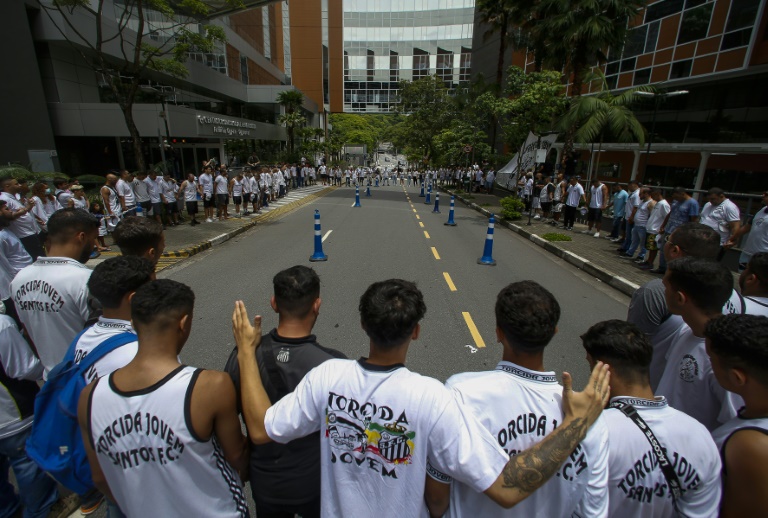
Fans of football superstar Pele congregated Sunday outside the Sao Paulo hospital where the 82-year-old Brazilian icon is being treated for a respiratory infection.

More than 100 devotees prayed for the recovery of the man widely regarded as the greatest footballer of all time. 

The three-time world champion had been hospitalized on Tuesday amid ongoing treatments for colon cancer, a condition first diagnosed in September 2021.

“We are a spiritual force” praying for the sporting idol as he wages “one of the toughest battles of his life,” one fan, Marcos Bispo dos Santos, told AFP.

Doctors at Sao Paulo’s Albert Einstein Hospital said Saturday that Pele — born Edson Arantes do Nascimento — remained “stable.” 

Pele “has had a good response to care without any worsening in the clinical picture in the last 24 hours,” they said in a statement. 

The star later struck an optimistic note in an Instagram post, saying, “My friends, I want to keep everyone calm and positive. I’m strong, with a lot of hope and I follow my treatment as usual.”

On Sunday, his fans stood mostly in silence outside the clinic in the Morumbi neighborhood of western Sao Paulo, holding a banner bearing an image of a youthful Pele and marked “Torcida Joven” (“Young Fans”).

“Long live the king!” said several posters pasted on walls near entrances to the hospital.

Around noon, the fans formed a circle and held hands as they recited an “Our Father.”

On Saturday, the daily Folha de S.Paulo reported that Pele was no longer responding to chemotherapy and was now receiving only “palliative care,” as ESPN Brazil had reported days earlier. 

The hospital and Pele’s family have not confirmed this. 

But amid the reports about the alleged deterioration of the star’s health, concern was growing both in Brazil’s football world and among ordinary Brazilians.

“We are here to give him strength, so that the king of football can recover,” said Maicon Peterson who, along with his two-year-old son, was part of the vigil outside the hospital.

“We are suffering a lot, but God willing, he will make it through this.”

OPEC+ to keep output unchanged in uncertain climate

Major oil-producing countries led by Saudi Arabia and Russia agreed Sunday to maintain their current output levels in a climate of uncertainty and ahead of fresh sanctions against Moscow coming into force next week.

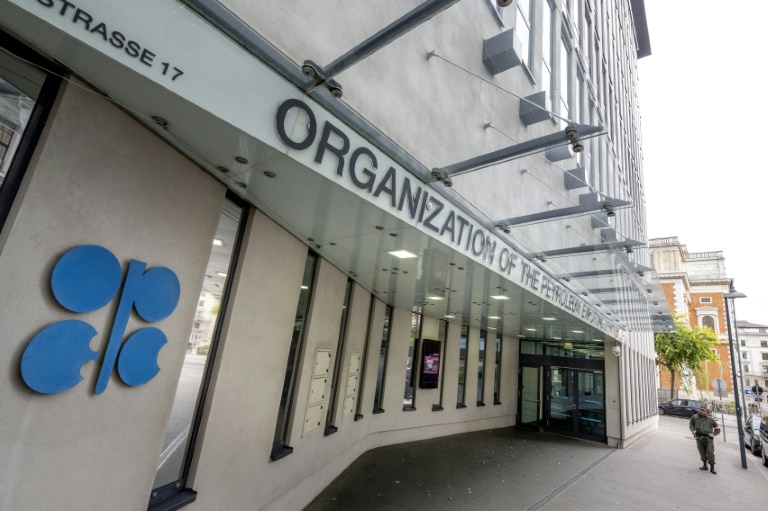
The representatives of the thirteen members of the Organization of the Petroleum Exporting Countries (OPEC) led by Riyadh, and their 10 allies headed by Moscow, decided to stick to their course agreed in October of a production cut of two million barrels per day until the end of 2023.

Sunday’s widely anticipated move was no “big surprise” given that the economy has been “slowing somewhat, pushing oil prices below $90, despite the lower production levels,” analyst Hans van Cleef with ABN AMRO said.  

Collectively known as OPEC+, the alliance said Sunday that its October decision to cut output was “purely driven by market considerations”, adding that it had been the “necessary and right course of action towards stabilizing global oil markets”. 

The OPEC+ output reduction in October represented the biggest cut since the height of the Covid pandemic in 2020, a move denounced by the United States as a concession to Moscow.

The next OPEC+ ministerial meeting is scheduled for June 4, 2023.

But the alliance said it was ready to “meet at any time and take immediate additional measures” to address market developments and support the oil market if necessary.

– Spotlight on Russia –

On Friday, the EU, G7 and Australia agreed a $60-per-barrel price cap on Russian oil, which will come into effect on Monday or soon after, alongside an EU embargo on maritime deliveries of Russian crude oil.

It will prevent seaborne shipments of Russian crude to the European Union, which account for two thirds of the bloc’s oil imports from Russia, an attempt to deprive Moscow’s war chest of billions of euros.

“We will sell oil and oil products to countries that will work with us on market terms, even if we have to reduce production somewhat,” Russia’s Deputy Prime Minister Alexander Novak said after Sunday’s quick meeting via videoconference.

Even though “inflation, the tightening of monetary policies and China’s Covid-19 epidemic” were posing risks to the market, it was still “in a better state than two months ago”, Novak said, according to Russian news agencies. 

“We are currently working on mechanisms to prohibit the use of the price cap tool at any level”, Novak added, stating that “such interference” could only cause “further market destabilization and scarcity of energy resources”.

Moscow had repeatedly denounced the incoming oil price cap, threatening to suspend deliveries to any country that adopted the measure. 

But Ukraine suggested on Saturday that the cap should have been set even lower.

For OPEC+, the big unknown in the oil equation is how heavily sanctions will hit Russian supply.

“Uncertainty on the impact on Russian oil production coming from the EU ban… and the G7 price cap and some easing of mobility restrictions in China likely supported the decision for a rollover,” UBS analyst Giovanni Staunovo said. 

“The upside risks for oil prices from this point on will increase” due to the announced EU and G7 measures in combination with supply and demand expected to remain unchanged, Van Cleef said.

– An ‘uncomfortable position’ –

Moscow’s threat to suspend deliveries to countries abiding by the price cap will put “some in a very uncomfortable position”, said OANDA analyst Craig Erlam, “choosing between losing access to cheap Russian crude or facing G7 sanctions”.

Amid economic gloom fuelled by soaring inflation and fears of China’s weaker energy demand due to its Covid-related restrictions, the two global crude benchmarks remained close to their lowest level of the year, far from their March peaks.

Since the group’s last meeting in early October, Brent North Sea oil and its US equivalent WTI have lost more than six percent of their value.

Moving forward, OPEC+ might still feel compelled to adopt “a more aggressive stance” by cutting or threatening to cut production, UniCredit analyst Edoardo Campanella said. 

“Russia might also retaliate by leveraging its influence within OPEC+ to push for more production cuts down the road, thus exacerbating the global energy crisis,” he added.

Close Bitnami banner
Bitnami