World

China moves to curb and censor rare, nationwide protests

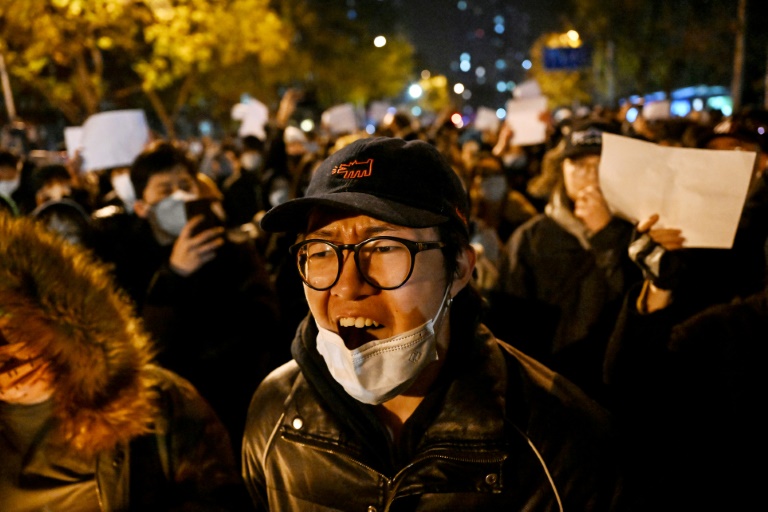
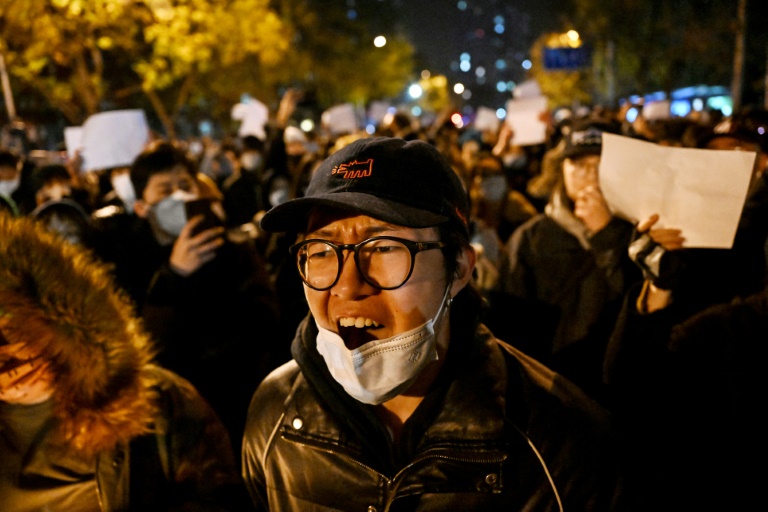
China’s security forces detained people Monday at the scene of a rare demonstration as authorities worked to extinguish protests that flared across the country calling for political freedoms and an end to Covid lockdowns.

AFP witnessed police leading two people away from a site in Shanghai where demonstrators gathered over the weekend, while China’s censors worked to scrub signs of the social media-driven rallies.

People took to the streets in major cities and gathered at university campuses across China on Sunday to call for an end to lockdowns and greater political freedoms, in a wave of protests not seen since pro-democracy rallies in 1989 were crushed.

A deadly fire last week in Urumqi, the capital of northwest China’s Xinjiang region, was the catalyst for the public anger, with many blaming Covid lockdowns for hampering rescue efforts.

But protesters also called for greater political freedoms — with some even demanding the resignation of China’s President Xi Jinping, recently re-appointed to a historic third term as the country’s leader.

Large crowds gathered Sunday in the capital Beijing and the economic hub of Shanghai, where police clashed with protesters as they tried to stop groups from converging at Wulumuqi street, named after the Mandarin for Urumqi.

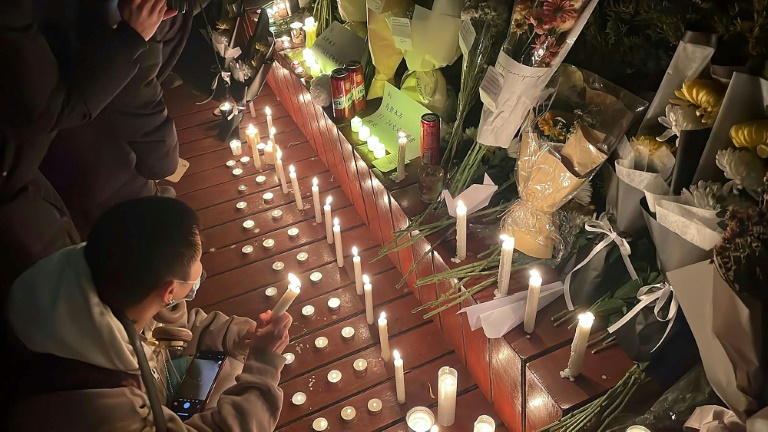
Hundreds of people rallied in the same area with blank sheets of paper and flowers to hold what appeared to be a silent protest on Sunday afternoon.

The BBC said one of its journalists had been arrested and beaten by police while covering the Shanghai protests.

In the capital, at least 400 people gathered on the banks of a river for several hours, with some shouting: “We are all Xinjiang people! Go Chinese people!”

AFP journalists at the tense scene of the Shanghai protests Monday saw a substantial police presence, with blue fences in place along the pavements to stop further gatherings.

Two people were then detained by police at the site, an AFP journalist saw, with law enforcement preventing passersby from taking photos or video of the area.

When asked why one of the people was taken away, a policeman told AFP “because he didn’t obey our arrangements” before referring the reporter to local police authorities.

Shanghai police had not responded on Monday to repeated enquiries about how many people had been detained.

An AFP journalist filmed people being detained on Sunday.

State censors appeared to have largely cleaned Chinese social media of any news about the rallies by Monday.

The search terms “Liangma River”, “Urumqi Road” — sites of protests in Beijing and Shanghai — had been scrubbed of any references to the rallies on the Twitter-like Weibo platform.

– ‘Boiling point’ –

China’s strict control of information and continued travel curbs tied to the zero-Covid policy make verifying numbers of protestors across the vast country challenging.

But such widespread rallies are exceptionally rare, with authorities harshly clamping down on any and all opposition to the central government.

Spreading through social media, they have been fuelled by frustration at the central government’s zero-Covid policy, which sees authorities impose snap lockdowns, lengthy quarantines and mass testing campaigns over just a handful of cases.

Protests also occurred on Sunday in Wuhan, the central city where Covid-19 first emerged, while there were reports of demonstrations in Guangzhou, Chengdu and Hong Kong.  

At the scene of the Beijing riverside rally, where rows of police vehicles were in place on Monday, a female jogger in her twenties told AFP she had seen the protests on social media.

“This protest was a good thing, it sent the signal that people were fed up with too strong restrictions,” the jogger, who asked not to be named, said.

“I think the government has understood the message and that they will ease the policy in order to give them and everyone a way out,” she added, saying that “censorship couldn’t keep up” with news of the protests.

State-run newspaper the People’s Daily published a commentary Monday morning warning against “paralysis” and “battle-weariness” in the fight against Covid — but stopped far short of calling for an end to hardline policy.

“People have now reached a boiling point because there has been no clear direction to path to end the zero-Covid policy,” Alfred Wu Muluan, a Chinese politics expert at the National University of Singapore, told AFP.

“The party has underestimated the people’s anger.”

China reported 40,052 domestic Covid-19 cases Monday, a record high but tiny compared to caseloads in the West at the height of the pandemic.

Dance classes give hope to Portuguese prisoners

Inside a high-security Portuguese prison, six inmates are moving gracefully around in a series of improvised dance moves, clutching props and following the rhythm of the music.

Outside, the high walls of Linho prison in the western suburbs of Lisbon are lined with barbed wire and a loudspeaker barks instructions for prisoners in a metallic voice.

But in the contemporary dance studio, in a converted former chapel, inmates are dancing freely to classical music with an object of their choice: a scarf, ball, plastic bags or a light bulb.

“Dance — with poetry!” calls out the teacher, 47-year-old dancer Catarina Camara.

She hopes the classes — part of a social dance project that began in April 2019 — can help change the mindset of some of the young prisoners.

“When we are here, it feels like we are not in prison,” says 30-year-old inmate Manuel Antunes.

“We can let ourselves go, carried by the moment and by what we feel.”

There are around 500 prisoners in Linho, many of them young men who have committed serious offences and been handed sentences of 15 years or more.

Around a dozen are now taking part in the dance project.

“It would be very naive to say that artistic practice saves people,” Camara tells AFP.

“But art, combined with other factors, can be decisive in changing someone’s life.”

– ‘Completely transformed’ –

She says many of the prisoners are “boys who grew up on the street and who had to fend for themselves very early.”

“They messed up. Some seriously messed up, and they really need to be supported.”

Fabio Tavares, 28, says he is one such person.

Never interested in contemporary dance before Camara’s class, he believes it has “completely transformed” him.

“I thought it would be useless… (but) the dance and discussions that we have here help me to see things differently,” he says.

The results have been positive beyond the direct impact of the classes too, according to prison director Carlos Moreira.

Prisoners participating in the dance project are “more tolerant towards others” and less likely to breach prison rules, he says.

Camara hopes that because “dance offers this experience of freedom”, it can help the men “prepare for the space of freedom” they will find on their release from prison.

When he has finished his sentence, Tavares plans to continue dancing and has already been offered training by choreographer Olga Roriz.

Roriz, who works with Camara, staged a performance with the prisoner-dancers last summer in Lisbon.

The dancers are now preparing for their own show inside the prison.

“I feel light when I’m here,” says Tavares.

“Sometimes it even feels like I’m not in prison but out, in a normal dance class.”

Somali forces battle militants for hotel in Mogadishu: police

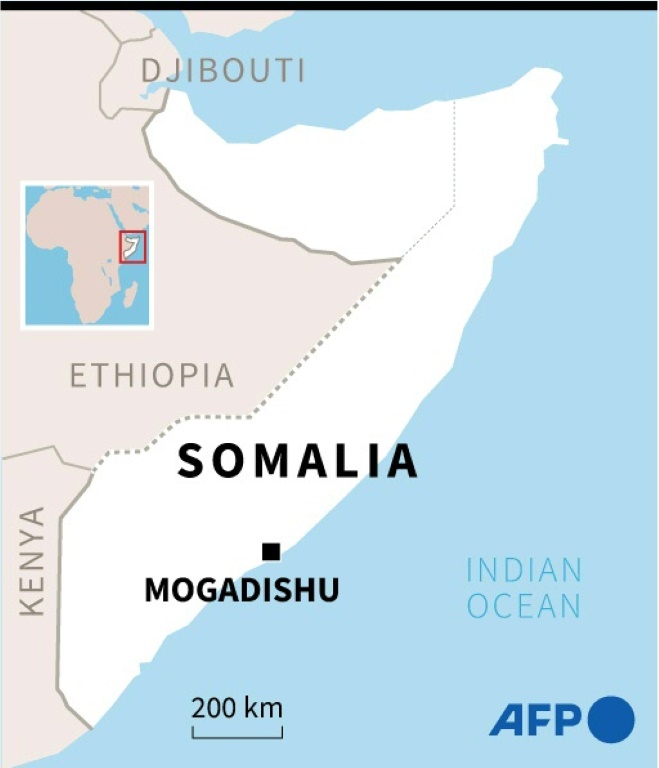
Somalia’s security forces exchanged gunfire with militants holed up in a hotel in Mogadishu on Monday after Al-Shabaab stormed the popular venue near the presidential palace and laid siege overnight.

Sporadic gunfire and explosions could still be heard after dawn around the Villa Rose, a hotel in a secure central part of Mogadishu frequented by lawmakers and public officials.

Police said late Sunday that government forces were seeking to “eliminate” a number of armed militants inside the Villa Rose after attacking the hotel in a hail of bullets and explosions.

National police spokesman Sadik Dudishe said many civilians and officials had been rescued, but did not offer further details.

Witnesses described two massive explosions followed by gunfire that sent people fleeing the scene in Bondhere district. The hotel is just a few blocks from the office of Somalia’s President Hassan Sheikh Mohamud.

Al-Shabaab, a militant group affiliated with Al-Qaeda that has been trying to overthrow Somalia’s central government for 15 years, claimed responsibility for the attack.

The African Union Transition Mission in Somalia (ATMIS), a 20,000-strong military force drawn from across the continent, praised the “swift” security response to the attack in a statement late Sunday.

On its website the Villa Rose describes the hotel as the “most secure lodging arrangement in Mogadishu” with metal detectors and a high perimeter wall. 

– Retaliatory attacks –

Al-Shabaab has intensified attacks against civilian and military targets as Somalia’s newly-elected government has pursued a policy of “all-out war” against the Islamists.

The security forces, backed by local militias, ATMIS and US air strikes, have driven Al-Shabaab from central parts of the country in recent months, but the offensive has drawn retribution.

On October 29, two cars packed with explosives blew up minutes apart in Mogadishu followed by gunfire, killing at least 121 people and injuring 333 others.

It was the deadliest attack in the fragile Horn of Africa nation in five years.

At least 21 people were killed in a siege on a Mogadishu hotel in August that lasted 30 hours before security forces could take control from the militants inside.

The UN said earlier this month that at least 613 civilians had been killed and 948 injured in violence this year in Somalia, mostly caused by improvised explosive devices (IEDs) attributed to Al-Shabaab. 

The figures were the highest since 2017 and a more-than 30-percent rise from last year.

UK start-up behind algae-based packaging bids for Earthshot glory

A British start-up founded by two ex-students from France and Spain, crafting biodegradable packaging from marine plants, is aiming to seal royal approval this week when Prince William unveils his latest Earthshot prizes.

Notpla — whose mantra is “we make packaging disappear” — is competing with 14 other firms for five prestigious awards, to be dished out by the prince and a star-studded cast at a ceremony in US city Boston on Friday.

In its second year, the initiative to reward innovative efforts to combat climate change will then be broadcast on UK and US television on Sunday and Monday, respectively, as well as online.

The five winners will each receive a £1 million ($1.2 million) grant. 

The co-creator of Notpla, which rather than using environmentally damaging plastics makes various naturally degrading — and even edible — packaging from seaweed and other marine plants, says they have already felt the competition’s benefits.

“Just being there is a massive boost to our visibility,” French co-founder Pierre Paslier, 35, told AFP.

“So that’s already a huge asset to be part of the finalists and I think that if we win, it’s just going to be that on a much larger scale.”

Together with fellow former Royal College of Art student and co-founder Rodrigo Garcia Gonzalez, 38, the duo began their eco-business adventure in a small London kitchen. 

They were intent on finding natural alternatives to petrochemicals-based packaging, sampling a variety of materials from tapioca seeds to other starches. 

– Seaweed ‘family’ –

“Eventually, we found seaweed,” explained Paslier, a former packaging engineer at French cosmetics giant L’Oreal who created Notpla with Gonzalez in 2014. 

“Now we have a flexible film, we make seaweed paper, we have rigid materials. So it’s really the beginning of a family of seaweed-based technologies that hopefully can help us stop using so much plastic.”

He said their early kitchen exploits had eventually led to the secretly-formulated “Ooho” creation.

An edible bubble membrane made from seaweed — holding water, sports drinks or other flavoured liquids including cocktails and sauces — it is marketed as a replacement for single-use plastic cups, bottles and sachets. 

Tasting like a gelatinous candy, it can be consumed whole — like a cherry tomato — or from a larger sachet, making it ideal at sporting events and festivals.

It has been widely used at marathons across the UK, including the 2019 London run.

Viral online interest has helped attract the attention of investors, with Notpla expanding rapidly to boast more than 60 employees and finding itself on the verge of manufacturing its products on an industrial scale.

Production of “Ooho” takes place at the firm’s offices in a large warehouse, a stone’s throw from the Queen Elizabeth Olympic Park in east London. 

Notpla’s growing young team also has laboratories there as it continues to develop new algae-based products.

– ‘Very renewable’ –

Among the more recent results: a naturally biodegradable coating protecting takeaway food boxes from grease and liquids. 

The company now supplies industry giant Just Eat in Britain and five other European countries. 

It also provided the packaging for all the food sold during the final of the women’s European football championships at London’s Wembley Stadium in July. 

Another of its new innovations is a transparent package for dry goods, such as pasta. 

Paslier noted that although his products may currently cost more than plastic alternatives, the latter’s sales price fails to account for “the impact on societal ecosystems, health for humans or for marine life”.

“This is basically going to be paid for [by] the next generations and that doesn’t come into the price of plastic that you buy on the market today,” he added.

“So what we want is to be the most affordable, sustainable packaging solution that takes into account its whole lifetime costs.”

Paslier believes seaweed can become the most affordable packaging option, in large part due to its fast growth rate which can top one metre (3.3 feet) a day in the lab.

“It’s a very, very renewable resource,” he added, noting it doesn’t require any fresh water or fertilisers.

Its emergence is undoubtedly timely.

A recent OECD report found, at the current rate, worldwide plastic waste will triple by 2060 to one billion tonnes per year, much of which will pollute the oceans and threaten many species. 

Uyghur man's agony after five relatives died in Urumqi fire

When a deadly fire broke out in China’s northwest Xinjiang region, triggering a wave of public anger over the country’s zero-Covid policy, Abdulhafiz Maimaitimin initially could not believe that it claimed five of his relatives’ lives.

Ten people were killed and nine injured when the blaze ripped through a residential building in the regional capital Urumqi on Thursday night, with many blaming lengthy lockdowns for hampering rescue efforts.

The tragedy spurred an outpouring of anger in Urumqi which has since swelled into a wave of large-scale protests and candlelit vigils in several major cities across China.

Much of Xinjiang has been locked down for three months, as the remote region battles an uptick in Covid cases that have also surged nationwide.

Maimaitimin, 27, now living in exile in Switzerland, was stunned when he heard through a friend about the deaths of his 48-year-old aunt, Haiernishahan Abdureheman, and four of her children aged between four and 13.

“My arms and legs shook and I felt dizzy, I wanted to throw up. I couldn’t understand it,” Maimaitimin, a member of the Muslim Uyghur minority, told AFP from his home in Zurich.

He lost contact with his aunt in May 2017, while Xinjiang was in the grip of a widespread security crackdown which saw an estimated million Uyghurs arbitrarily detained in prisons and internment camps, some simply for speaking to relatives overseas.

“She was a housewife, her whole life was devoted to taking care of her kids and educating them well,” he said, bursting into tears.

“Five years later I really could not imagine I would hear about my relatives in this way.”

A photo of his aunt verified by Maimaitimin shows her sitting beside her four young children on a couch in a beautifully decorated living room. 

“Now I still feel terrible, I can’t cope,” he said.

– Three-hour blaze –

Online posts circulating on both Chinese and overseas social media platforms since Friday have claimed that lengthy Covid lockdowns in Urumqi hampered rescue attempts.

Social media videos show water sprayed from a fire engine parked outside the compound barely reaching the burning windows, while in another the dying screams of residents trapped inside can be heard.

State media said the fire took three hours to be extinguished.

City officials later claimed the apartment was in a low-risk area where residents could leave their homes freely, but acknowledged there were cars and bollards blocking the fire engine’s path.

“Some residents had a weak ability to rescue themselves … and did not carry out effective fire fighting or escape in time to rescue themselves,” Li Wensheng, head of the city fire rescue service, said Friday.

However, some witnesses and social media users later claimed the building’s doors were locked shut.

In one viral screenshot of a residents’ chat group, Maimaitimin identified his other male cousin begging neighbours to save his mother and siblings.

“I can’t contact the people in (flat) 1901 and don’t know their circumstances, they can’t open the door. Can you break open the door? There are children inside,” read the texts from his surviving cousin, who was not in Urumqi at the time.

Maimaitimin believes that his family were not rescued in time because they were Uyghur and lived in a Uyghur-majority neighbourhood in the city’s Tianshan district.

Chinese officials have not yet revealed the identities of the deceased, but there is widespread online speculation that the real death toll was higher.

A photo circulating on social media of the building’s charred remains showed blackened, destroyed windows on six floors of the building. 

“I will never trust the Chinese government. If Uyghurs protested, they would choke them dead,” he said.

“I think that protesters will be caught, and (Uyghurs) will be put under even stricter control.

China Covid lockdowns shut delivery workers out of their homes

Overworked, underpaid and thoroughly fed up, Wang’s troubles deepened even further when authorities abruptly locked down the delivery driver’s Beijing apartment block earlier this month.

Officials in the Chinese capital have doubled down on the country’s hallmark zero-Covid policy in recent weeks, one of an array of cities to impose sweeping shutdowns, mass testing and teleworking mandates as caseloads have hit all-time highs.

Wang is not alone in feeling frustrated.

The ruling Communist Party’s uncompromising zero-Covid strategy — now in force for about three years — has stoked anger and resentment, with widespread and sometimes violent protests kicking off across China’s major cities.

Pandemic fatigue has been on the rise for some time, as a recent lightening of virus curbs has coincided with record infection tallies, prompting a patchwork of onerous restrictions in multiple major cities.

China is the last major economy wedded to a zero-Covid strategy, but maintaining relatively low numbers of cases and deaths has constrained its economic recovery, disrupted supply chains and hammered employment.

– ‘I have no choice’ –

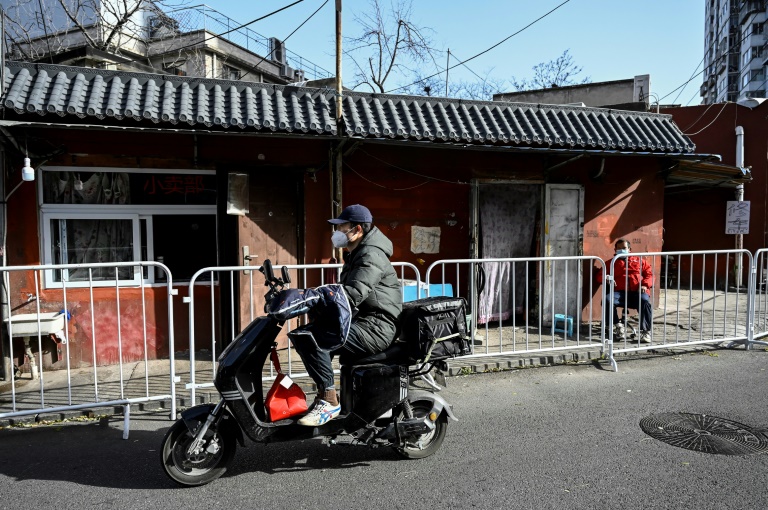
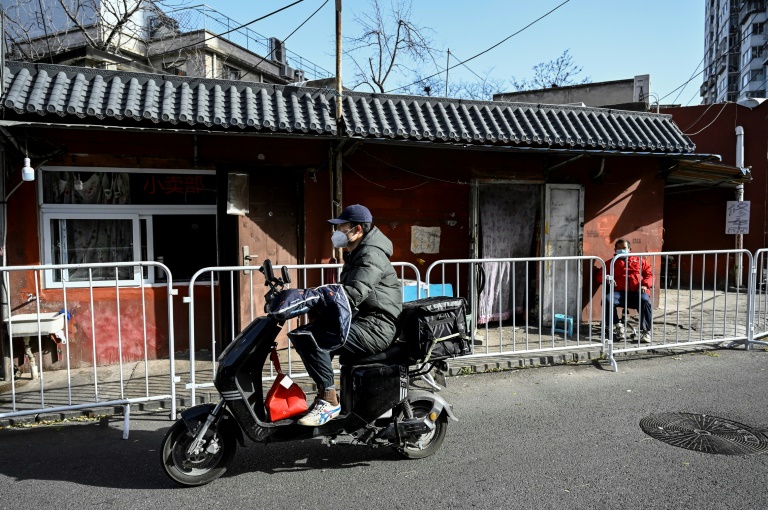
Demand for deliveries has soared under the tightening curbs as millions of housebound urbanites have turned to an army of low-paid couriers — mostly migrants from other provinces — to supply takeaway lunches and grocery orders.

But this time the restrictions have crept deep into places where drivers live, shutting many inside without pay and forcing others to choose between having a place to sleep and earning enough money to survive.

Wang, who scoots back and forth across a wealthy financial district delivering food orders for internet giant Meituan, said his housing compound was cordoned off on November 7 after two Covid cases were discovered.

Desperate not to lose his income — about 250 yuan ($34) a day — the 20-year-old broke lockdown rules by vaulting a fence to make his shifts, sneaking back in under cover of darkness.

“I have no choice. If I don’t make money, I can’t pay rent,” said the native of the industrial northern province of Shanxi.

“Lots of delivery guys don’t have anywhere to live at the moment,” he told AFP outside a deserted office block on a cold winter afternoon last week.

“I’m really dissatisfied with the Chinese government, because other countries aren’t strict about Covid any more,” he said.

“We’re going to such great lengths… and I don’t feel it’s necessary, because nobody is dying from it.”

AFP withheld Wang’s full name to protect him from potential repercussions for breaking lockdown and criticising the state.

– Sleeping rough –

When a shutdown loomed over Gu Qiang’s housing compound last week, the Meituan driver chose to sleep in his car.

“Spending 30 yuan to keep the engine running all night is still cheaper than getting a hotel,” the gruff northeast China native said.

“Some of my friends are living outside — they dare not go home.”

Several couriers interviewed by AFP described heavier workloads in recent weeks as lockdowns have left their companies short of labour.

While some said they were happy to take on money-spinning extra orders, most said they had endured longer working hours, extra stress and more negative interactions with customers.

They also said they had not received any additional support from Meituan or the companies to which delivery services have been outsourced.

Authorities last year launched an investigation into food delivery platforms following claims of exploitative labour practices including algorithms that effectively forced couriers to drive dangerously to meet tight delivery times.

Meituan did not respond to an AFP request for comment prior to publication.

But the company told the state-run China Daily newspaper last week that it had paid for hotel rooms for some stranded workers and welcomed calls for help from couriers in similar situations.

China Covid lockdowns shut delivery workers out of their homes

Overworked, underpaid and thoroughly fed up, Wang’s troubles deepened even further when authorities abruptly locked down the delivery driver’s Beijing apartment block earlier this month.

Officials in the Chinese capital have doubled down on the country’s hallmark zero-Covid policy in recent weeks, one of an array of cities to impose sweeping shutdowns, mass testing and teleworking mandates as caseloads have hit all-time highs.

Wang is not alone in feeling frustrated.

The ruling Communist Party’s uncompromising zero-Covid strategy — now in force for about three years — has stoked anger and resentment, with widespread and sometimes violent protests kicking off across China’s major cities.

Pandemic fatigue has been on the rise for some time, as a recent lightening of virus curbs has coincided with record infection tallies, prompting a patchwork of onerous restrictions in multiple major cities.

China is the last major economy wedded to a zero-Covid strategy, but maintaining relatively low numbers of cases and deaths has constrained its economic recovery, disrupted supply chains and hammered employment.

– ‘I have no choice’ –

Demand for deliveries has soared under the tightening curbs as millions of housebound urbanites have turned to an army of low-paid couriers — mostly migrants from other provinces — to supply takeaway lunches and grocery orders.

But this time the restrictions have crept deep into places where drivers live, shutting many inside without pay and forcing others to choose between having a place to sleep and earning enough money to survive.

Wang, who scoots back and forth across a wealthy financial district delivering food orders for internet giant Meituan, said his housing compound was cordoned off on November 7 after two Covid cases were discovered.

Desperate not to lose his income — about 250 yuan ($34) a day — the 20-year-old broke lockdown rules by vaulting a fence to make his shifts, sneaking back in under cover of darkness.

“I have no choice. If I don’t make money, I can’t pay rent,” said the native of the industrial northern province of Shanxi.

“Lots of delivery guys don’t have anywhere to live at the moment,” he told AFP outside a deserted office block on a cold winter afternoon last week.

“I’m really dissatisfied with the Chinese government, because other countries aren’t strict about Covid any more,” he said.

“We’re going to such great lengths… and I don’t feel it’s necessary, because nobody is dying from it.”

AFP withheld Wang’s full name to protect him from potential repercussions for breaking lockdown and criticising the state.

– Sleeping rough –

When a shutdown loomed over Gu Qiang’s housing compound last week, the Meituan driver chose to sleep in his car.

“Spending 30 yuan to keep the engine running all night is still cheaper than getting a hotel,” the gruff northeast China native said.

“Some of my friends are living outside — they dare not go home.”

Several couriers interviewed by AFP described heavier workloads in recent weeks as lockdowns have left their companies short of labour.

While some said they were happy to take on money-spinning extra orders, most said they had endured longer working hours, extra stress and more negative interactions with customers.

They also said they had not received any additional support from Meituan or the companies to which delivery services have been outsourced.

Authorities last year launched an investigation into food delivery platforms following claims of exploitative labour practices including algorithms that effectively forced couriers to drive dangerously to meet tight delivery times.

Meituan did not respond to an AFP request for comment prior to publication.

But the company told the state-run China Daily newspaper last week that it had paid for hotel rooms for some stranded workers and welcomed calls for help from couriers in similar situations.

Cuban municipal polls close as opposition deplores pressure

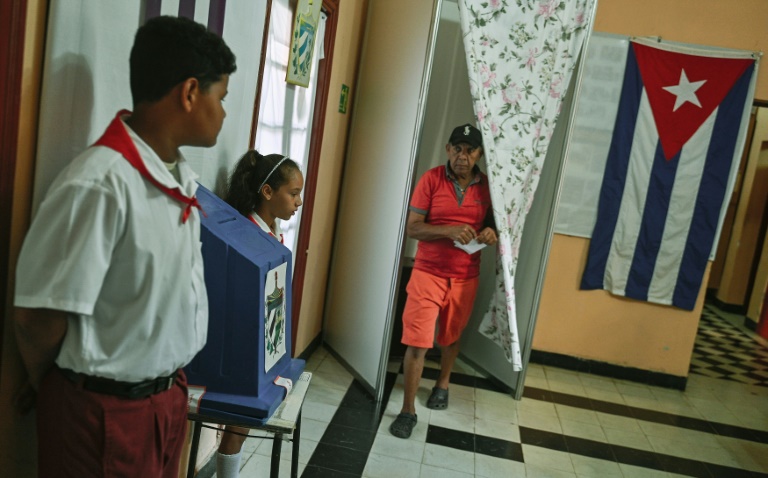
Cubans voted Sunday in municipal elections amid a grave economic crisis that some feared would weaken turnout and with the opposition charging that several of its candidates faced unfair pressure.

Polls closed at 7:00 pm (0000 GMT), one hour later than expected and after a day of voting without incident, AFP journalists reported.

Elections officials said the extension was due to requests made by polling stations and voters themselves.

As of 5:00 pm, according to the National Electoral Council, nearly 64 percent of Cuba’s eight million eligible voters had cast a secret ballot, selecting more than 12,400 municipal delegates, or councilors, from the 27,000 candidates nominated by show of hands in neighborhood assemblies.

Earlier Sunday, President Miguel Diaz-Canel, fresh off a trip that took him to Algeria, Russia, Turkey and China, went with his wife Lis Cuesta to vote at a polling station in Playa, west of Havana.

He later told reporters that the electoral process confirmed the political and social stability of the island, despite the “economic suffocation” he said the United States was imposing on Cuba.

The government had mounted an intense get-out-the-vote campaign on social media, as well as in the press and on television — both controlled by the ruling Communist Party, which oversees the election process but does not nominate candidates.

But the opposition platform known as the Council for the Democratic Transition in Cuba (CDTC), which promotes change and pluralism in the country through legal means, called on people to abstain, citing unfair pressure by the government.

– ‘Political police’ –

Its vice president, Manuel Cuesta, told AFP that three of the group’s candidates had been prevented “by the political police” from participating in neighborhood assemblies because they appeared to have a good chance of winning.

He said a fourth candidate, Jose Cabrera, was nominated in the southeastern city of Palma Soriano but never made it to the ballot over “threats of losing his job” and other difficulties.

The Cuban government has branded opposition members as US “mercenaries.”

These elections are the first step in a unique electoral system.

Councilors elected Sunday will form municipal governments that will propose 50 percent of the candidates for provincial assemblies and the National Assembly, which in turn elects the Council of State and the Cuban president from among its members.

The other 50 percent are put forward by social organizations close to the government.

In theory, the system allows any Cuban to reach parliament, but the opposition maintains that Communist Party militants have the ability to prevent any opposition member from being elected.

Adding uncertainty to the election — the first since Diaz-Canel came to power in 2018 —  is the economic crisis that has brought shortages of food and medicine and daily blackouts to the island, fueling an outflow of migrants and potentially increasing abstentionism.

Candidates who fail to win with an outright majority this Sunday will face a runoff on December 4.

Asian markets, crude drop on China Covid unrest

Stocks and oil prices sank Monday on concerns about protests across China at the government’s hardline zero-Covid policy, fuelling uncertainty in the world’s number two economy.

Hundreds of people took to the streets at the weekend after a deadly fire in the Xinjiang region on Thursday served as a catalyst for public anger, with many blaming virus lockdowns for hampering the rescue effort.

People have taken to the streets in Beijing, Shanghai, Guangzhou and Chengdu calling for an end to lockdowns as well as greater political freedoms in the highest-profile protests in China in years. The demonstrations come after an easing of some measures had fuelled hopes of a lighter pandemic approach.

China-linked stocks took the brunt of selling, with Hong Kong’s Hang Seng Index down more than three percent and Shanghai off more than one percent. The yuan was off more than one percent.

There were also losses in Tokyo, Sydney, Seoul, Singapore, Taipei and Wellington.

“Sentiment has turned sour as unrest across China grows,” said SPI Asset Management’s Stephen Inne. “Protest of this extent is rare in the country and raises many uncertainties.

“The best scenario is further easing and reopening, but the speed at how things deteriorated over the weekend suggests the government needs to act fast. The risk of the situation escalating from here and short-term volatility remains high.”

And Ken Cheung, of Mizuho Bank, added: “It appears that the zero-Covid policy is reaching its tipping point. More easing or refinement on the Covid measures will be needed to curb discontent.”

The prospect of a hit to demand in the world’s biggest crude importer hammered oil prices, with both main contracts down more than two percent.

The selling has taken a bit out of recent gains across markets in recent weeks sparked by hopes of a slowdown in the Federal Reserve’s interest rate hikes as inflation finally shows signs of softening.

However, some observers said the protests could provide long-term benefits as they could force President Xi Jinping to shift away from his strict, economically damaging measures sooner.

Teneo Holdings’ Gabriel Wildau said: “I don’t expect Xi to publicly admit error or show weakness, but this wave of protests could cause the leadership to decide privately that the exit needs to proceed more quickly than previously planned.”

Investors are now looking ahead to the release of US jobs data at the end of the week, which could provide clues about the Fed’s next moves, while speeches by central bank boss Jerome Powell and other key policymakers will also be pored over.

– Key figures around 0230 GMT –

Tokyo – Nikkei 225: DOWN 0.6 percent at 28,107.79 (break)

Hong Kong – Hang Seng Index: DOWN 3.2 percent at 17,016.92

Shanghai – Composite: DOWN 1.5 percent at 3,056.38

Euro/dollar: DOWN at $1.0359 from $1.0403 on Friday

Dollar/yen: DOWN at 138.47 yen from 139.03 yen

Pound/dollar: DOWN at $1.2044 from $1.2087

Euro/pound: DOWN at 86.01 pence from 86.03 pence

West Texas Intermediate: DOWN 2.5 percent at $74.36 per barrel

Brent North Sea crude: DOWN 2.5 percent at $81.65 per barrel

New York – Dow: UP 0.5 percent at 34,347.03 (close)

London – FTSE 100: UP 0.3 percent at 7,486.67 (close)

Asian markets, crude drop on China Covid unrest

Stocks and oil prices sank Monday on concerns about protests across China at the government’s hardline zero-Covid policy, fuelling uncertainty in the world’s number two economy.

Hundreds of people took to the streets at the weekend after a deadly fire in the Xinjiang region on Thursday served as a catalyst for public anger, with many blaming virus lockdowns for hampering the rescue effort.

People have taken to the streets in Beijing, Shanghai, Guangzhou and Chengdu calling for an end to lockdowns as well as greater political freedoms in the highest-profile protests in China in years. The demonstrations come after an easing of some measures had fuelled hopes of a lighter pandemic approach.

China-linked stocks took the brunt of selling, with Hong Kong’s Hang Seng Index down more than three percent and Shanghai off more than one percent. The yuan was off more than one percent.

There were also losses in Tokyo, Sydney, Seoul, Singapore, Taipei and Wellington.

“Sentiment has turned sour as unrest across China grows,” said SPI Asset Management’s Stephen Inne. “Protest of this extent is rare in the country and raises many uncertainties.

“The best scenario is further easing and reopening, but the speed at how things deteriorated over the weekend suggests the government needs to act fast. The risk of the situation escalating from here and short-term volatility remains high.”

And Ken Cheung, of Mizuho Bank, added: “It appears that the zero-Covid policy is reaching its tipping point. More easing or refinement on the Covid measures will be needed to curb discontent.”

The prospect of a hit to demand in the world’s biggest crude importer hammered oil prices, with both main contracts down more than two percent.

The selling has taken a bit out of recent gains across markets in recent weeks sparked by hopes of a slowdown in the Federal Reserve’s interest rate hikes as inflation finally shows signs of softening.

However, some observers said the protests could provide long-term benefits as they could force President Xi Jinping to shift away from his strict, economically damaging measures sooner.

Teneo Holdings’ Gabriel Wildau said: “I don’t expect Xi to publicly admit error or show weakness, but this wave of protests could cause the leadership to decide privately that the exit needs to proceed more quickly than previously planned.”

Investors are now looking ahead to the release of US jobs data at the end of the week, which could provide clues about the Fed’s next moves, while speeches by central bank boss Jerome Powell and other key policymakers will also be pored over.

– Key figures around 0230 GMT –

Tokyo – Nikkei 225: DOWN 0.6 percent at 28,107.79 (break)

Hong Kong – Hang Seng Index: DOWN 3.2 percent at 17,016.92

Shanghai – Composite: DOWN 1.5 percent at 3,056.38

Euro/dollar: DOWN at $1.0359 from $1.0403 on Friday

Dollar/yen: DOWN at 138.47 yen from 139.03 yen

Pound/dollar: DOWN at $1.2044 from $1.2087

Euro/pound: DOWN at 86.01 pence from 86.03 pence

West Texas Intermediate: DOWN 2.5 percent at $74.36 per barrel

Brent North Sea crude: DOWN 2.5 percent at $81.65 per barrel

New York – Dow: UP 0.5 percent at 34,347.03 (close)

London – FTSE 100: UP 0.3 percent at 7,486.67 (close)

Close Bitnami banner
Bitnami