World

China censors rare, nationwide protests

China’s censors were working Monday to extinguish signs of rare, social media-driven protests that flared across major cities over the weekend calling for political freedoms and an end to Covid lockdowns.

Sunday saw people take to the streets in several major cities across China to call for an end to lockdowns and greater political freedoms, in a wave of nationwide protests not seen since pro-democracy rallies in 1989 were crushed.

A deadly fire last week in Urumqi, the capital of northwest China’s Xinjiang region, has become a catalyst for public anger, with many blaming Covid lockdowns for hampering rescue efforts.

But they have also featured prominent calls for greater political freedoms — with some even demanding the resignation of China’s President Xi Jinping, recently re-appointed to an unprecedented third term as the country’s leader.

Large crowds gathered Sunday in the capital Beijing and Shanghai, where police clashed with protesters as they tried to stop groups from converging at Wulumuqi street, named after the Mandarin for Urumqi.

Crowds that had gathered overnight — some of whom chanted “Xi Jinping, step down! CCP, step down!” — were dispersed by Sunday morning.

But in the afternoon, hundreds rallied in the same area with blank sheets of paper and flowers to hold what appeared to be a silent protest, an eyewitness told AFP.

In the capital, at least 400 people gathered on the banks of a river for several hours, with some shouting: “We are all Xinjiang people! Go Chinese people!”

AFP reporters at the scene described the crowd singing the national anthem and listening to speeches, while on the other side of the canal bank, a line of police cars waited.

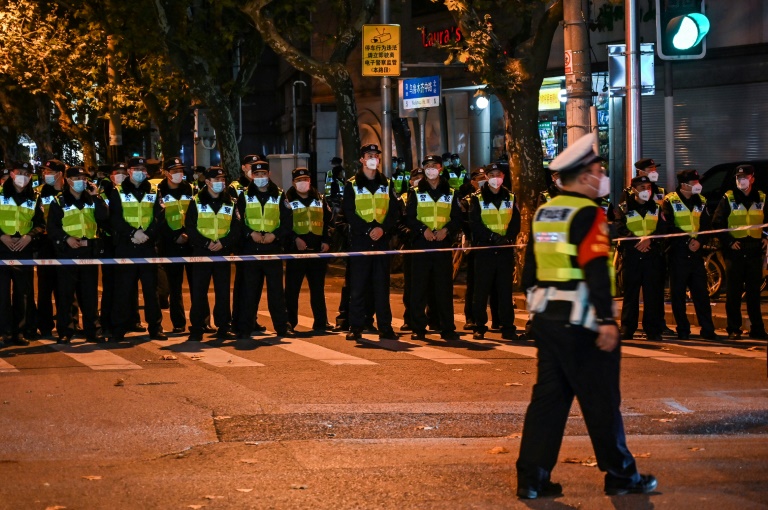
An AFP journalist at the scene of the Shanghai protests Monday morning saw a substantial police presence, with blue fences in place along the pavements to stop further gatherings.

State censors appeared to have scrubbed Chinese social media of any news about the rallies, with the search terms “Liangma River”, “Urumqi Road” — sites of protests in Beijing and Shanghai — scrubbed of any references to the rallies on the Twitter-like Weibo platform.

Videos including those showing university students singing in protest and rallies in other cities had also vanished from WeChat, replaced by notices saying the content was reported for “non-compliant or sensitive content.”

The Weibo search for the hashtag #A4 — a reference to the blank pieces of paper held up at rallies in a symbolic protest against censorship — also appeared to have been manipulated, showing only a handful of posts from the past day.

– ‘Boiling point’ –

China’s strict control of information and continued travel curbs tied to the zero-Covid policy make verifying numbers of protestors across the vast country challenging.

But such widespread rallies are exceptionally rare, with authorities harshly clamping down on any and all opposition to the central government.

Protests also occurred on Sunday in Wuhan, the central city where Covid-19 first emerged, while there were reports of demonstrations in Guangzhou, Chengdu and Hong Kong.  

Spreading through social media, they have been fuelled by frustration at the central government’s zero-Covid policy, which sees authorities impose snap lockdowns, lengthy quarantines and mass testing campaigns over just a handful of cases.

State-run newspaper the People’s Daily published a commentary Monday morning warning against “paralysis” and “battle-weariness” in the fight against Covid — but stopped far short of calling for an end to hardline policy.

“People have now reached a boiling point because there has been no clear direction to path to end the zero-Covid policy,” Alfred Wu Muluan, a Chinese politics expert at the National University of Singapore, told AFP.

“The party has underestimated the people’s anger.”

Investors were spooked by the weekend protests, with Asian stocks opening sharply lower on Monday morning.

China reported 40,052 domestic Covid-19 cases Monday, a record high but tiny compared to caseloads in the West at the height of the pandemic.
Uyghur man's agony after five relatives died in Urumqi fire

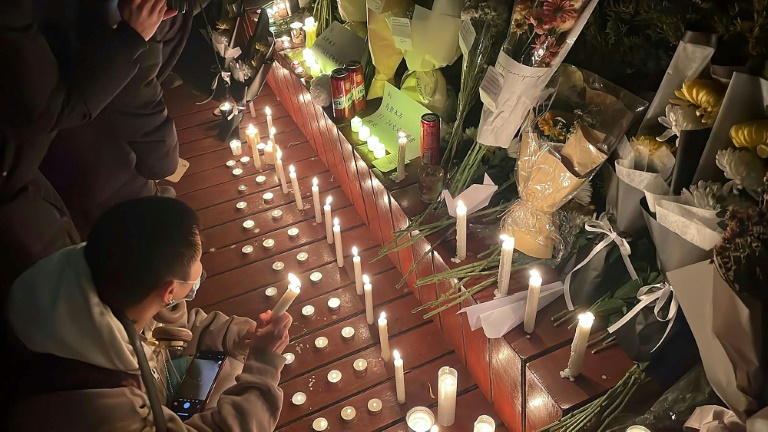
When a deadly fire broke out in China’s northwest Xinjiang region, triggering a wave of public anger over the country’s zero-Covid policy, Abdulhafiz Maimaitimin initially could not believe that it claimed five of his relatives’ lives.

Ten people were killed and nine injured when the blaze ripped through a residential building in the regional capital Urumqi on Thursday night, with many blaming lengthy lockdowns for hampering rescue efforts.

The tragedy spurred an outpouring of anger in Urumqi which has since swelled into a wave of large-scale protests and candlelit vigils in several major cities across China.

Much of Xinjiang has been locked down for three months, as the remote region battles an uptick in Covid cases that have also surged nationwide.

Maimaitimin, 27, now living in exile in Switzerland, was stunned when he heard through a friend about the deaths of his 48-year-old aunt, Haiernishahan Abdureheman, and four of her children aged between four and 13.

“My arms and legs shook and I felt dizzy, I wanted to throw up. I couldn’t understand it,” Maimaitimin, a member of the Muslim Uyghur minority, told AFP from his home in Zurich.

He lost contact with his aunt in May 2017, while Xinjiang was in the grip of a widespread security crackdown which saw an estimated million Uyghurs arbitrarily detained in prisons and internment camps, some simply for speaking to relatives overseas.

“She was a housewife, her whole life was devoted to taking care of her kids and educating them well,” he said, bursting into tears.

“Five years later I really could not imagine I would hear about my relatives in this way.”

A photo of his aunt verified by Maimaitimin shows her sitting beside her four young children on a couch in a beautifully decorated living room. 

“Now I still feel terrible, I can’t cope,” he said.

– Three-hour blaze –

Online posts circulating on both Chinese and overseas social media platforms since Friday have claimed that lengthy Covid lockdowns in Urumqi hampered rescue attempts.

Social media videos show water sprayed from a fire engine parked outside the compound barely reaching the burning windows, while in another the dying screams of residents trapped inside can be heard.

State media said the fire took three hours to be extinguished.

City officials later claimed the apartment was in a low-risk area where residents could leave their homes freely, but acknowledged there were cars and bollards blocking the fire engine’s path.

“Some residents had a weak ability to rescue themselves … and did not carry out effective fire fighting or escape in time to rescue themselves,” Li Wensheng, head of the city fire rescue service, said Friday.

However, some witnesses and social media users later claimed the building’s doors were locked shut.

In one viral screenshot of a residents’ chat group, Maimaitimin identified his other male cousin begging neighbours to save his mother and siblings.

“I can’t contact the people in (flat) 1901 and don’t know their circumstances, they can’t open the door. Can you break open the door? There are children inside,” read the texts from his surviving cousin, who was not in Urumqi at the time.

Maimaitimin believes that his family were not rescued in time because they were Uyghur and lived in a Uyghur-majority neighbourhood in the city’s Tianshan district.

Chinese officials have not yet revealed the identities of the deceased, but there is widespread online speculation that the real death toll was higher.

A photo circulating on social media of the building’s charred remains showed blackened, destroyed windows on six floors of the building. 

“I will never trust the Chinese government. If Uyghurs protested, they would choke them dead,” he said.

“I think that protesters will be caught, and (Uyghurs) will be put under even stricter control.

'It's not over': Iranian Kurds in Iraq in Tehran's crosshairs

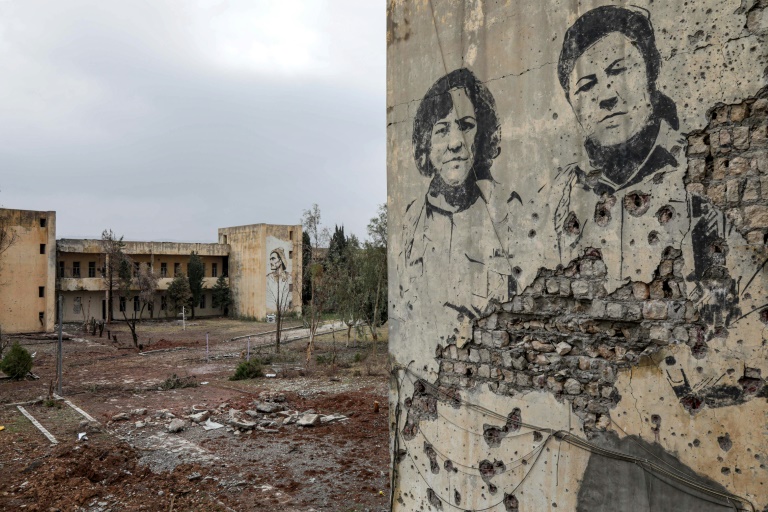
The roof is caved in, a wall has exploded and broken glass litters the floor at a base of the exiled Kurdish-Iranian opposition in mountainous northern Iraq.

“These are the regime’s missiles,” said Karim Farkhapour, a leader of the Democratic Party of Iranian Kurdistan (PDKI), with a revolver strapped to his traditional belt.

“The Iranian regime has bombed us three times in less than two months.”

The Islamic Republic of Iran has been torn by over two months of protests sparked by the death in custody of Kurdish-Iranian woman Mahsa Amini, 22.

As Iranians have vented their anger at the regime, Tehran has blamed outside forces, and exiled Kurdish groups on whose bases it has rained down missiles and so-called suicide drones.

The PDKI’s headquarters, dubbed “the Castle”, near the town of Koysinjaq, or Koya in Kurdish, looks like a desert mountain fort straight out of an adventure novel.

The movement settled there in 1993 during the era of former dictator Saddam Hussein, who was toppled in the 2003 US-led invasion and executed three years later.

Twelve PDKI members were killed and 20 wounded in the latest attacks on the site, said Farkhapour.

PDKI members have evacuated the fort, which remains heavily damaged, with cables dangling from the library roof and books scattered on the floor.

In another room, Farkhapour stepped gingerly through the rubble to reach a Kurdish flag that remained unscathed. 

“The Tehran regime is going to target us again,” he predicted grimly. “It’s not over, you’ll see.”

– ‘Hide the truth’ –

It was not the first time Iran’s Islamic Revolutionary Guard Corps has launched strikes against the PDKI or other groups in Iraqi Kurdistan.

The Iranian government labels these factions “terrorists” accusing them of fuelling the civil unrest since the September 16 death of Amini, who had been arrested for allegedly breaching Iran’s strict dress code for women.

Iran has accused the groups of importing weapons from Iraq across the porous border long used by smuggling networks.

“False”, retorted Moustafa Mouloudi, another of the leaders of the PDKI in Koysinjaq.

“There is absolutely no evidence that we have smuggled weapons from Iraq to Iran,” he said. “It’s a lie that the regime has made up to hide the truth from the people. The regime is the terrorist.” 

Iranian Kurdish groups such as the PDKI and Komala have long been in Tehran’s sights. 

Based in Iraqi Kurdistan since the 1980s with the blessing of Saddam, who was then at war with Iran, many follow a socialist doctrine.

“We are a secular party and we fight for women’s rights,” said Farkhapour.

Although analysts believe they have largely refrained from armed activities in recent years, they continue to actively campaign from exile. 

The PDKI denounces the discrimination suffered by Iran’s Kurdish minority, who make up some 10 million out of the country’s 83 million people.

The group has demanded a fully democratic and federal Iran in which Kurdish provinces would have considerable autonomy.

– ‘Living in fear’ –

The group is tightly organised in a rigid hierarchy and demanded that AFP reporters stick closely to an official programme for the visit.

Within the PDKI, “we are free”, said Shaunem Hamzi, a 36-year-old activist who lives in Koysinjaq with her parents. 

Before the latest attacks, she lived in a PDKI camp about 500 metres (just over 500 yards) from the citadel where some 200 families resided in single-storey cinderblock or concrete houses.

However, the latest attacks, she said, “have been much stronger than the previous ones. The children, the families were very scared. The fear of getting killed is among us now.”

Like the other inhabitants, Hamzi had to leave the camp and now frequently switches sleeping places.

As an Iranian Kurdish woman, she strongly identifies with the protest movement rocking Iran.

“If the regime even temporarily makes us stop, the protest will surface again, because it is in our hearts,” she said passionately.

“The protesters will never obey the regime’s rules.”

Protests across China as anger mounts over zero-Covid policy

Hundreds of people took to the streets in China’s major cities on Sunday to protest against the country’s zero-Covid policy, in a rare outpouring of public anger against the state.

China’s hardline virus strategy is stoking public frustration, with many growing weary of snap lockdowns, lengthy quarantines and mass testing campaigns.

A deadly fire on Thursday in Urumqi, the capital of northwest China’s Xinjiang region, has become a fresh catalyst for public anger, with many blaming Covid lockdowns for hampering rescue efforts. Authorities deny the claims. 

On Sunday night, at least 400 people gathered on the banks of a river in the capital Beijing for several hours, with some shouting: “We are all Xinjiang people! Go Chinese people!”

AFP reporters at the scene described the crowd singing the national anthem and listening to speeches, while on the other side of the canal bank, a line of police cars waited. 

Cars honked in support as people remained in the area until the early hours, chanting and waving blank sheets of paper symbolising censorship. 

Authorities blocked the road to stop cars passing, and around 100 plainclothes and police officers arrived on the scene. 

At around 2:00 am (1800 GMT) they were joined by coaches of paramilitary police. 

Eventually protesters agreed to leave after making officers promise their demands had been heard. 

– Shanghai clashes –

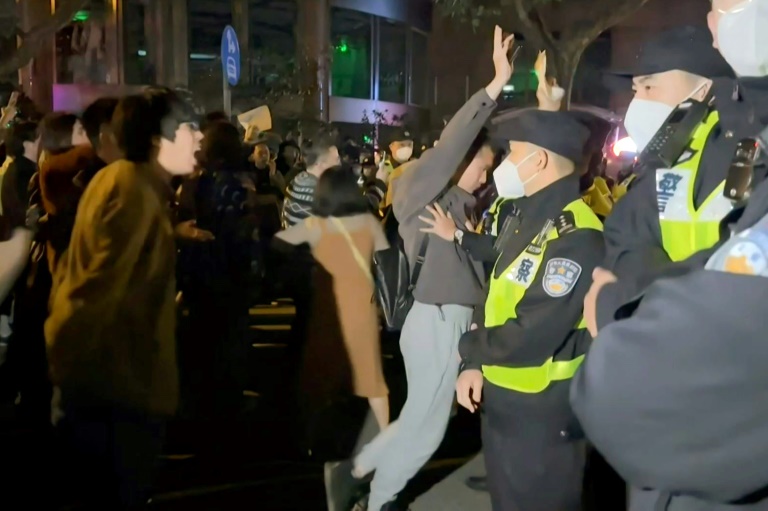
In downtown Shanghai — China’s biggest metropolis — AFP saw police clashing with groups of protesters, as officers tried to move people away from the site of an earlier demonstration on Wulumuqi street, named after the Mandarin for Urumqi. 

Crowds that had gathered overnight — some of whom chanted “Xi Jinping, step down! CCP, step down!” — were dispersed by Sunday morning.

But in the afternoon, hundreds rallied in the same area with blank sheets of paper and flowers to hold what appeared to be a silent protest, an eyewitness told AFP.

Social media videos from the area that appeared to be taken in the late afternoon showed the crowd chanting.  

By evening, dozens of policemen in yellow high-vis jackets formed a thick line, cordoning off the streets where the protests had taken place. 

AFP saw multiple people arrested as officers told demonstrators to leave the area. 

A foreigner who wished to remain anonymous told AFP he had seen a standoff as police directed a crowd away from Wulumuqi street. 

“The police appeared to be looking for individuals suspected of leading the protests,” he said.

“Protesters directed their anger at the police and the party, using the ‘step down!’ refrain of the last few days.”

By midnight the area was calm, though swamped by hundreds of police officers and dozens of cars lining both sides of the road in some places. 

Men in hard hats and overalls were erecting tall blue metal barriers on the sides of the street, cutting off the pavement. When asked why, they said they did not know.

In the central megacity of Wuhan, where the coronavirus first emerged, multiple livestreams that were quickly censored showed crowds walking through the streets cheering and filming on their phones.  

Footage of protests allegedly taken in major cities Guangzhou and Chengdu was also spreading online Sunday night, but AFP was unable to independently verify the videos. 

– University protests –

Earlier in the day, around 200 to 300 students rallied at Beijing’s elite Tsinghua University to protest against lockdowns, one witness who wished to remain anonymous told AFP.

A video that appeared to be taken in the same location showed students shouting, “Democracy and the rule of law, freedom of expression”, and was quickly taken down. 

Other vigils took place overnight at universities across China, including one at Tsinghua’s neighbour Peking University, an undergraduate participant told AFP. 

He said some anti-Covid slogans had been daubed on a wall in the university. 

Some of the words echoed a banner that was hung over a Beijing bridge just before the Communist Party Congress in October. 

“I heard people yelling: ‘No to Covid tests, yes to freedom!’,” he said, adding there were between 100 and 200 people there. 

Videos on social media also showed a mass vigil at Nanjing Institute of Communications, with people holding lights and white sheets of paper. 

Hashtags relating to the institute were censored on Weibo, and video platforms Duoyin and Kuaishou were scrubbed of footage. 

Videos from campuses in Xi’an, Guangzhou and Wuhan showing similar protests also spread on social media. AFP was unable to verify the footage independently. 

– ‘Lift lockdowns!’ –

China reported 39,506 domestic Covid-19 cases Sunday, a record high but tiny compared to caseloads in the West at the height of the pandemic.
The protests come against a backdrop of mounting public frustration over China’s zero-tolerance approach to the virus and follow sporadic rallies in other cities.

Hundreds of people massed outside Urumqi’s government offices after the deadly fire, chanting: “Lift lockdowns!”, footage partially verified by AFP shows. 

AFP verified the video by geolocating local landmarks but was unable to specify exactly when the protests occurred.

It is the latest in several high-profile cases where emergency services have been allegedly slowed down by Covid lockdowns.

The Qatar World Cup has also proved a flashpoint, as scenes of maskless fans provoked outrage on social media. 

China’s state broadcaster has started cutting close-ups of supporters and replacing them with shots of officials or players. 

China arrests BBC journalist covering Covid protests

The BBC said on Sunday one of its journalists in China had been arrested and beaten by police while covering protests against the country’s zero-Covid policy.

Hundreds of people took to the streets in China’s major cities on Sunday in a rare outpouring of public anger against the state.

“The BBC is extremely concerned about the treatment of our journalist Ed Lawrence, who was arrested and handcuffed while covering the protests in Shanghai,” the broadcaster said in a statement.

Lawrence, working in the country as an accredited journalist, was detained for several hours, during which time he was beaten and kicked by police, according to the BBC. He was later released.

“It is very worrying that one of our journalists was attacked in this way whilst carrying out his duties,” the statement said.

“We have had no official explanation or apology from the Chinese authorities, beyond a claim by the officials who later released him that they had arrested him for his own good in case he caught Covid from the crowd,” the statement added.

“We do not consider this a credible explanation.”

Mexican president masses supporters with eye on next election

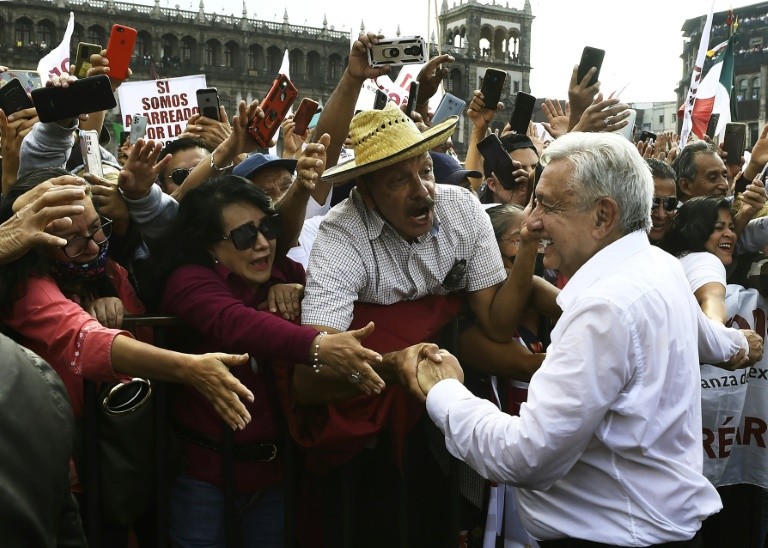
Mexican President Andres Manuel Lopez Obrador led huge crowds of supporters on a march through the capital Sunday in a show of political strength by the left-wing populist.

The rally came as allies of Lopez Obrador, known by his initials AMLO, jockey for position ahead of the next presidential election in 2024, in which he cannot run.

Lopez Obrador, 69, was mobbed by supporters as he spent more than five hours walking a few kilometers (miles) through the crowds to Mexico City’s main square, amid cries of “it’s an honor to be with Obrador.”

An estimated 1.2 million people joined the rally, according to presidential spokesman Jesus Ramirez, although there was no independent confirmation of that figure.

Lopez Obrador delivered a speech outlining what he considers to be the main accomplishments of his four years in office so far, including measures to alleviate poverty, improve public services and fight corruption.

Mariachi bands entertained the president’s supporters, who arrived on buses from around the country, many wearing purple, the color of his Morena party.

“The president is not alone,” read a placard at the rally, while others vowed support for the government’s controversial electoral reform plan.

“I like the way AMLO governs, always doing everything for the most vulnerable,” said Alma Perez, a 35-year-old teacher who traveled from the southern state of Guerrero to join the march.

Lopez Obrador “has done what no other president has done for the poor,” said Ramon Suarez, a 33-year-old electrician.

“He has some areas in which to improve such as security, but that’s not done overnight,” Suarez added.

It was the first such march led by a Mexican president in at least four decades, according to experts.

The rally comes two weeks after tens of thousands joined an opposition protest against the president’s proposed electoral reform.

Lopez Obrador wants to “show muscle,” said Fernando Dworak, a political analyst at the Mexican Autonomous Institute of Technology.

“It was a serious mistake by the opposition to believe that the president can be beaten on the streets,” he told AFP, referring to the November 13 anti-government protest.

– ‘Oiled machinery’ –

Lopez Obrador, who enjoys an approval rating of nearly 60 percent, owes much of his popularity to his social welfare programs aimed at helping the elderly and disadvantaged Mexicans.

Mexican presidents are barred from serving more than one term, and Lopez Obrador again ruled out trying to change the constitution to stay in office.

“No to re-election,” he told supporters.

At the same time, Lopez Obrador is keen to see his Morena party hold onto power after he stands aside.

Three of the president’s allies and potential successors — Mexico City Mayor Claudia Sheinbaum, Foreign Minister Marcelo Ebrard and Interior Minister Adan Augusto Lopez — accompanied him at the rally.

Lopez Obrador knows “that in order for him to win elections, he needs oiled machinery that works all the time,” said Gustavo Lopez, a political scientist at Tecnologico de Monterrey, a Mexican university.

Opposition parties accuse Lopez Obrador of being an “authoritarian” populist who is “militarizing” the country by giving a greater role to the armed forces in both security and infrastructure projects.

His efforts to revamp the independent National Electoral Institute (INE) have proven particularly controversial.

Lopez Obrador alleges that the INE endorsed fraud when he ran unsuccessfully for the presidency in 2006 and 2012, before winning in 2018.

He wants the organization to be replaced by a new body with members chosen by voters instead of lawmakers and with a smaller budget.

Critics see the plan as an attack on one of Mexico’s most important democratic institutions.

The reform would require support from at least two-thirds of lawmakers in Congress, and Lopez Obrador’s political opponents have vowed to oppose the changes.

Landslide in Cameroon kills at least 11

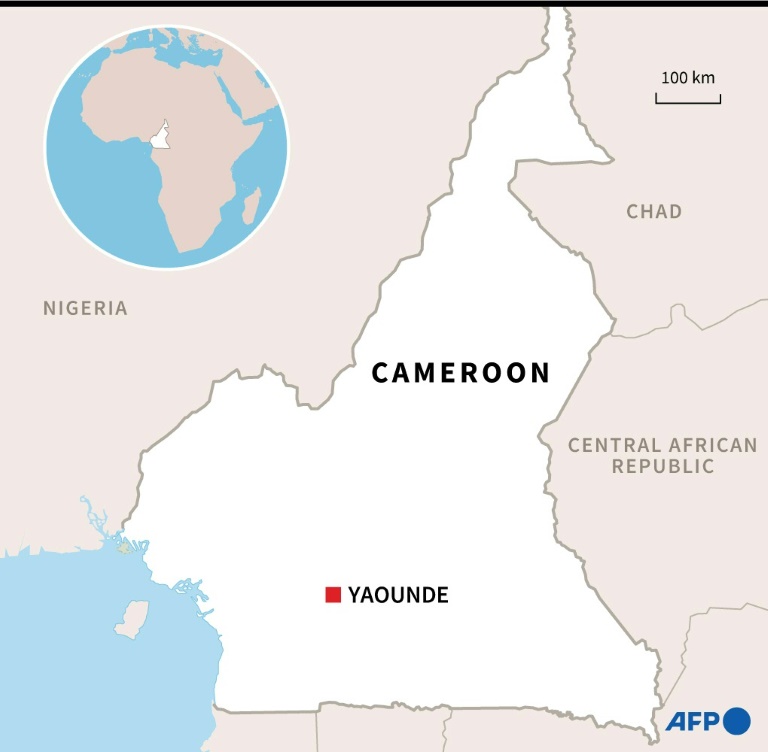
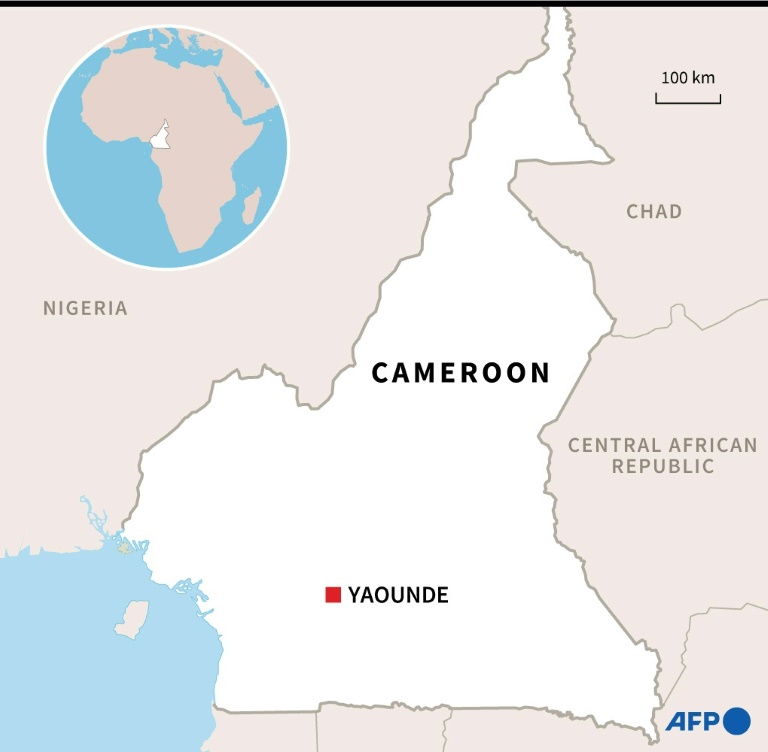
A landslide in Cameroon’s capital Yaounde killed at least 11 people attending a funeral on Sunday, a local official told state media.

The victims had gathered at the top of a hill for a memorial service for five people when the ground collapsed under part of the audience.

“Some were sitting in a tent where there was a landslide early this evening,” Paul Bea, governor of the Centre region that includes Yaounde, told state radio. He added that rescue efforts were ongoing.

The search had been suspended late Sunday evening before a planned resumption on Monday morning, a rescue worker at the scene told AFP.

Marie Claire Mendouga, 50, attended the ceremony but her tent was not affected by the landslide.

“We had just started to dance when the ground collapsed,” she told AFP.

She said she “went to dig with my hands” to try to get people out from under the earth, and was still covered in the brown clay from the site.

– Frantic search –

The disaster took place in Yaounde’s working-class district of Damas, on its eastern outskirts.

Four large white tents were on the hill’s summit, at the edge of what seemed to be a ridge, beyond which the ground had disappeared, an AFP correspondent at the scene said.

Police pick-up trucks were hauling away bodies covered by white sheets early on Sunday evening.

A police cordon prevented journalists from getting closer to the scene.

Emergency services struggled to make their way to the site, as hundreds of people frantically searched for loved ones. Some in the crowd wept as emergency workers scoured the area.

By 10:00 pm (2100 GMT) the search had been called off.

A member of the emergency services who asked not to be named said the death toll remained at 11, and the search for more victims would resume Monday morning.

In the crowd behind the security cordon, tears were streaming down faces.

“I’m not sure if I’ll be able to sleep,” Mendouga said.

“You are sitting down, you have people behind you and afterwards, they’re dead.”

Landslides occur relatively frequently in Cameroon, but they are rarely as deadly as Sunday’s incident in Yaounde.

Forty-three people were killed in the western city of Bafoussam in 2019, when a landslide triggered by heavy rains swept away a dozen precarious dwellings built on the side of a hill.

Landslide in Cameroon kills at least 11

A landslide in Cameroon’s capital Yaounde killed at least 11 people attending a funeral on Sunday, a local official told state media.

The victims had gathered at the top of a hill for a memorial service for five people when the ground collapsed under part of the audience.

“Some were sitting in a tent where there was a landslide early this evening,” Paul Bea, governor of the Centre region that includes Yaounde, told state radio. He added that rescue efforts were ongoing.

The search had been suspended late Sunday evening before a planned resumption on Monday morning, a rescue worker at the scene told AFP.

Marie Claire Mendouga, 50, attended the ceremony but her tent was not affected by the landslide.

“We had just started to dance when the ground collapsed,” she told AFP.

She said she “went to dig with my hands” to try to get people out from under the earth, and was still covered in the brown clay from the site.

– Frantic search –

The disaster took place in Yaounde’s working-class district of Damas, on its eastern outskirts.

Four large white tents were on the hill’s summit, at the edge of what seemed to be a ridge, beyond which the ground had disappeared, an AFP correspondent at the scene said.

Police pick-up trucks were hauling away bodies covered by white sheets early on Sunday evening.

A police cordon prevented journalists from getting closer to the scene.

Emergency services struggled to make their way to the site, as hundreds of people frantically searched for loved ones. Some in the crowd wept as emergency workers scoured the area.

By 10:00 pm (2100 GMT) the search had been called off.

A member of the emergency services who asked not to be named said the death toll remained at 11, and the search for more victims would resume Monday morning.

In the crowd behind the security cordon, tears were streaming down faces.

“I’m not sure if I’ll be able to sleep,” Mendouga said.

“You are sitting down, you have people behind you and afterwards, they’re dead.”

Landslides occur relatively frequently in Cameroon, but they are rarely as deadly as Sunday’s incident in Yaounde.

Forty-three people were killed in the western city of Bafoussam in 2019, when a landslide triggered by heavy rains swept away a dozen precarious dwellings built on the side of a hill.

Canada unveils new Asia-Pacific strategy with eye on China

Canada on Sunday unveiled its new economic and diplomatic strategy for the Asia-Pacific region, allocating 2.3 billion Canadian dollars (US$1.7 billion) over the next five years to the plan aimed at mitigating risks posed by China.

The government of Prime Minister Justin Trudeau has based its strategy on five major planks: promoting peace and security, notably by sending a warship to the region; bolstering trade and investment; boosting “feminist international assistance”; financing sustainable infrastructure; and increasing its diplomatic presence.

“The future of the Indo-Pacific is our future; we have a role to play in shaping it. To do so, we need to be a true, reliable partner,” Foreign Minister Melanie Joly said in a statement introducing the policy paper.

She said the new strategy “sends a clear message to the region that Canada is here, and they can trust we are here to stay.”

In an interview with the French-language daily La Presse to coincide with the introduction of the new policy, Joly said the message being sent was specifically aimed at Beijing, with which Ottawa has had fraught ties.

“There is a fundamental problem with the fact that China currently does not respect international norms and tries to change or interpret them to its own advantage,” Joly told the newspaper.

While the minister said the government would not go so far as to advise Canadian companies not to do business in China, she said: “My job is to explain the risk. And I’m saying there is a geopolitical risk in doing business in China.”

The government said the strategy “presents a comprehensive road map to deepen our engagement in the Indo-Pacific over the next decade, increasing our contributions to regional peace and security.”

The announcement comes on the heels of Trudeau and Joly’s trip to Asia for the Group of 20 summit in Indonesia, the ASEAN summit in Cambodia and a meeting of the Asia-Pacific Economic Cooperation (APEC) forum in Bangkok.

At the G20 summit, Chinese President Xi Jinping scolded Trudeau in an unusual public dressing-down, caught on video.

Relations between the two countries plunged into the deep freeze when Canadian authorities arrested Huawei executive Meng Wanzhou in 2018 for allegedly flouting US sanctions on Iran.

Beijing later detained two Canadian citizens in China, Michael Spavor and Michael Kovrig, in what critics called a tit-for-tat response.

Meng and the two Canadians were released last year after lengthy negotiations.

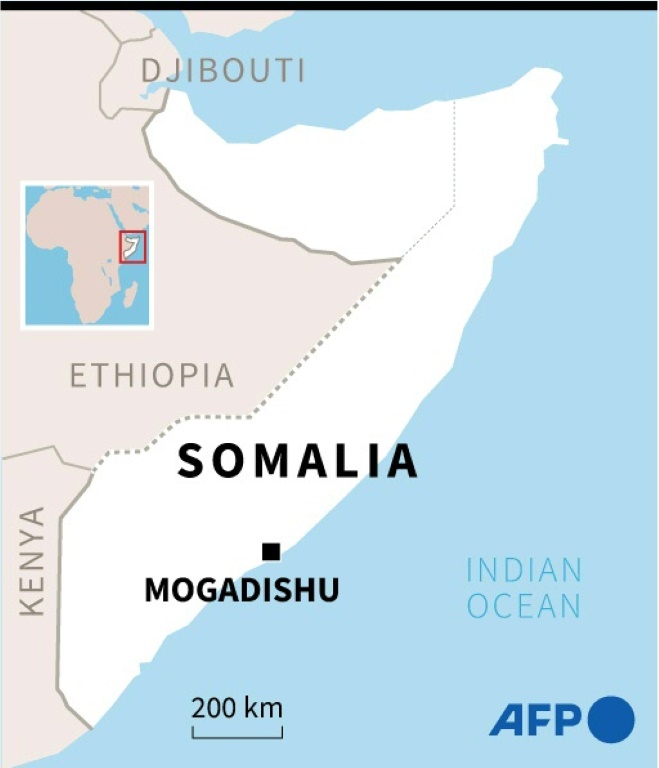
Al-Shabaab attacks hotel in Somali capital: police

Al-Shabaab militants attacked a hotel near the presidential palace in the Somali capital Mogadishu on Sunday, police and witnesses said, with explosions and gunfire heard in the city centre.

“A team of Al-Shabaab fighters attacked a commercial hotel in Bondhere district tonight (and) the security forces are engaging in an effort to eliminate them,” national police spokesman Sadik Dudishe said in statement.

He said many civilians and officials had been rescued from the Villa Rose, a hotel popular with politicians in a secure central area of the capital near the office of Somalia’s President Hassan Sheikh Mohamud.

Witnesses described hearing loud explosions followed by gunfire.

“I was close to Villa Rose when two heavy explosions rocked the hotel,” said one witness, Aadan Hussein. “There was heavy gunfire. The area was cordoned off and I saw people fleeing.” 

The hotel’s website describes the Villa Rose as the “most secure lodging arrangement in Mogadishu” with metal detectors and a high perimeter wall.

Al-Shabaab, a militant group affiliated with Al-Qaeda that has been trying to overthrow Somalia’s central government in Mogadishu for 15 years, claimed responsibility for the attack.

The African Union Transition Mission in Somalia (ATMIS), a 20,000-strong force drawn from across the continent, condemned the attack.

“ATMIS further applauds Somali Security Force for the swift response to prevent further casualties and property damage,” said ATMIS on Twitter.

– Retaliatory attacks –

President Mohamud declared “all-out war” against Al-Shabaab shortly after being elected in May. The security forces, backed by local militias, ATMIS and US air strikes, have driven Al-Shabaab from some parts of central Somalia.

But the insurgents have retaliated with a series of devastating attacks, underscoring their ability to strike at the heart of Somalia’s cities and military installations.

On October 29, two cars packed with explosives blew up minutes apart in Mogadishu followed by gunfire, killing at least 121 people and injuring 333 others.

It was the deadliest attack in the fragile Horn of Africa nation in five years.

A triple bombing in the central city of Beledweyne earlier that month left 30 dead including local officials, while at least 21 patrons at a hotel in Mogadishu were killed in a 30-hour siege in August.

The UN said earlier this month that at least 613 civilians had been killed and 948 injured in violence this year in Somalia, mostly caused by improvised explosive devices (IEDs) attributed to Al-Shabaab. 

The figures were the highest since 2017 and a more-than 30-percent rise from last year.

Close Bitnami banner
Bitnami