World

Rescuers search for missing after deadly landslide on Italian island

Italian rescuers were searching for a dozen missing people on the southern island of Ischia on Sunday after a landslide killed at least one and the government declared a state of emergency.

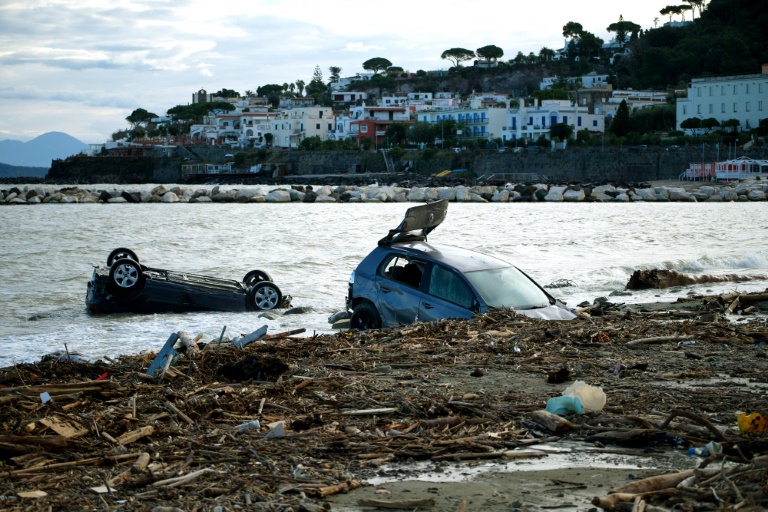
A wave of mud and debris crashed through the small town of Casamicciola Terme on Saturday morning, engulfing at least one house and sweeping cars down to the sea, local media and emergency services said.

A first tranche of two million euros ($2 million) of relief funds was released at the end of an emergency cabinet meeting which declared the state of emergency, said Minister for Civil Protection Nello Musumeci. 

More than 200 rescuers were still searching for a dozen missing people, while hundreds of volunteers and others, up to their knees in mud, were busy cleaning the town’s streets.

Rescuers had recovered the body of a 31-year-old woman, according to Italian news agency AGI, with other local media reporting 13 people had been injured.

The rescue effort was hampered by rain and high winds, which also delayed ferries bringing reinforcements from the mainland.

“It’s a situation that hurts us, if only for the people who disappeared under the mountain. Here it’s an island and even if we don’t really know everyone, it’s almost that,” Salvatore Lorini, 45, told AFP.

“The mountain came down, there was devastation of shops, cars, hotels and that was already happening nine years ago. Now I am cleaning my mother-in-law’s shop,” he said. 

– Complex rescue operation –

Interior Minister Matteo Piantedosi had earlier warned there were people trapped in the mud, saying it was a “very serious” situation.

However, he denied a statement by his colleague Matteo Salvini, the deputy prime minister and infrastructure minister, that eight people had died, saying this had not been confirmed.

Heavy rain sent torrents of mud through the streets of Casamicciola Terme, a spa resort of 8,000 inhabitants on the north of Ischia, a lush island near Capri that is thronged with tourists in summer.

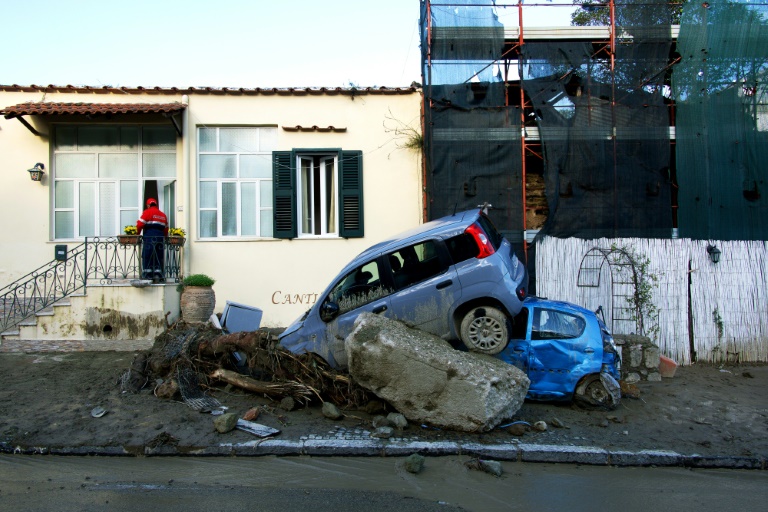
Trees were upturned and cars left battered on the side of the road or in the water, according to AFP journalists.

Boulders were scattered around as excavators sought to free up access to homes, cars and shops.

The fire service said earlier one house had been swamped by the mud and two people had been rescued from a car swept into the sea.

In the worst-affected area of the town, at least 30 families were trapped in their homes without water or electricity, with mud and debris blocking the road, ANSA news agency reported.

Officials had said they expected to evacuate and find temporary homes for between 150 and 200 people.

Local authorities called on residents of Ischia to stay inside to avoid hindering the rescue operation.

Casamicciola Terme was hit by an earthquake in 2017, in which two people died. It was completely destroyed by a much more powerful earthquake at the end of the 19th century.

The devastation in Ischia comes just weeks after 11 people died in heavy rain and flooding in the central Italian region of Marche.
Thousands protest Turkish strikes on Kurdish groups in Syria

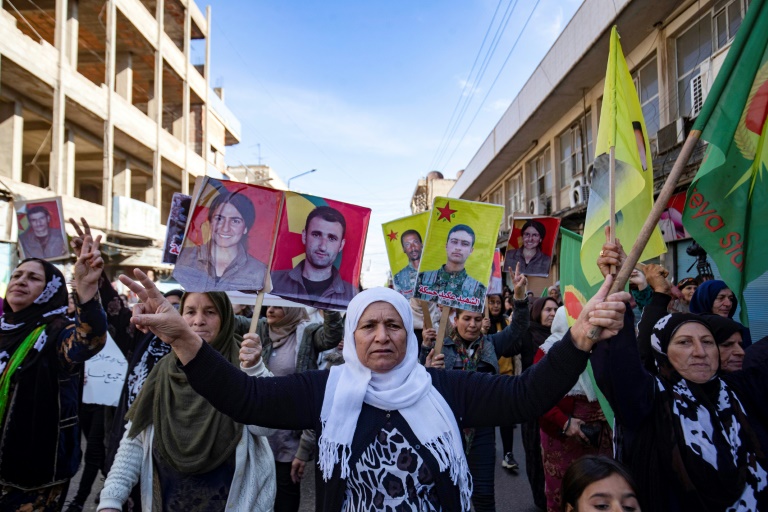
Thousands of Kurds protested on Sunday in the Syrian city of Qamishli against Turkish cross-border strikes targeting Kurdish groups in the country’s northeast, an AFP photojournalist said.

One week ago Turkey began a barrage of air strikes against the semi-autonomous Kurdish zones in north and northeastern Syria, and across the border in Iraq. 

It has also threatened a ground offensive in those areas of Syria.

The strikes came after a November 13 bombing in Istanbul that killed six people and wounded 81 and that Ankara blamed on the Kurdistan Workers Party (PKK), which it and its Western allies consider a terrorist group.

The PKK has waged an insurgency against the Turkish state since 1984. Turkey alleges that Syrian Kurdish fighters are the PKK’s allies.

Kurdish groups denied any involvement in the Ankara blast.

Demonstrators in Kurdish-controlled Qamishli in Hasakeh province on Sunday brandished photos of people killed during the last strikes in the semi-autonomous region, the AFP photojournalist said.

They carried Kurdish flags alongside photos of PKK leader Abdullah Ocalan — jailed in Turkey since 1999 — and protesters shouted slogans against Turkish President Recep Tayyip Erdogan.

They also chanted in favour of the resistance in “Rojava” — the name Kurds in Syria give to the area they administer.

“Only the will of the Kurdish people remains,” protester Siham Sleiman, 49, told AFP. “It will not be broken and we remain ready. We will not leave our historic land.”

Another demonstrator, Salah el-Dine Hamou, 55, said: “The message that we want to convey to the world is that we are victims of eradication.

“How long will we continue to die while other countries watch?”

The Turkish raids have killed at least 58 Kurdish fighters and Syrian soldiers, as well as a Kurdish journalist, according to the Britain-based Syrian Observatory for Human Rights, which has an extensive network of sources in Syria.

Turkey’s military has conducted three offensives against Kurdish fighters and jihadists since 2016 and already captured territory in northern Syria, held by Ankara-backed Syrian proxies.

US-supported Syrian Democratic Forces (SDF), now the Kurds’ de facto army in the area, led the battle that dislodged Islamic State group jihadist fighters from the last scraps of their Syrian territory in 2019.

Italy declares state of emergency after deadly landslide

Italy’s government declared a state of emergency on Sunday after a landslide on the southern island of Ischia killed at least one person and left a dozen missing.

A wave of mud and debris hit the small town of Casamicciola Terme early Saturday morning, engulfing at least one house and sweeping cars down to the sea, local media and emergency services said.

A first tranche of two million euros relief funds was released at the end of an emergency cabinet meeting which declared the state of emergency, said Minister for Civil Protection Nello Musumeci. 

More than 200 rescuers are still searching for a dozen missing people, while hundreds of volunteers, and others, up to their knees in mud, are busy cleaning the streets of the town. 

Wreckage of cars and buses crushed by the mudslide could be seen and boulders were scattered around as excavators sought to free up access to homes, cars and shops. 

Rescuers had recovered the body of a 31-year-old woman, according to Italian news agency AGI.

“It’s a situation that hurts us, if only for the people who disappeared under the mountain. Here it’s an island and even if we don’t really know everyone, it’s almost that,” Salvatore Lorini, 45, told AFP. 

“The mountain came down, there was devastation of shops, cars, hotels and that was already happening nine years ago. Now I am cleaning my mother-in-law’s shop,” he said. 

The landslide was caused by a lack of maintenance and prevention “because nature is nature, there was an earthquake, but a bit of prevention” could have saved lives, said Lorini.

The peninsula, off Naples, is no stranger to states of emergency following earthquakes, volcanic eruptions or severe weather.

Casamicciola Terme, a spa resort of 8,000 inhabitants in winter on the lush island of Ischia, near Capri, was hit by an earthquake in 2017 that killed two people. 

It was completely destroyed by a much more powerful earthquake at the end of the 19th century.  

'Little by little': Ukraine grinds away on the northeastern front

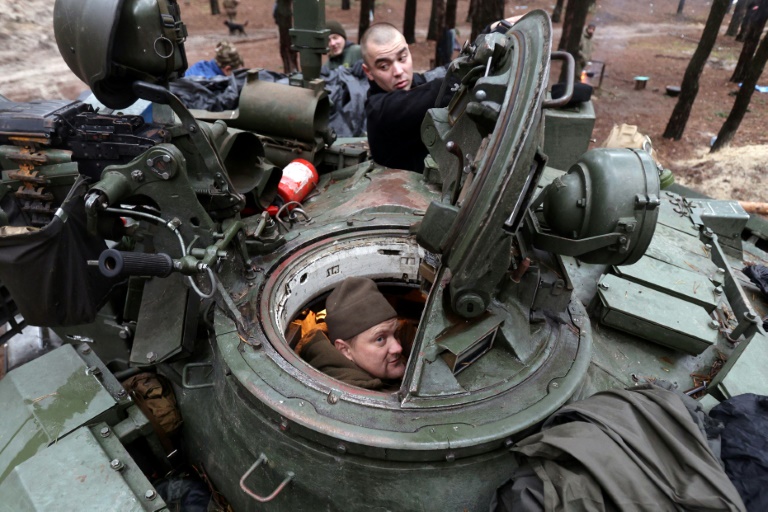
The motivation to keep fighting the Russians is simple for Viking, a Ukrainian soldier near the northeastern frontlines as cold weather and artillery onslaughts bogs down both sides. He wants revenge. 

“I can say that the hardest thing for me is the death of my friends. I had motivation before… but the anger, aggression and hatred reinforces it,” says Viking, the nom de guerre of the 26-year-old tank gunner. 

But despite the heavy losses incurred by the Ukrainian military over nine months of fighting since the Russian invasion in February, Viking and others in his tank platoon remain confident they will win the war. 

“We plan to push the Russians to the borders and even further,” he laughs. 

His platoon took part in the breakthrough offensive in September that crushed the Russian’s northeastern flank, sending their troops in a desperate flight east over the Oskil River in Ukraine’s Kharkiv region. 

And while the speed of the counter-offensive has since slowed after the Russian’s reformed their defensive lines, the Ukrainians say they continue to push even as the winter cold sets in — straining supply lines as road conditions and bad weather periodically affect combat. 

“We pushed back the Russians, gained a foothold, and are advancing little by little,” explains Patriot, a 23-year-old member of the platoon camped in a bucolic meadow surrounded by pine trees near the front.

– ‘A lot of shelling’ –

“There is a lot of shelling. In the last month, I heard about 100 to 200 attacks,” he tells AFP, during a trip to their position organised by the Ukrainian military. 

Nearby, a 44-year-old mechanic from the unit, who asked not to be named, labours away on the engine of a Russian tank the platoon had captured during September’s counter-offensive and is now using against its former owners. 

“The condition of Russian equipment is very bad. Everything was covered in diesel and dirty,” he says of the tank when they first found it. 

“It is almost ready,” he adds. 

After nine months in the field, the unit’s Soviet-era hardware reflects the greater dynamics at play in the war — one tank was provided by the Ukrainian military, another was taken from the Russians, and a third donated by Poland. 

The ammunition required to fight is supplied in part by Russian stocks captured on the battlefield. 

“It’s the Russian lend-lease act,” jokes another member of the team who goes by the call sign Agronome, in reference to a US deal to supply weapons to Ukraine.

The tank platoon’s fight is part of a larger push by the Ukrainian military in the northeast that is hoping to capture a key highway supplying the Russian occupied cities of Severodonetsk and Lysychansk.

The two cities were captured by Russian forces following a brutal summer campaign in Donbas, with both sides believed to have lost large numbers of troops.

– ‘Don’t feel the cold’ –

The loss of the cities would add only further humiliation and stymie Russian President Vladimir Putin’s stated goals of capturing the Donbas region, after suffering repeated setbacks triggered by Ukrainian thrusts in both the northeast and the south in Kherson. 

“On this part of the frontline we are in charge of holding our position and sometimes launching counter-offensives,” says Roman, a member of the overall tank battalion operating in the area.  

“The situation is completely under control and we are ready for new and sometimes unexpected challenges.”

Analysts predict that the tempo of fighting may surge again soon as colder conditions allow for fresh assaults along the frontline. 

“Temperatures are forecast to drop across Ukraine over the next week, which will likely freeze the ground and expedite the pace of fighting as mobility increases for both sides,” according to a recent assessment by US-based think tank The Institute for the Study of War. 

As for the fighters on the ground, the dropping temperatures matter little when compared to Russia’s artillery barrages. 

“When we know we can get hit at any moment, the adrenaline keeps us warm,” says Patriot. “We don’t feel the cold.”

Protests across China as anger mounts over zero-Covid policy

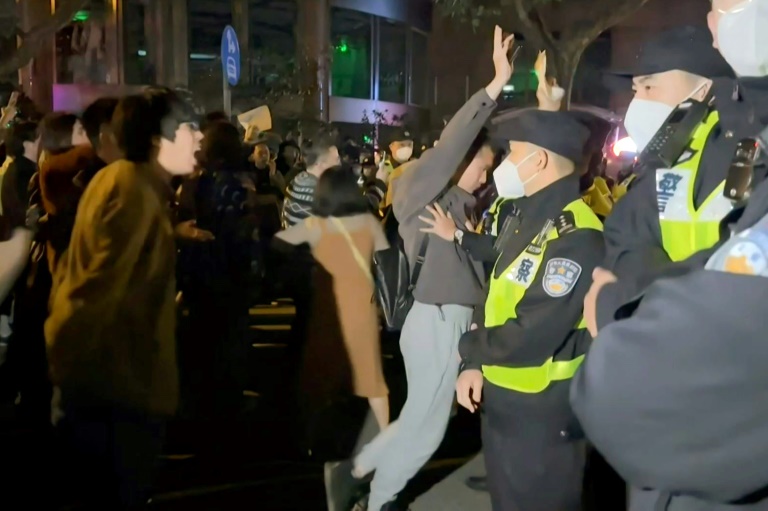
Hundreds of people took to the streets in Beijing and Shanghai on Sunday to protest against China’s zero-Covid policy in a rare outpouring of public anger against the state.

China’s hardline virus strategy is stoking public frustration, with many growing weary of snap lockdowns, lengthy quarantines and mass testing campaigns.

A deadly fire on Thursday in Urumqi, the capital of northwest China’s Xinjiang region, has become a fresh catalyst for public anger, with many blaming lengthy Covid lockdowns for hampering rescue efforts. Authorities deny the claims. 

Hundreds rallied at Beijing’s elite Tsinghua University to protest against lockdowns on Sunday, one witness who wished to remain anonymous told AFP.

“At 11:30 am students started holding up signs at the entrance of the canteen, then more and more people joined. Now there are 200 to 300 people,” they said.

Participants sang the national anthem and “the Internationale” — a standard of the international communist movement — and chanted “freedom will prevail” and “no to lockdowns, we want freedom”, they said.

They described students holding up blank pieces of paper, a symbolic protest against censorship.

A video that appeared to be taken in the same location showed students shouting, “Democracy and the rule of law, freedom of expression”, and was quickly taken down. 

Hundreds of people gathered in downtown Shanghai on Sunday afternoon to hold what appeared to be a silent protest near where a demonstration had erupted just hours earlier, an eyewitness told AFP.

Demonstrators holding blank pieces of paper and white flowers stood silently at several intersections, the person said under condition of anonymity.

Videos from the area spread on social media that appeared to be taken in the late afternoon showed a crowd chanting. 

Footage from several different angles showed a man holding a bouquet of yellow flowers being dragged into a police car at one intersection as onlookers shouted.

Later in the evening, an AFP reporter saw a heavy security presence.

Dozens of policemen in yellow high-vis jackets formed a thick line, cordoning off the streets where the protests had taken place, while their colleagues asked people to leave the area.

– Overnight protests –

Crowds had gathered hours before on nearby Wulumuqi street — named for Urumqi in Mandarin — with video showing protesters chanting “Xi Jinping, step down! CCP, step down!” in a rare display of public opposition to the Chinese Communist Party’s top leadership. The video was widely shared on social media and geolocated by AFP. 

A person who attended the Shanghai protests but asked not to be identified told AFP the first rally was in full swing at 2:00 am (1800 GMT), with one group mourning the 10 people killed in the Urumqi fire while another group chanted slogans.

Video taken by an eyewitness showed a large crowd shouting and raising blank pieces of paper as they faced several lines of police.

The attendee said there were minor clashes but that overall the police were “civilised”. 

“It’s shocking to know that, under today’s circumstances, there are still many brave people standing out,” they said. 

Multiple witnesses said several people were taken away by the police.

Shanghai police did not reply to AFP’s request for comment. 

Authorities were swift to curb online discussion of the protest, with related phrases scrubbed from the Twitter-like Weibo platform almost immediately after footage of the rallies emerged.

– University vigils –

Other vigils took place overnight at universities across China, including one at Tsinghua’s neighbour Peking University, an undergraduate participant told AFP. 

Speaking anonymously for fear of repercussions, he said some anti-Covid slogans had been daubed on a wall in the university. 

Some of the words echoed a banner that was hung over a Beijing bridge just before the Communist Party Congress in October. 

“When I arrived… I think there were at least 100 people there, maybe 200,” the student said. 

“I heard people yelling: ‘No to Covid tests, yes to freedom!’,” he said.

Photos and videos he showed AFP corroborated his account. 

Videos on social media also showed a mass vigil at Nanjing Institute of Communications, with people holding lights and white sheets of paper. 

Hashtags relating to the protest were censored on Weibo, and video platforms Duoyin and Kuaishou were scrubbed of footage. 

Videos from Xi’an, Guangzhou and Wuhan showing similar small protests also spread on social media. AFP was unable to verify the footage independently. 

– ‘Lift lockdowns!’ –

China reported 39,506 domestic Covid-19 cases Sunday, a record high but small compared to caseloads in the West at the height of the pandemic.

The protests come against a backdrop of mounting public frustration over China’s zero-tolerance approach to the virus and follow sporadic rallies in other cities.

Several high-profile cases in which emergency services have been allegedly slowed down by Covid lockdowns, leading to deaths, have catalysed public opposition.

Hundreds of people massed outside Urumqi’s government offices after the deadly fire, chanting: “Lift lockdowns!”, footage partially verified by AFP shows.

AFP verified the video by geolocating local landmarks but was unable to specify exactly when the protests occurred.

Qatar's migrant workers enjoy World Cup on the cheap

Shafeeq Saqafi paid $3 for the Argentina shirt he proudly wore when he sat with 15,000 other migrant workers in a hidden corner of Doha to watch Lionel Messi’s side salvage their World Cup.

Messi’s goal in the 2-0 win over Mexico late Saturday brought the biggest crowd seen at the Asian Town stadium to their feet and Saqafi beat his chest in delight.

Saqafi and his friends bristle at European media suggestions that they are “fake fans” but readily acknowledge that they buy counterfeit team shirts for $3 or less, instead of the $90 which official kit costs.

“I could not afford to have the letters printed on the back, but the shirt was something I really wanted,” said the 32-year-old hotel worker who earns just over $400 a month and sends more than half of that back to his family in Bangladesh.

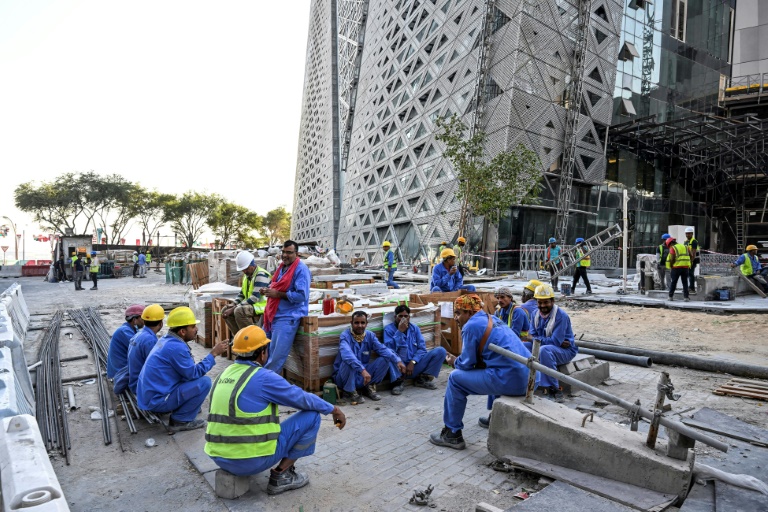
Saqafi is one of the 2.5 million foreign workers who have been the foundation of Qatar’s economic miracle — helping pump oil and gas, building its World Cup stadiums and infrastructure and staffing the dozens of new hotels that have opened in the past five years.

Rights groups say the workers have been massively abused. 

Qatar responds by citing the increased safety standards and salary protections in factories and at outdoor work sites, and reduced working hours in Qatar’s notoriously hot summer.

– Hindi pop and football – 

The stadium, in the Asian Town shopping complex on the outskirts of Doha, has become a daily draw for thousands of the poorest workers who live in nearby dormitories away from Doha’s glitzy shopping malls and restaurants.

An Indian woman DJ revs up the overwhelmingly male and South Asian crowd before each match with Hindi pop songs and Bollywood videos.

Many, like Saqafi, wear Argentina shirts. For most, the fan zone on the cricket pitch is the nearest they will get to the World Cup. The legal minimum wage is 1,000 riyals (around $260), which many still earn.

A few thousand 40-riyal ($10) World Cup tickets were put on sale and quickly snapped up. Those remaining are too expensive for the average construction worker in Qatar. 

Buying an official team shirt is also out of the question. So Saqafi and many of his friends bought one of the high quality fakes on sale in backstreet stores.

Yaseen Gul, who has worked for a Doha electrical firm for a decade, said he comes to the stadium “to enjoy myself — cheaply.”

“Qatar is very hard. The work is hard. In summer it is very hot,” he said. “But my salary has improved and I will not go home.”

Shaqeel Mahmoud said he could not afford to buy match tickets and he had to leave the Argentina game before the end because he had to go work.

A cup of hot milky tea at the stadium beverage stand costs $1, but many workers said this was too much and there were no queues. Hundreds line up at the FIFA Fan Festival 10 kilometres (six miles) away to pay $13.50 for a beer.

“There is no pressure to buy anything so I am grateful for that,” said Shaqeel.

Protests across China as anger mounts over zero-Covid policy

Hundreds of people took to the streets in Beijing and Shanghai on Sunday to protest against China’s zero-Covid policy in a rare outpouring of public anger against the state.

China’s hardline virus strategy is stoking public frustration, with many growing weary of snap lockdowns, lengthy quarantines and mass testing campaigns.

A deadly fire on Thursday in Urumqi, the capital of northwest China’s Xinjiang region, has become a fresh catalyst for public anger, with many blaming lengthy Covid lockdowns for hampering rescue efforts. Authorities deny the claims. 

Hundreds rallied at Beijing’s elite Tsinghua University to protest against lockdowns on Sunday, one witness who wished to remain anonymous told AFP.

“At 11:30 am students started holding up signs at the entrance of the canteen, then more and more people joined. Now there are 200 to 300 people,” they said.

Participants sang the national anthem and “the Internationale” — a standard of the international communist movement — and chanted “freedom will prevail” and “no to lockdowns, we want freedom”, they said.

They described students holding up blank pieces of paper, a symbolic protest against censorship.

And in Shanghai on Sunday afternoon, hundreds of people gathered in the megacity’s downtown to hold what appeared to be a silent protest, an eyewitness told AFP, near where a demonstration had erupted just hours earlier.

Demonstrators holding blank pieces of paper and white flowers stood silently at several intersections, the person said under condition of anonymity, before police officers eventually moved to clear the blocked roads.

Crowds had gathered hours before on nearby Wulumuqi street — named for Urumqi in Mandarin — with video showing protesters chanting “Xi Jinping, step down! CCP, step down!” in a rare display of public opposition to the Chinese Communist Party’s top leadership. The video was widely shared on social media and geolocated by AFP. 

A person who attended the Shanghai protests but who asked not to be identified told AFP the first rally was in full swing at 2:00 am (1800 GMT), with one group mourning the 10 people killed in the Urumqi fire while another group chanted slogans.

Video taken by an eyewitness showed a large crowd shouting and holding up blank pieces of paper as they faced several lines of police.

The attendee said there were minor clashes but that overall the police were “civilised”. 

“It’s shocking to know that, under today’s circumstances, there are still many brave people standing out,” they said. 

Multiple witnesses said several people were taken away by the police.

Authorities were swift to curb online discussion of the protest, with related phrases scrubbed from the Twitter-like Weibo platform almost immediately after footage of the rallies emerged.

– University vigils –

Other vigils took place overnight at universities across China, including one at Tsinghua’s neighbour Peking University, an undergraduate participant told AFP. 

Speaking anonymously for fear of repercussions, he said some anti-Covid slogans had been graffitied on a wall in the university. 

Some of the words echoed a banner that was hung over a Beijing bridge just before the Communist Party Congress in October. 

People had started gathering from around midnight local time, but he hadn’t dared join initially. 

“When I arrived … I think there were at least 100 people there, maybe 200,” the undergraduate said. 

“I heard people yelling: ‘No to Covid tests, yes to freedom!’,” he said.

Photos and videos he showed AFP corroborated his account. 

Videos on social media also showed a mass vigil at Nanjing Institute of Communications, with people holding lights and white sheets of paper. 

Hashtags relating to the protest were censored on Weibo, and video platforms Duoyin and Kuaishou were scrubbed of footage. 

Videos from Xi’an, Guangzhou and Wuhan showing similar small protests also spread on social media. AFP was unable to verify the footage independently. 

– ‘Lift lockdowns!’ –

China reported 39,506 domestic Covid-19 cases Sunday, a record high but small compared to caseloads in the West at the height of the pandemic.

The protests come against a backdrop of mounting public frustration over China’s zero-tolerance approach to the virus and follow sporadic rallies in other cities.

A number of high-profile cases in which emergency services have been allegedly slowed down by Covid lockdowns, leading to deaths, have catalysed public opposition.

Hundreds of people massed outside Urumqi’s government offices after the deadly fire, chanting: “Lift lockdowns!”, footage partially verified by AFP shows.

AFP verified the video by geolocating local landmarks but was unable to specify exactly when the protests occurred.

Protests across China as anger mounts over zero-Covid policy

Angry crowds took to the streets in Shanghai early on Sunday, and videos on social media showed protests in other cities across China, as public opposition to the government’s hardline zero-Covid policy mounts.

A deadly fire on Thursday in Urumqi, the capital of northwest China’s Xinjiang region, has spurred an outpouring of anger as many social media users blamed lengthy Covid lockdowns for hampering rescue efforts.

China is the last major economy wedded to a zero-Covid strategy, with authorities wielding snap lockdowns, lengthy quarantines and mass testing to snuff out new outbreaks as they emerge.

In a video widely shared on social media and geolocated by AFP, some protesters can be heard chanting “Xi Jinping, step down! CCP, step down!” in central Shanghai’s Wulumuqi street — named for Urumqi in Mandarin — in a rare display of public opposition to China’s top leadership.

A person who attended the Shanghai protests but asked not to be identified told AFP they arrived at the rally at 2:00 am (1800 GMT) to see one group of people putting flowers on the sidewalk to mourn the 10 people killed in the fire, while another group chanted slogans.

Video taken by an eyewitness showed a large crowd shouting and holding up blank white pieces of paper — a symbolic protest against censorship — as they faced several lines of police. 

The attendee said there were minor clashes but that overall the police were “civilised”. 

“It’s touching to see so many like-minded and humane people uniting together,” they said. 

“It’s shocking to know that, under today’s circumstances, there are still many brave people standing out.”

Multiple witnesses said a couple of people were taken away by the police.

Authorities were swift to curb online discussion of the protest, with related phrases scrubbed from the Twitter-like Weibo platform almost immediately after footage of the rallies emerged.

The area was quiet by daytime Sunday but a heavy security presence was visible. 

An AFP journalist saw some people holding flowers being approached by police before leaving. 

– University vigils –

Other vigils took place overnight at universities across China, including one at the elite Peking University, an undergraduate participant told AFP. 

Speaking anonymously for fear of repercussions, he said some anti-Covid slogans had been graffitied on a wall in the university, with some words echoing those written on a banner that was hung over a Beijing bridge just before the Communist Party Congress in October. 

People had started gathering from around midnight local time, but he hadn’t dared join initially. 

“When I arrived (two hours later), I think there were at least 100 people there, maybe 200,” he said. 

“At first, they sang the ‘Internationale’. Later, some students started shouting slogans, but the reaction wasn’t particularly loud. People weren’t really sure what they should shout. But I heard people yelling: ‘No to Covid tests, yes to freedom!'”

Photos and videos he showed AFP corroborated his account. 

The students were communicating with security guards and teachers, he said, but it is unclear if they faced punishment for taking part. 

The graffiti had already been covered up when he arrived. 

Videos on social media also showed a mass vigil at Nanjing Institute of Communications, with people holding lights and white sheets of paper. 

Hashtags relating to the protest were censored on Weibo, and video platforms Duoyin and Kuaishou were scrubbed of any videos. 

Videos from Xi’an, Guangzhou and Wuhan also spread on social media, showing similar small protests. AFP was unable to verify the footage independently. 

– Record cases –

China reported 39,506 domestic Covid cases Sunday, a record high but small compared to caseloads in the West at the height of the pandemic.

The protests come against a backdrop of mounting public frustration over China’s zero-tolerance approach to the virus and follow sporadic rallies in other cities recently.

A number of high-profile cases in which emergency services have been allegedly slowed down by Covid lockdowns, leading to deaths, have catalysed public opposition.

Following the deadly Urumqi fire, hundreds of people massed outside the city’s government offices, chanting: “Lift lockdowns!”, footage partially verified by AFP shows.

In another clip, dozens of people are seen marching through a neighbourhood in the east of the city, shouting the same slogan before facing off with a line of hazmat-clad officials and angrily rebuking security personnel.

AFP was able to verify the videos by geolocating local landmarks but was unable to specify exactly when the protests occurred.

Urumqi officials said on Saturday the city “had basically reduced social transmissions to zero” and would “restore the normal order of life for residents in low-risk areas in a staged and orderly manner”.

Mexico president to 'show muscle' at big political rally

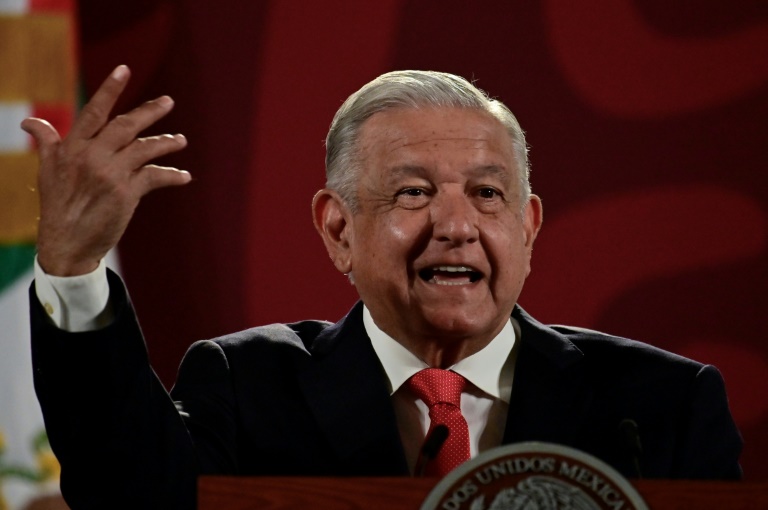
Supporters of Mexican President Andres Manuel Lopez Obrador are expected to flood the streets of Mexico City on Sunday in a major show of political strength by the left-wing populist.

The rally comes as presidential hopefuls, including Lopez Obrador’s allies, warm up for the race to replace him in 2024.

Two weeks after tens of thousands joined an opposition protest against his proposed electoral reform, Lopez Obrador plans to lead a pro-government march through the heart of the capital.

The aim is to celebrate the government’s “transformation of Mexico” four years into his six-year term, Lopez Obrador told reporters.

“I invite all the people, all those who can attend,” including government ministers and lawmakers, he said.

It will be the first such march led by a Mexican president in at least four decades, and possibly the biggest pro-government rally since Lopez Obrador took office in 2018, according to experts.

Lopez Obrador wants to “show muscle,” Fernando Dworak, a political analyst at the Mexican Autonomous Institute of Technology, said.

“It was a serious mistake by the opposition to believe that the president can be beaten on the streets,” he told AFP, referring to the November 13 anti-government protest.

– ‘Oiled machinery’ –

Lopez Obrador enjoys an approval rating of nearly 60 percent, and few doubt his ability to draw a huge crowd on Sunday, when he plans to give a speech outlining his achievements in office.

Mexican presidents are barred from serving more than one term, and Lopez Obrador has ruled out trying to change the constitution to stay in office.

Even so, he is keen to see his Morena party hold onto power after he stands aside.

Two of Lopez Obrador’s close allies and potential successors, Mexico City Mayor Claudia Sheinbaum and Foreign Minister Marcelo Ebrard, are expected to march alongside him.

Lopez Obrador knows “that in order for him to win elections he needs oiled machinery that works all the time,” said Gustavo Lopez, a political scientist at Tecnologico de Monterrey, a Mexican university.

Opposition parties accuse Lopez Obrador of being an “authoritarian” populist who is “militarizing” the country by giving a greater role to the armed forces in both security and infrastructure projects.

His efforts to revamp the independent National Electoral Institute (INE) have proven particularly controversial.

Lopez Obrador alleges that the INE endorsed fraud when he ran unsuccessfully for the presidency in 2006 and 2012, before winning in 2018.

He wants the organization to be replaced by a new body with members chosen by voters instead of lawmakers and with a smaller budget.

Critics see the plan as an attack on one of Mexico’s most important democratic institutions.

The reform would require support from at least two-thirds of lawmakers in Congress, and Lopez Obrador’s political opponents have vowed to oppose the changes.

Kim vows North Korea to have world's most powerful nuclear force

North Korean leader Kim Jong Un said his country aimed to have the world’s most powerful nuclear force as he celebrated the launch of its newest intercontinental ballistic missile at a ceremony with his young daughter, state media reported Sunday.

Kim also handed promotions to more than 100 officials and scientists for their work on the Hwasong-17 — dubbed the “monster missile” by analysts and believed to be capable of reaching the US mainland — just days after Pyongyang test-fired it in one of its most powerful launches yet.

Hailing the new ICBM as “the world’s strongest strategic weapon”, Kim said North Korean scientists had made a “wonderful leap forward in the development of the technology of mounting nuclear warheads on ballistic missiles”, the official Korean Central News Agency (KCNA) reported.

Building the nuclear force to protect the dignity and sovereignty of the state and the people “is the greatest and most important revolutionary cause, and its ultimate goal is to possess the world’s most powerful strategic force, the absolute force unprecedented in the century”, Kim was quoted as saying in his order promoting the officials.

The leading officials and scientists had demonstrated to the world Pyongyang’s “goal of building the world’s strongest army”, he added.

The launching vehicle for the new Hwasong-17 ICBM was awarded the title of “DPRK Hero”, a separate KCNA report said, using the initials for the North’s official name.

It “clearly proved before the world that the DPRK is a full-fledged nuclear power”, the report said, adding the North “fully demonstrated its might as the most powerful ICBM state”.

Hong Min of the Korea Institute for National Unification said the North’s trumpeting of the Hwasong-17’s test-firing was aimed at elevating its status as a nuclear power.

“If the (launch of the) Hwasong-15 in 2017 was focused on becoming a nation that can threaten the US mainland with nukes, the latest missile is focusing on becoming the most powerful ICBM state,” he said.

The UN Security Council has passed nearly a dozen resolutions imposing sanctions on North Korea over its nuclear and missile activity since 2006.

– ‘Limitless bolstering’ –

Attending a photo session on Saturday with officials and scientists who had contributed to the successful test-firing of the missile, Kim called for “limitless bolstering of the defence capabilities”, KCNA said in another report.

Kim exhorted the scientists and workers to “expand and bolster up the nuclear war deterrent of the country at an exceptionally rapid speed”.

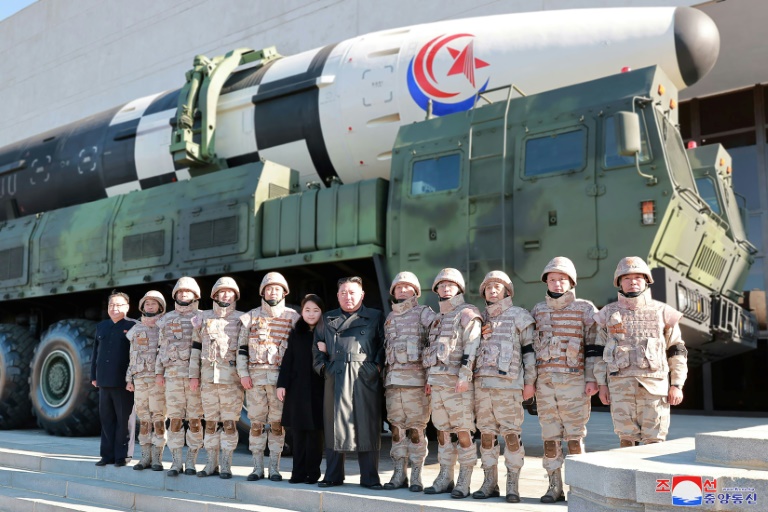
The official Rodong Sinmun newspaper carried more than a dozen pictures of Kim at the photo session with his “beloved daughter”, who was revealed to the world for the first time at last week’s ICBM launch.

Until then, North Korean state media had not mentioned Kim’s children, and last week’s report was the first official confirmation that he had a daughter, experts said.

The photos showed the girl — believed to be Kim’s second child, named Ju Ae — dressed in a black coat with a fur collar, linking arms with her father as they posed in front of the gigantic missile surrounded by uniformed soldiers.

Yang Moo-jin, a professor at the University of North Korean Studies in Seoul, said the daughter’s presence was meant to portray Hwasong-17 as “the protector of the future generation”.

“It looks like he will continue to parade his daughter on various occasions and use her as a means for propaganda,” he added.

The November 18 ICBM test was the latest in a record-breaking blitz of missile launches by Pyongyang, with officials and analysts in Seoul and Washington warning they could culminate in a seventh nuclear test by North Korea, which last tested an atomic device in 2017.

Close Bitnami banner
Bitnami