World

Recession-hit UK needs more migrant labour: business group

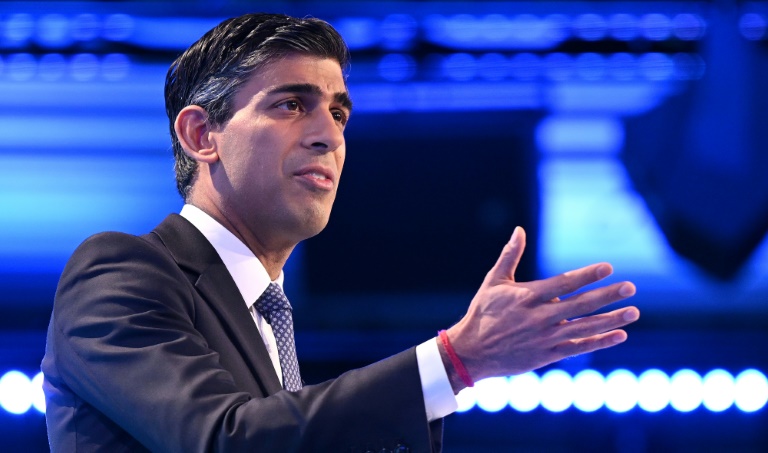
Britain needs more migrant labour to boost productivity as it faces a toxic mix of soaring inflation and shrinking growth, the country’s main business lobby group warned Monday.

The verdict from the Confederation of British Industry came at its annual gathering in Birmingham, Britain’s second biggest city.

The CBI conference comes after the government of Prime Minister Rishi Sunak last week slashed spending and hiked taxes in a budget, despite admitting that the inflation-wracked economy had fallen into recession.

“We come together, once more in extraordinary times,” CBI director-general Tony Danker told delegates in Birmingham, central England.

“Britain is in the middle of stagflation — rocketing inflation and negative growth — for the first time that probably most of us can remember.

“We know how to fight inflation. We know how to fight recession. But we don’t really know how to fight them together.”

Sunak, who also addressed the CBI on Monday, took office one month ago after predecessor Liz Truss delivered an unfunded tax-slashing mini-budget that tanked the pound and sent UK borrowing costs soaring.

UK inflation sits at a 41-year peak of 11.1 percent on rocketing food and energy costs in the wake of the Ukraine war.

Consumer prices have raced higher also as demand rebounds following the lifting of pandemic lockdowns.

That has worsened a cost-of-living crisis for businesses and individuals, hit also by soaring interest rates as the Bank of England seeks to cool runaway inflation.

– Immigration focus –

The UK has forecast its economy to shrink 1.4 percent next year, hit additionally by fallout from Brexit which has resulted in foreign workers returning home.

“When you look at the (growth) data, the only thing holding it up, actually, is higher hours worked due to higher immigration,” Danker added Monday.

“People are arguing against immigration — but it’s the only thing that has increased our growth potential since March.

“Let’s be honest — we don’t have the people we need, nor do we have the productivity.”

Addressing the conference, Sunak ducked the CBI’s call for more legal migrant labour — and stressed that he was focussed on curbing illegal migration.

Anita Donohoe, a conference attendee representing Kinaxia Logistics, said that while “immigration is very important”, Sunak is right to “tackle illegal immigration”.

She told AFP: “Focus on the legal immigration,” adding that her company has suffered as a result of losing truck drivers.

Andrew Guy of Friisberg and Partners hit out over Britain’s departure from the European Union for contributing to a skills shortage and affecting businesses generally, including their exports.

“I’m anti-Brexit in every way. There is not one good thing that came out of it,” he insisted.

“Until the government acknowledges its mistakes we’ll continue to struggle.”

– Cost of inflation –

Sunak also told CBI delegates that the budget sought “to grip inflation and balance the books”.

“The best way to help people is by stopping mortgages, rents and food prices from spiralling out of control,” Sunak said.

“Re-establishing stability is the critical first step. But there is so much more we need to do,” he added, stressing he wants to see more business innovation to boost economic activity.

A study published Monday revealed that restaurant insolvencies increased almost 60 percent over the last year.

“As well as increasing food and energy costs, restaurants have been hit by shortages of labour, particularly for skilled roles such as chefs, which has pushed up staff costs,” according to accountancy firm Mazars, which carried out the survey.

LGBTQ nightclub attack a suspected hate crime: Colorado mayor

The mayor of Colorado Springs said Monday that an attack by a lone gunman on an LGBTQ nightclub in the western US city that left five people dead and up to 30 injured had “the trappings of a hate crime.”

Police have identified the suspect in the Saturday night shooting at Club Q as Anderson Lee Aldrich, but have not yet divulged a motive for the attack.

The 22-year-old Aldrich, who was armed with a rifle and a handgun, was subdued by patrons at the club and taken into custody by police.

“The motive is still under investigation,” Colorado Springs Mayor John Suthers told NBC’s Today show. “But it certainly has the trappings of a hate crime.”

GLAAD, an LGBTQ advocacy organization, noted that the shooting came on the eve of the Transgender Day of Remembrance, which honors victims of transphobic attacks, and amid an uptick in hostility against the LGBTQ community in the United States.

“You can draw a straight line from the false and vile rhetoric about LGBTQ people spread by extremists and amplified across social media, to the nearly 300 anti-LGBTQ bills introduced this year, to the dozens of attacks on our community like this one,” GLAAD president Sarah Kate Ellis said in a statement.

Colorado Representative Brianna Titone, an openly trans state legislator, also singled out anti-LGBTQ rhetoric.

“When politicians and pundits keep perpetuating tropes, insults, and misinformation about the trans and LGBTQ+ community, this is a result,” Titone tweeted.

The attack was the deadliest on the LGBTQ community in the United States since a mass shooting at a nightclub in Orlando, Florida, in 2016 that claimed 49 lives.

Colorado authorities said it had not yet been officially classified as a hate crime but first-degree murder charges were certain to be filed.

Transgender rights were a hot-button issue in the United States leading up to midterm elections earlier this month, with Republicans putting forward a slew of legislative proposals to restrict them.

– Gunman overpowered –

Suthers, the mayor, said the gunman was overpowered in an “incredible act of heroism” by patrons of the club.

“Two, but primarily one as I understand it, are able to take a handgun that he’s got in his possession, take it away from him and use that weapon, not by shooting it, but by hitting him and disabling him,” he said.

“That act probably saved a lot of lives, there’s no question about that.”

Colorado Springs police chief Adrian Vasquez said Monday that the attack, which occurred shortly before midnight on Saturday, left five people dead and up to 30 injured.

“Injuries could range from being shot to maybe falling when trying to get out of the building,” Vasquez told CNN.

He said the suspect, who was armed with an “AR-style” rifle and a handgun, was currently in hospital and has declined to speak to to investigators.

Vasquez said police were scouring his social media to determine if “this was a bias-motivated crime.”

He said he expected charges to be filed later Monday.

The police chief also condemned what he called an “evil act” and pledged to do everything he can to make the community in Colorado Springs feel safe again.

– ‘Our safe space’ –

According to police, the suspect entered the club and immediately began shooting.

Police arrived within four minutes of receiving a call about an active shooting.

Bartender Michael Anderson praised the patrons who overpowered the gunman.

“There were some very brave people beating him and kicking him, stopping him from causing more damage,” he said. “They saved my life last night.”

Joshua Thurman was also in the club that night.

“It was so scary,” Thurman told reporters. “There were bodies on the floor. There was shattered glass, broken cups, people crying.

“It was supposed to be our safe space,” he said. “Where are we supposed to go?”

President Joe Biden condemned the attack, slamming violence against the LGBTQ community, particularly transgender women of color.

“We must drive out the inequities that contribute to violence against LGBTQI+ people. We cannot and must not tolerate hate,” he said.

Colorado Governor Jared Polis, who in 2018 became the first openly gay man elected as a US state governor, called the shooting “horrific, sickening and devastating.” 

A man with the same name as Aldrich was arrested on June 18 last year after his mother said he had threatened her with a homemade bomb, according to a news release at the time from the El Paso County Sheriff’s Office.

Vasquez, the police chief, said the suspect’s mother was not cooperating with the authorities at this time.

Fears of fresh China Covid curbs rattle stocks, oil prices

Oil prices plunged to lows unseen since January and global stocks mostly fell on Monday as renewed concerns about harsh coronavirus curbs in China rattled investor sentiment.

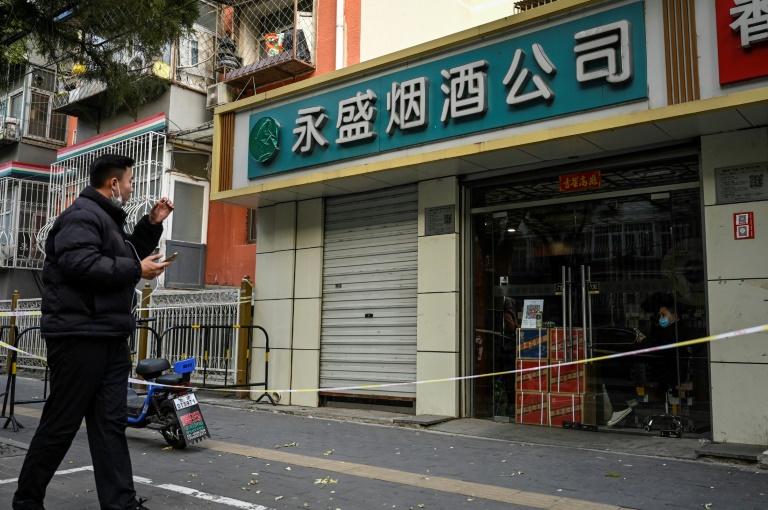
China’s first coronavirus death in six months sparked fears officials would reimpose strict, economically painful restrictions to fight outbreaks across the world’s second-biggest economy.

Brent North Sea crude slumped 5.5 percent to $82.84 per barrel and WTI shed 5.7 percent to $75.55 in mid-afternoon trading on fears over Chinese energy demand. 

Paris, London, Frankfurt and Milan all ended in the red on Monday while Wall Street also lost ground.

The fall in European and US stocks came after most Asian markets including Hong Kong’s Hang Seng Index and Shanghai ended lower, although Bangkok, Tokyo and Wellington were up.

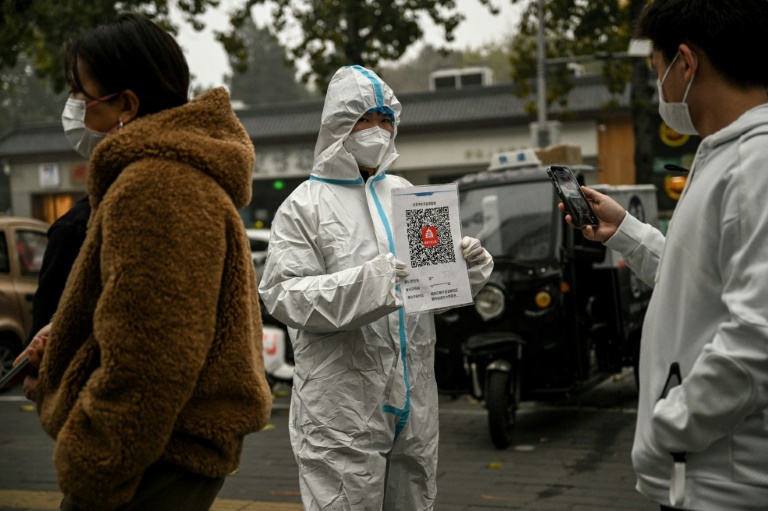
The death of an 87-year-old man in Beijing on Sunday came as infections across China spiked, testing authorities’ plans to loosen their grip by lowering quarantine times for foreigners and cancelling mass tests.

Two further Covid deaths were recorded on Monday, both elderly residents from Beijing.

The news threw a spanner in the works for investors who had grown hopeful of a gradual reopening of China’s economy.

“Crude oil prices have slipped back sharply on the back of concerns over weakening Chinese demand, as well as reports that Saudi Arabia supports the idea of a production increase,” noted Michael Hewson, chief market analyst at CMC Markets UK.

“No one can tell whether (Chinese President) Xi Jinping would pull back from the reopening plans, which would be another disaster for the Chinese stocks, and for the investor confidence,” said Ipek Ozkardeskaya, senior analyst at Swissquote Bank. 

Nevertheless, global markets have enjoyed a broadly healthy November thanks to signs of China easing and indications of slowing US inflation that fanned optimism the Federal Reserve would start to slow its pace of interest rate hikes.

But several officials soon lined up to warn that more needed to be done to get inflation back down from four-decade highs to more bearable levels.

Markets are meanwhile expected to stay relatively quiet for the rest of the week, with many US investors taking time off for Thanksgiving.

“Traders are also concerned by continued weakness in crypto prices in the wake of FTX’s collapse,” added market analyst Fawad Razaqzada.

“With this also being a quiet day and week in terms of macro data, they are understandably keen to proceed with caution.”

– Key figures around 1630 GMT –

London – FTSE 100: DOWN 0.1 percent at 7,376.85 points (close)

Paris – CAC 40: DOWN 0.2 percent at 6,634.45 (close)

Frankfurt – DAX: DOWN 0.4 percent at 14,379.93 (close)

EURO STOXX 50: DOWN 0.4 percent at 3,909.28

New York – Dow: DOWN 0.3 percent at 33,644.55

Tokyo – Nikkei 225: UP 0.2 percent at 27,944.79 (close)

Hong Kong – Hang Seng Index: DOWN 1.9 percent at 17,655.91 (close)

Shanghai – Composite: DOWN 0.4 percent at 3,085.04 (close)

Euro/dollar: DOWN at $1.0247 from $1.0325 on Friday

Dollar/yen: UP at 141.90 yen from 140.37 yen

Pound/dollar: DOWN at $1.1799 from $1.1890

Euro/pound: UP at 86.84 pence from 86.34 pence

West Texas Intermediate: DOWN 5.7 percent at $75.51 per barrel

Brent North Sea crude: DOWN 5.8 percent at $82.51 per barrel

Shallow quake kills 162, injures hundreds on Indonesia's Java island

A shallow 5.6-magnitude earthquake killed at least 162 people, with hundreds injured and others missing, when it toppled buildings and triggered landslides on Indonesia’s main island of Java on Monday, officials said.

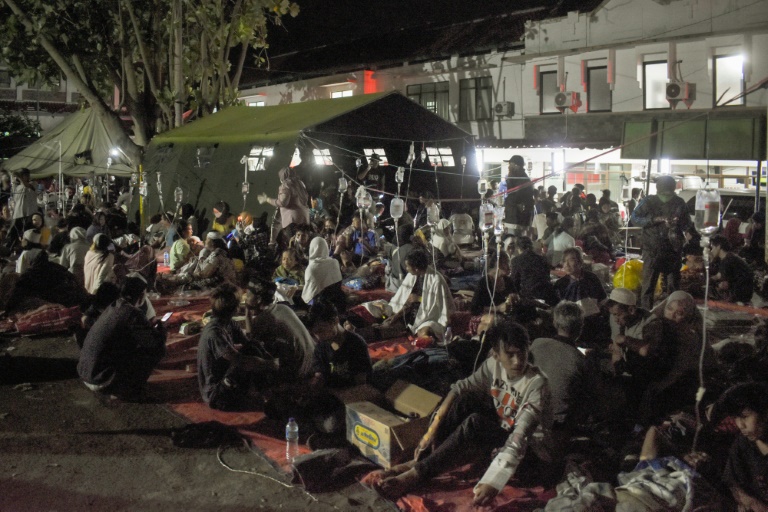
Doctors treated patients outdoors after the quake, which was felt as far away as the capital Jakarta, left hospitals in the West Java town of Cianjur without power for several hours. 

“I regret to inform that 162 are dead. 326 are injured with most of them sustained fractures from being crushed in ruins,” Ridwan Kamil, governor of worst-hit province West Java, told a press conference in a video seen by AFP. He said most of the victims were children.

Adam, spokesman for the local administration in Cianjur town, who like many Indonesians goes by one name, confirmed the toll to AFP.

Indonesia’s national disaster mitigation agency, BNPB, still lists the toll at 62. Due to miscounting, officials offered wildly fluctuating death tolls after an Indonesian stadium disaster last month.

The BNPB said 25 people remained trapped under the rubble as the rescue mission stretched into the night.

The agency said more than 2,000 houses were damaged and Kamil said more than 13,000 people were taken to evacuation centres.

“You can see it yourself, some got their heads, feet sewn outdoors. Some got stressed and started crying,” Kamil said.

Kamil said power had been partially restored by the evening, without specifying if that meant by generators or connection to a power grid.

The afternoon quake was centred in the Cianjur region and local authorities earlier said as many as 700 had been wounded, warning the death toll could rise further.

“Because there are still a lot of people trapped on the scene, we assume injuries and fatalities will increase over time,” Kamil said as ambulance sirens blared in the background.

Agus Azhari, 19, was with his elderly mother in the family home when their living room was destroyed within seconds, parts of the walls and roof collapsing around them.

“I pulled my mother’s hand, and we ran outside,” he said. “I heard people screaming for help from all around me,” Azhari told AFP.

The majority of deaths were counted in one hospital, the head of Cianjur’s local administration Herman Suherman said, with most of the victims killed in the ruins of collapsed buildings.

He told Indonesian media the town’s Sayang hospital had no power after the quake, leaving doctors unable to operate on victims immediately. 

More health workers were urgently needed due to the overwhelming number of patients, he said.

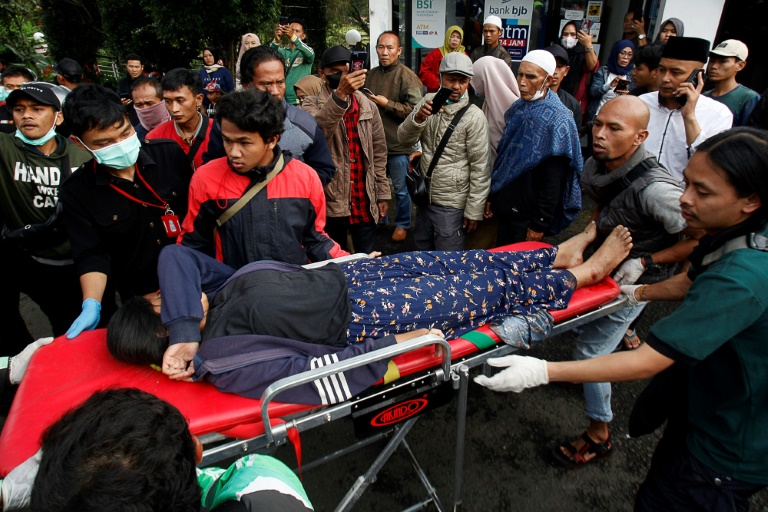
Locals rushed victims to the hospital in pickup trucks and on motorbikes, according to footage obtained by AFP. 

– ‘Emergency state’ –

They were placed in front of the facility as residents spread a tarpaulin on the road for the bodies.

At another facility, Cimacan hospital, green tents were erected outside for makeshift treatment, according to an AFP reporter at the scene. 

Victims arrived covered in blood, while parents looked for their children.

Kamil, the governor, said multiple landslides had cut off road access to some areas and bulldozers were being used to reopen them.

Shops, a hospital and an Islamic boarding school in the town were severely damaged, according to Indonesian media.

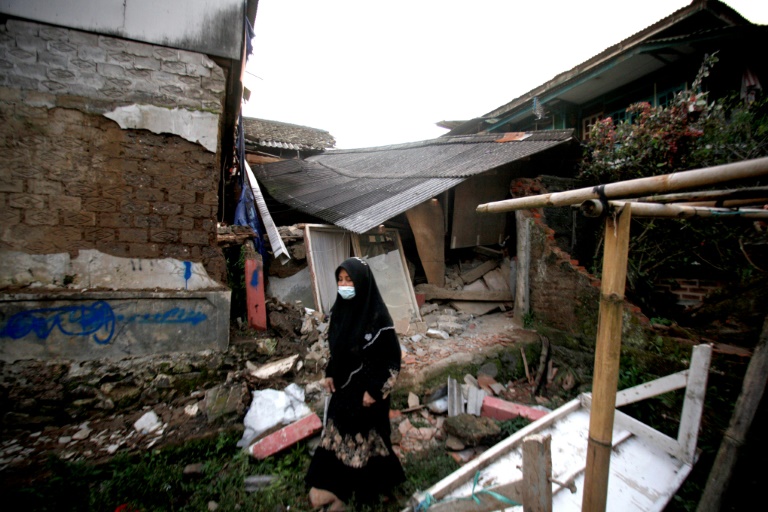
Collapsed buildings and debris lined the streets in Cianjur. The town is situated in a hilly area where many houses are built with a mixture of mud and concrete.

“The ambulances keep on coming,” Suherman said.

“There are many families in villages that have not been evacuated.”

Cianjur police chief Doni Hermawan told Metro TV authorities had rescued a woman and a baby from a landslide but a third person they found had died of their injuries.

– Jakarta rattled –

French President Emmanuel Macron was the first world leader to offer his condolences.

“Indonesia was hit this morning by an earthquake of destructive and deadly force. Thoughts for all the victims,” he wrote. 

Canadian Prime Minister Justin Trudeau sent condolences and said Ottawa “stands ready to help in any way”.

Indonesian President Joko Widodo is yet to respond to the quake.

Indonesia’s meteorological agency said it recorded 62 aftershocks in Cianjur after the quake, with magnitudes ranging from 1.8 to 4.

There were no reports of casualties or major damage in Jakarta, a three-hour drive away.

Mayadita Waluyo, a 22-year-old lawyer, described how panicked workers ran to building exits in Jakarta as the quake struck.

“I was working when the floor under me was shaking. I could feel the tremor clearly,” she said.

Indonesia experiences frequent seismic and volcanic activity due to its position on the Pacific “Ring of Fire”, where tectonic plates collide.

A 6.2-magnitude quake that shook Sulawesi island in January 2021 killed more than 100 people and left thousands homeless.

Governor, local official say Indonesia quake death toll jumps to 162

The governor of the worst-hit province and a local official said the death toll from an earthquake on Indonesia’s main island of Java on Monday had jumped to 162.

“I regret to inform that 162 are dead,” West Java governor Ridwan Kamil said in a video seen by AFP. Adam, the spokesman for the local administration in Cianjur town in West Java, who like many Indonesians goes by one name, confirmed the toll to AFP.

Indonesia’s national disaster mitigation agency, BNPB, still lists the toll at 62. Due to miscounting, officials offered wildly fluctuating death tolls after an Indonesian stadium disaster last month.

'I was crushed': Fear and panic grip Indonesian town battered by quake

Surrounded by chaos, panicked residents still filled the streets and hospitals of a West Javan town on Monday hours after a quake killed at least 62 people and injured hundreds more.

Agus Azhari, 19, was with his mother in their family home when the living room was destroyed within seconds by the quake that was centred on West Java’s Cianjur, the worst-hit town.

Parts of the walls and roof fell to the floor, along with cupboards and other debris that hit his legs and hands.

“I couldn’t see anything. The dust from the debris blocked my sight for a while,” Azhari told AFP. He said he had never experienced an earthquake like it before.

The Indonesian teen shared a video in which his 56-year-old mother screams, “Lord have mercy! My house!” as their home shook.

“I pulled my mother’s hand and we ran outside,” he said. “I heard people screaming for help from all around me.”

The shallow tremor, with a magnitude of 5.6, brought down the roofs and walls of homes built on the town’s hilly landscape. Many were made more vulnerable by the use of wood, mud and concrete in their construction.

Emergency workers raced to treat victims in any outdoor space possible, with the town’s three hospitals overwhelmed and not enough rooms to cope with an injury toll of 700.

At least 25 people were still trapped in the rubble, authorities said. 

Residents rushed lifeless bodies to Cianjur’s Sayang hospital in pickup trucks and on motorbikes. Power outages meant doctors were unable to operate immediately.

Some of the injured sat on stretchers or blankets with their heads and limbs bandaged. Elderly women sat in wheelchairs waiting to be treated as crowds of worried bystanders looked on.

– ‘I could do nothing’ –

At another hospital, Cimacan, victims arrived covered in blood while parents looked for missing children.

Several injured elderly women were taken on stretchers into makeshift green tents erected outside the hospital.

People ran to resuscitate victims in the immediate aftermath of the quake, while others fled their homes for safety.

Dozens of aftershocks shook the town for minutes that, for rattled locals, seemed like hours.

The province’s governor said some of the injured needed their heads and feet stitched back together from wounds sustained by the debris falling around them.

Landslides around the town buried bodies, and bulldozers were mobilised to reopen roads.

A woman and a baby were pulled alive from the rubble, while others lost their lives nearby.

Oman, a 55-year-old who, like most Indonesians goes by one name, was making fried rice in a village near Cianjur when his house started to sway.

“All of a sudden I was crushed beneath it. I could do nothing in the rubble. My wife was outside at the time,” he said.

His feet, legs and hands were squeezed in the ruins but his son arrived to pull him free, emerging with only a broken leg and a bloodied body.

“I did not know where to go but at least I am alive,” Oman said.

The search for survivors was set to last well  into the night as survivors reckoned with the carnage of lost homes and relatives.

“My mother looked at her house and she cried,” Azhari said.

Shallow quake kills 62, injures hundreds on Indonesia's Java island

A shallow 5.6-magnitude earthquake killed at least 62 people, with hundreds injured and others missing, when it toppled buildings and triggered landslides on Indonesia’s main island of Java on Monday, officials said.

Doctors treated patients outdoors after the quake, which was felt as far away as the capital Jakarta, left hospitals in the West Java town of Cianjur without power for several hours. 

Indonesia’s disaster mitigation agency said 25 people remained trapped under the rubble as the rescue mission stretched into the night.

The agency increased the death toll from 56 and said more than 2,000 houses were damaged and more than 5,000 people were taken to evacuation centres.

“You can see it yourself, some got their heads, feet sewn outdoors. Some got stressed and started crying,” West Java governor Ridwan Kamil told a news conference broadcast on Kompas TV.

Kamil said power had been partially restored by the evening, without specifying if that meant by generators or connection to a power grid.

The afternoon quake was centred in the Cianjur region and local authorities said as many as 700 had been wounded, warning the death toll could rise further. 

“Because there are still a lot of people trapped on the scene, we assume injuries and fatalities will increase over time,” Kamil said as ambulance sirens blared in the background.

Agus Azhari, 19, was with his elderly mother in the family home when the living room was destroyed within seconds, parts of the walls and roof collapsing around them.

“I pulled my mother’s hand, and we ran outside,” he said. “I heard people screaming for help from all around me,” Azhari told AFP.

The majority of deaths were counted in one hospital, the head of Cianjur’s local administration Herman Suherman said earlier, with most of the victims killed in the ruins of collapsed buildings.

He told Indonesian media the town’s Sayang hospital had no power after the quake, leaving doctors unable to operate on victims immediately. 

More health workers were urgently needed due to the overwhelming number of patients, he said.

Locals rushed victims to the hospital in pickup trucks and on motorbikes, according to footage obtained by AFP. 

– ‘Emergency state’ –

They were placed in front of the facility as residents spread a tarpaulin on the road for the bodies.

At another facility, Cimacan hospital, green tents were erected outside for makeshift treatment, according to an AFP reporter at the scene. 

Victims arrived covered in blood, while parents looked for their children.

Kamil, the governor, said multiple landslides had cut off road access to some areas and bulldozers were being used to reopen them.

Shops, a hospital and an Islamic boarding school in the town were severely damaged, according to Indonesian media.

Broadcasters showed several buildings in Cianjur with their roofs collapsed and debris lining the streets. The town is situated in a hilly area where many houses are built with a mixture of mud and concrete.

“The ambulances keep on coming from the villages to the hospital,” Suherman said.

“There are many families in villages that have not been evacuated.”

Cianjur police chief Doni Hermawan told Metro TV authorities had rescued a woman and a baby from a landslide but a third person they found had died of their injuries.

– Jakarta rattled –

French President Emmanuel Macron was the first world leader to offer his condolences.

“Indonesia was hit this morning by an earthquake of destructive and deadly force. Thoughts for all the victims,” he wrote. Indonesian President Joko Widodo is yet to respond to the quake.

Indonesia’s meteorological agency said it recorded 62 aftershocks in Cianjur after the quake, with magnitudes ranging from 1.8 to 4.

There were no reports of casualties or major damage in Jakarta, a three-hour drive away.

Mayadita Waluyo, a 22-year-old lawyer, described how panicked workers ran to building exits in Jakarta as the quake struck.

“I was working when the floor under me was shaking. I could feel the tremor clearly. I tried to do nothing to process what it was but it became even stronger and lasted for some time,” she said.

Indonesia experiences frequent seismic and volcanic activity due to its position on the Pacific “Ring of Fire”, where tectonic plates collide.

A 6.2-magnitude quake that shook Sulawesi island in January 2021 killed more than 100 people and left thousands homeless.

Markets rattled by fears of fresh Covid curbs in China

Asian and European stocks mostly fell Monday, with investor sentiment hit by renewed Covid concerns in China amid warnings that markets would remain lacklustre for some time.

Shares headed lower as China’s first coronavirus death in six months sparked fears officials would reimpose strict, economically painful restrictions to fight outbreaks across the country.

“The bear market is not over, in our view,” Goldman Sachs strategist Peter Oppenheimer said.

“The conditions that are typically consistent with an equity trough have not yet been reached. We would expect lower valuations (consistent with recessionary outcomes), a trough in the momentum of growth deterioration, and a peak in interest rates before a sustained recovery begins.”

Oil prices also slid on fears over energy demand in China, the world’s second biggest economy.

“There are concerns China may tighten Covid curbs further after the first Covid-related death in almost six months was reported, and a city near Beijing enforced a slew of restrictions,” said market analyst Fawad Razaqzada.

“Traders are also concerned by continued weakness in crypto prices in the wake of FTX’s collapse,” he said.

The death of an 87-year-old man in Beijing on Sunday came as infections across the country spiked, testing authorities’ plans to loosen their grip by lowering quarantine times for foreigners and cancelling mass tests.

Two further Covid deaths were recorded on Monday, both elderly residents from Beijing.

The news threw a spanner in the works for investors who had grown hopeful of a gradual reopening of China’s economy.

Hong Kong’s Hang Seng Index fell nearly two percent, extending a sell-off at the end of last week.

Shanghai was also down along with most Asian markets, but Bangkok, Tokyo and Wellington ended higher.

Nevertheless, global markets have enjoyed a broadly healthy November thanks to signs of China easing and indications of slowing US inflation that fanned optimism the Federal Reserve would start to slow its pace of interest rate hikes.

But several officials soon lined up to warn that more needed to be done to get inflation back down from four-decade highs to more bearable levels.

Markets are meanwhile expected to stay relatively quiet for the rest of the week, with many US investors taking time off for Thanksgiving.

– Key figures around 1430 GMT –

London – FTSE 100: DOWN 0.2 percent at 7,373.98 points

Paris – CAC 40: DOWN 0.3 percent at 6,626.94

Frankfurt – DAX: DOWN 0.4 percent at 14,379.97

EURO STOXX 50: DOWN 0.4 percent at 3,909.67

New York – Dow: DOWN by less than 0.1 percent at 33,735.28

Tokyo – Nikkei 225: UP 0.2 percent at 27,944.79 (close)

Hong Kong – Hang Seng Index: DOWN 1.9 percent at 17,655.91 (close)

Shanghai – Composite: DOWN 0.4 percent at 3,085.04 (close)

Euro/dollar: DOWN at $1.0240 from $1.0325 on Friday

Dollar/yen: UP at 141.48 yen from 140.37 yen

Pound/dollar: DOWN at $1.1809 from $1.1890

Euro/pound: UP at 86.71 pence from 86.34 pence

West Texas Intermediate: DOWN 3.7 percent at $77.16 per barrel

Brent North Sea crude: DOWN 3.7 percent at $84.36 per barrel

Recession-hit UK needs more migrant labour: business lobby

Britain needs more migrant labour to boost productivity as it faces a toxic mix of soaring inflation and shrinking growth, the country’s main business lobby group warned Monday.

The verdict from the Confederation of British Industry came at its annual gathering in Birmingham, Britain’s second biggest city.

The CBI conference comes after the government of Prime Minister Rishi Sunak slashed spending and hiked taxes in a budget, despite admitting that the inflation-wracked economy had fallen into recession.

“We come together, once more in extraordinary times,” CBI director-general Tony Danker told delegates in Birmingham, central England.

“Britain is in the middle of stagflation — rocketing inflation and negative growth — for the first time that probably most of us can remember.

“We know how to fight inflation. We know how to fight recession. But we don’t really know how to fight them together.”

Sunak, who also addressed the CBI on Monday, took office one month ago after predecessor Liz Truss delivered an unfunded tax-slashing mini-budget that tanked the pound and sent UK borrowing costs soaring.

UK inflation sits at a 41-year peak of 11.1 percent on rocketing food and energy costs in the wake of the Ukraine war.

Consumer prices have also raced higher as demand rebounds following the lifting of pandemic lockdowns.

That has worsened a cost-of-living crisis for businesses and individuals, hit also by soaring interest rates as the Bank of England seeks to cool runaway inflation.

The UK has forecast the economy to shrink 1.4 percent next year, hit also by fallout from Brexit which has resulted in foreign workers returning home.

“When you look at the (growth) data, the only thing holding it up, actually, is higher hours worked due to higher immigration,” Danker added on Monday.

“People are arguing against immigration — but it’s the only thing that has increased our growth potential since March.

“Let’s be honest — we don’t have the people we need, nor do we have the productivity.”

– Focus on illegal immigration –

Sunak, addressing the conference later on Monday, ducked the CBI’s call for more legal migrant labour — and stressed that he was focussed on curbing illegal migration.

“The country’s number one priority right now, when it comes to migration, is tackling illegal migration,” he said.

“When people see that happening, it undermines trust in the system, it doesn’t seem fair that people are able to break the rules.

“That’s what I’m absolutely determined to fix.”

He also told CBI delegates that last week’s budget sought “to grip inflation and balance the books”.

“The best way to help people is by stopping mortgages, rents and food prices from spiralling out of control,” Sunak said.

“Re-establishing stability is the critical first step. But there is so much more we need to do,” he added, stressing he wants to see more business innovation to boost economic activity.

E.Africa troops to 'enforce peace' in east DR Congo

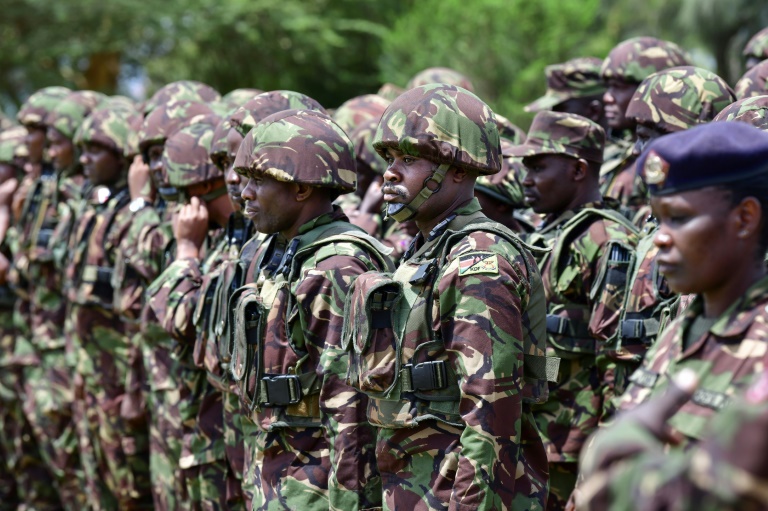
Kenyan President William Ruto said Monday that East African troops would “enforce peace” in embattled eastern DR Congo, where the M23 armed group have launched an offensive. 

Kenyan troops, deployed as part of an East African Community (EAC) force, arrived in the volatile region on November 12.

The regional force will “enforce peace on those who are hellbent on creating instability,” Ruto said in a news conference in the Democratic Republic of Congo’s capital, Kinshasa.

The M23, a largely Congolese Tutsi militia, has seized swathes of territory across North Kivu province, edging towards the region’s main city of Goma. 

The fighting has reignited regional tensions, with the DRC accusing its smaller neighbour Rwanda of backing the M23, something that UN experts and US officials have also said in recent months.

Kigali denies supporting the M23 and accuses Kinshasa of colluding with the FDLR — a former Rwandan Hutu rebel group established in the DRC after the 1994 genocide of mainly Tutsis in Rwanda.

The M23 first leapt to prominence 10 years ago when it captured Goma in 2012, before being driven out and going to ground. 

But it re-emerged late last year, claiming the DRC had failed to honour a pledge to integrate its fighters into the army, among other grievances.

Kenya is sending about 900 troops to the DRC as part of a joint EAC force created to help restore security.

Ruto said he was aware that there are already peacekeeping forces present in eastern DRC —  alluding to the thousands-strong United Nations force — but suggested that East African troops would be more forceful.

“From what see in the region, we do not think there is much peace to keep,” he said. 

– Political dialogue –

Kenyan General Jeff Nyagah, the commander of the EAC force, also said when he arrived in Goma on November 16 that the East African operation would be “an intervention force.” 

But, he stressed, the priority was to find a political solution to instability in eastern DRC, as well as to disarm militias.

Peace talks under the aegis of the seven-nation EAC were scheduled to be launched in the Kenyan capital Nairobi on Monday, but their start date remains unclear.

Ruto told reporters on Monday that EAC heads of state, in their joint mandate to the regional force, agreed that the mission was to ensure peace as well as enforce it.

The mandate has been communicated to the African Union and the UN Security Council, he said.

The force is expected to include soldiers from Burundi, Uganda and South Sudan, as well as from Kenya. But its intended total size remains unclear. 

The UN’s peacekeeping force in eastern DRC, known as MONUSCO, has a current strength of about 16,000 uniformed personnel. 

But many in the DRC see the peacekeepers as ineffective. 

At least 262,000 people have been displaced by the fighting, the UN estimated last week.

The M23 is just one of around 120 armed groups which are active in eastern Congo.

Many of them are a legacy of regional wars that flared before the turn of the century.  

Close Bitnami banner
Bitnami