World

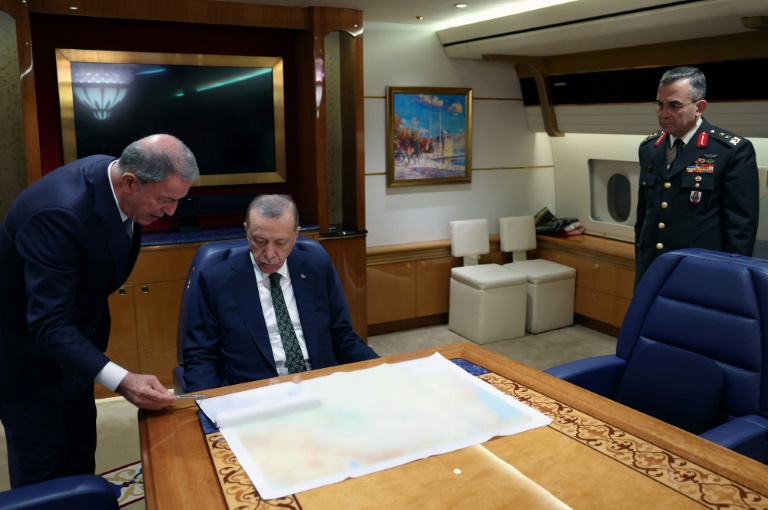
Erdogan says mulling ground operation in Syria

Turkish President Recep Tayyip Erdogan said Monday he was mulling going beyond air strikes and launching a ground operation in Syria following a deadly rocket strike on a Turkish border town.

Erdogan also renewed warnings that those attacking Turkey will pay dearly, a day after Ankara’s forces launched air raids on bases of outlawed Kurdish groups in northern Syria and Iraq.

“There is no question that this operation be limited to only an aerial operation,” Erdogan told reporters on returning to Turkey from Qatar where he attended the FIFA World Cup opening.

“Competent authorities, our defence ministry and chief of staff will together decide the level of force that should be used by our ground forces,” Erdogan said.

“We have already warned that we will make those who violate our territory pay,” he added.

Erdogan spoke after a rocket strike from Syrian territory killed at least three people, including a child, in a border Turkish town.

That strike came a day after Turkey carried out air raids against the bases of Kurdish militant groups in northern Syria and Iraq which it said were being used to launch “terrorist” attacks on Turkish soil.

The overnight raids mainly targeting positions held by Syrian Kurdish forces in northern and northeastern Syria killed at least 31 people, according to the British-based monitoring group the Syrian Observatory for Human Rights (SOHR).

The Kurdish-led Syrian Democratic Forces (SDF), among those attacked, said Turkey launched new air strikes on Monday.

The Turkish raids, codenamed Operation Claw-Sword, came a week after a blast in central Istanbul killed six people and wounded 81.

– ’70 planes and drones’ –

Turkey has blamed that attack on the Kurdistan Workers’ Party (PKK).

The blast, the deadliest in five years, revived bitter memories of a wave of nationwide attacks between 2015 and 2017.

The PKK has waged a bloody insurgency there for decades and is designated a terror group by Ankara and its Western allies.

But it has denied involvement in the Istanbul explosion.

Strikes also targeted PKK bases in northern Iraq’s mountainous regions of Kandil, Asos and Hakurk, and bases of the Kurdish People’s Protection Units (YPG), in Ayn al-Arab (called Kobane in Kurdish), Tal Rifaat, Jazira and Derik regions in Syria, Ankara’s defence ministry said.

Ankara considers the YPG to be a PKK-affiliated terror group.

Erdogan said consultations were ongoing on the strength of Ankara’s military response and added that the weekend strikes were carried out by “70 planes and drones” who “penetrated 140 kilometres (87 miles) into northern Iraq and 20 kilometres into northern Syria.”

An SDF spokesperson told AFP that Turkish airplanes launched on Monday fresh strikes near Kobani, a claim confirmed by the SOHR. A strike hit a regime forces position, according to the SDF.

Since the rocket attack in the morning, there has been an exchange of artillery fire between Turkish forces backed by Syrian proxies and the SDF, according to an AFP correspondent.

Erdogan also revealed he had had “no discussion with (US President Joe) Biden or (Russian President Vladimir) Putin on the subject of the operation.”

Turkey’s latest military push could create problems for its complex relations with its Western allies — particularly the United States, which has relied mostly on Syrian Kurdish militia forces in its fight against IS jihadists.

Turkey has often accused Washington of supplying Kurdish forces with weapons.

Russia for its part backs pro-Damascus militia in the region.
No backsliding on Brexit, says UK PM

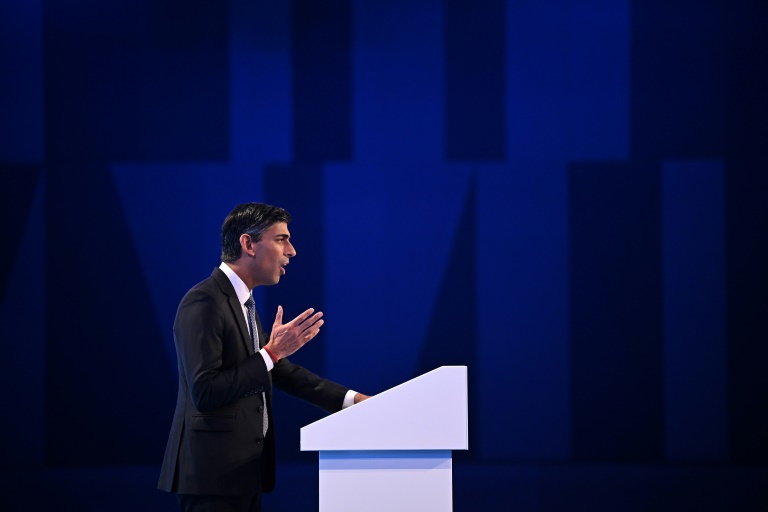
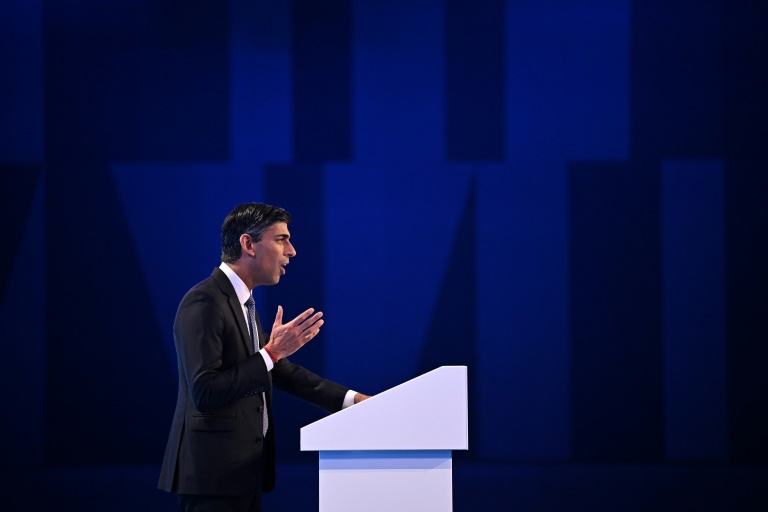
British Prime Minister Rishi Sunak on Monday denied that his government was seeking to row back on the UK’s EU withdrawal deal, despite an apparent growing backlash against Brexit.

Brexit-supporter Sunak told business leaders that life outside the European Union was “already delivering enormous benefits and opportunities”.

He touted greater curbs on immigration — a key plank of the Brexit deal — and closer trade ties with Asia.

But he added: “Let me be unequivocal about this: under my leadership, the United Kingdom will not pursue any relationship with Europe that relies on alignment with EU laws.”

The UK left the EU in full in January 2021, after years of political wrangling since the divisive referendum n 2016 to split from the bloc.

Brexit saw the UK withdraw from the European single market and customs union, while free movement between member states and the jurisdiction of European courts ended.

But a deal between London and Brussels maintained largely tariff-free trade with its remaining 27 members.

Sunak’s comments follow a Sunday Times report that “senior government figures” were planning to “put Britain on the path towards a Swiss-style relationship” with the EU.

Switzerland has far closer ties with the bloc through bilateral agreements allowing access to the single market, a high degree of free movement and by paying into EU coffers.

The report, and comments last week by finance minister Jeremy Hunt, who voted to remain in the EU, that he was eager to remove the “vast majority” of trade barriers with the EU.

That has sparked unease among eurosceptic members of the ruling Conservative party.

“The government has got to focus on what it needs to do, rather than trying to reopen a settled debate about Europe,” former Tory leader Iain Duncan Smith told The Sun. 

– Bad deals? –

The backlash stirred memories of the febrile aftermath of the referendum about how best to deliver Brexit.

Former prime minister Boris Johnson, a staunch critic of his predecessor Theresa May’s plan for Swiss-style ties, eventually won the argument with his harder version of Brexit.

He won a landslide election victory in December 2019 on a vow to “get Brexit done”, having negotiated his own 2019 divorce deal.

However, three years on, the UK is in a deep economic crisis and criticism of both Johnson’s agreement and the whole Brexit project is increasing.

Amid decades-high inflation and forecasts of its longest ever recession, a new YouGov poll last week suggested 56 percent of people now think it was wrong to leave the EU.

Some 32 percent were still in favour.

The Office for Budget Responsibility watchdog assessed that Brexit had had a “significant adverse impact” on UK trade, in comments backed by the Bank of England.

The OBR blamed Brexit for reducing overall trade volumes and denting trading relationships with the bloc.

The gloomy economic news was compounded by London losing its prized status as the biggest European stock market to Paris.

Brexiteers promised to strike trade deals around the world, including with the potentially lucrative United States market.

But an agreement with Washington is unlikely anytime soon.

Accords London has struck with other countries — negotiated by Sunak’s short-lived predecessor Liz Truss as trade minister — are also being lambasted.

Former environment minister George Eustice said last week that the agreement he helped finalise with Australia almost a year ago was “not actually a very good deal for the UK”.

“Overall, the truth of the matter is that the UK gave away far too much, for far too little in return,” he told MPs in parliament, citing liberalisation of beef and sheep markets.

In Brussels, the European Commission said: “Our relationship with the United Kingdom is based on the Withdrawal Agreement and the Trade and Cooperation Agreement.”

A temporary deal for food and agricultural products was “the only Swiss-style deal or offer on the table as far as we’re concerned”, a spokesman told reporters.

No backsliding on Brexit, says UK PM

British Prime Minister Rishi Sunak on Monday denied that his government was seeking to row back on the UK’s EU withdrawal deal, despite an apparent growing backlash against Brexit.

Brexit-supporter Sunak told business leaders that life outside the European Union was “already delivering enormous benefits and opportunities”.

He touted greater curbs on immigration — a key plank of the Brexit deal — and closer trade ties with Asia.

But he added: “Let me be unequivocal about this: under my leadership, the United Kingdom will not pursue any relationship with Europe that relies on alignment with EU laws.”

The UK left the EU in full in January 2021, after years of political wrangling since the divisive referendum n 2016 to split from the bloc.

Brexit saw the UK withdraw from the European single market and customs union, while free movement between member states and the jurisdiction of European courts ended.

But a deal between London and Brussels maintained largely tariff-free trade with its remaining 27 members.

Sunak’s comments follow a Sunday Times report that “senior government figures” were planning to “put Britain on the path towards a Swiss-style relationship” with the EU.

Switzerland has far closer ties with the bloc through bilateral agreements allowing access to the single market, a high degree of free movement and by paying into EU coffers.

The report, and comments last week by finance minister Jeremy Hunt, who voted to remain in the EU, that he was eager to remove the “vast majority” of trade barriers with the EU.

That has sparked unease among eurosceptic members of the ruling Conservative party.

“The government has got to focus on what it needs to do, rather than trying to reopen a settled debate about Europe,” former Tory leader Iain Duncan Smith told The Sun. 

– Bad deals? –

The backlash stirred memories of the febrile aftermath of the referendum about how best to deliver Brexit.

Former prime minister Boris Johnson, a staunch critic of his predecessor Theresa May’s plan for Swiss-style ties, eventually won the argument with his harder version of Brexit.

He won a landslide election victory in December 2019 on a vow to “get Brexit done”, having negotiated his own 2019 divorce deal.

However, three years on, the UK is in a deep economic crisis and criticism of both Johnson’s agreement and the whole Brexit project is increasing.

Amid decades-high inflation and forecasts of its longest ever recession, a new YouGov poll last week suggested 56 percent of people now think it was wrong to leave the EU.

Some 32 percent were still in favour.

The Office for Budget Responsibility watchdog assessed that Brexit had had a “significant adverse impact” on UK trade, in comments backed by the Bank of England.

The OBR blamed Brexit for reducing overall trade volumes and denting trading relationships with the bloc.

The gloomy economic news was compounded by London losing its prized status as the biggest European stock market to Paris.

Brexiteers promised to strike trade deals around the world, including with the potentially lucrative United States market.

But an agreement with Washington is unlikely anytime soon.

Accords London has struck with other countries — negotiated by Sunak’s short-lived predecessor Liz Truss as trade minister — are also being lambasted.

Former environment minister George Eustice said last week that the agreement he helped finalise with Australia almost a year ago was “not actually a very good deal for the UK”.

“Overall, the truth of the matter is that the UK gave away far too much, for far too little in return,” he told MPs in parliament, citing liberalisation of beef and sheep markets.

In Brussels, the European Commission said: “Our relationship with the United Kingdom is based on the Withdrawal Agreement and the Trade and Cooperation Agreement.”

A temporary deal for food and agricultural products was “the only Swiss-style deal or offer on the table as far as we’re concerned”, a spokesman told reporters.

Lufthansa launches hiring drive as recovery gathers pace

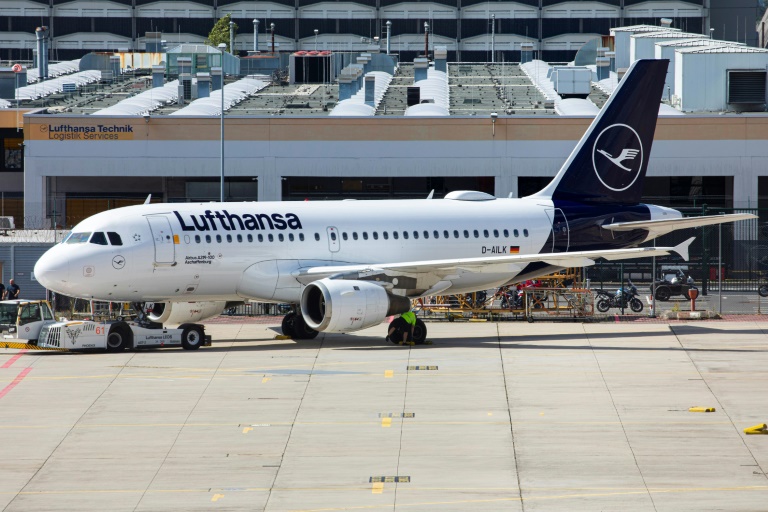
Lufthansa on Monday launched a drive to hire 20,000 employees, as the German airline giant recovers strongly from the coronavirus pandemic and seeks to tackle staffing shortages. 

The airline made huge losses when the virus brought global air travel to a halt but a rebound in demand has helped it return to profit this year.

Lufthansa said it was seeking the new hires in Germany, Switzerland, Austria and Belgium, with roles ranging from pilots and flight attendants to technicians and IT specialists. 

A spokesman said some of the roles were being newly created while some were replacements for people who had left. 

“In order to be at the forefront of the industry, we need dedicated and motivated employees for a variety of tasks and challenges,” said personnel chief Michael Niggemann.

According to figures published in October, Lufthansa had 108,000 employees at the end of September. It had 138,000 at the end of 2019, prior to the pandemic.

The airline industry in Europe is scrambling to hire new staff to cope with the rebound in demand, after many quit or were let go during the pandemic.  

Lufthansa, which cut thousands of staff during the pandemic, faced strike action by pilots and ground staff over the summer, due to worker shortages but also rising inflation. 

The airline group subsequently agreed to pay hikes for staff in several different areas.

In the third quarter, the airline group — which also includes Eurowings, Austrian, Swiss and Brussels Airlines — reported a healthy profit, and declared it had “left the pandemic behind”.

Lufthansa made huge losses in 2020 and 2021, and had to be bailed out by the German government, but it reported that its finances stabilised earlier than expected. 

Fifty-six dead as quake shakes Indonesia's Java island

A shallow 5.6-magnitude earthquake killed at least 56 people and injured hundreds when it damaged buildings and triggered landslides on Indonesia’s main island of Java on Monday, officials said.

Doctors treated patients outdoors after the quake — felt as far away as the capital Jakarta — left hospitals without power for several hours. 

“You can see it yourself, some got their heads, feet sewn outdoors. Some got stressed and started crying,” West Java governor Ridwan Kamil told a press conference broadcast on Kompas TV.

He added that power had been partially restored by the evening, without specifying if through a generator or connection to a power grid.

The afternoon quake was centred in the Cianjur region of West Java, according to the United States Geological Survey, with local authorities saying 56 people had been killed and over 700 wounded. 

“Because there are still a lot of people trapped on the scene, we assume injuries and fatalities will increase over time,” said Kamil as ambulance sirens blared throughout his press conference.

The majority of deaths were counted in one hospital, head of Cianjur’s local administration Herman Suherman said earlier, with most of the victims killed in the ruins of collapsed buildings.

He told local media the town’s Sayang hospital had no power after the quake, leaving doctors unable to immediately operate on victims. 

More health workers were urgently needed due to the overwhelming number of patients, he added.

Locals rushed victims to the hospital on pickup trucks and motorbikes, according to footage obtained by AFP. 

They were placed in front of the facility as residents spread a tarpaulin on the road for the bodies.

Kamil, the governor, said multiple landslides had cut off road access to some areas and bulldozers were being used to open them up.

– ‘Emergency state’ –

Thousands of houses could have been damaged in the quake, Adam, a spokesperson for the administration who, like many Indonesians, goes by one name, told AFP.

Shops, a hospital and an Islamic boarding school in the town were severely damaged, according to Indonesian media.

Broadcasters showed several buildings in Cianjur with their roofs collapsed and debris lining the streets.

Relatives of victims congregated at the hospital while at another facility, Cimacan hospital, green tents were erected outside for makeshift treatment, according to an AFP reporter at the scene.

“We are currently handling people who are in an emergency state in this hospital. The ambulances keep on coming from the villages to the hospital,” Suherman said.

“There are many families in villages that have not been evacuated.”

Indonesia’s disaster chief Suharyanto, who also goes by one name, said information was “still developing”.

Cianjur police chief Doni Hermawan told Metro TV authorities had rescued a woman and a baby from a landslide but a third person they found had died of their injuries.

– Jakarta rattled –

French President Emmanuel Macron was the first world leader to offer his condolences.

“Indonesia was hit this morning by an earthquake of destructive and deadly force. Thoughts for all the victims,” he wrote. Indonesian President Joko Widodo is yet to respond to the quake.

Indonesia’s meteorological agency warned residents near the epicentre to watch out for more tremors.

Indonesia’s meteorological agency said it recorded 25 aftershocks in Cianjur after the quake. They ranged from magnitudes 1.8 to 4 on the Richter scale.

But there were no reports of casualties or major damage in Jakarta.

Mayadita Waluyo, a 22-year-old lawyer, described how panicked workers ran to building exits in Jakarta as the quake struck.

“I was working when the floor under me was shaking. I could feel the tremor clearly. I tried to do nothing to process what it was but it became even stronger and lasted for some time,” she said.

“I feel a bit dizzy now and my legs are also a bit cramped because I had to walk downstairs from the 14th floor.”

Hundreds of people were waiting outdoors after the quake, including some wearing hard hats to protect themselves from falling debris, an AFP reporter there said.

Indonesia experiences frequent seismic and volcanic activity due to its position on the Pacific “Ring of Fire”, where tectonic plates collide.

A 6.2-magnitude quake that shook Sulawesi island in January 2021 killed more than 100 people and left thousands homeless.

Markets mainly drop on fresh China Covid fears

Asian and European stocks mostly fell Monday, with investor sentiment hit by renewed Covid concerns in China.

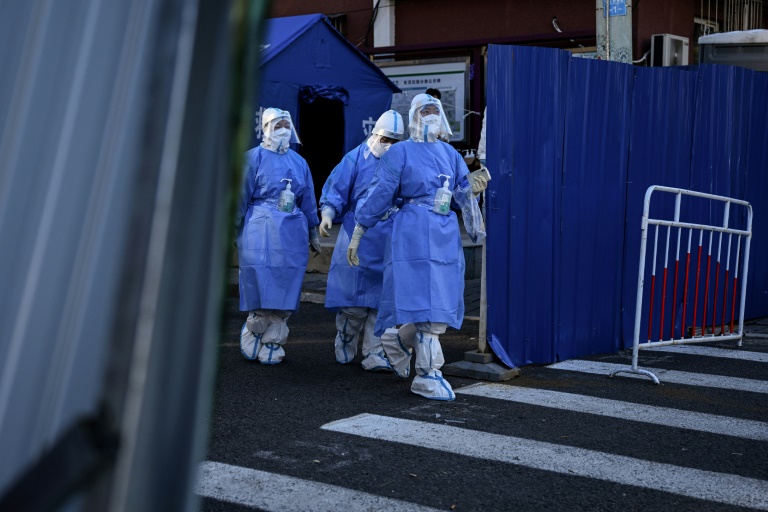
Shares headed lower as China’s first coronavirus death in six months sparked fears officials would reimpose strict, economically painful restrictions to fight outbreaks across the country.

Oil prices also slid on fears over energy demand in China, the world’s second biggest economy.

Investors “had been pinning hopes on a Chinese reopening to help ease global supply-chain problems and kickstart growth” in the Asian economic giant, said AJ Bell investment director Russ Mould.

“However, renewed outbreaks of Covid have seen some restrictions return and helped dampen sentiment, with oil prices also lower,” he added.

The death of an 87-year-old man in Beijing on Sunday came as infections across the country spiked, testing authorities’ plans to loosen their grip by lowering quarantine times for foreigners and cancelling mass tests.

The news threw a spanner in the works for investors who had grown hopeful of a gradual reopening of China’s economy.

“It feels like one step forward, two steps back,” said Forsyth Barr Asia analyst Willer Chen.  

“It is super hard to reopen in the short term, given winter is coming and cases are at a super high level and spreading across the whole country.”

The measures dealt a particular blow to Hong Kong’s Hang Seng Index, which fell nearly two percent, extending a sell-off at the end of last week.

Shanghai was also down along with most Asian markets, but Bangkok, Tokyo and Wellington ended higher.

Nevertheless, global markets have enjoyed a broadly healthy November thanks to signs of China easing and indications of slowing US inflation that fanned optimism the Federal Reserve would start to slow its pace of interest rate hikes.

But several officials soon lined up to warn that more needed to be done to get inflation back down from four-decade highs to more bearable levels.

Markets are meanwhile expected to stay relatively quiet for the rest of the week, with many US investors taking time off for Thanksgiving.

– Key figures around 1115 GMT –

London – FTSE 100: DOWN 0.1 percent at 7,380.96 points

Paris – CAC 40: DOWN 0.2 percent at 6,629.85

Frankfurt – DAX: DOWN 0.6 percent at 14,342.54

EURO STOXX 50: DOWN 0.5 percent at 3,906.26

Tokyo – Nikkei 225: UP 0.2 percent at 27,944.79 (close)

Hong Kong – Hang Seng Index: DOWN 1.9 percent at 17,655.91 (close)

Shanghai – Composite: DOWN 0.4 percent at 3,085.04 (close)

New York – Dow: UP 0.6 percent at 33,745.69 (close)

Euro/dollar: DOWN at $1.0244 from $1.0325 on Friday

Dollar/yen: UP at 141.43 yen from 140.37 yen

Pound/dollar: DOWN at $1.1809 from $1.1890

Euro/pound: UP at 86.75 from 86.34 pence

West Texas Intermediate: DOWN 0.5 percent at $79.70 per barrel

Brent North Sea crude: DOWN 0.7 percent at $87.03 per barrel

South African appeal court orders Zuma back to jail

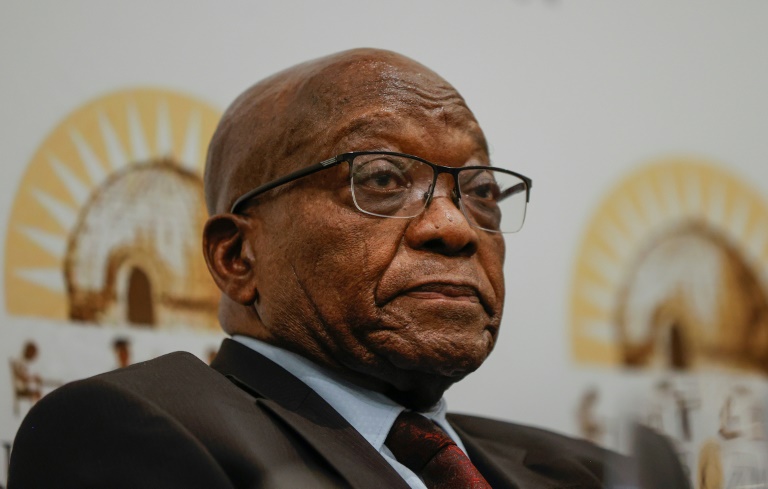
An appeal court in South Africa said on Monday that former president Jacob Zuma was unlawfully given medical parole from a jail term last year and should return to prison to complete his sentence.

Zuma, 80, had been handed a 15-month term in June 2021 for contempt of court, a move that triggered deadly unrest.

But he served only two months before being given parole for medical reasons that remain unclear.

Parole was granted by the head of South Africa’s prison service, despite an opinion by the service’s medical committee that Zuma did not meet the required conditions.

“This court has now determined that Mr Zuma’s release on medical parole was unlawful,” the supreme court of appeal said.

“Mr Zuma in law has not finished serving this sentence. He must return to the Estcourt Correctional Center to do so,” it said, referring to a jail northwest of the city of Durban.

According to medical assessments cited in the appeal court’s decision, Zuma has problems linked to high blood pressure, elevated levels of blood sugar and lesions of the colon.

Zuma, a prominent figure in the fight against apartheid, became president in 2009 and was forced to step down in disgrace by the ANC in 2018 following mounting corruption allegations.

But he remains a revered figure among grassroots members of the ruling African National Congress (ANC), who perceive him as a defender of the poor and oppressed.

When his jail term was announced, violent protests broke out that spiralled into looting, leaving 350 people dead.

The order by the supreme court of appeal is unlikely to be the final word in the long-running saga, as Zuma still has recourse to the Constitutional Court, the highest judicial instance in the land.

The prison authorities last month announced that Zuma’s 15-month term was now formally over.

He has since made several public appearances, singing and dancing before his supporters, and launched a verbal attack on his successor, Cyril Ramaphosa, accusing him of graft and treason.

Ramaphosa faces a crucial ANC conference next month, seeking re-election at a time when he is under pressure over allegations that he concealed a multi-million-dollar cash heist at his luxury farmhouse.

Zuma was jailed for refusing to testify to a high-level inquiry into massive state corruption that unfolded under his presidency.

He also faces separate corruption charges over an arms deal dating back more than two decades. 

Spain's high-speed rail competition heats up with new entrant

Competition in Spain’s high-speed rail market is heating up with a new operator starting passenger services on Friday, making it Europe’s first nation with three players in the sector.

The new firms have pushed down prices and increased passenger traffic on the high speed network, which at 4,000 kilometres (2,500 miles) is the second longest in the world after China’s.

Spain is the world’s second most popular tourist destination after France.

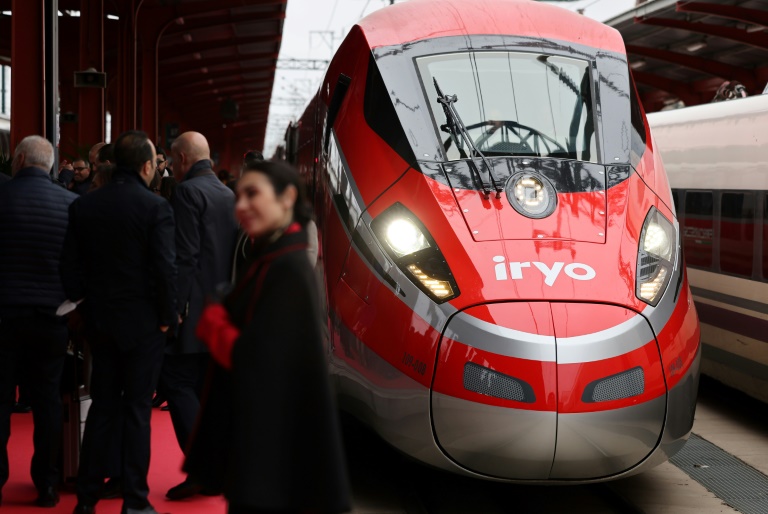
Private operator Iryo, which is 45 percent owned by Italy’s Trenitalia, made an inaugural symbolic trip on Monday from Madrid to Valencia on Spain’s Mediterranean coast.

It will begin passenger services on Friday with 16 daily return trips between Madrid and Barcelona, Spain’s two largest cities.

Iryo will compete with French railway company SNCF’s firm in the country, Ouigo, which has been operating since May 2021 and Spanish state-owned rail operator Renfe, which opened its first high-speed service in 1992.

The arrival of a third operator is a “historical step” which is “novel” in Europe, said Carlos Lerida, a rail transport expert at the Autonomous University of Madrid.

“Until now no high-speed rail network has operated with three competitors. Spain could serve as a model,” he told AFP.

Iryo, which is kicking off its operations in Spain with 20 trains, will in mid-December expand its services to include a Madrid-Valencia route.

And it March 2023 it will start running trains from Madrid to Seville and Malaga in the southwestern region of Andalusia.

Ouigo already operates trains along the Madrid-Barcelona and Madrid-Valencia routes and plans to start services to the Mediterranean port of Alicante as well as Andalusia next year.

– ‘Democratise high-speed’ –

Spain’s state rail infrastructure operator Adif in 2019 granted contracts allowing the firms to operate on these routes for 10 years.

Socialist Prime Minister Pedro Sanchez’s government is keen to lower ticket prices for bullet train tickets to make greater use of the high-speed rail network.

Greater competition will “democratise high-speed” rail travel, Transport Minister Raquel Sanchez said last month, calling Spain’s model for the sector “revolutionary”.

Renfe responded to the arrival of Ouigo in May 2021 with the launch of a low-cost bullet train service called Avlo.

The company has also renewed its fleet of trains and improved the service it offers passengers on their journeys.

Renfe has a seat sale underway with prices of a 500-kilometre (300-mile) trip between Madrid and Barcelona for as little as seven euros.

“We see the arrival of competition as an opportunity not as a problem,” a Renfe spokesman said.

Average prices for tickets on high-speed trains between Madrid and Barcelona have dropped by 25 percent since Ouigo started operating last year, according to Spain’s competition watchdog CNMC.

– ‘Underused’ network –

Passenger traffic on the route has jumped by 47 percent, and is up by 14 percent along Spain’s entire rail network since May 2021, according to Adif.

“The network was underused,” the director general of Ouigo’s Spanish branch, Helene Valenzuela, told AFP, adding this meant there was a “limited risk” in entering the market.

The company spent 630 million euros ($644 million) to launch its operations in Spain.

“Our main rivals are planes and cars, not other trains,” said Valenzuela.

“On a technical level, it is a challenge, because we have to organise the flow (of trains) in the stations. But on an economic level, it is an opportunity,” she added.

Competition in the high-speed rail sector has its limits.

It works on “very busy lines” but it is “much more complicated” on other routes where it is harder for companies to cover their costs and make a profit,” said rail transport expert Lerida.

Iran seeks to quell protests with death sentences, activists warn

Iran, already one of the world’s most prolific users of the death penalty, is planning to use capital punishment as a means to quell the protest movement by spreading a climate of fear in the population, activists warn.

The judiciary has already confirmed six death sentences over the protests, with Amnesty International saying that based on official reports at least 21 people currently on trial are charged with crimes that could see them hanged.

Iran currently executes more people annually than any nation other than China, according to rights groups.

Amnesty International says Iran put to death at least 314 people in 2021, while Norway-based Iran Human Rights (IHR) says the number of executions this year is already much higher at 482.

Campaigners warn that not only do the authorities plan to execute protesters on vague charges linked to alleged rioting or attacks on security forces during the demonstrations, but also step up hangings not related to the protest movement, notably of prisoners convicted on drug-related charges.

Amnesty said the authorities’ pursuit of the death penalty is “designed to intimidate those participating in the popular uprising… and deter others from joining the movement”.

The strategy aims to “instill fear among the public”, it added, condemning a “chilling escalation in the use of the death penalty as a tool of political repression and the systematic violation of fair trial rights in Iran”.

– ‘Strong signal’ –

The Iranian judiciary has conspicuously not named the six convicts already sentenced to death in a possible bid to prevent their names becoming rallying causes or hashtags on social media.

They have all been convicted either of “enmity against God” (“moharebeh”) or “corruption on earth” (“efsad-e fel arz”), sharia-related charges that are capital crimes in Iran and which rights activists have long feared are used against opponents of the regime.

Amnesty has nonetheless said the nature of the charges makes it possible to deduce the names of those sentenced so far.

They include Mohammad Ghobadlou, a young man whose mother has been seen on social media making an impassioned plea for her son’s life.

Among the 21 facing the death penalty is one woman, named by Amnesty as Farzaneh Ghare-Hasanlou, as well as her husband Hamid, a medical doctor.

Another risking capital punishment is Saman Seydi, also known as Saman Yasin, a Tehran-based rapper from Iran’s Kurdish minority who has backed the protests on social media and is accused of firing into the air and harming national security.

Rights groups are calling for concerted action from the international community to stop the executions, especially with the UN Human Rights Council set to hold a rare special session on Iran on Thursday.

Campaigners had already noticed a troubling uptick in capital punishment this year even before the protest movement got underway, with Iran again executing large numbers on drug-related charges despite recent moves to limit such executions.

Rights groups also complain that disproportionately large numbers from Iran’s ethnic minorities are executed, including Kurds but especially Baluch from the country’s impoverished southeast.

“Unless the international community sends a very, very strong signal to the Islamic republic authorities, we will be facing mass executions,” the director of IHR Mahmood Amiry-Moghaddam told the World Congress against the Death Penalty in Berlin.

He pointed to “not just political executions, but the ones that cost the least politically, particularly drug-related charges”.

– ‘Barrier of fear’ –

The protests sparked by the death of Mahsa Amini, who had been arrested by morality police in Tehran, have turned into the biggest challenge for the authorities since the 1979 Islamic revolution.

Authorities in Iran describe the protests as “riots” with judiciary chief Gholamhossein Mohseni Ejei saying those on trial are “affiliated with counter-revolutionary elements” and will be “punished according to the law”.

Earlier this month, 227 out of Iran’s 290 MPs voted for a motion urging the use of the death penalty in relation to the protests, calling on the judiciary to apply “an eye for an eye” retributive justice.

The past year had already seen Iranians in and outside the country mobilising against the use of the death penalty, with the Persian hashtag #edam_nakon (#dont_execute) becoming a viral trend.

Among those currently languishing in jail in Iran is film director Mohammad Rasoulof, who was arrested even before the protests began and whose anti-death penalty film “There is No Evil” won the top prize at the 2020 Berlin film festival.

“The Islamic republic has used the death penalty to uphold the barrier of fear for 43 years,” said Amiry-Moghaddam.

“The current protests have seen the collapse of that barrier which the Iranian authorities are now attempting to rebuild with the current repression and death sentences,” he added.

Malaysia's Anwar in talks with arch-rivals despite anti-graft pledge

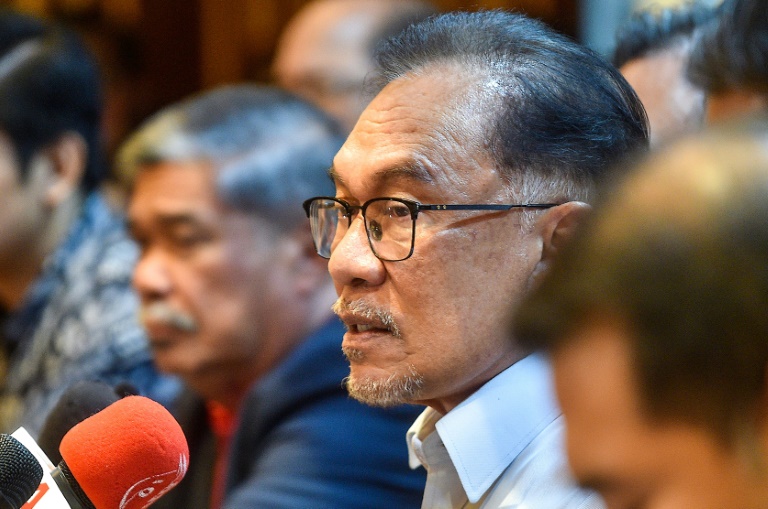
Malaysian opposition leader Anwar Ibrahim said on Monday he is in talks with the party of ex-premier Najib Razak, who is in jail for corruption, to form the next government after an inconclusive election.

Anwar’s multi-ethnic coalition, which campaigned on an anti-corruption ticket, won 82 seats in Saturday’s election, the most of any bloc but still short of the majority needed to form government.

Malaysia, one of Southeast Asia’s biggest economies, has had three changes of government in as many years, underscoring recent political instability.

Saturday’s election offered no immediate solution to that impasse, only more of the political horsetrading that have characterised recent polls.

“I am still very optimistic that we will be able to form a government, more transparent, more democratic and to safeguard the interests of the people in Malaysia,” Anwar told a news conference.

Another bloc, headed by former premier Muhyiddin Yassin, has also claimed it has enough backing to form government with the support of the conservative Pan-Malaysian Islamic Party (PAS).

Malaysia’s king is poised to break the stalemate. Parties have been told to submit their preferred prime minister and coalition partners to the king’s palace, with a deadline extended to 2:00 pm local time (0600 GMT) Tuesday.

Anwar spoke after holding formal talks with the incumbent ruling bloc Barisan Nasional, which is dominated by Najib’s graft-tainted United Malays National Organisation (UMNO).

He said the talks with his old foes were predicated on him becoming the prime minister, a dream he has held for more than two decades.

An agreement with UMNO would give Anwar an extra 30 seats for a simple majority of 112.

UMNO dominated Malaysian politics for decades but registered its worst election performance since independence in 1957.

-‘Court is court’-

It also suffered a humiliating defeat in the 2018 election due to public anger over the 1MDB graft scandal that involved billions of dollars of state funds.

Najib, who was at the centre of the scandal, is serving a 12-year jail term.

Anwar had campaigned on a promise to fight corruption, an issue that has come into sharper focus as Malaysians struggle with soaring food prices.

Asked about pending corruption cases involving more UMNO leaders, he said he would leave it to the justice system.

“Court is court. The judiciary must be free from the executive,” Anwar said.

The apparent contradiction in Anwar seeking support from a corruption-tainted party was not lost on political observers.

“Anwar and his coalition must thread the discussion of a unity government carefully so as not to alienate its supporters,” said Asrul Hadi Abdullah Sani, deputy managing director at BowerGroupAsia.

– Big gains for Islamists –

PAS become the largest party in Muhyiddin’s bloc after Saturday’s vote, triggering worries about its influence on national policy.

The party, for example, forced the cancellation of an annual craft beer festival in the capital, Kuala Lumpur, in 2017.

Two women convicted of having lesbian sex were also caned in front of more than 100 spectators in a PAS-ruled state the following year.

“I will see first if they abolish things like gambling and alcohol. I know in Islam, Muslims cannot do these but you cannot override non-Muslims’ enjoyment,” said warehouse manager Leonard Tan, 56, adding that he would migrate if the business environment was affected.

“If the direction is to close the activities that bring in revenue, it will scare off investors,” he said.

Islamist conservatism has been creeping into Malaysian society and politics for years, with ultra-conservatives eroding its traditionally moderate brand of Islam.

The majority of Malaysia’s 33 million people are Malay and Muslim, but it is also home to substantial ethnic Chinese and Indian minorities.

Close Bitnami banner
Bitnami