World

Turkey launches air raids against Kurdish militants in Syria, Iraq

Turkey announced on Sunday it had carried out air strikes against the bases of outlawed Kurdish militants across northern Syria and Iraq, which it said were being used to launch “terrorist” attacks on Turkish soil.

The raids in northern and northeastern Syria overnight, primarily against positions held by Syrian Kurdish forces, killed at least 31 people, British-based war monitoring group the Syrian Observatory for Human Rights said. 

The offensive, codenamed Operation Claw-Sword, comes a week after a blast in central Istanbul killed six people and wounded 81.

Turkey blamed the attack on the Kurdistan Workers’ Party (PKK), which has waged a bloody insurgency there for decades and is designated a terror group by Ankara and its Western allies. The PKK has denied involvement in the Istanbul explosion.

“Air Operation Claw-Sword was successfully carried out, within the scope of our strategy to eradicate terrorism at its source and eliminate terror attacks against our people and security forces from northern Iraq and Syria,” the defence ministry said in a statement. 

The strikes targeted PKK bases in northern Iraq’s mountainous regions of Kandil, Asos and Hakurk, as well as bases of the Kurdish People’s Protection Units (YPG), in Ayn al-Arab (called Kobane in Kurdish), Tal Rifaat, Jazira and Derik regions in Syria, the ministry said. 

Ankara considers the YPG as a PKK-affiliated terror group.

Of all, 89 targets including shelters, bunkers, caves, tunnels, ammunition depots, so-called headquarters and training camps belonging to the militants “were destroyed”, the ministry said, adding “many terrorists were neutralised”, including their leaders. 

“All our planes safely returned to their bases after the operation,” it added. 

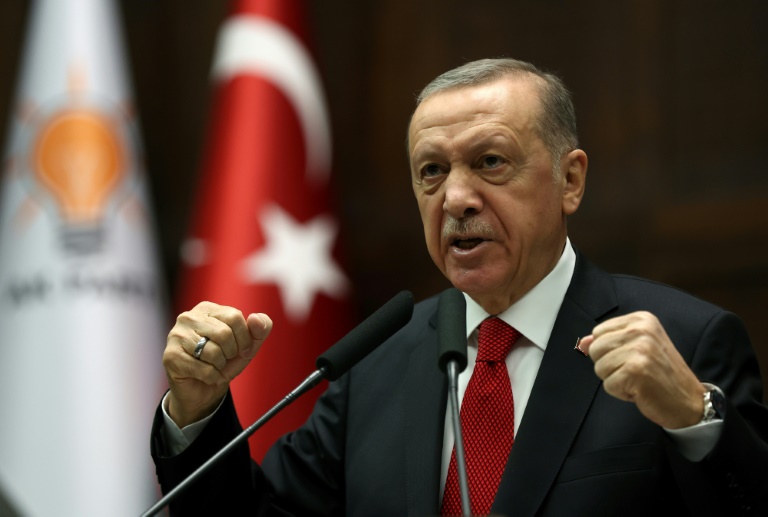
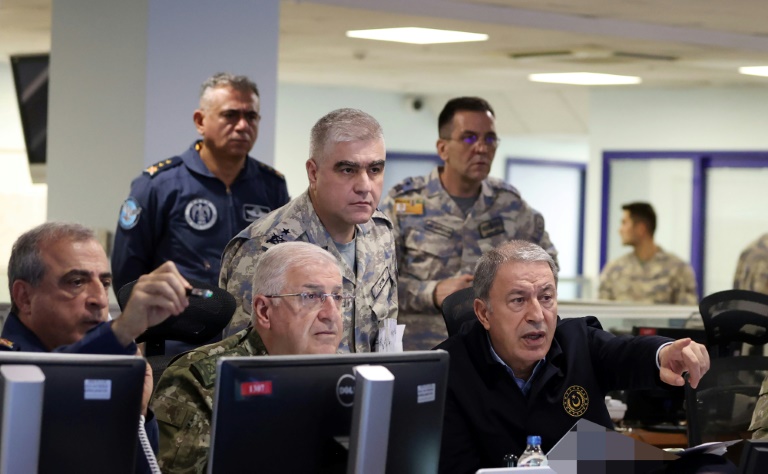
Defence Minister Hulusi Akar was seen in a video image briefing President Recep Tayyip Erdogan, who gave the order for the latest operation, which the Syrian government said killed a number of its soldiers. 

The Istanbul bombing was the deadliest in five years and evoked bitter memories of a wave of nationwide attacks from 2015 to 2017 that were attributed mostly to Kurdish militants or Islamic State (IS) group jihadists.

No individual or group has claimed responsibility.

– Rocket attack –

A rocket fired from Syria left three people wounded on the Turkish border, the official Anadolu news agency reported.

One Turkish soldier and two special forces police officers were injured after the rocket fired by Kurdish militia forces fell on the Oncupinar border gate area near the Syrian border, said the agency. 

After the Istanbul explosion, Turkish authorities arrested more than a dozen people, including chief suspect Alham Albashir — a Syrian woman who is said to have been working for Kurdish militants.  

Bulgaria has also detained five people accused of having helped one of the suspects. 

“The hour of reckoning has come,” the Turkish defence ministry tweeted early on Sunday, along with a photo of a plane taking off for a night operation.

Nearly 25 air strikes hit the provinces of Raqa, Hassakeh and Aleppo, killing 18 members of the Kurdish-led Syrian Democratic Forces (SDF), 12 members of Syria’s military and one journalist, according to the Syrian Observatory for Human Rights. 

Kurdish authorities in northeastern Syria meanwhile gave a toll of 29 dead — including 11 civilians, 15 fighters aligned with Syria’s military, two silo guards and one Kurdish fighter.

Turkey’s military has in the past denied claims that its strikes target civilians.

In its first comment on the Turkish strikes, the Syrian defence ministry said “a number of soldiers” were killed due to “Turkish aggressions in northern Aleppo and Hassakeh provinces at dawn”. 

– Complex ties with US –

Turkey’s latest military push could create problems for Ankara’s complex relations with its Western allies — particularly the United States, which has relied mostly on Syrian Kurdish militia forces in its fight against IS jihadists.

Turkey has often accused Washington of supplying Kurdish forces with weapons. 

Interior Minister Suleyman Soylu rejected the United States’ message of condolences after the Istanbul attack, even though Erdogan accepted them during a meeting on Tuesday with President Joe Biden on the margins of the G20 summit in Indonesia.  

Soylu has said Ankara believes the order for the Istanbul attack was given from Kobane, controlled by Syrian Kurdish militia forces, which have also denied any role. 

Kobane, a Kurdish-majority town near the Turkish border, was captured by IS in late 2014 before Syrian Kurdish forces drove them out early the following year.

The US-backed SDF said the Turkish attacks would “not go unanswered”, in a statement. 

Turkey has launched waves of attacks on Syria since 2016 targeting Kurdish militias as well as IS jihadists, and Ankara and forces backed by it have seized territory along the Syrian border.

Since May, Erdogan has threatened to launch a new operation in northern Syria.

burs-fo/raz
No way to run a COP: climate summit host Egypt gets bad marks

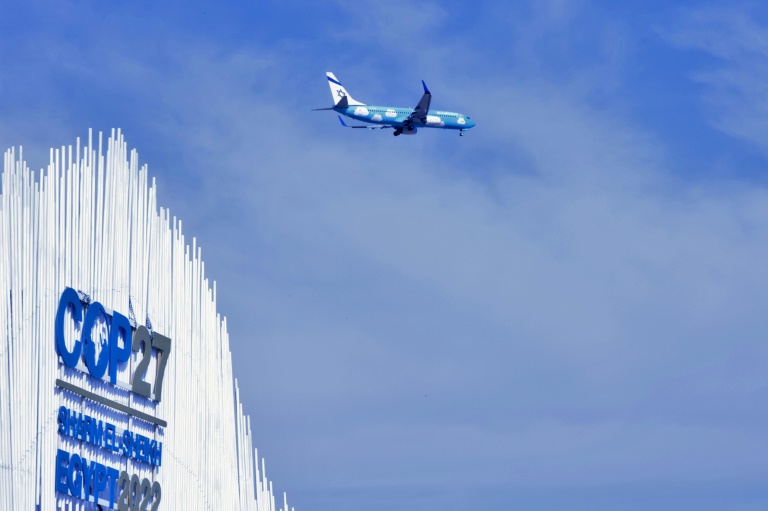
Almost from the start, Egypt came under fire over its handling of the UN COP27 climate talks tasked with responding to the growing threat of global warming. 

As the negotiations drew to a close nearly two days late with a historic win for vulnerable countries on funding for climate “loss and damage”, exhausted delegates lined up to voice hope — and frustration at the lack of progress on tackling emissions.

Historically, nations hosting the annual gathering of up to 35,000 leaders, diplomats, observers, campaigners and journalists are expected to rise above national interests enough to work hand-in-glove with the UN’s climate bureaucracy to shepherd the consensus-based process to a more or less happy ending.

The two-week marathon in the Red Sea resort of Sharm el-Sheikh, however, kicked off with duelling press conferences, suggesting diverging agendas and posing something of a quandary for journalists.

In his final address to the plenary, the COP27 president and Egyptian foreign minister Sameh Shoukry began his address on the back foot. 

“We are fair, balanced and transparent in our approach,” he told delegates, many of whom had complained of a lack of clarity in the difficult negotiating process.

“Any missteps that might have occurred were certainly not intentional, and were done with the best interests of the process in mind.”

– Fossil fuel lobbyists –

Far more serious, some observers alledged that Egypt failed to act as a neutral broker in the complicated, multi-tiered talks.

“The influence of the fossil fuel industry was found across the board,” said Laurence Tubiana, CEO of the European Climate Foundation and — as France’s top negotiator — a main architect of the 2015 Paris Agreement.

“The Egyptian presidency has produced a text that clearly protects oil and gas petro-states and the fossil fuel industry,” with no mention of phasing out fossil fuels so that the issue might be more widely debated.

Concerns over the role of oil and gas interests have long dogged the talks. 

But this year more than 600 fossil fuel lobbyists attended COP27 as “observers”, up 25 percent from last year’s climate summit and more than the number of delegates from all Pacific island nations combined, according to one research NGO.

Alden Meyer, a policy expert at think tank E3G who has been to all but one COP over the last 27 years, said there were concerns that the presidency had been reluctant to include ambitious language on emissions and fossil fuels. 

“Clearly, they’re acting in their own national interests, rather than serving as an honest broker in the presidency,” he told AFP, adding that they had been hosting a “gas industry trade fair” in Sharm el-Sheikh. 

In a scathing speech as the talks wrapped up Sunday, European Commission Vice President Frans Timmermans said the EU was disappointed that the meeting had not pushed for stronger commitments to achieve the aspirational goal of limiting global warming to 1.5 degrees Celsius from pre-industrial levels.

He also expressed frustration that despites the support of “more than 80 countries” calling for emissions to peak by 2025, “we don’t see this reflected here”.  

Meanwhile, Alok Sharma, who held the presidency at COP26 in Glasgow last year, listed an array of ambitious proposals on phasing out fossil fuels and slashing emissions that never even got an airing in draft texts, much less the final version.

– Transparency –

During Week One, Egypt came in for a drubbing in the international media for a array of logistical snafus ranging from scarce drinking water and price gouging to poor access for the disabled and overbearing security surveillance.

Organisers quickly rectified all but the last of these issues, not uncommon among the 27 climate conferences convened since 1995.

More troubling, however, was the way in which the Egyptian presidency guided the high-stakes talks at times, taking them to the wire, delegates said.

“I’ve never experienced anything like this — untransparent, unpredictable, and chaotic,” said one delegate with deep COP experience.

When Egypt finally pieced together the first draft text on the lynchpin issue of how to compensate developing nations already devastated by climate impacts — “loss and damage” in UN speak — they didn’t distribute it for all to see, which is the usual practice.

For the European Union, they called Timmermans alone in the middle of the night, showing but not giving him the text so that he could convey report back to the bloc’s 27 nations, EU sources said.

At least one voice at the conference, however, praised Egypt’s stewardship of COP27. 

“(Shoukry) is working under the principles of transparent, open and party-driven consensus,” China’s veteran climate envoy Xie Zhenhua said. 

COP27 agrees to fund climate damages, no progress on emission cuts

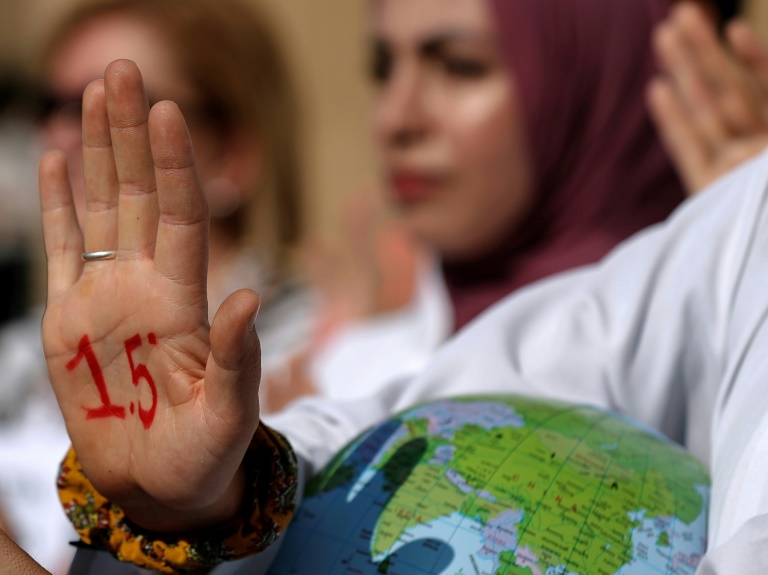
A fraught UN climate summit wrapped up Sunday with a landmark deal on funding to help vulnerable countries cope with devastating impacts of global warming — but also anger over a failure to push further ambition on cutting emissions.

The two-week talks in Egypt’s Red Sea resort of Sharm el-Sheikh, which at times appeared to teeter on the brink of collapse, delivered a major breakthrough on a fund for climate “loss and damage”.

Pakistani climate minister Sherry Rehman said COP27 “responded to the voices of the vulnerable, the damaged and the lost of the whole world”.

“We have struggled for 30 years on this path, and today in Sharm el-Sheikh this journey has achieved its first positive milestone,” she told the summit.

Tired delegates applauded when the loss and damage fund was adopted as the sun came up Sunday following almost two extra days of negotiations that went round-the-clock.

But jubilation over that achievement was countered by stern warnings.

UN chief Antonio Guterres said the UN climate talks had “taken an important step towards justice” with the loss and damage fund, but fell short in pushing for the urgent carbon-cutting needed to tackle global warming.

“Our planet is still in the emergency room,” Guterres said. “We need to drastically reduce emissions now and this is an issue this COP did not address.”

British Prime Minister Rishi Sunak also warned that “more must be done” while France regretted the “lack of ambition” and said there was no progress on efforts to reduce greenhouse gas emissions and abandon fossil fuels.

– ‘Stonewalled by emitters’ –

A final COP27 statement covering the broad array of efforts to grapple with a warming planet held the line on the aspirational goal of limiting global warming to 1.5 degrees Celsius from pre-industrial levels.

It also included language on renewable energy for the first time, while reiterating previous calls to accelerate “efforts towards the phasedown of unabated coal power and phase-out of inefficient fossil fuel subsidies”.

But that failed to go much further than a similar decision from last year’s COP26 meeting in Glasgow on key issues around cutting planet-heating pollution.

European Commission Vice President Frans Timmermans said the EU was “disappointed”, adding that more than 80 nations had backed a stronger emissions pledge.

“What we have in front of us is not enough of a step forward for people and planet,” he said.

“It doesn’t bring enough added efforts from major emitters to increase and accelerate their emission cuts,” said Timmermans, who 24 hours earlier had threatened to walk out of the talks rather than getting a “bad result”.

Britain’s Alok Sharma, who chaired COP26 in Glasgow, said a passage on energy had been “weakened, in the final minutes”.

German Foreign Minister Annalena Baerbock said she was frustrated that the emissions cut and fossil fuel phase-out were “stonewalled by a number of large emitters and oil producers”.

Criticised by some delegations for a lack of transparency during negotiations, Egyptian Foreign Minister Sameh Shoukry, the COP27 chair, said any missteps were “certainly not intentional”.

“I believe I succeeded in avoiding that any of the parties were to backslide,” he said.

– ‘Loss and damage’ –

The deal on loss and damage — which had only barely made it onto the negotiation agenda — gathered critical momentum during the talks.

Developing nations relentlessly pushed for the fund, finally succeeding in getting the backing of wealthy polluters long fearful of open-ended liability.

A statement from the Alliance of Small Island States, comprised of islands whose very existence is threatened by sea level rise, said the loss and damage deal was “historic”.

“The agreements made at COP27 are a win for our entire world,” said Molwyn Joseph, of Antigua and Barbuda and chair of AOSIS.

“We have shown those who have felt neglected that we hear you, we see you, and we are giving you the respect and care you deserve.”

With around 1.2C of warming so far, the world has seen a cascade of climate-driven extremes, shining a spotlight on the plight of developing countries faced with escalating disasters, as well as an energy and food price crisis and ballooning debt.

The fund will be geared towards developing nations “that are particularly vulnerable to the adverse effects of climate change” — language that had been requested by the EU.

– ‘On the brink’ –

The Europeans had also wanted to broaden the funder base to cough up cash — code for China and other better-off emerging countries. 

The final loss and damage text left many of the thornier questions to be dealt with by a transitional committee, which will report to next year’s climate meeting in Dubai to get the funding operational.

The fund will focus on what can be done now to support loss and damage resources but the agreement does not provide for liability or compensation, said a US State Department spokesperson.

Scientists say limiting warming to 1.5C is a far safer guardrail against catastrophic climate impacts, with the world currently way off track and heading for around 2.5C under current commitments and plans.

“The historic outcome on loss and damage at COP27 shows international cooperation is possible,” said Mary Robinson, former president of Ireland and Chair of The Elders.

“Equally, the renewed commitment on the 1.5C global warming limit was a source of relief. However, none of this changes the fact that the world remains on the brink of climate catastrophe.”  

Equatorial Guinea votes with veteran ruler set for sixth term

Equatorial Guinea went to the polls on Sunday, with President Teodoro Obiang Nguema Mbasogo all-but certain of winning a record sixth term in a country with next to no opposition.

Obiang, 80, has been in power for more than 43 years — the longest of any head of state alive today, monarchs excepted.

Voting is obligatory in the small West African country. 

“Voting is going well. Everything is normal,” fridge repair man Norberto Ondo, 53, told AFP at a polling station in the Semu district of the capital, Malabo. 

“I expect this election to bring us prosperity.”

“We have peace,” Jose Serafin Obiang Sima, a nurse in his 30s, told AFP. He said Equatorial Guinea was the only country in the region “where young people prosper”.

The re-election of Obiang, who seized power in a coup in 1979, seems virtually assured in one of the most authoritarian and closed states in the world.

Running against him is Andres Esono Ondo — from the only tolerated opposition party, the Convergence for Social Democracy — and Buenaventura Monsuy Asumu of the Social Democratic Coalition Party, a historic ally of Obiang’s ruling party. 

Asumu, an ex-minister is seen by the opposition as a “dummy candidate” without a chance.

– ‘Solely for the benefit of the Obiangs’ –

Ond has called the regime a “dictatorship” and predicted “massive fraud” during Sunday’s elections for the presidency, the parliament and local councils.

“The government governs solely for the benefit of the Obiang family,” he said recently.

The discovery of off-shore oil in the mid-nineties turned Equatorial Guinea into Africa’s third richest country in terms of per-capita income.

But wealth is concentrated in just a few hands and four-fifths of the population of 1.4 million live below the poverty line according to the latest available World Bank figures.

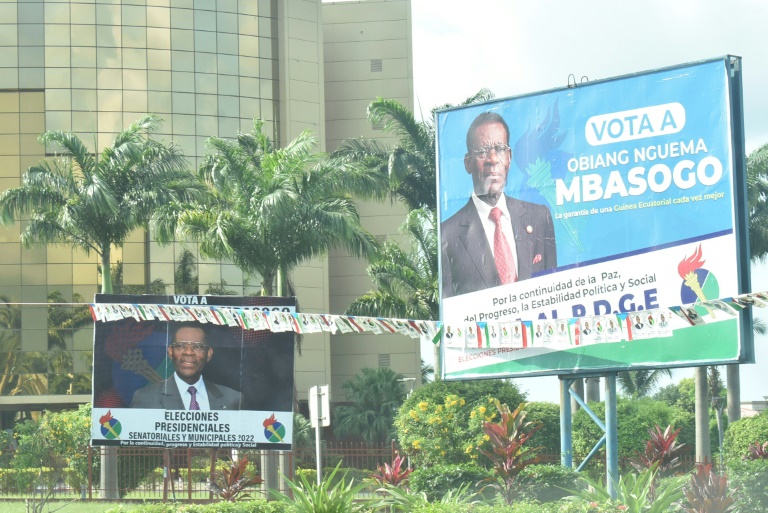
In the run-up to the vote, Malabo was plastered with posters of Obiang and the PDGE, the only legal political movement until 1991. State media all but ignored the other candidates.

The capital was under tight security on Sunday and streets were deserted except for near polling stations. The authorities banned sales of alcohol and the movement of all but officially accredited vehicles. 

Obiang voted in central Malabo around midday. His vehicle was surrounded by heavily armed soldiers, Israeli bodyguards and a personal guard composed of suited members of his own clan.


– Crackdown on opposition –

As in every election year, security forces have stepped up arrests. State media justified the crackdown as a bid to counter a “foiled plot” by the opposition to carry out attacks in Malabo and the economic capital, Bata. 

In September, security forces stormed the home of one of Obiang’s main opponents, Gabriel Nse Obiang Obono.

Four activists and a policeman died, according to the government. Dozens were injured and more than 150 were arrested, including Obono. 

Leading rights activist Joaquin Elo Ayeto told AFP the incident “discredited” the electoral process.

“The ruling party needs an ‘opposition’ to hold sham elections,” he said.

Results are not expected until Monday at the earliest.

Fraud allegations have plagued past polls.

Obiang is regularly re-elected with more than 93 percent of the vote. In 2016, the PDGE won 99 of the 100 seats in the lower house of parliament and all 70 seats in the senate.

Members of the opposition, most of whom are in exile, have urged citizens to spurn the ballot box.

Equatorial Guinea has a reputation for graft, ranking 172 out of 180 nations on Transparency International’s 2021 Corruption Perceptions Index.

Obiang’s son, the feared and powerful vice-president Teodoro Nguema Obiang Mangue, has been embroiled in scandals abroad over ill-gotten assets.

Turkey launches air raids against Kurdish militants in Syria, Iraq

Turkey announced on Sunday it had carried out air strikes against the bases of outlawed Kurdish militants across northern Syria and Iraq, which it said were being used to launch “terrorist” attacks on Turkish soil.

The offensive, codenamed Operation Claw-Sword, comes a week after a blast in central Istanbul that killed six people and wounded 81.

Turkey blamed the attack on the Kurdistan Workers’ Party (PKK), which has waged a bloody insurgency there for decades and is designated a terror group by Ankara and its Western allies. The PKK has denied involvement in the Istanbul explosion.

“Air Operation Claw-Sword was successfully carried out, within the scope of our strategy to eradicate terrorism at its source and eliminate terror attacks against our people and security forces from northern Iraq and Syria,” the defence ministry said in a statement. 

The raids targeted PKK bases in northern Iraq’s mountainous regions of Kandil, Asos and Hakurk, as well as bases of the Kurdish People’s Protection Units (YPG), in Ayn al-Arab (called Kobane in Kurdish), Tal Rifaat, Jazira and Derik regions in Syria, the ministry said. Ankara considers the YPG an extension of the PKK. 

Of all, 89 targets including shelters, bunkers, caves, tunnels, ammunition depots, so-called headquarters and training camps belonging to the militants “were destroyed”, the ministry said, adding “many terrorists were neutralised”, including the militant groups’ leaders. 

“All our planes safely returned to their bases after the operation,” it added. 

Defence Minister Hulusi Akar was seen in a video image briefing President Recep Tayyip Erdogan, who gave the order for the latest operation, which the Syrian defence ministry said killed a number of its soldiers. 

The Istanbul bombing was the deadliest in five years and evoked bitter memories of a wave of nationwide attacks from 2015 to 2017 that were attributed mostly to Kurdish militants or Islamic State (IS) group jihadists.

No individual or group has claimed responsibility.

– ‘Hour of reckoning’ –

After the explosion, Turkish authorities arrested more than a dozen people, including chief suspect Alham Albashir — a Syrian woman who is said to have been working for Kurdish militants.  

Bulgaria has also detained five people accused of having helped one of the suspects. 

“The hour of reckoning has come,” the Turkish defence ministry tweeted early on Sunday, along with a photo of a plane taking off for a night operation.

“Terrorist hotbeds razed by precision strikes,” the ministry said in another post, which was accompanied by a video showing a target being selected from the air followed by an explosion.

In its first comment on the Turkish strikes, the Syrian defence ministry said “a number of soldiers” were killed due to “Turkish aggressions in northern Aleppo and Hassakeh provinces at dawn”. 

The raids killed at least 11 members of the Kurdish-led Syrian Democratic Forces (SDF) and 10 Syrian regime soldiers, said the Syrian Observatory for Human Rights (SOHR), a Britain-based monitoring group that has an extensive network of contacts across the country.

The SOHR said the strikes killed only fighters while the SDF said that 11 civilians died. 

Turkey’s military has in the past denied claims that its strikes target civilians.

– ‘Bombing threatens whole region’ –

Turkey’s latest military push could create problems for Ankara’s complex relations with its Western allies — particularly the United States, which has relied mostly on Syrian Kurdish militia forces in its fight against IS jihadists.

But Turkey considers the YPG a terror group linked to the PKK and has often accused Washington of supplying arms to the Kurdish militias in Syria. 

Interior Minister Suleyman Soylu rejected the United States’ message of condolences after the Istanbul attack, even though Erdogan accepted them during a meeting on Tuesday with President Joe Biden on the margins of the G20 summit in Indonesia.  

Soylu has said Ankara believes the order for the Istanbul attack was given from Kobane, controlled by Syrian Kurdish militia forces, which have also denied any role. 

Kobane, a Kurdish-majority town near the Turkish border, was captured by IS in late 2014 before Syrian Kurdish forces drove them out early the following year.

“Turkish bombing of our safe areas threatens the whole region,” Mazloum Abdi, the chief commander of the US-allied SDF, tweeted.

Turkey has launched waves of attacks on Syria since 2016 targeting Kurdish militias as well as IS jihadists, and Ankara and forces backed by it have seized territory along the Syrian border.

Since May, Erdogan has threatened to launch a new operation in northern Syria.

burs-fo/gil

French-speaking bloc examines unrest in Africa

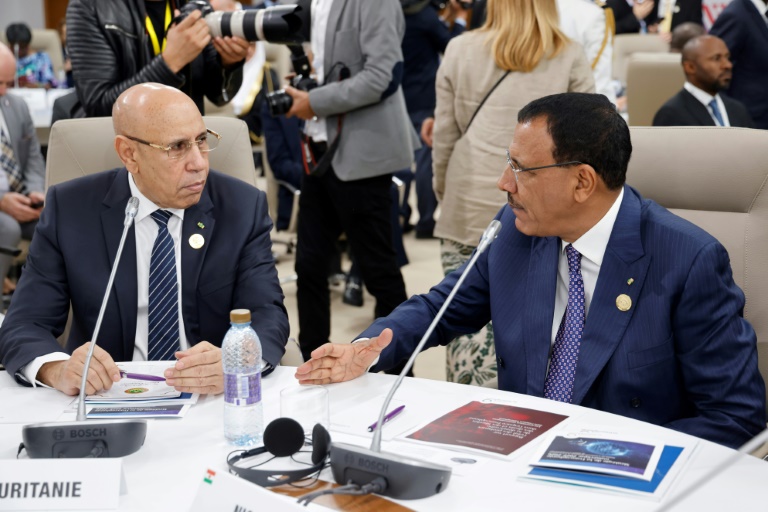
Facing calls to do more to resolve global crises, the world’s French-speaking leaders met in Tunisia Sunday to discuss growing instability and popular discontent in Francophone Africa.

But tensions crept into the International Organisation of Francophonie (IOF) conference itself when the Prime Minister of the Democratic Republic of Congo, Jean-Michel Sama Lukonde, refused to pose for a photo next to Paul Kagame, President of Rwanda.

The DRC accuses Rwanda of supporting M23 rebels who have seized swathes of territory in its eastern region, displacing tens of thousands of people and igniting regional tensions.

The head of the 88-member IOF bloc, Louise Mushikiwabo, said Saturday it should strive to be a “link that can be used to prevent tensions from degenerating into conflicts”.

But Senegalese civil society figure Alioune Tine said the IOF has shown itself to be “totally powerless in the face of fraudulent elections, third mandates (of African leaders) and military coups” in Mali, Guinea, Chad and Burkina Faso.

On Sunday, delegates at the conference on the island of Djerba were to also attend workshops on the youth and women’s entrepreneurship before an economic forum starts.

Ahead of the summit, Mushikiwabo told AFP that “the defiance that we’re seeing among young people in francophone Africa comes from political disillusionment” and frustrations over daily life. 

The IOF, founded in 1970, aims to promote the French language, develop economic cooperation and help mediate international conflicts.

Many African leaders have expressed dismay at the West’s rapid response to the war in Ukraine, in contrast to wars in their own countries.

Still, Macron said “a declaration of all the members” had stated “a very clear position on the war launched by Russia in Ukraine.”

Macron also said Saturday that the IOF should reclaim its diplomatic role, and Paris later announced that it would seek to take on the organisation’s rotating presidency from 2024.

Senegal’s President Macky Sall and Canadian Prime Minister Justin Trudeau have also been among leaders attending the two-day gathering which ends on Sunday.

This year’s conference is a diplomatic boon for Tunisian President Kais Saied, whose government has faced international criticism since a sweeping power grab last year in the only democracy to have emerged from the Arab Spring uprisings.

Macron on Saturday alluded to concerns over the country’s political future, saying that “fundamental freedoms were intrinsic” to Tunisia’s “democratic achievements”.

World Cup poised for kick-off as Benzema blow rocks France

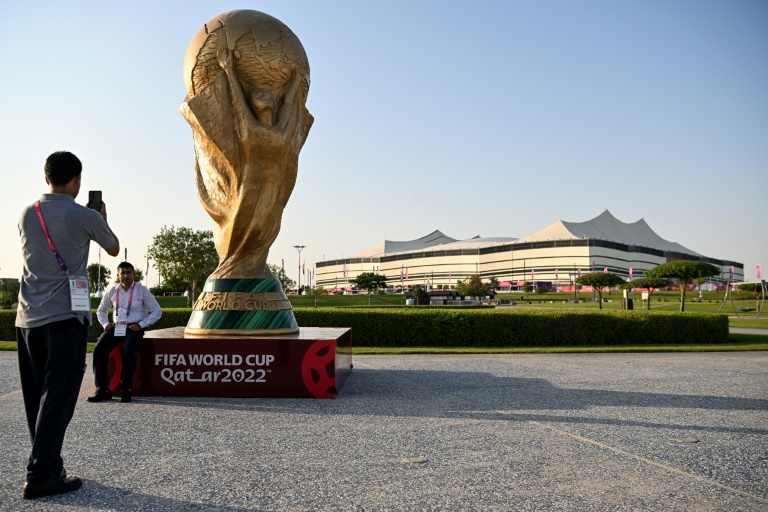
The World Cup kicks off with host nation Qatar facing Ecuador on Sunday as the month-long football showpiece finally gets under way after a tortuous 12-year build-up dogged by off-field controversies.

Foreign government officials, VIPs and celebrities will be in the crowd as the first World Cup staged in the Arab world opens at the Bedouin tent-inspired Al Bayt Stadium in Al Khor, 50 kilometres (31 miles) outside of Doha.

The venue is one of an array of new stadiums built for the tournament, which has cost Qatar an estimated $200 billion, the most expensive World Cup in history.

South Korean K-pop star Jung Kook will headline the 30-minute opening ceremony, which organisers said Sunday would reflect themes of “humanity, respect and inclusion”.

The list of foreign dignitaries at Sunday’s opening includes Saudi Arabia’s powerful Crown Prince Mohammed bin Salman, who orchestrated a regional blockade of Qatar in 2017. 

World Cup organisers hope the start of the football will quell the controversies that have overshadowed preparations for the tournament ever since Qatar was named as host nation in a shock FIFA vote in 2010.

Qatar’s treatment of migrant workers and the Gulf state’s human rights record have dominated the pre-tournament headlines.

On Saturday, FIFA president Gianni Infantino went on the offensive in an aggressive rebuttal of the opprobrium aimed at the event, arguing that much of the criticism was unfair.

“This moral lesson-giving — one-sided — is just hypocrisy,” Infantino said.

“I don’t want to give you any lessons of life, but what is going on here is profoundly, profoundly unjust.”

Controversies look certain to rumble on into the tournament even after the action starts.

Several European nations taking part — including England, Germany and Denmark — have said their players will wear rainbow-coloured “OneLove” armbands in a gesture of solidarity with the LGBTQ community. Homosexuality is illegal in Qatar.

The move raises the prospect of disciplinary action from FIFA, which has revealed plans to make its own alternative armbands available to teams.

Infantino insisted that all World Cup visitors would be welcome regardless of sexual orientation.

“I’ve been speaking about this topic with the highest leadership,” he said. “They can confirm that I can confirm that everyone is welcome.”

– Benzema blow, Brazil arrive –

All 32 teams competing at the World Cup have now arrived, with five-time champions Brazil the last to touch down in Doha late on Saturday.

Defending champions France suffered another injury hammer blow early Sunday after confirmation that star striker and Ballon D’Or winner Karim Benzema had been forced out of the tournament with injury.

The Real Madrid star limped out of a training session at the French camp on Saturday evening with a left thigh injury.

The French federation later confirmed in a statement that the 34-year-old would require “a recovery period of three weeks” and would play no part in the competition.

“I am extremely sad for Karim, for whom this World Cup was a major objective,” said France coach Didier Deschamps, who has decided not to replace the forward.

“Despite this new blow for the France team I have full faith in my squad. We will do all we can to rise to the huge challenge that awaits us.”

Benzema’s withdrawal comes with France already battling the injury absence of star midfielders Paul Pogba and N’Golo Kante.

Belgium are also reeling from an injury blow after striker Romelu Lukaku was ruled out of the Red Devils’ opening two games as he continues to recover from a hamstring problem.

Australia winger Martin Boyle joined the list of footballers who will play no part in the tournament. Head coach Graham Arnold said the winger had failed to recover from a knee injury.

“We all feel for Martin and it is a cruel blow for him,” Arnold said.

burs-rcw/jw

COP27 summit strikes historic deal to fund climate damages

A fraught UN climate summit wrapped up Sunday with a landmark deal on funding to help vulnerable countries cope with devastating impacts of global warming — but also anger over a failure to push further ambition on cutting emissions.

The two-week talks in Egypt’s Red Sea resort of Sharm el-Sheikh, which at times appeared to teeter on the brink of collapse, delivered a major breakthrough on a fund for climate “loss and damage”.

Pakistani climate minister Sherry Rehman said COP27 “responded to the voices of the vulnerable, the damaged and the lost of the whole world”.

“We have struggled for 30 years on this path, and today in Sharm el-Sheikh this journey has achieved its first positive milestone,” she told the summit.

Tired delegates applauded when the loss and damage fund was adopted as the sun came up Sunday following almost two extra days of negotiations that went round-the-clock.

But jubilation over that achievement was countered by stern warnings.

UN chief Antonio Guterres said the UN climate talks had “taken an important step towards justice” with the loss and damage fund, but fell short in pushing for the urgent carbon-cutting needed to tackle global warming.

“Our planet is still in the emergency room,” Guterres said. “We need to drastically reduce emissions now and this is an issue this COP did not address.”

– ‘Stonewalled by emitters’ –

A final COP27 statement covering the broad array of the world’s efforts to grapple with a warming planet held the line on the aspirational goal of limiting global warming to 1.5 degrees Celsius from pre-industrial levels.

It also included language on renewable energy for the first time, while reiterating previous calls to accelerate “efforts towards the phasedown of unabated coal power and phase-out of inefficient fossil fuel subsidies”.

But that failed to go much further than a similar decision from last year’s COP26 meeting in Glasgow on key issues around cutting planet-heating pollution.

European Commission Vice President Frans Timmermans said the EU was “disappointed”, adding that more than 80 nations had backed a stronger emissions pledge.

“What we have in front of us is not enough of a step forward for people and planet,” he said.

“It doesn’t bring enough added efforts from major emitters to increase and accelerate their emission cuts,” said Timmermans, who 24 hours earlier had threatened to walk out of the talks rather than getting a “bad result”.

Britain’s Alok Sharma, who chaired COP26 in Glasgow, said a passage on energy had been “weakened, in the final minutes”.

Germany Foreign Minister Annalena Baerbock said she was frustrated that the emissions cut and fossil fuel phase-out were “stonewalled by a number of large emitters and oil producers”.

Criticised by some delegations for a lack of transparency during negotiations, Egyptian Foreign Minister Sameh Shoukry, the COP27 chair, said any missteps were “certainly not intentional”.

“I believe I succeeded in avoiding that any of the parties were to backslide,” he said.

– ‘Loss and damage’ –

The deal on loss and damage — which had only barely made it onto the negotiation agenda — gathered critical momentum during the talks.

Developing nations relentlessly pushed for the fund, finally succeeding in getting the backing of wealthy polluters long fearful of open-ended liability.

A statement from the Alliance of Small Island States, comprised of islands whose very existence is threatened by sea level rise, said the loss and damage deal was “historic”.

“The agreements made at COP27 are a win for our entire world,” said Molwyn Joseph, of Antigua and Barbuda and chair of AOSIS.

“We have shown those who have felt neglected that we hear you, we see you, and we are giving you the respect and care you deserve.”

With around 1.2C of warming so far, the world has seen a cascade of climate-driven extremes, shining a spotlight on the plight of developing countries faced with escalating disasters, as well as an energy and food price crisis and ballooning debt.

The World Bank estimated that devastating floods in Pakistan this year caused $30 billion in damage and economic loss.

The fund will be geared towards developing nations “that are particularly vulnerable to the adverse effects of climate change” — language that had been requested by the EU.

– ‘On the brink’ –

The Europeans had also wanted to broaden the funder base to cough up cash — code for China and other better-off emerging countries. 

The final loss and damage text left many of the thornier questions to be dealt with by a transitional committee, which will report to next year’s climate meeting in Dubai to get the funding operational.

Scientists say limiting warming to 1.5C is a far safer guardrail against catastrophic climate impacts, with the world currently way off track and heading for around 2.5C under current commitments and plans.

“The historic outcome on loss and damage at COP27 shows international cooperation is possible,” said Mary Robinson, former president of Ireland and Chair of The Elders.

“Equally, the renewed commitment on the 1.5C global warming limit was a source of relief. However, none of this changes the fact that the world remains on the brink of climate catastrophe.”  

Turkey's high-stakes campaigns in Syria

Turkey has launched a string of offensives in neighbouring Syria since 2016 targeting Kurdish militias, Islamic State group jihadists and forces loyal to President Bashar al-Assad.

The latest, in Iraq and Syria and dubbed Operation Claw-Sword, come ahead of a general election in June that will see Turkish President Recep Tayyip Erdogan lean heavily on his nationalist supporters to try and win.

His government says it must protect Turkey’s volatile southern regions along the Syrian border from attacks by fighters from the Kurdish People’s Protection Units (YPG).

But like its past military adventures, the latest push could create problems for Turkey’s complex relations with its Western allies — particularly the United States.

Washington relied heavily on the YPG to defeat IS jihadists who overran large swaths of Syria and neighbouring Iraq in 2014.

Ankara views the YPG as the Syrian branch of outlawed Kurdistan Workers’ Party (PKK) militants who have been waging a deadly insurgency against the Turkish state since 1984. 

The government has blamed Kurdish militants for the deadly bombing in central Istanbul last Sunday. The PKK and YPG have both denied any involvement. 

The PKK is proscribed as a terrorist organisation by the US and EU. Ankara wants Washington to cut its ties with the YPG and fully back Turkey’s campaigns in Syria.

– Euphrates Shield –

Turkey’s first offensive from August 2016 to March 2017 was directed against both IS jihadists and the YPG in the northern province of Aleppo.

Enlisting the help of allied Syrian rebels, Turkish forces captured several strategic towns, including Jarabulus and Al-Bab.

The operation allowed Ankara to create a buffer zone between Turkey and Kurdish-held areas in northern Syria. 

– Olive Branch –

Turkey’s second offensive from January to March 2018 exclusively targeted YPG fighters in the Kurdish-majority northwestern region of Afrin, which remains under the control of Turkey’s Syrian rebel proxies to this day.

The United Nations estimated that half of the enclave’s 320,000 inhabitants fled during the offensive.

– Peace Spring –

Turkey launched a broad air and ground assault against Kurdish militias in northeastern Syria after former President Donald Trump controversially withdrew US forces from the region in October 2019.

Syrian rebels backed by the Turkish military gained control of a 30-kilometre-wide (19-mile-wide) strip of the Turkish-Syrian border during the campaign.

Targeting the very fighters the West backed to free Syria of the IS group, the operation drew widespread condemnation in Europe and the United States.

Washington sanctioned some Turkish ministries while several EU countries restricted some arms sales to Ankara.

– Spring Shield –

Unlike its other offensives, the one launched in February 2020 was specifically designed to halt the advances of Syrian regime forces in Idlib province.

The drone strike campaign was fraught with geopolitical risks, threatening to pit Turkey against Syrian ally Russia.

The operation ended within a week, when President Erdogan flew to Moscow to sign an agreement that guarantees a ceasefire in Idlib. 

In March 2020, Turkey and Russia agreed to establish a security corridor in the region, with joint Turkish-Russian patrols along a designated section of the M4 highway.

– ‘Restart from scratch’ –

Turkey originally aimed to topple Assad’s regime when the Syrian conflict erupted with the violent suppression of peaceful protesters in 2011.

But after backing various insurgent groups, Ankara has more recently shifted focus to preventing what Erdogan in 2019 dubbed a “terror corridor” from opening up in northern Syria.

Aside from fighting the YPG, he is also keen to avoid a new swell of Syrian refugees from crossing into its territory. 

Erdogan signalled this week he could reconsider ties with Assad. 

“We could restart from scratch after the June election,” he said. 

Erdogan intially opened his arms to Syrians fleeing the fighting, using the help of EU funding to house more than 3.6 million migrants and refugees.

But polls show Turks cooling on migrants and refugees, whose estimated number has reached five million.

Turkey finished erecting a 764-kilometre Syrian border wall in June 2018, and is building another with Iran aimed at halting the flow of migrants from Afghanistan.

Equatorial Guinea votes with veteran ruler set for sixth term

Equatorial Guinea went to the polls on Sunday, with President Teodoro Obiang Nguema Mbasogo all-but certain of winning a record sixth term in a the West African country with next to no opposition.

Obiang, aged 80, has been in power for more than 43 years — the longest tenure of any living head of state today except for monarchs.

A few dozen voters had already queued up when the doors swung open at a polling station set up in a school in Malabo’s Semu district early in the morning.

“Voting is going well. Everything is normal. All citizens have to vote,” fridge repair man Norberto Ondo told AFP.

“I expect this election to bring us prosperity,” the 53-year-old added after dropping his ballot in a box at the Nuestra Senora de Bisila school.

Obiang’s re-election seems virtually assured in one of the most authoritarian and enclosed states in the world.

Running against him is Andres Esono Ondo, 61, from the nation’s only tolerated opposition party.

The secretary general of the Convergence for Social Democracy (CPDS) is a candidate for the first time and the sole representative of the muzzled opposition.

Ondo has said he fears “fraud” during voting to elect the president, senators and members of parliament.

The government has levelled its own accusations against the politician, in 2019 accusing him of planning “a coup in Equatorial Guinea with foreign funding”.

The third candidate is Buenaventura Monsuy Asumu of the Social Democratic Coalition Party (PCSD), a historic ally of Obiang’s ruling party.

The ex-minister is running for the fourth time but has never done well in previous elections. The opposition have called  him a “dummy candidate” without a chance.

– ‘Foiled plot’ –

As in every election year, security forces have stepped up arrests. State media has justified the crackdown as a bid to counter a “foiled plot” by the opposition to carry out attacks on embassies, petrol stations and the homes of ministers. 

In September, after a week-long siege, security forces stormed the home of one of Obiang’s main opponents, Gabriel Nse Obiang Obono.

His house had also served as an office for his banned Citizens for Innovation (CI) party. 

The assault left five dead — four activists and a policeman, according to the government. 

Dozens were injured and more than 150 people were arrested, including Obono. 

Leading rights activist Joaquin Elo Ayeto told AFP the incident had “discredited” the electoral process.

“The ruling party needs an ‘opposition’ to hold sham elections,” he said.

Allegations of fraud have plagued past polls.

In 2016, Obiang was re-elected with 93.7 percent of the vote.

His PDGE won 99 of the 100 seats in the lower house and all 70 seats in the senate.

In 2009, the president scored more than 95 percent of the vote.

Campaigning this year saw pictures of Obiang and his Democratic Party of Equatorial Guinea (PDGE), the country’s only legal political movement until 1991, splashed all over Malabo.

Members of the opposition, most of whom are in exile, hold no hope for a breakthrough at the ballot box.

“Obiang’s elections have never been free or democratic but marked by widespread and systematic… fraud,” they said in a joint statement.

Despite all being obliged to vote, they urged “all citizens of Equatorial Guinea not to take part in any phase of the electoral process”.

The discovery of off-shore oil turned Equatorial Guinea into Africa’s third richest country, in terms of per-capita income, but the wealth is very unequally distributed.

Four-fifths of the population of 1.4 million live below the poverty threshold according to World Bank figures for 2006, the latest available.

The country has a long-established reputation internationally for graft, ranking 172 out of 180 nations on Transparency International’s 2021 Corruption Perceptions Index.

Close Bitnami banner
Bitnami