World

Mourners hit streets as Iran protests take bloody turn

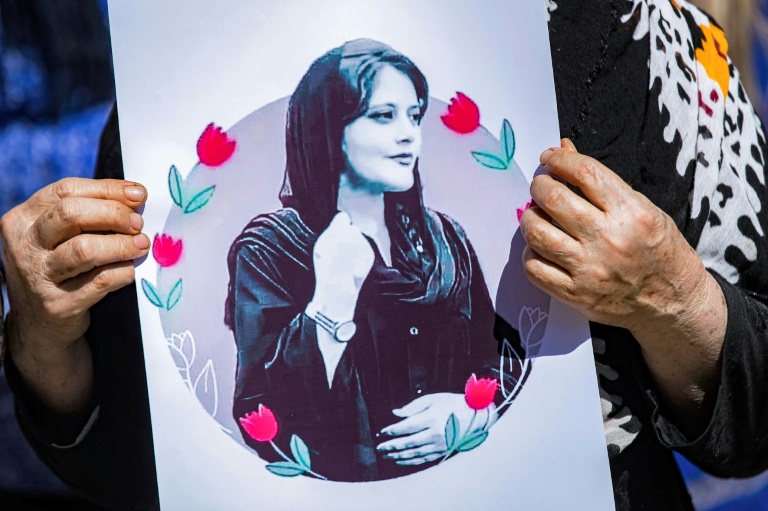
Hundreds of mourners poured onto the streets of an Iranian city Thursday, defying a lethal crackdown on protests over Mahsa Amini’s death that shows signs of turning even bloodier.

Iran’s foreign minister and media raised the spectre of civil war.

This week’s protests coincide with the third anniversary of “Bloody Aban” — or Bloody November — when hundreds were killed in a crackdown on street violence that erupted over a shock overnight decision to hike fuel prices.

Security forces on Thursday killed one protester in Bukan and two in Sanandaj, where mourners were paying tribute to “four victims of the popular resistance” 40 days after they were slain, the Oslo-based Hengaw rights group said.

The state news agency IRNA later confirmed that police colonel Hassan Youssefi was killed after being stabbed repeatedly in Sanandaj, about 200 kilometres (124 miles) west of the capital Tehran.

People had thronged the streets even as the sound of gunfire was heard in a video published by Hengaw and verified by AFP.

Separately, two Basij members were stabbed to death and three others injured as they sought to intervene to prevent “rioters” from threatening shopkeepers in the northeastern city of Mashhad, the news agency said.

“Death to the dictator,” protesters chanted in another online video as they marched down a street in Sanandaj filled with bonfires, directing their fury at Iran’s supreme leader Ayatollah Ali Khamenei.

The tradition in Iran of holding a “chehelom” mourning ceremony 40 days after a death has fuelled the demonstrations that have become the regime’s biggest challenge from the street in decades.

Fears are growing that the regime is turning “more violent after being unable to suppress the people for two months”, said Saeid Golkar, from the University of Tennessee at Chattanooga.

Speculation has mounted that Iran’s leadership has decided to crush the protest movement in the same way that it did in November 2019, when security forces killed at least 304 people, according to Amnesty International.

– Boy killed –

The demonstrations were sparked by the death of 22-year-old Amini on September 16, after her arrest for allegedly violating Iran’s strict dress code for women.

The unrest has been fanned by fury over the brutal enforcement of the mandatory hijab law, but has grown into a broad movement against the theocracy that has ruled Iran since the 1979 Islamic Revolution.

Gunmen on motorcycles killed nine people in two mysterious attacks Wednesday, state media said, as the protests intensified.

In the southwestern city of Izeh, “a terrorist group took advantage of a gathering of protesters” to shoot dead seven people — including a 45-year-old woman, two children aged nine and 13, IRNA said.

Three police officers and two Basij members were wounded, a security official told state TV.

But a family member of the nine-year-old boy killed on Wednesday, identified as Kian Pirfalak, accused security forces of carrying out the attack. The accusation came in a tweet shared by US-funded Radio Farda.

“He was going home with his father and was targeted with bullets by the corrupt regime of the Islamic republic. Their car was attacked from all four sides,” the unidentified family member is heard saying in an audio recording.

In a separate attack hours later in Iran’s third city Isfahan, two assailants on a motorcycle shot dead two members of the Basij paramilitary force and wounded another two, Fars news agency said.

IRNA later reported a police colonel who was injured Wednesday in Isfahan died of his wounds on Thursday in hospital.

Elsewhere, Hengaw accused the security forces of killing at least 10 people within a 24-hour period up until late Wednesday at protests in several cities.

IRNA said “rioters” had damaged and burned public property in Bukan, including setting fire to the municipality building. It added that police later dispersed them.

Another police colonel was stabbed to death in Sanandaj, IRNA said. 

– ‘Civil war’ –

Iran’s Foreign Minister Hossein Amir-Abollahian accused Israel and its allies of plotting a “civil war in” the Islamic republic.

But, he tweeted, they “must know that Iran is not Libya or Sudan” and that the “wisdom of our people has thwarted their plan”.

Fars news agency, which is close to the authorities, said the attacks Wednesday show “that those who want to dismantle the country have entered into the armed action phase”.

No one has claimed responsibility for the motorcycle attacks.

These actions were carried out “with the aim of inciting the people and security forces to a civil war,” after a “large quantity of weapons” clandestinely entered the country, Fars said.

General Hossein Salami, head of the Revolutionary Guards, said Iran was facing a “conspiracy” by foreigners including the US, Israel and Saudi Arabia who “are preparing to fight God, his prophet and the martyrs.” He was quoted by Fars.

Iran Human Rights, another Oslo-based organisation, said Wednesday that security forces had killed at least 342 people since the start of protests.

Iran was seeking the death penalty for at least 21 people in “sham trials designed to intimidate” protesters, Amnesty International said.
Boris Johnson on post-PM earnings spree in US

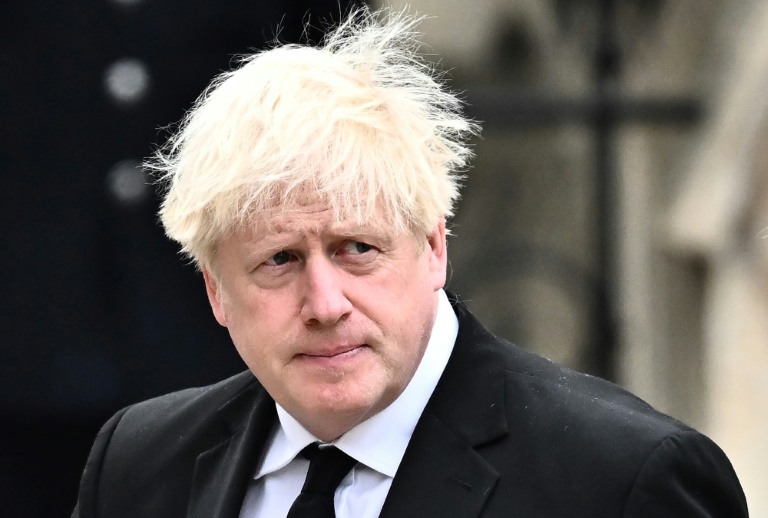
Leaving 10 Downing Street was a political hammer blow for Boris Johnson but is doing no harm to his depleted bank balance.

The former prime minister was paid more than $325,000 for just one speech at a US insurance industry event, according to an updated list of British MPs’ register of interests released Thursday.

When he became Britain’s leader in 2019, the former journalist was forced to give up a lucrative round of newspaper articles and after-dinner speeches, and got into more than one financial scrape as prime minister.

Forced out in September, Johnson used his new-found freedom to address the Council of Insurance Agents and Brokers in Colorado Springs on October 14.

The speaking fee organised by the Harry Walker Agency in New York came to £276,130 ($325,150), while Johnson and two members of staff also received transport and accommodation expenses.

Just before Colorado, over October 11-12, Johnson was paid £11,559.84 by Rupert Murdoch to fly to a “business meeting” in Montana, where the media mogul owns a cattle ranch.

The US trip interrupted a post-premiership Caribbean holiday for Johnson.

The register showed that on the way out, he, his wife Carrie and their two small children were given luxury lounge space as guests of Gatwick Airport on October 7.

The London airport did the same for them on their return on October 22, when Johnson rushed back from the Dominican Republic to take part in an unexpected new race for the Conservative leadership after the implosion of Liz Truss’s premiership.

He gave up the bid the next day, and accepted family accommodation until November 11 from Lord Anthony Bamford, a pro-Brexit businessman who also bankrolled Boris and Carrie Johnson’s wedding reception at his country manor house in July.

The ousted prime minister is doing some things for free.

As of October 3, Johnson declared that he is serving in the unpaid role of president of “Conservative Friends of Ukraine”, building on his outspoken support as premier against Russia’s invasion.

There was nothing listed on the new register for Rishi Sunak, who succeeded Truss last month.

Truss declared a donation of £33,265.48 “to cover winding up costs for my leadership campaign” in July and August. She is now freer to earn outside politics.

UK austerity budget stings markets

A British austerity budget hit the pound and gilts on Thursday, with stocks suffering worldwide on the glum economic outlook and the prospect of painfully high interest rates to curb inflation.

Britain unveiled a painful budget with £55 billion ($65 billion) of tax hikes and spending cuts despite confirming its economy was already in recession.

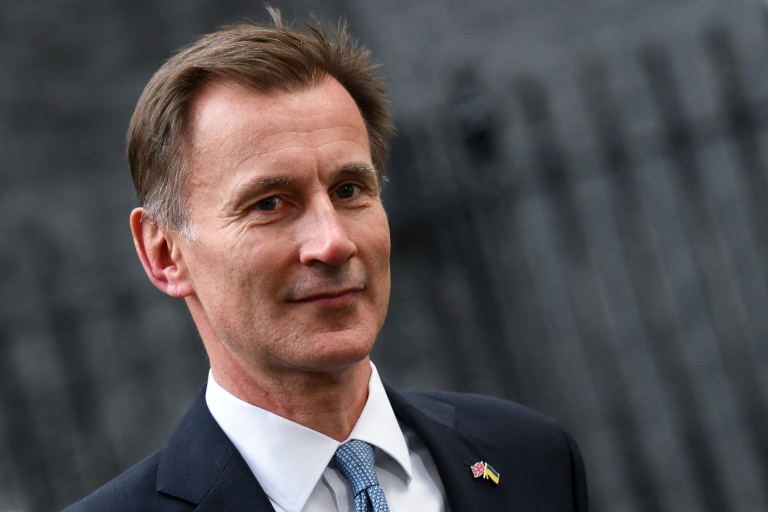
Finance minister Jeremy Hunt said the measures were needed to bring financial stability after recent turmoil in the markets, insisting they would alleviate rather than aggravate the downturn.

But the measures didn’t reassure British markets, with the pound falling and government borrowing costs rising. The drop in the pound helped the multinationals on the blue-chip FTSE 100 index, but the wider FTSE 250 index dominated by British firms fell 1.8 percent. 

CMC Markets analyst Michael Hewson said upheaval in markets in September over the profligate fiscal policies of the previous government had largely subsided, meaning a budget that makes Britain a worse place to do business was no longer necessary.

“Today’s budget should have walked the line between pushing inflation lower, without completely crushing demand in the economy with too many tax rises, and spending cuts,” Hewson said in a note to investors. 

“Initial analysis of today’s package suggests that we’ve got a lot of the former, and not too much of the latter, which is bad news if you’re looking to get businesses to invest,” he added.

The pound was down more than one percent against the dollar and also fell against the euro. 

Traders fear the budget will worsen Britain’s cost-of-living crisis after inflation spiked to a 1981 peak of 11.1 percent, and the government confirmed that the British economy was already in a recession that could last two years.

Wall Street stocks moved lower as investors worried the US Federal Reserve will continue to aggressively raise interest rates to lower rampant inflation, even if it means pushing the economy in recession.

Investors have been reassured by some data suggesting inflationary pressures are diminishing, as well as the overall economy is holding up well, but statements by some Fed policymakers spooked traders. 

“Concerns that the Fed will overtighten and force the U.S. economy into a hard landing were partly behind yesterday’s selling and widening inversion of the yield curve,” said Patrick O’Hare at Briefing.com

“Those concerns remain in place today and have been heightened by remarks made this morning by some voting” members of the Fed’s monetary policymaking committee, he added.

The Fed’s main interest rate is currently at 3.75 to 4.0 percent, but one Fed member said it may need to go as high as 7.0 percent. Another said a contraction in the economy may be needed.

Oil prices fell back on worries about Chinese demand.

“China remains a downside risk for oil in the near term, despite its recent relaxation of certain Covid curbs,” said Craig Erlam at OANDA online trading platform.

“A surge in cases in major cities, mass testing, and restrictions will hit economic activity despite recent measures which will weigh on demand in the world’s second-largest economy,” he added.

– Key figures around 1530 GMT –

New York – Dow: DOWN 0.7 percent at 33,335.18 points

EURO STOXX 50: DOWN 0.1 percent at 3,878.42

London – FTSE 100: DOWN less than 0.1 percent at 7,346.54 (close) 

Paris – CAC 40: DOWN 0.5 percent at 6,576.12 (close)

Frankfurt – DAX: UP 0.2 percent at 14,266.38 (close)

Tokyo – Nikkei 225: DOWN 0.4 percent at 27,930.57 (close)

Hong Kong – Hang Seng Index: DOWN 1.2 percent at 18,045.66 (close)

Shanghai – Composite: DOWN 0.2 percent at 3,115.43 (close)

Pound/dollar: DOWN at $1.1777 from $1.1914 on Wednesday

Euro/dollar: DOWN at $1.0325 from $1.0395

Dollar/yen: UP at 140.62 yen from 139.54 yen

Euro/pound: UP at 87.68 from 87.21 pence

Brent North Sea crude: DOWN 2.7 percent at $90.38 per barrel

West Texas Intermediate: DOWN 4.0 percent at $82.20 per barrel

burs-rl/bp

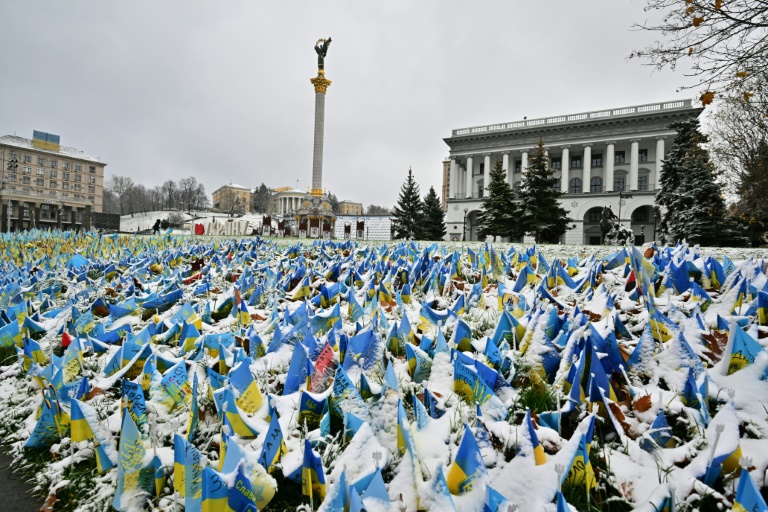
Russian strikes batter grid as first snow hits Ukraine

Fresh Russian strikes hit cities across Ukraine on Thursday, the latest in a wave of attacks that have crippled the country’s energy infrastructure as winter sets in and temperatures drop.

Repeated barrages have been disrupting electricity and water supplies to millions of Ukrainians, but the Kremlin blamed civilians’ suffering on Kyiv’s refusal to negotiate, rather than on Russian missiles.

AFP journalists in several Ukraine cities said the fresh strikes had hit with snow falling for the first time this season and after officials in Kyiv warned of “difficult” days ahead with a cold spell approaching.

The salvoes also came as Moscow and Kyiv confirmed the extension of an agreement allowing Ukraine to export grain through the Black Sea, which aims to help ease pressure on the global supply of food.

Ukraine has faced a pounding series of strikes against its power grid following battlefield victories against Russia, the latest being Moscow’s retreat from the southern city of Kherson.

“Four missiles and five Shahed drones were shot down over Kyiv,” the Kyiv regional administration announced, referring to the Iranian-made suicide drones that Moscow has been deploying against Ukraine targets in swarms.

An earlier stage of the war engulfing the nation saw Malaysia Airlines flight MH17 brought down over Ukraine in 2014, killing all 298 people on board.

A Dutch court on Thursday sentenced two Russians and a Ukrainian to life in prison over the plane’s downing with a Russian-supplied missile, but none of the suspects were in court.

President Volodymyr Zelensky hailed the “important” ruling but said it the people ultimately responsible must be brought to justice too.

– ‘Difficult situation’ –

As Russia’s full-scale invasion of Ukraine continues, the head of the central region of Dnipropetrovsk Valentyn Reznichenko said strikes had hit the administrative centre of Dnipro. 

“An industrial enterprise has been hit. There is a big fire,” he said, later announcing that 23 people were injured, including a 15-year-old girl.

In the southern Odessa region, a Russian strike targeted infrastructure and the governor warned residents of the threat of a “massive” missile attack” urging them to seek shelter.

The eastern region of Kharkiv was also struck, governor Oleg Synegubov announced, adding that Russia hit “critical infrastructure” in strikes that injured at least three people.

Zelensky in response described Russia as a “terrorist state” and said Moscow “wants to bring Ukrainians only more pain and suffering.”

The Kremlin however said that ultimately Kyiv was to blame for the fallout from the blackouts.

“The unwillingness of the Ukrainian side to settle the problem, to start negotiations, its refusal to seek common ground — this is their consequence,” Kremlin spokesman Dmitry Peskov said.

The largest wave of Russian missiles on cities across Ukraine earlier this week cut power to millions of homes, but supplies were largely restored to people cut off within hours.

Ukrainian energy company Ukrenergo however said Thursday that the “cold snap” had brought increased demand in regions where electricity was recently restored.

“This has further complicated the already difficult situation with the power system,” the company said.

Energy advisor to the Ukrainian government Oleksandr Kharchenko told local media that some 50 percent of Ukrainians were experiencing disruptions and that the west of the country was the worst hit. 

“Unfortunately, the attacks are quite effective, and the losses are accumulating,” he was cited as saying.

– ‘Russia bears full responsibility’ –

Tensions spiked earlier this week after a missile landed in a Polish town on the border with Ukraine, and there was a flurry of blame over who was responsible for the blast that killed two.

Zelensky, after previously saying a Russian missile was to blame, seemed to soften his public comments on the incident that had raised worries of a dangerous escalation.

“I don’t know what happened. We don’t know for sure. The world does not know,” Zelensky said.

“But I am sure that it was a Russian missile, I am sure that we fired from air defence systems. But it is impossible to talk about something specific today — that it was the air defence of Ukraine,” he added.

Ukraine’s foreign minister Dmytro Kuleba, also appeared to roll back Kyiv’s determined position that it was a Russian missile that struck Poland following a call with US Secretary of State Antony Blinken.

Separately, a monitoring group said Thursday that Russia’s use of newly-produced landmines in Ukraine poses the greatest challenge to the landmark Mine Ban Treaty struck 25 years.

The monitor said it had confirmed evidence that Russian troops had planted “victim-activated booby-traps and improvised explosive devices in Ukraine… prior to retreating and abandoning their positions”.

UK unveils recession budget triggered by markets chaos

Britain’s government Thursday unveiled a painful budget with £55 billion ($65 billion) of tax hikes and spending cuts despite confirming the country was in recession.

Finance minister Jeremy Hunt said the measures were needed to bring financial stability and shore up public finances after recent markets turmoil, insisting they would alleviate rather than aggravate the downturn. 

Market were not entirely convinced, however, with sterling trading down more than one percent against the dollar.

A day after official data showed UK inflation rocketing to a 41-year high above 11 percent, Hunt triggered a fresh era of austerity following the calamitous and short-lived tenure of former prime minister Liz Truss.

– ‘UK in recession’ –

Britain’s Office for Budget Responsibility (OBR) judged “that the UK, like other countries, is now in recession”, Chancellor of the Exchequer Hunt told parliament Thursday.

Despite the downturn, Hunt and Prime Minister Rishi Sunak insist tough action is needed after Truss unleashed a package of unfunded tax cuts that caused panic on financial markets.

The pound had hit a record-low close to parity against the dollar in late September after Truss failed to reveal the impact of her tax cuts on growth and inflation.

Her budget also triggered temporary purchases of UK government bonds by the Bank of England (BoE) to stabilise the market.

Pantheon Macroeconomics analyst Samuel Tombs warned the budget risked “amplifying the recession already underway”, while other experts said the pound’s slide Thursday was owing to the bleak economic outlook.

Hunt said the UK economy was set to shrink 1.4 percent next year.

The BoE, which is raising interest rates to combat sky-high inflation, has warned the UK economy may experience a record-long recession until mid-2024.

Despite this, Hunt confirmed tax rises for workers alongside spending cutbacks.

He pledged, however, to increased outlay on the cherished National Health Service amid a severe backlog in patient operations.

The chancellor added that benefits for the unemployed and pensioners would increase close to the inflation rate, and the minimum wage would climb.

At the same time, the government prolonged a freeze on its international aid budget introduced during the coronavirus pandemic in a move condemned by charities.

Hunt also ramped up a windfall tax on oil and gas giants, whose profits have surged on fallout from the Ukraine war, to help fund support for consumers hit by rocketing energy bills.

Energy giants such as BP and Shell will face an exceptional tax on profits of 35 percent, up from 25 percent, lasting an additional three years to 2028.

The government will also impose a new temporary levy on electricity generation companies.

The conflict in Ukraine has helped push worldwide inflation to its highest levels in decades. Prices are also up on supply constraints fuelled by Covid.

Britain’s economy is additionally being impacted by Brexit, the OBR said a day after similar comments by BoE governor Andrew Bailey.

– Scrooge –

Hunt at the weekend likened himself to the penny-pinching miser Ebenezer Scrooge in Charles Dickens’ festive favourite “A Christmas Carol”, but argued his plan would “make sure Christmas is never cancelled”.

He told MPs on Thursday: “In the face of unprecedented global headwinds, families, pensioners, businesses, teachers, nurses and many others are worried about the future.

“So today we deliver a plan to tackle the cost-of-living crisis and rebuild our economy.”

It comes as UK workers across various sectors have gone on strike this year to demand pay rises to compensate for surging inflation.

State-employed nurses and firefighters could be the latest groups to carry out industrial action, joining further walkouts this winter by rail workers and postal staff.

Rachel Reeves, economy spokeswoman for the main opposition Labour party, slammed the budget.

“The Conservatives have crashed our economy, given up on growth and sent inflation through the roof.

“As usual, it is ordinary working people who are paying the price,” she added.

The government added that a cap on average annual household fuel bills would rise by a fifth to £3,000.

Jailed Egypt dissident's health 'deteriorated severely': family

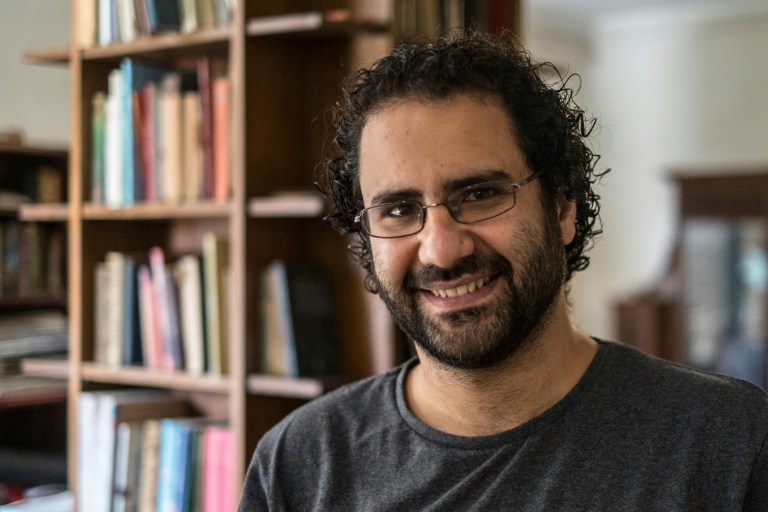
Jailed British-Egyptian activist Alaa Abdel Fattah’s health has “deteriorated severely”, his sister said Thursday after the first family visit since he ended a seven-month long hunger strike.

In a message on Twitter, Mona Seif said news from the visit was “unsettling”.

“Alaa deteriorated severely in the past two weeks, but at least they got to see him, and he needed to see the family so much”, she wrote.

His other sister Sanaa Seif said her brother appeared “frail, vulnerable and emotional” at the visit, which was conducted “behind a glass shield with a phone speaker with little space to understand or communicate”.

After seven months consuming what his family said was “100 calories a day”, Abdel Fattah escalated his strike to all food, and then water on November 6 to coincide with the start of the UN COP27 climate summit in Egypt. 

In a letter handed to his family on Tuesday, but dated Monday, he said he had ended the strike.

Thursday was the first time the activist’s mother Laila Soueif was allowed to visit him in nearly a month, after prison authorities repeatedly denied her access last week.

The family has not disclosed more information about the visit or Abdel Fattah’s status, but “will share the full details later,” Seif added.

The pro-democracy blogger is currently serving a five-year sentence for “spreading false news” by sharing another user’s Facebook post about police brutality.

– ‘Free them all!’ –

In his short letter on Monday, he did not detail the reasons behind his decision to end the strike, but asked his mother to “bring a cake” to Thursday’s visit.

“I want to celebrate my birthday with you,” wrote the activist, who turns 41 on Friday.

His family — who were concerned authorities might be “force-feeding” him and had feared he would die behind bars — raised questions over how the decision came about.

The dissident’s aunt, novelist Ahdaf Soueif, wrote on Twitter on Tuesday: “So what happened inside? What was negotiated?”

“Alaa had no idea the size of the support surrounding him,” she continued.

Egypt’s turn hosting the UN climate summit in the resort town of Sharm el-Sheikh is coming to an end this week, with Abdel Fattah continuing to make global headlines as an example of what rights groups call Egypt’s “abysmal” human rights record.

World leaders have raised his case in bilateral meetings with President Abdel Fattah al-Sisi.

Several speakers at the summit ended with the words “You have not yet been defeated” — the title of Abdel Fattah’s book. It has become a rallying cry for activists, both at the climate talks and posting online, demanding climate justice and human rights.

On Thursday, summit attendees chanted “Free Alaa! Free them all!” at the closing of the COP27 People’s Plenary, a meeting of civil society representatives in the official negotiations hall.

Rights groups estimate Cairo is holding about 60,000 political prisoners, many of them in brutal conditions and overcrowded cells.

Salvadoran president vows to buy "one #Bitcoin every day'

President Nayib Bukele of El Salvador, the first country to make bitcoin legal tender, said Thursday the nation would buy one unit of the currency every day, doubling down in the face of public criticism of his embrace of the crypto money. 

“We are buying one #Bitcoin every day starting tomorrow,” the president tweeted. 

Bitcoin traded at about $16,500 per unit on Thursday, down from $45,000 in September 2021 when El Salvador adopted the cryptocurrency, and some $68,000 two months later — its highest historic value. 

Bukele’s idea was to give more Salvadorans access to banking services and to promote crypto money transfers from some three million expats, mainly in the United States, to relatives back home.  

Remittances make up more than a quarter of El Salvador’s gross domestic product.  

But according to data from the Salvadoran Central Bank a year after the introduction of bitcoin, “less than two percent” of remittances were made using the cryptocurrency. 

The measure has been questioned by International Monetary Fund and World Bank due, among other things, to the currency’s notorious volatility. 

Taking advantage of the plummeting prices, Bukele bought 80 bitcoin with public funds for $19,000 each in July, bringing the Central American country’s total reserves to 2,381 units. 

But an opinion poll last month showed more than three-quarters of Salvadorans thought Bukele’s adoption of the coin was a “failure,” and fewer than a quarter used it.

The study, conducted by the University of Central America, found that nearly 80 percent of Salvadorans believe their president “should not continue to spend public money to buy bitcoin.”  

On Wednesday, El Salvador’s ambassador in Washington Milena Mayorga, a Bitcoin promotor, told state TV Canal 10 its use “is a process, first we have to get to know it, education is the key.” 

Salvadoran president vows to buy "one #Bitcoin every day'

President Nayib Bukele of El Salvador, the first country to make bitcoin legal tender, said Thursday the nation would buy one unit of the currency every day, doubling down in the face of public criticism of his embrace of the crypto money. 

“We are buying one #Bitcoin every day starting tomorrow,” the president tweeted. 

Bitcoin traded at about $16,500 per unit on Thursday, down from $45,000 in September 2021 when El Salvador adopted the cryptocurrency, and some $68,000 two months later — its highest historic value. 

Bukele’s idea was to give more Salvadorans access to banking services and to promote crypto money transfers from some three million expats, mainly in the United States, to relatives back home.  

Remittances make up more than a quarter of El Salvador’s gross domestic product.  

But according to data from the Salvadoran Central Bank a year after the introduction of bitcoin, “less than two percent” of remittances were made using the cryptocurrency. 

The measure has been questioned by International Monetary Fund and World Bank due, among other things, to the currency’s notorious volatility. 

Taking advantage of the plummeting prices, Bukele bought 80 bitcoin with public funds for $19,000 each in July, bringing the Central American country’s total reserves to 2,381 units. 

But an opinion poll last month showed more than three-quarters of Salvadorans thought Bukele’s adoption of the coin was a “failure,” and fewer than a quarter used it.

The study, conducted by the University of Central America, found that nearly 80 percent of Salvadorans believe their president “should not continue to spend public money to buy bitcoin.”  

On Wednesday, El Salvador’s ambassador in Washington Milena Mayorga, a Bitcoin promotor, told state TV Canal 10 its use “is a process, first we have to get to know it, education is the key.” 

FTX had 'complete failure' of controls, new CEO says

Collapsed cryptocurrency exchange FTX suffered a “complete failure of corporate controls” under founder Sam Bankman-Fried, the company’s new chief executive said Thursday, calling the situation “unprecedented.”

The scathing condemnation came in a filing in US bankruptcy court from John J. Ray — an executive with 40 years of experience in corporate restructurings including the infamous implosion of Enron in 2001.

Ray lambasted the failures of oversight, incomplete records, missing and unreliable financial statements and “potentially compromised” leadership at FTX, which declared bankruptcy last week — a stunning downfall for a firm recently valued at $32 billion.

“Never in my career have I seen such a complete failure of corporate controls and such a complete absence of trustworthy financial information as occurred here,” Ray said in the filing. 

“From compromised systems integrity and faulty regulatory oversight abroad, to the concentration of control in the hands of a very small group of inexperienced, unsophisticated and potentially compromised individuals, this situation is unprecedented,” he said.

The downfall of FTX came amid growing doubts over its financial stability, with attention focused on the relationship between the exchange and Alameda Research, a trading house also owned by Bankman-Fried, and reports he shifted funds out of the exchange, even as he tried to fill a $7 billion financing gap.

Binance, the world’s biggest cryptocurrency platform, backed out of a buyout deal that could have stemmed the fall amid reports about mismanagement of client funds and potential investigations by regulators.

US officials are now calling for more oversight of the industry, and Congress plans to hold hearings to investigate.

Ray said he has “substantial concerns” about the reliability of financial statements and related entities, and noted that there were “at least $372 million of unauthorized transfers.”

Executives at the firm — many of whom Ray said “were not aware of the shortfalls or potential commingling of digital assets” –“have located and secured only a fraction of the digital assets of the FTX Group that they hope to recover.”

The implosion was a spectacular reversal of fortune for the founder and one-time cryptocurrency wunderkind Bankman-Fried.

Ray slammed the former CEO saying he “often communicated by using applications that were set to auto-delete,” and making clear he no longer speaks for FTX notwithstanding his frequent public declarations.

Bankman-Fried “continues to make erratic and misleading public statements,” Ray said, pointing to comments published by Vox on Thursday in which the disgraced executive said he regretted filing for bankruptcy.

“F*** regulators they make everything worse,” Bankman-Fried said in a direct message on Twitter to the Vox reporter.

He later tweeted that he was “venting” and his comments were meant to remain private.

FTX had 'complete failure' of controls, new CEO says

Collapsed cryptocurrency exchange FTX suffered a “complete failure of corporate controls” under founder Sam Bankman-Fried, the company’s new chief executive said Thursday, calling the situation “unprecedented.”

The scathing condemnation came in a filing in US bankruptcy court from John J. Ray — an executive with 40 years of experience in corporate restructurings including the infamous implosion of Enron in 2001.

Ray lambasted the failures of oversight, incomplete records, missing and unreliable financial statements and “potentially compromised” leadership at FTX, which declared bankruptcy last week — a stunning downfall for a firm recently valued at $32 billion.

“Never in my career have I seen such a complete failure of corporate controls and such a complete absence of trustworthy financial information as occurred here,” Ray said in the filing. 

“From compromised systems integrity and faulty regulatory oversight abroad, to the concentration of control in the hands of a very small group of inexperienced, unsophisticated and potentially compromised individuals, this situation is unprecedented,” he said.

The downfall of FTX came amid growing doubts over its financial stability, with attention focused on the relationship between the exchange and Alameda Research, a trading house also owned by Bankman-Fried, and reports he shifted funds out of the exchange, even as he tried to fill a $7 billion financing gap.

Binance, the world’s biggest cryptocurrency platform, backed out of a buyout deal that could have stemmed the fall amid reports about mismanagement of client funds and potential investigations by regulators.

US officials are now calling for more oversight of the industry, and Congress plans to hold hearings to investigate.

Ray said he has “substantial concerns” about the reliability of financial statements and related entities, and noted that there were “at least $372 million of unauthorized transfers.”

Executives at the firm — many of whom Ray said “were not aware of the shortfalls or potential commingling of digital assets” –“have located and secured only a fraction of the digital assets of the FTX Group that they hope to recover.”

The implosion was a spectacular reversal of fortune for the founder and one-time cryptocurrency wunderkind Bankman-Fried.

Ray slammed the former CEO saying he “often communicated by using applications that were set to auto-delete,” and making clear he no longer speaks for FTX notwithstanding his frequent public declarations.

Bankman-Fried “continues to make erratic and misleading public statements,” Ray said, pointing to comments published by Vox on Thursday in which the disgraced executive said he regretted filing for bankruptcy.

“F*** regulators they make everything worse,” Bankman-Fried said in a direct message on Twitter to the Vox reporter.

He later tweeted that he was “venting” and his comments were meant to remain private.

Close Bitnami banner
Bitnami