World

Biden arrives in Bali for G20, Xi summit

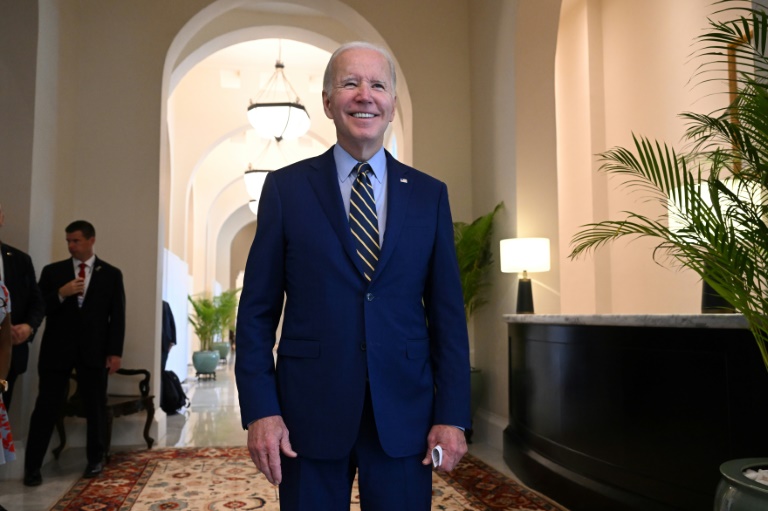
US President Joe Biden arrived in Indonesia’s Bali on Sunday for a summit of the world’s 20 largest economies and a high-stakes meeting with Chinese leader Xi Jinping.

The US leader said he expects to establish “red lines” in Washington’s fraught relations with Beijing in his first face-to-face talks as president with Xi.

The superpower sit-down will come on the sidelines of the G20 summit from Monday, the biggest gathering by the group since the Covid-19 pandemic began.

Biden said he was going into the discussions with Xi “stronger”, after his Democratic Party’s unexpected success in midterm elections they had been forecast to lose heavily.

But the summit comes with Beijing and Washington’s rivalry intensifying as a more powerful and assertive China tries to disrupt the US-led international order.

The world’s two largest economies are at loggerheads on everything from trade to human rights in China’s Xinjiang region and the status of the self-ruled island of Taiwan, and Biden said he expected “straightforward discussions” with Xi.

“I know Xi Jinping, he knows me,” he told reporters in Phnom Penh where he met with Asian leaders before heading to the Indonesian resort island of Bali.

“We have very little misunderstanding. We just got to figure out what the red lines are,” Biden said.

Biden hopes to “come out of this meeting with areas where the two countries and the two presidents and their teams can work cooperatively on substantive issues, National Security Advisor Jake Sullivan told reporters as the US leader flew to Bali.

He will push China to rein in North Korea after a record-breaking series of missile tests fuelled expectations that Pyongyang will soon carry out its seventh nuclear test.

– Putin stays away –

China is North Korea’s main ally and while Biden is not expected to make demands, he will warn Xi that further missile and nuclear build-up would mean the United States boosting its military presence in the region — something Beijing bitterly opposes.

Biden met Japan and South Korea’s leaders before flying to Bali, with the allies pledging a “strong and resolute response” to any North Korean nuclear test.

The US-China talks will cast a long shadow over the first post-pandemic G20, a reunion that Russian President Vladimir Putin has pointedly opted to skip.

He instead sent his Foreign Minister Sergei Lavrov, who arrived earlier on Sunday.

Putin’s invasion of Ukraine has made the trip to Bali logistically difficult and politically fraught, and while the war is not officially on the summit agenda, the conflict will dominate discussions.

Soaring energy and food prices have hit richer and poorer G20 members alike -– and both are directly fuelled by the war.

There is likely to be pressure on Russia to extend a deal allowing Ukrainian grain and fertiliser shipments through the Black Sea when the current agreement expires on November 19.

– ‘Never been this complex’ –

At a minimum, Biden and his allies want the G20 to make it clear to Putin that nuclear war is unacceptable.

Even that once uncontroversial position is likely to be blocked by a mixture of Russian opposition and Chinese unwillingness to break ranks with its ally in Moscow or give Washington a win.

At a recent meeting with German Chancellor Olaf Scholz, Xi said a nuclear war could not be won and should never be fought.

Ryan Hass, a former director for China at the US National Security Council, said Xi “likely will not be as magnanimous in his meeting with Biden”. 

“He will not want to be perceived as satisfying a request from Biden, whether on Ukraine, nuclear use, North Korea, or any other issue,” Hass told AFP.

G20 host Indonesia — still careful not to favour either China or the United States — is not confident that the leaders will be able to break the deadlock.

Ministerial meetings hosted by Indonesia in the run-up to the summit have failed to agree on a final joint communique — a procedural-sounding tradition that can be important in driving cooperation.

“Honestly, I think the global situation has never been this complex,” said Indonesian government minister Luhut Binsar Pandjaitan on the eve of the summit.

“If eventually (the G20) leaders do not produce a communique, that’s that, it’s OK.” 

burs-sah/arb/qan
Relief in Ukraine's Kherson after Russian occupation

Ukrainians in the liberated southern city of Kherson expressed a sense of relief on Sunday as they adjusted to life under Kyiv authorities after months of Russian occupation.

Residents said the Russians left a trail of destruction after an eight-month occupation, and an animal rights group said Moscow’s forces had even stolen a racoon, wolves and squirrels from a local zoo.

There were no scenes of jubilation on Sunday, an AFP correspondent said, but many locals said they felt a great sense of relief after Kyiv had wrested back control of the city. 

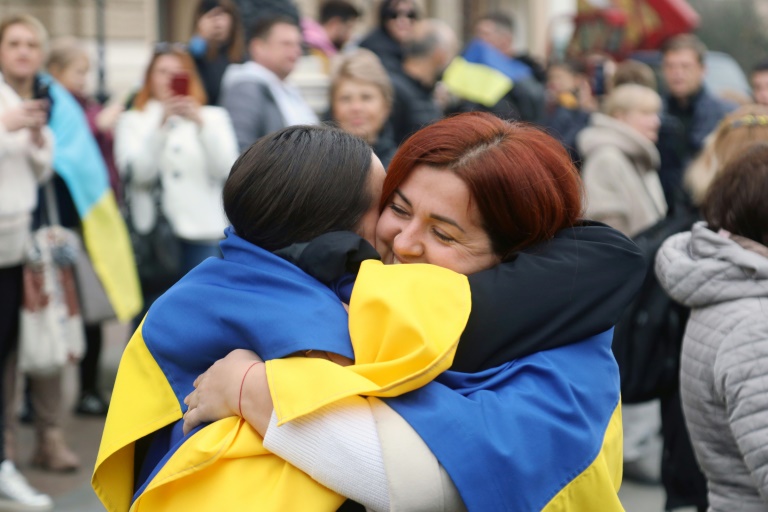
Residents queued to get food, and many adults and children walked around wrapped in Ukrainian flags.

Some gathered on the city’s main square, mostly to use Starlink satellite internet and connect with relatives.

“They took everything with them. They cleared out the stores,” said Viktoria Dybovska, a 30-year-old sales clerk.

“They switched off the lights three or four days ago just as they were leaving. They simply vanished overnight,” added Antonina Vysochenko, 29.

Oleksandr Todorchuk, founder of UAnimals, an animal rights movement, said the Russian troops had stolen animals from a local zoo.

“They have taken most of the zoo’s collection to Crimea: from llamas and wolves to donkeys and squirrels,” he said on Facebook.

In a major humiliation for the Kremlin, the Russian army withdrew from the city of Kherson on Friday. 

Kherson was one of four regions in Ukraine that Russian President Vladimir Putin claimed to have annexed in September. 

Ukrainian President Volodymyr Zelensky said on Saturday that before fleeing Kherson, the Russians “destroyed all critical infrastructure — communication, water supply, heat, electricity.”

Ukrainian television broadcasts have returned and officials said on Saturday that authorities were working to de-mine the city, record Russian crimes and restore power supplies.

On Saturday, in the formerly occupied village of Pravdyne, outside Kherson, returning locals embraced their neighbours, with some unable to hold back tears.

“Victory, finally!” said Svitlana Galak, who lost her eldest daughter in the war. 

“Thank god we’ve been liberated and everything will now fall into place,” the 43-year-old told AFP.

“We are Ukraine,” added her husband, Viktor, 44.

Several disabled anti-tank mines and grenades could be seen in the settlement, which is home to a Polish Roman Catholic church, with a number of damaged buildings also visible.

While de-mining is carried out, a curfew has been put in place and movement in and out of the city has been limited, local authorities said.

– Evacuation orders – 

The city of Kherson — which serves as a gateway to the Black Sea — was the first major urban hub to fall after Russia invaded in February.

Zelensky has said that Ukraine’s forces had established control over more than 60 settlements in the Kherson region. 

Ukraine’s police chief Igor Klymenko said on Saturday that around 200 officers were erecting roadblocks and recording “crimes of the Russian occupiers”.

He urged Kherson residents to watch out for possible landmines laid by the Russian troops, saying one policeman had been wounded while de-mining an administrative building.

A woman and two children were taken to hospital with injuries after an explosive device went off near their car in the village of Mylove, police said.

Across the Dnipro River in the east, local pro-Moscow authorities in the district of Kakhovka issued an evacuation order to its employees to head to the Russian region of Krasnodar.

Ukraine’s armed forces said late Saturday that Russian forces were “strengthening fortification” of the defensive lines on the left bank of the Dnipro.

Kherson’s full recapture opens a gateway for Ukraine to the entire Kherson region, with access to both the Black Sea in the west and the Sea of Azov in the east.

– ‘What was it all for?’ –

On Saturday, an increasingly isolated Putin spoke by phone with Iranian President Ebrahim Raisi, pledging to intensify political and trade cooperation, the Kremlin said.

Shunned by the West over his offensive in Ukraine, the 70-year-old leader will not travel to Indonesia for the G20 leaders’ summit next week.

US Secretary of State Antony Blinken hailed the “remarkable courage” of Ukraine’s military and people and vowed US support “will continue for as long as it takes” to defeat Russia.

In London, British Defence Secretary Ben Wallace said Russia’s “strategic failure” in Kherson could prompt ordinary Russians to question the war. 

“Ordinary people of Russia must surely ask themselves: ‘What was it all for?'”

The Kremlin insists that Kherson remains part of Russia.

Fans, trophy and teams arrive in Qatar for World Cup countdown

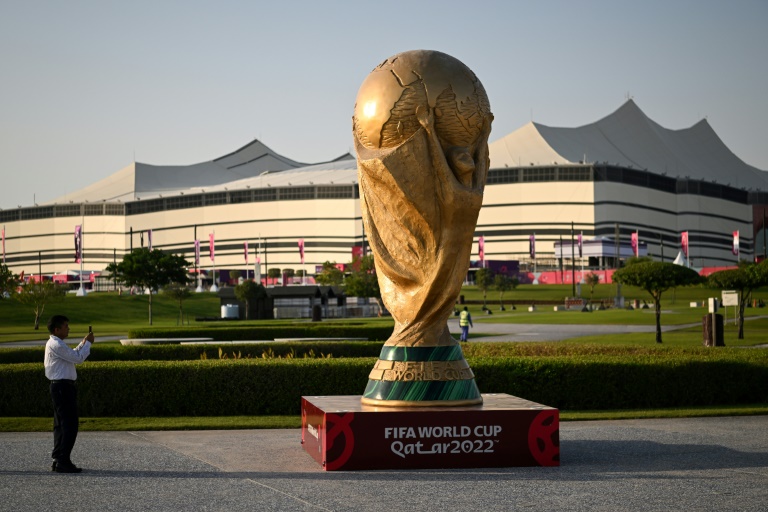
One week from kickoff, the World Cup trophy returned to Qatar on Sunday, teams and fans started arriving and safety barriers went up across Doha ahead of one of the most controversial football tournaments ever.

The trophy which will be presented to the winning team on December 18 returned from a world tour in time for next Sunday’s opening game when hosts Qatar take on Ecuador.

FIFA’s pleas to “focus on the football” have struggled however against an international spotlight on Qatar’s treatment of migrant workers, women and the LGBTQ community. Qatar has angrily rebuffed most of the attacks and local media on Sunday blasted the “arrogance” of some Western countries.

“It seems to have been all we have read about in recent weeks,” said Ringo Gonzalez, an Ecuadoran based in Germany, who was among fans gathering at the World Cup countdown clock on the Doha seafront early Sunday.

“It will be good to see the teams finally doing something. I want Ecuador to do well and to see Lionel Messi and the other big names in action.”

The United States team has already arrived in Doha and Australia were to join them on Sunday. Qatar is predicting more than one million fans will be in the smallest country to host a World Cup, and many have arrived in the capital.

Many star players were still involved for their European clubs on Sunday in the final matches before the season is paused for the World Cup. 

Lionel Messi, Neymar and Kylian Mbappe were all named in the starting lineup for Paris Saint-Germain against Auxerre in Ligue 1.

In Doha port, the giant newly built cruise ship, MSC Europa, was to be officially named on Sunday before it welcomes thousands of World Cup fans.

– No champagne for ship naming –

In a concession to Qatar’s Islamic culture that restricts alcohol and bans gambling, a bottle of rose water was to be smashed on the hull instead of traditional champagne for the inauguration and the ship’s casino was to be closed while it was in port.

Three cruise ships will house up to 10,000 fans and MSC said the Europa was fully booked for the first two weeks of the 29-day tournament.

On land, barriers have gone up on main streets and around metro stations and stadiums as security forces brace for the football invasion.

Organisers say that 2.9 million of the 3.1 million tickets have been sold and scores of hopeful fans waited outside the FIFA ticketing centre hoping that scarce tickets become available for top games.

Matthew Coleman, an Australian living in Doha, and his Dutch friend Gijs Beenker, left empty-handed because there were no “interesting” matches available.

At a nearby World Cup souvenir store, the staff said Europeans who buy the official ball or the La’eeb mascot were the main clients.

Migrant workers from South Asia have bought thousands of replica Brazil and Argentina shirts and can be seen wearing them in the streets. The labourers have been at the centre of an often acrimonious dispute over deaths, injuries and their working conditions since Qatar was awarded the World Cup in 2010.

European and Qatari media on Sunday kept up their war of words over whether the energy-rich Gulf state should host the event.

One British newspaper said that many fans believed that Indians in Qatar had been “paid” to take part in rallies supporting Argentina and Brazil. Thousands of migrant workers flocked to the march on Friday.

In response, Qatar’s Al-Sharq newspaper said the anti-Qatar campaign “confirms the arrogance of some Western countries who believe organizing the World Cup must remain monopolized by them”.

Al Raya said “the enthusiastic, festive atmosphere of large crowds of football fans of different nationalities in Doha revealed the failure of smear campaigns led by some media and Western politicians against the 2022 World Cup”.

Taliban ban Afghan women from gyms and public baths

Gyms and public baths are now also off limits to Afghan women, the Taliban confirmed Sunday, days after banning them from parks and funfairs.

Women are increasingly being squeezed out of public life since the Taliban’s return last year despite the hardline Islamists promising a softer version of the harsh rule that characterised their first stint in power that ended in 2001.

Most female government workers have lost their jobs — or are being paid a pittance to stay at home — while women are also barred from travelling without a male relative, and must cover up with a burqa or hijab when out of the home.

Schools for teenage girls have also been shuttered across most of the country since the Taliban’s August 2021 return.

“Gyms are closed for women because their trainers were male and some of them were combined gyms,” Mohammad Akif Sadeq Mohajir, spokesman for the Ministry for the Prevention of Vice and Promotion of Virtue, told AFP.

He said “hammams” — traditional public bathing houses that have always been segregated by sex — were now also off limits.

“Currently, every house has a bathroom in it, so it won’t be any issue for the women,” he said.

One video clip circulating on social media — which could not immediately be verified — showed a group of women, backs to the camera, lamenting the gym ban.

“It’s a women-only gym — the teachers and trainers are all women,” a voice says, breaking with emotion.

“You can’t just ban us from everything. Do we not have the right to anything at all?”

Activists have said the increasing restrictions on women are an attempt to stop them from gathering to organise opposition to the Taliban’s rule.

Small groups of women have staged frequent flash protests in Kabul and other major cities, risking the wrath of Taliban officials who have beaten and detained them.

Earlier this month the United Nations voiced concern after the Taliban disrupted a press conference in the capital, submitting female participants to body searches and detaining the event organiser and several others.

Israel's Netanyahu tapped to form next government

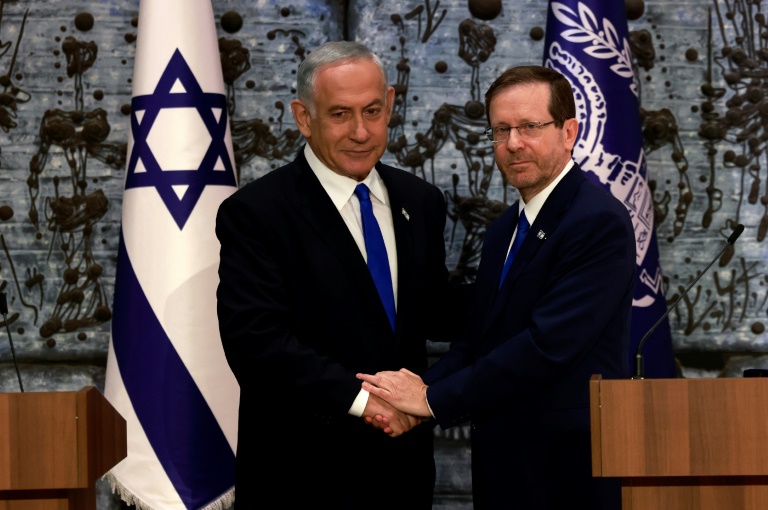
Israel’s veteran ex-premier Benjamin Netanyahu secured a mandate Sunday to form a new government, paving the way for his comeback at the helm of what is expected to be the most right-wing administration in the country’s history. 

After a period of unprecedented political gridlock tested the electorate with five votes in less than four years, November 1 polls gave Netanyahu and his far-right allies a clear majority in the 120-seat parliament.

“I have decided to assign to you, Benjamin Netanyahu, the task of forming a government,” President Isaac Herzog told him at a ceremony in Jerusalem. 

Accepting the mandate, the 73-year-old right-wing politician widely known as “Bibi” vowed to serve all Israelis, “those who voted for us and those who did not — it is my responsibility”.  

Netanyahu, who is fighting corruption allegations in court, will have at least 28 days to build a coalition with his allies — two ultra-Orthodox Jewish parties and a rising extreme-right alliance called Religious Zionism.

Herzog noted Netanyahu’s ongoing trial: “I am not oblivious, of course, to the fact that there are ongoing legal proceedings against Mr Netanyahu at the Jerusalem District Court, and I do not trivialise this at all”.

But he said that recent precedent made clear Netanyahu could serve as prime minister while contesting the allegations. 

Netanyahu can seek a two-week extension to his initial mandate but is expected to announce a coalition deal reasonably quickly, given broad ideological unity within the incoming government. 

Itamar Ben-Gvir and Bezalel Smotrich, co-leaders of the Religious Zionism bloc, have publicly demanded control of two key ministries — public security and defence — at a time violence has soared between Israel and the Palestinians.

– ‘Prophetise catastrophe’ –

Netanyahu’s next moves will be closely scrutinised as unease mounts in some quarters over his policy plans and the goals of his controversial governing partners. 

Netanyahu, however, insisted that those seeking to “prophetise catastrophe and scare the public” are misguided. 

“It’s not the first time we have heard this kind of talk,” he said, making unspecific references to his own previous governments. “It was wrong then and it is still wrong today.”

The new government is however widely expected to pass sweeping judicial reforms, a long-held priority of Israel’s right. That could include a so-called “override clause” giving parliament the right to overrule the supreme court any time it declares legislation to be illegal.

Netanyahu’s government may also take full control over appointing supreme court judges, a task currently performed by a panel of lawmakers, sitting judges and lawyers.

Suzie Navot, a constitutional law professor at the Israel Democracy Institute think tank, said “it is difficult for me to exaggerate the damage and danger” of the proposed reforms.

The centrist Yesh Atid party of outgoing Prime Minister Yair Lapid on Sunday condemned a “dark day for Israel’s democracy,” in an apparent reference to the judicial reform package. 

Religious Zionism has also called for the main charge against Netanyahu — “breach of trust” — to be abolished. 

Yesh Atid charged that the incoming government’s goal was to “save Netanyahu from his trial”.

– ‘Very sensitive questions’ –

Ben-Gvir, a firebrand known for anti-Arab rhetoric and incendiary calls for Israel to annex the entire West Bank, has repeatedly called for the security services to use more force in countering Palestinian unrest.

Recent months have been the deadliest period in years in the Israeli-occupied West Bank according to the United Nations, with near daily army raids and an increase in clashes and attacks on Israeli forces.

Netanyahu’s previous terms in office saw what little remained of the Middle East peace process collapse in a surge of Israeli settlement expansion in the occupied West Bank.

Herzog, whose role is largely symbolic, was reported to have tried to convince outgoing premier Lapid and his defence minister Benny Gantz to form a unity cabinet with Netanyahu, in order to keep Ben-Gvir from entering government.

The presidency publicly denied the claims.

Herzog this week told Ben-Gvir that as head of state he had received “questions from Israeli citizens and world leaders… very sensitive questions on human rights”.

The president added: “There is a certain image of you and your party which seems — and I’ll say it in all honesty — worrying in many regards.”

Let the court decide: Vanuatu's climate push raises hopes

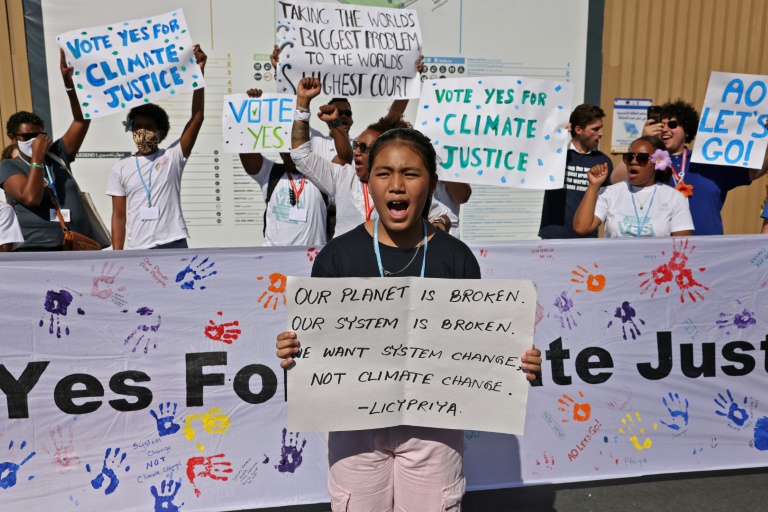
Seeking to speed up global efforts against climate change, Vanuatu is leading efforts to get the International Court of Justice involved, a move praised by activists at UN talks.

The COP27 climate summit in Egypt has been dominated by calls for nations to redouble their efforts to cut emissions and for rich polluters to finally provide the money that developing nations need to cope with global warming.

Threatened by rising sea levels, the small Pacific island of Vanuatu signalled last year that it would seek a non-binding “advisory opinion” from the Hague-based ICJ.

A year later, the initiative was formally launched at the UN General Assembly, which will have to vote on whether to back it in the next few months.

“I say let the gavel fall. Let judges inspire our leaders to act and let justice be done,” Ugandan climate activist Vanessa Nakate said at the COP27 meeting in the Red Sea resort of Sharm el-Sheikh.

Speaking to some 100 world leaders attending a summit on Tuesday, Vanuatu President Nikenike Vurobaravu said the initiative had grown into a coalition of 85 countries.

“Clearly, something is not working,” Vurobaravu said, noting that emissions are rising, climate financing remains “wholly inadequate” and the ambitious goal of limiting global warming to 1.5 degrees Celsius may not be met.

“I appeal in the strongest terms to leaders here at COP27 to vote in favour of the ICJ resolution at the UN General Assembly so that we can finally put human rights at the centre of climate decisions,” Vurobaravu said.

– ‘So much excitement’ –

Vanuatu’s UN ambassador, Odo Tevi, said the goal is to “clarify the rights and obligations of states under international law as it pertains to the adverse effects of climate change”.

Vanuatu also wants the ICJ to “clarify the due diligence requirements relating to climate action for emitters of greenhouse gases — past, present and future,” he said.

The question could irk developed countries that have historically been the biggest emitters of greenhouse gases but reject the idea of paying reparations to developing nations for the losses caused by natural disasters.

The issue of “loss and damage” is at the forefront of the COP27 talks that are scheduled to end on Friday.

Yeb Sano, executive director at Greenpeace Southeast Asia, said Vanuatu’s effort has “generated so much excitement” and global support.

“The international community needs clarity of purpose and this campaign is a beacon of hope that has the power to breathe new life… into the multilateral negotiations,” Sano said.

– ‘A matter of survival’ –

A similar effort more than a decade ago by another Pacific island, Palau, fizzled. But times have changed, with a slew of climate-related disasters this year highlighting the urgency the planet faces.

Though a legal opinion by ICJ would not be binding, Vanuatu hopes it would shape international law for generations to come.

Margaretha Wewerinke-Singh, an assistant professor of public international law at Leiden University in the Netherlands, said the ICJ can provide “legally relevant guidance” that is “very likely to be followed” by courts around the world.

While the Paris Agreement targets for emissions reduction are not binding, she said an ICJ opinion could signal that there are “legal obligations for taking action on climate change and legal consequences when these obligations are breached”. 

Perhaps more importantly, she added, an ICJ opinion could “inspire more ambitious climate action” from governments and big companies.

Harjeet Singh, a senior adviser at the Climate Action Network, said ICJ hearings on the matter would generate “much awareness” around climate change.

“It’s a matter of survival,” he told AFP.

Biden to seek red lines in talks with Xi

US President Joe Biden said Sunday he will seek to establish “red lines” in America’s fraught relations with Beijing in high-stakes talks with Chinese counterpart Xi Jinping.

The superpower sit-down will come on the sidelines of the G20 summit in Indonesia Monday, with leaders from the world’s 20 largest economies holding their biggest gathering since the pandemic.

Biden said he was going into his first face-to-face with Xi as president “stronger”, after his Democratic Party’s unexpected success in midterm elections they had been forecast to lose heavily.

But the summit comes with Beijing and Washington’s rivalry intensifying as a more powerful and assertive China tries to disrupt the US-led international order.

The world’s two largest economies are at loggerheads on everything from trade to human rights in China’s Xinjiang region and the status of the self-ruled island of Taiwan, and Biden said he expected “straightforward discussions” with Xi.

“I know Xi Jinping, he knows me,” he told reporters in Phnom Penh where he met with Asian leaders before heading to the G20 on the Indonesian resort island of Bali.

“We have very little misunderstanding. We just got to figure out what the red lines are,” Biden said.

White House officials say Biden will push China to rein in North Korea after a record-breaking series of missile tests fuelled expectations the reclusive regime will soon carry out its seventh nuclear test.

– Putin stays away –

China is Pyongyang’s main ally and while Biden is not expected to make demands, he will warn Xi that further missile and nuclear build-up would mean the United States boosting its military presence in the region — something Beijing bitterly opposes.

“North Korea represents a threat not just to the United States, not just to (South Korea) and Japan but to peace and stability across the entire region,” US National Security Advisor Jake Sullivan told reporters.

The talks will cast a long shadow over the first post-pandemic G20, a reunion that Russian President Vladimir Putin has pointedly opted to skip.  

He is instead sending his Foreign Minister Sergei Lavrov, who arrived on Sunday evening.

Putin’s invasion of Ukraine has made the trip to Bali logistically difficult and politically fraught, and while the war is not officially on the summit agenda, the conflict will dominate discussions.

Soaring energy and food prices have hit richer and poorer G20 members alike -– and both are directly fuelled by Putin’s war.

There is likely to be pressure on Russia to extend a deal allowing Ukrainian grain and fertiliser shipments through the Black Sea when the current agreement expires on November 19. 

– ‘Never been this complex’ –

At a minimum, Biden and his allies want the G20 to make it clear to Putin that nuclear war is unacceptable.

Even that once uncontroversial position is likely to be blocked by a mixture of Russian opposition and Chinese unwillingness to break ranks with its ally in Moscow or give Washington a win.

At a recent meeting with German Chancellor Olaf Scholz, Xi said a nuclear war could not be won and should never be fought.

Ryan Hass, a former director for China at the US National Security Council, said Xi “likely will not be as magnanimous in his meeting with Biden.” 

“He will not want to be perceived as satisfying a request from Biden, whether on Ukraine, nuclear use, North Korea, or any other issue,” Hass told AFP.

G20 host Indonesia — still careful not to favour either China or the United States — is not confident that the leaders will be able to break the deadlock.

A string of G20 ministerial meetings, hosted by Indonesia in the run-up to the summit, have failed to agree on a final joint communique — a procedural-sounding tradition that can be important in driving cooperation.

“Honestly, I think the global situation has never been this complex” said Indonesian government minister Luhut Binsar Pandjaitan on the eve of the summit.

“If eventually (the G20) leaders do not produce a communique, that’s that, it’s OK.” 

burs-sah/arb/mtp

Charles III leads first Remembrance Sunday as king

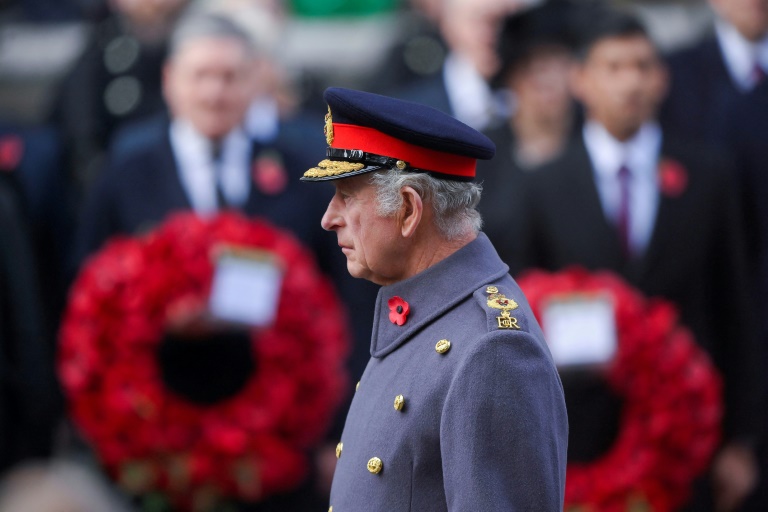
Charles III led his first Remembrance Sunday event as king, laying a wreath in tribute to UK and Commonwealth war dead, as Britain’s new prime minister also lauded Ukraine’s defenders.

The 73-year-old monarch had  previously deputised for his mother Queen Elizabeth II, who died in September aged 96 after a year of failing health.

Since 2017, she had watched the annual service from a balcony of the foreign ministry overlooking the Cenotaph in central London.

Last year a back complaint forced Elizabeth to miss the ceremony, just weeks after an unscheduled overnight stay in hospital.

Charles, who served in the Royal Navy in the 1970s, laid a wreath on her behalf.

Now king and commander-in-chief of British forces, he laid his first wreath at the war memorial as reigning monarch, dressed in a field marshal’s ceremonial uniform. 

Charles stood in silence after depositing the ring of red artificial poppies — Britain’s symbol of remembrance.

The wreath was mounted on black leaves, with a ribbon in the king’s scarlet, purple and gold horseracing colours.

Two minutes’ silence was observed after Big Ben tolled 11 times, marking the resumption of full operations for the newly restored Great Clock in the nearby Houses of Parliament.

Cannon fire marked the beginning and end of the silence, culminating in buglers playing the Last Post in front of the Cenotaph, before UK politicians and Commonwealth ambassadors laid their own wreaths.

New Conservative leader Rishi Sunak was attending his first Remembrance Sunday as prime minister. 

“This year more than ever, we are reminded of the huge debt of gratitude we owe those who lay down their lives to protect their country,” Sunak said in a statement.

“As we fall silent together on Remembrance Sunday, we will honour the memories of the men and women we have lost, and pay tribute to the brave soldiers of Ukraine as they continue their fight for freedom.”

– ‘Special poignancy’ –

Speaking to Sky News, Chief of the Defence Staff Admiral Tony Radakin said there was particular emotion attached to this Remembrance Sunday.

“I think there’s a special poignancy this year with both the loss of Her Majesty, another loss of a Second World War veteran,” he said.

“I also think it’s poignant when we have once again the spectre of war in Europe and all that that entails, and a country that’s been invaded and is fighting for its freedom,” he said, referring to war in Ukraine.

Remembrance Sunday in Britain is the culmination of days of events to pay tribute to all those who lost their lives in conflict.

On Thursday Queen Consort Camilla laid a cross at the Field of Remembrance outside London’s Westminster Abbey, alongside 70,000 other symbols left by military associations, and a space dedicated to Elizabeth.

On Friday — Armistice Day, marking the end of hostilities in World War I — a service was held at the National Memorial Arboretum in central England.

The king, queen and senior family members on Saturday attended an annual concert organised by the Royal British Legion veterans’ charity.

On Sunday, around 10,000 veterans marched past the Cenotaph including 400 who fought in the Falklands War, 40 years ago.

Other royals attending on Sunday included Charles’s eldest son and heir, Prince William, and William’s wife Kate.

Melania Trump lawyer tipped to become Slovenia's first woman president

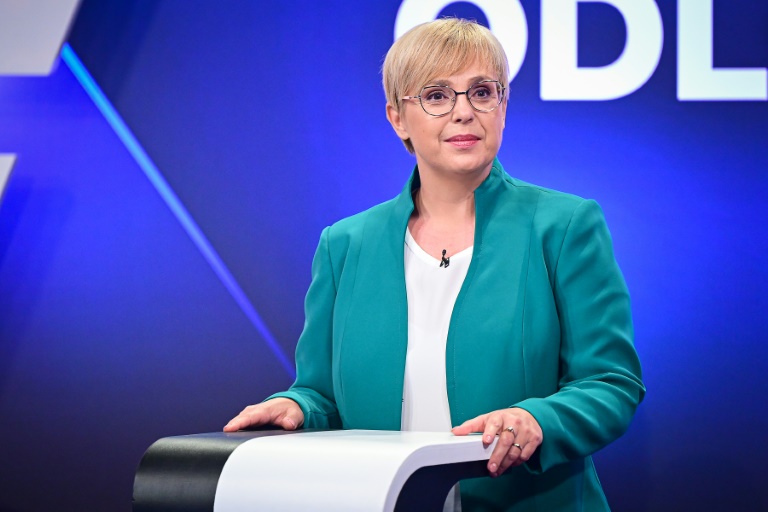
Slovenians were voting on Sunday in a run-off poll expected to elect the country’s first woman president — a lawyer linked to former US first lady Melania Trump.

Natasa Pirc Musar, backed by the centre-left government, is running against ex-foreign minister Anze Logar, a veteran of conservative politics, in the EU country of two million.

A lawyer, Pirc Musar was hired to protect the interests of Slovenian-born Trump during her husband’s presidency, stopping companies attempting to commercialise products with her name.

She is forecast to win just slightly above 50 percent of the vote, ahead of Logar who is due to get between 44 and 49 percent, according to the latest polls.

Pirc Musar, who headed the country’s data protection authority for a decade, says her victory would make her “the voice of women” in Slovenia and abroad.

Though the president’s role is largely ceremonial, the human rights advocate has vowed to be a “moral authority”.

“The president cannot be neutral… and have no opinion… I have never been afraid to speak out,” the former television presenter, 54, told AFP.

Pirc Musar, who is a keen motorcyclist, has come under attack because of her husband’s lucrative investments — especially in tax havens.

Her opponent Logar, 46, also ran as an independent but is a long-time member of the Slovenian Democratic Party (SDS) of Janez Jansa, who failed in his bid to be re-elected as premier in April.

“I entered this campaign to win,” Logar said, casting his ballot in the capital Ljubljana.

– ‘More balance’ –

Critics accused Jansa of attacking media freedom and the judiciary and undermining the rule of law in his latest term in office.

Logar plays the cello and is a keen mountaineer who cycled to the presidential debates.

“It is good if the president represents a different view than the ruling coalition — (it) provides more balance… which is better for a democratic system,” Logar told AFP ahead of Sunday’s vote.

Newspaper columnist Uros Esih said Pirc Musar has surrounded herself with “strong advisers”, allowing her to compete with the relatively more experienced Logar.

But Logar would “more likely be a mere instrument” of Jansa’s party, Esih said. 

“I hope a candidate that will bring people together will win,” Rok Novak, an economist in his early 50s, said at a Ljubljana voting centre.

“Slovenia is so polarised right now.”

Logar came first in the first round last month when the centre-left votes were split largely between Pirc Musar and another candidate.

Analysts say a low turnout would favour Logar, but polls predict about half of those eligible will vote, as in the first round, putting Pirc Musar ahead.

Polling stations opened in the former Yugoslav republic at 7:00 am (0600 GMT) and are due to close at 7:00 pm, with partial results expected later the same day.

Incumbent Borut Pahor, a former Social Democrat, could not run for re-election after having held the post for two five-year stints.

Pensioner Silva Lotric was optimistic as she cast her ballot.

“I hope my candidate will win… if my candidate wins, she will definitely bring changes,” to the role of the president.

Biden to seek red lines in talks with Xi

US President Joe Biden said Sunday he will seek to establish “red lines” in America’s fraught relations with Beijing when he holds high-stakes talks with Chinese counterpart Xi Jinping.

Biden said he goes into Monday’s encounter on the sidelines of a G20 summit in Indonesia stronger after his Democratic Party’s unexpected success in midterm elections they were forecast to lose heavily.

Washington and Beijing are at loggerheads over issues ranging from trade to human rights in China’s Xinjiang region and the status of the self-ruled island of Taiwan. Biden said he expected candid talks with Xi.

“I know Xi Jinping, he knows me,” he added, saying they have always had “straightforward discussions”.

The two men have known each for more than a decade, since Biden’s time as vice-president, but Monday will see them meet face-to-face for the first time in their current roles.

“We have very little misunderstanding. We just got to figure out what the red lines are,” Biden said.

White House officials say Biden will push China to use its influence to rein in North Korea after a record-breaking spate of missile tests sent fears soaring that the reclusive regime will soon carry out its seventh nuclear test.

Biden had a fillip overnight with the news that the Democrats retained their effective majority in the US Senate thanks to Catherine Cortez Masto winning in Nevada.

“I know I’m coming in stronger,” he said of the midterms’ impact on his talks with Xi.

– Japan, S. Korea talks –

Biden will meet his South Korean counterpart Yoon Suk-yeol and Japanese Prime Minister Fumio Kishida on Sunday to discuss ways to address the threat posed by the North’s missile programme.

China is Pyongyang’s main ally and US officials say that, while Biden will not make demands, he will warn Xi that further missile and nuclear build-up would mean the United States boosting its military presence in the region — something Beijing bitterly opposes.

“North Korea represents a threat not just to the United States, not just to (South Korea) and Japan but to peace and stability across the entire region,” US National Security Advisor Jake Sullivan told reporters.

Kim Jong Un’s regime ramped up missile launches in response to large-scale US-South Korean air exercises, which the North described as “aggressive and provocative”.

Biden on Sunday held talks with Prime Minister Anthony Albanese of Australia, a key regional ally and member of the Quad security group.

Beijing has denounced the Quad, which also includes the United States, Japan and India, as an attempt to isolate it.

– Diplomatic blitz –

Biden flew to Phnom Penh from the COP27 climate conference as part of US efforts to boost its influence in Southeast Asia as a counter to China.

China has been flexing its muscles — through trade, diplomacy and military clout — in recent years in a region it sees as its strategic backyard.

Biden told leaders at an East Asia Summit — including Chinese Premier Li Keqiang — on Sunday that the United States would speak out against Beijing’s rights abuses, according to a White House press release.

A day earlier Biden took a veiled swipe at Beijing in talks with leaders from the Association of Southeast Asian Nations (ASEAN) regional bloc.

He said the United States would work with ASEAN to “defend against the significant threats to rules-based order and threats to the rule of law”.

While the president did not refer to China by name, Washington has long criticised what it says are Beijing’s efforts to undermine international norms on everything from intellectual property to human rights.

Despite the US-China tensions the pair clinked glasses together in a toast at a gala dinner Saturday night, where they were seated on either side of the host, Cambodian leader Hun Sen.

While Biden goes into the meeting with Xi buoyed by the Democrats seeing off a predicted Republican “red wave”, Xi was anointed last month for a historic third term as paramount leader by the Chinese Communist Party congress.

Li met International Monetary Fund chief Kristalina Georgieva at the ASEAN gathering on Saturday, when he also addressed participants.

Biden and Li took part Sunday in an East Asia Summit that rounds off the first leg of a trilogy of top gatherings in the region, with the G20 on the holiday island of Bali and an APEC gathering in Bangkok to follow.

The consequences of the war in Ukraine are set to dominate the upcoming talks, although Russian President Vladimir Putin will be notably absent.

Close Bitnami banner
Bitnami