World

Far-right Poles have Ukraine on their minds at Independence Day march

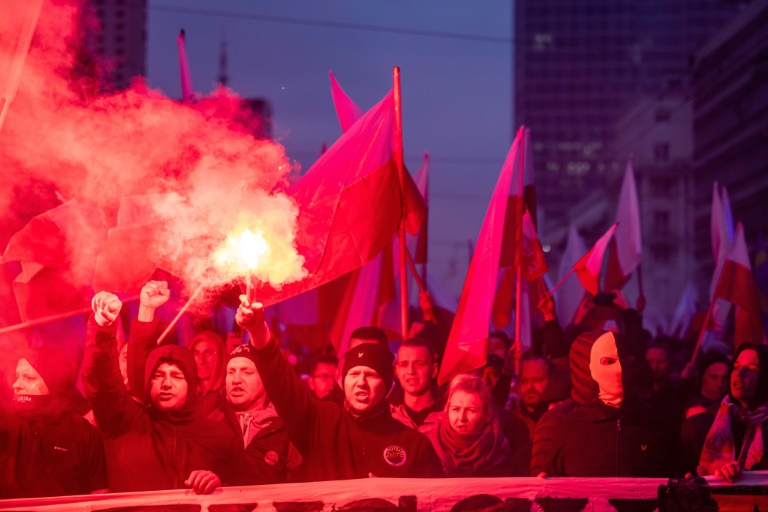
Warsaw’s annual “Independence March” by far-right nationalist groups has long been used to espouse Polish pride, but Ukraine was on their minds at this year’s event. 

“Hitler is dead but Putin is alive and he is repeating history with the Ukrainians,” declared Stanislaw Fidurski, a 95-year-old retired colonel at Friday’s march, which was led by four hussars dressed in historical costumes. 

He said Poland could form a larger state with Ukraine — an idea supported by two septuagenarians Marek and Piotr who said it would help Warsaw to “resist Russia”. 

Dressed in a military uniform with his medals, Fidurski was among the roughly 10,000 people attending the march — a smaller number than usual. 

They sang the national anthem, which was punctuated by the explosion of firecrackers and the flares of smoke torches.

The event commemorating Poland’s Independence Day can be a lightning rod for controversy, pitting conservative groups against more liberal Poles. 

Waving red-and-white Polish flags and carrying the banners of small far-right parties and Catholic groups, many in the crowd also hoisted posters denouncing LGBTQ-friendly policies.

“This march carries the idea of the rebirth of Poles facing materialism, consumerism, internationalisation,” said Jacek Krzystek, co-founder of the Independence March.

“We want to free ourselves from certain things that unfortunately destroy Western Europe,” he said, without specifying.

Some activists from a small ultra-nationalist party, the Confederation of the Polish Crown, waved a sign proclaiming for Warsaw to “Stop the Ukrainisation of Poland”. 

“This is not our war,” blared another banner from the march.

Since Russia’s invasion in February, the UN refugee agency says more than 7.8 million Ukrainians have fled. Neighbours including the Czech Republic, Poland, Romania and Slovakia have opened their borders, homes and wallets to help those fleeing the war.

“Freedom is always important, no matter the context. You have to take care of it because you can lose it quickly,” said Marek Krason, who came for the march from the southeastern region of Rzeszow, with his nine-year-old son. 

But there are limits, he said. 

“We must help the Ukrainians who need it, but without falling into madness,” Krason said. 

Protesters and police clash in Bolivia's Santa Cruz

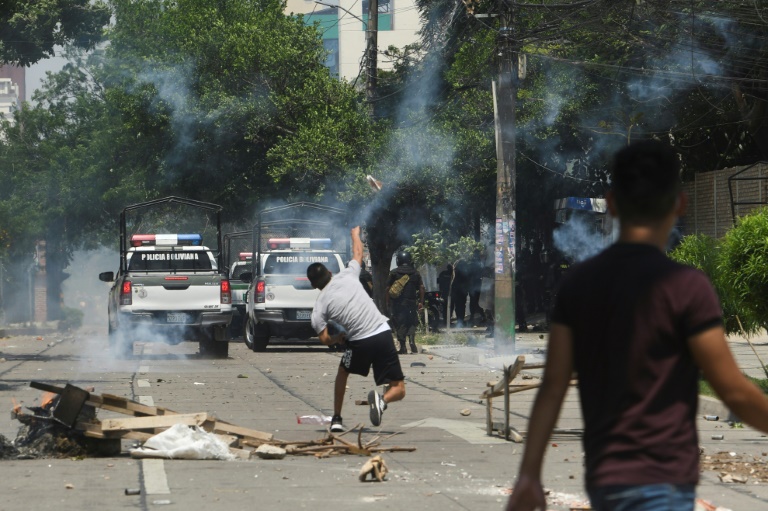
Riot police used tear gas to quell violent street protests in Bolivia’s largest city on Friday, the latest disturbances in three weeks of unrest over demands that a new census be conducted.

Vendors and public transit workers set tires ablaze in streets and threw rocks at opponents of leftist President Luis Arce in the center of Santa Cruz, a key hub of the energy industry in Bolivia’s tropical lowlands.

Television footage showed that a peasant federation office affiliated with the ruling party was looted and burned. Later, the headquarters of the largest local union, the Central Obrera Departamental (COD), was also looted.

Santa Cruz is a stronghold of center-right political forces that are opposed to the Arce government. They argue that the region is not adequately politically represented and receives fewer funds than it should, as calculations are based on a 2012 census.

On Friday, Arce announced that the government would be sticking to plans to hold the next census in 2024, announcing that it would be held on March 23 that year.

He also promised to redistribute the state’s economic funds to all regions within six months of the new census results.

Santa Cruz plans to hold a people’s assembly next Sunday to define its position in response to the president’s announcement.

Earlier on Friday, opposition protesters in Santa Cruz set up barricades of burned tires and claimed they were beaten by police.

Luis Fernando Camacho, the right-wing governor of Santa Cruz province, said the protesters were “set upon by the police and by MAS,” Arce’s ruling Movement To Socialism party.

Interior Minister Eduardo del Castillo, however, said that the demonstration of vendors and drivers seeking an end to the opposition roadblocks “was the peaceful march of the people that was brutally attacked by radical sectors that seek confrontation”.

Authorities offered no official count of arrests or injuries sustained in the violence on Friday.

The federal government said that four people have been killed and 178 injured in unrest over the past three weeks in Santa Cruz.

In his statement on public television, Arce called for “the return of calm, peace and normalcy in the department of Santa Cruz”.

Far-right Poles have Ukraine on their minds at Independence Day march

Warsaw’s annual “Independence March” by far-right nationalist groups has long been used to espouse Polish pride, but Ukraine was on their minds at this year’s event. 

“Hitler is dead but Putin is alive and he is repeating history with the Ukrainians,” declared Stanislaw Fidurski, a 95-year-old retired colonel at Friday’s march, which was led by four hussars dressed in historical costumes. 

He said Poland could form a larger state with Ukraine — an idea supported by two septuagenarians Marek and Piotr who said it would help Warsaw to “resist Russia”. 

Dressed in a military uniform with his medals, Fidurski was among the roughly 10,000 people attending the march — a smaller number than usual. 

They sang the national anthem, which was punctuated by the explosion of firecrackers and the flares of smoke torches.

The event commemorating Poland’s Independence Day can be a lightning rod for controversy, pitting conservative groups against more liberal Poles. 

Waving red-and-white Polish flags and carrying the banners of small far-right parties and Catholic groups, many in the crowd also hoisted posters denouncing LGBTQ-friendly policies.

“This march carries the idea of the rebirth of Poles facing materialism, consumerism, internationalisation,” said Jacek Krzystek, co-founder of the Independence March.

“We want to free ourselves from certain things that unfortunately destroy Western Europe,” he said, without specifying.

Some activists from a small ultra-nationalist party, the Confederation of the Polish Crown, waved a sign proclaiming for Warsaw to “Stop the Ukrainisation of Poland”. 

“This is not our war,” blared another banner from the march.

Since Russia’s invasion in February, the UN refugee agency says more than 7.8 Ukrainians have fled. Neighbours including the Czech Republic, Poland, Romania and Slovakia have opened their borders, homes and wallets to help those fleeing the war.

“Freedom is always important, no matter the context. You have to take care of it because you can lose it quickly,” said Marek Krason, who came for the march from the southeastern region of Rzeszow, with his nine-year-old son. 

But there are limits, he said. 

“We must help the Ukrainians who need it, but without falling into madness,” Krason said. 

Chile president creates commission to resolve Indigenous land issues

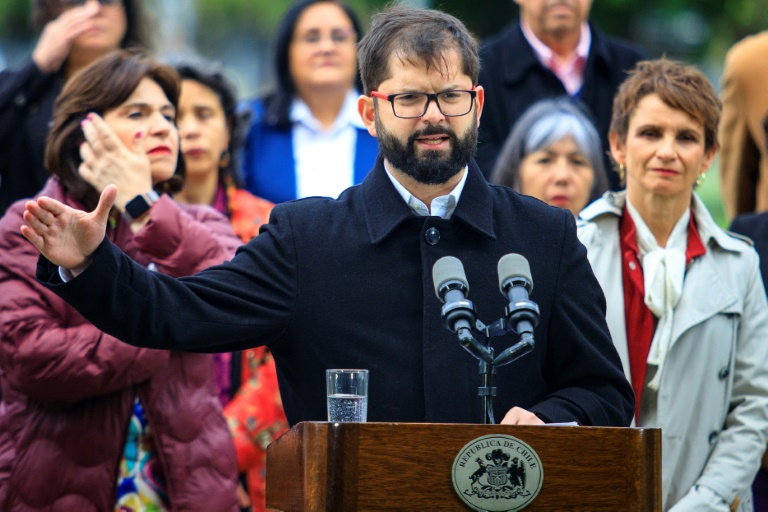
Chile President Gabriel Boric met with Mapuche Indigenous leaders on Friday and announced the creation of a commission to resolve issues of land ownership in the flashpoint southern Araucania region, which has seen a spate of recent arson attacks.

Araucania is home to groups of Mapuche, the country’s largest Indigenous group, who are demanding the restitution of their ancestral land, much of which is currently in the hands of private logging companies.

Boric said a Commission for Peace and Understanding, which will start functioning by March 2023, will weigh domestic and international recommendations about how to resolve violence in Araucania and “look for a solution to the conflict.”

The Chilean president warned that not everyone would be happy with the verdicts and timelines of the commission.

“It will not be possible to return all the land. There are many cities in southern Chile that were built on land that was once Mapuche and these cities must be preserved,” Boric said.

Some non-Mapuche Chileans “settled on these lands and dropped roots generations ago” and their rights must be respected as well, he said.

Radical Mapuche groups have carried out numerous arson attacks, mostly on forestry companies and their equipment, but recently a school and church were also torched.

Boric began a surprise visit to the region on Thursday and branded the arsonists “terrorists” and “cowards.”

Hours after he spoke, arsonists torched a house and a truck.

The violence has resulted in the deaths of at least eight people in the rural region so far this year.

The radical Arauco Malleco Coordination (CAM), one of the main Mapuche groups in the region, opposed Boric’s visit, saying it “obeys the interests of the oligarchy, the power of economic groups that directly oppose the Mapuche cause.”

A previous attempt to visit the area by Boric’s then-interior minister Izkia Siches in March was marred by gunfire. Speaking to a local radio station, Boric said that visit had been a mistake.

“We realized that the situation in Araucania must be addressed without shortcuts,” he said, adding that a “solid, robust agenda” was needed before visiting.

In the 16th century, the Mapuche resisted Spanish expansion in their territories but they were finally subdued in 1870 by the Chilean army, which subsequently began installing settlements in the region.

The restitution of these ancestral lands is at the heart of the Mapuche struggle.

Boric’s predecessor, Sebastian Pinera, deployed the military to Araucania in late 2021. The new president ended that operation, but was forced to backtrack in May following another violent escalation.

Zelensky proclaims strategic Kherson 'ours', as US hails Ukraine's victory

Ukrainian President Volodymyr Zelensky declared Kherson “ours” after Russia withdrew troops from the city, which the US hailed Saturday as an “extraordinary victory”.

“We are winning battles on the ground. But the war continues,” foreign minister Dmytro Kuleba said after Ukraine’s triumphant recovery of Kherson — the only regional capital Moscow had captured in the nine months since Russia’s invasion. 

In the port city located on the Black Sea, the Ukrainian national anthem rang out in the central Kherson square as a small crowd sang along while huddled around a bonfire, a video published by Ukraine’s parliament on social media showed. 

“Special units are already in the city,” Zelensky wrote on Telegram, posting footage in which Ukrainian troops appeared to gather with residents.

About 50 kilometres (30 miles) from Kherson, Andriy Zholob, a commander of a medical unit, said they had greeted by smiling faces and given “embroidered towels which we display on our vehicles”. 

“We see children running to meet us and greeting us,” Zholob told AFP.

In nearby Mykolaiv province, which Russian forces have failed to capture despite months of attacks, governor Vitaliy Kim said the entire region, save for the Kinburn cape in the south, had been returned to Ukrainian control.

“Now it’s official: the entire Mykolaiv region (except Kinburn) has been liberated,” Kim wrote on Telegram.

The US hailed Ukraine’s “extraordinary victory” in recapturing Kherson from the Russians on Saturday. 

“It’s a big moment and it’s due to the incredible tenacity and skill of the Ukrainians, backed by the relentless and united support of the United States and our allies,” US National Security Advisor Jake Sullivan said while travelling to Cambodia with President Joe Biden for a regional summit.

But Kuleba — attending the same summit — warned that Kyiv still sees “Russia mobilising more conscripts and bringing more weapons to Ukraine”. 

“I understand that everyone wants this war to end as soon as possible,” he said during a meeting with Australian Prime Minister Anthony Albanese in which he called for the Western world’s continued support. 

“We are definitely the ones who want that more than anyone else.”

– Ukrainian television back on  –

In Kherson, Kyiv’s forces reconnected the local television network to Ukrainian broadcasters after local media reported that retreating Russian forces blew up the television tower and energy facilities, leaving the city without power.

Kyiv’s defence ministry said earlier Friday that Kherson “is returning to Ukrainian control and units of the Armed Forces of Ukraine are entering the city”.

Ukrainian artillery teams had clear views of Russia’s routes of retreat and warned: “Any attempts to oppose the Armed Forces of Ukraine will be stopped.”

Russia’s defence ministry said “more than 30,000 Russian servicemen, about 5,000 pieces of hardware and military equipment and materiel have been withdrawn”.

Kherson was the first major urban hub to fall after President Vladimir Putin ordered Russian troops into Ukraine on February 24. 

Its full recapture by Kyiv would be a political and symbolic blow to Putin and open a gateway for Ukraine’s forces to the entire Kherson region, with access to both the Black Sea in the west and Sea of Azov in the east.

“Ukraine is gaining another important victory right now and proves that whatever Russia says or does, Ukraine will win,” Kuleba wrote on social media.

He posted an amateur video showing Ukrainians removing a billboard near Kherson that proclaimed: “Russia is here forever”.

– ‘In tears’ –

In Ukraine’s capital, the news was met with joy.

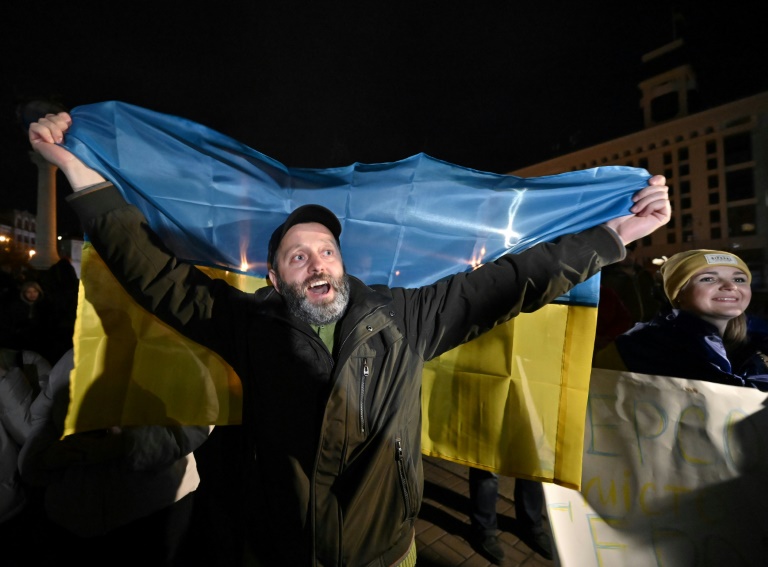
Wrapped in flags, popping champagne corks and belting out the Ukrainian national anthem, residents of Kherson living in Kyiv gathered in the city’s Maidan square to celebrate.

“I didn’t believe it at first, I thought it was going to take weeks and months, a few hundred metres at a time, and now we see them arrive in Kherson in one day, it’s the best surprise,” said Artem Lukiv, 41, a Kherson resident living in Kyiv.

While it would appear a major Russian setback, the Kremlin insisted that Kherson was still part of Russia and that it did not regret annexing the entire Kherson region at a lavish ceremony in late September.

“This is a subject of the Russian Federation. There are no changes in this and there cannot be changes,” Kremlin spokesman Dmitry Peskov told reporters.

A full Ukrainian recapture of the Kherson region would disrupt a vital land bridge for Russia between its mainland and the Crimean peninsula, which Moscow annexed from Ukraine in 2014.

– ‘Cynical’ attack –

Ukrainian officials were initially wary after Moscow announced this week that it would pull forces to defensive positions on the east bank of the river in the city.

Kherson was one of four regions in Ukraine that Putin claimed to have annexed during the September ceremony, vowing at the time to use all available methods to defend it.

Asked by reporters whether Russia regretted annexing Kherson, Peskov said the Kremlin had “no regrets” about the move.

Earlier on Friday, a Russian strike on a residential building in Mykolaiv killed seven people, regional governor Vitaliy Kim said on social media.

An AFP journalist at the scene saw a gaping hole gouged out of a Soviet-style residential building with emergency workers in yellow helmets on site clearing rubble.

Zelensky branded the strike a “cynical response to our successes at the front”.

As Biden returns to table with Xi, US views darken on Chinese leader

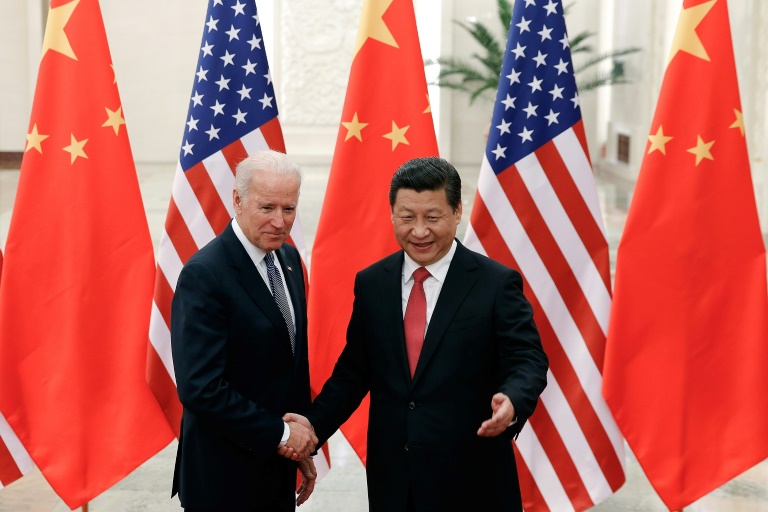
Sitting next to Xi Jinping during one of their marathon sessions in 2011, Joe Biden saluted the direction of US-China ties.

“The trajectory of the relationship is nothing but positive,” Biden told businesspeople who came to see the two vice presidents at a Beijing hotel, voicing “great optimism about the next 30 years”.

As the two leaders, now presidents, prepare to meet again little more than a decade into that timeframe, the trajectory of relations is anything but positive — and virtually no US policymaker is optimistic about Xi, China’s most powerful leader in decades who just secured a historic third term.

Biden and Xi will hold talks Monday on the sidelines of a Group of 20 summit in Bali at a time of rising US alarm. Xi’s China, in the words of Secretary of State Antony Blinken, has become “more repressive at home” and “more aggressive abroad” — with the threat of China invading Taiwan, once largely theoretical, increasingly seen as real.

It will be the first in-person meeting between the US and Chinese presidents since Donald Trump spoke in 2019 with Xi, who only recently resumed international travel following the pandemic.

But Biden and Xi know each other unusually well for two world leaders. They have talked by phone or videoconference five times since the Democrat entered the White House in 2021.

And the relationship goes much deeper.

When Xi was leader in waiting, Biden flew to China in 2011 and later invited him to tour the United States including rural Iowa, where a young Xi had gone on an exchange.

Biden said that as vice president he spent 67 hours in person with Xi, part of an effort by the then administration of Barack Obama at least to understand, if not court, the rising Chinese leader.

– Cold calculations –

US officials and experts have since come to believe that the 69-year-old Xi has no desire for moderation, with the new Central Committee of the Chinese Communist Party stacked with hardliners and lacking any obvious heir apparent.

“We all knew that Xi Jinping was going to prevail. But I think people are still surprised that Xi Jinping could not even find the grace to save some accommodation for his political opponents,” said Yun Sun, a senior fellow at the Stimson Center in Washington.

With the Party Congress over, Xi now has greater space and flexibility to focus on his international push for a stronger China, she said.

“We are not looking at a Xi Jinping who is going to be less emboldened,” she said.

Both Biden and Trump have identified China as the preeminent global competitor to the United States. But while Trump by late in his term was railing against China on everything from trade to Covid-19, Biden has supported talks on narrow areas of cooperation.

Biden told reporters Wednesday he would speak to Xi about each country’s “red lines” in hopes of avoiding conflict.

Chief among red lines for China is Taiwan, the self-governing democracy Beijing claims as its own, with Beijing carrying out exercises seen as a trial run for an invasion to protest against House Speaker Nancy Pelosi’s visit in August.

Biden has said three times that the United States would defend Taiwan militarily if China attacks, although the White House has walked back the apparent shift from longstanding US ambiguity.

Privately some US allies have cheered on the more forceful approach towards Beijing including on the South China Sea, where Washington has moved from neutrality to championing Southeast Asian nations’ myriad claims.

“There is a widespread feeling that the United States has finally understood the nature of the threat,” said a senior Washington-based diplomat from an Asian country friendly with the United States.

– Inching away –

The United States has also made initial moves with allies on a once unthinkable idea — easing two decades of economic reliance on China, which is racing ahead under Xi to dominate next-generation technology and where Covid lockdowns have exposed the fragility of supply chains.

“Seeing what the US is doing to sort of de facto decouple or separate, at least in the technology space, that may be changing calculations” of other Asian countries, said Matt Goodman, senior vice president for economics at the Center for Strategic and International Studies.

Biden has voiced hope for working with China, the largest carbon emitter, on climate change, and officials said Saturday that Biden would press Xi on North Korea, a Chinese ally that has launched a volley of missiles in recent weeks.

Yun doubted China would oblige, saying that Xi views cooperation as transactional.

“With competition the main theme of the US’s China policy, why would China cooperate?” she said.

“Their calculation is that they are not going to do anything from the goodness of their hearts. They want to see the US give something.”

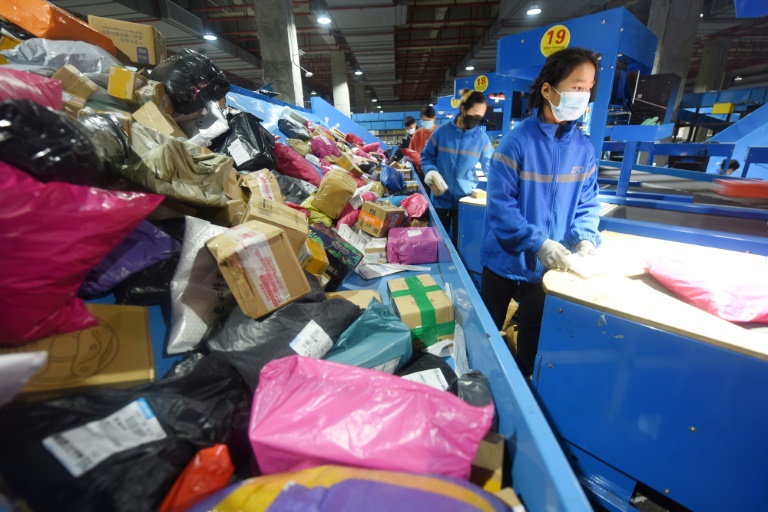
Alibaba keeps Singles Day sales tally under wraps for first time

Chinese e-commerce giant Alibaba has not released full sales figures for its annual Singles Day event for the first time ever, as a cooling economy dampened demand.

Launched in 2009, Singles Day is the world’s largest shopping festival, dwarfing similar US events such as Black Friday and Cyber Monday in terms of sales. 

Alibaba’s sales last year hit 540.3 billion yuan ($76.1 billion), and many were watching to see if the company and other retailers taking part could combine for a record one trillion yuan in sales.

In a statement Saturday, Alibaba said results for this year’s event were “in line with last year’s… despite macro challenges and Covid-related impact,” without offering details.

Some 290,000 brands participated in 2022, it added, with merchants offering varying levels of discounts starting as early as late October.

Research firm Syntun a day earlier estimated that platforms including Alibaba and JD.com had reached a combined 262 billion yuan between 8:00 pm Thursday and 2:00 pm (0600 GMT) Friday.

Once a festival of frenzied consumption led by Alibaba’s effervescent founder Jack Ma, Singles Day has been more muted in recent years amid a Beijing crackdown on online platforms and waning state media coverage.

In April, regulators fined Alibaba $2.8 billion for anti-competitive practices, and Ma’s public presence has been noticeably diminished over the past two years.

“In terms of communications from the platform companies around the festival, there’s been a shift away from celebrating excessive consumption and emphasizing gross merchandise value (GMV),” Jacob Cooke, CEO of e-commerce consultancy WPIC Marketing + Technologies said. 

“The shift has been going on for a few years now, and that’s related to common prosperity, the anti-monopoly drive,” he added, referring to President Xi Jinping’s ongoing drive to curb the influence of big tech. 

Consumers are also tightening their belts as Beijing persists with a zero-Covid strategy that has led to widespread pay cuts and disrupted supply chains.

Conceived by Alibaba, the event’s title riffs on a tongue-in-cheek celebration of singlehood inspired by the four ones — “11/11” — that denote its date of November 11.

Alibaba is scheduled to report its earnings to stakeholders next week. 

Protests wane in Brazil, but diehards stand by Bolsonaro

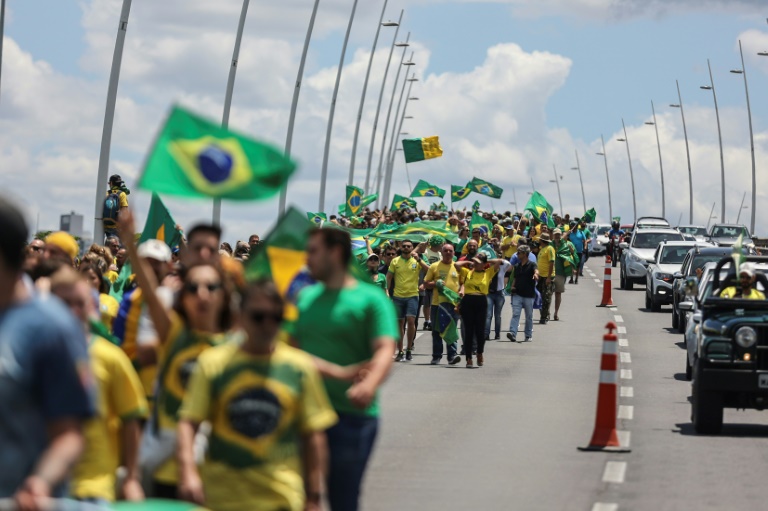
Protests in deeply polarized Brazil have dwindled since presidential elections nearly two weeks ago but some hard-core supporters of President Jair Bolsonaro remain in the streets.

A retired metalworker, Jose Carlos Flamino, stood at his encampment on Friday near a military barracks in Sao Paulo and vowed to remain “as long as is necessary.”

He still doesn’t accept that Luiz Inacio Lula da Silva, a leftist former president who squeaked out a 50.9 percent victory over Bolsonaro’s 49.1 percent in the October 30 vote, won fairly and squarely.

“The balloting that gave victory to Lula is not reliable,” said Flamino, 53, demanding the military overturn the vote.

He’s not alone. Other diehard Bolsonaro supporters are camped out with him at the Sao Paulo garrison and at military barracks across Brazil.

Bolsonaro, a retired army captain, “was a victim of an injustice but we are fighting here for the fatherland,” said Aguinaldo Coimbro, a 52-year-old market analyst, a Brazilian flag draped over his shoulders.

About 100 people with him outside the Sao Paulo military base chanted, “SOS, armed forces,” and called on the military to “save Brazil.”

Most wore green and yellow clothing, the colors of the national flag that has turned into a symbol for Bolsonaro followers. 

“Brazil didn’t elect anyone. The people don’t accept this. We don’t want to become Venezuela. Our freedom doesn’t have a price,” said Lena Pasqualini, 62, a jewelry saleswoman resting at a support center with donated food for the protesters.  

At a temporary encampment of protesters next to the central Duque de Caxias garrison in Rio de Janeiro, around 100 people remained on Friday morning, down from several thousand in the days after the October 30 runoff election. 

Even as demonstrations melt to only a few dozen people, protesters insist they represent multitudes. 

The election “was stolen, and that’s why all of Brazil is in the streets,” said Paulo Campelo, 70, a retired soldier.

“We want the army to eliminate those bastards who want to authenticate the fraudulent elections,” Campelo added.

– Lula: ‘One wins, one loses’ –

The Armed Forces said Friday in a statement that “the solution to possible controversies… must make use of the legal instruments of the democratic rule of law.”

Protesters assert that a “fraud” was perpetrated with the electronic ballot box system, used in Brazil since 1996, and questioned without proof by Bolsonaro.

Numerous international observers and a report by the Armed Forces themselves released on Wednesday fully dispute that allegation.   

Lula on Thursday appealed to the “minority in the streets” to go home.

“Democracy is that, one wins, one loses,” the president-elect said. “How many times have I cried because I lost?”

Bolsonaro, who has not openly acknowledged his defeat and has practically disappeared from public life for more than a week, asked his supporters to take down hundreds of roadblocks they threw up after the vote, but supported protests elsewhere.

On Friday Brazilian roads were completely back to normal, the Federal Highway Police told AFP.

UN, Russia grain, fertiliser exports talks end without breakthrough

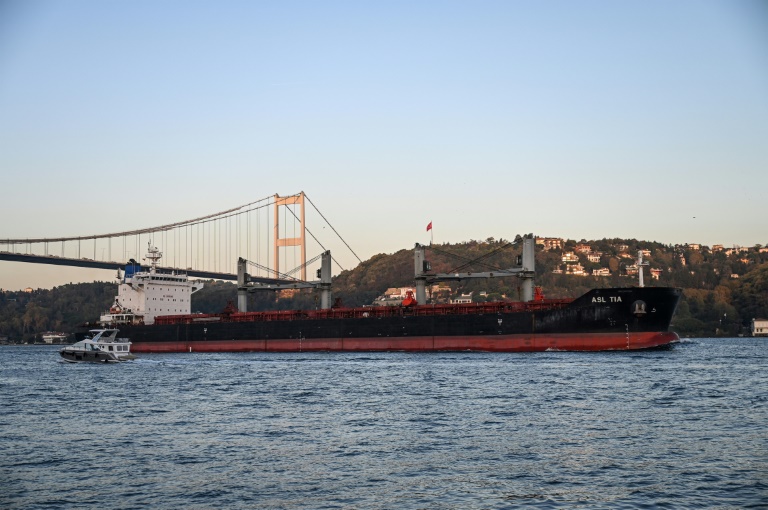
United Nations chiefs held talks with Russian officials Friday on the Black Sea agreements on exporting grain and fertilisers, eight days before one of the deals is set to expire.

The discussions took place behind closed doors at the UN Palais des Nations headquarters in Geneva and wrapped up mid-afternoon. 

“The discussions updated on progress made in facilitating the unimpeded export of food and fertilisers, including ammonia, originating from the Russian Federation to global markets,” said a UN statement. 

The meeting between UN humanitarian chief Martin Griffiths, UN trade and development agency head Rebeca Grynspan and a Russian delegation led by deputy foreign minister Sergei Vershinin also focused on “steps taken to facilitate payments, shipping insurance, and access to EU ports for grains and fertiliser”. 

“The world cannot afford to let global fertiliser accessibility problems become a global food shortage,” the statement said. 

The UN also managed to unblock a shipment of 20,000 tons of fertiliser in the Netherlands, stuck in the Dutch port of Rotterdam due to EU-imposed sanctions on certain individuals and goods. 

The shipment will head for Malawi in the coming days under the auspices of the UN’s World Food Programme, according to the Netherlands’ Ministry of Foreign Affairs.

“The fertiliser in question was frozen because a sanctioned individual is involved with the Russian company that owns it,” it said, without naming the individual or company involved. 

“The decision to release the fertiliser was made on the understanding that the UN would ensure that it is delivered to the agreed location (Malawi) and that the Russian company and sanctioned individual will earn nothing from the transaction,” the Hague said.

– 10.2 million tonnes exported –

Two agreements brokered by the UN and Turkey were signed on July 22.

The first was to allow the export of Ukrainian grain blocked by Russia’s war in the country, while the second was on the export of Russian food and fertilisers despite Western sanctions imposed on Moscow following its invasion.

The 120-day Black Sea Grain Initiative runs out on November 19, and the United Nations is seeking to renew it for one year.

Moscow, however, has not yet said whether it will agree to that.

It has complained that the second agreement exempting its fertilisers from sanctions, which is due to run for three years, is not being respected.

“The UN calls on all actors to expedite the removal of any remaining impediments to the export and transportation of fertilisers to countries most in need,” the UN spokesperson added.

Ukraine is one of the world’s top grain producers, and the Russian invasion had blocked 20 million tonnes of grain in its ports until the safe passage deal was agreed to.

As of Thursday, 10.2 million tonnes of grains and other foodstuffs had been exported from Ukraine under the deal, relieving some fears over a deepening global food security crisis.

– ‘Very serious’ implications –

The UN’s Food and Agriculture Organization (FAO) said the implications could be very concerning for global food security if the deal is not renewed.

“We see it as an important initiative that has improved food availability,” said Boubaker Ben Belhassen, director of the FAO’s markets and trade division.

“However, should we be in a scenario that nobody wants to see, that there is a termination of the deal, I think the situation could be really difficult and the implications could be very serious,” he told reporters via video-link from Rome, where the FAO is based.

He pointed in particular to global food security, prices, availability and food staples.

Ben Belhassen said that in the short term, prices would increase, especially for wheat, maize and sunflower seed oil, while the availability of grains on the global market would go down.

There could be a heavy impact on countries that depend on Black Sea imports, notably in the Middle East and North Africa.

Ben Belhassen also warned of the impact within Ukraine if the deals are not renewed.

The grain agreement has until now allowed Ukraine to release stocks from the last winter harvest, easing storage capacity pressure, he said.

It has also given farmers in the war-torn country a revenue stream, allowing them to make decisions on future investments and planting the next crop, he added.

Zelensky proclaims strategic Kherson 'ours', as US hails Ukraine's victory

Ukrainian President Volodymyr Zelensky declared Kherson “ours” after Russia withdrew troops from the city, which the US hailed Saturday as an “extraordinary victory”.

“As of now, our defenders are on the outskirts of the city. But special units are already in the city,” Zelensky wrote on Telegram, posting footage in which Ukrainian troops appeared to gather with residents.

“We see children running to meet us and greeting us,” said Andriy Zholob, the commander of a medical unit currently about 50 kilometres (30 miles) from Kherson. 

“We see attractive, smiling faces, flowers, embroidered towels which we display on our vehicles,” he added.

Ukraine’s parliament published a video of the national anthem being played in a central Kherson square as a small crowd of people, huddled around a bonfire in the dark of night, sang along before the camera zoomed in on a Ukrainian flag flying from a government building.

“The Ukrainian anthem in the center of Kherson,” said the caption to the video, published on social media.

In nearby Mykolaiv province, which Russians have failed to capture but have subjected to months of attacks, governor Vitaliy Kim said the entire region, save for the Kinburn cape in the south, was returned to Ukrainian control.

“Now it’s official: the entire Mykolaiv region (except Kinburn) has been liberated,” Kim wrote on Telegram.

The US hailed Ukraine’s “extraordinary victory” in recapturing Kherson from the Russians on Saturday. 

“It’s a big moment and it’s due to the incredible tenacity and skill of the Ukrainians, backed by the relentless and united support of the United States and our allies,” US National Security Advisor Jake Sullivan said while travelling to Cambodia with President Joe Biden for a regional summit.

– Ukrainian television back on  –

In Kherson, Kyiv’s forces reconnected the local television network to Ukrainian broadcasters, after local media reported that retreating Russian forces blew up the television tower and energy facilities, leaving the city without power.

Kyiv’s defence ministry said earlier Friday that Kherson “is returning to Ukrainian control and units of the Armed Forces of Ukraine are entering the city.”

Ukrainian artillery teams had clear views over Russia’s routes of retreat and warned: “Any attempts to oppose the Armed Forces of Ukraine will be stopped.”

Russia’s defence ministry said “more than 30,000 Russian servicemen, about 5,000 pieces of hardware and military equipment and materiel have been withdrawn”.

Kherson was the first major urban hub to fall after President Vladimir Putin ordered Russian troops into Ukraine on February 24. 

Its full recapture by Kyiv would be a political and symbolic blow to Putin and open a gateway for Ukraine’s forces to the entire Kherson region, with access to both the Black Sea in the west and Sea of Azov in the east.

“Ukraine is gaining another important victory right now and proves that whatever Russia says or does, Ukraine will win,” Foreign Minister Dmytro Kuleba wrote on social media.

He posted an amateur video showing Ukrainians removing a billboard near Kherson that proclaimed: “Russia is here forever”.

– ‘In tears’ –

In Ukraine’s capital, the news was met with joy.

Wrapped in flags, popping champagne corks and belting out the Ukrainian national anthem, residents of Kherson living in Kyiv gathered in the city’s Maidan square to celebrate.

“I didn’t believe it at first, I thought it was going to take weeks and months, a few hundred metres at a time, and now we see them arrive in Kherson in one day, it’s the best surprise,” said Artem Lukiv, 41, a Kherson resident living in Kyiv.

While it would appear a major Russian setback, the Kremlin insisted that Kherson was still part of Russia and that it did not regret annexing the entire Kherson region at a lavish ceremony in late September.

“This is a subject of the Russian Federation. There are no changes in this and there cannot be changes,” Kremlin spokesman Dmitry Peskov told reporters.

A full Ukrainian recapture of the Kherson region would disrupt a vital land bridge for Russia between its mainland and the Crimean peninsula, which Moscow annexed from Ukraine in 2014.

– ‘Cynical’ attack –

Ukrainian officials were initially wary after Moscow announced this week that it would pull forces to defensive positions on the east bank of the river in the city.

Kherson was one of four regions in Ukraine that Putin claimed to have annexed during the September ceremony, vowing at the time to use all available methods to defend it.

Asked by reporters whether Russia regretted annexing Kherson, Peskov said the Kremlin had “no regrets” about the move.

Earlier on Friday, a Russian strike on a residential building in Mykolaiv killed seven people, regional governor Vitaliy Kim said on social media.

An AFP journalist at the scene saw a gaping hole gouged out of a Soviet-style residential building with emergency workers in yellow helmets on site clearing rubble.

Zelensky branded the strike a “cynical response to our successes at the front”.
Close Bitnami banner
Bitnami