World

Musk 'kills' new Twitter label, hours after launch

Twitter launched two new verification tools Wednesday but “killed” one of them hours later in a messy start to owner Elon Musk’s campaign to revamp the influential platform following his $44 billion buyout.

The social media platform unveiled its long-awaited Twitter Blue subscription service, which allows users to pay $7.99 per month for a coveted blue tick, as well as a separate gray “official” badge for some high-profile accounts.

But the new gray label was almost immediately scrapped, overshadowing the launch of Twitter Blue, which is currently only available on the mobile app on iPhones and in the United States.

“I just killed it,” Musk tweeted hours after the new tag was added to government accounts, big companies and major media outlets.

“Please note that Twitter will do lots of dumb things in coming months. We will keep what works & change what doesn’t,” the world’s richest man added.

The U-turn invited further scrutiny of Musk’s plans for Twitter a week after he laid off thousands of workers and drew a massive drop in spending by advertisers, who are wary of the site’s direction.

The blue tick has been a mark of an account’s authenticity and doubts emerged that public figures or media outlets would pay for it. The official gray tag was seen by observers as a workaround to solve that problem.

The launch of the new official label began Wednesday and was on the accounts of companies such as Apple and BMW, as well as public ones such as the White House and major media outlets.

But only hours later, it was gone for many of them.

Accounts that had received the “official” badge — including Agence France-Presse, BBC News, Pope Francis and Kanye West — saw the mention disappear.

– ‘A lot of work’ –

Esther Crawford, an executive who announced the gray tick on Tuesday, insisted that the official label was still going to be part of the relaunch, but that “we are just focusing on government and commercial entities to begin with.”

“There are no sacred cows in product at Twitter anymore. Elon is willing to try lots of things — many will fail, some will succeed,” she tweeted Wednesday.

“The goal is to find the right mix of successful changes to ensure the long-term health and growth of the business.”

During a panel for advertisers broadcast on Twitter, Musk exercised some damage control, admitting that a lot of work lay ahead to get the site to the place he wished to reach.

“We’ve got a lot to do on the software side. I can’t emphasize that enough,” he said.

Musk took control of Twitter after a drawn-out legal battle in which the mercurial tycoon tried to renege on a deal that many believe he overpaid for.

It emerged on Tuesday that Musk sold $4 billion worth of shares in Tesla to help pay for a transaction in which he took on billions of dollars in debt.

Twitter Blue is seen as one way to overcome the loss in advertisers since Musk took over.

Twitter last week fired half of its 7,500 employees, which Musk said was necessary as the company was losing $4 million a day.
Taliban ban women from parks and funfairs in Afghan capital

The Taliban have banned Afghan women from entering the capital’s public parks and funfairs, just months after ordering access to be segregated by gender.

The new rule, introduced this week, further squeezes women out of an ever-shrinking public space that already sees them banned from traveling without a male escort and forced to wear a hijab or burqa whenever out of the home.

Schools for teenage girls have also been shut for over a year across most of the country.

“For the past 15 months, we tried our best to arrange and sort it out — and even specified the days,” said Mohammad Akif Sadeq Mohajir, spokesman for the Ministry for the Prevention of Vice and Promotion of Virtue.

“But still, in some places — in fact, we must say in many places — the rules were violated,” he told AFP late Wednesday.

“There was mixing (of men and women), hijab was not observed, that’s why the decision has been taken for now.”

The news was met with dismay by women and park operators — who invested heavily in developing the facilities.

“There are no schools, no work… we should at least have a place to have fun,” said one mother, who asked to be identified only as Wahida, as she watched her children play in a park through the window of an adjoining restaurant.

“We are just bored and fed up with being at home all day, our minds are tired,” she told AFP.

At the next table, Raihana, 21, who is studying Islamic law at university, shared her disappointment after arriving at the park to spend the day with her sisters.

“We were very excited… we are tired of staying at home,” she said.

“Obviously, in Islam, it is allowed to go out and visit parks. When you have no freedom in your own country, then what does it mean to live here?”

 – ‘Idle attractions’ – 

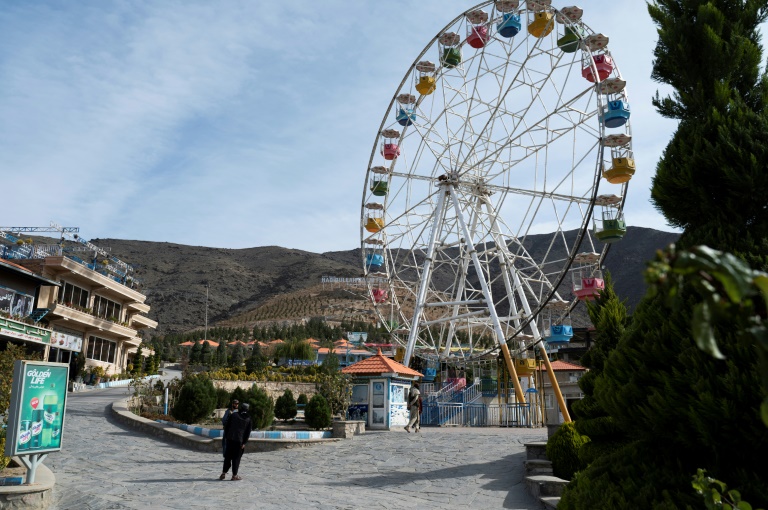
A few kilometers away, the Ferris wheel and most of the other rides in Zazai Park — which offers a spectacular view of the city — have ground to a sudden halt because of a lack of business.

Before this week’s ban, it could accommodate hundreds of visitors on days when women brought their children for family gatherings.

On Fridays and public holidays, even more would flock to the park — one of the few attractions in the city.  

On Wednesday, only a handful of men wandered nonchalantly through the complex.

Habib Jan Zazai, co-developer of the complex, fears he may have to close down a business that he has poured $11 million into, and which employs more than 250 people.

“Without women, the children will not come alone,” he told AFP.

He warned such edicts would discourage investment by foreigners or Afghans living abroad, as well as impact revenue collection.

“A government is run by taxes. If an investor is not paying tax, then how can they run?”

Mohammad Tamim, 20, sipping tea in the park during a visit from Kandahar, where he teaches at a madrassa, called the ban “bad news”.

“Every human psychologically needs to be entertained,” he said.

“Muslims need to be entertained — especially after 20 years of war.”

Defiant Xi re-emerges on global stage, prepares for US competition

Fresh from securing a historic third term as China’s top leader, President Xi Jinping is poised for a triumphant re-entry to the world stage at a pivotal G20 summit next week.

After almost three years of self-imposed pandemic isolation where international diplomacy was largely conducted via videolink, China now aims to shore up its global alliances — especially with developing countries — in the face of increased competition with the United States and a world environment destabilised by the Ukraine war.

A flurry of state visits to China in the past week have highlighted the importance of maintaining trade and other diplomatic ties — even as China acts more assertively to defend its interests.

German Chancellor Olaf Scholz defied fierce domestic criticism to visit Beijing on Friday with a business delegation in tow, vowing to deepen trade cooperation with China alongside raising contentious issues such as the Ukraine war.

His visit caps off a string of trips by the leaders of Pakistan, Tanzania and the Vietnamese Communist Party — the most numerous face-to-face meetings Xi has conducted since hosting more than a dozen world leaders at February’s Beijing Olympics. 

France’s foreign minister last week said President Macron is likely to visit China in the coming months. 

– ‘Exuding confidence’ –

At next week’s G20 summit in Bali, Xi will join world leaders including US President Joe Biden, top European Union official Ursula von der Leyen, and the prime ministers of Australia, India, Japan and Britain, among others.

Russian President Vladimir Putin will not be at the conference, where his country’s invasion of Ukraine in February will be one of the main talking points.

Xi’s attendance has not yet been confirmed by the Chinese foreign ministry, which normally announces his travel plans shortly before they happen, but he is widely expected to be present.

“I expect Xi Jinping to arrive at the G20 exuding confidence from the refreshed mandate he has just received from the Communist Party of China,” said Drew Thompson, visiting senior fellow at the National University of Singapore.

Biden on Wednesday appeared to confirm a meeting with Xi on the G20 sidelines, saying that he would gauge Xi’s “red lines” to reduce the potential for conflict after soaring tensions on Taiwan.

Experts are not expecting any breakthroughs on resolving long-term differences, however.

“The political differences between the US and China are deep-seated… A meeting on the margins of a multilateral meeting (is) not the venue to resolve such strategic differences,” said Thompson.

“There is certainly benefit to the engagement, such as better understanding what each side expects from the other, which can hopefully reduce misunderstanding and prevent miscalculation.”

Foreign Minister Wang Yi held his first in-person meeting with US ambassador to China Nicholas Burns last month, after having snubbed him since his arrival in March.

Since November, Wang has also held phone calls with his Australian, Singaporean and French counterparts, suggesting Xi could be holding more high-level bilateral meetings at the G20.

– Rising US tensions –

The US-China relationship further deteriorated this year over Taiwan, a UN human rights report on Xinjiang and US semiconductor export restrictions that aim to curb China’s fledgling chip industry.

At last month’s Communist Party congress, Xi warned of a challenging geopolitical climate without mentioning the US by name, as he wove a narrative of China’s “inevitable” triumph over adversity in a key speech.

“This vision calls for decoupling economic modernity from Western political and social norms and underlying cultural beliefs,” wrote former Australian prime minister Kevin Rudd in Foreign Affairs magazine. 

“It offers a new international order anchored in Chinese rather than US geopolitical power.” 

Beijing is also not losing sight of its regional backyard, having sent Premier Li Keqiang on a “swan song” visit to Cambodia this week for multiple ASEAN forums. 

Xi is also expected to attend the APEC summit in Bangkok shortly after the G20, the Thai foreign minister said last week. Japanese media have also reported a likely meeting between Xi and Japanese Prime Minister Fumio Kishida either at the G20 or APEC.

His packed itinerary will not stop there.

The Wall Street Journal reported that Xi is likely to make a state visit to Saudi Arabia to shore up oil-dependent economic ties, with energy security a pressing focus during the Ukraine war.

Paul Allen's art collection tops $1 bn at Christie's

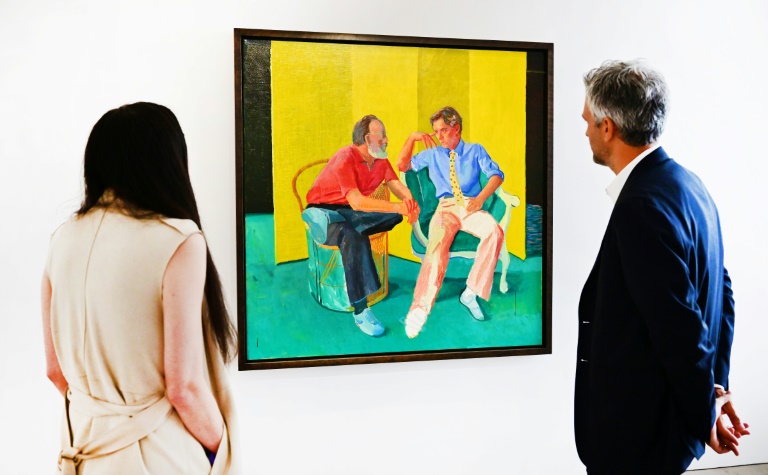
Paintings and sculptures from the collection of late Microsoft co-founder Paul Allen were auctioned off for a historic $1 billion Wednesday, Christie’s auction house said, with records set for works by Van Gogh, Cezanne, Gauguin, Seurat and Klimt.

Five paintings entered the exclusive club of works of art sold for more than $100 million at auction, the New York auction house said, in a sign that the art market continues to grow despite economic uncertainties related to the war in Ukraine and inflation.

The most expensive piece of the evening, Georges Seurat’s 1888 work “Les Poseuses, Ensemble (small version)”, a renowned work of pointillism, fetched $149.24 million, including fees, Christie’s said.

The auction house had announced that all the proceeds would be donated to charity.

Wednesday’s auction sold 60 of 150 lots, with the rest to be sold on Thursday.

The value of the collection has already surpassed the record for the Macklowe collection, named after a wealthy New York couple, which fetched $922 million at competitor Sotheby’s earlier this spring.

– Microsoft fortune –

Allen made his fortune with the establishment of the PC operating system with his better-known Microsoft co-founder Bill Gates in 1975.

He amassed a huge art collection that he loaned to museums before his death in 2018 at the age of 65.

He had a net worth of $20.3 billion at the time of his death, according to Forbes.

Allen left Microsoft in 1983, due to health problems and a deteriorating relationship with Gates, who remained in charge of the company until 2000.

He founded a pop culture museum in his hometown of Seattle and owned several sports franchises, including the Seattle Seahawks.

Despite their strained friendship, Allen signed Gates’s “Giving Pledge” campaign and all proceeds from the auction are to be donated to charitable causes.

– Diverse collection –

The sale on Wednesday totaled about $1.5 billion, according to an AFP calculation, and included French painter Paul Cezanne’s “La Montagne Sainte-Victoire” — which fetched $137.8 million, almost double the artist’s auction record.

A work by Vincent Van Gogh, “Orchard with Cypresses,” broke the Dutch artist’s previous record, bringing in $117.2 million.

A painting from Paul Gauguin’s Tahitian period, “Maternity II,” brought $105.7 million.

Austrian painter Gustav Klimt’s “Birch Forest” brought in $104.6 million.

The billion mark was surpassed on lot number 32, an Alberto Giacometti sculpture, “Woman of Venice III,” which sold for $25 million.

The auction was a testament to the quality of Allen’s collection, which included a diverse range of works from the German-American painter-sculptor Max Ernst, whose sculpture “The King Playing with the Queen” sold for $24.3 million, to the American Jasper Johns, one of the few living artists featured in the collection, whose lithograph “Small False Start” sold for $55.35 million.

Putin will not go to G20 summit in Bali

Russian President Vladimir Putin will not attend the G20 leaders’ summit in Indonesia next week, Moscow’s embassy in Jakarta told AFP on Thursday.

It was the first Russian confirmation that Putin will not travel to the resort island of Bali for the summit, which would have put him in the same room as US President Joe Biden for the first time since the invasion of Ukraine in February.

Biden has called Putin a “war criminal” and ruled out meeting him in Bali if he went unless the conversation involved the release of Americans held in Russia.

“I can confirm that (foreign minister) Sergei Lavrov will lead the Russian delegation to the G20. President Putin’s programme is still being worked out, he could participate virtually,” said Yulia Tomskaya, the embassy’s chief of protocol.

The decision follows months of speculation about Putin’s participation at the November 15-16 summit.

The Kremlin is expected to try and shield itself from Western condemnation over the war, in which its forces are suffering setbacks in the face of a Ukrainian counter-offensive.

Another source with knowledge of Russia’s G20 planning confirmed that Putin would be replaced by Lavrov.

The person said it was unclear if the Russian leader would attend virtually as “the issue has not been finalised”.

Lavrov walked out of a G20 foreign ministers’ meeting in Bali in July after officials roundly condemned Russia over Ukraine.

Host Indonesia pursues a neutral foreign policy and has rebuffed Western calls to disinvite Russia from the summit.

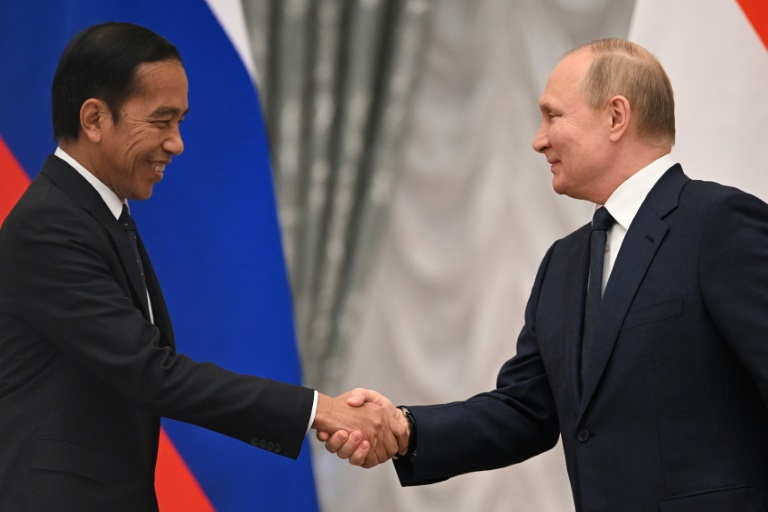
Indonesian President Joko Widodo had invited Putin despite the invasion, prompting a flurry of Western criticism. In August, he said Putin had accepted that invitation.

Ukrainian President Volodymyr Zelensky is expected to attend virtually. He had threatened to boycott the summit if Putin attended.

Ukraine is not a G20 member.

– Increasing isolation –

Experts said Putin’s absence would hurt the summit, with no progress likely to be made on the Ukraine war and its global economic fallout.

“The G20 cannot do much, so it will only be a symbolic forum. Their discussion is always stuck on the issue of war,” said Radityo Dharmaputra, a Russia and eastern Europe expert at Indonesia’s Airlangga University.

“The main issue itself — the war — cannot be discussed and resolved. Fruitful results might come up in bilateral meetings but the rest of it is just the leaders trying to attend in respect for Indonesia as the host.”

While Biden has shunned contact with his Russian counterpart, France has warned against worsening Putin’s isolation on the world stage.

Russia refers to its invasion as a special military operation to “de-Nazify” Ukraine and blames subsequent Western sanctions for the global food and energy crises that followed.

While those sanctions have gnawed at Russia’s war effort, other countries have maintained economic ties with Moscow. India and China stepped up their purchases of Russian oil.

– Global crises –

The G20 summit will be the biggest meeting of the bloc since the onset of the Covid-19 pandemic.

Fresh from securing a historic third term, Chinese President Xi Jinping is also expected to attend.

The Chinese leader will be looking to shore up Beijing’s global alliances in the face of US competition without close ally Putin in toe.

The talks will be held under the shadow of divisions over the food and energy crises worsened by the Ukraine war, on top of soaring inflation and climate change.

The G20 meetings held in the build-up to the leaders’ meeting all ended without a joint communique.

The summit in Bali next week is also not expected to close with a joint declaration because of disagreements over who is to blame for the global crises.

The Indonesian foreign ministry said “the negotiation for the final document is still ongoing”.

Over 100,000 Russian troops killed, wounded in Ukraine: top US general

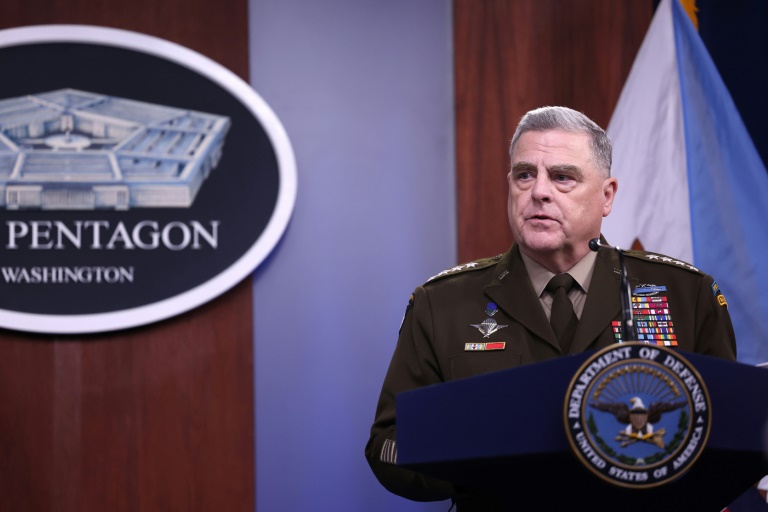
More than 100,000 Russian military personnel have been killed or wounded in Ukraine, with Kyiv’s forces likely suffering similar casualties, top US General Mark Milley said Wednesday.

“You’re looking at well over 100,000 Russian soldiers killed and wounded,” Milley said in remarks at the Economic Club of New York. “Same thing probably on the Ukrainian side.”

The figures provided by Milley — which could not be independently confirmed — are the most precise to date from the United States government more than eight months into the war.

Milley also said there is a chance for talks on ending the war, and that military victory may not be possible for either Russia or Ukraine.

“There has to be a mutual recognition that military victory is probably in the true sense of the word maybe not achievable through military means, and therefore you need to turn to other means,” Milley said.

“There’s… an opportunity here, a window of opportunity for negotiation.”

Milley’s comments came after Russia ordered its troops to withdraw from the city of Kherson in southern Ukraine — a major blow to Moscow’s military campaign.

But officials in Kyiv reacted with caution, saying the Russian army was unlikely to leave the strategic city without a fight, while US President Joe Biden suggested the retreat was evidence Moscow has “real problems” on the battlefield.

'Death every day': Fear and fortitude in Uganda's Ebola epicentre

As Ugandan farmer Bonaventura Senyonga prepares to bury his grandson, age-old traditions are forgotten and fear hangs in the air while a government medical team prepares the body for the funeral — the latest victim of Ebola in the East African nation.

Bidding the dead goodbye is rarely a quiet affair in Uganda, where the bereaved seek solace in the embrace of community members who converge on their homes to mourn the loss together.

Not this time.

Instead, 80-year-old Senyonga is accompanied by just a handful of relatives as he digs a grave on the family’s ancestral land, surrounded by banana trees.

“At first we thought it was a joke or witchcraft but when we started seeing bodies, we realised this is real and that Ebola can kill,” Senyonga told AFP.

His 30-year-old grandson Ibrahim Kyeyune was a father of two girls and worked as a motorcycle mechanic in central Kassanda district, which together with neighbouring Mubende is at the epicentre of Uganda’s Ebola crisis.

Both districts have been under a lockdown since mid-October, with a dawn to dusk curfew, a ban on personal travel and public places shuttered.

The reappearance of the virus after three years has sparked fear in Uganda, with cases now reported in the capital Kampala as the highly contagious disease makes its way through the country of 47 million people.

In all, 53 people have died, including children, out of more than 135 cases, according to latest Ugandan health ministry figures.

In Kassanda’s impoverished Kasazi B village, everyone is afraid, says Yoronemu Nakumanyanga, Kyeyune’s uncle.

“Ebola has shocked us beyond what we imagined. We see and feel death every day,” he told AFP at his nephew’s gravesite.

“I know when the body finally arrives, people in the neighbourhood will start running away, thinking Ebola virus spreads through the air,” he said.

Ebola is not airborne — it spreads through bodily fluids, with common symptoms being fever, vomiting, bleeding and diarrhoea.

But misinformation remains rife and poses a major challenge.

In some cases, victims’ relatives have exhumed their bodies after medically supervised burials to perform traditional rituals, triggering a spike in infections.

In other instances, patients have sought out witchdoctors for help instead of going to a health facility — a worrying trend that prompted President Yoweri Museveni last month to order traditional healers to stop treating sick people.

“We have embraced the fight against Ebola and complied with President Museveni’s directive to close our shrines for the time being,” said Wilson Akulirewo Kyeya, a leader of the traditional herbalists in Kassanda.

– ‘I saw them die’ –

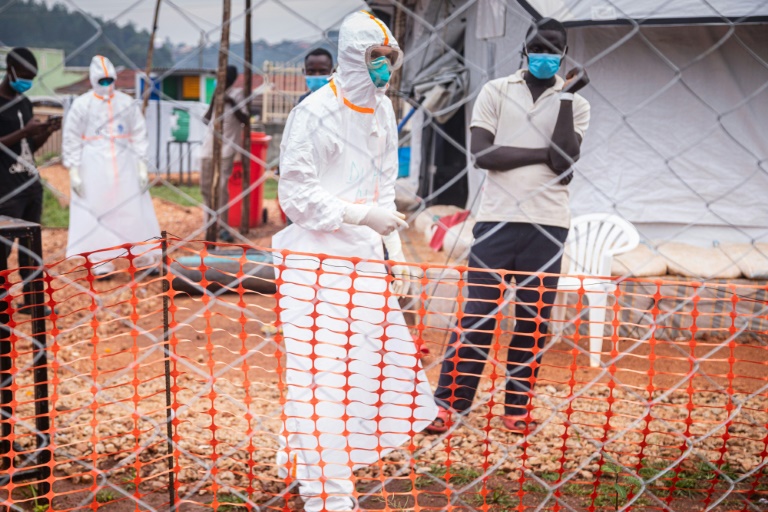
The authorities are trying to expand rural health facilities, installing isolation and treatment tents inside villages so communities can access medical attention quickly.

But fear of Ebola runs deep.

Brian Bright Ndawula, a 42-year-old trader from Mubende, was the sole survivor among four family members who were diagnosed with the disease, losing his wife, his aunt and his four-year-old son.

“When we were advised to go to hospital to have an Ebola test we feared going into isolation… and being detained,” he told AFP.

But when their condition worsened and the doctor treating them at the private clinic also began showing symptoms, he realised they had contracted the dreaded virus.

“I saw them die and knew I was next but God intervened and saved my life,” he said, consumed by regret over his decision to delay getting tested.

“My wife, child and aunt would be alive, had we approached the Ebola team early enough.”

– ‘Greatest hour of need’ –

Today, survivors like Ndawula have emerged as a powerful weapon in Uganda’s fight against Ebola, sharing their experiences as a cautionary tale but also as a reminder that patients can survive if they receive early treatment.

Health Minister Jane Ruth Aceng urged recovered patients in Mubende to spread the message that “whoever shows signs of Ebola should not run away from medical workers but instead run towards them, because if you run away with Ebola, it will kill you.”

It is an undertaking many in this community have taken to heart.

Doctor Hadson Kunsa, who contracted the disease while treating Ebola patients, told AFP he was terrified when he received his diagnosis.

“I pleaded to God to give me a second chance and told God I will leave Mubende after recovery,” he said.

But he explained he could not bring himself to do it.

“I will not leave Mubende and betray these people at the greatest hour of need.”

Hackers demand $10 mn for stolen Australian health records

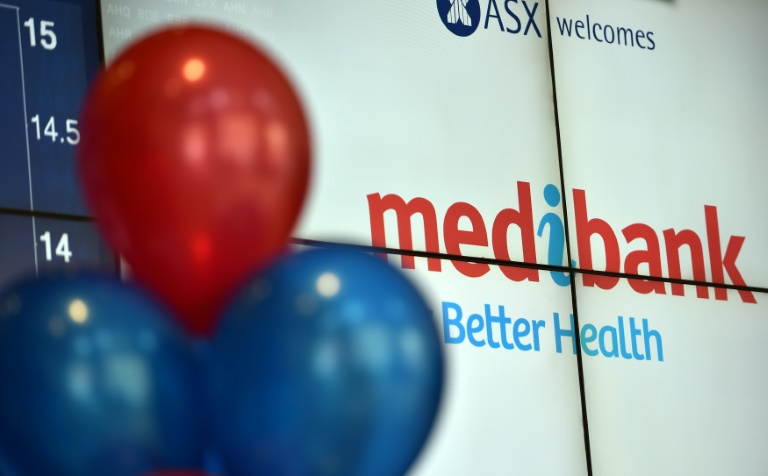
Hackers on Thursday demanded US$10 million to stop leaking highly sensitive records stolen from a major Australian healthcare company, as they uploaded yet more intimate details about customers.

Medibank, Australia’s largest private health insurer, confirmed this week that hackers had accessed the information of 9.7 million current and former clients, including Prime Minister Anthony Albanese.

The hackers on Thursday uploaded a second batch of files to a dark web forum, with more sensitive details about hundreds of Medibank customers.

The first leaks appear to have been selected to cause maximum harm: targeting those who received treatment related to drug abuse, sexually transmitted infections or pregnancy terminations.

“Added one more file abortions.csv,” the anonymous hackers wrote on the forum, before detailing their ransom threat.

“Society ask us about ransom, it’s 10 million USD. We can make discount… $1 = 1 customer.”

Medibank has repeatedly refused to pay the ransom.

– ‘Profit and greed’ –

The Medibank hack — and an earlier data breach impacting nine million customers at telecom company Optus — has raised questions about Australia’s ability to repel cyber criminals.

Dennis Desmond, a former FBI agent and US Defense Intelligence Agency officer, said Australia was no worse “than any other high-value target or Western country”. 

“It’s very unfortunate, but I don’t think Australia is any more vulnerable than any other Western developed nation,” he told AFP. 

Desmond said profit-driven hackers were unlikely to single out a specific country — and were typically more interested in targeting companies holding valuable data. 

“It’s the data types that are of the most interest to these hackers,” he said. 

“The healthcare data is a huge target and personally identifiable data is high-value. 

“Generally, profit and greed are the number one drivers.”

– ‘Scummy criminals’ –

The Medibank hack is likely to include data on some of the country’s most influential and wealthy individuals. 

Medibank chief executive David Koczkar condemned the “disgraceful” extortion tactics. 

“The weaponisation of people’s private information in an effort to extort payment is malicious and it is an attack on the most vulnerable members of our community.”

The group behind the attack appears to be pressuring Medibank by hunting for the most potentially damaging personal information within the records.

The first records posted to the dark web forum were separated into “naughty” and “nice” lists.

Some on the “naughty” list had numeric codes that appeared to link them to drug addiction, alcohol abuse and HIV infection. 

For example, one record carried an entry that read: “p_diag: F122”. 

F122 corresponds with “cannabis dependence” under the International Classification of Diseases, published by the World Health Organization.

Names, addresses, passport numbers and birth dates were also included in the data. 

Home Affairs Minister Clare O’Neil has described the hackers as “scummy criminals”. 

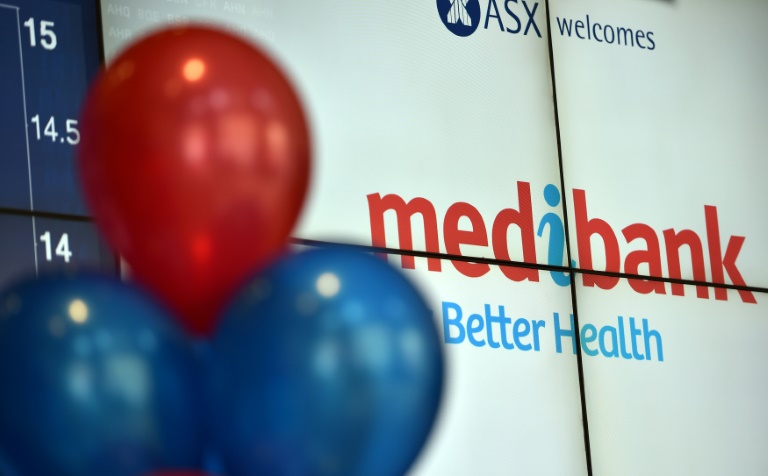
Hackers demand $10 mn for stolen Australian health records

Hackers on Thursday demanded US$10 million to stop leaking highly sensitive records stolen from a major Australian healthcare company, as they uploaded yet more intimate details about customers.

Medibank, Australia’s largest private health insurer, confirmed this week that hackers had accessed the information of 9.7 million current and former clients, including Prime Minister Anthony Albanese.

The hackers on Thursday uploaded a second batch of files to a dark web forum, with more sensitive details about hundreds of Medibank customers.

The first leaks appear to have been selected to cause maximum harm: targeting those who received treatment related to drug abuse, sexually transmitted infections or pregnancy terminations.

“Added one more file abortions.csv,” the anonymous hackers wrote on the forum, before detailing their ransom threat.

“Society ask us about ransom, it’s 10 million USD. We can make discount… $1 = 1 customer.”

Medibank has repeatedly refused to pay the ransom.

– ‘Profit and greed’ –

The Medibank hack — and an earlier data breach impacting nine million customers at telecom company Optus — has raised questions about Australia’s ability to repel cyber criminals.

Dennis Desmond, a former FBI agent and US Defense Intelligence Agency officer, said Australia was no worse “than any other high-value target or Western country”. 

“It’s very unfortunate, but I don’t think Australia is any more vulnerable than any other Western developed nation,” he told AFP. 

Desmond said profit-driven hackers were unlikely to single out a specific country — and were typically more interested in targeting companies holding valuable data. 

“It’s the data types that are of the most interest to these hackers,” he said. 

“The healthcare data is a huge target and personally identifiable data is high-value. 

“Generally, profit and greed are the number one drivers.”

– ‘Scummy criminals’ –

The Medibank hack is likely to include data on some of the country’s most influential and wealthy individuals. 

Medibank chief executive David Koczkar condemned the “disgraceful” extortion tactics. 

“The weaponisation of people’s private information in an effort to extort payment is malicious and it is an attack on the most vulnerable members of our community.”

The group behind the attack appears to be pressuring Medibank by hunting for the most potentially damaging personal information within the records.

The first records posted to the dark web forum were separated into “naughty” and “nice” lists.

Some on the “naughty” list had numeric codes that appeared to link them to drug addiction, alcohol abuse and HIV infection. 

For example, one record carried an entry that read: “p_diag: F122”. 

F122 corresponds with “cannabis dependence” under the International Classification of Diseases, published by the World Health Organization.

Names, addresses, passport numbers and birth dates were also included in the data. 

Home Affairs Minister Clare O’Neil has described the hackers as “scummy criminals”. 

Saudi light festival tries to sell public on arts push

Dazzling installations have been lighting up the Saudi capital, bringing a taste of the kingdom’s push to become a global arts destination to ordinary Saudis — not just habitual museum-goers.

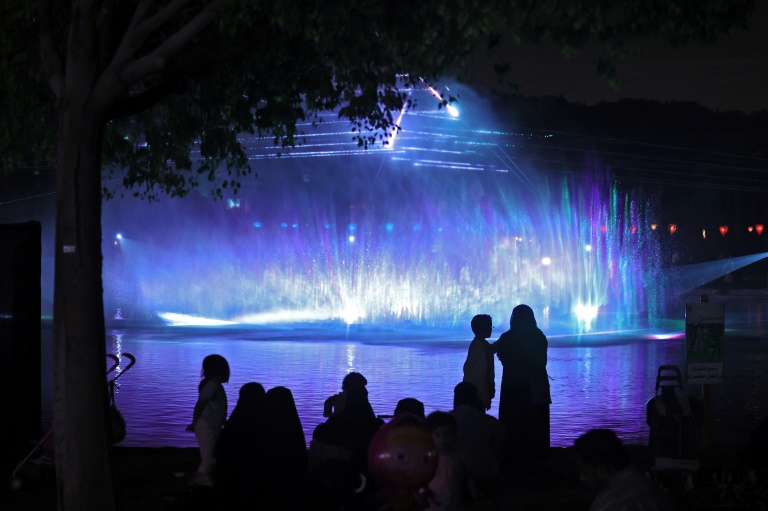
A massive red orb glowing outside the national library, illuminated rods dotting the riverside at a popular picnic spot, and Arabesque designs projected onto the mud-brick walls of a 130-year-old fort — these are all part of Noor Riyadh, a city-wide festival.

Saudi curator Jumana Ghouth said she found it “amazing” to see Saudis from different socio-economic backgrounds “interact with the work”, given that “we’re not really a nation that grew up with art”.

Saudi Arabia has generated buzz, and some controversy, in recent years for luring major names in the contemporary art world to shows like Desert X, situated amid the dramatic sandstone mountains of Al-Ula in the thinly populated north.

Noor Riyadh, by contrast, brings light installations to more than 40 locations in a fast-growing city of more than seven million people, many of whom may never consider dropping in on a gallery.

“Specifically those that cannot even afford to travel -– we’re bringing art to them,” Ghouth said.

The focus on well-trafficked public spaces means “these art pieces just popped up in their comfort zone”, said Gaida Almogren, another Saudi curator involved in the festival which opened last week. 

“I think that’s the role of art: to come and poke, and see how you’re reacting.”

Launch events for Noor Riyadh included a light show in a park involving 2,000 drones and a rave in the desert outside the city, with the DJ set up underneath a large, glowing inverted pyramid.

Most encounters with the light installations, however, are much more subdued. 

One recent night, Adel Shuker wandered with his wife and sister-in-law through a Noor Riyadh installation by Puerto Rican artist Gisela Colon, marvelling at how the light glimmered off a manmade lake nearby.

“The light, how they put it there, how they distribute the light — it’s just like art, really,” Shuker said.

It was a novel experience for the 52-year-old retired navy analyst, who described himself as unfamiliar with Riyadh’s art museums and galleries.

“I want to be honest with you: I don’t go there,” he said. 

“We don’t have time — Riyadh now, it’s very crowded, you cannot move easily. It’s rush hour anywhere, at any time. So we have to find time for ourselves.”

– Avoiding politics –

More than 130 artists from 40 countries participated in Noor Riyadh, which runs until November 19.

As with other exhibitions in the kingdom, the festival raises questions about “artwashing”, or using the arts to launder the image of a country notorious for silencing dissidents, most notably slain journalist Jamal Khashoggi.

In recent months, Saudi Arabia has come under fire for decades-long prison terms handed down to two women who tweeted and retweeted posts critical of the government.

The negative headlines resulting from such cases undermine a central goal of Crown Prince Mohammed bin Salman’s Vision 2030 reform agenda: to soften the kingdom’s harsh image.

The Noor Riyadh installations generally steer clear of political messaging, though several highlight the ravages of climate change.

The festival’s co-curator Herve Mikaeloff, who worked with international artists, allowed that some of them may have been apprehensive about coming to Saudi Arabia but said none received pressure from local authorities about content.

“For sure, if you accept work here, you have to accept the rules and you have to accept the juridical and political situation of it,” Mikaeloff told AFP.

“I think most of the artists that I was talking with wanted to underline that a festival like this (is) also a political gesture, to open the country to the world.”

Close Bitnami banner
Bitnami