World

Asian markets mostly up after solid US jobs data

Most Asian markets rose on Monday following strong US jobs data, with fresh rallies seen in Hong Kong even after China said it would stick to its strict zero-Covid policy.

Global stock markets and oil prices were buoyant last week on hopes that Beijing would roll back some of its economically painful policies aimed at stamping out the disease within its borders.

But on Saturday, the Chinese government said it would “unswervingly” stick to its current plan, which involves harsh lockdowns and strict quarantine and testing regimens for even the smallest clusters of cases.

Wall Street equities had enjoyed a boost on Friday from the latest US jobs data, which showed that hiring remained resilient and wages continued to rise, though at a slower pace.

The data, which comes days ahead of critical US midterm elections, raised hopes of a soft landing for the world’s biggest economy despite aggressive Fed rate hikes aimed at taming inflation.

All three main US indexes ended around 1.3 percent higher on Friday, and Tokyo shares extended those gains, trading up 1.3 percent in the early afternoon.

Hong Kong shares dipped slightly at the open, then rocketed 3.4 percent by the break — adding to a jump of more than five percent in the previous session.

Bourses in Shanghai and Shenzhen also edged up 0.5 percent and 0.6 percent respectively, having started the day flat.

“Last week, the financial market was stirring on rumours of China reopening,” Raymond Yeung and Zhaopeng Xing of ANZ Research said in a note on Monday.

But as the rumours about a reopening were unsubstantiated, “it is more likely the market is over-interpreting new information and downplaying old developments”, they wrote.

“Obviously, China feels the urgency to normalise the economy… But the political leadership will not adopt ‘living with Covid’,” the pair added.

“In our view, the availability of locally developed new vaccines will be a game changer”.

China is the last major economy wedded to a strategy of extinguishing Covid-19 outbreaks as they emerge, despite the widespread disruption to businesses and international supply chains.

In morning trade on Monday, Seoul rose 0.9 percent, Taipei was up 1.5 percent and Sydney was up 0.5 percent. Singapore added 0.3 percent, and Jakarta was flat.

Dashed hopes of a Chinese reopening also drove down oil prices, which had rallied on Friday on the optimism that Beijing could soon change course, pushing up demand for crude.

– Key figures around 0400 GMT –

Tokyo – Nikkei 225: UP 1.3 percent at 27,543.52

Hong Kong – Hang Seng Index: UP 3.4 percent at 16,714.57 (break)

Shanghai – Composite: UP 0.5 percent at 3,084.87 

London – FTSE 100: UP 2.0 percent at 7,334.84 (close)

Pound/dollar: DOWN at $1.1309 from $1.1376 Friday

Euro/dollar: DOWN at $0.9937 from $0.9964

Dollar/yen: UP at 147.21 yen from 146.62 yen

Euro/pound: UP at 87.71 pence from 87.56 pence

West Texas Intermediate: DOWN 1.3 percent at $91.41 per barrel

Brent North Sea crude: DOWN 1.0 percent at $97.55 per barrel

New York – Dow: UP 1.3 percent at 32,403.22 (close)
N. Korea vows 'overwhelming' response to US-South Korea war games

The North Korean military said its response to US-South Korean war drills would be “resolute and overwhelming”, state media reported Monday.

The warning came after a spate of North Korean weapons tests last week — including an intercontinental ballistic missile — as the United States and South Korea conducted their biggest-ever air force exercise.

The United States and South Korea have warned that such missile launches could culminate in a nuclear test by North Korea.

The North Korean military, formally known as the Korean People’s Army (KPA), said it was responding to Vigilant Storm — the US-South Korean exercise — describing it as “an open provocation”, according to the official Korean Central News Agency (KCNA).

Vigilant Storm was “aimed at intentionally escalating the tension in the region and a dangerous war drill of very high aggressive nature directly targeting” North Korea, the KPA said.

North Korea will respond to all “anti-DPRK war drills” with “sustained, resolute and overwhelming” measures, it said.

The United States has dismissed criticism of the exercise as North Korean propaganda, saying it posed no threat to other nations.

The KPA said it conducted operations, including the launch of tactical ballistic missiles that simulated attacks on air force bases, and practised shooting down enemy aircraft.

One ballistic missile was launched to test “a special functional warhead paralyzing the operation command system of the enemy”, the KPA said, without providing any further details about that weapon.

The North Korean air force also conducted a “large-scale all-out combat sortie operation”, involving 500 planes, according to KCNA.

That mobilisation prompted South Korea to scramble fighter jets on Friday.

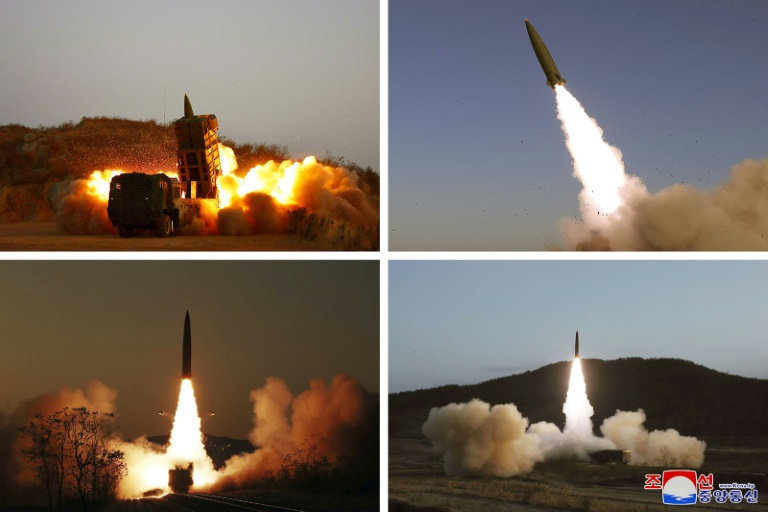
Images of North Korean military operations released on Monday by KCNA showed missiles being fired from various undisclosed locations, including some from mobile launchers.

– Weak air force –

Experts say Pyongyang is particularly sensitive about drills such as Vigilant Storm because its air force is one of the weakest links in its military, lacking high-tech jets and properly trained pilots.

The details of North Korea’s operations last week indicate the importance it places on destroying air bases in the South, said Cheong Seong-chang, a researcher at the Sejong Institute in Seoul.

“North Korea considers it important to strike and neutralise air bases first because their air power is weak,” Cheong told AFP.

Compared with North Korea’s ageing fleet, Vigilant Storm saw some of the most advanced US and South Korean warplanes in action, including F-35 stealth fighters.

The exercise was meant to run from Monday to Friday last week, but Washington and Seoul extended it by a day in response to the flurry of North Korean missile launches.

Two US Air Force B-1Bs — long-range heavy bombers — joined the drills in a show of force.

US-South Korea joint drills have long sparked strong reactions from North Korea, which sees them as rehearsals for an invasion.

Pyongyang has especially condemned past deployments of US strategic weapons such as long-range bombers and aircraft carrier strike groups.

Parts of the KPA statement, including the claim that it could counter the “theory of superiority” of US and South Korean air forces, were domestic propaganda, said Park Won-gon, a professor at the Ewha University in Seoul.

“It is saying that North Korea responded sufficiently against the largest joint drills between Seoul and Washington and that they prevailed.”

South Korea began its annual Taegeuk computer-simulated military exercise on Monday, which aims to improve its ability to respond to various North Korean threats.

Asian markets mostly up after solid US jobs data

Most Asian markets started the week with gains Monday following strong US jobs data, although stocks in Shanghai were flat after China said it would stick to its strict zero-Covid policy.

Global stock markets and oil prices rallied last week on hopes that Beijing would roll back some of its economically painful policies aimed at stamping out the disease within its borders.

But on Saturday, the Chinese government said it would “unswervingly” stick to its current plan, which involves harsh lockdowns and strict quarantine and testing regimens for even the smallest clusters of cases.

Wall Street equities had enjoyed a boost on Friday from the latest US jobs data, which showed that hiring remained resilient and wages continued to rise, though at a slower pace.

The data, which comes days ahead of critical US midterm elections, raised hopes of a soft landing for the world’s biggest economy despite aggressive Fed rate hikes aimed at taming inflation.

All three main US indexes ended around 1.3 percent higher on Friday, and Tokyo shares extended those gains on Monday to end the morning session 1.2 percent up.

Hong Kong shares dipped slightly at the open but quickly recovered to add 1.4 percent — adding to a jump of more than five percent in the previous session.

Bourses in Shanghai and Shenzhen were barely changed in morning trade, however.

“Last week, the financial market was stirring on rumours of China reopening,” Raymond Yeung and Zhaopeng Xing of ANZ Research said in a note on Monday.

But as the rumours about a reopening were unsubstantiated, “it is more likely the market is over-interpreting new information and downplaying old developments”, they wrote.

“Obviously, China feels the urgency to normalise the economy… But the political leadership will not adopt ‘living with Covid’,” the pair added.

“In our view, the availability of locally developed new vaccines will be a game changer”.

China is the last major economy wedded to a strategy of extinguishing Covid-19 outbreaks as they emerge.

It is still imposing snap lockdowns, mass testing and lengthy quarantines — despite the widespread disruption to businesses and international supply chains.

Seoul rose 0.8 percent, Taipei was up 1.1 percent and Sydney was up 0.5 percent in early trade on Monday. Singapore was flat and Jakarta dipped 0.3 percent.

Dashed hopes of a Chinese reopening also drove down oil prices, which had rallied on Friday on the optimism that Beijing could soon change course, pushing up demand for crude.

– Key figures around 0230 GMT –

Tokyo – Nikkei 225: UP 1.2 percent at 27,528.66 (break)

Hong Kong – Hang Seng Index: UP 1.4 percent at 16,393.36

Shanghai – Composite: DOWN 0.1 percent at 3,068.62

London – FTSE 100: UP 2.0 percent at 7,334.84 (close)

Pound/dollar: DOWN at $1.1325 from $1.1376 Friday

Euro/dollar: DOWN at $0.9933 from $0.9964

Dollar/yen: UP at 147.21 yen from 146.62 yen

Euro/pound: UP at 87.80 pence from 87.56 pence

West Texas Intermediate: DOWN 1.4 percent at $91.28 per barrel

Brent North Sea crude: DOWN 1.2 percent at $97.43 per barrel

New York – Dow: UP 1.3 percent at 32,403.22 (close)
Asian markets mostly up after solid US jobs data

Most Asian markets started the week with gains Monday following strong US jobs data, although stocks in Shanghai were flat after China said it would stick to its strict zero-Covid policy.

Global stock markets and oil prices rallied last week on hopes that Beijing would roll back some of its economically painful policies aimed at stamping out the disease within its borders.

But on Saturday, the Chinese government said it would “unswervingly” stick to its current plan, which involves harsh lockdowns and strict quarantine and testing regimens for even the smallest clusters of cases.

Wall Street equities had enjoyed a boost on Friday from the latest US jobs data, which showed that hiring remained resilient and wages continued to rise, though at a slower pace.

The data, which comes days ahead of critical US midterm elections, raised hopes of a soft landing for the world’s biggest economy despite aggressive Fed rate hikes aimed at taming inflation.

All three main US indexes ended around 1.3 percent higher on Friday, and Tokyo shares extended those gains on Monday to end the morning session 1.2 percent up.

Hong Kong shares dipped slightly at the open but quickly recovered to add 1.4 percent — adding to a jump of more than five percent in the previous session.

Bourses in Shanghai and Shenzhen were barely changed in morning trade, however.

“Last week, the financial market was stirring on rumours of China reopening,” Raymond Yeung and Zhaopeng Xing of ANZ Research said in a note on Monday.

But as the rumours about a reopening were unsubstantiated, “it is more likely the market is over-interpreting new information and downplaying old developments”, they wrote.

“Obviously, China feels the urgency to normalise the economy… But the political leadership will not adopt ‘living with Covid’,” the pair added.

“In our view, the availability of locally developed new vaccines will be a game changer”.

China is the last major economy wedded to a strategy of extinguishing Covid-19 outbreaks as they emerge.

It is still imposing snap lockdowns, mass testing and lengthy quarantines — despite the widespread disruption to businesses and international supply chains.

Seoul rose 0.8 percent, Taipei was up 1.1 percent and Sydney was up 0.5 percent in early trade on Monday. Singapore was flat and Jakarta dipped 0.3 percent.

Dashed hopes of a Chinese reopening also drove down oil prices, which had rallied on Friday on the optimism that Beijing could soon change course, pushing up demand for crude.

– Key figures around 0230 GMT –

Tokyo – Nikkei 225: UP 1.2 percent at 27,528.66 (break)

Hong Kong – Hang Seng Index: UP 1.4 percent at 16,393.36

Shanghai – Composite: DOWN 0.1 percent at 3,068.62

London – FTSE 100: UP 2.0 percent at 7,334.84 (close)

Pound/dollar: DOWN at $1.1325 from $1.1376 Friday

Euro/dollar: DOWN at $0.9933 from $0.9964

Dollar/yen: UP at 147.21 yen from 146.62 yen

Euro/pound: UP at 87.80 pence from 87.56 pence

West Texas Intermediate: DOWN 1.4 percent at $91.28 per barrel

Brent North Sea crude: DOWN 1.2 percent at $97.43 per barrel

New York – Dow: UP 1.3 percent at 32,403.22 (close)

Apple says iPhone production hit by China Covid lockdown

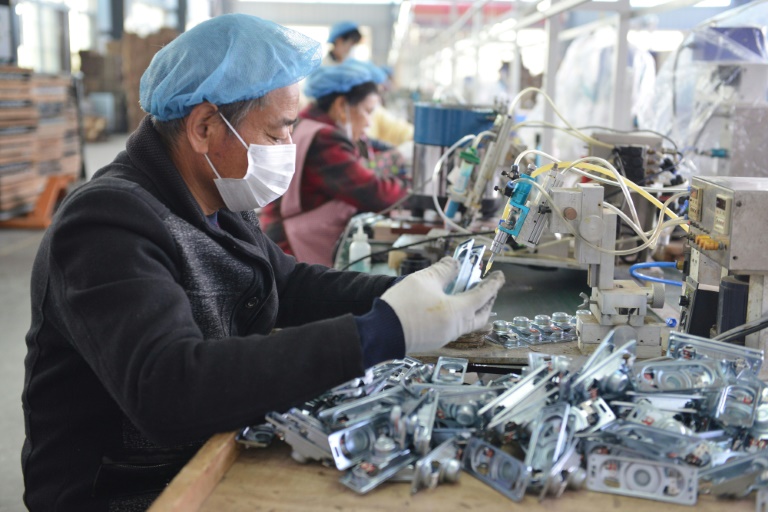
Apple said Covid restrictions have “temporarily impacted” production at the world’s largest iPhone factory in central China, warning that customers will now face longer wait times ahead of the holiday season.

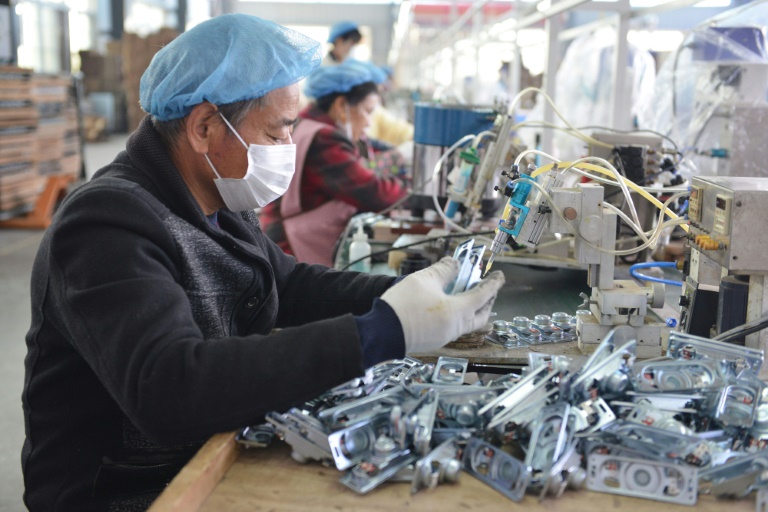
Foxconn, Apple’s principal subcontractor, locked down its massive factory in Zhengzhou last month after a spike in infections — in line with China’s zero-Covid policy. 

In a separate statement Monday, the Taiwanese firm said its fourth quarter earnings this year would take a hit from the coronavirus lockdowns.

Panicking workers last week had fled the site on foot in the wake of allegations of poor conditions at the facility, which employs hundreds of thousands of workers.

“Covid-19 restrictions have temporarily impacted the primary iPhone 14 Pro and iPhone 14 Pro Max assembly facility located in Zhengzhou, China,” California-based Apple said in a statement late Sunday.

“The facility is currently operating at significantly reduced capacity.”

Despite strong demand for Apple’s products ahead of the holiday season, “we now expect lower iPhone 14 Pro and iPhone 14 Pro Max shipments than we previously anticipated”, it said. 

“Customers will experience longer wait times to receive their new products.” 

Foxconn is China’s biggest private sector employer, with over a million people working across the country in about 30 factories and research institutes.

But Zhengzhou is the Taiwanese company’s crown jewel, churning out iPhones in quantities not seen anywhere else.

“In a normal situation, almost all the iPhone production is happening in Zhengzhou,” Ivan Lam, an analyst with specialist firm Counterpoint, told AFP.

The company was initially “cautiously optimistic” about its fourth quarter earnings, it said. 

“But due to the pandemic affecting some of our operations in Zhengzhou, the company will ‘revise down’ the outlook for the fourth quarter,” Foxconn said in a statement. 

“Foxconn is now working with the government in (a) concerted effort to stamp out the pandemic and resume production to its full capacity as quickly as possible,” the company said. 

It did not give any statistical projection for how badly they expected earnings to be hit. 

– ‘We are drowning’ –

Local authorities locked down the area surrounding the factory on Wednesday, but not before reports emerged of a lack of adequate medical care at the plant.

Multiple workers have recounted scenes of chaos and increasing disorganisation at Foxconn’s complex of workshops and dormitories, which form a city-within-a-city near Zhengzhou’s airport.

“People with fevers are not guaranteed to receive medicine,” another Foxconn worker, a 30-year-old man who also asked to remain anonymous, told AFP.

“We are drowning,” he said.

China is the last major economy wedded to a strategy of extinguishing Covid outbreaks as they emerge, imposing snap lockdowns, mass testing and lengthy quarantines despite the widespread disruption to businesses and international supply chains.

And authorities poured cold water on speculation that the policy could be relaxed Saturday, with National Health Commission (NHC) spokesperson Mi Feng saying that Beijing would “stick unswervingly to… the overall policy of dynamic zero-Covid”.

“At present, China is still facing the dual threat of imported infections and the spread of domestic outbreaks,” Mi said at a press briefing.

“The disease control situation is as grim and complex as ever,” he said. “We must continue to put people and lives first.”

Apple says iPhone production hit by China Covid lockdown

Apple said Covid restrictions have “temporarily impacted” production at the world’s largest iPhone factory in central China, warning that customers will now face longer wait times ahead of the holiday season.

Foxconn, Apple’s principal subcontractor, locked down its massive factory in Zhengzhou last month after a spike in infections — in line with China’s zero-Covid policy. 

In a separate statement Monday, the Taiwanese firm said its fourth quarter earnings this year would take a hit from the coronavirus lockdowns.

Panicking workers last week had fled the site on foot in the wake of allegations of poor conditions at the facility, which employs hundreds of thousands of workers.

“Covid-19 restrictions have temporarily impacted the primary iPhone 14 Pro and iPhone 14 Pro Max assembly facility located in Zhengzhou, China,” California-based Apple said in a statement late Sunday.

“The facility is currently operating at significantly reduced capacity.”

Despite strong demand for Apple’s products ahead of the holiday season, “we now expect lower iPhone 14 Pro and iPhone 14 Pro Max shipments than we previously anticipated”, it said. 

“Customers will experience longer wait times to receive their new products.” 

Foxconn is China’s biggest private sector employer, with over a million people working across the country in about 30 factories and research institutes.

But Zhengzhou is the Taiwanese company’s crown jewel, churning out iPhones in quantities not seen anywhere else.

“In a normal situation, almost all the iPhone production is happening in Zhengzhou,” Ivan Lam, an analyst with specialist firm Counterpoint, told AFP.

The company was initially “cautiously optimistic” about its fourth quarter earnings, it said. 

“But due to the pandemic affecting some of our operations in Zhengzhou, the company will ‘revise down’ the outlook for the fourth quarter,” Foxconn said in a statement. 

“Foxconn is now working with the government in (a) concerted effort to stamp out the pandemic and resume production to its full capacity as quickly as possible,” the company said. 

It did not give any statistical projection for how badly they expected earnings to be hit. 

– ‘We are drowning’ –

Local authorities locked down the area surrounding the factory on Wednesday, but not before reports emerged of a lack of adequate medical care at the plant.

Multiple workers have recounted scenes of chaos and increasing disorganisation at Foxconn’s complex of workshops and dormitories, which form a city-within-a-city near Zhengzhou’s airport.

“People with fevers are not guaranteed to receive medicine,” another Foxconn worker, a 30-year-old man who also asked to remain anonymous, told AFP.

“We are drowning,” he said.

China is the last major economy wedded to a strategy of extinguishing Covid outbreaks as they emerge, imposing snap lockdowns, mass testing and lengthy quarantines despite the widespread disruption to businesses and international supply chains.

And authorities poured cold water on speculation that the policy could be relaxed Saturday, with National Health Commission (NHC) spokesperson Mi Feng saying that Beijing would “stick unswervingly to… the overall policy of dynamic zero-Covid”.

“At present, China is still facing the dual threat of imported infections and the spread of domestic outbreaks,” Mi said at a press briefing.

“The disease control situation is as grim and complex as ever,” he said. “We must continue to put people and lives first.”

India at 75: upending narratives and rewriting history

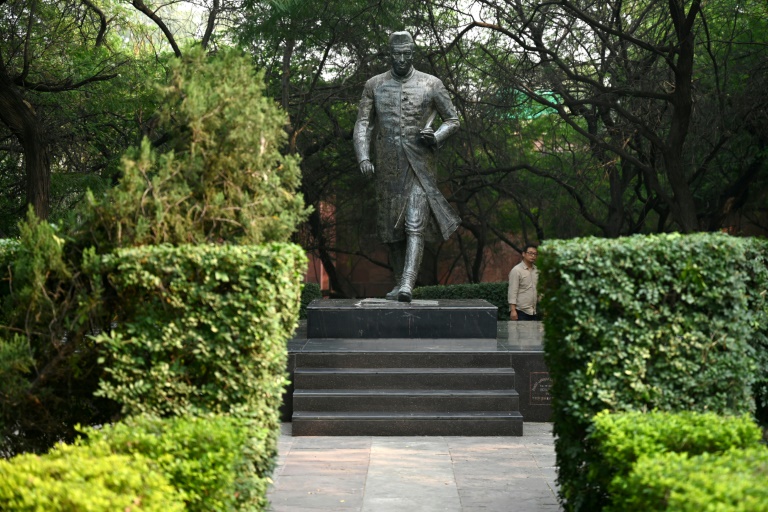
The palatial family home of India’s first prime minister Jawaharlal Nehru, the freedom struggle stalwart and close confidant of Mahatma Gandhi, is now a museum where loyalists come to pay tribute.

But 75 years after independence, that history is being rewritten across the country as the ruling Bharatiya Janata Party (BJP) seeks to promote its own Hindu nationalist agenda.

Critics accuse the BJP of upending settled narratives to fit its outlook, promoting the roles of its ideological forebears, and downgrading the contributions of Muslims to Indian history and society.

The BJP ousted Nehru’s Congress party at elections in 2014, after the dynasty he founded had dominated Indian politics for decades. 

His daughter Indira Gandhi, who grew up in the house, and grandson Rajiv both went on to become prime ministers.

Today, whether the emperor Akbar –- of the Muslim Mughal dynasty that ruled India for 300 years –- won or lost a key battle against a revered Hindu king depends on which textbook is being used.

At the launch of a book on Hindu kings’ resistance to the Mughals, home minister Amit Shah — a key ally of Prime Minister Narendra Modi — declared: “No one can stop us from writing the truth. We are now independent. We can write our own history.”

And the city where Nehru’s house stands has been renamed Prayagraj, after being known for 450 years as Allahabad, a moniker bestowed by Akbar.

According to Vinod Mishra, who has worked there for 15 years, the building’s visitors illustrate the changing approaches to history.

“Earlier everyone came here in awe and admiration but now many look at the home, his belongings, and quip that he too made a lot of money like other [corrupt] politicians,” Mishra told AFP.

Older visitors “still enter each room and reverentially touch the feet of Nehru’s portraits”, he said, but younger generations are more irreverent. 

“It’s fascinating to see that he had things like a tennis racket, tea kettle, a shaver and even went to London, which most people still can’t afford,” said engineering student Amar Yadav, 18.

– ‘Imaginary barbaric past’ –

Often accused of anti-Muslim rhetoric, BJP leaders have described the Mughals as Islamic invaders, increasing the anxieties of the country’s 210-million-odd Muslims.

But they say the authors who dominated historiography after independence from Britain in 1947 glorified conquerors over local kings and achievements.

And they say they over-emphasised Congress’s role in the independence struggle, denying the more revolutionary or nationalist figures the BJP reveres their due.

Modi often criticises Nehru — blaming him for the festering dispute over Kashmir, or losing a 1962 war to China — to target Congress, still the main opposition party and controlled by the Nehru-Gandhi family.

The BJP’s efforts to rewrite the past “aren’t just about history but securing its own place in the present for the next few decades”, S. Irfan Habib, a New Delhi-based historian told AFP.

“It’s dangerous as these books mould young minds who’ll grow with a very different understanding of India,” Habib said.

“The government in power has full majority and there’s nothing much one can do,” he added.

Contemporary history is also being reworked, say Indian media: a top official body slashed school textbook content this year.

Among the deletions were the Gujarat riots that killed at least 1,000 people, mostly Muslims, in 2002 — when Modi was the state’s premier.

It was one of India’s worst outbreaks of religious violence in recent times, and one removed passage reportedly warned that such events “alert us to the dangers involved in using religious sentiments for political purposes”.

– ‘Insult to India’ –

The states of Haryana and Gujarat have announced the addition of a Hindu holy book to the school curriculum, despite the education system being secular.

A Karnataka textbook incorporated a speech by the founder of the right-wing Rashtriya Swayamsewak Sangh, the BJP’s ideological fountainhead.

Rahul Gandhi, Nehru’s great-grandson and a Congress party leader, slammed it as an “attempt to teach children saffronised lessons… an insult to India, which is the cradle of diversity”.

Saffron, the sacred colour of Hindu monks’ robes, is a part of the BJP flag. 

Another book in the same state claimed that Vinayak Damodar Savarkar, a right-wing revolutionary jailed by the British, made regular excursions from his jail cell on the wings of small birds.

Savarkar’s biographer Vikram Sampath condemned the “stupid insertion”.

He is one of the young historians who support “decolonisation” of Indian history, but want to see quality maintained during revisions.

India was “slowly maturing as a democracy”, he said, hoping for a time when “historical characters won’t get caught in the slug fest of contemporary electoral politics”.

– ‘Greatest con job’ –

For some, the history textbook changes fit into the ruling party’s agenda of appealing to the country’s Hindu majority.

The BJP has backed several big-ticket projects including a grand temple corridor in Varanasi, a mega statue to a Hindu warrior king who successfully challenged the Mughals, and a grand temple at the Ayodhya site where zealots destroyed a Mughal-era mosque three decades ago.

Now emboldened right-wing groups have laid fresh claims to several Muslim sites they say were built atop temples destroyed during Islamic rule, raising fears of violence.

Some of them question the contributions of non-Hindu rulers, and the merits of secularism in an overwhelmingly Hindu country of about 1.4 billion people. 

“What did the Islamic invasions do for this country in 1,400 years of onslaught?” said Omendra Ratnu, who wrote the book launched by home minister Shah.

“They built three buildings — Taj Mahal, Red Fort and the Qutub Minar — and all three are disputed, have Hindu claims,” he told AFP. 

Mainstream Indian history was a “con job … by some very crafty and wicked people”, he said, adding textbook revisions were “baby steps — but steps in the right direction”.

Ukrainian soldiers keep watch at recaptured border

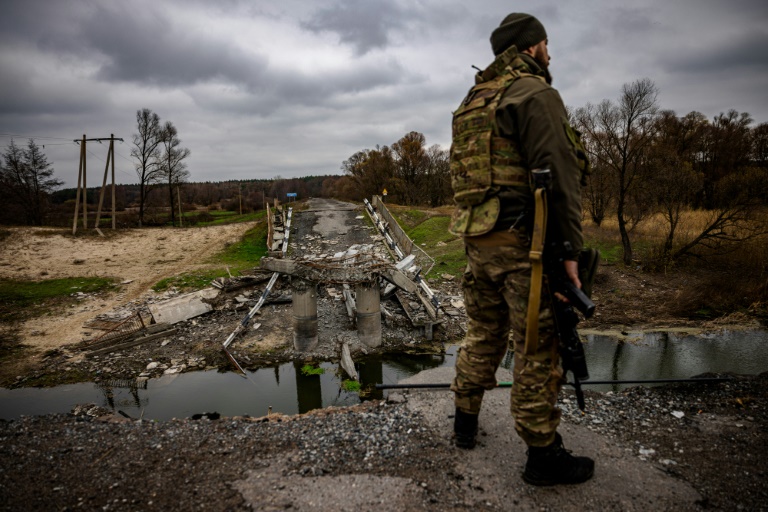
The Ukrainian commander points ahead. There’s a bridge over the Donets River, then forest. Beyond it lies the Russian city of Belgorod.

“That green hill over there is Russia,” says commander Roman Gryshchenko.

In September, he helped push Moscow’s forces back across the border near Kharkiv.

The retreat marked one of the high points of the Ukrainian counteroffensive in the northeast.

Now, Kyiv’s troops in the village of Starytsya stand so close to Russia that some phones mistakenly get texts to say they’ve arrived in the country.

Gryshchenko insists the area is now “absolutely secure” — but his troops are keeping watch. 

They still face drone attacks, occasional artillery strikes and the threat of raids from Russian commandos, he says.

The 5,000-strong 127th brigade he leads was formed from a volunteer force, and its mission is to defend positions in this recaptured border zone.

The last official Ukrainian outpost is buried in a trench off a muddy road leading straight to Russia. Beyond it, special forces soldiers and border guards operate unseen.

A lone sentry keeps his finger on the trigger, alert to suspicious noises in the forest.

Below ground, a sheltered room with internet connection acts as a digital surveillance station.

Soldier Sheleh, 32, taps a computer mouse, its red light glowing in the dim room.

He inspects video footage of the area — mostly bushes and dirt roads.

“Here we monitor our side of the border and watch for possible crossings that could be used for infiltration,” he says.

They work day and night, and through bombardments, he adds.

That morning, a dozen Russian soldiers moved inside Ukrainian territory before a brigade drone dropped a grenade and forced them to retreat, according to a video the 127 brigade sent to AFP.

This area was among the first to be breached by columns of tanks sent through Belgorod in February. 

With Ukraine’s troops now in control, Gryshchenko takes a tour through the recaptured territory, revisiting old battle scenes.

A Russian camp abandoned in the panic of the retreat, with pieces on a chess board still frozen mid-game.

A stretch of river used by the Ukrainian forces to surprise Russian special forces in May.

And a charred tank, the first Russian T-90 destroyed in Ukraine.

For the commander, it’s a trophy. But he regrets that it was so badly damaged his troops couldn’t reuse it.

“If we’d had the weapons we do now in March, I’d already be on the Red Square” in Moscow, he said.

World leaders gather for climate talks under cloud of crises

World leaders meeting Monday for climate talks in Egypt are under pressure to deepen cuts in emissions and financially back developing countries already devastated by the effects of rising temperatures.

The UN’s COP27 climate summit in the Red Sea resort of Sharm el-Sheikh comes as nations worldwide are facing increasingly intense natural disasters that have taken thousands of lives this year alone and cost billions of dollars.

At the opening ceremony on Sunday, COP27 officials urged governments to keep up efforts to combat climate change despite the economic crises linked to Russia’s war on Ukraine, an energy crunch, soaring inflation and the persistent Covid-19 pandemic.

“The fear is other priorities take precedence,” top United Nations climate change official Simon Stiell told a news conference.

The “fear is that we lose another day, another week, another month, another year — because we can’t”, he said.

The world must slash greenhouse emissions 45 percent by 2030 to cap global warming at 1.5 degrees Celsius above late-19th-century levels.

But current trends would see carbon pollution increase 10 percent by the end of the decade and Earth’s surface heat up 2.8C, according to findings unveiled in recent days.

Only 29 of 194 countries have presented improved climate plans, as called for at the UN talks in Glasgow last year, Stiell noted.

Some 110 heads of state and government are expected to participate in two days of talks, with the notable absence of Chinese leader Xi Jinping, whose country is the world’s top emitter of greenhouse gases.

US President Joe Biden, whose country ranks second on the top-polluters list, will join COP27 later this week after midterm elections on Tuesday that could put Republicans hostile to international action on climate change in charge of Congress.

– ‘Loss and damage’ –

Fresh from his own election victory, Brazil’s Luiz Inacio Lula da Silva is expected to attend the summit, with hopes high that he will protect the Amazon from deforestation after defeating climate-sceptic President Jair Bolsonaro.

Another new leader, British Prime Minister Rishi Sunak, reversed a decision not to attend the talks and is due to urge countries to move “further and faster” in transitioning away from fossil fuels.

He will also hold discussions with French President Emmanuel Macron.

On Sunday, the heads of developing nations won a small victory when delegates agreed to put the controversial issue of money for “loss and damage” on the summit agenda.

Pakistan, which chairs the powerful G77+China negotiating bloc of more than 130 developing nations, has made the issue a priority.

“We definitely regard this as a success for the parties,” said Egypt’s Sameh Shoukry, who chairs the COP27.

The United States and the European Union have dragged their feet on the issue for years, fearing it would create an open-ended reparations framework.

But European Commission Vice President Frans Timmermans welcomed the inclusion of loss and damage, tweeting that the “climate crisis has impacts beyond what vulnerable countries can shoulder alone”.

Rich nations will also be expected to set a timetable for the delivery of $100 billion per year to help developing countries green their economies and build resilience against future climate change. 

The promise is already two years past due and remains $17 billion short, according to the OECD.

COP27 is scheduled to continue until November 18 with ministerial meetings.

'Why are we here?': Climate activists shunted to COP27 sidelines

Ugandan youth activist Nyombi Morris arrived in Egypt for the UN’s COP27 climate summit with high hopes of being part of the campaign for environmental justice.

But it didn’t take long for Egypt’s stiff security measures to shatter his dreams, as rights groups warn the North African country has stifled protests with “dozens” of arrests. 

“I was so happy when they announced that COP would be in Africa,” said Morris, who founded the Earth Volunteers youth organisation campaigning for “climate justice”.

“I thought maybe I would get a chance to be at the room where the negotiations are taking place.”

Instead, “with the questions we received at the airport, it will not be easy for us to continue with our plan”, the 24-year-old said.

In 2008, when Morris was 10, devastating flash floods hit Uganda’s eastern Butaleja district — an area where the illegal extraction of riverbank sand for construction was common. Some 400 people, including Morris’s family, lost their homes.

Morris, who has said the digging “exacerbated flooding already made worse by climate change”, said they had to move to the capital Kampala.

“I am here to represent my mother who lost a farm, who lost a home,” he said. “I am here to ask for compensation for my community.”

– ‘Abusive security measures’ –

Activists wanting to demonstrate at COP27, held in the Egyptian resort town of Sharm el-Sheikh, must request accreditation 36 hours in advance, providing information such as the names of the protest organisers and details of the proposed march.

Approved demonstrations are only allowed during working hours, and in a specific purpose-built area. 

That accreditation process is risky, Morris fears.

“When they started asking about our locations, where we will be staying, our passports, our names, we were worried,” he said.

“What if they follow one of us and (we) get arrested?”

He cited the case of Indian climate activist Ajit Rajagopal, who was arrested after setting off to march from Cairo to Sharm el-Sheikh. He was later released after an international outcry.

Human Rights Watch on Sunday warned that “dozens of people” calling for protests had been detained.

“Egypt’s government has no intention of easing its abusive security measures and allowing for free speech and assembly,” the watchdog said.

Rights groups say at least 138 people have been arrested ahead of a rally slated for November 11 — planned nationwide but not in Sharm el-Sheikh — against what they decry as repression and sharp increases in the cost of living.

– ‘Watching online’ –

Africa is home to some of the countries least responsible for planet-heating emissions but hardest hit by an onslaught of weather extremes.

On top of security restrictions, Morris lamented that activists like him were excluded from the talks.

“I am watching online because our ‘observers’ badges don’t allow us to enter,” he said.

“I’m like ‘so, why are we here?'”

He said his hopes have faded that having the summit in Africa might make a difference — including in demanding wealthy nations responsible for emissions pay their dues.

“It is not an African COP, it is a polluters’ COP — because it is polluters dominating,” he said. 

“Haven’t you seen Coca-Cola here?” he added, referring to one of this year’s official sponsors.

Campaign group Greenpeace has called Egypt’s choice of the soft drink giant “appalling”, blaming the company for much of the “plastic pollution in the world”.

Last year, at the COP26 in Glasgow, tens of thousands of demonstrators from all over the world marched to demand “climate justice”.

Swedish climate activist Greta Thunberg is skipping COP27, slamming it as a forum for “greenwashing” and saying the “space for civil society this year is extremely limited”.

On Sunday, ignoring the restrictions, a handful of activists waved banners at the entrance to the summit hall.

“We are trying to promote the veganism to help save the planet from the greenhouse gases”, said Tom Modgmah, a follower of Vietnamese “Supreme Master Ching Hai”, alongside colleagues waving banners.

“Be vegan, make peace,” they read.

Close Bitnami banner
Bitnami