World

Africa's mega-cities look to mass transit to ease growing pains

Tade Balogun times his commute like a military operation. 

Each day, the Lagos consultant leaves home before dawn, arrives for work early and takes a nap before before starting his day. 

He then stays until 9 pm — that way, he escapes the chaos and gridlock that can transform his 29-kilometre (18-mile) drive into a three-hour nightmare.

By the time he gets home, Balogun says, his daughters are fast asleep. But, he adds wryly, his blood pressure has remained in the safety zone: “Lagos traffic can cause a health hazard.” 

Balogun’s trek highlights the plight of Nigeria’s economic hub and other fast-growing African cities as the world’s population reaches the eight billion mark in the coming days.

In a metropolitan area sprawling across nearly 1,200 square kilometres (450 square miles), much of which has been informally settled, Lagos’s 20 million people struggle each day with notoriously poor infrastructure, except for a few wealthy enclaves.

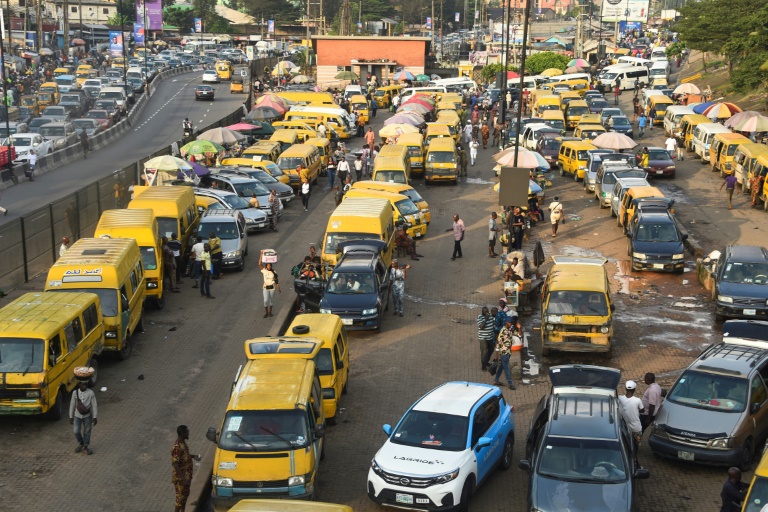
Arguably the worst problem is transport, for the city is dependent on roads — and they are a choke of cars, trucks, motorbikes and packed yellow Danfo minibuses, along with hawkers who weave in between the unruly lanes of traffic. 

Seeking to change this, the Lagos State government has drawn up ambitious plans, including a new airport and a mass transit network of trains, buses and ferries. 

“For the economy of any city to thrive, your transport system must be adequate, efficient,” Lagos metropolitan transport authority chief Abimbola Akinajo told AFP. 

“It is a big part of what we need to get right in order for the city to function right.”

– Delayed train network –

But experts say the funding and logistical challenges of this blueprint are mountainous, and some wonder whether some basic questions have been asked.

“We have to understand, what is Lagos? Whether Lagos as a state, Lagos as a metropolis, or as a megacity,” said Muyiwa Agunbiade, a University of Lagos urban development professor.  

“If you don’t know the population, it’s difficult for us to plan for the people.” 

Delivering big transport projects on time and on budget is a headache almost anywhere in the world.

But in Lagos’s case, a much-trumpeted city rail network has been delayed by more than a decade.

Akinajo acknowledged funding and implementation problems had snarled the scheme but insisted a part of one rail line would be finished this year and start taking passengers by early 2023.

Engineers are running test trains along half of the Blue line route — one of six in a planned network to eventually link rail to more regulated buses and ferries.

With one line running, Akinajo said, Lagos hopes investors will come. British advisers and the French development agency are helping.

Agunbiade agreed getting things moving was crucial.

“If you have all this working, it will be a major game changer.”

– Urbanising Africa –

The challenges facing Lagos are mirrored elsewhere in quickly urbanising Africa, where population growth typically outstrips basic infrastructure and planning. 

DR Congo’s Kinshasa and Tanzania’s Dar Es Salaam are on track to join Lagos as the world’s three most populated cities by 2100, according to researchers at the University of Toronto Global Cities Institute.

Dar Es Salaam already has had some success with its dedicated Bus Rapid Transit routes, which with widened roads reduced dense congestion.

Kinshasa is more complex — a civil war in the early 2000s and regional violence in 2016 added displaced people to the city’s swiftly growing population.

The roads are so clogged with traffic that many people prefer to walk. Public transport is by taxis and minibuses dubbed “spirits of death”.

“When you see the size of the traffic jams and the mass of people, you realise road transport cannot solve the problem,” said Martin Lukusa, Kinshasa’s director of public transport.

The “Metrokin” project is still under construction to rehabilitate old rail lines.

– Water a ‘quicker win’ –

Lagos State is also eyeing another resource — using the lagoon that lies between the city and a narrow strip of coast on the Atlantic as a means of transport.

Lagos State waterways agency chief Oluwadamilola Emmanuel said the plans are to increase the number of operators and expand jetty and safety infrastructure. 

Around 300 private boat operators will be brought into a more regulated system along with larger state ferries able to move more people.

Small boat owners recently formed a union, making a transition easier, he said.

“Water is a quicker win because we have a natural asset,” he said, acknowledging the need to overcome Lagosian worries about marine safety to encourage more use.

Travelling from mainland Ikorodu to the Victoria Island business area can take two hours by car, but small boats can skip across the lagoon in 25 minutes. 

The trip, though, is pricey — at 1,000 naira ($2.30), it is double a Danfo bus ride.

“The vision is there,” said one development partner. “Financing is a problem. Cost is also a problem. There will still be a lot of people who will pay less to sit in a bus.” 

Lindsay Sawyer, an urban studies researcher at Sheffield University in northern England, agreed that to tame the traffic, the city had to keep costs low and absorb existing informal structures.

“It’s about affordability and capacity. The Danfo are still everywhere because they are still the most affordable option,” he said.

Most harried Lagos commuters can only wait for solutions.

“It’s a madhouse,” said Lagos stock manager Ochuko Oghuvwu, who commutes 20 hours a week. “By now Lagos should have a metro line.”


Planet Earth: 8 billion humans and dwindling resources

Are eight billion humans too many for planet Earth? As we reach this milestone on November 15, most experts say the bigger problem is the overconsumption of resources by the  wealthiest residents.

“Eight billion people, it is a momentous milestone for humanity,” said United Nations Population Fund chief Natalia Kanem, hailing an increase in life expectancy and fewer maternal and child deaths.

“Yet, I realize this moment might not be celebrated by all. Some express concerns that our world is overpopulated. I am here to say clearly that the sheer number of human lives is not a cause for fear.”

So, are there too many of us for Earth to sustain?

Many experts say that this is the wrong question. Instead of the fear of overpopulation, we should focus on the overconsumption of the planet’s resources by the wealthiest among us.

“Too many for whom, too many for what? If you ask me, am I too many? I don’t think so,” Joel Cohen of Rockefeller University’s Laboratory of Populations told AFP.

He said the question of how many people Earth can support has two sides: natural limits and human choices.

– ‘Stupid and greedy’ –

Our choices result in humans consuming far more biological resources, such as forests and land, than the planet can regenerate each year. 

The overconsumption of fossil fuels, for example, leads to more carbon dioxide emissions, responsible for global warming.

We would need the biocapacity of 1.75 Earths to sustainably meet the needs of the current population, according to the Global Footprint Network and WWF NGOs.

The most recent UN climate report mentions population growth as one of the main drivers of an increase in greenhouse gases. However, it plays a smaller role than economic growth.

“We are stupid. We lacked foresight. We are greedy. We don’t use the information we have. That’s where the choices and the problems lie,” said Cohen. 

However, he rejects the idea that humans are a curse on the planet, saying people should be given better choices.

“Our impact on the planet is driven far more by our behavior than by our numbers,” said Jennifer Sciubba, a researcher at the Wilson Center, a think tank.

“It’s lazy and damaging to keep going back to overpopulation,” she added, as this allows people in wealthy nations, who consume the most, to cast the blame for the planet’s woes onto developing countries where population growth is highest.

“Really, it’s us. It’s me and you, the air conditioning I enjoy, the pool I have outside, and the meat I eat at night that causes so much more damage.”

If everyone on the planet lived like a citizen of India, we would only need the capacity of 0.8 Earths a year, according to the Global Footprint Network and WWF. If we all consumed like a resident of the United States, we would need five Earths a year.

The United Nations estimates that our planet will be home to 9.7 billion people by 2050. 

– Women’s rights –

One of the trickiest questions that arise when discussing population is that of controlling fertility. Even those who believe we need to lower the Earth’s population are adamant about protecting women’s rights.

Robin Maynard, the executive director of the NGO Population Matters, says there needs to be a decrease in the population, but “only through positive, voluntary, rights-respecting means” and not “deplorable examples” of population control.

The NGO Project Drawdown lists education and family planning among the top 100 solutions to halt global warming.

“A smaller population with sustainable levels of consumption would reduce demands on energy, transportation, materials, food, and natural systems.”

Vanessa Perez of the World Resources Institute agrees that “every person that is born on the planet puts additional stress on the planet.” 

“It is a very thorny issue,” she said, adding that we should reject “this idea that the elite capture this narrative and say we need to cap population growth in the South.”

She believes the most interesting debate is not about the number of people but “distribution and equity.”

Cohen points out that even if we currently produce enough food for 8 billion people, there are still 800 million people who are “chronically undernourished.”

“The concept of ‘too many’ avoids the much more difficult problem, which is: are we using what we know to make the human beings we have as healthy, productive, happy, peaceful, and prosperous as we could?”

US Powerball jackpot grows to record $1.9 bn

The US Powerball jackpot grew to a staggering $1.9 billion -– the largest prize in world history -– after yet another week without a winner, ensuring a new surge in lottery fever across the country.

The winning numbers for Saturday’s draw were 28, 45, 53, 56 and 69, with a Powerball of 20.

With no ticket matching the five numbers and the Powerball, the pot rolls over with a grand prize of $1.9 billion up for grabs in Monday’s draw, organizers said.

The Powerball jackpot is the biggest ever amassed, surpassing the already record $1.6 billion which went unclaimed in Saturday’s draw.

The odds of winning the jackpot are still 1 in 292.2 million. If there were duplicate winners who select the same combination of numbers, they would share the jackpot.

The last time someone claimed the Powerball jackpot was August 3, when a lucky ticket holder in Pennsylvania raked in an estimated $206.9 million. Since then, the Powerball jackpot has grown and grown.

While no one claimed the big prize on Saturday, 16 tickets matched the five main numbers to win $1 million each. To get the jackpot you to get the Powerball number, too.

It costs $2 to buy a Powerball ticket, and a winner could choose a lump sum payment, calculated for Monday’s jackpot at $929 million. Or they could opt for payments over 29 years.

Most winners choose the lump sum payout.

Many lottery enthusiasts were taking to social media to muse about what they would do in the event their billion-dollar American dream became a reality.

“If I hit this powerball I’d never write a line of code again,” wrote one computer expert on Twitter Sunday.

Others spoke of buying minor league sports teams, or donating hundreds of millions of dollars to charity.

Hope springs eternal for some enthusiasts.

“Bad news: I didn’t win Powerball last night,” grumbled an apparent ticket buyer on Twitter. “Good news: nobody won and the next drawing is now $1.9 BILLION.”

Italy accused of illegally rejecting migrants as anger mounts

Humanitarian groups on Sunday said Italy had broken international law by refusing to let in migrants plucked from the sea as a German rescue charity said it would take legal action against Rome.

As rescue ships in Catania waited for permission to disembark every last person, a migrant rescue hotline said some 500 others had run into difficulty on the perilous Mediterranean crossing.

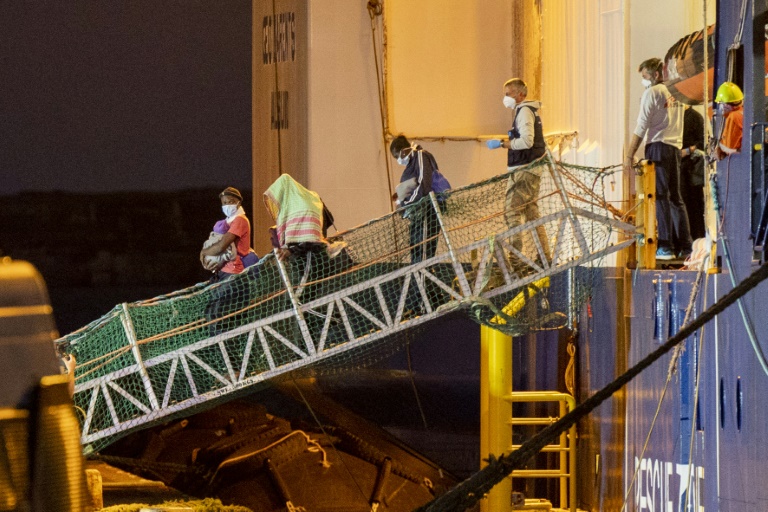
A father carrying a baby in a purple beanie was among the first to get off Geo Barents, a ship run by medical charity Doctors Without Borders (MSF).

He was one of the lucky 357 people allowed off. Italy refused entry to 215 others.

Earlier in the day authorities accepted 144 people including children and the sick from the German-flagged Humanity 1, but rejected 35 adult male migrants, the charity SOS Humanity said.

The ship was then “ordered to leave the port of Catania”, but its captain refused, it said.

The charity said Italian authorities had decided after a “brief medical examination” that the 35 adults were “healthy”, but said there was “no translator present to assess their mental and physical condition, nor was there a psychological evaluation”.

“Furthermore, the 35 survivors have the right to apply for asylum, and to a formal asylum procedure, which can only be carried out on land”.

– Legal action –

The organisation said it would be taking legal action and appeals against the government’s policy would be submitted to courts in Rome and Catania on Monday.

Amnesty International urged Italy to stop discriminating, saying “the law of the sea is clear; a rescue ends when all those rescued are disembarked in a place of safety”.

Italy was “violating its international obligations”, the rights organisation said.

Those refused permission to leave the Humanity 1 were “extremely depressed”, SOS Humanity’s press officer Petra Krischok told AFP.

MSF said the “selective and partial disembarkation” was illegal and accused politicians of “playing with (migrants’) lives”.

The Humanity 1 and Geo Barents were two of four ships that had requested a safe port. The Ocean Viking and Rise Above are still off the coast of Sicily.

A photographer on the Ocean Viking said there was “tension among the survivors”, who were rescued 16 days ago and faced yet another cold night on deck as the weather worsened.

As the vessels waited, Alarm Phone, a group running a hotline for migrants needing rescue, said it had been alerted to “a large boat carrying about 500 people in distress” in the Mediterranean.

– ‘Leave territorial waters’ –

Italy’s new far-right government has vowed to crack down on migrants attempting the perilous boat crossing from North Africa to Europe.

Over 87,000 people have landed in Italy so far this year, according to the interior ministry — though only 14 percent of those were rescued at sea and brought to safety by charity vessels.

Interior minister Matteo Piantedosi earlier said those who do not “qualify” would have to “leave territorial waters”.

Sources close to transport minister Matteo Salvini, who controls the ports, said they would be “provided with the assistance necessary” to do so.

Member of parliament Aboubakar Soumahoro, who was present as those chosen from the Humanity 1 disembarked, slammed the “selection of shipwrecked migrants”.

The main opposition party said Piantedosi should offer an explanation to parliament.

– ‘Europe’s responsibility’ –

Piantedosi said Saturday those migrants not allowed into Italy would have to be “taken care of by the flag state” — a reference to the national flags under which vessels sail.

The Humanity 1 and Mission Lifeline charity’s Rise Above sail under the German flag.

The Geo Barents and SOS Mediterranee’s Ocean Viking are registered in Norway.

The Norwegian foreign ministry said Thursday it bore “no responsibility” for those rescued by private Norwegian-flagged ships in the Mediterranean.

Germany insisted in a diplomatic message to Italy that the charities were “making an important contribution to saving human lives” and asked Rome “to help them as soon as possible”.

Pope Francis weighed in Sunday, saying that Italy “can do nothing without Europe’s agreement” and telling journalists that as far as migrant arrivals were concerned, “it is Europe’s responsibility”.

Republicans eye 'wake-up call' for Biden as midterms loom

Bullish Republicans on Sunday promised to deliver a “wake-up call” to Joe Biden and retake Congress in this week’s crucial midterm elections, as the US president’s Democrats insisted they were still in the fight with two days to go.

Biden and his predecessor Donald Trump have been pulling out the stops to draw voters to the polls in Tuesday’s contest — which Biden says marks a defining moment for US democracy.

After rival Saturday night rallies in battleground Pennsylvania, both men had new appearances set for Sunday — Biden in New York, Trump in Miami — while senior party leaders took to the airwaves seeking out every last American vote.

A massive 40 million Americans have already voted early, according to NBC News on Sunday, and both sides were predicting victory.

But the latest polls have put Democrats on the defensive, while Senator Rick Scott, chair of the National Republican Senatorial Committee, summed up the mood in his party by predicting “a great night” in both chambers of Congress.

Fellow Republican Glenn Youngkin, the governor of Virginia, told ABC News talk show “This Week” that his camp was the one now “offering common-sense solutions” to pressing issues like sky-high inflation and crime.

“This is going to be a wake-up call to President Biden,” Youngkin said.

With Republican figurehead Trump doubling down on voting conspiracy theories ahead of the midterms, and several candidates in his camp casting doubt on the upcoming results, party leaders sought to assure voters that Republicans will accept the outcome — even if they lose.

Asked directly whether every Republican candidate will accept the results, whatever they are, party chair Ronna McDaniel told CNN: “They will.” 

Several hundred Republicans seeking office next week have endorsed Trump’s baseless claims of fraud in 2020 — and a number are casting doubt on the midterms as well. 

Kari Lake, the party’s far-right candidate for governor in Arizona, for example has refused to say whether she would honor the results.

Asked by CNN last month if she would accept the outcome of her race, which polls show is a toss-up, she said: “I’m going to win the election, and I will accept that result.”

– ‘A defining moment’ –

US midterm elections are typically seen as a referendum on the president in power, whose party tends to lose seats in Congress, particularly if — as with Biden — the president’s approval rating is under 50 percent. 

Polls put Republicans ahead in the fight for the House, and also show them gaining momentum in key Senate races as voters seek to take out frustration over four-decades-high inflation and rising illegal immigration.

A new NBC News poll contained a particularly worrying result for Democrats: It found that a whopping 72 percent of voters believed the country is headed in the wrong direction, to 21 percent who saw it as being on the right track, auguring badly for the party in power.

But there was one glimmer of good news for the president’s party: After trailing earlier, Democrats have caught up with Republicans in election interest, with an identical 73 percent of each party’s voters expressing high interest.

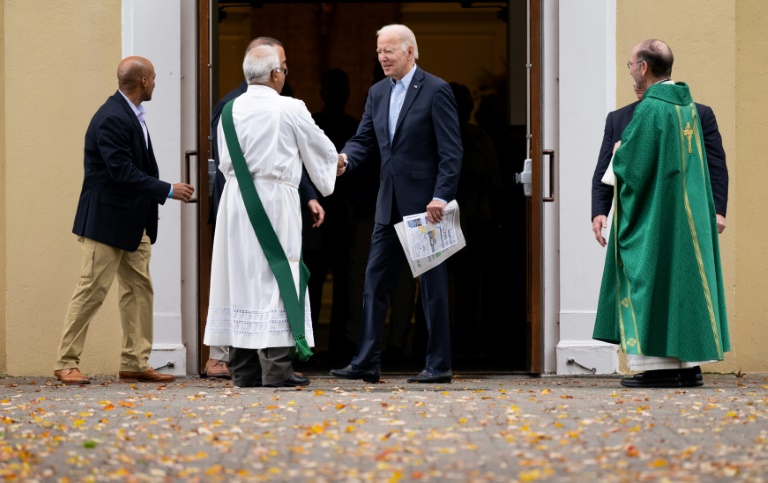
Biden attended mass early Sunday in Wilmington, Delaware, before flying to New York to rally in support of Governor Kathy Hochul, who faces an unexpectedly strong Republican challenge.

Biden joined forces with Democratic superstar Barack Obama in key swing state Pennsylvania a day earlier — campaigning alongside Senate hopeful John Fetterman and governor candidate Josh Shapiro.

Speaking to thousands in a Philadelphia arena, Biden cited Trumpists’ growing support for conspiracy theories to highlight what is at stake.

“Democracy is literally on the ballot. This is a defining moment for the nation,” Biden warned.

Trump himself was attending a rival rally to boost Fetterman’s opponent, TV celebrity doctor Mehmet Oz, and Shapiro’s far-right opponent Doug Mastriano.

In a rambling speech, Trump defended his attempts to overturn the 2020 election and urged Americans to “vote Republican in a giant red wave” — while teasing his potential new White House run in 2024.

“I promise you in the very next very, very, very short period of time, you’re going to be so happy,” Trump told his supporters.

Democrats have pushed back against the narrative of an inevitable Republican takeover of Congress.

“We’re going to hold this majority,” congressman Sean Patrick Maloney, who heads the Democratic congressional campaign arm, insisted to NBC, saying Biden unfairly received a “bum rap” for inflation while getting too little credit for successes like job growth.

But polls suggest Biden’s Democrats have struggled to convince voters on kitchen-table issues central to the election — and there is little indication that Biden’s dire warnings of a threat to democracy have turned the tables in their favor.

Stand-off at port as Italy accepts only some rescued migrants

Italy on Sunday took in families with babies and vulnerable migrants rescued in the Mediterranean as charities slammed Rome’s decision to order the others back into international waters.

As humanitarian vessels waited in the port of Catania to disembark those saved, a migrants rescue hotline said some 500 others had run into difficulty on the perilous Mediterranean crossing.

A father carrying a baby in a purple beanie was among the first to get off Geo Barents, a ship run by medical charity Doctors Without Borders (MSF). He kissed and hugged her tightly as they came down the gangplank.

He was one of the lucky ones.

Rome allowed 144 people including minors and the sick off the German-flagged Humanity 1 earlier Sunday, but 35 adult male migrants were refused permission to set foot on Italian soil, charity SOS Humanity said.

The ship was then “ordered to leave the port of Catania”, it said in a statement.

“The captain of the Humanity 1, who is legally responsible for the safety of all people on board, has refused,” it said.

The charity said Italian authorities had decided after a “brief medical examination” that the 35 adults were “healthy”, but said there was “no translator present to assess their mental and physical condition, nor was there a psychological evaluation”.

“Furthermore, the 35 survivors have the right to apply for asylum, and to a formal asylum procedure, which can only be carried out on land”.

– ‘Playing with lives’ –

Those refused permission to leave the Humanity 1 were “extremely depressed”, SOS Humanity’s press officer Petra Krischok told AFP.

MSF said the “selective and partial disembarkation” was illegal and accused politicians of “playing with (migrants’) lives”.

The Humanity 1 and Geo Barents were two of four ships that had requested a safe port. The Ocean Viking and Rise Above are still off Sicily.

As the vessels waited, Alarm Phone, a group running a hotline for migrants needing rescue, said it had been alerted to “a large boat carrying about 500 people in distress” in the Mediterranean.

Italy’s new far-right government has vowed to crack down on boat migrants attempting the perilous crossing from North Africa to Europe.

Over 87,000 people have landed in Italy so far this year, according to the interior ministry — though only 14 percent of those were rescued at sea and brought to safety by charity vessels.

Interior Minister Matteo Piantedosi earlier said those who do not “qualify” would have to “leave territorial waters”.

Sources close to Transport Minister Matteo Salvini, who controls the ports, said they would be “provided with the assistance necessary” to do so.

The leader of the main opposition party, Democratic Party chief Enrico Letta, accused the government on Twitter of breaking international law.

Piantedosi should explain his actions to parliament, the party said.

Member of parliament Aboubakar Soumahoro, present as those chosen from the Humanity 1 were disembarked, slammed the “selection of shipwrecked migrants”, saying lawyers were already at work on challenging the decision.

– ‘Europe’s responsibility’ –

Piantedosi said Saturday those migrants not allowed into Italy would have to be “taken care of by the flag state” — a reference to the national flags under which the vessels sail.

The Humanity 1 and Mission Lifeline charity’s Rise Above sail under the German flag.

The Geo Barents and SOS Mediterranee’s Ocean Viking are registered in Norway.

The Norwegian foreign ministry said Thursday it bore “no responsibility” for those rescued by private Norwegian-flagged ships in the Mediterranean.

Germany insisted in a diplomatic “note” to Italy that the charities were “making an important contribution to saving human lives” and asked Rome “to help them as soon as possible”.

Pope Francis weighed in Sunday, saying that Italy “can do nothing without Europe’s agreement” and telling journalists that as far as migrant arrivals were concerned, “it is Europe’s responsibility”.

Republicans eye 'wake-up call' for Biden as midterms loom

Bullish Republicans on Sunday promised to deliver a “wake-up call” to Joe Biden and retake Congress in this week’s crucial midterm elections, as the US president’s Democrats insisted they were still in the fight with two days to go.

Biden and his predecessor Donald Trump have been pulling out the stops to draw voters to the polls in Tuesday’s contest — which Biden says marks a “defining” moment for US democracy.

After rival Saturday night rallies in battleground Pennsylvania, both men had new appearances set for Sunday — Biden in New York, Trump in Miami — while senior party leaders took to the airwaves seeking out every last American vote.

A massive 40 million Americans have already voted early, according to NBC News on Sunday, and both sides were predicting victory.

But the latest polls have put Democrats on the defensive, while Senator Rick Scott, chair of the National Republican Senatorial Committee, summed up the mood in his party by predicting “a great night” in both chambers of Congress.

Fellow Republican Glenn Youngkin, the governor of Virginia, told ABC News talk show “This Week” that his camp was the one now “offering common-sense solutions” to pressing issues like sky-inflation and crime.

“This is going to be a wake-up call to President Biden,” Youngkin said.

With Republican figurehead Trump doubling down on voting conspiracy theories ahead of the midterms, and several candidates in his camp casting doubt on the upcoming results, party leaders sought to assure voters that Republicans will accept the outcome — even if they lose.

Asked directly whether every Republican candidate will accept the results, whatever they are, party chair Ronna McDaniel told CNN: “They will.” 

Several hundred Republicans seeking office next week have endorsed Trump’s baseless claims of fraud in 2020 — and a number are casting doubt on the midterms as well, in contrast with McDaniel’s comments. 

Kari Lake, the party’s far-right candidate for governor in Arizona, for example has refused to say whether she would honor the results.

Asked by CNN last month if she would accept the outcome of her race, which polls show is a toss-up, she said: “I’m going to win the election, and I will accept that result.”

– ‘Bum rap?’ –

US midterm elections are typically seen as a referendum on the president in power, whose party tends to lose seats in Congress, particularly if — as with Biden — the president’s approval rating is under 50 percent. 

Polls put Republicans ahead in the fight for the House, and also show them gaining momentum in key Senate races as voters seek to take out frustration over four-decades-high inflation and rising illegal immigration.

Biden attended mass early Sunday in Wilmington, Delaware, before flying to New York to rally in support of Governor Kathy Hochul, who faces an unexpectedly strong Republican challenge.

Biden joined forces with Democratic superstar Barack Obama in key swing state Pennsylvania a day earlier — campaigning alongside Senate hopeful John Fetterman and governor candidate Josh Shapiro.

Speaking to thousands in a Philadelphia arena, Biden cited Trumpists’ growing support for conspiracy theories to highlight what is at stake.

“Democracy is literally on the ballot. This is a defining moment for the nation,” Biden warned, as he sought to push his party to the finish line.

Trump himself was attending a rival rally to boost Fetterman’s opponent, TV celebrity doctor Mehmet Oz, and Shapiro’s far-right opponent Doug Mastriano.

In a rambling speech, Trump defended his attempts to overturn the 2020 election and urged Americans to “vote Republican in a giant red wave” — while teasing his potential new White House run in 2024.

“I promise you in the very next very, very, very short period of time, you’re going to be so happy,” Trump told his supporters.

Democrats have pushed back against the narrative of an inevitable Republican takeover of Congress.

“We’re going to hold this majority,” congressman Sean Patrick Maloney, who heads the Democratic congressional campaign arm, insisted to NBC, saying Biden unfairly received a “bum rap” for inflation while getting too little credit for successes like job growth.

But polls suggest Biden’s Democrats have struggled to convince voters on the kitchen-table issues central to this week’s election — and there is little indication that Biden’s dire warnings of a threat to democracy have turned the tables in their favor.

19 killed after plane plunges into Lake Victoria in Tanzania

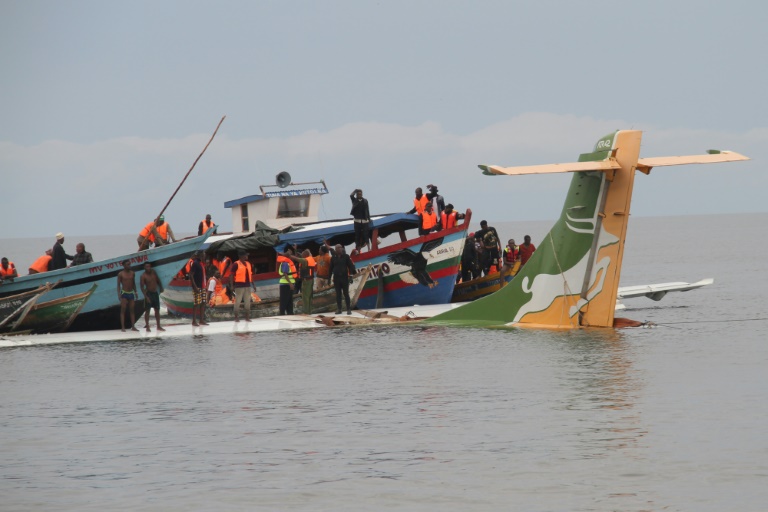
The death toll from Sunday’s plane crash in Tanzania has jumped to 19, Prime Minister Kassim Majaliwa said, after the Precision Air flight with dozens of passengers aboard plunged into Lake Victoria while approaching the northwestern city of Bukoba.

“All Tanzanians are with you in mourning the 19 people who lost lives during this accident,” Majaliwa told a crowd after arriving at Bukoba airport, where the flight had been scheduled to land from financial capital Dar es Salaam.

Regional authorities earlier said that 26 survivors out of the 43 people on board flight PW 494 had been pulled to safety and taken to hospital in the lakeside city.

But Precision Air, a publicly-listed company which is Tanzania’s largest private carrier, said in a statement that 24 people had survived the accident, with an airline official telling AFP that the other two hospitalised patients were not aboard the plane to begin with.

“There are two people who were injured during rescue efforts who have been counted as survivors but they were not passengers,” he said on condition of anonymity.

The airline said it had dispatched rescuers and investigators to the scene and expressed its “deepest sympathies” over the accident, which occurred at around 08:53 am (0553 GMT) on Sunday.

The company said the aircraft was an ATR 42-500, manufactured by Toulouse-based Franco-Italian firm ATR, and had 39 passengers — including an infant — and four crew members on board.

Video footage broadcast on local media showed the plane largely submerged as rescuers, including fishermen, waded through water to bring people to safety.

Emergency workers attempted to lift the aircraft out of the water using ropes, assisted by cranes as residents also sought to help.

President Samia Suluhu Hassan expressed her condolences to those affected by the accident, saying: “We pray to god to help us.”

The disaster ranks among the deadliest plane crashes in the East African nation’s history.

– ‘Heroic efforts’ –

The US embassy in Dar es Salaam released a statement, paying tribute to “the heroic efforts of first responders, especially ordinary citizens who helped rescue victims.”

The African Union Commission chair Moussa Faki Mahamat also shared his condolences, as did the secretary general of the regional East African Community bloc, Peter Mathuki.

“Our hearts and prayers go to the families of passengers on-board a plane that crashed into Lake Victoria, with our full solidarity to the Government & people of #Tanzania,” Faki wrote on Twitter.

“The East African Community joins and sends our condolences to Mama Samia Suluhu Hassan, families and friends of all those who were affected by the Precision Air plane accident,” Mathuki said, also on Twitter.

Precision Air, which is partly owned by Kenya Airways, was founded in 1993 and operates domestic and regional flights as well as private charters to popular tourist destinations such as Serengeti National Park and the Zanzibar archipelago.

The accident comes five years after 11 people died when a plane belonging to safari company Coastal Aviation crashed in northern Tanzania.

In March 2019, an Ethiopian Airlines flight from Addis Ababa to Nairobi plunged six minutes after take-off into a field southeast of the Ethiopian capital, killing all 157 people on board.

The disaster, five months after a similar crash in Indonesia, triggered the global grounding of the Boeing 737 MAX model of jet for 20 months, before it returned to service in late 2020.

In 2007, a Kenya Airways flight from the Ivory Coast city of Abidjan to Kenya’s capital Nairobi crashed into a swamp after take-off, killing all 114 passengers.

In 2000, another Kenya Airways flight from Abidjan to Nairobi crashed into the Atlantic Ocean minutes after take-off, killing 169 people while 10 survived.

A year earlier, a dozen people, including 10 US tourists, died in a plane crash in northern Tanzania while flying between Serengeti National Park and the Kilimanjaro airport.

New Iran protests erupt in universities, Kurdish region

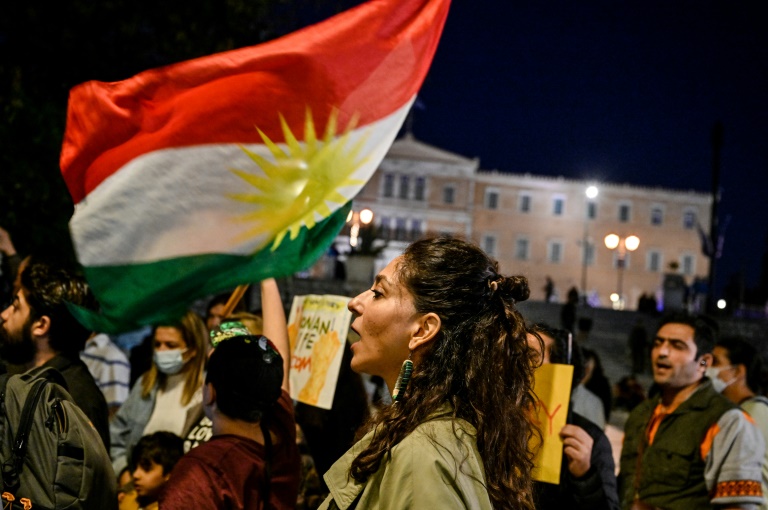
New protests erupted in Iran on Sunday at universities and in the largely Kurdish northwest, keeping a seven-week anti-regime movement going even in the face of a fierce crackdown.

The protests, triggered in mid-September by the death of Mahsa Amini after she was arrested for allegedly breaching strict dress rules for women, have evolved into the biggest challenge for the clerical leadership since the 1979 revolution.

Unlike demonstrations in November 2019, they have been nationwide, spread across social classes, universities, the streets and even schools, showing no sign of letting up.

The Norway-based Hengaw rights group said security forces opened fire on Sunday at a protest in Marivan, a town in Kurdistan province, wounding 35 people. 

It was not immediately possible to verify the toll. 

The latest protest was sparked by the death in Tehran of a Kurdish student from Marivan, Nasrin Ghadri, who according to Hengaw died on Saturday after being beaten over the head by police.

Iranian authorities have not yet commented on the cause of her death. 

Hengaw said she was buried at dawn without a funeral ceremony on the insistence of the authorities who feared the event could become a protest flashpoint.

Images posted on social media showed protesters threw stones at the official administration building and took down and burned the Islamic republic’s flag. Residents, including women without headscarves, marched through the streets.

Authorities sent reinforcements to the area and the sound of gunfire echoed around the city as night fell, Hengaw added.

– ‘Fundamental changes’ –

Kurdish-populated regions have been the crucible of protests since the death of Amini, herself a Kurd from the town of Saqez in Kurdistan province.

Universities have also emerged as major protest hotbeds. Iran Human Rights (IHR), a Norway-based organisation, said students at Sharif University in Tehran were staging sit-ins Sunday in support of arrested colleagues.

Students at the university in Babol in northern Iran meanwhile removed gender segregation barriers that by law were erected in their cafeteria, it added.

The protests have been sustained by myriad different tactics, with observers noting a relatively new trend of young people tipping off clerics’ turbans in the streets.

IHR said Saturday that at least 186 people have been killed in the crackdown on the Mahsa Amini protests, up by 10 from Wednesday.

It said another 118 people had lost their lives in distinct protests since September 30 in Sistan-Baluchistan, a mainly Sunni Muslim province in the southeast, presenting a further major headache for the regime.

IHR said security forces killed at least 16 people with live bullets when protests erupted after prayers on Friday in the town of Khash in Sistan-Baluchistan.

“Iranians continue taking to the streets and are more determined than ever to bring fundamental changes,” said IHR director Mahmood Amiry-Moghaddam. “The response from the Islamic Republic is more violence.” 

– Fierce crackdown –

The protests were fanned by fury over the restrictive dress rules for women, over which Amini had been arrested. But they have now become a broad movement against the theocracy that has ruled Iran since the fall of the shah.

Meanwhile Sunnis in Sistan-Baluchistan — where the alleged rape of a girl in police custody was the spark for protests — have long felt discriminated against by the nation’s Shiite leadership. 

IHR also warned that “dozens” of arrested protesters had been charged with purported crimes which could see them sentenced to death — up from only a handful earlier reported to be potentially facing that fate. 

As well as thousands of ordinary citizens, the crackdown has seen the arrests of prominent activists, journalists and artists such as the influential rapper Toomaj Salehi.

There is also growing concern about the well-being of Wall Street Journal contributor and freedom of expression campaigner Hossein Ronaghi, who was arrested in September and whose family says is on hunger strike in Evin prison. 

In a new blow, his father Ahmad is now in intensive care after suffering a heart attack while conducting a vigil outside Evin, Hossein Ronaghi’s brother Hassan wrote on Twitter.

Meanwhile prominent dissident Majid Tavakoli, also jailed at the start of the crackdown, was beaten in Evin, his family wrote on social media.

COP27: Financing for climate damages gets a foot in the door

UN climate negotiations on Sunday offered a sliver of hope and “solidarity” for developing countries battered by increasingly costly impacts of global warming, in agreeing to discuss the thorny issue of money for “loss and damage”.

Countries least responsible for planet-heating emissions — but hardest hit by an onslaught of weather extremes — have been ramping up the pressure on wealthy polluting nations to provide financial help for accelerating damages.

But in a sign of how contentious the issue is among richer nations fearful of open-ended climate liability, the issue was only added to the formal agenda to the UN’s COP27 climate summit in the Egyptian resort town of Sharm el-Sheikh after two days of last-ditch negotiations.

This “reflects a sense of solidarity and empathy for the suffering of the victims of climate induced disasters,” Egypt’s Sameh Shoukry, the COP27 president, said to applause.

At last year’s UN summit in Glasgow, the European Union and the United States rejected calls for a separate financial mechanism.

Instead, negotiators agreed to start a “dialogue” extending through 2024 on financial compensation.

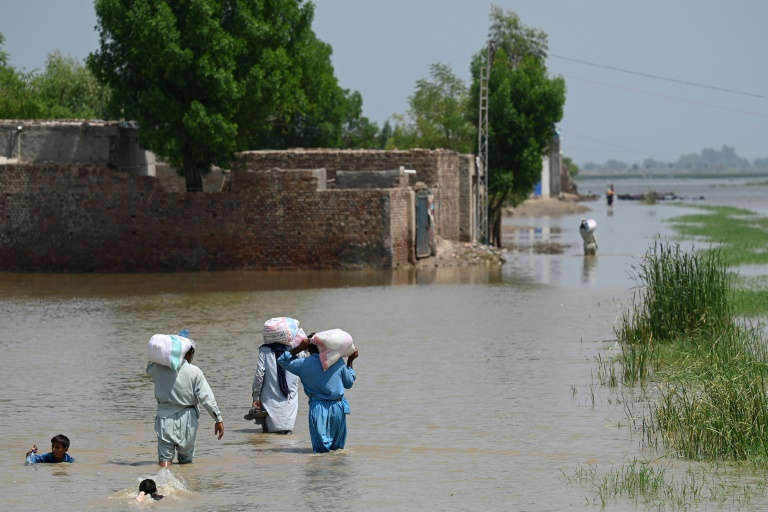
The issue has grown ever more urgent in recent months as nations were slammed by a crescendo of disasters, such as the massive flooding that put a third of Pakistan under water in August.

– ‘Lives are being lost’ –

Senegal’s Madeleine Diouf Sarr, who represents the Least Developed Countries negotiating bloc, said climate action across the board had been far too slow.

“Lives are being lost. Climate change is causing irreversible loss and damage, and our people carry the greatest cost,” she said, adding that an agreement on funding arrangements must be reached in Egypt. 

Appeals for more money are bolstered by a field known as event attribution science, which now makes it possible to measure how much global warming increases the likelihood or intensity of an individual cyclone, heat wave, drought or heavy rain event.

“Today, countries cleared an historic first hurdle toward acknowledging and answering the call for financing to address increasingly severe losses and damages,” said Ani Dasgupta, head of the World Resources Institute, a climate policy think tank.

But he said that getting negotiators to agree to discuss the issue was only an initial step.  

“We still have a marathon ahead of us before countries iron out a formal decision on this central issue for CO27,” he said.

Wrangling over loss and damage has unfolded against the backdrop of an unmet promise by rich nations to provide $100 billion a year starting in 2020 to help the developing world green their economies and anticipate future impacts, called “adaptation” in UN climate lingo.  

That funding goal is still $17 billion dollars short. Rich nations have vowed to hit the target by the end of 2023, but observers say the issue has severely undermined trust.

The UN Environment Programme has said the goal — first set in 2009 — has not kept up with reality, and estimates that funding to build resilience to future climate threats should be up to 10 times higher.

– ‘Words to actions’ –

Meanwhile, countries are far off track to reach the Paris deal goal of limiting global warming to 1.5 degrees Celsius.

The UN says the world is currently heading to 2.8C of warming, or a still-catastrophic 2.4C even if all national pledges under the Paris treaty are fulfilled. 

Depending on how deeply the world slashes carbon pollution, loss and damage from climate change could cost developing countries $290 to 580 billion a year by 2030, reaching $1 trillion to 1.8 trillion in 2050, according to the Grantham Research Institute on Climate Change and the Environment in London.

The World Bank has estimated the Pakistan floods alone caused $30 billion in damages and economic loss. Millions of people were displaced and two million homes destroyed.

Simon Stiell, the UN’s climate change executive secretary, said vulnerable countries are “tired” and “frustrated”. 

“Here in Sharm el-Sheikh we have a duty to speed up our international efforts and turn words into action to catch up with their lived experience,” he said.

Up to now, poor countries have had scant leverage in the UN wrangle over money. But as climate damages multiply, patience is wearing thin. 

The AOSIS negotiating block of small island nations told AFP that they would like to see the details for a dedicated loss-and-damage fund worked out within a year.

“There’s not enough support for us to even to begin to prepare for the loss and damage that we are expected to face,” said AOSIS lead negotiator on climate finance Michai Robertson.

mh/klm/pjm

Close Bitnami banner
Bitnami