World

German leader calls for equal trade ties in controversial China summit

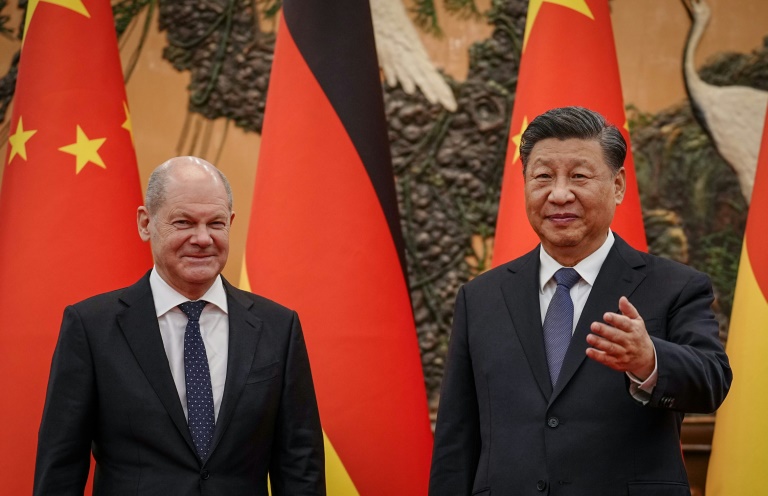
German Chancellor Olaf Scholz told Chinese leaders in Beijing on Friday that Berlin expected equal treatment on trade as he tried to drum up greater economic cooperation despite growing distrust of the Asian superpower in the West.

Scholz is under pressure to push Beijing to get tough on Russia over the war in Ukraine, and he said Friday that Germany and China had agreed they both opposed any use of nuclear weapons in the conflict.

The German chancellor is the first G7 leader to visit China since the start of the coronavirus pandemic, which led the world’s number two economy to close its borders and President Xi Jinping to largely eschew in-person diplomacy.

But his trip has prompted criticism at home over Berlin’s growing economic reliance on Beijing, and sparked controversy for coming so soon after Xi strengthened his hold on power in China just last month.

Tensions are also running high between the West and Beijing on issues ranging from Taiwan to alleged human rights abuses.

Scholz held talks with human rights lawyers critical of the regime in Beijing ahead of the trip, a source in his entourage told AFP.

Received by a smiling Xi at Beijing’s Great Hall of the People shortly after arriving, Scholz said he hoped to “further develop” economic cooperation — while alluding to areas of disagreement.

“It is good that we are able to have an exchange here about all questions, including those questions where we have different perspectives — that’s what an exchange is for,” Scholz said. 

“We also want to talk about how we can further develop our economic cooperation on other topics: climate change, food security, indebted countries.”

“Xi underscored the need for China and Germany, two major countries with great influence, to work together in times of change and instability and contribute more to global peace and development,” Beijing’s Xinhua News Agency reported.

Scholz also spoke with Chinese Premier Li Keqiang at a meeting in which he called for fair trade between the two countries. 

At a press briefing during which Chinese officials said there was “not enough time” for questions, Scholz urged Beijing to do more to “use its influence” on its ally Russia, currently engaged in a months-long war in Ukraine.

Both sides said they opposed the use of nuclear weapons in the conflict, with Scholz telling reporters: “Everyone says clearly that an escalation via the use of a tactical nuclear weapon is ruled out”.

China has steadfastly avoided criticising Russia for invading Ukraine and instead blames the United States and NATO for the war.

– ‘Keep doing business’ –

The German delegation of more than 60 people was met on the tarmac at Beijing airport by a military guard — as well as health workers in white hazmat suits who conducted mandatory PCR tests in buses converted into mobile laboratories. 

Scholz’s PCR test was taken in his plane by a German doctor he brought with him and supervised by Chinese health officials, according to the German government.

China’s economic importance is seen by some in Berlin as more crucial than ever, as Germany hurtles towards a recession battling an energy crisis triggered by the Ukraine war. 

China is a major market for German goods, from machinery to cars.

But German industry’s heavy dependence on China is facing fresh scrutiny after the over-reliance on Russian energy imports left it exposed when Moscow turned off the taps.

Scholz’s approach is still underpinned by the idea that “we want to keep doing business with China, no matter what that means for the dependence of our economy, and for our ability to act”, opposition lawmaker Norbert Roettgen told the Rheinische Post newspaper.

Concern about China has also come from within Germany’s ruling coalition, with Foreign Minister Annalena Baerbock saying past mistakes with Russia must not be repeated.

– ‘All the more important’ –

There are also concerns that the trip — coming on the heels of Xi securing a historic third term at a Communist Party Congress last month — may have unsettled the United States and the European Union.

“For Beijing, this is less about concrete outcomes and more about the symbolism of the German chancellor paying Xi a visit so soon after the party congress,” said Noah Barkin, visiting senior fellow in the Asia Program at the US German Marshall Fund.

“It gives international legitimacy to his leader-for-life status, and it shows that China is not isolated,” he added.

Berlin, however, says there have been consultations with key partners, and Scholz has insisted he is visiting China as a “European” as well as the leader of Germany.

In an article published before his departure, he said direct talks with Chinese leaders were “all the more important” after the long hiatus caused by the pandemic.

He promised to raise thorny topics such as respect for civil liberties and the rights of minorities in Xinjiang.

“We strongly agree with what he (Scholz) shared in that op-ed”, including “encouraging President Xi to press President Putin on never using a nuclear weapon of any kind”, US Secretary of State Antony Blinken said Friday after a meeting of G7 foreign ministers in Germany.
G7 steadfast on Ukraine, cautious on China at German meet

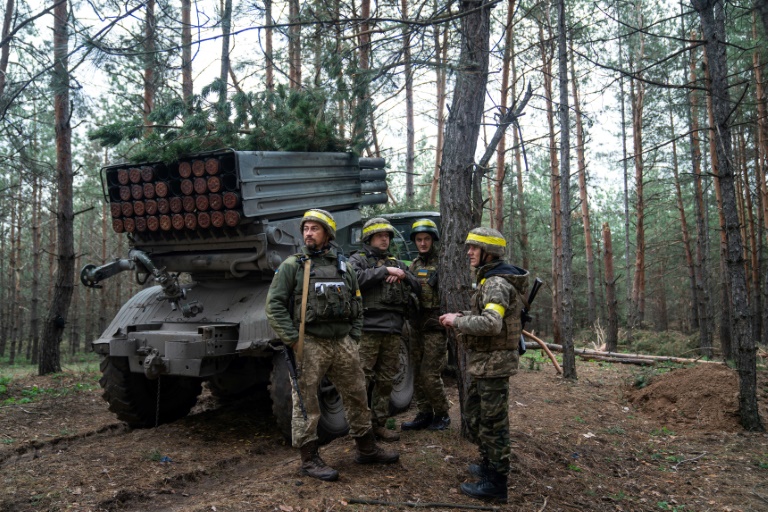
The Group of Seven foreign ministers on Friday vowed to continue supporting Ukraine in the fight against Russia and urged caution towards China after two days of talks in Germany.

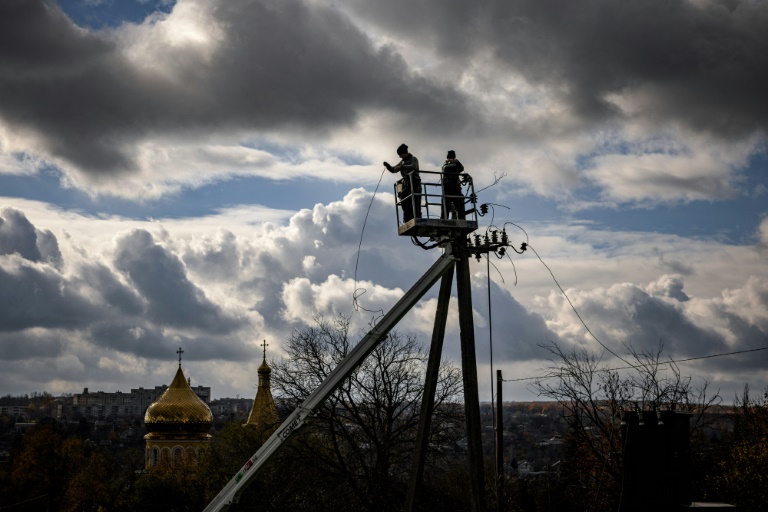
The G7 club of rich countries has agreed a new structure to funnel aid to Ukraine to help rebuild infrastructure targeted by Russia, the foreign ministers said in a statement.

“Today we establish a G7 coordination mechanism to help Ukraine repair, restore and defend its critical energy and water infrastructure,” they said after the talks in the western city of Muenster.

The ministers said Russia was trying to “terrorise the civilian population” of Ukraine with attacks against people and infrastructure, in particular energy and water facilities.

US Secretary of State Antony Blinken said Russian President Vladimir Putin appeared to have “decided that if he can’t seize Ukraine by force, he will try to freeze it into submission”.

German Foreign Minister Annalena Baerbock also reiterated the group’s backing for Ukraine and said “every single day of this war is one too many”.

“Every single day of this brutal attack on innocent people in Ukraine means suffering, death and destruction,” she said.

The G7 also expressed concern over Putin’s recent comments on nuclear weapons and warned any use of such arms would be met with “severe consequences”. 

“Russia’s irresponsible nuclear rhetoric is unacceptable,” they said, also rejecting Russia’s “false claims that Ukraine is preparing a radiological ‘dirty bomb'”.

– ‘Constructive cooperation’ –

Speaking to AFP on the sidelines of the talks, British foreign minister James Cleverly said the allies would help Ukraine “bring this conflict to a successful conclusion for however long that takes”.

China was also high on the agenda at the summit, which took place just as German Chancellor Olaf Scholz was on a controversial visit to Beijing.

Scholz told Chinese leaders on Friday that Berlin expected equal treatment on trade as he tried to drum up greater economic cooperation despite growing distrust of the Asian superpower in the West.

The G7 countries said they were ready for “constructive cooperation with China, where possible and in our interest”.

But at the same time, they called on Beijing to “act in accordance with its international commitments and legal obligations” and to “abstain from threats, coercion, intimidation, or the use of force”.

“We strongly oppose any unilateral attempts to change the status quo by force or coercion,” they said, in an allusion to Taiwan.

Blinken said the G7 nations were increasingly on the same page in their policy towards China.

“From everything that I’ve seen, including the conversations… with our German partners, as well as with all of our G7 partners, the convergence of the alignment on China is increasingly strong and increasingly clear,” he said.

– Iran rebuke –

Iran also figured at the gathering, with the ministers condemning Tehran’s “brutal and disproportionate” response to a wave of protests sparked by the death of young Kurdish woman Mahsa Amini.

The diplomats criticised Tehran’s “destabilising activities in and around the Middle East”, such as the transfer of weapons, including drones, “to state and non-state actors”.

“Such proliferation is destabilising for the region and escalates already high tensions,” they said.

The closing statement also criticised a record-breaking series of North Korean missile launches earlier this week that included a failed intercontinental ballistic missile test.

And in another nod to the fallout from the war in Ukraine, the ministers called on oil-producing states to increase production to help bring down prices, a month after OPEC+ decided to drastically reduce its output.

The G7 intends to finalise “in the coming weeks” the implementation of a Russian oil price cap mechanism, they said.

To round off the meeting, the ministers held talks with their Kenyan and Ghanaian counterparts, as well as representatives from the African Union.

The G7 includes Britain, Canada, France, Germany, Italy, Japan and the US. Germany is set to hand over the presidency of the club to Japan in 2023.

Surge in claims puts UK asylum system under pressure

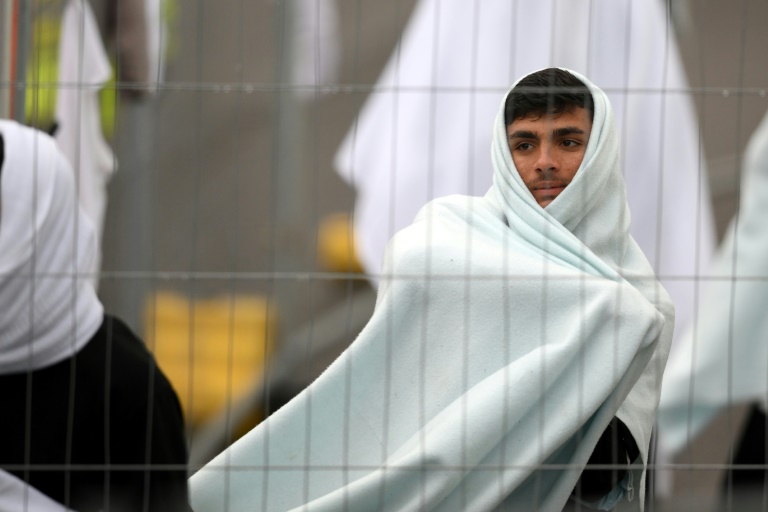
Britain is struggling to cope with an increase in asylum-seekers, as numbers risking their lives to cross the Channel on small boats hit record levels.

Overcrowded reception centres and long delays to process applications are causing a political headache for the government, which promised tighter immigration controls post-Brexit.

Several newspapers this week carried the image of a young girl running towards the fence of one facility to hand a scribbled message to journalists, criticising conditions inside.

Her note shone an unflattering light on the Manston reception centre in southeast England, where migrants are first taken for identity checks after their arrival, and the system.

Nearly 40,000 people — most of them Albanians, Iranians and Afghans — have been intercepted by patrols already this year, surpassing the total for the whole of the last 12 months.

Increased checks on ferries and lorries by French and British border police have forced desperate migrants onto unsuitable craft to cross one of the world’s busiest shipping lanes.

In all, more than 63,000 new asylum applications have been made in the year from June last year — the highest number since the record of more than 80,000 in 2002.

Both Britain’s current interior minister Suella Braverman and her predecessor Priti Patel have described the system as “broken”.

– 449 days –

According to official figures, an asylum-seeker in Britain now waits on average 449 days before getting a response to their application. 

For non-accompanied minors, the delay can even stretch to 550 days.

As a result, 166,085 applications are outstanding — double that in June 2020, four MPs told Braverman in a letter on Wednesday.

Peter Walsh, a researcher at the Migration Observatory at the University of Oxford, described the backlog of cases as “the central problem”.

“The reason, largely, is because asylum claims are being processed more slowly than they had been in the past,” he told AFP.

Walsh has calculated that the number of applications getting a first response within six months — the government’s official policy up to 2019 — fell from 87 percent in 2014 to just six percent in 2021.

Braverman has characterised the increasing number of asylum-seekers as an “invasion” that had paralysed the system, and said the state was faced with eye-watering costs for accommodation while applications are processed.

Her language was widely denounced as inflammatory and even earned a rebuke from the UN’s new human rights supremo.

But a parliamentary committee report published in June said the increasing pressures on the asylum system “are not… a direct consequence of increasing demand”, pointing instead to the processing of applications in Britain.

The MPs blamed “inappropriate” software to handle cases and “insufficient administrative and technical specialist staff”.

Walsh also pointed to “inadequately trained” staff and a high turnover of employees.

– Pressure –

In a sign of the workload, on September 4 this year, nearly 1,000 people were intercepted on small boats in the Channel and brought ashore.

The subject has come to the fore again this week after reports that some 4,000 people were being held at the Manston reception facility near Dover, when its capacity is 1,600.

Last Sunday, firebombs were thrown at another reception facility in Dover by a man who was later found dead.

Local lawmakers, campaigners supporting asylum-seekers and the political opposition are calling on the government to get a grip on the situation.

In the last few days, hundreds have been moved from Manston to hotels hastily reserved by the government.

Yet even here this has not gone smoothly: in Northallerton, northern England, Ukrainian refugees were forced to give up their hotel rooms for asylum-seekers from Manston, The Times reported.

Others were reportedly taken to central London and dropped off near Victoria railway station, forcing them to spend the night on the streets, several media outlets reported.

The government has denied the claim.

Schumacher's 2003 F1-winning Ferrari up for auction

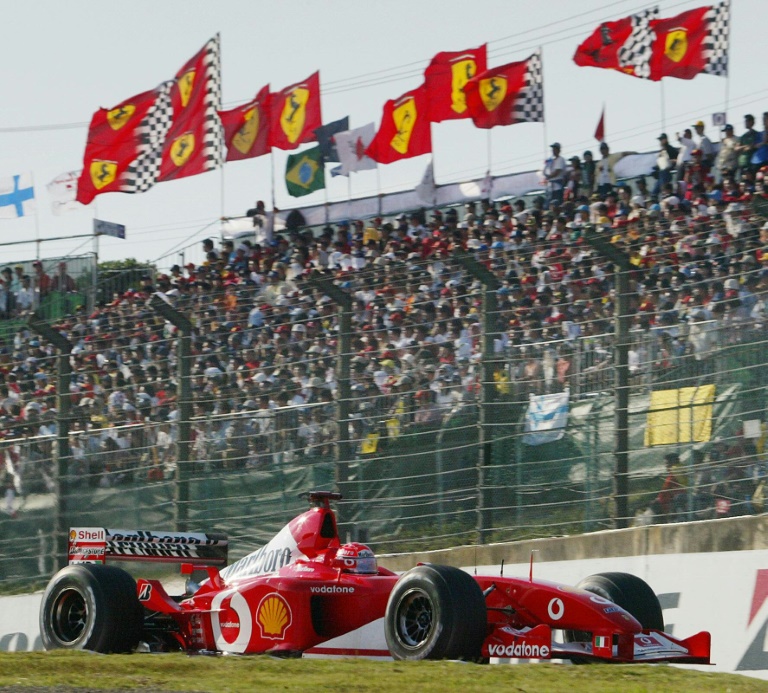
The Ferrari in which Formula One legend Michael Schumacher drove to the 2003 World Championship title is set to be auctioned by Sotheby’s on Wednesday.

The F2003-GA, Chassis 229 is estimated to fetch between 7.5 and 9.5 million Swiss francs ($7.6 and $9.6 million) when it goes on offer during the Sotheby’s Luxury Week of sales in Geneva.

It is “one of the most significant Formula One cars of all time”, the auctioneers said.

Schumacher raced nine times in the car, winning five Grands Prix in the 2003 season and driving it when he clinched the title in Japan.

“It’s one of the Ferraris with the most victories in the constructor’s history, so it’s a very important car in the history of motor racing,” Vincent Luzuy, from the Sotheby’s branch dealing with luxury car sales, told AFP.

Designed by Rory Byrne and Ross Brawn, the F2003-GA featured a longer wheelbase to improve aerodynamics, he explained.

It was brought in at the Spanish Grand Prix, the fifth race of the 2003 season. Chassis 229 is by far the most successful of the six F2003-GAs that were built.

Schumacher drove it to victory in Spain and also won the Austrian, Canadian, Italian and US Grands Prix in the car.

He also claimed pole position in Spain, Austria and Italy in the car, and the fastest laps in Austria, Italy and the United States.

– ‘Real pleasure’ –

The car powered Schumacher to his sixth F1 title — a total that saw the German overtake the five won by Argentina’s Juan Manuel Fangio in the 1950s.

It also helped Ferrari win a 13th constructor’s championship — the Italian team’s fifth in a row.

“It’s a real pleasure driving it,” Schumacher’s F1 driver son Mick said after giving the car a run around Ferrari’s Fiorano Circuit.

“It’s when the cars were sounding the nicest, driving the nicest,” he said, citing the three-litre V-10 engine.

Luzuy said such F1 cars were rare on the market.

“We’ve got quite a few interested collectors,” he said.

“In 2017 we sold a car from the 2001 season also driven by Schumacher. At the time, we estimated the car at $3.5 million and in the end it sold for $7.5 million, so it proves that there’s still a special interest in these cars, especially those with such a history,” he said.

The car was sold in New York to a US buyer.

Schumacher has not been seen in public since suffering serious injuries in skiing accident in 2013.

– Jewels up for grabs –

Sotheby’s Geneva Luxury Week kicked off on Friday, featuring a range of jewellery, watches, and designer handbags.

Jewellery enthusiasts can try to acquire a fancy vivid blue cushion-shaped diamond weighing 5.53 carats, which is estimated at 11 to 15 million Swiss francs.

It is part of the De Beers Exceptional Blue Collection — a group of eight rare fancy blue diamonds with a total value of more than $70 million, being sold in Geneva, New York and Hong Kong.

Another outstanding lot is a fine emerald and diamond bracelet from the 1850s from the collection of empress Eugenie (1826-1920), the wife of French emperor Napoleon III. It is estimated between 60,000 and 80,000 Swiss francs.

US blacklists two top Haiti politicians as 'drug traffickers'

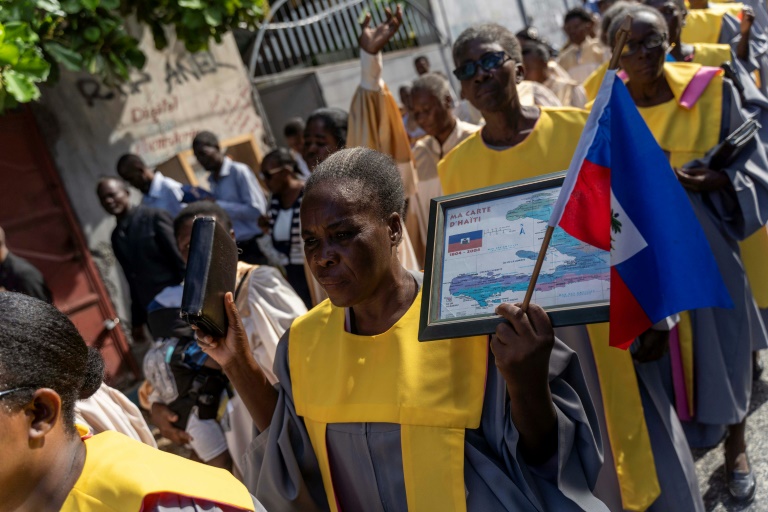
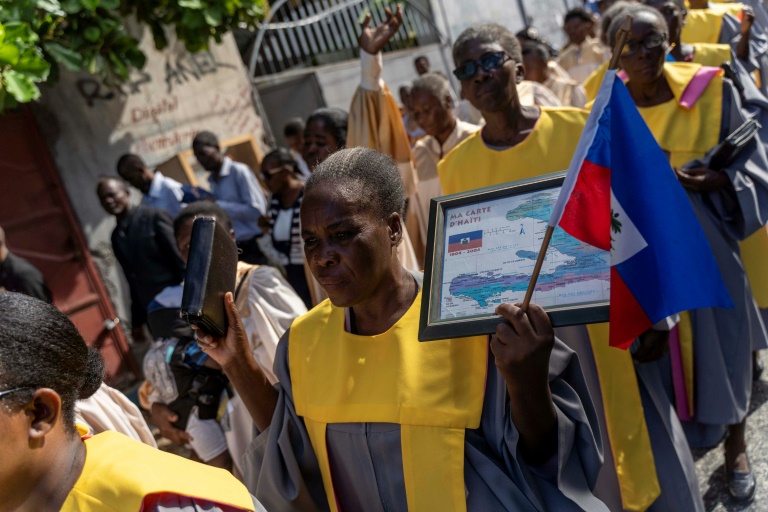
The United States imposed sanctions on two top Haitian politicians, former Senate President Joseph Lambert and former senator Youri Latortue, accusing them of being longtime drug traffickers.

The US Treasury said Lambert, who made a bid for the presidency last year, and Latortue, formerly a top security official, “have abused their official positions to traffic drugs and collaborated with criminal and gang networks to undermine the rule of law in Haiti.”

In a parallel statement placing Lambert on the State Department’s blacklist, Secretary of State Antony Blinken said the powerful politician was involved in “significant corruption and a gross violation of human rights.”

Blinken said there was also credible evidence that Lambert was behind an extrajudicial killing. 

The announcements, which said Canada was also sanctioning the two, came as the international community seeks to help the Haitian government restore order and regain control of crucial port facilities after a surge in gang violence.

Since mid-September armed gangs have virtually paralyzed Haiti, including blockading the most important oil terminal of the country, causing shortages of fuel and drinking water.

On Monday UN Secretary-General Antonio Guterres told the Security Council that it was urgent to act on a proposal to send an international peacekeeping force to Haiti to deal with the “nightmare” there.

John Kirby, spokesman for the White House’s National Security Council, said Friday that discussions were ongoing on a multinational force for Haiti. 

“We’re actively involved in talking with a variety of partners about what a force could look like,” he said.

“No decisions have been made about any one particular state participating,” he said, adding that the force would be restricted to “provision of humanitarian assistance.”

– Gangs and drugs –

Both Lambert and Latortue have been accused of close associations with gangs.

A classified 2006 US diplomatic memo leaked in 2010 by Wikileaks said Latortue “may well be the most brazenly corrupt of leading Haitian politicians.”

It identified him as the “first cousin once removed” of former prime minister Gerard Latortue.

The Treasury said Lambert and Latortue have long histories of drug trafficking.

Both were deeply involved in trafficking cocaine from Colombia and Haiti, gave protection to other traffickers, and ordered followers to carry out violent acts on their behalf.

“The United States and our international partners will continue to take action against those who facilitate drug trafficking, enable corruption, and seek to profit from instability in Haiti,” said Treasury Under Secretary Brian Nelson in a statement.

Kirby said US authorities “stand ready to take additional action as appropriate against other bad actors.”

Treasury sanctions seek to seize any assets that those named have under US jurisdiction and block any US individuals or entities, including international banks with US offices, from doing business with them.

The State Department designation generally bans them from entry into the United States. The State Department also blacklisted Lambert’s wife Jesula Lambert Domond.

US blacklists two top Haiti politicians as 'drug traffickers'

The United States imposed sanctions on two top Haitian politicians, former Senate President Joseph Lambert and former senator Youri Latortue, accusing them of being longtime drug traffickers.

The US Treasury said Lambert, who made a bid for the presidency last year, and Latortue, formerly a top security official, “have abused their official positions to traffic drugs and collaborated with criminal and gang networks to undermine the rule of law in Haiti.”

In a parallel statement placing Lambert on the State Department’s blacklist, Secretary of State Antony Blinken said the powerful politician was involved in “significant corruption and a gross violation of human rights.”

Blinken said there was also credible evidence that Lambert was behind an extrajudicial killing. 

The announcements, which said Canada was also sanctioning the two, came as the international community seeks to help the Haitian government restore order and regain control of crucial port facilities after a surge in gang violence.

Since mid-September armed gangs have virtually paralyzed Haiti, including blockading the most important oil terminal of the country, causing shortages of fuel and drinking water.

On Monday UN Secretary-General Antonio Guterres told the Security Council that it was urgent to act on a proposal to send an international peacekeeping force to Haiti to deal with the “nightmare” there.

John Kirby, spokesman for the White House’s National Security Council, said Friday that discussions were ongoing on a multinational force for Haiti. 

“We’re actively involved in talking with a variety of partners about what a force could look like,” he said.

“No decisions have been made about any one particular state participating,” he said, adding that the force would be restricted to “provision of humanitarian assistance.”

– Gangs and drugs –

Both Lambert and Latortue have been accused of close associations with gangs.

A classified 2006 US diplomatic memo leaked in 2010 by Wikileaks said Latortue “may well be the most brazenly corrupt of leading Haitian politicians.”

It identified him as the “first cousin once removed” of former prime minister Gerard Latortue.

The Treasury said Lambert and Latortue have long histories of drug trafficking.

Both were deeply involved in trafficking cocaine from Colombia and Haiti, gave protection to other traffickers, and ordered followers to carry out violent acts on their behalf.

“The United States and our international partners will continue to take action against those who facilitate drug trafficking, enable corruption, and seek to profit from instability in Haiti,” said Treasury Under Secretary Brian Nelson in a statement.

Kirby said US authorities “stand ready to take additional action as appropriate against other bad actors.”

Treasury sanctions seek to seize any assets that those named have under US jurisdiction and block any US individuals or entities, including international banks with US offices, from doing business with them.

The State Department designation generally bans them from entry into the United States. The State Department also blacklisted Lambert’s wife Jesula Lambert Domond.

From pigs to TVs: Ukrainians despair at looting as Russia retreats

From the rubble inside Kupiansk town hall, Olena salvages a chair, a screen: little was left when the Russians withdrew from this northeastern Ukrainian town, fuelling widespread allegations of systematic looting.

On February 27, three days after the war began, Kupiansk mayor Genadiy Matsehora agreed to surrender his town to the Russian army in exchange for a cessation of hostilities. 

And the town — a key rail hub located 50 kilometres (30 miles) from the border which had a pre-war population of 27,000 — remained under Russian occupation until September 10.

The mayor, a member of the Moscow-backed Opposition Platform-For Life party, was swiftly denounced by Kyiv for treason and has since fled to Russia. 

In Matsehora’s second-floor office, a pile of his business cards still lie on the desk, while on the floor is a torn poster of Russian President Vladimir Putin.

“This is where the man who the Russian occupiers appointed mayor used to sit,” says Olena, a local authority employee who is wearing earrings emblazoned with the blue-and-gold trident emblem of Ukraine. 

It’s the first time this young mother has been back to her workplace since the war began. 

“Those who wanted to come back to work had to wipe their feet on the Ukrainian flag and shout: ‘Thank you Russia, our liberators!’ while being filmed,” she said. 

Arrested by the Russians for five days in March, she refuses to give her surname for fear of a backlash against her family. 

After her arrest, she remained holed up inside her house, then took refuge in the cellar at the height of the fighting in September. 

Only when the town was liberated did she dare leave the cellar, only to find her house had been turned upside down. 

“They took my microwave, my washing machine and something that I just can’t explain: the water tank of my toilet. Not the toilet itself, just the water tank,” she told AFP.

– Mailing home the plunder? – 

Since the start of the invasion on February 24, there have been countless allegations of looting in areas occupied by Russian troops, suggesting a systematic approach rather than the odd misdemeanour by a handful of bad apples.

Ukrainian authorities have registered complaints from individuals and businesses who are hoping that one day they could be compensated in the context of any future war reparations paid out by Moscow.

In April, Belarusian investigative media group the Hajun Project, released CCTV footage from a parcel delivery service in the border town of Mazyr showing Russian soldiers sending home scores of packages.

Each parcel weighed between 50 and 450 kilogrammes (110 to 990 pounds), with more than two tonnes of goods shifted during the footage, which covered a period of more than three hours. 

In Kupiansk, which for months served as the headquarters for Russia’s civil-military administration, many residents took the looting in their stride, relieved to be spared arrest or torture at the hands of their occupiers.

– Pigs, cars and radiators – 

At the police station — which for now is housed in a temporary structure after its headquarters was flattened in the fighting — all complaints are duly registered. 

But at this stage, there are not enough resources to deal with the growing list of complaints, which will need to be processed for insurance purposes.

“The number of complaints after the occupation is huge,” senior investigator Oleksandr Gitselev told AFP. 

But he was unable to say how many complaints had been registered, with people also filing reports about property damage, albeit with little hope of compensation. 

“They mainly stole agricultural machinery, cars, grain and household appliances, among other things,” he explained. 

On one farm, “they even took pigs, probably to eat them,” Gitselev said. 

“They went into every house and helped themselves: televisions, screens, computers… and even bathroom parts or radiators,” he said. 

“What for? I’ve no idea. Maybe they don’t have these things back home.”

Stocks, oil prices rally on China hopes

Stock markets and oil prices rallied Friday on hopes China would roll back some of its economically-painful policies surrounding Covid.

Equities also got a boost from the latest US jobs data, which raised hopes of a soft landing of the economy despite rising interest rates.

“Asia markets bounced back strongly today on more unsubstantiated reports that the Chinese government is looking at a reopening strategy as it looks to navigate a path out of the straitjacket of its current zero-Covid policy,” said CMC Makets analyst Michael Hewson. 

“These reports, which still haven’t been confirmed in any official capacity, have prompted a huge relief rally in equity markets, despite concerns that any reopening is unlikely to happen in the immediate future, and the very real risk that it is merely a sucker’s rally,” he added.

The rally continued into Europe, where London, Paris and Frankfurt all rose at least two percent.

Wall Street stocks also shot higher at the opening bell, but much of the gains had evaporated by midday.

The optimism also lifted oil prices by more than four percent at one point as traders eyed rising demand for crude on the news out of China.

In foreign exchange, the dollar slid more than one percent against the euro despite the prospect of higher US interest rates.

The pound also won back some ground against the dollar, rising 1.2 percent a day after tumbling as the Bank of England said the UK economy could face a two-year-long recession that it believes has already begun.

The BoE on Thursday also lifted its main interest rate by 0.75 percentage points, the most in 33 years in efforts to contain runaway inflation.

The week also saw the Federal Reserve hike its key rate by the same amount, as central banks try to cool decades-high inflation.

The Fed has pointed to a still-strong labour market as a key reason for not shifting from aggressive rate-tightening.

The addition of 261,000 jobs last month, far more than economists had forecast, will likely reinforce the determination of policymakers to continue the hawkish policy.

That would normally see equities tumble as higher interest rates are bad for most businesses.

But the figures are “consistent with achieving a soft landing for the economy”, said market analyst Patrick O’Hare at Briefing.com.

Fed Chair Jerome Powell has indicated the central bank is willing to push the US economy into recession if necessary to tame inflation.

But Chris Beauchamp, chief market analyst at online trading platform IG, pointed to one indicator in the report that suggests a drop of 300,000 jobs was the reason why the unemployment rate inched higher.

“This might be a case of cherry-picking par excellence, but markets have taken it as the first sign that the hitherto-unstoppable US market is weakening, thus perhaps bringing forward the chances of that fabled Fed pivot we keep hearing so much about,” said Beauchamp.

Markets have been looking for any data that would help the Fed “pivot” away from its aggressive rate hikes.

– Key figures around 1530 GMT –

New York – Dow: UP 0.3 percent at 32,085.46 points

EURO STOXX 50: UP 2.7 percent at 3,688.33

London – FTSE 100: UP 2.0 percent at 7,334.84 (close)

Frankfurt – DAX: UP 2.5 percent at 13,459.85 (close)

Paris – CAC 40: UP 2.8 percent at 6,416.44 (close)

Tokyo – Nikkei 225: DOWN 1.7 percent at 27,199.74 (close)

Hong Kong – Hang Seng Index: UP 5.4 percent at 16,161.14 (close)

Shanghai – Composite: UP 2.4 percent at 3,070.80 (close)

Pound/dollar: UP at $1.1303 from $1.1160 Thursday

Euro/dollar: UP at $0.9911 from $0.9751

Dollar/yen: DOWN at 147.15 yen from 148.25 yen

Euro/pound: UNCHANGED at 87.73 pence

Brent North Sea crude: UP 3.0 percent at $97.50 per barrel

West Texas Intermediate: UP 3.7 percent at $91.41 per barrel

burs-rl/bp

Imran Khan claims Pakistan PM Sharif had role in plot to kill him

Former Pakistan prime minister Imran Khan on Friday accused his successor of involvement in a plot to kill him as he recovered in hospital from gunshot wounds following an assassination attempt.

Khan told reporters that Shehbaz Sharif, who replaced him as premier following a vote of no confidence in April, masterminded the attack along with Interior Minister Rana Sanaullah and a senior army commander.

“These three decided to kill me,” Khan said in his first public appearance since Thursday’s shooting, adding that two gunmen were involved.

The government has denied any part, and blamed the assassination attempt on a lone assailant fueled by religious extremism.

The attack on Khan’s convoy killed one man and wounded at least 10, significantly raising the stakes in a political crisis that has gripped the South Asian nation since Khan’s ousting.

The 70-year-old former international cricket star had been leading a campaign convoy of thousands since last week from Lahore to the capital Islamabad.

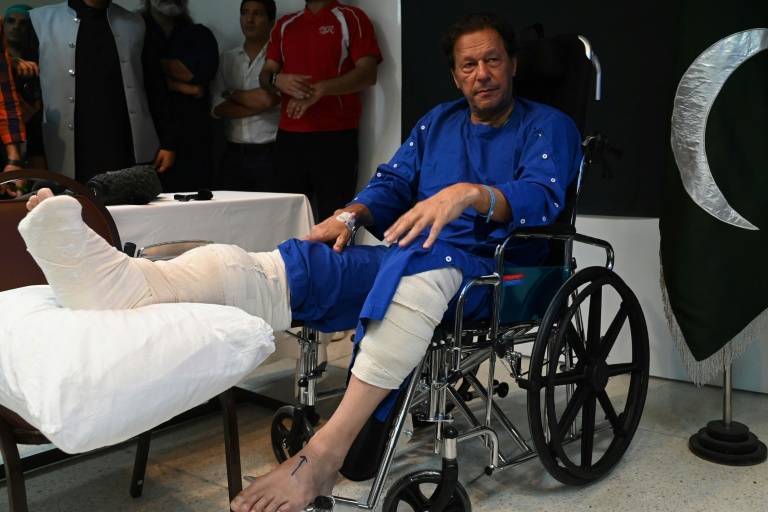
Sitting in a wheelchair — his right leg in a cast and left leg heavily bandaged — Khan spoke for over an hour, railing against the government and establishment he accuses of unseating him. 

He said his opponents wanted to accuse him of “desecrating religion, or desecrating the prophet” and would then blame a religious extremist for killing him.

Khan offered no evidence to support his claims.

Sanaullah had earlier said the attack was “a very clear case of religious extremism”.

The suspect in police custody, named by Punjab government officials as Naveed Ahmad, said in a video leaked by police to the media that Khan was “misleading the public”.

He added he was angry with Khan’s noisy convoy for interrupting the call to prayer that summons Muslims to the mosque five times a day.

Khan was looking out at the crowd when bullets were sprayed at his modified container truck as it slowly inched through a thick crowd in Wazirabad, around 170 kilometres (105 miles) east of Islamabad.

“Bullets hit my leg, and when I was falling there was another burst,” Khan told reporters. 

“There were two men. Had they synchronised well, I would have not survived.

“One of them was caught and he is being touted as a religious fanatic. He was not a religious fanatic — there was an elaborate plan behind this.”

– Threats –

Naveed Ahmad, the man in custody, comes from a poor village near the rally site where Khan was shot.

Neighbours told AFP the father was a “simple boy” with no obvious religious or political leanings.

Pakistan has long grappled with Islamist militancy, with right-wing religious groups having huge sway over the population.

Khan has previously been accused of stoking religious sentiments to broaden his support base.

Pakistan has been no stranger to assassination attempts during decades of political instability, and the powerful military has led the country several times.

Pakistan’s first prime minister, Liaquat Ali Khan, was shot dead at a rally in Rawalpindi in 1951. 

Another former prime minister, Benazir Bhutto, was killed in 2007 when a huge bomb detonated near her vehicle as she greeted supporters in the city of Rawalpindi.

– ‘I’ll hit the streets again’ –

Khan was booted from office in April by a no-confidence vote after defections by some of his coalition partners, but he retains huge support.

He was voted into power in 2018 on an anti-corruption platform by an electorate tired of dynastic politics, but his mishandling of the economy — and falling out with a military accused of helping his rise — sealed his fate.

Since then, he has railed against the establishment and Sharif’s government, which he says was imposed on Pakistan by a “conspiracy” involving the United States.

Khan and Sharif have for months traded bitter accusations of corruption and incompetence, raising the political temperature in a nation that is frequently at boiling point.

Khan said he would resume his so-called “long march” on the capital when he had recovered from his wounds.

“One bullet hit the upper part of my leg, one bullet passed near my main artery and another stopped near it,” he said, calling his survival “mercy from Allah”.

“The day I’m well, I’ll hit the streets again.”

Earlier Friday, scattered protests broke out around the country after afternoon prayers, the most important of the week, with police deploying tear gas in several cities to control crowds.

Raisi dismisses Biden 'free Iran' pledge after protest surge

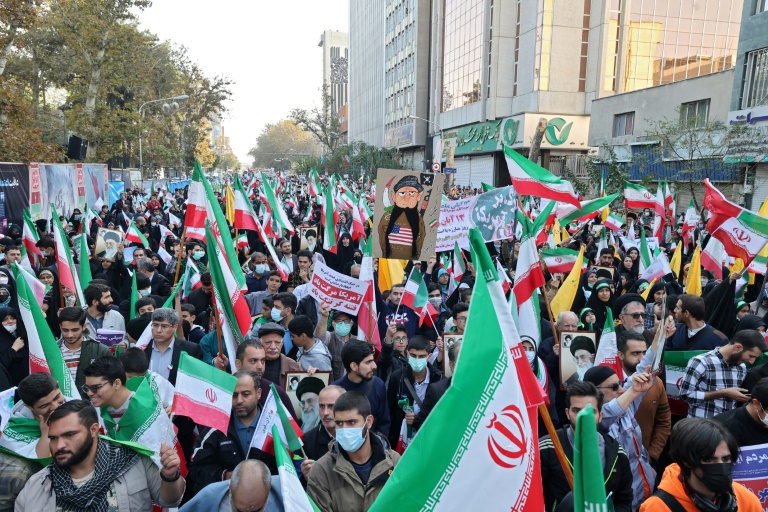
Iranian President Ebrahim Raisi on Friday dismissed a pledge from US leader Joe Biden to “free Iran” as the clerical regime faced a new upsurge in seven weeks of protests.

The protests began after the September 16 death of Mahsa Amini who had been arrested by the morality police. In their scale, nationwide spread and anti-regime nature, the demonstrations have become the biggest challenge from the street to the authorities since the 1979 revolution.

Campaigning for mid-term elections in the United States, Biden had said: “Don’t worry we’re gonna free Iran. They’re gonna free themselves pretty soon.”

Raisi retorted that Iran had already been freed by the overthrow of the Western-backed shah in 1979. He quipped that Biden’s memory lapse was “probably due to the absent-mindedness that he suffers from”.

“Our young men and young women are determined and we will never allow you to carry out your satanic desires,” he told a gathering commemorating the November 1979 seizure of the US embassy in Tehran by radical students.

– ‘Brutal and disproportionate’ –

The problems for Iran’s system under supreme leader Ayatollah Ali Khamenei, 83, are compounded by the tradition of holding mourning ceremonies 40 days after a death, meaning each death can spark new protests six weeks on.

Thursday had seen fierce clashes between protesters and security forces at such a ceremony in Karaj outside Tehran, which according to state media resulted in the deaths of one member of Iran’s Basij paramilitary force and two other unidentified people.

On Friday, mourners in Iran’s third largest city Isfahan chanted anti-government slogans at the 40-day ceremony for Shirin Alizadeh, 36, who was shot dead in her car on September 21 while filming a protest on the Caspian Sea coast.

However security forces opened fire in a bid to prevent the ceremony from taking place, the 1500tasvir monitoring channel said. 

Human rights group Amnesty International said it was told by witnesses that security forces had fired metal pellets and tear gas to disperse mourners and several bereaved relatives had been wounded.

In a statement after talks in Germany, G7 foreign ministers condemned “the brutal and disproportionate use of force against peaceful protesters.”

According to an updated death toll issued Wednesday by Norway-based Iran Human Rights, 176 people have been killed in the security forces’ response to protests sparked by Amini’s death.

Another 101 people have lost their lives in separate protests in the southeastern province of Sistan-Baluchistan.

In a new flare-up in the mainly Sunni Muslim province after the killing of a Shiite cleric this week, security forces fired on protesters in the town of Khash, south of provincial capital Zahedan, killing at least one and wounding many more, NGOs said.

The official IRNA news agency said several police had been wounded by stone-throwing protesters who set fire to a police patrol post.

– Mass arrests –

Mass arrests have seen 1,000 people charged so far and activists say many risk the death penalty.

According to the New York-based Committee to Protect Journalists (CPJ), 54 journalists have been arrested, with a dozen confirmed released on bail so far.

The latest confirmed to be held is Nazila Maroufian, a Tehran-based journalist from Amini’s hometown of Saqez in Kurdistan province, who was detained on Sunday, the Norway-based Hengaw rights group said.

She had published an interview with Amini’s father in defiance of warnings from the authorities, the journalist wrote on Twitter before her arrest.

According to Hengaw, Saman Yasin, a singer from the Kurdish-populated city of Kermanshah in western Iran who was arrested in October, has now been charged with “waging war against God”. 

The charge, which carries the death penalty, is based on Islamic sharia law and frequently used against opponents of the Iranian authorities. Hengaw said Yasin has supported the protests in songs and on social media.

Activists meanwhile condemned as a forced confession a video published by Iran’s state-run media of Toomaj Salehi, a prominent rapper arrested at the weekend after backing the protests.

The video shows a blindfolded man, who says he is Salehi, admitting to making “a mistake”. 

There is also growing concern about the well-being of Wall Street Journal contributor and freedom of expression campaigner Hossein Ronaghi, who was arrested in September.

According to his family, he is on hunger strike after sustaining two broken legs in custody.

Close Bitnami banner
Bitnami