World

World on 'precipice', says Pope as he meets grand imam in Bahrain

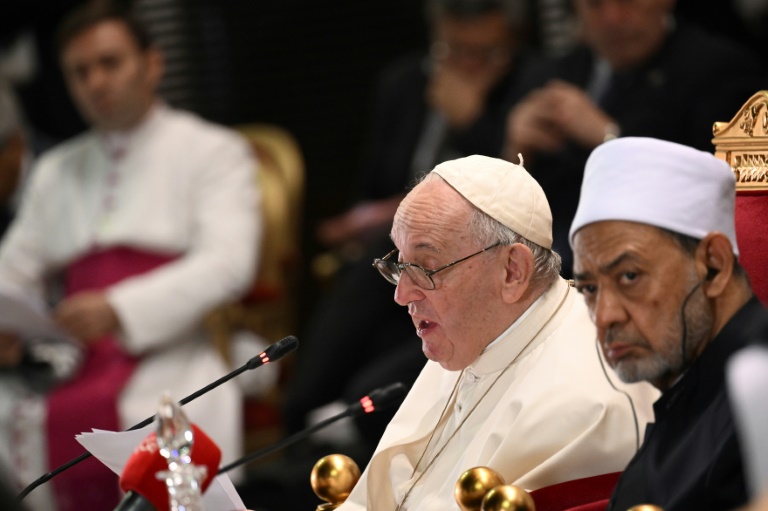
Pope Francis warned the world is on the edge of a “delicate precipice” and buffeted by “winds of war” as he held inter-faith talks with one of Sunni Islam’s top leaders in Bahrain on Friday.

The 85-year-old Argentine decried the “opposing blocs” of East and West, a veiled reference to the standoff over Russia’s invasion of Ukraine, in a speech to religious leaders in the tiny Gulf state.

“We continue to find ourselves on the brink of a delicate precipice and we do not want to fall,” he told an audience including Bahrain’s king and Sheikh Ahmed al-Tayeb, the grand imam of Cairo’s prestigious Al-Azhar mosque.

“A few potentates are caught up in a resolute struggle for partisan interests, reviving obsolete rhetoric, redesigning spheres of influence and opposing blocs,” he added. 

“We appear to be witnessing a dramatic and childlike scenario: in the garden of humanity, instead of cultivating our surroundings, we are playing instead with fire, missiles and bombs.”

While most of his engagements so far had been with senior officials, on Friday afternoon he led an ecumenical service in a new cathedral near Manama, attended by hundreds of migrant workers.

The pope’s visit, aimed at strengthening relations with Islam, comes with the Ukraine war in its ninth month, and as tensions grow on the Korean peninsula and in the Taiwan Strait.

Vatican Secretary of State Cardinal Pietro Parolin, who met Russia’s Foreign Minister Sergei Lavrov in September, told journalists that there had been “a few small signs” of progress in negotiations with Moscow, warning that peace initiatives should not be “exploited for other goals”.

Francis, who is on his second visit to the wealthy Gulf, later met privately with al-Tayeb, with whom he signed a Muslim-Christian manifesto for peace in the United Arab Emirates in 2019.

“This meeting has great symbolic importance, both locally and internationally, for promoting peace and peaceful co-existence between different religions and civilisations,” said Hala Ramzi Fayez, a Christian and member of Bahrain’s parliament.

– Sunni, Shiite talks? –

Leader of the world’s 1.3 billion Catholics, Francis has placed inter-faith dialogue at the heart of his papacy, visiting other Muslim-majority countries including Egypt, Turkey and Iraq.

Al-Tayeb, who met with the pope on previous Middle East visits, also called on Friday for talks between Islam’s two main branches, Sunni and Shiite, to settle sectarian differences.

Later, the pope addressed 17 members of the Muslim Council of Elders, an international group of Islamic scholars and dignitaries, at the mosque of the Sakhir Royal Palace.

He told them dialogue was “the oxygen of peaceful coexistence”.

“In a world that is increasingly wounded and divided, that beneath the surface of globalisation senses anxiety and fear, the great religious traditions must be the heart that unites the members of the body,” he said.

He also struck out at the arms trade, a “commerce of death” that he said was “turning our common home into one great arsenal”.

The pope, who is using a wheelchair and a walking stick due to chronic knee problems, later addressed Christians at the ultra-modern, 2,000-seat Our Lady of Arabia Cathedral in Awali.

The congregation, including many migrant workers living in the kingdom, applauded and filmed on mobile phones as he was wheeled into the octagonal hall, its walls decorated with icons.

The pope was flanked by senior clergy of different sects as he delivered an address calling for unity among Christians.

– ‘Blessed’ –

Charma, a 45-year-old real estate agent from the Philippines who has been working in Bahrain for 18 years, said seeing the pontiff was a “once in a lifetime” experience.

“It’s a great feeling, I feel blessed to see him personally because I’m here at this event,” she said, with tears in her eyes.

The pope had began the first papal visit to Bahrain on Thursday by hitting out at the death penalty and urging respect for human rights and better conditions for workers.

Bahrain’s finance minister Sheikh Salman bin Khalifa Al-Khalifa insisted the country has “led the region” with its criminal justice reforms.

“We have some of the most robust and wide-ranging human rights and criminal justice protections in the region,” the minister told AFP on Friday.

“There are very well-established channels through which any of these critics can go, well established institutions of accountability,” he said, adding that the pope’s comments on the death penalty did not single out Bahrain.

“It is important to note that that reference… was a general reference to countries around the world,” the minister said. 

Bahrain has executed six people since 2017, when it carried out its first execution in seven years. Some of the condemned were convicted following a 2011 uprising put down with military support from neighbouring Saudi Arabia.

Tigray rebels accuse Ethiopia of attacks after peace deal

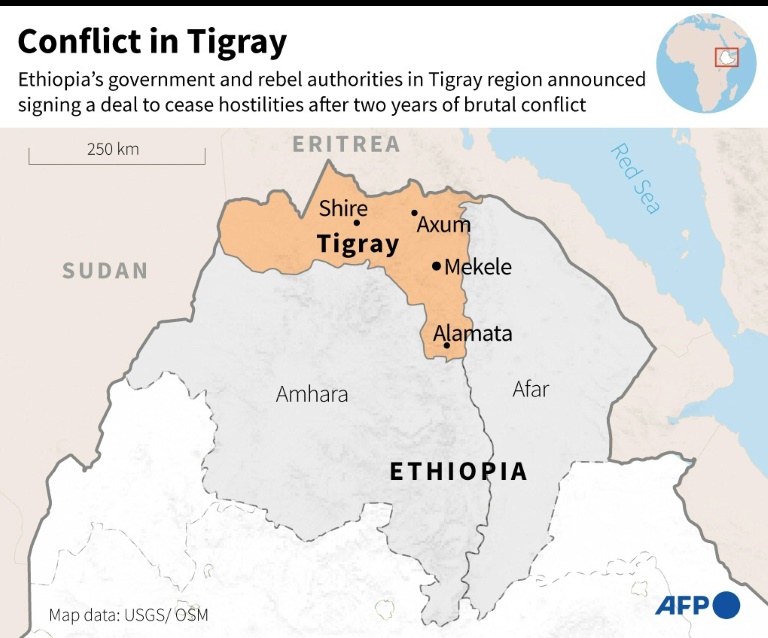
Tigrayan authorities on Friday accused Ethiopia’s government of carrying out a drone strike on civilians, less than 48 hours after the warring parties signed a deal to end their bloody conflict.

The breakthrough agreement sealed in South Africa has been hailed internationally as a key step towards stopping a war that began exactly two years ago on Friday.

A spokesman for the rebel Tigray People’s Liberation Front (TPLF) alleged that Prime Minister Abiy Ahmed’s government had carried out attacks against civilians in the Tigrayan city of Maychew on Thursday.

“According to sources at Lemlem-Karl Hospital, drone of #Ethiopia has attacked civilians,” Kindeya Gebrehiwot said on Twitter.

He said there was artillery shelling “in the same city that killed & wounded civilians. This happens after signing the peace agreement at #Pretoria”.

AFP was not able to independently verify the claims.

Access to northern Ethiopia is severely restricted and Tigray has been under a communications blackout for more than a year.

There was no immediate response from Ethiopian government officials or the African Union (AU) to requests from AFP.

But Abiy’s national security adviser Redwan Hussein, who headed the government’s negotiating team, said the prime minister had presided over a briefing for ministers, regional leaders and party officials on Friday to discuss the deal and “focus on dividends of peace”.

Ethiopia’s government “remains committed to the peace agreement,” he said on Twitter.

The deal signed on Wednesday says both sides agreed “to permanently silence the guns” and to a “programme of disarmament, demobilisation, and reintegration for the TPLF combatants”.

But observers say that key details and a clear roadmap that would help sustain momentum are absent, and distrust runs deep.

– ‘Very difficult’ –

Even as the AU-led negotiations began in Pretoria last week, fierce fighting was under way in Tigray between TPLF fighters and federal forces backed by soldiers from neighbouring Eritrea.

Ethiopia’s northernmost region has been in the throes of a severe humanitarian crisis due to lack of food and medicine, as well as limited access to basic services. 

Observers and diplomats have warned of the difficult road ahead, with the EU’s foreign policy chief Josep Borrell on Friday saying that arriving at a permanent ceasefire was “going to be very difficult”.

Speaking to reporters on the sidelines of the G7 foreign ministers’ meeting in the German city of Muenster, Borrell acknowledged that the agreement was “good news”, but cautioned: “Making peace is much more difficult than making war.”

“The world is looking at Ukraine and blaming Russia. But Ethiopia is for sure the worst humanitarian crisis… and war in the last two years,” Borrell said.

Abiy, a Nobel Peace Prize laureate, sent troops into Tigray on November 4, 2020 to topple the TPLF, the region’s ruling party, in response to what he said were attacks on federal army camps.

Twitter mass layoffs begin as Musk launches overhaul

Thousands of Twitter employees were ordered to stay home Friday to await a bracing round of layoffs that could see half of the payroll axed as new owner Elon Musk launches his major overhaul of the company.

A company-wide email seen by AFP said Twitter employees would receive word on their future at the company via email at the start of business Friday, California time.

The cull is part of Musk’s push to find ways to pay for the mammoth $44 billion deal for which he took on billions of dollars in debt and sold $15.5 billion worth of Tesla shares, his electric car company.

Musk, the Tesla and SpaceX chief, has been scrambling to find new ways for Twitter to make money after his mammoth buyout, including an idea to charge users $8 a month for verified accounts.

The moves would help overcome the potential loss of advertisers, Twitter’s main source of revenue, with many of the world’s top brands putting their ad buys on hold, spooked by Musk’s well-known disdain for content moderation.

The mercurial tycoon on Friday complained on Twitter of a “massive drop in revenue” that he blamed on “activist groups” that were pressuring advertisers.

“We did everything we could to appease the activists. Extremely messed up! They’re trying to destroy free speech in America,” he added.

This appeared to refer to Musk’s recent meeting with civil rights groups in which he heard concerns that Twitter would open the floodgates to hate speech.

In an effort to soothe nerves, Musk had vowed that Twitter will not become a “free-for-all hellscape”, but his pledge was quickly followed by a tweet relaying a conspiracy theory about an assault on the husband of the US House Speaker.

Though extremely influential with opinion-makers and celebrities, the California company has long struggled to generate profit and has failed to keep pace with Facebook, Instagram and TikTok in gaining new users.

“In an effort to place Twitter on a healthy path, we will go through the difficult process of reducing our global workforce,” the company email said.

The email did not give a number but the Washington Post and New York Times reported that about half of Twitter’s 7,500 employees — mostly based in San Francisco — will be let go.

– ‘Return home’ –

The company said that in order to “ensure the safety” of employees and sensitive data, the main offices would remain closed and all badge access suspended.

“Those on the way to the office should turn around and return home,” the email added.

It also said that those still employed at the company would find out on their company email, while those shown the door would get notice on their personal email.

Some workers had already begun to learn their fates and took to Twitter to say goodbye to colleagues.

“Spoiler Alert: I do not have a job,” tweeted ex-employee Blake Herzinger as others reported losing access to company servers and email accounts.

Twitter employees have been bracing for this kind of bad news since Musk completed his acquisition late last week and quickly set about dissolving its board and firing its chief executive and top managers.

Late on Thursday, a group of five Twitter employees who had already been fired filed a class action complaint against the company on the grounds that they had not been given the required 60-day notice period as required by law.

The lawsuit references the US Worker Adjustment and Retraining Notification (WARN) Act, which provides workers a right to advance notice in cases of mass layoffs or plant closings.

Twitter mass layoffs begin as Musk launches overhaul

Thousands of Twitter employees were ordered to stay home Friday to await a bracing round of layoffs that could see half of the payroll axed as new owner Elon Musk launches his major overhaul of the company.

A company-wide email seen by AFP said Twitter employees would receive word on their future at the company via email at the start of business Friday, California time.

The cull is part of Musk’s push to find ways to pay for the mammoth $44 billion deal for which he took on billions of dollars in debt and sold $15.5 billion worth of Tesla shares, his electric car company.

Musk, the Tesla and SpaceX chief, has been scrambling to find new ways for Twitter to make money after his mammoth buyout, including an idea to charge users $8 a month for verified accounts.

The moves would help overcome the potential loss of advertisers, Twitter’s main source of revenue, with many of the world’s top brands putting their ad buys on hold, spooked by Musk’s well-known disdain for content moderation.

The mercurial tycoon on Friday complained on Twitter of a “massive drop in revenue” that he blamed on “activist groups” that were pressuring advertisers.

“We did everything we could to appease the activists. Extremely messed up! They’re trying to destroy free speech in America,” he added.

This appeared to refer to Musk’s recent meeting with civil rights groups in which he heard concerns that Twitter would open the floodgates to hate speech.

In an effort to soothe nerves, Musk had vowed that Twitter will not become a “free-for-all hellscape”, but his pledge was quickly followed by a tweet relaying a conspiracy theory about an assault on the husband of the US House Speaker.

Though extremely influential with opinion-makers and celebrities, the California company has long struggled to generate profit and has failed to keep pace with Facebook, Instagram and TikTok in gaining new users.

“In an effort to place Twitter on a healthy path, we will go through the difficult process of reducing our global workforce,” the company email said.

The email did not give a number but the Washington Post and New York Times reported that about half of Twitter’s 7,500 employees — mostly based in San Francisco — will be let go.

– ‘Return home’ –

The company said that in order to “ensure the safety” of employees and sensitive data, the main offices would remain closed and all badge access suspended.

“Those on the way to the office should turn around and return home,” the email added.

It also said that those still employed at the company would find out on their company email, while those shown the door would get notice on their personal email.

Some workers had already begun to learn their fates and took to Twitter to say goodbye to colleagues.

“Spoiler Alert: I do not have a job,” tweeted ex-employee Blake Herzinger as others reported losing access to company servers and email accounts.

Twitter employees have been bracing for this kind of bad news since Musk completed his acquisition late last week and quickly set about dissolving its board and firing its chief executive and top managers.

Late on Thursday, a group of five Twitter employees who had already been fired filed a class action complaint against the company on the grounds that they had not been given the required 60-day notice period as required by law.

The lawsuit references the US Worker Adjustment and Retraining Notification (WARN) Act, which provides workers a right to advance notice in cases of mass layoffs or plant closings.

Imran Khan says Pakistan PM Shehbaz Sharif involved in plot to kill him

Former Pakistan prime minister Imran Khan accused his successor Friday of involvement in a plot to kill him as he recovered in hospital from gunshot wounds following an assassination attempt.

Khan told reporters that Shehbaz Sharif, who replaced him as premier following a vote of no confidence in April, was involved in a plot that included Interior Minister Rana Sanaullah and a senior army commander.

“These three decided to kill me,” Khan said in his first public appearance since Thursday’s attack, adding that two gunman were involved.

The government has denied any part, and blamed the assassination attempt on a gunman fueled by religious extremism.

The attack on Khan’s convoy killed one man and wounded at least 10, significantly raising the stakes in a political crisis that has gripped the South Asian nation since Khan’s ousting in April.

The 70-year-old former international cricket star had been leading a campaign convoy of thousands since last week from Lahore to the capital Islamabad.

Sitting in a wheelchair — his right leg in a cast and left leg heavily bandaged — Khan spoke for over an hour, railing against the government and establishment he accuses of unseating him.

Earlier, scattered protests broke out around the country after Friday afternoon prayers, the most important of the week, with police deploying tear gas in several cities to control crowds.

Khan was looking out at the crowd when bullets were sprayed at his modified container truck as it slowly inched through a thick crowd in Wazirabad, around 170 kilometres (105 miles) east of Islamabad.

“Everyone who was standing in the very front row got hit,” former information minister Fawad Chaudhry, who was standing behind Khan, told AFP earlier.

One gunman was tackled by a supporter, preventing more injuries, he added.

A suspect was taken into police custody and a video which appears to be a confession to police was leaked to the media, in which he says Khan was “misleading the public”.

He adds that he was angry with the noisy procession for interrupting the call to prayer that summons Muslims to the mosque five times a day.

Interior Minister Sanaullah said the attack was “a very clear case of religious extremism”.

“The allegations made by the accused in the video are very alarming and very terrifying,” he said at a press conference.

– Threats –

The accused, named by Punjab government officials as Naveed Ahmad, comes from a poor village near the rally site where Khan was shot.

Neighbours told AFP the father was a “simple boy” with no obvious religious or political leanings.

Pakistan has long grappled with Islamist militancy, with right-wing religious groups having huge sway over the population.

Khan has previously been accused of stoking religious sentiments to broaden his support base.

Pakistan has been no stranger to assassination attempts during decades of political instability, and the powerful military has led the country several times.

Pakistan’s first prime minister, Liaquat Ali Khan, was shot dead at a rally in Rawalpindi in 1951. Another former prime minister, Benazir Bhutto, was killed in 2007 when a huge bomb detonated near her vehicle as she greeted supporters in the city of Rawalpindi.

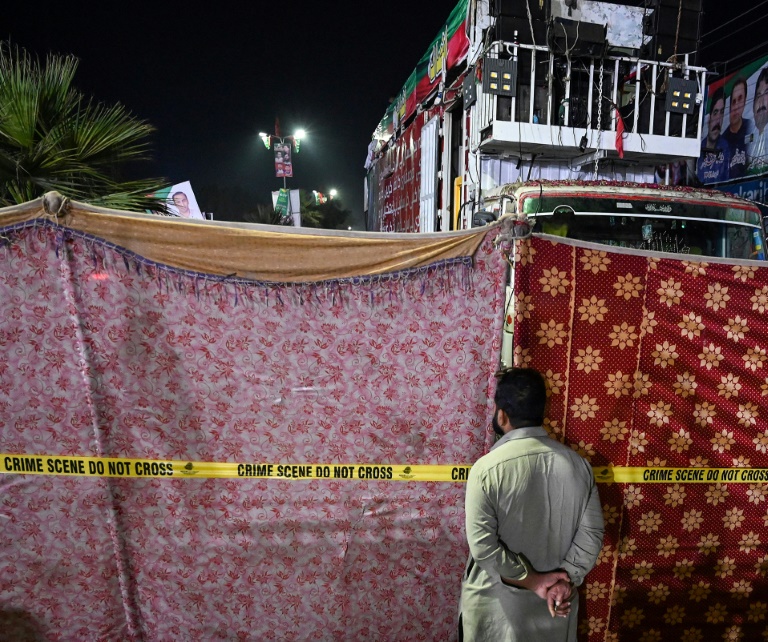
Khan’s campaign truck has become a crime scene for now, cordoned off and guarded by commandos as forensic experts comb the area.

– Khan booted from power –

Khan was booted from office in April by a no-confidence vote after defections by some of his coalition partners, but he retains huge support.

He was voted into power in 2018 on an anti-corruption platform by an electorate tired of dynastic politics, but his mishandling of the economy — and falling out with a military accused of helping his rise — sealed his fate.

Since then, he has railed against the establishment and Sharif’s government, which he says was imposed on Pakistan by a “conspiracy” involving the United States.

Khan and Shehbaz have for months traded bitter accusations of corruption and incompetence, raising the political temperature in a nation that is frequently at boiling point.

Khan has repeatedly told supporters he was prepared to die for the country, and aides have long warned of unspecified threats made on his life.

The attack drew international condemnation including from the United States, which had uneasy relations with Khan when he was in power.

“Violence has no place in politics, and we call on all parties to refrain from violence, harassment and intimidation,” US Secretary of State Antony Blinken said in a statement.

Trump signals 2024 run as Democrats brace for punishing midterms

Donald Trump is planning to ride a wave of Republican victories in next week’s midterm elections by announcing a run for the presidency, US media reported Friday, as Democrats braced for a punishing night even in the most liberal corners of America.

The one-term president has hinted for almost two years a potential third tilt at the White House after losing to Joe Biden, but aides are firming up plans for an announcement on November 14, according to Axios.

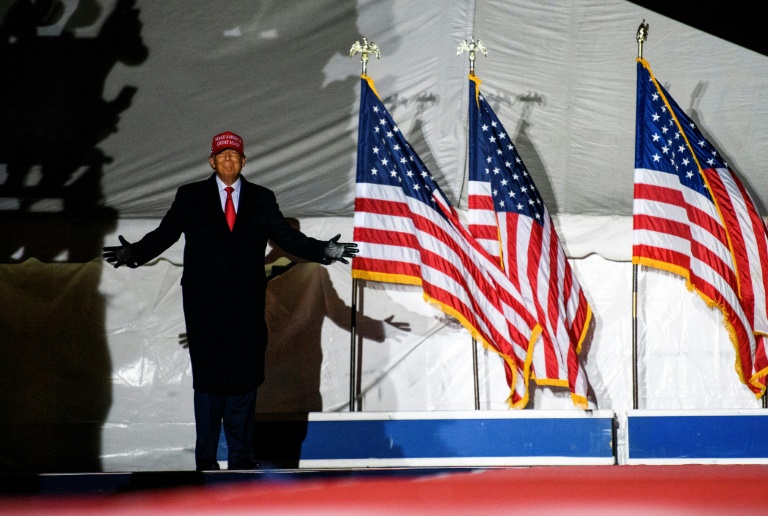
Trump sent his clearest signal yet that he intends to announce his 2024 candidacy soon, as he addressed a rally Thursday in Iowa, the first state to hold its Republican nominating contest in presidential elections. 

“In order to make our country successful and safe and glorious, I will very, very, very probably do it again, OK? Very, very, very probably,” Trump teased to rapt applause at the event in Sioux City. 

“Get ready. That’s all I’m telling you. Very soon. Get ready. Get ready.”

Trump’s remarks came with polling pointing to a re-emerging “red wave” that will likely see the tycoon’s party dismantling the Democrats’ razor-thin majority in the House and possibly retaking the Senate.

Republicans are confident they can flip the one state they need for the upper chamber and are expecting gains in the House of 12 to 25 seats, easily enough to overcome the Democrats’ eight-member advantage.

– ‘I’ve got a plan’ –

The final weeks of the campaign have seen bullish Republicans even looking beyond the country’s swing states to Democratic bastions that once looked out of reach. 

Strategists from both parties are seeing districts across New York, Oregon and Connecticut that went for Biden by double digits in 2020 coming back into play. 

Hillary Clinton campaigned on Thursday in New York to boost the faltering fortunes of Governor Kathy Hochul while former president Barack Obama speaks in Pennsylvania Saturday.

With Democrats being dragged down by Biden’s underwater approval ratings, particularly on inflation, the president was due to pitch his party as the choice for growth and innovation at a tour of a San Diego communications company later Friday. 

Ahead of the visit, Biden hailed new figures for October showing the economy adding 261,000 jobs and unemployment at low levels.

“I’ve got a plan to bring costs down, especially for health care, energy, and other everyday expenses… The Republican plan is very different,” he said in a statement. 

“They want to increase prescription drug costs, health insurance costs, and energy costs, while giving more tax breaks to big corporations and the very wealthy.”

– ‘Speculation and rumors’ –

In one glimmer of hope for the Democrats, Oprah Winfrey endorsed Pennsylvania Senate candidate John Fetterman during a virtual get-out-the-vote event Thursday.

It was a notable snub of Fetterman’s Republican rival, celebrity surgeon Mehmet Oz, who rose to fame largely through appearances on Winfrey’s show. 

But with the Republicans confident of flipping Georgia and Nevada, the Keystone State might not even be needed for a takeover of the Senate. 

Trump had initially considered announcing before next Tuesday to get ahead of the field in the Republican primary.

But he was persuaded by close ally Kellyanne Conway that the move would leave him open to blame in the event of a bad night for Republicans.

The strategist, who ran Trump’s 2016 campaign and served as a top advisor in his administration, said Thursday at a campaign event he could be expected to “announce soon.”

Trump spokesman Taylor Budowich told AFP he was “not commenting on the never-ending media speculation and rumors” about a Trump return to the Oval Office.

“As President Trump has said, Americans should go vote up and down the ballot for Republicans, and he will continue that message tomorrow night in Pennsylvania,” he added.

German leader calls for equal trade ties in controversial China summit

German Chancellor Olaf Scholz told Chinese leaders in Beijing on Friday that Berlin expected equal treatment on trade as he tried to drum up greater economic cooperation despite growing distrust of the Asian superpower in the West.

Scholz is under pressure to push Beijing to get tough on Russia over the war in Ukraine, and he said Friday that Germany and China had agreed they both opposed any use of nuclear weapons in the conflict.

The German chancellor is the first G7 leader to visit China since the start of the coronavirus pandemic, which led the world’s number two economy to close its borders and President Xi Jinping to largely eschew in-person diplomacy.

But his trip has prompted criticism at home over Berlin’s growing economic reliance on Beijing, and sparked controversy for coming so soon after Xi strengthened his hold on power in China just last month.

Tensions are also running high between the West and Beijing on issues ranging from Taiwan to alleged human rights abuses.

Scholz held talks with human rights lawyers critical of the regime in Beijing ahead of the trip, a source in his entourage told AFP.

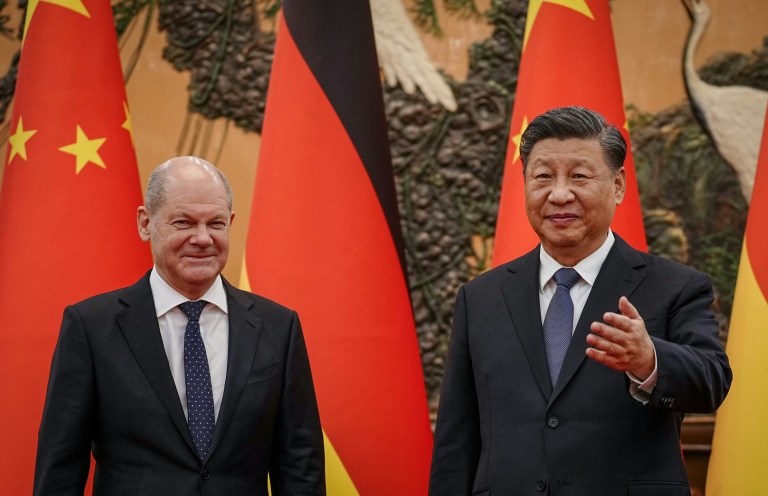
Received by a smiling Xi at Beijing’s Great Hall of the People shortly after arriving, Scholz said he hoped to “further develop” economic cooperation — while alluding to areas of disagreement.

“It is good that we are able to have an exchange here about all questions, including those questions where we have different perspectives — that’s what an exchange is for,” Scholz said. 

“We also want to talk about how we can further develop our economic cooperation on other topics: climate change, food security, indebted countries.”

“Xi underscored the need for China and Germany, two major countries with great influence, to work together in times of change and instability and contribute more to global peace and development,” Beijing’s Xinhua News Agency reported.

Scholz also spoke with Chinese Premier Li Keqiang later in the afternoon at a meeting in which he called for fair trade between the two countries. 

“We do not believe in ideas of decoupling (from China) but it is also clear that that has something to do with economic ties as equals, with reciprocity,” he said in a statement.

At a press briefing during which Chinese officials said there was “not enough time” for questions, Scholz also urged Beijing to do more to “use its influence” on its ally Russia, currently engaged in a months-long war in Ukraine.

Both sides said they opposed the use of nuclear weapons in the conflict, with Scholz telling reporters that “in China everyone knows that an escalation (of the war) would have consequences for us all”.

“That is why it is very important for me to stress that everyone says clearly that an escalation via the use of a tactical nuclear weapon is ruled out,” he said.

China has steadfastly avoided criticizing Russia for invading Ukraine and instead blames the United States and NATO for the war.

– ‘Keep doing business’ –

The German delegation of more than 60 people was met on the tarmac at Beijing airport by a military guard — as well as health workers in white hazmat suits who conducted mandatory PCR tests in buses converted into mobile laboratories. 

Scholz’s PCR test was taken in his plane by a German doctor he brought with him and supervised by Chinese health officials, according to the German government.

China’s economic importance is seen by some in Berlin as more crucial than ever, as Germany hurtles towards a recession battling an energy crisis triggered by the Ukraine war. 

China is a major market for German goods, from machinery to vehicles made by the likes of Volkswagen, BMW and Mercedes-Benz.

But German industry’s heavy dependence on China is facing fresh scrutiny after the over-reliance on Russian energy imports left it exposed when Moscow turned off the taps.

Scholz’s approach is still underpinned by the idea that “we want to keep doing business with China, no matter what that means for the dependence of our economy, and for our ability to act”, opposition lawmaker Norbert Roettgen told the Rheinische Post newspaper.

Concern about China has also come from within Germany’s ruling coalition, with Foreign Minister Annalena Baerbock saying past mistakes with Russia must not be repeated.

A row erupted last month about whether to allow Chinese shipping giant Cosco to buy a stake in a Hamburg port terminal. 

Scholz ultimately defied calls from six ministries to veto the sale over security concerns, instead permitting the company to acquire a reduced stake.

– ‘All the more important’ –

There are also concerns that the trip — coming on the heels of Xi securing a historic third term at a Communist Party Congress last month — may have unsettled the United States and the European Union.

“For Beijing this is less about concrete outcomes and more about the symbolism of the German chancellor paying Xi a visit so soon after the party congress,” said Noah Barkin, visiting senior fellow in the Asia Program at the US German Marshall Fund.

“It gives international legitimacy to his leader-for-life status, and it shows that China is not isolated,” he added.

Berlin, however, says there have been consultations with key partners, while Scholz has insisted he is visiting China as a “European” as well as the leader of Germany.

He said direct talks with Chinese leaders were “all the more important” after the long hiatus caused by the pandemic.

He promised earlier to raise thorny topics such as respect for civil liberties and the rights of minorities in Xinjiang.

pw-reb-oho-lxc-mjw/axn/mca/md

Scholz spoke with dissidents before China visit: source

German Chancellor Olaf Scholz held talks with human rights lawyers critical of the regime in Beijing ahead of a controversial trip to China on Friday, a source in his entourage told AFP.

The meeting between Scholz and the dissidents was held via an encrypted video link on Tuesday, the source said.

The chancellor’s trip has prompted criticism at home over Berlin’s growing economic reliance on Beijing, and sparked controversy for coming so soon after President Xi Jinping strengthened his hold on power in China just last month.

Scholz’s interlocutors, who were not named, were said to be well-known in their field, while some of them had served multi-year prison sentences, the source said.

The human rights lawyers participated in the video conference from a location in the German embassy in Beijing.

The dissidents and their families spoke “powerfully” about the challenging living and working conditions they faced in China, the source said.

Meetings with human rights activists and other civil society representatives are typically part of the programme for German leaders visiting China.

However, strict coronavirus-related restrictions in China meant that an in-person meeting was not possible this time around. 

Anyone coming into contact with Scholz would have had to remain in quarantine for 10 days in a state-controlled facility following the encounter.

For this reason, Scholz’s office decided to conduct the meeting virtually.

During the visit to Beijing, Scholz said he hoped to “further develop” economic cooperation, while alluding to areas of disagreement.

The chancellor indicated before his departure that he would raise thorny topics such as respect for civil liberties and the rights of minorities in Xinjiang.

“It is crucial that we should never be silent when we see violations of human rights,” Scholz told reporters Friday at a news conference with Premier Li Keqiang.

“I did not and it should never happen when other interlocutors travel to China and hold talks.”

US sees strong job gains in October as wages move higher

US job gains topped expectations in October, official data showed Friday, as hiring remained resilient and wages moved ever higher even as unemployment edged up, underscoring the challenges in lowering rampant inflation.

The data comes days ahead of midterm elections, where decades-high inflation has propelled economic issues to the top of voters’ minds and President Joe Biden faces a battle to avoid losing control of both chambers of Congress.

The figures will provide little comfort to the Federal Reserve, which has been battling to cool the economy, as policymakers fear high prices will become entrenched and rising pay will create an upward spiral — inflicting more harm on families and businesses.

American employers added 261,000 workers last month, far more than economists had forecast, though this eased from a revised 315,000 figure in September.

The jobless rate rose two-tenths to 3.7 percent, the Labor Department said in its closely-watched US employment report.

“Inflation is our top economic challenge… The global inflation that is raging in other countries is hitting us as well,” said Biden in a statement on Friday, although noting that unemployment remains relatively low.

He said policymakers will “do what it takes to bring inflation down.”

Average hourly earnings for private sector workers jumped another 12 cents or 0.4 percent, to $32.58, the data showed.

Wages have increased 4.7 percent over the last 12 months as firms have had to compete to find and retain workers in the tight labor market. 

That pace is slightly slower than the pace in September, which the Fed will welcome, but many employees are pushing for increases to avoid losing ground to elevated consumer costs.

– ‘Softening’ –

“The bottom line here is that the labor market is softening, but has not yet reached the point where the data are screaming at the Fed to stop tightening,” said Ian Shepherdson, chief economist at Pantheon Macroeconomics, in an analysis.

But if labor market trends continue, markets will start to push policymakers to “rethink the idea of continued hikes next year,” he added.

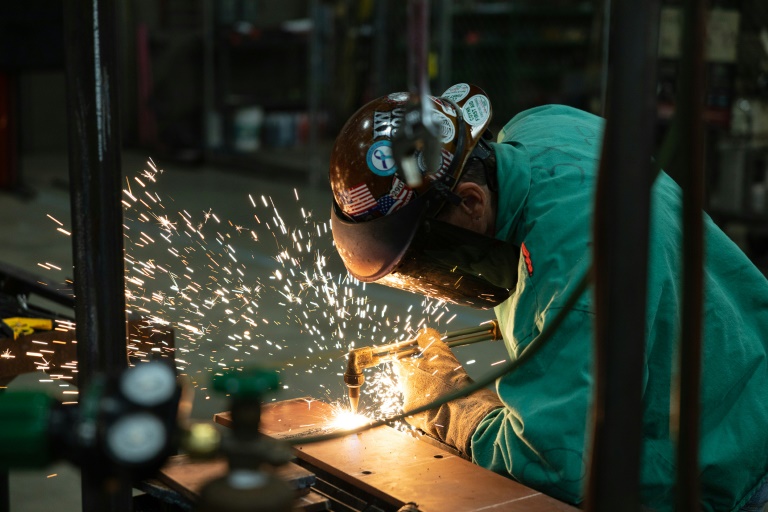
On Friday, the Labor Department’s report indicated notable job gains in health care, professional and technical services, and manufacturing.

The Fed has raised borrowing rates six times this year to cool demand, but there have been few signs it is having an impact on consumer spending or inflation.

The central bank said this week that it would have to continue hiking rates, although that has raised the risk that the world’s biggest economy will suffer a downturn.

But Susan Collins, president of the Boston Federal Reserve Bank added on Friday that she sees a chance to accomplish the task of reining in price increases without completely putting the brakes on growth.

While inflation so far is only slowly drifting down, “I do not believe a significant slowdown is required to accomplish our goal,” she said in a speech in Washington.

But she stressed that the Fed must continue to act as “current levels of inflation are simply too high, and are taking a significant toll on households and firms.”

While the policy tightening normally would be expected to lead to job losses, economists say employers are reluctant to shed workers that they struggled to find.

“The data are still showing strong positive momentum in the labor market which is not yet showing much adjustment in response to a rapid tightening of monetary policy,” said Rubeela Farooqi of High Frequency Economics. 

“These data will keep the Fed on track to keep raising rates into restrictive territory,” she said in an analysis.

Russia says thousands removed from Kherson daily

Moscow was pushing ahead Friday with a civilian pullout from the Russian-occupied Kherson region amid a mounting Ukrainian counter-offensive, with President Vladimir Putin saying residents must be “removed” from danger zones. 

The Russian army said “more than 5,000 civilians” were being led across the Dnipro River every day, showing footage of soldiers directing lines of cars onto flotillas crossing over to the river’s eastern bank.

Moscow’s forces began urging civilians to leave Kherson in mid-October, vowing to turn the region’s main city of the same name into a fortress ahead of an anticipated Ukrainian offensive. 

Kyiv has likened the departures to Soviet-style “deportations” of its people.

“Those who live in Kherson should be removed from zones of dangerous fighting,” Putin said on Red Square as he marked Russian Unity Day, a patriotic holiday. 

“The civilian population should not suffer from shelling, an offensive, a counter-offensive or other such things,” he said. 

Western countries, meanwhile, have urged Putin to extend a landmark deal for the export of Ukrainian grain to avert a global food crisis, which is up for renewal on November 19. 

Russia rejoined the UN-brokered deal on Wednesday, after suspending its participation for four days over a drone attack on its Black Sea fleet in Russian-annexed Crimea, but has threatened to pull out again.

On a visit to China, German Chancellor Olaf Scholz urged Putin to extend the deal.

“Hunger must not be used as a weapon,” he said.

“I urge the Russian president not to refuse to extend the grain agreement which ends in a few days.”

He asked China’s Xi Jinping — who has good relations with Putin — to use Beijing’s “influence” on Moscow to stop fighting in Ukraine.

“The Russian war in Ukraine is a dangerous situation for the whole world,” Scholz said.

The G7 group of wealthy nations also said it wants Russia to prolong the deal that allows the safe passage of grain shipments from Ukraine.

Its top diplomats have held two days of talks in the western German city of Muenster, with Ukraine topping the agenda. 

– ‘49,000 new recruits already fighting’ –

In Moscow, Putin led patriotic celebrations on Unity Day — a holiday he instated in 2005 to celebrate fending off a Polish invasion in 1612. 

Speaking on Red Square to a handful of patriotic volunteers, Putin said 318,000 recruits had signed up since he announced a military call-up in September, which has since been completed. 

That exceeded his target of 300,000 because “volunteers keep coming”, he claimed. 

Of that number, 49,000 were taking part in active fighting.

Putin’s draft led to another wave of tens of thousands rushing to leave the country. Russia’s ex-leader Dmitry Medvedev on Friday called them “cowardly traitors and greedy defectors”.

The Kremlin chief said he wanted to restore historical monuments in the occupied territories so that those “who lived under crazy, idiotic propaganda for 30 years” would know “where their ancestors came from”.

He singled out the port city of Mariupol on the Sea of Azov, which was flattened by weeks of battles over its steelworks and fell into Russian hands in May. 

“Mariupol is a very famous — an ancient, you could say — Russian city,” Putin said.  

He said Russian authorities had a “lot to work on” in reconstruction plans of the city. 

Putin’s offensive in Ukraine has dragged into its ninth month, forcing millions to flee the country and leaving thousands of troops dead on both sides.

Russia has recently hit Ukraine’s energy networks, with President Volodymyr Zelensky saying the strikes have left 4.5 million people without power. 

Close Bitnami banner
Bitnami