World

After lengthy slump, Boeing outlines path to comeback

After years of stumbles and weak results, Boeing said Wednesday it expects to return at mid-decade to operational health and a more robust financial performance.

The aerospace giant — which has reported losses the last three years — guided investors to 2025-26 as the timeframe when they should expect a strong financial performance resembling those the company posted prior to the 737 MAX and Covid-19 crises.

Investors cheered the outlook, sending shares up more than seven percent at one point as Boeing signaled a more normal level of production and plane deliveries within the foreseeable future.

“We are on the right path to return to the operational and financial strength we expect of ourselves,” said Chief Executive Dave Calhoun at the outset of the company’s first investor day since 2016.

Boeing’s difficult period began in October 2018 with a deadly Lion Air crash of the 737 MAX, the first of two fatal crashes of the plane that together claimed nearly 350 lives and led to a global grounding of more than a year and a half.

The company’s problems mushroomed when the coronavirus pandemic decimated global travel beginning in 2020.

Demand has recovered strongly and the MAX has been cleared for service by most leading regulators.

But Boeing has struggled to fully exploit the improving environment due in part to supply chain problems and heavier scrutiny from US air safety regulators. These issues have forced the company to curtail production and delayed the certification of new aircraft.

The forecast released Wednesday includes a gradual improvement in Boeing plane deliveries and production in 2023 and 2024 and hitting its stride after that, boosting revenues.

Stan Deal, head of Boeing’s commercial division, told analysts he expects to liquidate most of a backlog of undelivered planes by 2024, with a few spilling into 2025. This includes 787 Dreamliner planes, in addition to MAX aircraft.

Deal also updated the timeframe on the certification of the 737 MAX 10, its latest version of the plane, saying the aircraft should be cleared for service by late 2023 or early 2024.

The company projected free cash flow, a closely-watched benchmark of financial health, rising in 2023 to $3-$5 billion from the $1.5-$2 billion range in 2022.

It said free cash flow will surge to around $10 billion in 2024 and 2026, much closer to the $13.6 billion Boeing notched in 2018.

Shares finished 2.8 percent higher at $147.41.

Dollar gains, US stocks fall as Fed hikes rates again

Wall Street stocks fell and the dollar gained Wednesday after the Federal Reserve announced another large interest rate hike and indicated it was in no rush to moderate its stance.

The US central bank raised the benchmark lending rate by 0.75 percentage point, the fourth straight increase of that size and the sixth hike this year.

The move was expected, but markets were fixated on signals on whether the Fed might undertake smaller hikes in December and at future meetings. Equities had rallied in October in part due to hopes for a Fed pivot.

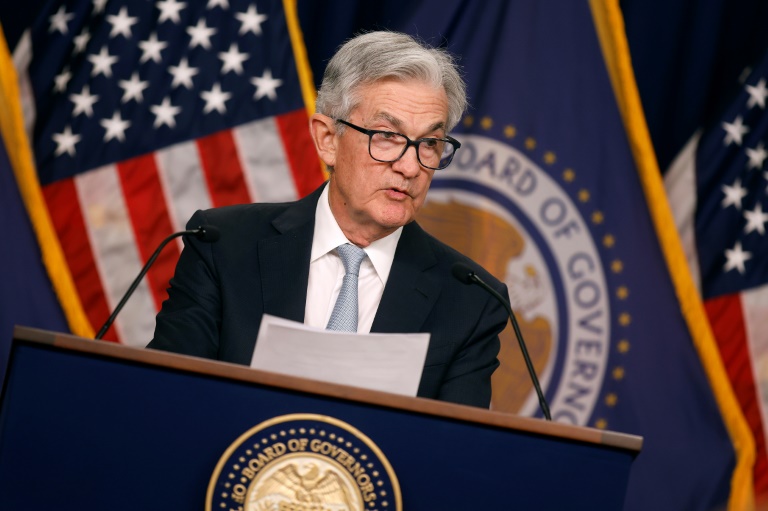
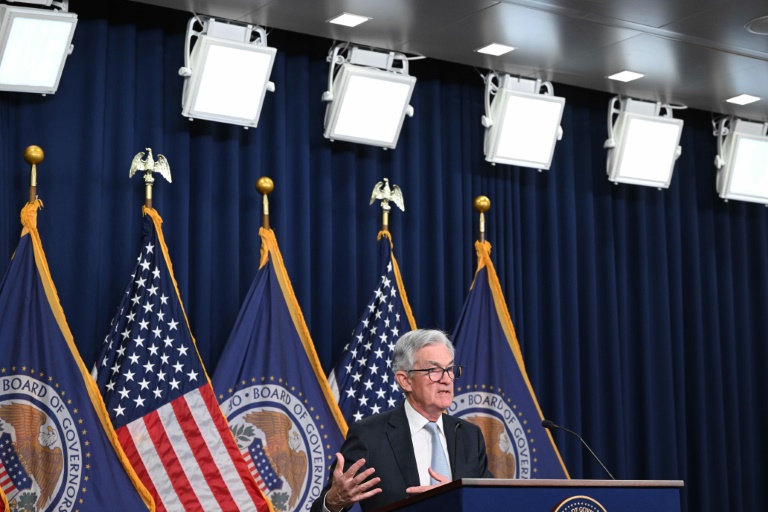
But after rising on the Fed’s policy statement, equities tumbled into the red during the press conference when Fed Chair Jerome Powell said it was “very premature” to discuss pausing rate increases and brushing back criticism that the central bank had “overtightened.”

FHN Financial’s Chris Low noted that Powell indicated that in order to tame inflation, interest rates would need to settle at a higher level than previously thought.  

“The biggest takeaway was not the expected strong hint at a slower pace,” Low said. “It was the realization rates would have to go higher.”

Stocks gave up their gains and turned negative before finishing the day firmly lower.

The S&P 500 dropped 2.5 percent, while the dollar also reversed course, finishing higher against the euro and pound.

The Fed’s aggressive rate hikes this year so far have not had a noticeable impact on prices, but they have stoked fears of an impending recession even as the job market remains strong.

While the US housing market has cooled sharply amid higher interest rates, key inflation measures show prices continue to rise and the labor market remains tight, with job openings rising and private hiring accelerating in October.

Elsewhere, London equities shed 0.6 percent on the eve of another expected large rate increase from the Bank of England.

In the eurozone, Frankfurt and Paris fell following weak eurozone manufacturing survey data and a dip in German exports.

In Asia, stocks were mixed. Hong Kong led gainers — extending the previous day’s surge — as traders remain hopeful China could begin rolling back its economically painful zero-Covid policy, the day after an unverified statement suggesting a shift was taking place.

Among individual companies, Boeing gained 2.8 percent as executives outlined a plan to return to financial strength in the 2025-26 timeframe after a lengthy slump due to the 737 MAX and Covid-19 crises.

– Key figures around 2100 GMT –

New York – Dow: DOWN 1.6 percent at 32,147.76 (close)

New York – S&P 500: DOWN 2.5 percent at 3,759.69 (close)

New York – Nasdaq: DOWN 3.4 percent at 10,524.80 (close)

London – FTSE 100: DOWN 0.6 percent at 7,144.14 (close)

Frankfurt – DAX: DOWN 0.6 percent at 13,256.74 (close)

Paris – CAC 40: DOWN 0.8 percent at 6,276.74 (close)

EURO STOXX 50: DOWN 0.8 percent at 3,622.01 (close)

Tokyo – Nikkei 225: DOWN 0.1 percent at 27,663.39 (close)

Hong Kong – Hang Seng Index: UP 2.4 percent at 15,827.17 (close)

Shanghai – Composite: UP 1.2 percent at 3,003.37 (close)

Euro/dollar: DOWN at $0.9816 from $0.9883 on Tuesday

Pound/dollar: DOWN at $1.1390 from $1.1486

Dollar/yen: DOWN at 147.90 yen from 148.23 yen

Euro/pound: UP at 86.17 pence from 85.96 pence

Brent North Sea crude: UP 1.6 percent at $96.15 per barrel

West Texas Intermediate: UP 1.8 percent at $90.00 per barrel

burs-jmb/hs

Fed delivers another steep rate hike with more to come

The Federal Reserve delivered another steep interest rate increase on Wednesday, as expected, with its move to cool red-hot inflation taking on more weight amid the political maelstrom of key US midterm elections.

With high inflation squeezing American families of all political stripes, President Joe Biden faces a battle to avoid losing control of both chambers of Congress.

The Fed’s aggressive rate hikes this year so far have not had a noticeable impact on prices, but they have stoked fears of an impending recession even as the job market remains strong.

The US central bank raised the benchmark lending rate by 0.75 percentage point — the fourth straight increase of that size and the sixth hike this year — in its all-out battle to tame inflation not seen since the 1980s.

The latest three-quarter percentage point increase takes the benchmark lending rate to 3.75-4.0 percent, the highest since January 2008.

By making it more costly to borrow, policymakers aim to put the brakes on spending and bring demand more into balance with supply that has been battered by global supply issues and the ongoing Russian war in Ukraine.

While the US housing market has cooled sharply amid higher interest rates, key inflation measures show prices continue to rise and the labor market remains tight, with job openings rising and private hiring accelerating in October.

The policy-setting Federal Open Market Committee (FOMC) said more rate increases will be needed to tamp down rising prices but it will take into consideration the impact on the economy when deciding on the pace of future moves — opening the door to the possibility it will implement smaller steps in coming months.

But Fed Chair Jerome Powell cautioned that policymakers are not yet ready to halt their efforts.

“It will take time, however, for the full effects of monetary restraint to be realized, especially on inflation,” Powell told reporters.

“It’s very premature in my view to be thinking about or talking about pausing our rate hike. We have a ways to go.”

But he said the committee could begin discussing the possibility of slowing the aggressive pace of rate increases at the December meeting, but ultimately might have to increase the level higher than expected to achieve the goal of bringing inflation down to two percent.

– Slower growth –

As central bankers walk a tightrope fighting inflation while avoiding tipping the economy into a recession, politicians are ramping up pressure on Fed officials.

Powell acknowledged that bringing inflation down is “likely to require below-trend growth,” and that the window to achieve a soft landing — slowing inflation while avoiding a downturn — has narrowed.

Biden is facing growing voter frustration over high inflation and there are signals in polling that a “red wave” could sweep the opposition Republicans to power in the House and Senate.

Republicans put the blame for inflation and slower growth squarely on Biden, while the president’s Democrats worry the Fed moves will lead to higher unemployment.

But Powell has argued that allowing high inflation to become entrenched would inflict even more pain on American families and workers.

In his press conference Wednesday, Powell dismissed criticism that the central bank had moved too quickly, and said the outlook for the world’s largest economy is highly uncertain.

“No one knows whether there’s going to be a recession or not, and if so, how bad that recession would be,” he said.

White House spokesperson Karine Jean-Pierre said the Fed moves are “part of our transition” to “stable and steady growth with lower inflation.”

The US stock market endured another volatile day, jumping after the Fed announcement, when it looked like a pause was coming, and then sinking as Powell spoke.

Ian Shepherdson of Pantheon Macroeconomics said that while the statement offered hope of a policy pivot, “Powell isn’t budging yet.”

He said the FOMC offered “a clear signal that the wave of 75bp hikes is over,” however, the Fed chief “was deeply reluctant to promise that shift in December.”

Kerry sees Brazil, Mexico rising climate hopes ahead of summit

US climate envoy John Kerry said Wednesday he expects bold new action by Mexico and Brazil’s next government, raising hopes of achieving progress at this month’s global warming summit in Egypt.

Kerry also gave his firmest indication yet that the United States was willing to engage on compensating poor nations that have already been hit hard by climate change, set to be a major agenda item at the talks known as COP27.

In Brazil, where the Amazon plays a vital role counteracting the planet’s carbon emissions, leftist former president Luiz Inacio Lula da Silva triumphed in Sunday’s elections against the far-right incumbent Jair Bolsonaro, an ally of agribusiness in the rainforest.

Lula in his victory speech pledged to work toward zero deforestation.

“President-elect Lula is committed,” Kerry told reporters in Washington, pointing to Lula’s efforts as president in the century’s first decade on the environment.

“Now I hope we’ll be able to refine that program and move forward even more rapidly with the reforms that are necessary in order to try to save the Amazon,” Kerry said.

“Under the Bolsonaro government, regrettably, the level of deforestation increased in the Amazon and it is at perilous high levels today.”

Kerry insisted he was not “tone deaf” to economic concerns around the world including in Brazil, Latin America’s biggest economy, noting that many residents of the Amazon made a living on cattle or logging.

“We in the rest of the world are going to have to recognize that if we’re going to value this great forest, we have to help them to be able to preserve it,” he said.

Kerry, a former secretary of state and key architect of the 2015 Paris accord, has returned to his globe-trotting in his climate role, recently visiting Mexico as part of efforts to mobilize action ahead of COP27.

He said he expected more countries to raise their ambitions in coming days through their so-called Nationally Determined Contributions, plans they submit under the Paris agreement.

“We will have a major announcement, which President (Andres Manuel) Lopez Obrador has agreed to, with respect to what Mexico is now going to undertake,” Kerry said.

– ‘Upfront’ on loss and damage –

One year after the Glasgow summit, the summit in the Red Sea resort Sharm el-Sheikh will again draw world leaders including President Joe Biden, who this year sealed a landmark legislative package to fight climate change.

After successive UN meets focused both on reducing emissions and adapting to the impact, activists have stepped up a campaign for countries with historic responsibility for climate change to pay for losses and damage already being sustained. 

Developing countries are bearing the brunt of some of the worst of climate change with Pakistan, which emits less than one percent of global carbon output, this year seeing one-third of its territory submerged by floods that killed more than 1,700 people. 

After initially dismissing loss payments as politically unfeasible, Kerry in recent weeks has said the United States is willing to discuss the issue, although some green campaigners have voiced fear that wealthy countries will simply try to neutralize the topic through talks that go nowhere. 

Kerry insisted the United States was willing to look at concrete measures and to speed up a two-year timeline set in Glasgow for assessing a way forward on the issue. 

“We are anxious to see the loss and damage issue dealt with upfront and in a real way at COP,” Kerry said. 

“We certainly support coming out with some kind of structure that provides for appropriate financial arrangements,” he said.

“We don’t feel that this has to be an issue that has to be pounded at people because we agree — as do almost all nations now — that much more has to happen, faster.”

But the rival Republican Party, if it wins control of Congress in elections next week, is expected to target climate assistance.

Kerry, the Democratic presidential candidate in 2004, played down a report that he could retire after the election, saying he was focused on COP.

Ethiopia warring parties agree to cease hostilities

The warring sides in Ethiopia announced Wednesday an agreement to silence their guns after two years of devastating conflict that have claimed thousands of lives and left millions needing aid in Africa’s second most populous country.

The surprise deal between Prime Minister Abiy Ahmed’s government and Tigrayan rebels was unveiled after little over a week of negotiations led by the African Union in South Africa and was hailed by the UN and the US among others.

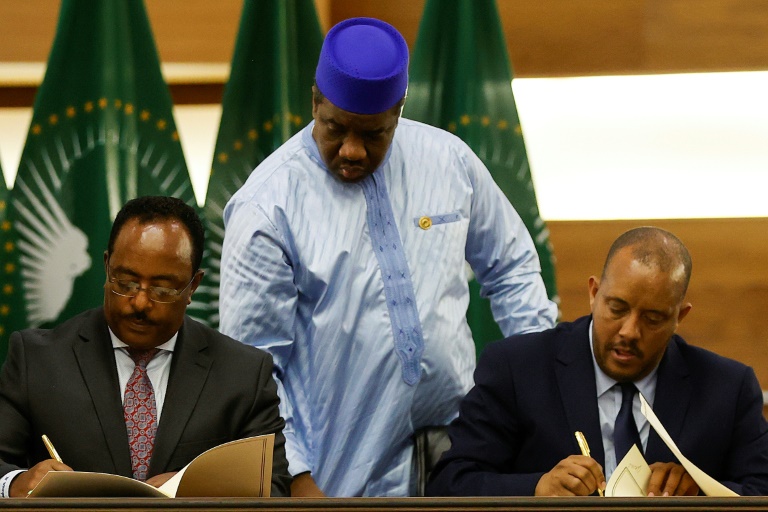
“We have agreed to permanently silence the guns and end the two years of conflict in northern Ethiopia,” the government and Tigray People’s Liberation Front (TPLF) said in a joint statement after marathon talks.

The breakthrough was announced by the African Union’s mediator, former Nigerian president Olusegun Obasanjo, almost exactly two years to the day since the war erupted in November 2020.

“Today is the beginning of a new dawn for Ethiopia, for the Horn of Africa and indeed for Africa as a whole,” he said.

“The two parties in the Ethiopian conflict have formally agreed to the cessation of hostilities as well as the systematic, orderly, smooth and coordinated disarmament,” Obasanjo said at a briefing in Pretoria.

They also agreed on a “restoration of law and order, restoration of services, unhindered access to humanitarian supplies, protection of civilians… among other areas of agreement”, he added.

It was not immediately clear how the deal would be monitored to ensure it was implemented, and there was no mention by Obasanjo of international and rebel calls for Eritrea’s feared army to withdraw from the battlefield.

– ‘Welcome first step’ –

Diplomatic efforts to bring Abiy’s government and the TPLF to the negotiating table had taken on renewed urgency after combat resumed in late August, torpedoing a five-month truce that had allowed limited amounts of aid into war-stricken Tigray.

The talks were launched on Tuesday last week and were initially scheduled to run until Sunday but were extended.

They were the first formal dialogue between the two sides since the start of the conflict that had raised concerns about the stability of Ethiopia and the volatile Horn of Africa region.

UN Secretary-General Antonio Guterres hailed Obasanjo’s announcement as “a welcome first step” that could “bring some solace” to millions of suffering civilians, his spokesman Stephane Dujarric told reporters.

The United States also described it as an “important step towards peace”, with State Department spokesman Ned Price hoping it would lead to a “durable cessation of hostilities to set the stage for an end to human rights abuses and atrocities”.

The delegations in Pretoria said it was now up to both sides to honour the agreement, while Abiy himself vowed a “strong” commitment to its implementation.

The head of the government team, Abiy’s national security adviser Redwan Hussein, praised the sides for their “constructive engagement to allow the country to put this tragic period of conflict behind us”.

Tigrayan delegation chief Getachew Reda said they were ready to “implement and expedite this agreement”, adding: “In order to address the pains of our people, we have made concessions because we have to build trust.”

– Dire shortages –

The war has forced well over two million people from their homes, and according to US estimates killed as many as half a million.

Despite the peace process in Pretoria, intense fighting had continued unabated in Tigray, where government troops backed by the Eritrean army and regional forces waged artillery bombardments and air strikes, capturing a string of towns from the rebels.

The international community had voiced increasing alarm over the combat and the toll among civilians caught in the crossfire.

Asked about Eritrea, South Africa’s former vice president Phumzile Mlambo-Ngcuka, who was facilitating the negotiations, said only: “These two parties (Ethiopia’s government and Tigrayan authorities) are not the only two groups that are relevant for peace to happen in Ethiopia.

“So we are entrusting them with the responsibility of going back home to socialise this agreement… to ensure that many more people embrace this agreement.”

Tigray, a region of six million people, has been under a communications blackout for much of the conflict, lacking basic services and facing dire shortages of food, fuel and medicines.

The conflict erupted on November 4, 2020, when Nobel peace laureate Abiy sent troops into Tigray after accusing the TPLF, the regional ruling party, of attacking federal army camps.

The fighting followed months of seething tensions between Abiy and the TPLF, which had dominated the ruling coalition in Ethiopia for almost three decades before he came to power in 2018.

Germany primes energy price cap as bills soar

Germany on Wednesday signed off on an energy price cap, the cornerstone of a massive 200-billion-euro ($198-billion) package to shield households and businesses from rising costs.

“The source for these consequences and great challenges is (Russian President Vladimir) Putin’s war,” German Chancellor Olaf Scholz said at a press conference. 

The support package was Germany’s response “so that citizens do not have to fear their bills”, said Scholz, who has ploughed ahead with plans despite criticism from European partners.

Germany’s businesses have also been crying out for help at a time when Europe’s largest economy is drifting towards recession and inflation has shot past 10 percent.

The plan will see the price for a percentage of household and businesses’ typical consumption capped at lower-than-market prices.

For gas, 25,000 larger businesses, as well as almost 2,000 hospitals and schools will benefit from the cap as soon as January 1 next year, according to the plan agreed between the federal government and regional leaders. 

Households and smaller businesses meanwhile could have to wait until March 1 at the latest for the price brake to come into force.

Policymakers will “seek” to apply the relief retroactively from February 2023, according to the document.

A similar price cap will also apply to electricity from the start of the new year in January, with the measures set to last through to the end of April 2024.

– December help –

While the cap for smaller consumers will only come into force later, the government will pick up their heating bills in December.

For households, the price of a kilowatt-hour of gas will be capped at 12 cents for up to 80 percent of their typical usage.

The same unit of gas currently costs billpayers 18.6 cents, according to the price comparison site Check 24.

All in all, the support measures could save a single-person household with a typical gas consumption of 5,000 kWh around 264 euros over a year, the site estimates.

The partial price cap was designed to maintain “incentives to save energy” over the winter while supplies are short, according to the government paper, despite concerns that lowering prices would sustain demand.

The plans left a “winter gap” for consumers until at least February, North Rhine-Westphalia state premier Hendrik Wuest said at the same news conference as Scholz.

Wuest, who had pushed for the government to bring the price cap in earlier for households, said the chancellor had agreed to “examine” alternative solutions put forward by regional leaders.

– European discontent –

Germany, long reliant on Moscow for energy imports, has been hit hard by the sharp rise in prices since the invasion of Ukraine and the cut to supplies.

Despite the Germany economy eking out 0.3-percent growth between July and September, most analysts still expect the country to slip into recession as the high cost of energy drags on production.

Businesses that have been pushing for more support from the government welcomed the plans.

The price cap measures should “create a bit of security and at the same time ease worries”, the BDI industrial lobby said Monday ahead of the final agreement.

Berlin’s massive go-it-alone plan to shield its economy has ruffled feathers among European partners who would have preferred a common solution.

They feared that more highly indebted EU countries could not afford the outlay made by Germany, while the plan could affect their own energy costs.

Germany’s energy price shield will be partly financed through new borrowing through an economic stabilisation fund created during the coronavirus pandemic. 

Berlin also intends to fund the cap by skimming off part of the bumper profits made by energy companies as prices have risen.

Troops deployed in Ecuador after spate of organized crime attacks

Police and soldiers on Wednesday patrolled the terror-stricken streets of two Ecuadoran cities after a spate of attacks blamed on organized crime groups waging a deadly drug war.  

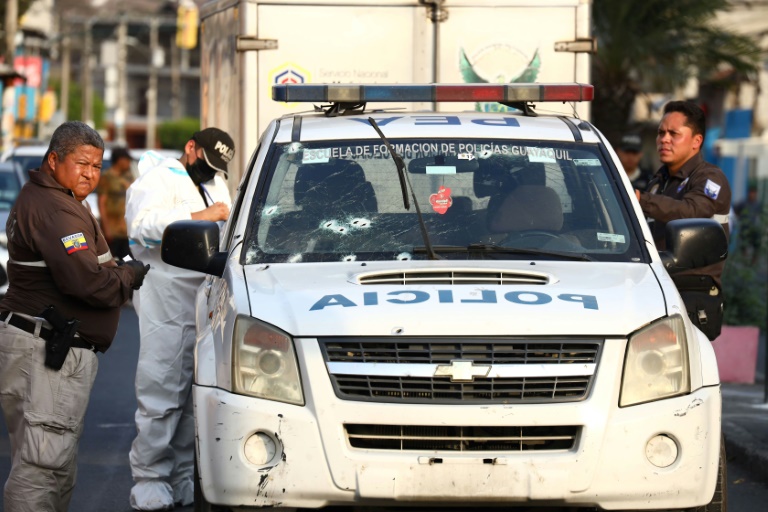
Following a wave of strikes Tuesday in which five police officers were killed and a civilian wounded at a clinic, a state of emergency and nightly curfew has taken effect in the western provinces of Guayas and Esmeraldas.  

The civilian died Wednesday of gunshot injuries to the head, health officials said, bringing the death toll from the attacks to six.   

Two police officials were also injured.  

Groups armed with guns and explosives, including car bombs, hit more than 18 targets Tuesday in the cities of Guayaquil and Duran in the Guayas province and in Esmeraldas further north.

Targets included police and gas installations, a clinic and a bus terminal.  

President Guillermo Lasso declared a 45-day state of emergency in response, with a nightly 9pm-to-5am curfew for the two provinces and special powers to limit freedom of movement and assembly.  

Classes in some areas were suspended.  

On Wednesday, the streets of Guayaquil — the scene of much of the street and prison violence to have hit Ecuador since last year — were unusually quiet. And nervous.  

Jorge Arguello, the 36-year-old head of a publishing company, told AFP there was “fear on the streets” and he himself was afraid to leave home after spotting motorcycles — associated with gangs and hitmen — doing the rounds.  

Anti-crime operations in the city of 2.8 million people, capital of the Guayas province, yielded 28 arrests on Wednesday morning, according to Interior Minister Juan Zapata.

Arms, ammunition and explosives were seized.

“It is scary to go out,” said Guayaquil resident Elizabeth, 37, who did not want to give her full name for fear of reprisal.  

In the morning, she and other neighbors had to call 911 to report what they thought was a car bomb in the street outside their homes.

“They came right away, they deactivated it and nothing bad happened. But on the street it smelled like gunpowder,” Elizabeth recalled.  

– ‘Open war’ –

Ecuador — once a relatively peaceful neighbor of major cocaine producers Colombia and Peru — has seen a wave of violent crime that authorities blame on turf battles between drug gangs believed to have ties to Mexican cartels.  

Civilians have increasingly been caught up in the bloodshed that has claimed more than 60 police lives since last year.  

Authorities said Tuesday’s attacks were in response to a mass transfer of inmates from the gang-controlled Guayas 1 prison in Guayaquil.  

Angered by the move, inmates at a prison in Esmeraldas took eight guards hostage. They were all later freed.  

A day earlier, two headless bodies were found hanging from a pedestrian bridge in Esmeraldas.  

Ecuador has gone from being a drug transit route in recent years to an important distribution center in its own right.

The United States and Europe are the main destinations of drugs from Latin America.

The murder rate in Ecuador nearly doubled in 2021 to 14 per 100,000 inhabitants, and reached 18 per 100,000 between January and October this year, according to official data.

Hundreds of inmates have died since February last year — many beheaded or burned — as the gang war is waged also behind bars — especially at Guayas 1.  

“These acts of sabotage and terrorism are… a declaration of open war,” Lasso said of Tuesday’s attacks. 

In 2021, law enforcement seized a record 210 tons of drugs, mostly cocaine. So far this year’s seizures total 160 tons.  

North Korea fires more than 20 missiles, one close to South

North Korea fired more than 20 missiles Wednesday, including one that landed close to South Korea’s waters in what President Yoon Suk-yeol said was “effectively a territorial invasion”.

It also fired an artillery barrage into a maritime “buffer zone” that experts said was part of an “aggressive and threatening” response by Pyongyang to large-scale joint air drills the United States and South Korea are conducting.

One short-range ballistic missile crossed the Northern Limit Line, the de facto maritime border, prompting a rare warning for residents on the island of Ulleungdo to seek shelter in bunkers.

Seoul’s military said it was the “first time since the peninsula was divided” at the end of Korean War hostilities in 1953 that a North Korean missile had landed so close to the South’s territorial waters.

“President Yoon pointed out today that North Korea’s provocation is an effective territorial invasion by a missile,” his office said in a statement.

One of the missiles landed in waters just 57 kilometres (35 miles) east of the mainland, the military said, calling the incident “very rare and intolerable”.

Pyongyang fired a total of 23 missiles including seven short-range ballistic missiles and six ground-to-air ones, Seoul’s military said.

North Korea also conducted an artillery barrage, firing into a maritime “buffer-zone” set up in 2018 in a bid to reduce tensions between the two countries during an ill-fated bout of diplomacy.

The huge volley of launches were “provocations against South Korea”, said Go Myong-hyun, a researcher at the Asan Institute for Policy Studies.

“I wouldn’t be surprised if they lead up to a nuclear test,” he added.

South Korea, for its part, said it had fired three air-to-ground missiles into the sea towards the north of the two countries’ maritime boundary.

President Yoon called a meeting of the National Security Council, ordering “swift and stern measures so that North Korea’s provocations pay a clear price”.

South Korea closed some air routes over the East Sea, also known as the Sea of Japan, advising local airlines to detour to “ensure passenger safety in the routes to the United States and Japan”.

White House national security spokesman John Kirby slammed North Korea as “reckless” for carrying out the launches.

“We… condemn these missile launches and the DPRK’s reckless decision to fire a missile below the de facto maritime boundary with the Republic of Korea,” Kirby said. 

European Council President Charles Michel said he was outraged by Pyongyang’s “aggressive and irresponsible behaviour,” while Russia called for calm. Britain also joined the chorus of condemnation of the launches.

Separately, Kirby said the United States believes North Korea is sending a significant amount of artillery ammunition to Russia for its war in Ukraine, under cover of shipments to the Middle East or Africa.

– ‘Vigilant Storm’ –

Pyongyang’s day of missile launches came as Seoul and Washington staged their largest-ever joint air drills, dubbed Vigilant Storm, which involved hundreds of warplanes from both sides.

Pak Jong Chon, a high-ranking North Korean official, had earlier called the drills aggressive and provocative, according to a report in state media Wednesday.

Pak said the name of the exercises harked back to Operation Desert Storm, the US-led military assault on Iraq in 1990-1991 after the invasion of Kuwait.

“If the US and South Korea attempt to use armed forces against the (Democratic People’s Republic of Korea) without any fear, the special means of the DPRK’s armed forces will carry out their strategic mission without delay,” he said.

“The US and South Korea will have to… pay the most horrible price in history.”

– ‘Dangerous situation’ –

North Korea’s missile launches on Wednesday appeared to be “the most aggressive and threatening armed demonstration against the South since 2010”, Cheong Seong-chang, a researcher at the Sejong Institute, told AFP.

“It is now a dangerous and unstable situation that could lead to armed conflict,” he added.

In March 2010, a North Korean submarine torpedoed the South Korean naval vessel Cheonan, killing 46 sailors, including 16 who were on mandatory military service.

In November of the same year, the North shelled a South Korean border island, killing two marines — both of them young conscripts.

Wednesday’s missile tests follow a recent blitz of launches, including what the North said were tactical nuclear drills.

Washington and Seoul have repeatedly warned the launches could culminate in another nuclear test — which would be Pyongyang’s seventh.

“Pyongyang seems to have completed its most powerful deterrent. This is a serious threat,” Park Won-gon, a professor at Ewha University, told AFP.

The North’s latest launches came with South Korea in a period of national mourning after more than 150 people — mostly young women in their 20s — were killed in a crowd crush in Seoul on Saturday.

It shows “North Korea’s clear priorities”, Yang Moo-jin, professor at the University of North Korean Studies in Seoul, told AFP.

“Pyongyang probably thinks it has no reason to take the Itaewon tragedy into its consideration, as Seoul and Washington’s largest-ever joint air drills are also happening anyway,” he added.


Ethiopia warring parties agree to cease hostilities

The warring sides in Ethiopia announced Wednesday an agreement to silence their guns after two years of devastating conflict that have claimed thousands of lives and left millions needing aid in Africa’s second most populous country.

The surprise deal between Prime Minister Abiy Ahmed’s government and Tigrayan rebels was unveiled after little over a week of negotiations led by the African Union in South Africa.

“We have agreed to permanently silence the guns and end the two years of conflict in northern Ethiopia,” the government and Tigray People’s Liberation Front (TPLF) said in a joint statement after marathon talks.

The breakthrough was announced by the African Union’s mediator, former Nigerian president Olusegun Obasanjo, almost exactly two years to the day since the war erupted in November 2020. 

“Today is the beginning of a new dawn for Ethiopia, for the Horn of Africa and indeed for Africa as a whole,” he said.

“The two parties in the Ethiopian conflict have formally agreed to the cessation of hostilities as well as the systematic, orderly, smooth and coordinated disarmament,” Obasanjo said at a briefing in Pretoria.

They also agreed on a “restoration of law and order, restoration of services, unhindered access to humanitarian supplies, protection of civilians… among other areas of agreement”, he added.

But, he cautioned: “This moment is not the end of the peace process but the beginning of it. Implementation of the peace agreement signed today is critical.”

It was not immediately clear how the deal would be monitored to ensure it was implemented, and there was no mention by Obasanjo of international and rebel calls for Eritrea’s feared army to withdraw from the battlefield.

– ‘Welcome first step’ –

Diplomatic efforts to bring Abiy’s government and the TPLF to the negotiating table had gathered pace after combat resumed in late August, torpedoing a five-month truce that had allowed limited amounts of aid into war-stricken Tigray.

The negotiations were launched on Tuesday last week and were initially scheduled to run until Sunday but were extended.

They were the first formal dialogue between the two sides since the start of the conflict that had raised concerns about the stability of the country as well as the volatile Horn of Africa region.

UN Secretary-General Antonio Guterres hailed Obasanjo’s announcement.

“It is very much a welcome first step, which we hope can start to bring some solace to the millions of Ethiopian civilians that have really suffered during this conflict,” his spokesman Stephane Dujarric told reporters.

The delegations in Pretoria said it was now up to both sides to honour the agreement.

The head of the government team, Abiy’s national security adviser Redwan Hussein, praised the sides for their “constructive engagement to allow the country to put this tragic period of conflict behind us”.

Tigrayan delegation chief Getachew Reda said they were ready to “implement and expedite this agreement”, adding: “In order to address the pains of our people, we have made concessions because we have to build trust.”

– Dire shortages –

Despite the peace process in Pretoria, intense fighting had continued unabated in Tigray, where government troops backed by the Eritrean army and regional forces waged artillery bombardments and air strikes, capturing a string of towns from the rebels.

The international community had voiced increasing alarm over the combat and the toll among civilians caught in the crossfire.

Asked about Eritrea, South Africa’s former vice president Phumzile Mlambo-Ngcuka, who was facilitating the negotiations, said only: “These two parties (Ethiopia’s government and Tigrayan authorities) are not the only two groups that are relevant for peace to happen in Ethiopia.

“So we are entrusting them with the responsibility of going back home to socialise this agreement… to ensure that many more people embrace this agreement.”

Tigray, a region of six million people, has been under a communications blackout for much of the conflict, lacking basic services and facing dire shortages of food, fuel and medicines.

The conflict erupted on November 4, 2020, when Nobel peace laureate Abiy sent troops into Tigray after accusing the TPLF, the regional ruling party, of attacking federal army camps.

The fighting followed months of seething tensions between Abiy and the TPLF, which had dominated the ruling coalition in Ethiopia for almost three decades before he came to power in 2018.

The war has forced well over two million people from their homes, and according to US estimates killed as many as half a million.

Germany primes energy price cap as bills soar

Germany on Wednesday signed off on an energy price cap, the cornerstone of a massive 200-billion-euro ($198-billion) package to shield households and businesses from rising costs.

“The source for these consequences and great challenges is (Russian President Vladimir) Putin’s war,” Scholz said at a press conference. 

The support package was Germany’s response “so that citizens do not have to fear their bills”, said Scholz, who has ploughed ahead with plans despite criticism from European partners.

Germany’s businesses have also crying out for help at a time when Europe’s largest economy is drifting towards recession and inflation has shot past 10 percent.

The plan will see the price for a percentage of household and businesses’ typical consumption capped at lower-than-market prices.

For gas, 25,000 larger businesses, as well as almost 2,000 hospitals and schools will benefit from the cap as soon as January 1 next year, according to the plan agreed between the federal government and regional leaders. 

Households and smaller businesses meanwhile could have to wait until March 1 at the latest for the price brake to come into force.

Policymakers will “seek” to apply the relief retroactively from February 2023, according to the document.

A similar price cap will also apply to electricity from the start of the new year in January, with the measures set to last through to the end of April 2024.

– December help –

While the cap for smaller consumers will only come into force later, the government will pick up their heating bills in December.

For households, the price of a kilowatt-hour of gas will be capped at 12 cents for up to 80 percent of their typical usage.

The same unit of gas currently costs billpayers 18.6 cents, according to the price comparison site Check 24.

All in all, the support measures could save a single-person household with a typical gas consumption of 5,000 kWh around 264 euros over a year, the site estimates.

The partial price cap was designed to maintain “incentives to save energy” over the winter while supplies are short, according to the government paper, despite concerns that lowering prices would sustain demand.

The plans left a “winter gap” for consumers until at least February, North Rhine-Westphalia state premier Hendrik Wuest said at the same news conference as Scholz.

Wuest, who had pushed for the government to bring the price cap in earlier for households, said the chancellor had agreed to “examine” alternative solutions put forward by regional leaders.

– European discontent –

Germany, long reliant on Moscow for energy imports, has been hit hard by the sharp rise in prices since the invasion of Ukraine and the cut to supplies.

Despite the Germany economy eking out 0.3-percent growth between July and September, most analysts still expect the country to slip into recession as the high cost of energy drags on production.

Businesses that have been pushing for more support from the government welcomed the plans.

The price cap measures should “create a bit of security and at the same time ease worries”, the BDI industrial lobby said Monday ahead of the final agreement.

Berlin’s massive go-it-alone plan to shield its economy has ruffled feathers among European partners who would have preferred a common solution.

They feared that more highly indebted EU countries could not afford the outlay made by Germany, while the plan could affect their own energy costs.

Germany’s energy price shield will be partly financed through new borrowing through an economic stabilisation fund created during the coronavirus pandemic. 

Berlin also intends to fund the cap by skimming off part of the bumper profits made by energy companies as prices have risen.

Close Bitnami banner
Bitnami