World

C.Africa special court sentences three for crimes against humanity

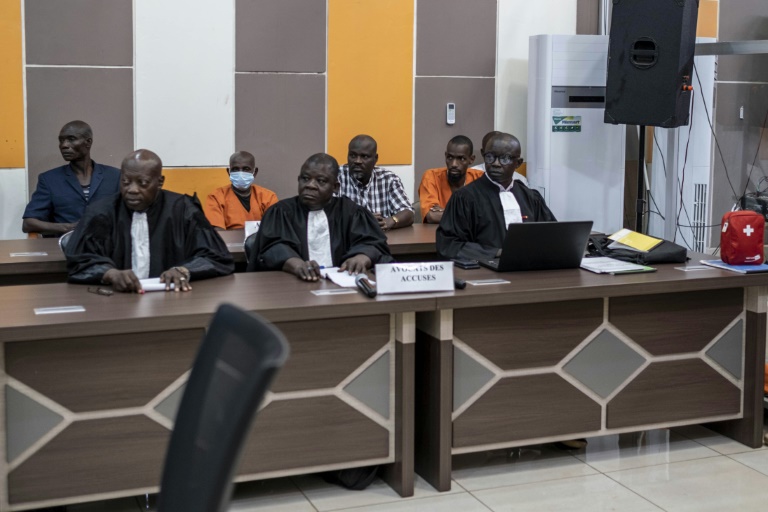
In a historic ruling, a UN-backed court in the Central African Republic on Monday convicted three militiamen of crimes against humanity and handed them jail terms ranging from 20 years to life.

Issa Sallet Adoum, Ousman Yaouba and Tahir Mahamat were accused of taking part in an attack by the 3R armed group in May 2019 in which 46 villagers in northwest CAR were massacred.

After its first-ever trial, the Special Criminal Court, a tribunal of local and international judges, sentenced Adoum to life and the others to 20 years.

One of the poorest and most volatile countries in the world, CAR plunged into civil war in 2013 largely along sectarian lines.

Violence fell back in intensity in 2018 but as recently as early 2021, two-thirds of the country lay in the hands of armed groups spawned in the conflict.

The 3R (Return, Reclamation and Rehabilitation) is one of the most powerful of these militias, drawing its members mainly from the Fulani ethnic group, also called Peuls.

The special court’s mandate applies to war crimes and crimes against humanity dating back to 2003.

The tribunal was set up in 2015 with UN backing but struggled for years to get going in the face of logistical hurdles, lack of money and local hostility.

After a faltering start caused by a lack of defence lawyers, its first trial opened on April 25 to a panel of national and international judges, with prosecutors from the CAR, the Democratic Republic of Congo, France and Togo.

– Murder and rape –

Prosecutors had requested life terms for the three, accused of slaughtering civilians in the villages of Koundjili and Lemouna on May 21, 2019.

In a statement, the court said the trio were guilty of murder, inhumane acts and humiliating and degrading treatment.

Adoum, as “military chief”, was additionally convicted over rapes committed by subordinates and of war crimes.

The three were acquitted on charges of torture committed as a crime of war.

Defence attorney Manguereka Andre Olivier said the defendants would file an appeal against the ruling. They have three days in which to submit their petition.

Mahamat, who protested his innocence, went on hunger strike three weeks earlier. He was brought in for sentencing on a stretcher, an AFP journalist saw.

The two other defendants, appearing behind a thick glass screen wearing orange prisoner clothing and with their backs turned to a packed courtroom, betrayed little emotion as the sentence was pronounced.

Victims of the 2019 atrocity hailed the court’s ruling, after years of despair about the prospects for justice in a country sapped by weak governance, poverty and other ills.

“We are very happy with the verdict — it’s a message to the murderers: sooner or later, justice will catch up with them,” said Fernand Made-Djapou, a lawyer who acts as spokesman for an alliance of civilian plaintiffs.

“I was there at the attack on Koundjili, where my elder brother… was killed, along with 13 other people I knew,” a 34-year-old man told AFP, speaking on condition of anonymity.

“I am pleased with the ruling and also that the court mentioned the rape, which affected six of my sisters.”

– ‘Triumph’ –

Justice Minister Arnaud Djoubaye Abazene, speaking outside the court, said the ruling was a “triumph of justice” and “a strong signal… against impunity”.

“The verdict is a milestone for the victims and communities that have been terrorised during the country’s conflicts,” said Elise Keppler, associate international justice director of Human Rights Watch (HRW).

Two other major cases are also pending, in the CAR and in The Hague.

In September 30, the court announced that it had charged an army commander, Vianney Semndiro, with crimes against humanity, torture, rape, sexual slavery and “forced disappearance of persons”.

The alleged atrocities were committed at the Bossembele military camp north of the capital, Bangui, between 2009 and 2013, during the regime of former president Francois Bozize.

Part of the secretive camp had been transformed into jails for “political” prisoners, according to international NGOs and journalists who visited the camp in 2013 after the fall of Bozize.

In a separate case, the International Criminal Court (ICC) in The Hague last month began the trial of Mahamat Said Abdel Kani, an alleged commander of the mainly Muslim Seleka armed group that ousted Bozize. 

He faces seven charges of war crimes and crimes against humanity relating to atrocities at a police compound where suspected Bozize supporters were beaten and tortured.  

Covid outbreak traps visitors at Shanghai Disneyland

Shanghai Disney Resort abruptly shut its doors Monday as Chinese authorities imposed a snap lockdown, trapping guests who are not permitted to leave until they test negative for Covid-19.

China is the last major economy wedded to a zero-Covid policy, with authorities brandishing snap lockdowns, mass testing and lengthy quarantines in an effort to stamp out emerging outbreaks.

But new variants have tested local officials’ ability to snuff out flare-ups faster than they can spread, causing much of the country to live under an ever-changing mosaic of Covid curbs.

Visitors to Shanghai Disney Resort are not allowed to leave “until on-site testing returns a negative result”, the city government said in an online notice on Monday.

It added that those who had visited the park since Thursday must obtain three negative Covid tests over three successive days and “avoid participating in group activities”.

The announcement came after Disney said it was “temporarily closing with immediate effect… in accordance with disease control requirements”.

The sprawling 390-hectare (960 acres) theme park and resort includes Shanghai Disneyland, Disneytown and Wishing Star Park. The resort had previously said that it was operating at reduced capacity due to Covid restrictions.

“We will notify guests as soon as we have a confirmed date to resume operations,” Disney said. 

China reported 2,699 local Covid infections on Monday, including 10 asymptomatic cases in Shanghai, according to the National Health Commission.

The eastern megacity — a major hub for the world’s second-largest economy — seethed under a months-long lockdown earlier this year marked by sporadic food shortages and isolated protests.

Markets mostly rise on hopes Fed will take foot off pedal

World stocks mostly rose Monday before a key Federal Reserve policy meeting later in the week, with investors hoping for a less hawkish tilt in plans for interest rate hikes. 

Frankfurt and London equities climbed, but Paris slipped on news of record high eurozone inflation and slowing economic growth.

Investors were nevertheless soothed by reports that the Fed could take its foot off the accelerator in its push to rein in decades-high inflation.

It is expected to announce a fourth successive 75 basis point hike on Wednesday, but it could hint that officials are open to dialling back the pace of increases.

The US slipped into the red on Monday morning, after Wall Street enjoyed strong gains before the weekend thanks to a rally in tech firms after strong earnings from Apple.

“The Fed decision is high priority — and the likelihood of a less hawkish Fed is increasing, which could benefit riskier assets” like equities, said XTM Market analyst Walid Koudmani.

The US gathering comes as other central banks recently indicated they are willing to ease up, with Canada raising rates less than expected last week.

The Bank of England is however expected to deliver another hefty rate hike on Thursday.

– Better earnings than expected –

Concerns that rapidly rising borrowing costs will send economies into a recession have hammered markets globally this year.

Yet a better-than-expected earnings season has provided recent support.

More multinationals are due to report this week as the financial reporting season rolls on, including pharmaceutical giants Moderna and Pfizer, technology behemoth Sony, and car brands BMW, Toyota and Ferrari.

But investors remain on edge over red-hot inflation, as analysts warned a recession in the Eurozone appeared to be on its way.

Economic growth in the bloc fell to 0.2 percent in the third quarter, as inflation hit another record high on the back of soaring energy prices, the EU’s statistics agency said Monday.

“It is a matter of how deep the recession will be and not if there will be one,” Oxford Economics said in an analyst note.

Consumer prices jumped by a fresh record of 10.7 percent in October, stoked by an eye-watering 41.9 percent rise in energy costs, Eurostat said.

The news came after the European Central Bank warned last week that a recession was looming, as it announced another jumbo interest rate hike to try to curb inflation driven up by the fallout from energy producer Russia’s war on Ukraine.

“Double-digit inflation and decade-high interest rates do not bode well for eurozone growth during the rest of this year and into 2023,” noted economist Benjamin Trevis at think-tank CEBR.

– ‘Salt to the wounds’ –

Asia mainly advanced, although Hong Kong and Shanghai sank on concerns over the economic impact of Chinese Covid restrictions.

Beijing reported a contraction in factory activity Monday as sweeping pandemic restrictions paralysed major industrial cities.

That also weighed heavily on oil because China is a major global consumer.

“Although these data points are weaker than expected, it should be no surprise given those broad-based Covid-related restrictions that remained in place during the party congress,” said Stephen Innes, managing partner at SPI Asset Management.

“Negative news from the real estate sector is adding salt to the economic wounds.”

– Key figures around 1330 GMT –

London – FTSE 100: UP 0.5 percent at 7,084.52 points

Frankfurt – DAX: UP 0.19 percent at 13,271.77

Paris – CAC 40: DOWN 0.1 percent at 6,267.68

EURO STOXX 50: UP 0.2 percent at 3,619.19

New York – Dow: DOWN 0.3 percent at 32,749.75

Tokyo – Nikkei 225: UP 1.8 percent at 27,587.46 (close)

Hong Kong – Hang Seng Index: DOWN 1.2 percent at 14,687.02 (close)

Shanghai – Composite: DOWN 0.8 percent at 2,893.48 (close)

Euro/dollar: DOWN at $0.9906 from $0.9965 on Friday

Pound/dollar: DOWN at $1.1498 from $1.1615 

Dollar/yen: UP at 148.72 yen from 147.60 yen

Euro/pound: UP at 86.15 pence from 85.80 pence

West Texas Intermediate: DOWN 1.3 percent at $87.90 per barrel

Brent North Sea crude: DOWN 0.4 percent at $96.31 per barrel

burs-rox/pvh

Somalia appeals for international help after deadly blasts

Somalia’s president has issued an urgent plea for international help for wounded victims of devastating car bombings at the weekend that claimed the lives of 100 people.

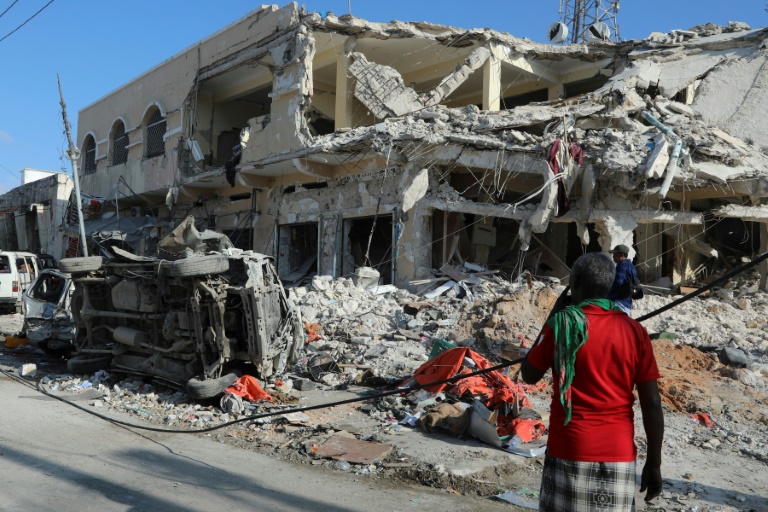
Bulldozers were still clearing the blast site in the capital Mogadishu on Monday in the hunt for bodies feared trapped under the rubble.

Saturday’s attack, which also wounded more than 300 people, was claimed by the Al-Shabaab jihadist group and was the deadliest in the fragile Horn of Africa nation in five years. 

“We appeal for the international community, Somali brothers, and other Muslim brothers and or partners to send doctors to Somalia to help the hospitals treat the wounded people,” President Hassan Sheikh Mohamud said in a statement on Sunday. 

He warned that the death toll could rise, as ill-equipped hospitals were swamped.

Somalia has been mired in chaos since the fall of president Siad Barre’s military regime in 1991 and has one of the world’s weakest health systems after decades of conflict.

“We cannot airlift all these numbers of wounded people… anyone who can send us (help) we request to send us,” said Mohamud.

Prime Minister Hamza Abdi Barre has ordered schools closed so that students can take part in a national blood donation drive.

Mohamud said he himself was among several hundred people who had donated blood to hospitals for the victims.

The World Health Organization said on Sunday it was ready to help the government treat the wounded and provide trauma care.

– We are ‘at war’ –

Al-Shabaab, an Islamist group linked to Al-Qaeda, claimed responsibility for the attack in which two cars packed with explosives blew up minutes apart near the city’s busy Zobe intersection, followed by gunfire.

It said it had targeted the country’s ministry of education.

The explosions tore through walls and shattered windows of nearby buildings, sending shrapnel flying and plumes of smoke and dust into the air.

Ali Yare Ali, a local government official in Mogadishu, told reporters that between seven and nine bodies were suspected to be under the rubble of buildings destroyed by the blasts.

The attack took place at the same junction where a truck packed with explosives blew up on October 14, 2017, killing 512 people and injuring more than 290, the deadliest attack in Somalia.

Somalia’s allies denounced the bombings, with the United States, the United Nations and the African Union among those issuing messages of support.

The attack tests the government’s ability to secure the conflict-weary nation, including the capital of nearly 2.5 million people. 

“The Somali nation and these terrorists are at war, as I speak now, there is fighting ongoing in many parts of the country,” Mohamud said Sunday.

“We are at war with them, and we are killing each other.”

– ‘Horrible scenes’ –

Mohamud called on all Somalis to show solidarity and support those affected by the attack.

“We must get united in providing assistance to the families, children and parents of those who were martyred,” he said, lauding donations of water, food and clothes to survivors.

It was not immediately clear how the cars loaded with explosives evaded the numerous checkpoints that ring-fence the coastal city.

Witnesses said the road was busy with rows of tuk-tuks and other vehicles when the first blast hit.

First responders were met with a second explosion, killing the elderly and women with children strapped on their back, police said.

“I could not sleep last night because of the horrible scene,” police officer Adan Mohamed told AFP on Sunday. 

Al-Shabaab fighters have stepped up their attacks in Somalia since Mohamud was elected in May and vowed an “all-out-war” on the Islamists.

In August, the group launched a 30-hour gun and bomb attack on the popular Hayat hotel in Mogadishu, killing 21 people and wounding 117.

The insurgents have been seeking to overthrow the fragile foreign-backed government in Mogadishu for about 15 years.

They were driven out of the capital in 2011 by an African Union force but the group still controls swathes of countryside and continues to wage deadly strikes on civilian, political and military targets.

Rescuers search for bodies as Philippines storm death toll hits 101

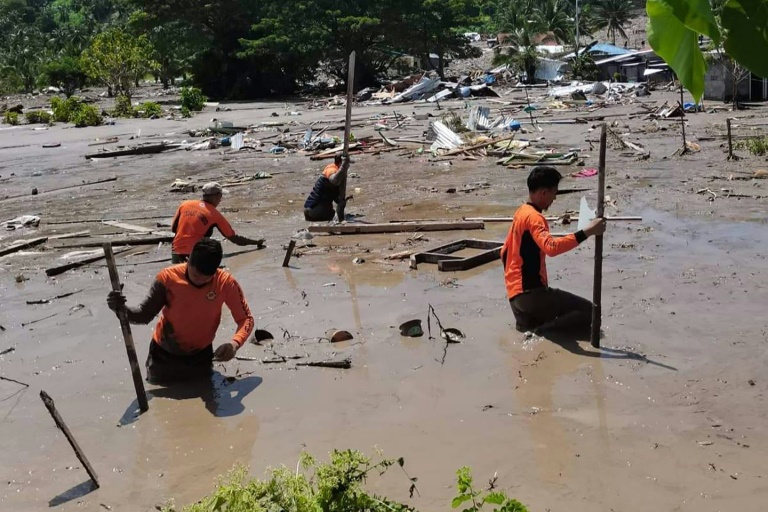
Philippine rescuers on Monday waded through thigh-deep mud using long pieces of wood to search for bodies buried by a landslide, as the death toll from a powerful storm rose to 101.

Just over half of the fatalities were from a series of flash floods and landslides unleashed by Tropical Storm Nalgae, which destroyed villages on the southern island of Mindanao on Friday.

Mindanao is rarely hit by the 20 or so typhoons that strike the Philippines each year, but storms that do reach the region tend to be deadlier than in Luzon and central parts of the country.

There is little hope of finding survivors in the worst-hit areas after the storm swept across the archipelago nation, inundating communities in and around the capital Manila over the weekend.

The national disaster agency has recorded 66 people still missing and scores of others injured.

Perfidia Seguendia, 71, and her family lost all their belongings except the clothes they were wearing when they fled to their neighbour’s two-storey house in Noveleta municipality, south of Manila.

“Everything was flooded — our fridge, washing machine, motorcycle, TV, everything,” Seguendia told AFP.

“All we managed to do was to cry because we can’t really do anything about it. We weren’t able to save anything, just our lives.”

The Philippine Coast Guard posted pictures on Facebook showing its personnel in devastated Kusiong village, in Maguindanao del Norte province of Mindanao, struggling through thick, thigh-deep mud and water as they searched for more bodies.

Kusiong was buried by a massive landslide, which created a huge mound of debris, just below several picturesque mountain peaks.

Rescuers poked long pieces of wood into the morass looking for five missing villagers, after recovering 20 bodies in recent days, the coast guard said.

Twelve of the dead, including seven from one family, were buried Monday in two mass graves dug by a backhoe. 

Mourners, who survived the landslide, laid flowers and candles at the site.  

“We have shifted our operation from search and rescue to retrieval because the chances of survival after two days are almost nil,” said Naguib Sinarimbo, civil defence chief of the Bangsamoro region in Mindanao.

Meanwhile, survivors faced the heartbreaking task of cleaning up their sodden homes.

Residents shovelled mud from their houses and shops after piling their furniture and other belongings in the streets of Noveleta.

“In my entire life living here, it’s the first time we experienced this kind of flooding,” said Joselito Ilano, 55, whose house was flooded by waist-high water.

“I am used to flooding here but this is just the worst, I was caught by surprise.”

– More rain on the way –

President Ferdinand Marcos began touring some of the hard-hit areas on Monday, including Noveleta, as aid agencies rushed food packs, drinking water and other relief to victims.

Marcos said preemptive evacuations in Noveleta had saved lives.

“While the calamity was huge, the number of casualties was not that high, although there’s a lot of damage to infrastructure,” he said.

Nalgae inundated villages, destroyed crops and knocked out power in many regions as it swept across the country.

It struck on an extended weekend for All Saints’ Day, which is on Tuesday, when millions of Filipinos travel to visit the graves of loved ones.

Scientists have warned that deadly and destructive storms are becoming more powerful as the world gets warmer because of climate change.

The state weather forecaster warned that another tropical storm was heading towards the Philippines even as Nalgae moved across the South China Sea.

Starting Wednesday, the new weather system could bring more heavy rain and misery to southern and central regions badly affected by Nalgae.

Landslides and flash floods originating from largely deforested mountainsides have been among the deadliest hazards posed by storms in the Philippines in recent years. 

Ukraine grain exports resume as Turkey fights to save deal

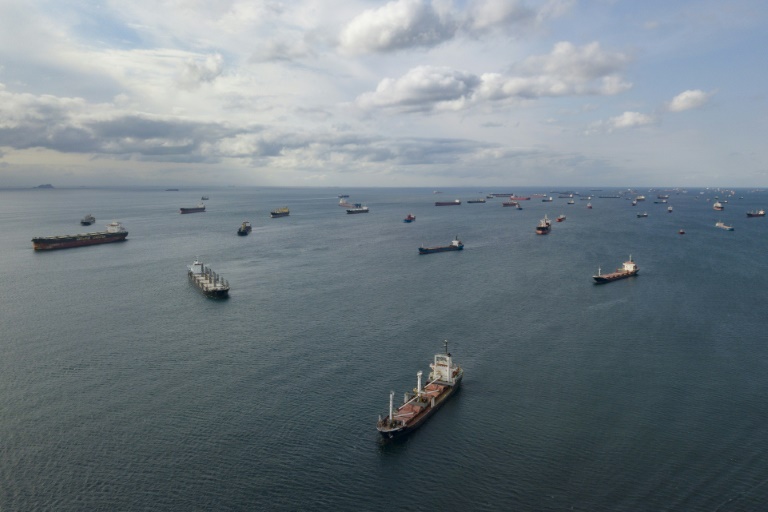
Cargo ships loaded with grain and other agricultural products left Ukrainian ports on Monday despite Russia’s decision to pull out from a landmark deal designed to ease a global food crisis.

As one of the brokers of the grain deal, Turkey has stepped up diplomacy with the two warring countries in a bid to save it as Russia warned that continuing to enforce the agreement without its participation would be “dangerous”.

At least 10 ships including the Ikaria Angel  — chartered by the World Food Programme and loaded with 30,000 tonnes of wheat destined for an emergency response in the Horn of Africa — left Ukrainian ports on Monday, according to a website that tracks marine traffic. 

“Civilian cargo ships can never be a military target or held hostage. The food must flow,” Amir M. Abdulla, the UN Coordinator for the Black Sea Grain Initiative, tweeted on Monday. 

In all, 12 ships were due to leave Ukrainian ports on Monday and four more were due to head to the country, according to the Joint Coordination Center (JCC) that has been overseeing the agreement brokered by Turkey and the UN.

-‘Continue our efforts’-

The marine traffic came two days after Russia notified the UN and Turkey that it was suspending its participation in the grain agreement, after Moscow accused Ukraine of a “massive” drone attack on its Black Sea Fleet in Crimea. 

Ukraine has labelled the Russian charges as a “false pretext”.

Moscow also withdrew from ship inspections, which were mandatory under the deal.

Grain prices were up on Monday morning after the Russian decision. 

Turkish President Recep Tayyip Erdogan vowed to pursue efforts to keep the agreement in force despite Russia’s moves.

“Although Russia acts hesitantly… we will resolutely continue our efforts to serve humanity,” Erdogan said in a televised address. 

Monday’s shipping schedule was agreed by the Ukrainian, Turkish and UN delegations, with Russia informed of the movements, the JCC said in a statement late on Sunday.  

A source familiar with the matter said: “As a signatory to the agreement, they have been requested to take the necessary measures to ensure the safety of the vessels.”

– ‘Dangerous’-

The Kremlin said it would be “dangerous” to enforce the agreement without its involvement. 

“In conditions where Russia talks about the impossibility of guaranteeing the safety of navigation in these areas, such a deal is hardly feasible. And it takes on a different character, much more risky, dangerous,” Kremlin spokesman Dmitry Peskov told journalists.

Turkey’s defence minister Hulusi Akar said talks were under way with the relevant parties for the agreement to remain in place. 

Akar said he spoke with Ukrainian authorities and would contact his Russian counterpart, Sergei Shoigu, on Monday evening. 

“This (agreement) should continue. Suspending this initiative will not benefit Russia, Ukraine or anyone else,” he said, urging the parties “to review their decisions.”

Ukraine, one of the world’s largest grain exporters, was forced to halt almost all deliveries following Russia’s invasion in late February. 

The July deal to unlock its grain exports is critical to easing the global food crisis caused by the conflict.

The agreement, which established a safety corridor through which vessels could travel to Istanbul for inspections, had already allowed more than 9.5 million tonnes of Ukrainian grain to be exported and was due to be renewed on November 19.

A separate deal signed with Russia allowed the export of Russian food and fertilisers, despite Western sanctions imposed on Moscow. But it was never implemented, to the dismay of Moscow, which has complained about the issue for weeks.

On Thursday, a few days before Russia’s suspending its participation in the grain deal, its ambassador to the UN Vassily Nebenzia told reporters that Russian exports must be allowed to go through before Moscow would commit to a deal extension.  

Ethiopia peace talks ongoing in South Africa

Talks between the Ethiopian government and the rebel authorities in Tigray aimed at finding a peaceful resolution to their devastating two-year conflict were continuing Monday, a diplomat said.

The negotiations led by the African Union began last Tuesday in South Africa, the first formal dialogue to try to end a war that has killed many thousands of people and unleashed a desperate humanitarian crisis in northern Ethiopia.

South Africa had initially said the talks being held in Pretoria would run until Sunday, but they remain shrouded in secrecy.

Ebba Kalondo, spokeswoman for AU Commission chair Moussa Faki Mahamat, said in a message to AFP that “there was no date limitation put on the talks”.

A diplomat with knowledge of the discussions confirmed to AFP that the talks were continuing on Monday, without giving further details, adding: “They are very strict about confidentiality.”

A source close to the Tigrayan delegation in South Africa had told AFP at the weekend that the talks would likely continue until Tuesday.

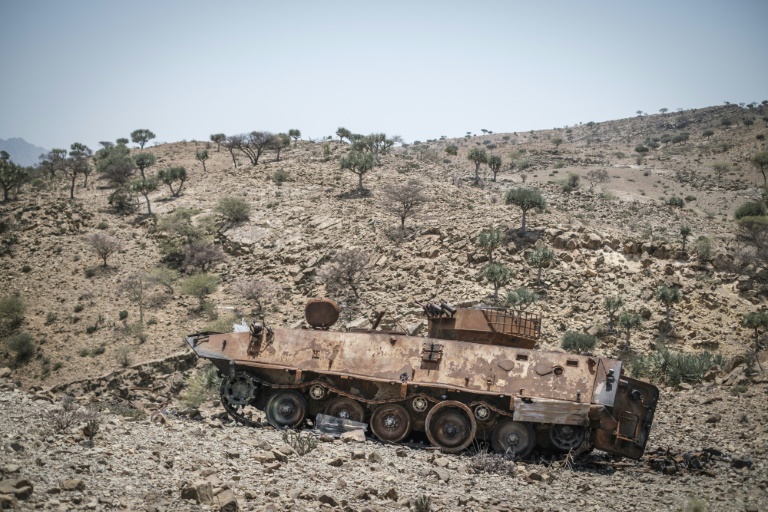
Since the negotiations began, intense fighting has continued unabated in Tigray, where government troops backed by the Eritrean army and regional forces have been waging artillery bombardments and air strikes, capturing a string of towns from the rebels.

Diplomatic efforts to try to bring the government and the rebels to the negotiating table gathered pace after combat resumed in late August, torpedoing a five-month truce that had allowed limited amounts of aid into Tigray.

The international community has voiced deep alarm over the ongoing fighting and the human cost it has exacted on civilians caught in the crossfire.

It is calling for an immediate cessation of hostilities, humanitarian access to Tigray where many face hunger, and a withdrawal of Eritrean forces, whose return to the conflict has raised fears of renewed atrocities against civilians. 

The conflict erupted on November 4, 2020, when Ethiopian Prime Minister Abiy Ahmed sent troops into Tigray after accusing the region’s ruling Tigray People’s Liberation Front (TPLF) of attacking federal army camps.

The fighting in Africa’s second most populous country has forced more than two million people from their homes, and according to US estimates, killed as many as half a million.

However, Tigray remains largely closed off to the outside world with no communications and a shortage of food, fuel and medicines, while access to northern Ethiopia is restricted for journalists. 

Bankrupt Sri Lanka's inflation dips to 66 percent

Inflation in crisis-hit Sri Lanka dipped marginally for the first time in 12 months but prices were still an eye-watering 66 percent higher than a year ago, official data showed Monday.

The island nation of 22 million people has suffered months of extreme economic hardship with severe shortages of essentials including food, fuel and medicines.

The Department of Census and Statistics data showed October inflation was nearly four percentage points lower than the record 69.8 percent in September.

Food inflation which had also reached a record high for the 12th consecutive month in September at 94.9 percent moderated to 85.6 percent in October.

The department did not give reasons for the slowdown in inflation, but authorities had reduced fuel prices twice in October, cutting prices by 20 percent.

However, the price of petrol is still double the amount before the start of the crisis late last year, while diesel — used commonly for public transport — is still three and a half times more.

Sharp price increases for both food and fuel has led to a drop in demand and queues for petrol and diesel and cooking gas have sharply reduced in recent weeks.

The World Bank has warned that the economy could shrink by 9.2 percent this year, worse than the 8.7 percent contraction the central bank of Sri Lanka had forecasted.

An unprecedented downturn forced the government to default on its $51 billion foreign debt in April and go to the International Monetary Fund (IMF) for a bailout. 

Blackouts, chronic fuel shortages and high prices triggered months of political unrest, ultimately forcing the president Gotabaya Rajapaksa to flee the country and resign in July. 

The IMF has tentatively approved a four-year, $2.9 billion bailout to help Sri Lanka reorganise its finances, subject to an agreement with its creditors.

It had also asked the government to contain spiralling inflation and address corruption as part of efforts to salvage the troubled economy.

India bridge collapse kills more than 130

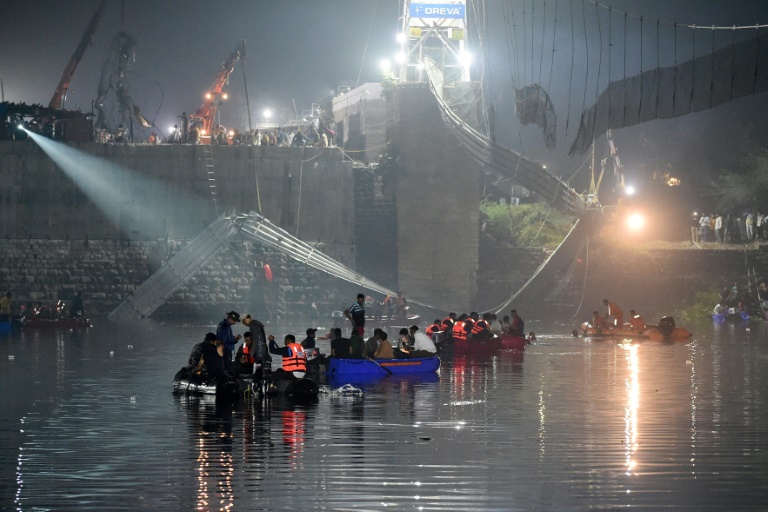
At least 137 people died in western India when a colonial-era pedestrian bridge packed with revellers collapsed into the river below, police said Monday.

Authorities said nearly 500 people were celebrating the last day of the Diwali festival on and around the nearly 150-year-old suspension bridge in Morbi when supporting cables snapped after dark on Sunday.

CCTV footage showed the structure in Prime Minister Narendra Modi’s home state of Gujarat swaying — with a few people apparently deliberately rocking it — before it suddenly gave way.

The walkway and one fence crashed into the river, leaving the other side dangling in mid-air and hundreds of people in the water.

“I saw the bridge collapse before my eyes,” said one witness who worked all night on rescue efforts, without giving his name.

“It was traumatic when a woman showed me a photo of her daughter and asked if I had rescued her. I could not tell her that her daughter had died.”

Supran, another witness, said the bridge was “jam-packed”.

“The cables snapped and the bridge came down in a split second. People fell on each other and into the river,” he told local media.

News reports showed footage of people clinging onto the twisted remains of the bridge or trying to swim to safety in the dark.

Many Indians cannot swim and another Morbi resident, Ranjanbhai Patel, said he helped pull out those who had been able to reach the banks.

“As most of the people had fallen into the river, we were not able to save them,” he said.

Local police chief P. Dekavadiya said that by Monday afternoon that the death toll had risen to 137. They included around 50 children, the youngest being a two-year-old boy.

One local MP, Kalyanji Kundariya, told media he had lost 12 family members in the accident, including five children.

The bridge over the Machchhu river, a popular tourist spot, had only reopened several days earlier, after months of repairs.

– ‘No certificate’ –

Authorities launched a rescue operation following the collapse, with boats and divers searching the river all night and on Monday.

The bridge, 233 metres (764 feet) long and 1.5 metres wide, was inaugurated in 1880 by  British colonial authorities and made with materials shipped from England, reports said.

The Gujarat tourist department describes the “grand suspension bridge” about 200 kilometres (120 miles) west of the state’s main city, Ahmedabad, as an “artistic and technological marvel”.

Sandeepsinh Jhala, Morbi municipality’s chief officer, said the bridge had not been issued a safety certificate after the renovations.

Police on Monday detained several people for questioning from the firm that carried out the repairs, Morbi superintendent Rahul Tripathi said.

Reports named the firm as a unit of the Gujarat-based Oreva group, which describes itself as the world’s largest clock manufacturer, and also makes lighting products and e-bikes. The company could not immediately be reached for comment.

Modi, who was due to visit the site on Tuesday, said that he “may rarely have experienced so much pain in my life”.

Moscow and New Delhi have enjoyed close relations for decades and the Kremlin said in a statement that Russian President Vladimir Putin sent his condolences.

Japan’s Prime Minister Fumio Kishida said he was “deeply saddened” while Nepal, Bhutan, Britain and France also sent messages of support.

Accidents from old and poorly maintained infrastructure, including bridges, are common in India.

In 2016, the collapse of a flyover onto a busy street in Kolkata killed at least 26 people. 

Five years earlier, at least 32 people perished when a packed bridge collapsed in the hill resort of Darjeeling.

Markets mostly rise on hopes Fed will take foot off pedal

World stocks mostly rose Monday before a key Federal Reserve policy meeting later in the week, with investors hoping for a less hawkish tilt in plans for interest rate hikes. 

Frankfurt and London equities climbed, but Paris slipped on news of record high eurozone inflation and slowing economic growth.

Asia mainly advanced, although Hong Kong and Shanghai sank on concerns over the economic impact of Chinese Covid restrictions.

That also weighed heavily on oil because China is a major global consumer.

– ‘High priority’ –

Investors were nevertheless soothed by reports that the Fed could take its foot off the accelerator in its push to rein in decades-high inflation.

“The Fed decision is high priority — and the likelihood of a less hawkish Fed is increasing, which could benefit riskier assets” like equities, said XTM Market analyst Walid Koudmani.

“Furthermore, Friday’s non-farm payrolls report is also going to be quite important as it will precede next week’s mid-term US election and set the tone.”

The Fed is expected to announce a fourth successive 75 basis point hike on Wednesday, but it could hint that officials are open to dialling back the pace of increases.

The gathering comes as other central banks recently indicated they are willing to ease up, with Canada raising rates less than expected last week.

The Bank of England is however expected to deliver another hefty rate hike on Thursday.

Concerns that rapidly rising borrowing costs will send economies into a recession have hammered markets globally this year.

Yet a better-than-expected earnings season has provided recent support, but investors remain on edge over red-hot inflation.

Eurozone economic growth fell to 0.2 percent in the third quarter, as inflation hit another record high on the back of soaring energy prices, the EU’s statistics agency said Monday.

Consumer prices jumped by a fresh record of 10.7 percent in October, stoked by an eye-watering 41.9 percent rise in energy costs, Eurostat said.

The news came after the European Central Bank warned last week that a recession was looming, as it announced another jumbo interest rate hike to try to curb inflation driven up by the fallout from energy producer Russia’s war on Ukraine.

“Double-digit inflation and decade-high interest rates do not bode well for eurozone growth during the rest of this year and into 2023,” noted economist Benjamin Trevis at think-tank CEBR.

Wall Street meanwhile enjoyed strong gains before the weekend, thanks to a rally in tech firms after strong earnings from Apple.

– Key figures around 1130 GMT –

London – FTSE 100: UP 0.1 percent at 7,057.08 points

Frankfurt – DAX: UP 0.2 percent at 13,266.49

Paris – CAC 40: DOWN 0.2 percent at 6,263.60

EURO STOXX 50: UP 0.1 percent at 3,616.77

Tokyo – Nikkei 225: UP 1.8 percent at 27,587.46 (close)

Hong Kong – Hang Seng Index: DOWN 1.2 percent at 14,687.02 (close)

Shanghai – Composite: DOWN 0.8 percent at 2,893.48 (close)

New York – Dow: UP 2.6 percent at 32,861.80 (close)

Euro/dollar: DOWN at $0.9935 from $0.9965 on Friday

Pound/dollar: DOWN at $1.1547 from $1.1615 

Dollar/yen: UP at 148.46 yen from 147.60 yen

Euro/pound: UP at 86.04 pence from 85.80 pence

West Texas Intermediate: DOWN 1.6 percent at $86.49 per barrel

Brent North Sea crude: DOWN 1.5 percent at $94.35 per barrel

Close Bitnami banner
Bitnami