World

C.Africa special court sentences three for crimes against humanity

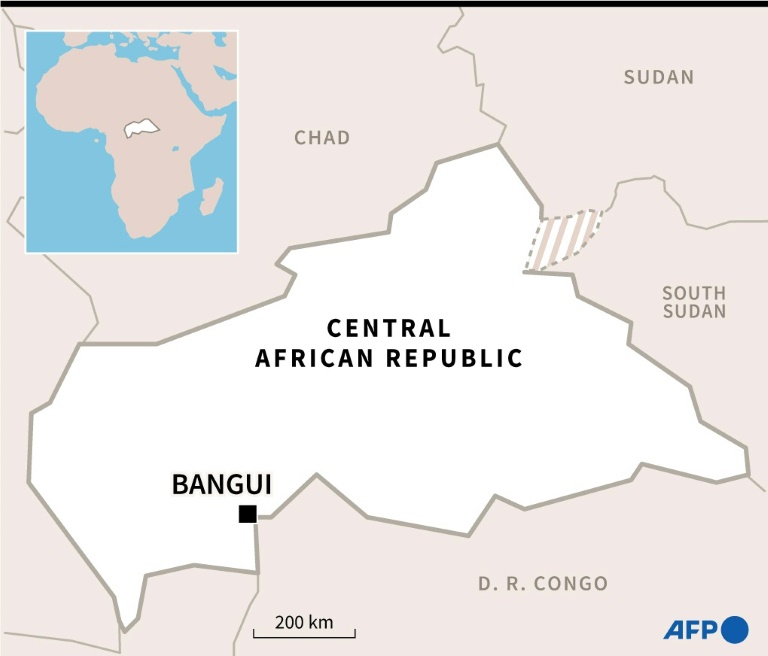
A court in the Central African Republic (CAR) in a historic ruling on Monday convicted three militiamen for crimes against humanity and handed them jail terms ranging from 20 years to life.

Issa Sallet Adoum, Ousman Yaouba and Tahir Mahamat were accused of taking part in an attack by the 3R armed group in May 2019 in which 46 villagers in northwest CAR were massacred.

The Special Criminal Court, a tribunal of local and international judges, sentenced Adoum to life and the others to 20 years after its first-ever trial.

One of the poorest and most volatile countries in the world, CAR plunged into civil war in 2013 largely along sectarian lines.

Violence fell back in intensity in 2018 but as recently as early 2021, two-thirds of the country lay in the hands of armed groups spawned in the conflict.

The mandate of the special court applies to war crimes and crimes against humanity dating back to 2003.

The court was set up in 2015 with UN backing but struggled for years to get going in the face of logistical hurdles, lack of money and local hostility.

After a faltering start, its first trial opened in April to a panel of national and international judges, with prosecutors from the Democratic Republic of Congo, France and Togo.

The 3R (Return, Reclamation and Rehabilitation) is one of the CAR’s most powerful armed groups, drawn mainly from the Fulani ethnic group, also called Peuls.

Prosecutors in August had requested life terms for the three.

In a statement, the court said the trio were guilty of murder, inhumane acts and humiliating and degrading treatment.

Adoum, as “military chief,” was additionally convicted over rapes committed by subordinates and of war crimes.

The three were acquitted on charges of torture committed as a crime of war.

Mahamat, who protested his innocence, went on hunger strike three weeks earlier. He was brought in for sentencing on a stretcher, an AFP journalist saw.

The defendants have three days in which to appeal.

'Sharp' global labour market slowdown underway: UN

The war raging in Ukraine and other overlapping crises are taking a toll on labour markets worldwide, the UN said Monday, suggesting a “sharp” slowdown was already underway.

In a fresh report, the International Labour Organization cautioned that the outlook for global labour markets has deteriorated in recent months.

“The ILO projects that if current trends continue, global employment growth will deteriorate significantly in the last three months of this current year 2022, and unemployment might start increasing,” agency chief Gilbert Houngbo told reporters.

The UN agency warned that multiple, overlapping crises, compounded by Russia’s war in Ukraine, were piling up with the world still in the grips of the Covid-19 pandemic.

Amid deepening energy and food security crises, swelling inflation, tightening monetary policy and fears of a looming global recession, it said both employment creation and the quality of jobs were declining.

“While it normally takes time for an economic slowdown or a recession to result in job destruction and unemployment, available data suggests that a sharp labour market slowdown is already underway,” the report said.

– 40 million jobs missing –

At the beginning of this year, as the world began recovering from the height of the pandemic, employment-to-population ratios returned to or even exceeded pre-Covid-crisis levels in most advanced economies.

ILO said this uptick was especially apparent in high-skilled occupations — but cautioned that it was also driven by a surge in informal jobs, where social protections are generally lacking.

The situation has worsened in recent months, ILO said, estimating that overall hours worked was 1.5 percent below pre-pandemic levels in the third quarter.

That amounts to a deficit of 40 million full-time jobs.

As the number of jobs available is shrinking, surging inflation is causing real wages to fall in many countries, as many households are still grappling with pandemic-induced income declines, it said.

– Ukraine employment plunges –

Monday’s report highlighted in particular the dire employment situation in Ukraine itself since Russia invaded in February.

Houngbo said the war had caused “a dramatic effect on Ukraine’s own labour market.”

Inflation in the conflict-torn country is expected to top 30 percent by the end of the year, while ILO estimated employment there would be 15.5 percent below the 2021 level.

That means 2.4 million jobs lost since the start of the war — half the number predicted by ILO in April, when the number of areas in Ukraine under occupation or facing active hostilities was higher.

But the UN agency cautioned the “partial labour market recovery is modest and highly fragile.”

It highlighted the large number of internally displaced people looking for jobs.

“This risks pushing wages down in these areas,” Houngbo said.

The report also estimated that 10.4 percent of Ukraine’s pre-war workforce — some 1.6 million people, mostly women — had fled to other countries.

A recent survey found around a quarter of Ukrainian refugees had found waged work or self-employment in their host countries, ILO said.

– ‘Deeply worrying’ –

Monday’s report called for in-depth social dialogue to create the policies needed to counter labour market downturns.

It also warned that excessive policy tightening could cause “undue damage to jobs and incomes in both advanced and developing countries.”

There is a “need to ensure that the monetary tightening to combat inflation … is really dovetailed with social measures, dovetailed with minimum social protection,” Houngbo said, describing the global employment situation as “deeply worrying”.

“Preventing a significant global labour market downturn, will require comprehensive, integrated and balanced policies both nationally and globally.” 

'Sharp' global labour market slowdown underway: UN

The war raging in Ukraine and other overlapping crises are taking a toll on labour markets worldwide, the UN said Monday, suggesting a “sharp” slowdown was already underway.

In a fresh report, the International Labour Organization cautioned that the outlook for global labour markets has deteriorated in recent months.

“The ILO projects that if current trends continue, global employment growth will deteriorate significantly in the last three months of this current year 2022, and unemployment might start increasing,” agency chief Gilbert Houngbo told reporters.

The UN agency warned that multiple, overlapping crises, compounded by Russia’s war in Ukraine, were piling up with the world still in the grips of the Covid-19 pandemic.

Amid deepening energy and food security crises, swelling inflation, tightening monetary policy and fears of a looming global recession, it said both employment creation and the quality of jobs were declining.

“While it normally takes time for an economic slowdown or a recession to result in job destruction and unemployment, available data suggests that a sharp labour market slowdown is already underway,” the report said.

– 40 million jobs missing –

At the beginning of this year, as the world began recovering from the height of the pandemic, employment-to-population ratios returned to or even exceeded pre-Covid-crisis levels in most advanced economies.

ILO said this uptick was especially apparent in high-skilled occupations — but cautioned that it was also driven by a surge in informal jobs, where social protections are generally lacking.

The situation has worsened in recent months, ILO said, estimating that overall hours worked was 1.5 percent below pre-pandemic levels in the third quarter.

That amounts to a deficit of 40 million full-time jobs.

As the number of jobs available is shrinking, surging inflation is causing real wages to fall in many countries, as many households are still grappling with pandemic-induced income declines, it said.

– Ukraine employment plunges –

Monday’s report highlighted in particular the dire employment situation in Ukraine itself since Russia invaded in February.

Houngbo said the war had caused “a dramatic effect on Ukraine’s own labour market.”

Inflation in the conflict-torn country is expected to top 30 percent by the end of the year, while ILO estimated employment there would be 15.5 percent below the 2021 level.

That means 2.4 million jobs lost since the start of the war — half the number predicted by ILO in April, when the number of areas in Ukraine under occupation or facing active hostilities was higher.

But the UN agency cautioned the “partial labour market recovery is modest and highly fragile.”

It highlighted the large number of internally displaced people looking for jobs.

“This risks pushing wages down in these areas,” Houngbo said.

The report also estimated that 10.4 percent of Ukraine’s pre-war workforce — some 1.6 million people, mostly women — had fled to other countries.

A recent survey found around a quarter of Ukrainian refugees had found waged work or self-employment in their host countries, ILO said.

– ‘Deeply worrying’ –

Monday’s report called for in-depth social dialogue to create the policies needed to counter labour market downturns.

It also warned that excessive policy tightening could cause “undue damage to jobs and incomes in both advanced and developing countries.”

There is a “need to ensure that the monetary tightening to combat inflation … is really dovetailed with social measures, dovetailed with minimum social protection,” Houngbo said, describing the global employment situation as “deeply worrying”.

“Preventing a significant global labour market downturn, will require comprehensive, integrated and balanced policies both nationally and globally.” 

Gas crisis fears recede for now as Europe stockpiles

With prices falling and ports clogged with liquefied natural gas tankers, fears of a winter heating crisis in Europe have eased but experts are warning against complacency.

For over a week now, there have been bottlenecks at Spanish ports of ships bringing in LNG, indicating Europe is at full capacity.

Spanish gas regulator Enagas says the backlog at ports is expected to last at least until this week.

The Dutch TTF, a leading European benchmark price, is now close to its lowest level since June, at under 100 euros per megawatt hour at the end of October.

Its price has fallen more than 60 percent since a massive surge in August when Russia’s disruptions to its supply via the Nord Stream pipelines alarmed markets.

TTF’s short-term futures price even briefly went negative last week, for the first time since October 2019. In the United States, gas prices have also fallen sharply.

The days of stratospheric price rises of up to 350 euros per megawatt hour in Europe in March, a few days after Russia’s invasion of Ukraine began, seem to be well and truly in the past.

Since then Europe has made efforts to fill its storage facilities to reduce dependence on Russian gas and sought alternative suppliers, holding crisis meetings and calling for a cut in domestic usage.

– ‘Not out of woods’ –

The strategy has paid off with Europe’s storage reserves now at over 90 percent.

“Since Q1 2022, the EU has benefited from very strong LNG inflow primarily from the US,” analysts at broker Marex said in a note.

Georgi Slavov, head of research at Marex, told AFP that Europe is currently seeing an oversupply of gas but “it is premature to declare victory on that front”.

He said the current abundance is down to factors including unusually warm temperatures, which mean Europeans are not using gas for heating.

In addition the “economic slowdown is limiting gas use,” Slavov said, and “self-imposed restrictions on gas consumption also help enormously”.

A cold winter and industry shifting back to higher energy use could quickly reverse the trend.

“The continent is not out of the woods yet,” said Nikoline Bromander, an analyst for Rystad Energy. 

“With Russian flows continuing to decline, winter 2023 will be even tougher.”

The price for European natural gas is still fluctuating at a very high level, up more than 80 percent since the start of the year. 

– Short-term imbalance –

And “the price curve will not fall into negative in the US or in Europe”, said Eli Rubin of EBW Analytics Group.

A similar situation happened to US crude at the height of the Covid-19 pandemic when demand plummeted and the glut in supply led to a frantic race to stock up.

“Storage, which is the balancing mechanism between supply and demand, normally mops up the excess supply,” said Slavov.

The benchmark WTI crude oil prices then plummeted into negative values as investors were ready to pay not to have barrels of oil due to lack of storage space.

But with gas “we are talking about short-term imbalances that have a short-term effect on the price,” mainly concerning immediate deliveries, said Rubin.

Spain is seeing the same situation, with the waiting tankers indicating a temporary bottleneck, not a fundamental imbalance between too abundant supply versus demand.

This happens “every year” as winter approaches and is a localised issue off the coast of Spain, said Vincent Demoury, general delegate of GIGNL, the International Group of Liquefied Natural Gas Importers.

Spain has six LNG terminals, more than any other European country, where 108 ships unload every week.

Spain also has 44 percent of the EU’s gas storage capacity, according to Enagas.

Demoury say the fall in gas consumption and the high level of gas stocks for winter mean there are no more “available slots in Europe in November” to unload ships.

It is not the case that Europe is drowning in oversupply, since the LNG tankers are simply used as temporary floating storage “waiting for consumers to need gas and for prices to be more attractive,” Demoury said.

Ukraine water, power cuts after 'massive' Russian missile attack

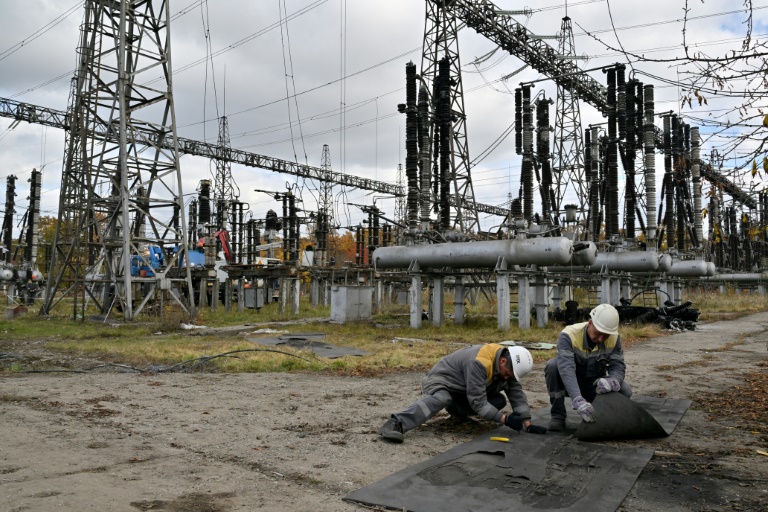
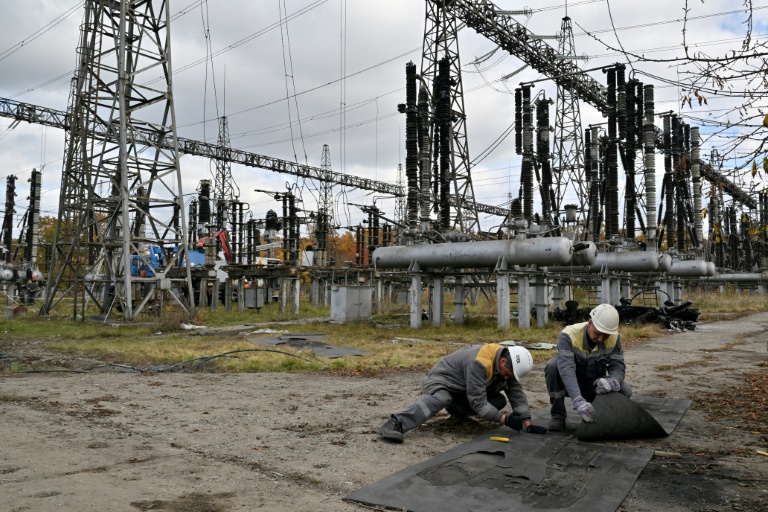
Ukraine suffered sweeping blackouts and water supplies were cut for 80 percent of Kyiv residents on Monday after what Ukrainian officials called another “massive” Russian missile attack on energy facilities.

“More than 50” cruise missiles were launched at targets across the country early on Monday, the Ukrainian army said on Telegram. 

“From 7:00 am (0500 GMT) on October 31, Russian occupiers carried out several waves of missile attacks against critical infrastructure in Ukraine,” the army said, adding that “44 missiles” had been shot down.

Several blasts shook the capital Kyiv, days after Russia blamed Ukraine for drone attacks on its Crimea fleet in the Black Sea.

“Currently, due to the emergency situation in Kyiv, 80 percent of consumers remain without water supply,” the city’s mayor Vitali Klitschko said on Telegram.

“Engineers are also working to restore power to 350,000 homes in Kyiv that were left without electricity,” he added.

At least five explosions were heard in the city between 8:00 am and 8:20 am local time, according to AFP journalists.

Prime Minister Denys Shmyhal said there were power cuts in “hundreds” of urban settlements across seven Ukrainian regions.

“Russian terrorists have again launched a massive attack against electricity installations,” said the deputy head of Ukraine’s presidency, Kyrylo Tymoshenko.

– ‘Cold winter ahead’ –

Near one of the sites targeted north of Kyiv, a soldier told AFP that three missiles had struck.

“It is dangerous here because there could be more strikes,” the soldier said at a blocked crossroads.

In a nearby town, Mila Ryabova, 39, told AFP she was woken by between eight and 10 “powerful explosions”.

“We were together with my family, preparing my daughter for school, but now there is no electricity in our house and at school,” said Ryabova, a translator.

“I’m not afraid of anything. (Some people) are still in shelters now, but not us. 

“But we are worrying and talking about opportunities to move abroad, because there is a cold winter ahead. We may not have electricity, heat supply. It can be hard to handle, especially with a small child.”

Similar attacks targeted infrastructure across Ukraine, including Lviv in the west, Zaporizhzhia in the south and Kharkiv in the northeast.

The Moldovan government said a Russian missile shot down by Ukrainian air defences fell on a village in northern Moldova on Monday, but without causing any injuries.

The country’s interior ministry said the missile fell on the village of Naslavcea close to the Ukrainian border.

“Instead of fighting on the battlefield, Russia fights civilians,” Ukrainian Foreign Minister Dmytro Kuleba said on Twitter.

– Grain deal –

Monday’s attack comes after Russia pulled out of a landmark agreement that allowed vital grain shipments via a maritime safety corridor. 

The July deal to unlock grain exports signed between warring nations Russia and Ukraine — and brokered by Turkey and the United Nations — is critical to easing the global food crisis caused by the conflict.

But Russia announced Saturday it would pull out of the deal after accusing Kyiv of a “massive” drone attack on its Black Sea fleet, which Ukraine labelled a “false pretext”.

Sevastopol in Moscow-annexed Crimea has been targeted several times in recent months and serves as the fleet’s headquarters and a logistical hub for operations in Ukraine.

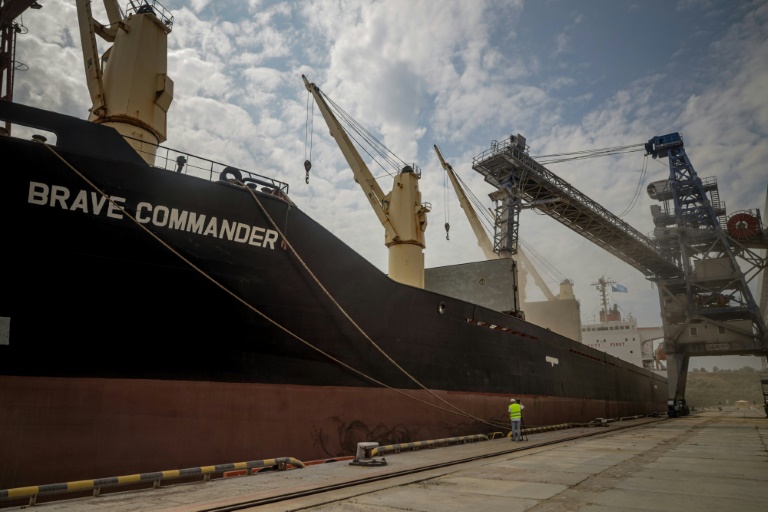
Despite Russia’s decision to exit the deal, two cargo ships loaded with grain and other agricultural products left Ukrainian ports on Monday, according to a marine traffic website. 

Twelve ships were due to leave Ukraine on Monday and four were to head to the country, per the Joint Coordination Center that has been overseeing the agreement. 

“Civilian cargo ships can never be a military target or held hostage. The food must flow,” Amir Abdulla, UN Coordinator for the Black Sea Grain Initiative, said on Twitter. 

“More than two million tons of food” were at sea, but stalled by Russia’s actions, Zelensky said in his evening address on Sunday.

“This is an absolutely transparent intention of Russia to return the threat of large-scale famine to Africa and Asia,” he added.

burs/dt/jm

Japan govt spent $43 bn to bolster yen in October

Japan’s finance ministry said Monday it spent $43 billion in October to bolster the value of the yen, which has tumbled against the dollar this year to lows not seen since the 1990s.

The ministry said it spent 6.35 trillion yen ($43 billion) on forex intervention operations between September 29 and October 27, without giving details of when or how often they had taken place.

It follows a similar decision to sell dollars and buy yen in September that cost 2.8 trillion yen (nearly $20 billion at the time) and was announced by authorities soon after it happened.

But the government had until now refused to confirm speculation by traders and analysts of further intervention this month, causing rollercoaster fluctuations in the yen’s value.

The currency dropped beyond 151 per dollar earlier in October for the first time in 32 years, before rebounding sharply, then gradually falling again.

Around the time of Monday’s announcement, one dollar bought 148 yen — still dramatically weaker than February levels of around 115.

Behind the currency’s slide is the contrast between the monetary policies of the US and Japanese central banks.

While the US Federal Reserve is fighting inflation with aggressive rate hikes, the Bank of Japan has stuck to its longstanding monetary easing programme, designed to encourage sustainable growth.

BoJ governor Haruhiko Kuroda said on Friday there would be no change “any time soon” to the bank’s ultra-loose stance.

“Traders want to test the resolve of the Bank of Japan,” Carol Kong, economist and currency strategist at Commonwealth Bank of Australia, told AFP.

The Japanese government has “a huge amount to spend on intervention”, with more than $1 trillion left in its forex coffers after September’s action, she said.

But to keep costs down, “they have instead used a lot of verbal intervention to try to keep dollar yen on the weaker side”.

Kuroda and Finance Minister Shunichi Suzuki have repeatedly vowed tough action against rapid changes in forex rates.

As well as the impact of government interventions, the yen has also strengthened slightly in recent days because investors expect the Fed to soon temper its hawkish rate hikes, Kong said.

But as long as the Bank of Japan sticks to its guns, moves by the Japanese government to strengthen the yen can only have a limited effect, said Rakuten Securities chief strategist Masayuki Kubota in a recent commentary.

“Intervention can’t stop the yen’s depreciation, but if fundamentals — the gap between Japanese and US interest rates — change, the fall of the yen will stop,” he wrote.

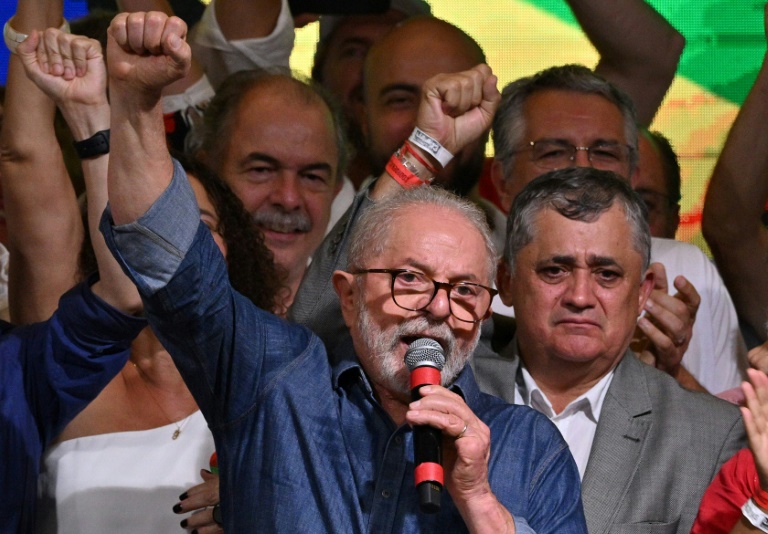
Congratulations pour in for Brazil president-elect Lula

Congratulations poured in from across the globe for Brazil’s leftist president-elect Luiz Inacio Lula da Silva after his narrow victory over far-right incumbent Jair Bolsonaro was announced.

Shortly after Lula was declared the winner, US President Joe Biden said: “I send my congratulations to Luiz Inacio Lula da Silva on his election to be the next president of Brazil following free, fair, and credible elections.”

French leader Emmanuel Macron also offered his good wishes, saying the poll opened “a new page” in Brazil’s history.

“Together, we will join forces to take up the many common challenges and renew the ties of friendship between our two countries,” the French president said minutes after the results announcement.

Canadian Prime Minister Justin Trudeau offered a hearty “Congratulations, Lula!” and said: “The people of Brazil have spoken.”

Trudeau said he looked forward to working with Lula, who served as Brazil’s president from 2003 to 2010, to “advance shared priorities — like protecting the environment.”

All eyes in Western capitals have been on the election’s impact on the future of the Amazon rainforest and the global climate emergency.

– Left-wing wins –

President Alberto Fernandez of neighboring Argentina said Lula’s win “opens a new era for the history of Latin America. A time of hope and future that begins today.”

“After so many injustices you lived through, the people of Brazil have elected you and democracy has triumphed,” he added in a tweet.

After leaving office, Lula was imprisoned for 18 months on controversial and since-quashed corruption charges.

Lula’s return to power in Brazil follows a string of left-wing wins in Latin America.

Gustavo Petro, who became Colombia’s first leftist president after his election this summer, tweeted “Long live Lula.”

He later shared a map showing that the majority of Latin American countries are now led by leftist governments.

Mexico’s President Andres Manuel Lopez Obrador, also from the left wing, tweeted: “Lula won, blessed people of Brazil. There will be equality and humanism.”

And Venezuelan President Nicolas Maduro offered a “big hug” to Lula, saying in a tweet: “Long live the peoples determined to be free, sovereign and independent! Today in Brazil democracy triumphed.”

– BRICS reacts –

Fellow members of the BRICS group of emerging economies also extended their congratulations.

Russian President Vladimir Putin said he hoped for “constructive” cooperation.

“Please accept my sincere congratulations… the election results have confirmed your impressive political authority,” Putin said in a telegram to Lula.

Chinese leader Xi Jinping wished the country “new successes.”

“I am willing to work with President-elect Lula to make joint plans from a strategic height and long-term perspective, and take the China-Brazil comprehensive strategic partnership to a new level,” he said.  

Indian Prime Minister Narendra Modi said he looked forward “to working closely together to further deepen and widen our bilateral relations.”

South African President Cyril Ramaphosa also said his country “looks forward to working with the government of Brazil under the leadership of Mr da Silva.”

The European Union’s chief diplomat Josep Borrell joined the international chorus.

“Brazilian citizens went to the polls to elect their new president in a peaceful and well-organised election.”

Borrell was followed by other European well-wishers, including Spanish Prime Minister Pedro Sanchez and German Foreign Minister Annalena Baerbock.

“Congratulations Lula on your victory… Let’s work together for social justice, equality and against climate change,” Sanchez tweeted.

Baerbock said Brazil’s democracy was “the biggest winner”, after the closely fought election.

“Another big winner is the world’s climate,” she said. 

Britain’s Prime Minister Rishi Sunak said he looked forward to working together on issues, including “growing the global economy to protecting the planet’s natural resources and promoting democratic values.”

Somalia appeals for international help after deadly blasts

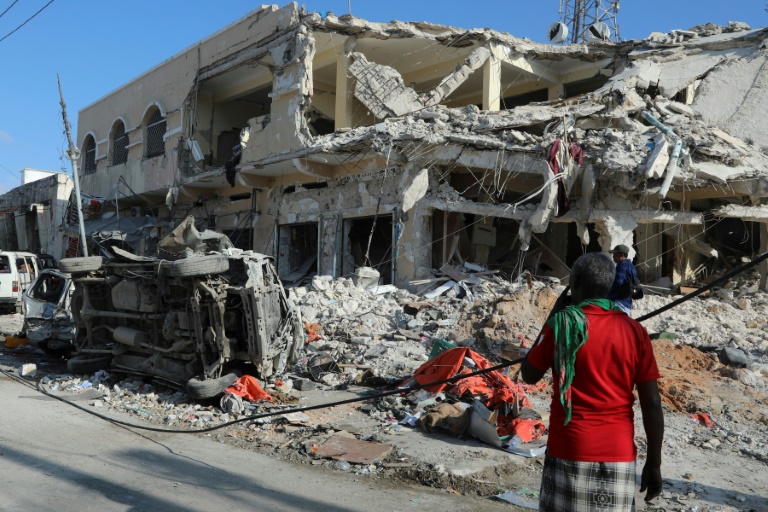
Somalia’s president has issued an urgent plea for international help for wounded victims of devastating car bombings at the weekend that claimed the lives of 100 people.

Bulldozers were continuing to clear the blast site in the capital Mogadishu on Monday in the hunt for bodies feared trapped under the rubble.

Saturday’s attack, which also wounded more than 300 people, was claimed by the Al-Shabaab jihadist group and was the deadliest in the fragile Horn of Africa nation in five years. 

“We appeal for the international community, Somali brothers, and other Muslim brothers and or partners to send doctors to Somalia to help the hospitals treat the wounded people,” President Hassan Sheikh Mohamud said in a statement Sunday. 

He warned that the death toll could rise, as ill-equipped hospitals were swamped.

Somalia has one of the world’s weakest health systems after decades of conflict.

“We cannot airlift all these numbers of wounded people… anyone who can send us we request to send us,” said Mohamud, who himself has donated blood for the victims.

Prime Minister Hamza Abdi Barre has ordered schools closed so that students can take part in a national blood donation drive. 

The World Health Organization said on Sunday it was ready to help the government treat the injured and provide trauma care.

Al-Shabaab, an Islamist group linked to Al-Qaeda, claimed responsibility for the attack in which two cars packed with explosives blew up minutes apart near the city’s busy Zobe intersection, followed by gunfire.

It said in a statement it had targeted the country’s ministry of education.

The explosions tore through walls and shattered windows of nearby buildings, sending shrapnel flying and plumes of smoke and dust into the air.

– ‘All-out-war’ –

Ali Yare Ali, a local government official in Mogadishu, told reporters that between seven and nine bodies were suspected to be under the rubble of buildings destroyed by the blasts.

Somalia’s allies denounced the bombings, with the United States, the United Nations and the African Union among those issuing messages of support.

The attack tests the government’s ability to secure the conflict-weary nation, including the capital of nearly 2.5 million people. 

“The Somali nation and these terrorists are at war, as I speak now, there is fighting ongoing in many parts of the country,” Mohamud said Sunday.

“We are at war with them, and we are killing each other.”

The attack took place at the same busy junction where a truck packed with explosives blew up on October 14, 2017, killing 512 people and injuring more than 290, the deadliest attack in Somalia.

Al-Shabaab fighters have stepped up their attacks in Somalia since Mohamud was elected in May and vowed an “all-out-war” on the Islamists.

The insurgents have been seeking to overthrow the fragile foreign-backed government in Mogadishu for about 15 years.

Al-Shabaab fighters were driven out of the capital in 2011 by an African Union force but the group still controls swathes of countryside and continues to wage deadly strikes on civilian, political and military targets.

Grief, prayers and anger at South Korea crowd crush memorial

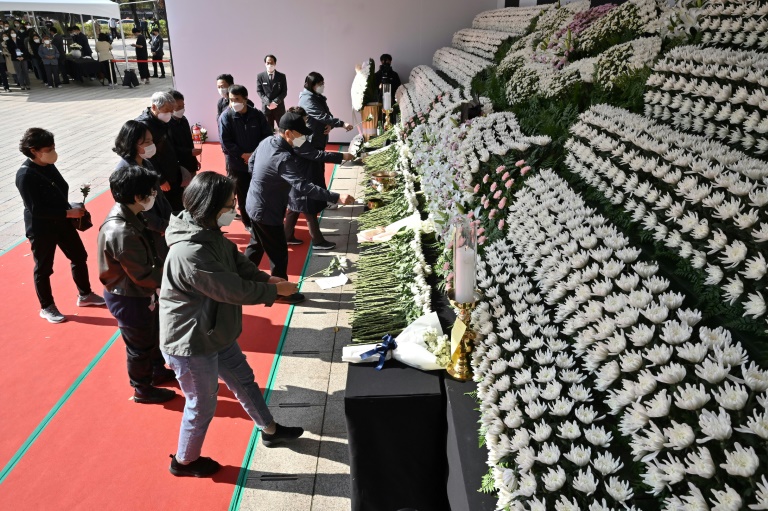
Wiping away tears, Song Jung-hee laid a single white chrysanthemum at a memorial for the 154 victims of a fatal crowd crush in South Korea. 

What was supposed to be a Saturday night of post-pandemic celebration in Seoul’s popular Itaewon nightlife district turned into one of South Korea’s deadliest disaster. 

With tens of thousands of people crammed into a narrow alleyway — and police and crowd control measures nowhere in sight — eye-witnesses have described how partygoers became trapped, crushed and suffocated in a human surge. 

“I wish we could have protected them,” 69-year-old Song told AFP, as she wiped her eyes with a handkerchief.

“I feel guilty — we have let the young people down.” 

Around Song at the altar set up in central Seoul were mourners in various states of distress. Many sobbed as they placed a flower down, with some in office suits — coming to pay their respects during their lunch break — queuing for their turn.

“I cried all night for the poor young people we lost. They were so young, in the prime of their life,” said 71-year-old Park Sun-ja, whose eyes were raw and swollen behind sunglasses.

“It is such a loss for our country,” she told AFP.

The youngest of the victims were schoolchildren, South Korea’s education ministry confirmed Monday, but most were young women in their 20s.

“The victims were young. I’m a similar age and I’m just devastated by what happened,” 19-year-old student Hwang Gyu-hyeon told AFP.

“I can’t believe this accident happened despite the signs that were clear beforehand,” she said. “Nothing was done to prepare for this crowd.”

– ‘This would not have happened’ –

There is growing criticism in media and online over failures in policing and crowd control at the Halloween event. The government has defended the level of police deployment. 

But many mourners at the memorial altar laid the blame squarely on the authorities and the lack of crowd control measures. 

“If only there had been more police officers to keep order, this would not have happened,” Song said angrily. 

The 154 victims included people from more than a dozen different countries, from Australia to Vietnam. 

Japanese businesswoman Chi Naomi, 46, said the death of two of her compatriots had brought the disaster home for her.

“It doesn’t feel like someone else’s tragedy,” she said, adding that in Japan, young people also enjoyed Halloween celebrations, but authorities made sure they were safe.

“I wonder why there wasn’t proper control in Itaewon on that day,” she said.

“I’ve been to the site myself, and it is such a small alley. They could have taken so many steps, like making the alley a one-way or limiting the number of people there. I don’t understand why these steps weren’t taken.”

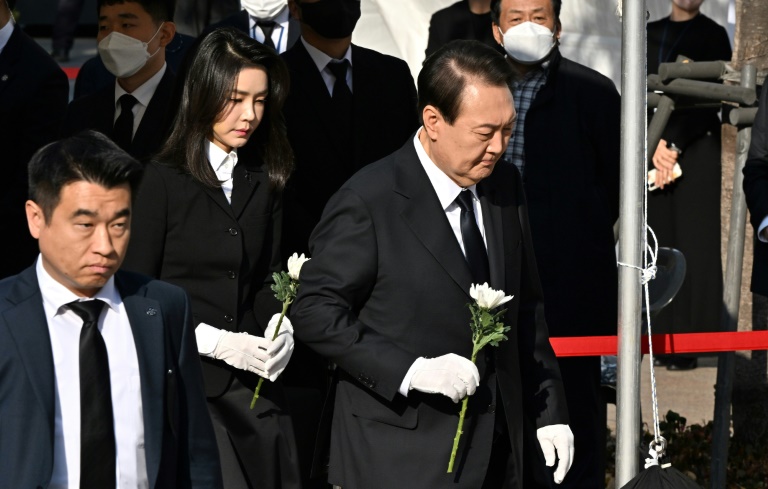
At a second official memorial in Noksapyeong, near Seoul’s new government offices, a group of policemen came to pay tribute to the victims, many looking visibly moved as they laid white flowers on the altar.

Wearing yellow jackets, a group of families linked to South Korea’s 2014 Sewol ferry disaster, in which 304 people — mostly schoolchildren — died, also came to the Noksapyeong memorial to pay their respects, weeping as they laid flowers at the altar.

– ‘Just too much’ –

At a makeshift memorial close to the narrow, three-meter-wide (10 feet) alleyway at the epicenter of the disaster, Buddhist monks chanted prayers for the dead.

Friends hugged and comforted each other while they added their flowers and other tributes to the growing pile at the scene, which soon took up much of the sidewalk.

British tourist Robyn Lindsay told AFP that she and her friends were at the Itaewon Halloween event on Saturday night. 

“But we left before it got too crazy because it was just too much,” she said, adding that they managed to get out and head home before the disaster. 

“We were very, very lucky,” Lindsay said, wiping away tears as she paid her respects at the street-side shrine. “We are just thinking about all the victims and their families.”

kjk-sks-aw-yll/ceb/dhc

South Korea mourns Halloween crowd surge victims

South Koreans gathered Monday at memorials honouring the 154 people killed in a crowd surge at Halloween celebrations, as authorities faced accusations that lax crowd control had caused the disaster.

Police said Monday they had set up a task force to investigate the exact cause of the fatal crush, seizing CCTV from businesses close to the scene in Seoul’s popular Itaewon district and interviewing dozens of witnesses.

But at an official altar set up in central Seoul to mourn the young victims, South Koreans wept, prayed — and railed against authorities’ failures to prevent the catastrophic loss of young life.

“I am devastated by what happened, they were just trying to have a good time,” 19-year-old student Hwang Gyu-hyeon told AFP, weeping and struggling to speak clearly, as she explained how the deaths of so many people her own age had affected her.

“I pray for the victims. I can’t believe this accident happened despite the signs that were clear beforehand. Nothing was done to prepare for this crowd,” she said.

Song Jung-hee, 69, said she kept thinking about how “excited and spirited” the young victims must have been, eager to enjoy a night out without Covid restrictions for the first time in three years.

“If only there had been more police officers to keep order, this would not have happened,” she told AFP.

– Police failures? –

Calls for accountability were growing Monday in the press and online, as potential lapses of crowd control and policing emerged.

As many as 100,000 people — mostly in their teens and 20s, many wearing Halloween costumes — had poured into Itaewon’s small, winding streets, with eyewitnesses describing scant security and no crowd control.

Police said at a briefing Monday they had deployed 137 officers to the event, pointing out that the number was significantly higher than previous years.

But local reports said many of the police officers were focused on drug use, rather than crowd control.

And the authorities themselves admitted they had not forseen that “large-scale casualties would occur due to the gathering of many people”, Hong Ki-hyun, chief of the National Police Agency’s Public Order Management Bureau, told Yonhap.

“I was told that police officers on the scene didn’t detect a sudden surge in the crowd,” Hong said.

The disaster clearly “could have been controlled or prevented”, Lee Young-ju, a professor from the Department of Fire and Disaster at the University of Seoul, told broadcaster YTN.

“But this was not taken care of, with no one taking the responsibility in the first place.”

Online, claims also spread that police this year were not actively managing the crowd, which allowed too many partygoers to congregate around the subway station and in the alleyway at the epicentre of the disaster.

“I’ve lived in Itaewon for 10 years and experienced Halloween every year but yesterday was by no means particularly crowded compared to previous years,” Twitter user @isakchoi312 wrote.

“Ultimately, I think the cause of the disaster was crowd control.”

On Sunday, the government had defended the policing plan.

South Korea is typically strong on crowd control, with the country’s regular protest rallies often so heavily policed that officers can outnumber participants.

Protest organisers must by law report plans to authorities in advance, but there were no such requirements for the young people flocking to the Itaewon Halloween event.

This means it would have been hard for police to do more. 

“The current system lacks legal and institutional grounds for the police to control the general public,” a presidential office official told a briefing, speaking on condition of anonymity.

– Chaos, fear –

The crush happened as tens of thousands of partygoers were packed into a downhill alleyway no more than three metres (10 feet) wide.

Eye-witnesses described scenes of chaos, as people pushed and shoved to get through, with survivors scrambling to get out of the suffocating crowd as people piled on top of one another.

Most of the 154 dead, including 26 foreigners, had been identified Sunday, with the education ministry confirming Monday that at least six young teenagers were among the victims.

But the toll could rise further with at least 33 people in critical condition, officials said.

The country started a week of national mourning, with entertainment events and concerts cancelled and flags nationwide flying at half-mast.

Close Bitnami banner
Bitnami