World

Rescuers search for bodies as Philippines storm death toll hits 98

Philippine rescuers on Monday waded through thigh-deep mud using long pieces of wood to search for bodies buried by a landslide, as the death toll from a powerful storm rose to 98.

Just over half of the fatalities were from a series of flash floods and landslides unleashed by Tropical Storm Nalgae, which destroyed villages on the southern island of Mindanao on Friday.

Mindanao is rarely hit by the 20 or so typhoons that strike the Philippines each year, but storms that do reach the region tend to be deadlier than in Luzon and central parts of the country.

There is little hope of finding survivors in the worst-hit areas after the storm swept across the archipelago nation, inundating communities in and around the capital Manila over the weekend.

The national disaster agency has recorded 63 people still missing and scores of others injured.

Perfidia Seguendia, 71, and her family lost all their belongings except the clothes they were wearing when they fled to their neighbour’s two-storey house in Noveleta municipality, south of Manila.

“Everything was flooded — our fridge, washing machine, motorcycle, TV, everything,” Seguendia told AFP.

“All we managed to do was to cry because we can’t really do anything about it. We weren’t able to save anything, just our lives.”

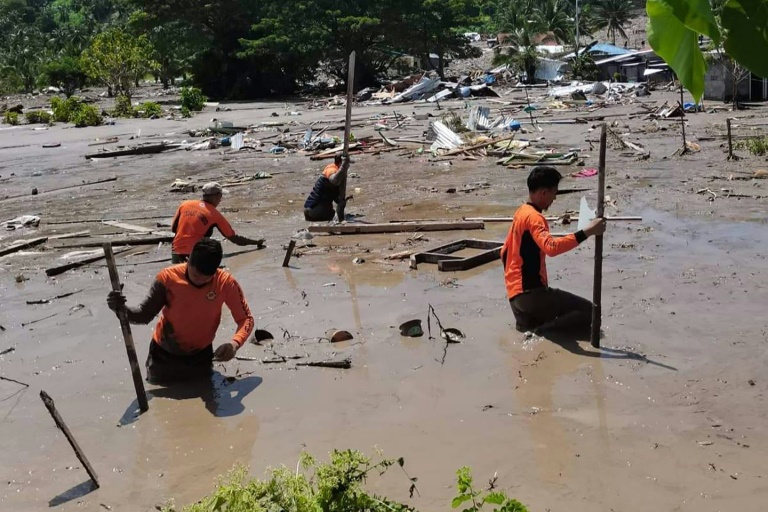
The Philippine Coast Guard posted pictures on Facebook showing its personnel in devastated Kusiong village, in Maguindanao del Norte province of Mindanao, struggling through thick, thigh-deep mud and water as they searched for more bodies.

Kusiong was buried by a massive landslide, which created a huge mound of debris, just below several picturesque mountain peaks.

Rescuers poked long pieces of wood into the morass looking for five missing villagers, after recovering 20 bodies in recent days, the coast guard said.

“We have shifted our operation from search and rescue to retrieval because the chances of survival after two days are almost nil,” said Naguib Sinarimbo, civil defence chief of the Bangsamoro region in Mindanao.

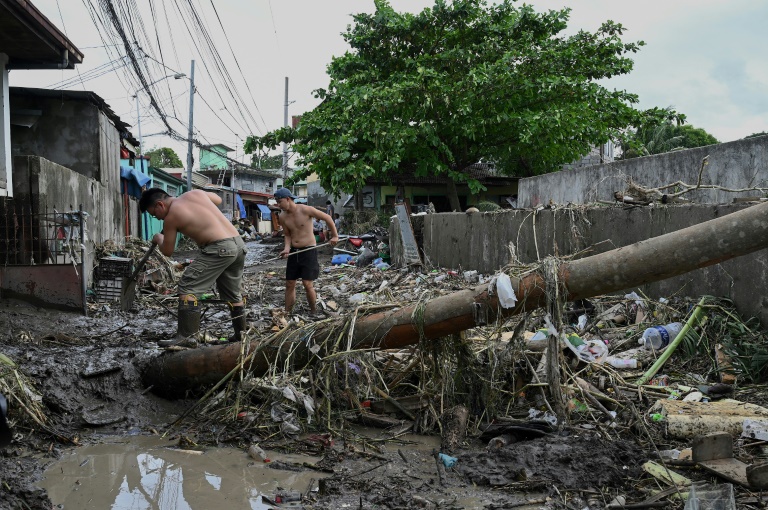
Meanwhile, survivors faced the heartbreaking task of cleaning up their sodden homes.

Residents shovelled mud from their houses and shops after piling their furniture and other belongings in the streets of Noveleta.

“In my entire life living here, it’s the first time we experienced this kind of flooding,” said Joselito Ilano, 55, whose house was flooded by waist-high water.

“I am used to flooding here but this is just the worst, I was caught by surprise.”

– More rain on the way –

President Ferdinand Marcos began touring some of the hard-hit areas on Monday, including Noveleta, as aid agencies rushed food packs, drinking water and other relief to victims.

Marcos said preemptive evacuations in Noveleta had saved lives.

“While the calamity was huge, the number of casualties was not that high, although there’s a lot of damage to infrastructure,” he said.

Nalgae inundated villages, destroyed crops and knocked out power in many regions as it swept across the country.

It struck on an extended weekend for All Saints’ Day, which is on Tuesday, when millions of Filipinos travel to visit the graves of loved ones.

Scientists have warned that deadly and destructive storms are becoming more powerful as the world gets warmer because of climate change.

The state weather forecaster warned that another tropical storm was heading towards the Philippines even as Nalgae moved across the South China Sea.

Starting Wednesday, the new weather system could bring more heavy rain and misery to southern and central regions badly affected by Nalgae.

Landslides and flash floods originating from largely deforested mountainsides have been among the deadliest hazards posed by storms in the Philippines in recent years. 
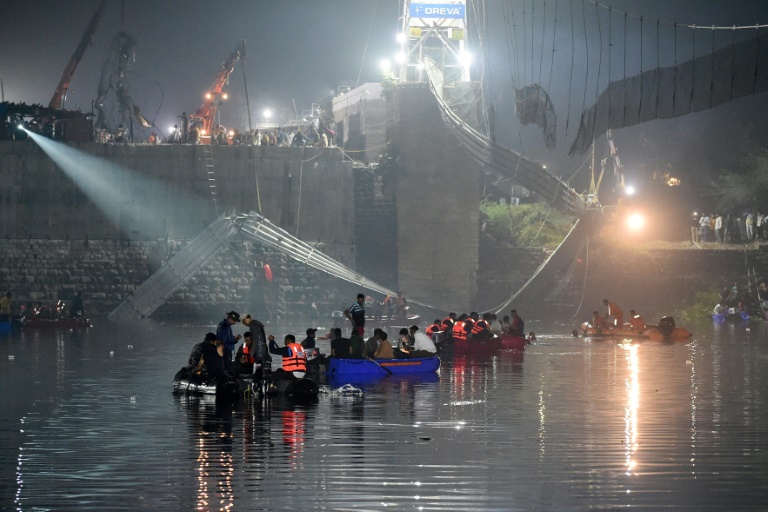
India bridge collapse kills more than 130

At least 132 people died in India when a colonial-era pedestrian bridge packed with revellers collapsed into the river below, police said Monday.

Authorities said nearly 500 people were celebrating the last day of the Diwali festival on and around the nearly 150-year-old suspension bridge in Morbi when supporting cables snapped after dark on Sunday.

CCTV footage showed the structure in the western state of Gujarat swaying — with a few people apparently deliberately rocking it — before it suddenly gave way.

The walkway and one fence crashed into the river, leaving the other side dangling in mid-air and hundreds of people in the water.

“I saw the bridge collapse before my eyes,” said one witness who worked all night on rescue efforts, without giving his name.

“It was traumatic when a woman showed me a photo of her daughter and asked if I had rescued her. I could not tell her that her daughter had died.”

Another witness named Supran said the bridge was “jam-packed”.

“The cables snapped and the bridge came down in a split second. People fell on each other and into the river,” he told local media.

News reports showed footage of people clinging onto the twisted remains of the bridge or trying to swim to safety in the dark.

Most Indians cannot swim and another Morbi resident, Ranjanbhai Patel, said he helped pull out those who had been able to reach the banks.

“As most of the people had fallen into the river, we were not able to save them,” he said.

Senior police official Ashok Kumar Yadav told AFP on Monday morning that the death toll stood at 132.

Sources said that most of the victims were women and children.

One local MP, Kalyanji Kundariya, told media he had lost 12 family members in the accident, including five children.

The bridge over the Machchhu river, a popular tourist spot, had only reopened several days earlier for the local Gujarati New Year holiday after months of repairs.

– ‘No certificate’ –

Authorities launched a rescue operation following the collapse, with boats and divers searching the river all night and on Monday morning.

P. Dekavadiya, the head of police in Morbi, told AFP that more than 130 survivors had been rescued.

The suspension bridge, 233 metres (764 feet) long and 1.5 metres wide, was inaugurated in 1880 by the British colonial authorities and made with materials shipped from England, reports said.

The Gujarat tourist department describes the “grand suspension bridge” some 200 kilometres (120 miles) west of the state’s main city, Ahmedabad, as an “artistic and technological marvel”.

Sandeepsinh Jhala, Morbi municipality chief officer, said that after the recent renovation the bridge had not been issued with a safety certificate.

District police have launched an enquiry against the contractor, Yadav said.

Reports said the work had been carried out by a unit of the Gujarat-based Oreva group, which describes itself as the world’s largest clock manufacturer, and also makes lighting products and e-bikes. It could not immediately be reached for comment.

Prime Minister Narendra Modi, who was touring Gujarat, his home state, said that he “may rarely have experienced so much pain in my life.”

Moscow and New Delhi have enjoyed close relations for decades and the Kremlin said in a statement that Russian President Vladimir Putin sent his condolences.

Accidents from old and poorly maintained infrastructure including bridges are common in India.

In 2016 the collapse of a flyover onto a busy street in Kolkata killed at least 26 people. Five years earlier at least 32 people perished when a packed bridge collapsed in the hill resort of Darjeeling.

Markets boosted by rate hopes ahead of Fed decision

Most markets rose Monday ahead of a crucial Federal Reserve policy meeting later in the week, with investors hoping for a less hawkish tilt in their plans for interest rates.

A sense of relief has settled on trading floors over the past week following a report that the US central bank could take its foot off the accelerator in its push to rein in decades-high inflation.

Adding to the positive mood has been an indication that others around the world are looking at slowing down, though the excitement was tempered Friday by record inflation readings in Europe and data showing prices remained elevated.

Asian dealers were given a strong lead from Wall Street, where all three main indexes ended more than two percent higher thanks to a rally in tech firms following a strong earnings report from Apple.

Tokyo, Seoul, Sydney, Singapore, Taipei, Mumbai, Bangkok and Wellington all piled on more than one percent, while Jakarta was also up.

London and Frankfurt were flat at the open while Paris dipped.

Hong Kong and Shanghai were hit by concerns about China’s growth outlook as the government continues its zero-Covid strategy of lockdowns, with restrictions imposed in towns and cities nationwide.

Data showing activity in the factory and services sectors contracted last month highlighted the impact the measures are having on the world’s number two economy.

The drops also come after China announced a tally of more than 2,500 new virus cases, the biggest outbreak in more than two months, fanning concerns of further painful shutdowns.

All eyes are on the Fed’s policy meeting, which ends Wednesday.

While it is widely expected to announce a fourth successive 75 basis point hike, traders will be poring over the post-meeting statement looking for a hint that officials are open to dialling back the pace of increases.

The gathering comes as other central banks have recently indicated they are willing to ease up, with Canada raising rates less than expected last week, while authorities in Australia and Europe have taken a more dovish view.

Concerns that rapidly rising borrowing costs will send economies into a recession have hammered markets globally this year.

“There has been a succession of central bank downshifts, adding to the ‘peak hawkishness’ theme running through macro markets,” said SPI Asset Management’s Stephen Innes. “And investors are entirely focused on these U-turns as peak rates get priced in. 

“So, people don’t want to miss the stock market rally wagon, especially if the Fed conveys a similar policy downshift this week, sending the rally into overdrive as pivot procrastinators will be forced to chase.”

The policy decision is followed Friday by the release of US jobs figures, which will give a fresh snapshot of the economy in light of rising prices and interest rates.

A better-than-expected earnings season has also provided support to global markets, easing concerns that tighter monetary policies would hammer firms’ bottom lines, though big-name tech giants have taken a blow.

National Australia Bank’s Rodrigo Catril said more than 70 percent of companies that had reported had beaten forecasts, though he added that while markets had risen over the past month, some traders remained cautious.

“Those with a positive inclination may look at October’s equity performance as a sign of a new uptrend while others would suggest we have not yet seen the worst given the lag effects from monetary policy and the prospect of still more tightening to come,” he said in a note.

– Key figures around 0820 GMT –

Tokyo – Nikkei 225: UP 1.8 percent at 27,587.46 (close)

Hong Kong – Hang Seng Index: DOWN 1.2 percent at 14,687.02 (close)

Shanghai – Composite: DOWN 0.8 percent at 2,893.48 (close)

London – FTSE 100: FLAT at 7,046.37

Euro/dollar: DOWN at $0.9928 from $0.9967 on Friday

Pound/dollar: DOWN at $1.1570 from $1.1618 

Dollar/yen: UP at 148.01 yen from 147.46 yen

Euro/pound: UP at 85.80 pence from 85.77 pence

West Texas Intermediate: DOWN 0.5 percent at $87.44 per barrel

Brent North Sea crude: DOWN 0.5 percent at $95.30 per barrel

New York – Dow: UP 2.6 percent at 32,861.80 (close)

Explosions rock Kyiv days after Russia blames Ukraine for Black Sea attack

Several blasts shook Kyiv on Monday, days after Russia blamed Ukraine for drone attacks on its Crimea fleet in the Black Sea.

At least five explosions were heard in the Ukrainian capital between 8:00 am (0600 GMT) and 8:20 am, according to AFP journalists.

Kyiv had already been hit on October 10 and 17 by drones.

After Monday’s blasts, mayor Vitali Klitschko said in a Telegram message: “An area of Kyiv is without electricity and certain areas without water following Russian strikes.”

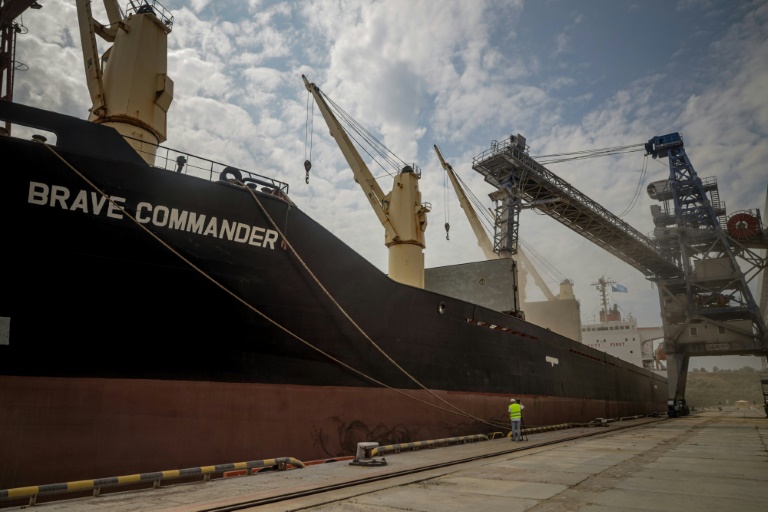
Monday’s attack on the Ukrainian capital comes after Russia pulled out of a landmark agreement that allowed vital grain shipments via a maritime safety corridor. 

The July deal to unlock grain exports signed between warring nations Russia and Ukraine — and brokered by Turkey and the United Nations — is critical to easing the global food crisis caused by the conflict.

“(A) bulk carrier loaded with 40 tons of grain was supposed to leave the Ukraine port today,” Infrastructure Minister Oleksandr Kubrakov tweeted.

“These foodstuffs were intended for Ethiopians, that are on the verge of famine. But due to the blockage of the ‘grain corridor’ by Russia the export is impossible,” the Ukrainian minister said.

The agreement, which established a corridor through which vessels could travel to Istanbul for inspections, had already allowed more than nine million tonnes of Ukrainian grain to be exported and was due to be renewed on November 19.

But Russia announced Saturday it would pull out of the deal after accusing Kyiv of a “massive” drone attack on its Black Sea fleet, which Ukraine labelled a “false pretext”.

US President Joe Biden called the move “purely outrageous” while Secretary of State Antony Blinken said Moscow was “weaponising food”.

Russia’s defence ministry alleged Sunday the attack drones had “Canadian-made navigation modules”, and that they “were moving in the safe zone of the ‘grain corridor'”.

UN Secretary-General Antonio Guterres on Sunday expressed “deep concern” about the situation, his spokesman said, and delayed his departure for an Arab League Summit in Algiers by a day “to focus on the issue”.

The EU on Sunday urged Russia to “revert its decision”.

– Enough grain to ‘feed millions’ –

The centre coordinating the logistics of the deal said in a statement that no traffic would move through the safety corridor on Sunday.

“A joint agreement has not been reached… for the movement of inbound and outbound vessels on 30 October,” it said. “There are more than 10 vessels both outbound and inbound waiting to enter the corridor.”

Turkey’s defence ministry later Sunday said ships would not leave Ukraine “during this period” but Turkey would continue checks of ships in Istanbul carrying Ukrainian grain “today and tomorrow”.

It also said Russia had formally notified Turkey of its suspension but “Russian personnel remained at the coordination centre” in Istanbul.

The Istanbul-based Joint Coordination Center (JCC) announced later Sunday that Russia had also suspended its participation in the grain inspections.

Ninety-seven loaded ships were waiting for clearance off Istanbul’s coast Sunday, the United Nations, which coordinates the JCC, said in a statement, adding it was proposing reopening the “maritime humanitarian corridor” to about a dozen vessels on Monday.

In his evening address, Ukrainian President Volodymyr Zelensky said “more than 2 million tons of food” were at sea, but stalled by Russia’s actions.

“This is an absolutely transparent intention of Russia to return the threat of large-scale famine to Africa and Asia,” he added.

– ‘Peddling false claims’ –

Sevastopol in Moscow-annexed Crimea has been targeted several times in recent months and serves as the Black Sea fleet’s headquarters and a logistical hub for operations in Ukraine.

Russia’s army claimed to have “destroyed” nine aerial drones and seven maritime ones in an attack on the port early Saturday. 

It alleged British “specialists” based in the southern Ukrainian city of Ochakiv had helped prepare and train Kyiv to carry out the strike. 

In a further singling out of the UK — which Moscow sees as one of the most unfriendly Western countries — Russia said the same British unit was involved in explosions on the Nord Stream gas pipelines last month.

Britain strongly rebutted both claims, saying “the Russian Ministry of Defence is resorting to peddling false claims of an epic scale”.

Moscow’s military said ships targeted at their Crimean base were involved in the grain deal.

– ‘Massive’ attack –

Russia had recently criticised the deal, saying its own grain exports have suffered due to Western sanctions. 

Mikhail Razvozhayev, the Moscow-installed governor of Sevastopol, said Saturday’s drone attack was the “most massive” the peninsula had seen. 

Attacks on Crimea, annexed by Moscow in 2014, have increased recently as Kyiv presses a counter-offensive in the south to retake territory held by Moscow. 

In early October, Moscow’s key bridge linking Crimea to the Russian mainland was damaged by a blast that President Vladimir Putin blamed on Ukraine.

Kyiv said Sunday its troops in the south are “holding their positions and hit the enemy in order to create conditions for further offensive actions.”

Moscow-installed authorities in Kherson, just north of Crimea, have vowed to turn the city into a fortress, preparing for an inevitable assault. 

burs/dhc/mtp

Lula's leftist triumph: Is this Latin America's second 'pink tide'?

With his narrow election victory over incumbent Jair Bolsonaro Sunday, Brazil’s president-elect Luiz Inacio Lula da Silva appears to have cemented a left-wing political conquest of Latin America.

From Mexico in the north to Chile in the south, the region’s constantly see-sawing political map once again resembles that of the early 2000s, when a so-called “pink tide” of left-leaning governments washed over it.

But analysts say this time is different: the trend is driven by pragmatism rather than ideology.

“It’s not because Latin Americans are becoming more leftist. I don’t think there’s any evidence to support that,” analyst Michael Shifter of the Inter-American Dialogue told AFP.

In their most recent election cycles, Latin American countries have resoundingly dethroned incumbent parties on the right and center-right of the political spectrum.

Honduras, Bolivia and Argentina are among those to have turned their backs on the right, while Colombia in June elected its first leftist president despite a deep-rooted mistrust, as elsewhere in the region, of anything with perceived links to “communism.”

Many voters were jolted leftward by economic troubles and the devastating effects of the Covid-19 pandemic.

Voters across the globe felt ignored, even denigrated, by the political establishment as poverty and inequality deepened.

“It is more of a rejectionist trend than anything else… people looking for an alternative,” said Shifter of the recent string of leftist victories.

“It just so happens that we are in that moment in Latin America where a lot of the governments that are being rejected are of the right or the center right.”

– ‘Optimistic wave’ –

In Brazil, far-right Jair Bolsonaro — widely seen as racist, sexist and homophobic — was a divisive leader, adding to the push towards Lula, an icon of the Brazilian and Latin American left.

His Covid-skeptic stance is blamed in large part for Brazil’s enormous pandemic death toll of more than 685,000, and he presided over record destruction of the Amazon rainforest.

Lula is a political veteran who served two terms from 2003 to 2010 and was credited with lifting some 30 million Brazilians out of poverty.

He was a part of the original “pink tide” that also saw the rise of leftist leaders such as Evo Morales in Bolivia, Michelle Bachelet in Chile, Rafael Correa in Ecuador and Hugo Chavez in Venezuela.

At the time, “there was a very optimistic wave of left-wing governments trying to reduce poverty, trying to deal with inequality,” said Guilherme Casaroes, political analyst at the Getulio Vargas Foundation’s Sao Paulo School of Business Administration.

“And economic conditions were much better.” 

Then came the global financial crisis that ravaged export-dependent Latin America, and triggered a reactive shift, en masse, to the political right.

But this generation of leaders could not, or would not, rise to the challenge of an economic crunch made infinitely worse by a pandemic that underscored unequal access to healthcare and education and exposed weak leadership.

As inequality became more pronounced, the electorate became more polarized. 

– What next? – 

Unlike the last time, this “pink tide” — if it is one at all — does not seem to be driven by a common, ideological purpose, observers say.

“The left-wing governments that we have in Latin America today, they are very different to each other,” Casaroes told AFP.

“You have authoritarian governments in Nicaragua and Venezuela, we have a left-wing populist in Mexico, we have relatively weak governments in Chile and Colombia and Argentina.”

And so Lula — generally viewed as a fiscally moderate and pragmatic leftist rather than a radical or populist one — would struggle with any project to encourage regional political or economic integration.

“This left-leaning turn is less coordinated,” than with the first ‘pink tide,” said Leonardo Paz, Brazil consultant for the International Crisis Group think tank.

“Why is it happening at the same time? Because the right was in power in almost all countries but… these presidents failed to provide change.”

For Shifter, Lula’s victory was part of a global anti-incumbent trend, indicative of Bolsonaro having been a “failed president.”

“Believe me, if Lula is not successful, it could go the other way in four years. If he doesn’t satisfy Brazilian voters, they’ll reject him and will go to somebody who is more to the right.”

Philippines storm death toll jumps to 98

The death toll from a storm that battered the Philippines has jumped to 98, the national disaster agency said Monday, with little hope of finding survivors in the worst-hit areas.

Just over half of the fatalities were from a series of flash floods and landslides unleashed by Tropical Storm Nalgae, which destroyed villages on the southern island of Mindanao on Friday.

Mindanao is rarely hit by the 20 or so typhoons that strike the Philippines each year, but storms that do reach the region tend to be deadlier than in Luzon and central parts of the country.

“We have shifted our operation from search and rescue to retrieval because the chances of survival after two days are almost nil,” said Naguib Sinarimbo, civil defence chief of the Bangsamoro region in Mindanao.

The number of fatalities is likely to rise, with the national disaster agency recording 63 people still missing and scores of others injured.

The Philippine Coast Guard posted pictures on Facebook showing its personnel in devastated Kusiong village, in Maguindanao del Norte province of Mindanao, wading through thick, thigh-high mud and water, and using long pieces of timber in the search for more bodies.

Kusiong was buried by a massive landslide, which created a huge mound of debris, just below several picturesque mountain peaks.

Meanwhile, survivors faced the heartbreaking task of cleaning up their sodden homes.

Residents shovelled mud from their houses and shops after piling their furniture and other belongings in the streets of Noveleta municipality, south of the capital, Manila.

“In my entire life living here, it’s the first time we experienced this kind of flooding,” said Joselito Ilano, 55, whose house was flooded by waist-high water.

“I am used to flooding here but this is just the worst, I was caught by surprise.”

Perfidia Seguendia, 71, and her family lost all their belongings except the clothes they were wearing when they fled to their neighbour’s two-storey house.

“Everything was flooded — our fridge, washing machine, motorcycle, TV, everything,” Seguendia told AFP.

“All we managed to do was to cry because we can’t really do anything about it. We weren’t able to save anything, just our lives.”

– More rain on the way –

President Ferdinand Marcos began touring some of the hard-hit areas on Monday, including Noveleta, as aid agencies rushed food packs, drinking water and other relief to victims.

Marcos said preemptive evacuations in Noveleta had saved lives.

“While the calamity was huge, the number of casualties was not that high, although there’s a lot of damage to infrastructure,” he said.  

Nalgae inundated villages, destroyed crops and knocked out power in many regions as it swept across the country.

It struck on an extended weekend for All Saints’ Day, which is on Tuesday, when millions of Filipinos travel to visit the graves of loved ones.

Scientists have warned that deadly and destructive storms are becoming more powerful as the world gets warmer because of climate change.

The state weather forecaster warned that another tropical storm was heading towards the Philippines even as Nalgae moved across the South China Sea.

Starting Wednesday, the new weather system could bring more heavy rain and misery to southern and central regions badly affected by Nalgae.

Landslides and flash floods originating from largely deforested mountainsides have been among the deadliest hazards posed by storms in the Philippines in recent years. 

Stellantis China Jeep joint venture to file for bankruptcy

A Chinese joint venture producing Jeep SUVs for Stellantis will file for bankruptcy, the European carmaker said Monday, after its chief executive complained earlier this month political tensions with the West were affecting the business environment.

Earlier this month Carlos Tavares had said the auto giant would consider ending production in China, questioning whether the stability of relations between Beijing and the world could be guaranteed.

Shareholders have given their approval for the joint venture to file for bankruptcy “in a loss-making context”, Stellantis said.

The carmaker had terminated the Jeep joint venture with local partner Guangzhou Automobile Group (GAC) in July, and is in talks with local partner Dongfeng about its Peugeot and Citroen brands.

The Jeep joint venture’s “assets were no longer sufficient to pay off all debts”, GAC said in a separate filing to the Hong Kong stock exchange on Monday, confirming that the venture would file for bankruptcy.

“Affected by factors including decline in product competitiveness, (the GAC-Stellantis venture’s) production and operations have gradually fallen into difficulties,” GAC said.

Unlike German rival Volkswagen, which sold three million cars in China last year, Stellantis has never broken through there.

The company aims for revenues of 20 billion euros ($19.6 billion) in China by 2030 with its 14 brands, but Tavares earlier this month complained of unequal treatment from Beijing.

“The red carpet is rolled out for Chinese manufacturers in Europe, and that’s not how we’re welcomed in China,” he told reporters at the Paris Motor Show.

Growing concern over unseasonal warm spell in Europe

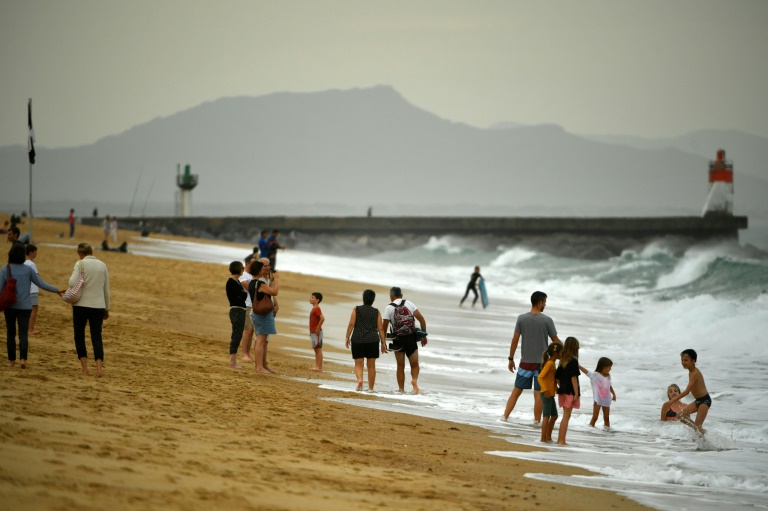
October morning temperatures topping 30 Celsius (86 Fahrenheit) in Spain may have brought cheer to the tourists, but they are provoking concern among environmentalists. 

The mercury has been rising well above the norm across vast swathes of Europe, from Spain to as far north as Sweden.

After a summer marked by repeated heatwaves across much of the continent, Europe is experiencing exceptional temperatures even as it heads into the start of autumn — a sign of accelerating climate change.

“The month has not yet ended but we can already say practically without fear of contradiction that it will be the hottest (in Spain) since 1961,” when records began to be collated, said Ruben del Campo of Spain’s meteorological service Aemet.

If extrapolated data from historical reconstructions is taken into account, he added, this past month will have been Spain’s warmest October for fully a century.

“One, two days above 30 degrees is normal” for Spain, said del Campo. “But so many days, no. These are summer temperatures, whereas we are already heading into autumn.”

On Friday morning, the northern resort of San Sebastian saw the temperature hit 30.3 Celsius at 8:30  am (0630 GMT) — well above the seasonal average.

With forest fires declared in recent days in the Basque region, of which San Sebastian is a part, authorities have banned barbecues and fireworks to keep risks to a minimum.

The unseasonal warm spell has brought a new word into the Spanish lexicon — “verono” — an amalgam of verano (summer) and otono (autumn).

And it has left del Campo highlighting a “notable acceleration” in climate change over the past decade, exposing Spain to increasing creeping desertification.

According to the Climate Central think tank, the Spanish cities of Madrid, Barcelona, Valencia and Zaragoza are all in the top 10 European cities most affected by global warming on the evidence of the past 12 months.

– Sizzling Spain to Sweden –

Neighbouring France has, like Spain, seen a hotter than normal October. But well to the north, Sweden has been sizzling too —  managing to see a record 19.5 degrees in the southern city of Kristianstad on Friday.

“This is the highest temperature ever recorded in Sweden this late in the year,” Erik Hojgard-Olsen, meteorologist at the Swedish Meteorological and Hydrological Institute (SMHI), told AFP.

In southwestern France, which also suffered widespread forest fire damage in the summer during repeated heatwaves, Meteo France said Friday temperatures closed in on 30 degrees. 

In Belgium, the capital Brussels saw a maximum forecast of 24 Celsius — fully 10 degrees higher than the norm for late October.

Britain’s Met Office noted Wednesday had seen Londoners enjoy a balmy 20.5 Celsius, “closer to what we would normally see at the end of August rather than the end of October”.

A warm front coming up from the southwest of the continent has also benefited Germany, which has been enjoying temperatures more in keeping with summertime than the onset of November.

“Hard to believe it’s late October as large parts of Europe (and North Africa) see unusual heat,” tweeted the World Meteorological Organization on Friday.

– ‘Not normal’ –

For Ruben del Campo, some people may see an upside in being able to keep the central heating off for now — or even manage an out-of-season trip to the beach.

“But in reality, the consequences are not good,” he said, noting low water levels in reservoirs — bad news for Spain, whose intensive agriculture provides Europe with a hefty proportion of its fruit and vegetables.

Spanish reservoir levels were last week down to 31.8 percent of capacity compared with their decade seasonal average of 49.3 percent.

Residents and tourists alike enjoying the upside of a trip to Barcelona’s beaches said they were aware there was a downside. 

“We are really happy to have this heat — we like it. But it’s not normal,” said Alicia Pesquera, a 43-year-old beauty therapist.

“Of course it concerns us. Right now it should be raining or at least be a bit cool,” said Fernando Raibas, a tourist visiting from the northern region of Galicia.

India bridge collapse kills 132

At least 132 people died in India when a colonial-era pedestrian bridge overloaded with religious revellers collapsed into the river below, police said Monday.

Authorities said nearly 500 people were celebrating a festival on and around the nearly 150-year-old suspension bridge in Morbi when supporting cables snapped after dark on Sunday.

The structure in the western state of Gujarat crashed into the river, spilling scores of people into the water while others clung desperately to the wreckage shouting for help.

“I saw the bridge collapse before my eyes,” one witness who worked all night trying to rescue people said, without giving his name.

“It was traumatic when a woman showed me a photo of her daughter and asked if I had rescued her. I could not tell her that her daughter had died.”

Another witness named Supran told local media that the bridge was “jam-packed”. 

“The cables snapped and the bridge came down in a split second. People fell on each other and into the river,” he said.

Ranjanbhai Patel, another Morbi resident, told local media of the difficulties he and other faced in their bid to help people to shore. 

“We pulled out people who were able to swim ashore. As most of the people had fallen into the river, we were not able to save them,” he said.

Senior police official Ashok Kumar Yadav told AFP on Monday morning that the death toll now stood at 132. Sources said that most of the victims were women and children.

Around 15 others were being treated in hospital.

The bridge over the Machchhu river, a popular tourist spot, had only reopened several days earlier after months of repairs.

News reports showed footage of people clambering up the twisted remains of the bridge or trying to swim to safety in the dark.

P. Dekavadiya, the head of police in Morbi, earlier told AFP by phone that more that 130 people had been rescued.

– ‘No certificate’ –

The suspension bridge, 233 metres (764 feet) long and 1.5 metres wide, was inaugurated in 1880 by the British colonial authorities and made with materials shipped from England, reports said.

Broadcaster NDTV reported that it reopened on Wednesday after seven months of repairs despite not having a safety certificate, and that video footage from Saturday showed it swaying wildly.

District police have launched an enquiry against the contractor, Yadav said. The state has set up a five-member team to probe the tragedy.

Authorities quickly launched a rescue operation following the collapse, with boats and divers deployed to search for missing people.

Dozens of soldiers and sailors from the Indian Army and Navy were also called in for the rescue operation.

Prime Minister Narendra Modi, who was touring his home state of Gujarat at the time, announced compensation for those killed and injured in the accident.

The Gujarat government on its website describes the bridge some 200 kilometres (120 miles) west of the state’s main city, Ahmedabad, as “an engineering marvel”.

Accidents from old and poorly maintained infrastructure including bridges are common in India.

In 2016 the collapse of a flyover onto a busy street in the eastern city of Kolkata killed at least 26 people. 

In 2011 at least 32 people were killed when a bridge packed with festival crowds collapsed near the hill town of Darjeeling in India’s northeast.

Less than a week later around 30 people were killed when a footbridge over a river in the northeastern state of Arunachal Pradesh collapsed.

Former US Marine who 'trained Chinese crew' to face Australian court

A former US fighter pilot detained in Australia under a shroud of secrecy will face court on Friday, with a fellow ex-Marine telling AFP the retired instructor trained flight crew in China before his arrest.

Daniel Edmund Duggan was arrested in rural New South Wales on October 21, Australia’s attorney general’s department has confirmed, the same week British intelligence officials issued a rare warning about China’s recruitment of retired military pilots.

The attorney general’s department said Duggan, 54, had been arrested at Washington’s request — although both US and Australian authorities have declined to comment further and details of the charges have been sealed.

Duggan now faces extradition to the United States and is scheduled to appear in Sydney Local Court on Friday, according to court listings.

An ex-Marine pilot who has known Duggan for almost 20 years told AFP it was well known Chinese companies had been recruiting military fliers — and he struggled to comprehend why Duggan would now be targeted for arrest.

“I can’t imagine what secrets he would have, that he would pass along, that would have caused him this much trouble,” said the ex-Marine, who requested anonymity because he still worked for a commercial airline.

“I think the China work was pretty well known by most ex-military pilots. I would have first heard about it well over 10 years ago… it’s just that it’s recently made the news.”

– ‘Well regarded’ –

Duggan spent over a decade flying in the US Marine Corps, reaching the rank of Major and working as a military tactical flight instructor, according to his company website.

He moved to Australia after leaving the Marines, with Australian company records listing him as a director in an “adventure flight” company called Top Gun Tasmania between 2005 and 2014.

The company operated “an initial military training aircraft of the Chinese Air Force” known as a Nanchang fighter jet, according to its website.

“Our Nanchang aircraft are maintained to the same high standard using the maintenance systems used by the Chinese Air Force,” the website said.

Australian company records indicate he moved to Beijing around 2014, listing his address at an apartment in Beijing’s upmarket Chaoyang District.

The ex-marine pilot told AFP Duggan had been “working for a company in China doing CRM training” — referring to cockpit resource management, a set of procedures used to improve flight safety.

He added that Duggan was a skilled pilot who had flown the notoriously-difficult Harrier jump jet in an exchange with the Spanish navy.

“Dan was well regarded. That’s a highly sought-after job.”

A Beijing restaurant review in 2017 mentioned an American pilot called Dan Duggan had been running an aviation-themed dive bar called the “Flying Kangaroo” in Chaoyang.

– ‘Taking decisive steps’ –

Last week, both the British and Australian governments revealed fears Beijing was poaching retired pilots to train China’s air force in western military techniques.

“We are taking decisive steps to stop Chinese recruitment schemes attempting to headhunt serving and former UK Armed Forces pilots to train People’s Liberation Army personnel,” the British defence ministry said in a statement.

British media reported that more than 30 pilots had accepted lucrative offers to train China’s military.

Chinese foreign ministry spokesman Wang Wenbin denied any knowledge of such employment of British pilots, telling a regular press briefing: “I am not aware of the circumstances you mentioned.”

Australian Defence Minister Richard Marles launched a separate investigation, saying he would be “disturbed” if Australian army pilots were being “lured” to China.

China’s military has undergone a period of rapid modernisation under President Xi Jingping, building the world’s largest navy and revamping the world’s biggest standing army.

Close Bitnami banner
Bitnami