World

Tears, fear and futile prayer as Lula wins Brazil vote

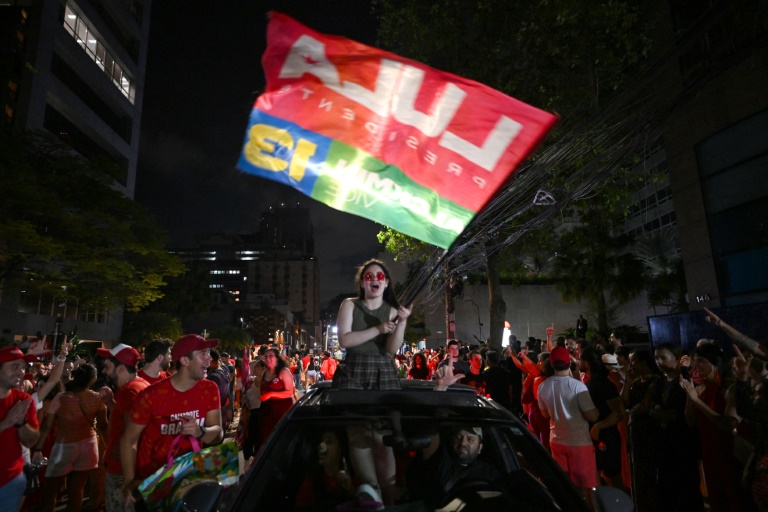
Luiz Inacio Lula da Silva supporters were already breaking out the flares and crying with joy, while backers of Jair Bolsonaro dropped to their knees in Brazil’s capital, praying for an election miracle.

For almost three hours a nail-biting presidential vote count was too close to call, but as the leftist hero’s lead of less than two percentage points stuck, it became clear that no prayer could stop the inevitable.

“The feeling is indescribable,” said Carolina Freio, 44, a public servant, in a Copacabana bar as she welled up with tears after Lula clinched victory with 50.9 percent to Bolsonaro’s 49.1 percent.

“He represents so much: gender equality, freedom. Lula will change everything,” she said, overcome with emotion.

Lula’s supporters exploded with joy across the country. In economic powerhouse Sao Paulo, thousands crammed the streets in a sea of red, the colour used by his fans, clinking beers and setting off flares.

“I won, it is my victory, like everyone I am crying with joy,” said a jubilant Mary Alves Silva, 53, a retired banker with Lula stickers covering her arms and chest. She added that the win was also for the stricken Amazon rainforest and its Indigenous inhabitants.

At a bar in Leme, an upscale neighbourhood of Rio de Janeiro, technician Victoria Cabral remained on edge after the results came in.

“I cannot understand how half of the country voted for Bolsonaro, it makes me feel very insecure,” she said.

“However, I think hope will return now. It goes beyond politics, we are talking about humanity. Bolsonaro is racist, homophobic, thieving, misogynistic…. I can go on. Not that Lula is the ideal candidate, but he is so much better.”

– ‘Faked election’ –

As the result crystalized, Bolsonaro supporters gathered in the capital Brasilia dropped to their knees and raised their hands skyward in prayer and supplication.

“We need a miracle,” a speaker said over the microphone, as Bolsonaro supporters clutched each other and wept.

“I am still hoping the president will meet with the generals, we are hoping that things can change at any moment,” said a 57-year-old dentist who did not want to be named.

Ruth da Silva Barbosa, a 50-year-old teacher, said she was “revolted” by the outcome.

“The Brazilian people aren’t going to swallow a faked election and hand our nation over to a thief,” she said.

The country finds itself split in two after a dirty and divisive vote.

After months of attacking the electoral system, Bolsonaro maintained radio silence for hours after the result was announced, raising tension in Latin America’s biggest economy.

“It scares me because I believe he is capable of anything, even though I think democracy will prevail,” said 34-year-old software developer Larissa Meneses, taking part in the Sao Paulo festivities.

As the Lula party continued, Bolsonaro’s supporters quickly dispersed.

Rogerio Barbosa, selling Brazilian flags near a Sao Paulo metro station, was desolately packing up his merchandise.

“I came in case Bolsonaro won, so I could sell his flag,” said the 58-year-old.

“I preferred Bolsonaro. God, family, anyway. I will see what Lula can do for us.”

Twilight of the Tigris: Iraq's mighty river drying up

It was the river that is said to have watered the biblical Garden of Eden and helped give birth to civilisation itself.

But today the Tigris is dying. 

Human activity and climate change have choked its once mighty flow through Iraq, where — with its twin river the Euphrates — it made Mesopotamia a cradle of civilisation thousands of years ago.

Iraq may be oil-rich but the country is plagued by poverty after decades of war and by droughts and desertification.

Battered by one natural disaster after another, it is one of the five countries most exposed to climate change, according to the UN.

From April on, temperatures exceed 35 degrees Celsius (95 degrees Fahrenheit) and intense sandstorms often turn the sky orange, covering the country in a film of dust.

Hellish summers see the mercury top a blistering 50 degrees Celsius — near the limit of human endurance — with frequent power cuts shutting down air-conditioning for millions.

The Tigris, the lifeline connecting the storied cities of Mosul, Baghdad and Basra, has been choked by dams, most of them upstream in Turkey, and decreasing rainfall. 

An AFP video journalist travelled along the river’s 1,500-kilometre (900-mile) course through Iraq, from the rugged Kurdish north to the Gulf in the south, to document the ecological disaster that is forcing people to change their ancient way of life.  

– Kurdish north: ‘Less water every day’ –

The Tigris’ journey through Iraq begins in the mountains of autonomous Kurdistan, near the borders of Turkey and Syria, where local people raise sheep and grow potatoes.

“Our life depends on the Tigris,” said farmer Pibo Hassan Dolmassa, 41, wearing a dusty coat, in the town of Faysh Khabur. “All our work, our agriculture, depends on it.  

“Before, the water was pouring in torrents,” he said, but over the last two or three years “there is less water every day”.

Iraq’s government and Kurdish farmers accuse Turkey, where the Tigris has its source, of withholding water in its dams, dramatically reducing the flow into Iraq.

According to Iraqi official statistics, the level of the Tigris entering Iraq has dropped to just 35 percent of its average over the past century.  

Baghdad regularly asks Ankara to release more water. 

But Turkey’s ambassador to Iraq, Ali Riza Guney, urged Iraq to “use the available water more efficiently”, tweeting in July that “water is largely wasted in Iraq”.

He may have a point, say experts. Iraqi farmers tend to flood their fields, as they have done since ancient Sumerian times, rather than irrigate them, resulting in huge water losses.

– Central plains: ‘We sold everything’ –

All that is left of the River Diyala, a tributary that meets the Tigris near the capital Baghdad in the central plains, are puddles of stagnant water dotting its parched bed.

Drought has dried up the watercourse that is crucial to the region’s agriculture.  

This year authorities have been forced to reduce Iraq’s cultivated areas by half, meaning no crops will be grown in the badly-hit Diyala Governorate. 

“We will be forced to give up farming and sell our animals,” said Abu Mehdi, 42, who wears a white djellaba robe.  

“We were displaced by the war” against Iran in the 1980s, he said, “and now we are going to be displaced because of water. Without water, we can’t live in these areas at all.”

The farmer went into debt to dig a 30-metre (100-foot) well to try to get water. “We sold everything,” Abu Mehdi said, but “it was a failure”. 

The World Bank warned last year that much of Iraq is likely to face a similar fate. 

“By 2050 a temperature increase of one degree Celsius and a precipitation decrease of 10 percent would cause a 20 percent reduction of available freshwater,” it said. 

“Under these circumstances, nearly one third of the irrigated land in Iraq will have no water.”

Water scarcity hitting farming and food security are already among the “main drivers of rural-to-urban migration” in Iraq, the UN and several non-government groups said in June.

And the International Organization for Migration said last month that “climate factors” had displaced more than 3,300 families in Iraq’s central and southern areas in the first three months of this year.

“Climate migration is already a reality in Iraq,” the IOM said.

– Baghdad: sandbanks and pollution –

This summer in Baghdad, the level of the Tigris dropped so low that people played volleyball in the middle of the river, splashing barely waist-deep through its waters.

Iraq’s Ministry of Water Resources blames silt because of the river’s reduced flow, with sand and soil once washed downstream now settling to form sandbanks.

Until recently the Baghdad authorities used heavy machinery to dredge the silt, but with cash tight, work has slowed.

Years of war have destroyed much of Iraq’s water infrastructure, with many cities, factories, farms and even hospitals left to dump their waste straight into the river.

As sewage and rubbish from Greater Baghdad pour into the shrinking Tigris, the pollution creates a concentrated toxic soup that threatens marine life and human health.

Environmental policies have not been a high priority for Iraqi governments struggling with political, security and economic crises.

Ecological awareness also remains low among the general public, said activist Hajer Hadi of the Green Climate group, even if “every Iraqi feels climate change through rising temperatures, lower rainfall, falling water levels and dust storms”.

– South: salt water, dead palms –

“You see these palm trees? They are thirsty,” said Molla al-Rached, a 65-year-old farmer, pointing to the brown skeletons of what was once a verdant palm grove.

“They need water! Should I try to irrigate them with a glass of water?” he asked bitterly. “Or with a bottle?” 

“There is no fresh water, there is no more life,” said the farmer, a beige keffiyeh scarf wrapped around his head.

He lives at Ras al-Bisha where the confluence of the Tigris and Euphrates river, the Shatt al-Arab, empties into the Gulf, near the borders with Iran and Kuwait.

In nearby Basra — once dubbed the Venice of the Middle East — many of the depleted waterways are choked with rubbish.

To the north, much of the once famed Mesopotamian Marshes — the vast wetland home to the “Marsh Arabs” and their unique culture — have been reduced to desert since Saddam Hussein drained them in the 1980s to punish its population.

But another threat is impacting the Shatt al-Arab: salt water from the Gulf is pushing ever further upstream as the river flow declines.

The UN and local farmers say rising salination is already hitting farm yields, in a trend set to worsen as global warming raises sea levels.

Al-Rached said he has to buy water from tankers for his livestock, and wildlife is now encroaching into settled areas in search of water.

“My government doesn’t provide me with water,” he said. “I want water, I want to live. I want to plant, like my ancestors.”

– River delta: a fisherman’s plight – 

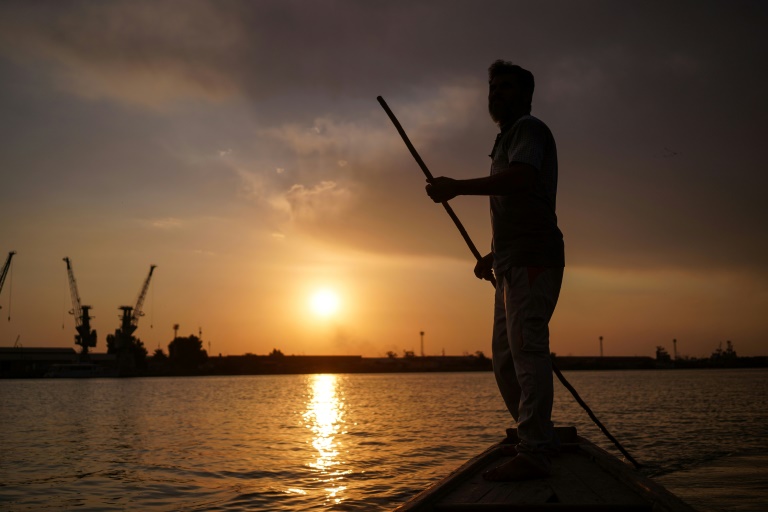
Standing barefoot in his boat like a Venetian gondolier, fisherman Naim Haddad steers it home as the sun sets on the waters of the Shatt al-Arab. 

“From father to son, we have dedicated our lives to fishing,” said the 40-year-old holding up the day’s catch.

In a country where grilled carp is the national dish, the father-of-eight is proud that he receives “no government salary, no allowances”.

But salination is taking its toll as it pushes out the most prized freshwater species, which are replaced by ocean fish.

“In the summer, we have salt water,” said Haddad. “The sea water rises and comes here.”

Last month local authorities reported that salt levels in the river north of Basra reached 6,800 parts per million — nearly seven times that of fresh water.

Haddad can’t switch to fishing at sea because his small boat is unsuitable for the choppier Gulf waters, where he would also risk run-ins with the Iranian and Kuwaiti coastguards.

And so the fisherman is left at the mercy of Iraq’s shrinking rivers, his fate tied to theirs. 

“If the water goes,” he said, “the fishing goes. And so does our livelihood.”

Death toll from Philippine storm rises to 98: disaster agency

The death toll from a storm that battered the Philippines in recent days has risen to 98, the national disaster agency said Monday, as more bodies are retrieved.

Just over half of the fatalities were from a series of flash floods and landslides that destroyed villages on the southern island of Mindanao on Friday.

“We have shifted our operation from search and rescue to retrieval operation because the chances of survival after two days is almost nil,” said Naguib Sinarimbo, civil defence chief of the Bangsamoro region in Mindanao.

As rescue teams searched through mud and debris for more bodies, survivors of Tropical Storm Nalgae continued the heartbreaking task of cleaning up their sodden homes.

Nalgae swept across the disaster-prone country, inundating villages, destroying crops and knocking out power in many regions.

It struck on an extended weekend for All Saints’ Day, which is on Tuesday, when millions of Filipinos traverse the country to visit the graves of loved ones.

The number of fatalities is likely to rise, with the national disaster agency recording 63 people still missing in its latest report.

Scientists have warned that storms, which kill people and livestock and destroy farms, houses, roads and bridges, are becoming more powerful as the world gets warmer because of climate change.

 rbl/amj/mca

Brazil's new leader Lula rises from ashes at 77

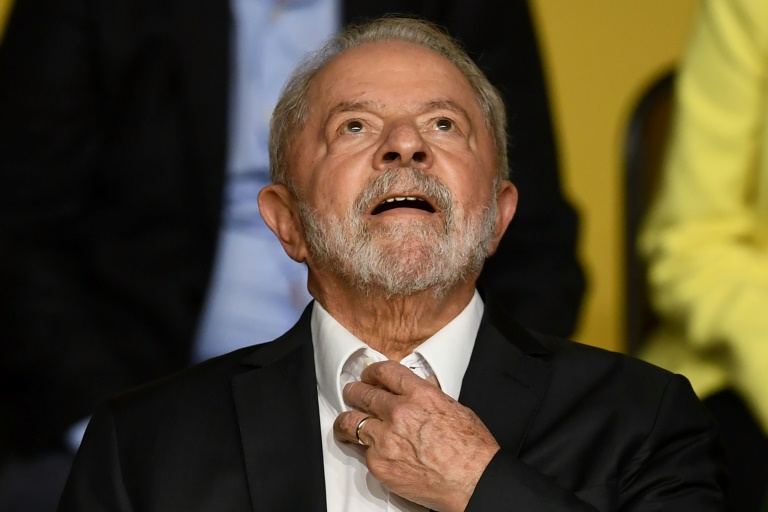
Luiz Inacio Lula da Silva, who rose from poverty to Brazil’s presidency before crashing into disgrace in a corruption scandal, made a spectacular comeback as leader of Latin America’s biggest economy at the age of 77.

Lula, as he is affectionately known, scraped ahead of far-right incumbent Jair Bolsonaro to win a third term at the helm, election authorities confirmed.

Just 18 months ago, the bearded leftist hero with the trademark raspy voice was a political pariah, imprisoned in a corruption scandal that divided the nation.

Disgust with his Workers’ Party (PT) propelled Bolsonaro into office in 2018, however the vitriolic and divisive conservative quickly lost popularity as he oversaw Covid-19 carnage, environmental destruction, and made comments criticized as racist, sexist and homophobic.

“We need to fix this country… so the Brazilian people can smile again,” Lula said during a tireless campaign in which he crisscrossed the country and appeared on popular podcasts to lure younger voters.

He vowed that under his rule, Brazilians will be able to get back to “eating picanha and drinking beer” on the weekends, referring to the popular cut of beef that high inflation put out of reach for many.

The comments reveal the renowned political skill and folksy touch that endeared him to many across the globe, with Barack Obama once dubbing him “the most popular politician on Earth.”

The charismatic Lula was the slight favorite throughout a lengthy and polarizing election campaign.

However the election came down to the wire, with Bolsonaro snapping at his heels until the last.

– Fall from grace –

Lula left office in 2010 as a blue-collar hero who presided over a commodity-fueled economic boom that helped lift 30 million people out of poverty.

Despite fears at the time that his brand of leftism would be too radical, Lula’s 2003-2010 administration mixed trailblazing social programs with market-friendly economic policy.

He gained a reputation as a moderate and pragmatic leader.

Lula also turned Brazil into a key player on the international stage, helping secure it the 2014 World Cup and the 2016 Olympics in Rio de Janeiro.

At the end of his time in office, his approval rating stood at an unprecedented 87 percent.

But he then became mired in a massive corruption scandal centered on state-run oil company Petrobras that engulfed some of Brazil’s most influential politicians, business executives and the PT.

Lula has always denied the accusations that he received kickbacks for giving out access to juicy Petrobras contracts.

He was jailed in 2018, the year Bolsonaro won. He spent more than 18 months in prison before being freed pending appeal.

His convictions were thrown out last year by the Supreme Court, which found the lead judge on the case was biased.

However, he was not exonerated. Many Brazilians remain traumatized by the scale of the corruption scandal. While many others have fond memories of economic prosperity under his rule, others voted for him merely to see the back of Bolsonaro.

– From poverty to president –

Lula grew up in deep poverty, the seventh of eight children born to a family of illiterate farmers in the arid northeastern state of Pernambuco.

When he was seven, his family joined a wave of migration to the industrial heartland of Sao Paulo.

Lula worked as a shoeshine boy and peanut vendor before becoming a metalworker at the tender age of 14.

In the 1960s, he lost a finger in a workplace accident.

He rose quickly to become head of his trade union, and led major strikes in the 1970s that challenged the then-military dictatorship.

In 1980, he co-founded the Workers’ Party, standing as its candidate for president nine years later.

Lula lost three presidential bids from 1989 to 1998, finally succeeding in 2002 and again four years later.

This was his sixth presidential campaign.

The twice-widowed father of five survived throat cancer and in 2017 lost his wife of four decades, Marisa Leticia Rocco, to a stroke.

Lula has said he is again “in love as if I were 20 years old” with Rosangela “Janja” da Silva, a sociologist and PT activist whom he married in May.

Lula has said he will not seek a second term.

Paris museum says painting was target of attempted attack

A young woman tried to throw soup at a painting at the world-famous Musee d’Orsay in Paris this week, the museum confirmed Sunday, in a similar attack to others by climate activists in Europe.

The museum refused to say which painting was targeted but it is home to artwork by some of the most famous European artists including Paul Cezanne, Paul Gauguin, Vincent van Gogh, Edouard Manet and Claude Monet.

The museum told AFP it had filed a legal complaint for the “attempt to damage a piece of work” after the female activist was intercepted on Thursday, confirming a report in Le Parisien daily.

The Paris prosecutor’s office said police had opened an investigation after the complaint.

According to Le Parisien newspaper, the woman had initially tried to approach the 1889 Van Gogh self-portrait at Saint-Remy before attempting to throw soup at a painting by Gauguin.

The daily reported she was wearing a “Just Stop Oil” T-shirt, as others have worn during similar stunts in recent weeks.

On Sunday two environmental activists glued themselves to metal poles supporting a dinosaur skeleton that was over 60 million years old at Berlin’s Natural History Museum to protest Germany’s climate policies.

And also Thursday, climate activists glued themselves to Johannes Vermeer’s “Girl with a Pearl Earring” at the Mauritshuis museum in The Hague, Netherlands.

Environmental activists splashed tomato soup on Van Gogh’s “Sunflowers” at the National Gallery in London earlier this month, while others threw mashed potato over a Monet painting at the Barberini Museum in Germany. 

As the attacks multiply, French Culture Minister Rima Abdul Malak has urged national museums to “redouble their vigilance”.

Twitter owner Musk tweets conspiracy theory, then deletes it

New Twitter owner Elon Musk tweeted an anti-LGBT conspiracy theory Sunday about what happened the night US Speaker Nancy Pelosi’s husband was attacked, then hours later deleted the post.

The seesaw action by Musk, a self-declared “free speech absolutist,” cast new uncertainty on the direction the social media platform will take under his new ownership. It also underscored the huge megaphone Musk now has at his disposal.

Musk early Sunday tweeted a response to Hillary Clinton, who posted a news story about the alleged attacker’s links to the far right.

“There is a tiny possibility there might be more to this story than meets the eye,” Musk told Clinton, attaching a link to the story, which is no longer accessible, by the conservative Santa Monica Observer.

Musk may have had second thoughts about the tweet because around noon a message appeared, “This Tweet was deleted by the Tweet author.” By then, Musk’s tweet had been liked 110,000 times, the online Semafor news site said.

The tweet was no longer visible Sunday afternoon on Musk’s feed.

The weekly outlet cited by Musk in his tweet has published other conspiracy theories in the past, including that a body double for Clinton was sent to a debate with Donald Trump during the 2016 election campaign, according to the Los Angeles Times.

Musk’s Sunday tweet swiftly became a focal point for critics who have been nervous about the direction in which he intends to take Twitter, the leading social media platform for global discourse and diplomacy.

Twitter’s communications department did not respond to an AFP request for comment about the tweet and whether Musk himself deleted it.

Musk, whose outspoken and controversial tweets have courted trouble in the past, has vowed to dial back content moderation, relying more on computer algorithms than human monitors. Conservatives say past moderation has unfairly targeted their views.

In a message meant to reassure jittery Twitter advertisers on his leadership, Musk said late last week that he realizes Twitter “cannot become a free-for-all hellscape where anything can be said with no consequences.”

But detractors warn that without standards, the world’s “digital town square” is at risk of becoming flooded with misinformation, with possibly perilous consequences for democracy and public health.

“Clinton: Conspiracy theories are getting people killed and we shouldn’t amplify them. Owner of Twitter: But have you considered this conspiracy theory?” wrote University of Denver political scientist Seth Masket after Musk’s Sunday tweet.

The former UN special rapporteur for freedom of expression, David Kaye, poked fun at the multiple hats Musk seems to want to wear. He wrote on Twitter: “troll elon should report this takedown to chief twit elon.” 

– Troll campaign tests Musk –

Nancy Pelosi, who is second in line to the US presidency, has said her family is “heartbroken and traumatized” after the intruder broke into the couple’s San Francisco home early Friday and attacked Paul Pelosi with a hammer, fracturing his skull.

The 82-year-old is recovering in hospital. 

President Joe Biden has said it appears the assault was “intended for Nancy,” and called out increasingly polarizing political rhetoric.

“The Republican Party and its mouthpieces now regularly spread hate and deranged conspiracy theories. It is shocking, but not surprising, that violence is the result,” Clinton said in her tweet.

Musk’s response came just hours after Twitter said the site was being targeted by a trolling campaign testing its moderation policies under the billionaire entrepreneur’s leadership.

“Twitter’s policies haven’t changed…. And we’re taking steps to put a stop to an organized effort to make people think we have,” tweeted the platform’s chief of safety and integrity, Yoel Roth.

Roth said a “small number of accounts” had posted “a ton” of hate content — including 50,000 tweets using a particular slur made by just 300 accounts.

“Nearly all” of the accounts are inauthentic, he said.

Roth also retweeted a Musk post in which the Tesla chief reiterated that “we have not yet made any changes to Twitter’s content moderation policies.”

Thousands of Czechs rally in support of Ukraine

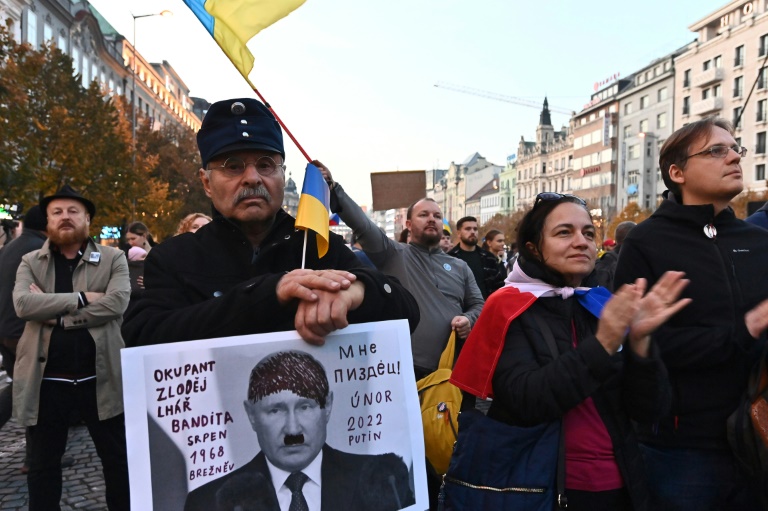
Thousands of people rallied in Prague’s historic centre on Sunday in support of Ukraine, which has been battling a Russian invasion since February.

Held under Czech, Ukrainian, EU and NATO flags, the “Czechia against fear” rally brought together participants from both countries to the iconic Wenceslas Square.

“This rally is very important because it is in support of Ukraine and it’s a reminder that we have to support it and handle all that is happening in the world and in Ukraine well,” Ukrainian student Irina Udod told AFP.

The Czech Republic has provided Ukraine with substantial military and humanitarian aid since the invasion started on February 24.

Speakers at the rally included Olena Zelenska, the wife of Ukrainian President Volodymyr Zelensky, who thanked the Czech Republic for support in a video message.

Banners targeted Russian President Vladimir Putin, depicted as a figurine sitting on a toilet as well as a puppet-corpse in a black coffin.

“Support to Ukraine is absolutely vital, because Ukraine won’t make it without help,” Petr Stepanek, also attending the rally, said.

Prague police put the number of participants in the “lower tens of thousands”, just like on Friday when an anti-government protest was held in the same square.

Friday’s rally, organised by a group with ties to the far-right scene, slammed the government for paying too much attention to Ukraine and neglecting its own people.

Protesters worried about soaring inflation pulled by high energy prices called on the centre-right government of Petr Fiala to step down. 

An EU and NATO member of 10.5 million people, the Czech Republic currently holds the EU presidency.

Iran protesters rally again despite Guards order to stand down

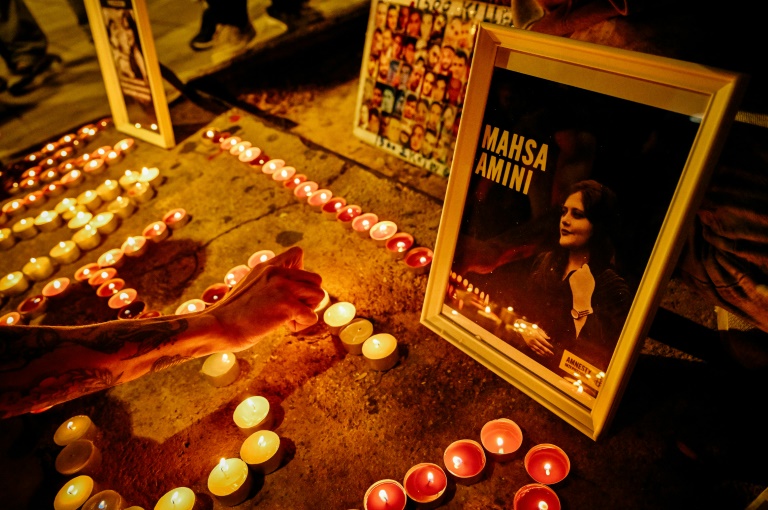
Iranian protesters rallied again Sunday, defying an order by the powerful Revolutionary Guards to stop the demonstrations — now in their seventh week — sparked by the death of Mahsa Amini.

Students gathered overnight and Sunday across Iran, even after Major General Hossein Salami, head of the Islamic Revolutionary Guard Corps, had warned demonstrators: “Do not come to the streets!”

Amini, 22, died in custody on September 16 after her arrest in Tehran for an alleged breach of Iran’s strict dress rules for women, triggering a wave of unrest and a state response on the “riots” that Amnesty International calls a “brutal crackdown”. 

Security forces on Sunday fired gunshots and tear gas at a gathering of students in the flashpoint western city of Sanandaj, where videos showed billowing clouds of smoke amid chants of “freedom”, the Norway-based Hengaw organisation reported.

It also posted a video with the sound of echoing gunfire, and of a 12-year-old girl wailing with her bloody arm peppered with metal pellets, in reports AFP could not independently verify.

Security forces have struggled to contain the protests, which started with women taking to the streets and burning their hijab headscarves and which have evolved into a broader campaign to end the Islamic republic founded in 1979.

– Over 160 killed –

Students had protested on Saturday at campuses in Tehran, Kerman in the country’s south, and the western city of Kermanshah, among others, online videos showed.

Oslo-based group Iran Human Rights (IHR) said demonstrations were held in more than 50 universities and institutes of higher learning.

“Each person getting killed is followed by a thousand people!” protesters shouted at the funeral of a demonstrator on Saturday in Arak, southwest of Tehran, footage published by the 1500tasvir social media channel showed, adding that the crowd was later dispersed with tear gas.

Protests on Sunday were reported in multiple universities including the capital as well as in Mazandaran and Mashhad, where IHR said crowds chanted “Death to the dictator”.

The rights group said Friday that at least 160 protesters, including more than two dozen children, had been killed since protests began.

At least another 93 people were killed during separate demonstrations that erupted on September 30 in the southeastern city of Zahedan over the reported rape of a teenage girl by a police commander, according to IHR.

In Amini’s hometown of Saqez, security forces in plain clothes broke up a protest at a vocational college, where officers “attacked the students and abducted a number of them”, Hengaw said.

– Journalist protest –

Hundreds have been detained, and on Sunday more than 300 Iranian journalists and photojournalists signed a statement condemning authorities for “arresting colleagues and stripping them of their civil rights after their detentions”.

Reformist daily Sazandegi said Sunday that “more than 20 journalists are still in detention”, while the Tehran journalists’ association dismissed the “security approach” as “illegal” and “in conflict with press freedom”.

Tehran has sought to portray the protest movement as a plot hatched by its arch-enemy the United States, charging that some journalists had received “training courses” with the aim of changing power in Tehran.

According to local media, a report by the security services referred to journalist Elaheh Mohammadi from the Sazandegi paper and photographer Niloufar Hamedi of the daily Shargh, who helped publicise Amini’s case and who have been detained for weeks.

Both their outlets challenged the report, with Shargh editor Mehdi Rahmanian insisting that “our journalist and our newspaper… acted within the framework of the journalistic mission”.

The protests have attracted global attention, and solidarity demonstrations have been held in cities all over the world.

In Berlin, three men were hurt early on Sunday when a pro-democracy vigil outside the Iranian embassy was attacked, German police said.

burs-pjm/fz/jsa/lg

Brazil votes in white-knuckle Bolsonaro-Lula showdown

Brazil was on a knife-edge Sunday as voters chose between far-right incumbent Jair Bolsonaro and his leftist arch-rival, Luiz Inacio Lula da Silva, in a presidential election seen as too close to call.

The runoff election caps a dirty and divisive campaign that has left the nation of 215 million people deeply split between supporters of conservative ex-army captain Bolsonaro, those of charismatic ex-metalworker Lula, and many others more or less equally disgusted by both.

“I think this has been the best government Brazil has ever had,” said Afro-Brazilian lawyer Eliane de Oliveira, 61, who voted for Bolsonaro in Rio de Janeiro’s Copacabana neighborhood, saying she was happy to have a government “that is not corrupt”, in a dig at the graft-tainted Lula.

Standing nearby, physical education teacher Gustavo Souza voted for Lula and “the hope of improving people’s lives.”

Like many, he said he was “scared” about the outcome, reflecting fears that Bolsonaro would not accept the result after months of attacking the electoral system.

“People have become so radical. They will need some maturity… or it will turn into the third or fourth world war,” he said, laughing nervously.

– ‘Brazil will be victorious’-

Lula, 77, narrowly won the first-round election on October 2, and enters the finale the slight favorite with 52 percent of voter support to 48 percent for Bolsonaro, according to a final poll from the Datafolha institute Saturday.

However, Bolsonaro, 67, performed better than expected last time around, and the result this time is anyone’s guess.

The president cast his ballot wearing a T-shirt in the yellow-and-green of the Brazilian flag — a symbol he has adopted as his own.

“God willing, we’ll be victorious later today. Or even better, Brazil will be victorious,” he said, grinning as he greeted supporters in Rio de Janeiro’s Vila Militar neighborhood.

He then headed to the airport to snap pictures and take a ride in the presidential helicopter with players for Flamengo, Brazil’s most popular football team, who were fresh off winning the South American club championships in Ecuador Friday evening.

Lula voted in Sao Bernardo do Campo, the southeastern city where he got his start as a union leader, wearing a white guayabera-style shirt and surrounded by white-clad allies.

He said he was “confident in the victory of democracy,” and that he would seek to “restore peace” in a divided nation if elected.

– Democracy, Amazon –

The electoral showdown caps months of mud-slinging and personal attacks, in a campaign plagued by disinformation.

The election has global ramifications: Conservationists believe the result could seal the fate of the stricken Amazon rainforest, pushed to the brink by fires and deforestation that have surged under Bolsonaro.

However, for Brazilians, issues of poverty, hunger, corruption and traditional values are top of mind.

Waiting at his polling station in Sao Paulo, psychologist Marcelo Silveira Curi, 35, said he disliked both candidates but was reluctantly voting for Lula.

“He’s not ideal, but he’s the option if you oppose this government,” he told AFP.

Politically split couple Elisete and Alex Silveira, who have been married for 27 years, said the tension tearing Brazil apart has invaded their home, as they voted in the capital, Brasilia — Elisete, 46, in pro-Lula red, and Alex, 50, in pro-Bolsonaro yellow and green.

“We agreed on a resolution: no talking politics at home, out of the love we have for each other,” laughed Elisete, a dance teacher.

– Will Bolsonaro cry foul? –

One of the main questions hanging over the poll has been if Bolsonaro — often dubbed the “Tropical Trump” — will accept a loss.

On Friday night he pledged to respect the election, though possible accusations of rigging and a backlash from his supporters loom large.

Bolsonaro came under fire for his disastrous handling of the Covid-19 pandemic, which left more than 680,000 dead in Brazil, as well as his vitriolic style and disdain for political correctness.

However, in recent months, falling unemployment figures, slowing inflation and a recovering economy have given him a boost.

His core supporters — the business sector, anti-corruption voters and the powerful “Bibles, bullets and beef” coalition — love his gloves-off style and focus on conservative values.

– Comeback kid –

Lula was the country’s most popular president when he left office, helping to lift millions out of poverty with his social programs.

But he then became mired in a massive corruption scandal and was jailed for 18 months, before his convictions were thrown out last year. The Supreme Court found the lead judge was biased, but Lula was not exonerated.

If he wins, he faces a hostile Congress dominated by Bolsonaro lawmakers and allies.

Brazil’s 156 million voters will cast their ballots until 5:00 pm (2000 GMT). The result of the electronic vote is expected in a matter of hours.

Mussolini supporters mark 'March on Rome' centenary

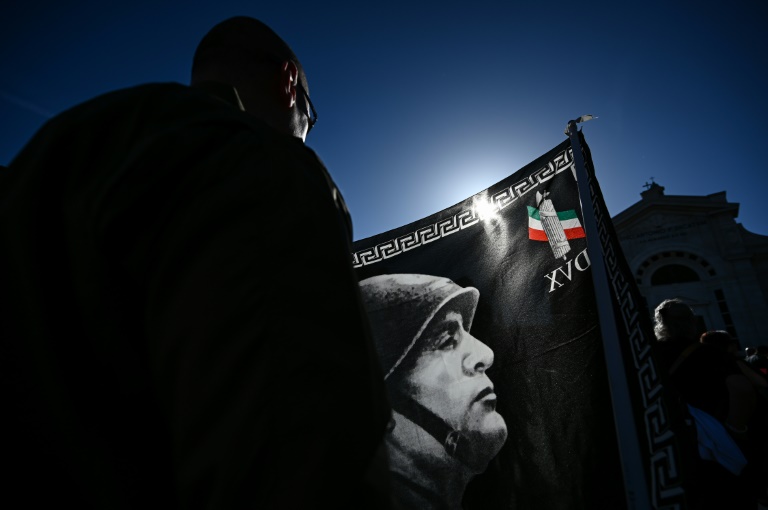
Thousands of supporters of Italian dictator Benito Mussolini paraded in his birthplace Sunday to mark the centenary of the historic “March on Rome” that ushered in Fascism.

Local police estimated the crowd at about 2,000 people who gathered to march in the small hilly town of Predappio in Emilia-Romagna, Mussolini’s birthplace and site of his family crypt where he is buried. 

Mussolini’s tomb is a pilgrimage site that regularly attracts tens of thousands of visitors each year. 

But Sunday’s gathering differed from previous ones, with Fascist sympathisers expressing support for Italy’s new government led by Giorgia Meloni, the most right-wing to take office since World War II.

“I’d have voted for Lucifer if he had defeated the left in Italy. So I’m glad we have the Meloni government,” said parade organiser Mirco Santarelli, according to Italian news agency Ansa. 

Marching with banners and an enormous Italian flag, many in the crowd wore black in a nod to Mussolini’s notorious Blackshirts. 

There were no reported incidents.

Some in the crowd raised their right arms to give the Fascist salute despite organisers instructing them not to do so. 

“If after 100 years we are still here, it is to pay tribute to the one whom this state wanted and to whom we will never fail in our admiration,” said Orsola Mussolini, great-grand-daughter of the former leader who attended the march with her sister Vittoria.

On October 28, 1922, Mussolini’s paramilitary forces entered the Italian capital and were handed power, marking the start of a regime marked by intense authoritarianism and nationalism that lasted until 1943. 

Mussolini was shot by partisans in April 1945 in the waning hours of the war, his body later hung and mutilated by the crowd in a Milan plaza.  

Although Italian law today bans the apology for — or justification of — Fascism, it is rarely enforced. 

Vestiges of “Il Duce” remain visible to this day throughout Italy, including his name inscribed on buildings, while portraits of the dictator still adorn the walls of some government ministries. 

The centenary of the March on Rome this year coincides with the new government led by Meloni, whose “Brothers of Italy” party has neo-fascist roots. 

Meloni has sought to distance herself from that legacy without entirely renouncing it. She has insisted she has never felt sympathy for “undemocratic regimes” and called Fascism’s race laws — which began stripping rights from Jews in 1938 — “the lowest point in Italian history”. 

On Friday, Predappio was also the site of an anti-fascist gathering to celebrate the liberation of the town from Nazi and Fascist forces, on October 28, 1944. 

Close Bitnami banner
Bitnami