World

Death toll from Somalia twin bombings climbs to 100

The number of people killed in twin car bombings in the Somali capital Mogadishu, claimed by Al-Shabaab Islamists, has risen to 100, President Hassan Sheikh Mohamud said on Sunday.

“So far, the number of people who died has reached 100 and 300 are wounded, and the number for both the death and wounded continues to increase,” he said after visiting the blast location.

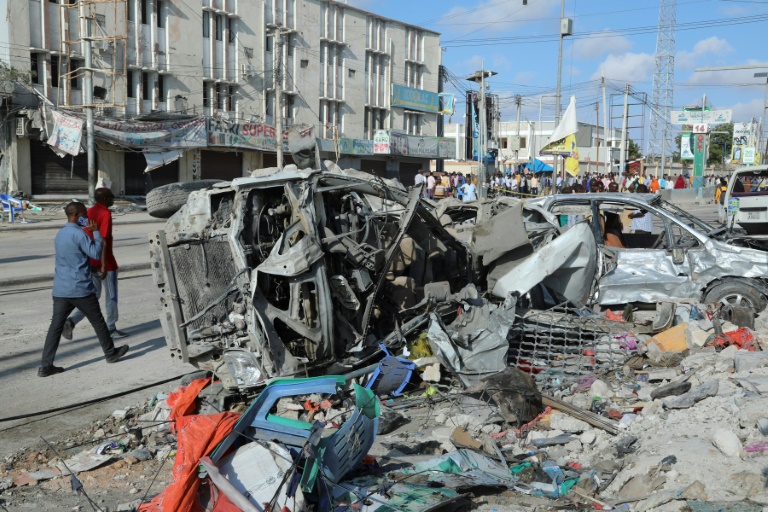
Two cars packed with explosives blew up minutes apart near the busy Zobe intersection, followed by gunfire in an attack targeting Somalia’s education ministry.

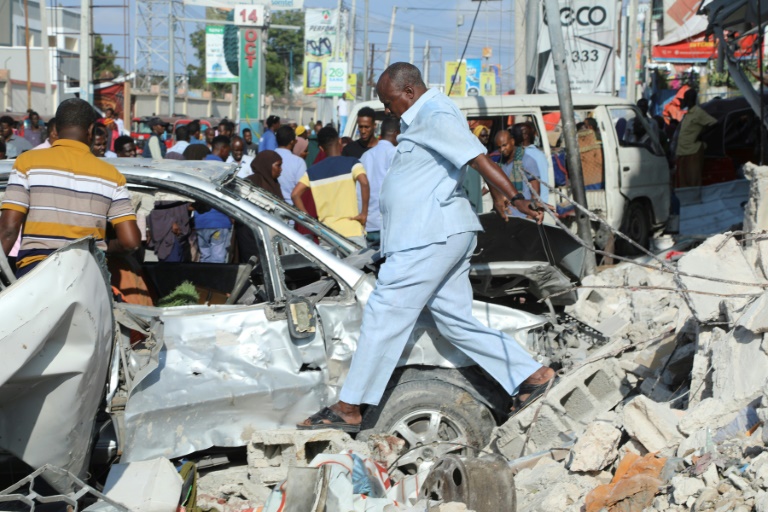
The afternoon explosions tore through walls, shattered windows of nearby buildings, sending shrapnel flying and plumes of smoke and dust into the air.

The victims included women, children and the elderly, police spokesman Sadik Dudishe said. 

“The ruthless terrorists killed mothers. Some of them died with their children trapped on their backs,” he said on Saturday, adding that the attackers had been stopped from killing more “innocent civilians and students.”

“I could not sleep last night because of the horrible scene,” police officer Adan Mohamed said on Sunday.

The attack took place at the same busy junction where a truck packed with explosives blew up on October 14, 2017, killing 512 people and injuring more than 290, the deadliest attack in the troubled country.

Mohamud described the incident as “historic”, saying “it is the same place, and the same innocent people involved.”

“This is not right. God willing, they will not be having an ability to do another Zobe incident,” he said, referring to the Islamist group Al-Shabaab.

Al-Qaeda-linked Al-Shabaab claimed responsibility for the attack in a statement, saying its fighters were targeting the ministry of education.

Shop owner Mohamed Jama said he was in the company of four men when the huge explosions hit. 

His shop which is located next to a bank collapsed and its windows shattered, the flying glass penetrating the flesh of the men.

“One of us had serious injuries… we bled there for a few minutes,” he told AFP in hospital.

The bloody siege drew international condemnation from Somalia’s allies, including the United Nations, Turkey as well as the African Union and its force tasked with helping Somali forces take over primary responsibility for security by the end of 2024.

The UN mission in Somalia UNSOM vowed to stand “resolutely with all Somalis against terrorism.”

“These attacks underline the urgency and critical importance of the ongoing military offensive to further degrade Al-Shabaab,” AU Transition Mission in Somalia (ATMIS), which replaced the previous AMISOM peacekeeping force, said on Twitter late Saturday. 

EU foreign policy chief Josep Borrell said in a tweet that Brussels “stands by President Hassan Mohamud and the people of Somalia after the terrorist attack”. 

“Our resolve and determination to fight against terrorism and defeat Al Shabab is higher than ever,” he wrote.

Pope Francis condoled with the victims of the bloody attack.

“Let us pray for the victims of the attack in Mogadishu in which more than 100 people lost their lives, among whom many children,” he said, following his traditional Angelus prayer in Saint Peter’s Square.

UN High Commissioner for Refugees Filippo Grandi said the “cowardly” act proved that Somalia need more support to end the violence and drought. 

Meanwhile, the World Health Organisation said it was ready to help the government treat the injured and provide trauma care to the victims. 

– ‘All-out war’ –

Al-Shabaab have been seeking to overthrow the fragile foreign-backed government in Mogadishu for about 15 years.

Its fighters were driven out of the capital in 2011 by an African Union force but the group still controls swathes of countryside and continues to wage deadly strikes on civilian and military targets.

In August, the group launched a 30-hour gun and bomb attack on the popular Hayat hotel in Mogadishu, killing 21 people and wounding 117.

Mohamud, who was elected in May, vowed after the August siege to wage “all-out war” on the Islamists.

In September, he urged citizens to stay away from areas controlled by jihadists, saying the armed forces and tribal militia were ratcheting up offensives against them.

Al-Shabaab remains a potent force despite multinational efforts to degrade its leadership.

The group last week claimed responsibility for an attack on a hotel in the port city of Kismayo that killed nine people and wounded 47 others. 

Somalia has been mired in chaos since the fall of president Siad Barre’s military regime in 1991.

His ousting was followed by a civil war and the ascendancy of Al-Shabaab.

As well as the insurgency, Somalia — like its neighbours in the Horn of Africa — is in the grip of the worst drought in more than 40 years. Four failed rainy seasons have wiped out livestock and crops.

The conflict-wracked nation is considered one of the most vulnerable to climate change but is particularly ill-equipped to cope with the crisis as it battles the deadly Islamist insurgency.


Twitter owner Musk tweets conspiracy theory about violent Pelosi attack

New Twitter owner Elon Musk tweeted an anti-LGBT conspiracy theory Sunday about what happened the night US Speaker Nancy Pelosi’s husband was attacked, underscoring concerns about the platform’s future after he vowed it would not become a “free-for-all hellscape.”

Musk, a self-declared “free speech absolutist,” was responding to former Democratic presidential candidate Hillary Clinton, who had tweeted to draw a line between Republicans who promote baseless conspiracy theories and the violent attack on Paul Pelosi in San Francisco.

“There is a tiny possibility there might be more to this story than meets the eye,” Musk told Clinton, attaching a link to the story, which is no longer accessible, by the conservative Santa Monica Observer.

The weekly outlet has published other conspiracy theories in the past, including that a body double for Clinton was sent to a debate with Donald Trump during the 2016 election campaign, according to the Los Angeles Times.

Musk’s tweet swiftly became a focal point for critics who have been nervous about the direction in which he intends to take Twitter, the leading platform for global discourse and diplomacy.

Musk, whose outspoken and controversial tweets have courted trouble in the past, has vowed to dial back content moderation, relying more on computer algorithms than human monitors. Conservatives say past moderation has unfairly targeted their views.

In a message meant to reassure jittery Twitter advertisers on his leadership, Musk said earlier this week that he realizes Twitter “cannot become a free-for-all hellscape where anything can be said with no consequences.”

But detractors warn that without standards, the world’s “digital town square” is at risk of becoming flooded with misinformation, with possibly perilous consequences for democracy and public health.

“Clinton: Conspiracy theories are getting people killed and we shouldn’t amplify them. Owner of Twitter: But have you considered this conspiracy theory?” wrote University of Denver political scientist Seth Masket after Musk’s Sunday tweet.

Masket later tweeted a screenshot suggesting he had complained to Twitter about Musk’s tweet, adding: “Somehow I doubt much will come of this.”

– Troll campaign tests Musk –

Nancy Pelosi, who is second in line to the US presidency, has said her family is “heartbroken and traumatized” after the intruder broke into the couple’s San Francisco home early Friday and attacked Paul Pelosi with a hammer, fracturing his skull.

The 82-year-old is recovering in hospital. 

President Joe Biden has said it appears the assault was “intended for Nancy,” and called out increasingly polarizing political rhetoric.

“The Republican Party and its mouthpieces now regularly spread hate and deranged conspiracy theories. It is shocking, but not surprising, that violence is the result,” Clinton said in her tweet.

Musk’s response came just hours after Twitter said that the site was being targeted by a trolling campaign testing its moderation policies under the billionaire’s leadership.

“Twitter’s policies haven’t changed… And we’re taking steps to put a stop to an organized effort to make people think we have,” tweeted the platform’s chief of safety and integrity, Yoel Roth.

Roth said that a “small number of accounts” had posted “a ton” of hate content — including 50,000 tweets using a particular slur made by just 300 accounts.

“Nearly all” of the accounts are inauthentic, he said.

Roth also retweeted a Musk post in which the Tesla chief reiterated that “we have not yet made any changes to Twitter’s content moderation policies.”

Twitter owner Musk tweets conspiracy theory about violent Pelosi attack

New Twitter owner Elon Musk tweeted an anti-LGBT conspiracy theory Sunday about what happened the night US Speaker Nancy Pelosi’s husband was attacked, underscoring concerns about the platform’s future after he vowed it would not become a “free-for-all hellscape.”

Musk, a self-declared “free speech absolutist,” was responding to former Democratic presidential candidate Hillary Clinton, who had tweeted to draw a line between Republicans who promote baseless conspiracy theories and the violent attack on Paul Pelosi in San Francisco.

“There is a tiny possibility there might be more to this story than meets the eye,” Musk told Clinton, attaching a link to the story, which is no longer accessible, by the conservative Santa Monica Observer.

The weekly outlet has published other conspiracy theories in the past, including that a body double for Clinton was sent to a debate with Donald Trump during the 2016 election campaign, according to the Los Angeles Times.

Musk’s tweet swiftly became a focal point for critics who have been nervous about the direction in which he intends to take Twitter, the leading platform for global discourse and diplomacy.

Musk, whose outspoken and controversial tweets have courted trouble in the past, has vowed to dial back content moderation, relying more on computer algorithms than human monitors. Conservatives say past moderation has unfairly targeted their views.

In a message meant to reassure jittery Twitter advertisers on his leadership, Musk said earlier this week that he realizes Twitter “cannot become a free-for-all hellscape where anything can be said with no consequences.”

But detractors warn that without standards, the world’s “digital town square” is at risk of becoming flooded with misinformation, with possibly perilous consequences for democracy and public health.

“Clinton: Conspiracy theories are getting people killed and we shouldn’t amplify them. Owner of Twitter: But have you considered this conspiracy theory?” wrote University of Denver political scientist Seth Masket after Musk’s Sunday tweet.

Masket later tweeted a screenshot suggesting he had complained to Twitter about Musk’s tweet, adding: “Somehow I doubt much will come of this.”

– Troll campaign tests Musk –

Nancy Pelosi, who is second in line to the US presidency, has said her family is “heartbroken and traumatized” after the intruder broke into the couple’s San Francisco home early Friday and attacked Paul Pelosi with a hammer, fracturing his skull.

The 82-year-old is recovering in hospital. 

President Joe Biden has said it appears the assault was “intended for Nancy,” and called out increasingly polarizing political rhetoric.

“The Republican Party and its mouthpieces now regularly spread hate and deranged conspiracy theories. It is shocking, but not surprising, that violence is the result,” Clinton said in her tweet.

Musk’s response came just hours after Twitter said that the site was being targeted by a trolling campaign testing its moderation policies under the billionaire’s leadership.

“Twitter’s policies haven’t changed… And we’re taking steps to put a stop to an organized effort to make people think we have,” tweeted the platform’s chief of safety and integrity, Yoel Roth.

Roth said that a “small number of accounts” had posted “a ton” of hate content — including 50,000 tweets using a particular slur made by just 300 accounts.

“Nearly all” of the accounts are inauthentic, he said.

Roth also retweeted a Musk post in which the Tesla chief reiterated that “we have not yet made any changes to Twitter’s content moderation policies.”

Iran protesters rally again despite Guards order to stand down

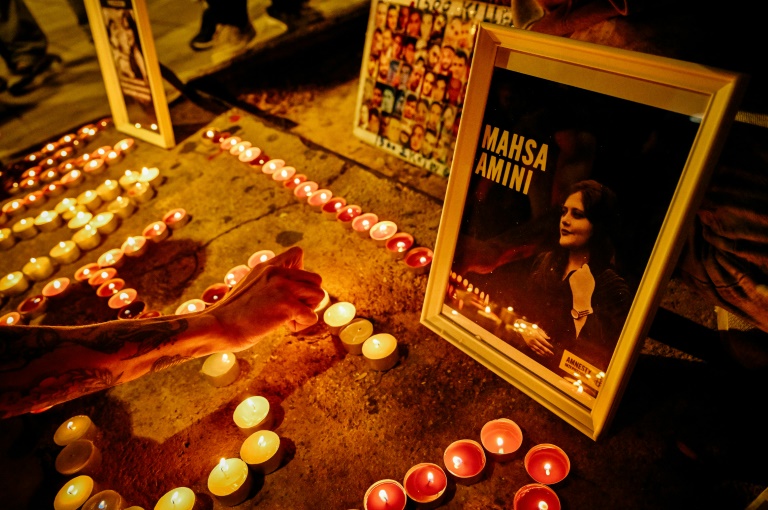
Iranian protesters rallied again Sunday, defying an order by the powerful Revolutionary Guards to stop the demonstrations — now in their seventh week — sparked by the death of Mahsa Amini.

Students gathered overnight and Sunday across Iran, even after Major General Hossein Salami, head of the Islamic Revolutionary Guard Corps, had warned demonstrators: “Do not come to the streets!”

Amini, 22, died in custody on September 16 after her arrest in Tehran for an alleged breach of Iran’s strict dress rules for women, triggering a wave of unrest and a state response on the “riots” that Amnesty International calls a “brutal crackdown”. 

Security forces on Sunday fired gunshots and tear gas at a gathering of students in the flashpoint western city of Sanandaj, where videos showed billowing clouds of smoke amid chants of “freedom”, the Norway-based Hengaw organisation reported.

It also posted a video with the sound of echoing gunfire, and of a 12-year-old girl wailing with her bloody arm peppered with metal pellets, in reports AFP could not independently verify.

Security forces have struggled to contain the protests, which started with women taking to the streets and burning their hijab headscarves and which have evolved into a broader campaign to end the Islamic republic founded in 1979. 

– Over 160 killed –

Students had protested on Saturday at campuses in Tehran, Kerman in the country’s south, and the western city of Kermanshah, among others, online videos showed.

“Each person getting killed is followed by a thousand people!” protesters shouted at the funeral of a demonstrator on Saturday in Arak, southwest of Tehran, footage published by the 1500tasvir social media channel showed, adding that the crowd was later dispersed with tear gas.

Demonstrations on Sunday were reported in multiple universities including the capital as well as in Mazandaran and Mashhad, where Oslo-based group Iran Human Rights (IHR) said crowds chanted “Death to the dictator”.

IHR said Friday that at least 160 protesters, including more than two dozen children, had been killed since protests began.

At least another 93 people were killed during separate demonstrations that erupted on September 30 in the southeastern city of Zahedan over the reported rape of a teenage girl by a police commander, according to the rights group.

In Amini’s hometown of Saqez, security forces in plain clothes broke up a protest at a vocational college, where officers “attacked the students and abducted a number of them”, Hengaw said.

– Journalist protest –

Hundreds have been detained, and on Sunday more than 300 Iranian journalists and photojournalists signed a statement condemning authorities for “arresting colleagues and stripping them of their civil rights after their detentions”.

Reformist daily Sazandegi said Sunday that “more than 20 journalists are still in detention”, while the Tehran journalists’ association dismissed the “security approach” as “illegal” and “in conflict with press freedom”.

Tehran has sought to portray the protest movement as a plot hatched by its arch-enemy the United States, charging that some journalists had received “training courses” with the aim of changing power in Tehran.

According to local media, a report by the security services referred to journalist Elaheh Mohammadi from the Sazandegi paper and photographer Niloufar Hamedi of the daily Shargh, who helped publicise Amini’s case and who have been detained for weeks.

Both their outlets challenged the report, with Shargh editor Mehdi Rahmanian insisting that “our journalist and our newspaper… acted within the framework of the journalistic mission”.

The protests in Iran have been mirrored by scores of rallies of support in cities worldwide.

On Saturday, Canadian Prime Minister Justin Trudeau marched with protesters in the capital Ottawa, telling Iranian activists that “we will stand with you”.

burs-pjm/fz/lg

More than 150 killed in Halloween stampede in Seoul

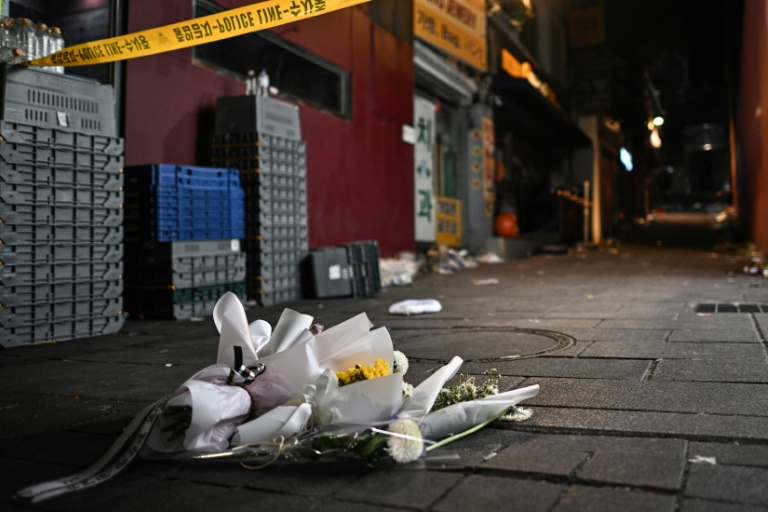
More than 150 people have been killed in a stampede at a Halloween event in Seoul, officials said Sunday, with South Korea’s president vowing a thorough investigation into one of the country’s worst-ever disasters.

The crowd surge and crush took place in the capital’s popular central Itaewon district, where estimates suggest as many as 100,000 people — mostly in their teens and 20s — went to celebrate Halloween Saturday night, clogging the area’s narrow alleyways and winding streets.

President Yoon Suk-yeol declared a period of national mourning Sunday, telling the country in a televised address that “a tragedy and disaster occurred that should not have happened”.

He said the government “will thoroughly investigate the cause of the incident and make fundamental improvements to ensure the same accident does not occur again”.

Witnesses described being trapped in a narrow, sloping alleyway, and scrambling to get out of the suffocating crowd as people piled on top of one another.

“There were so many people just being pushed around and I got caught in the crowd and I couldn’t get out at first,” 30-year-old Jeon Ga-eul told AFP.

The interior ministry said 153 people had died, including 20 foreigners, in the stampede, which occurred around 10 pm local time (1300 GMT).

Most of the victims were young women in their 20s, it said, adding that 133 people were injured.

An official from the defence ministry said three military personnel were among the dead.

Authorities also said they had received more than 2,600 reports of people missing.

– ‘Unprecedentedly large’ –

Seoul mayor Oh Se-hoon, who rushed back to South Korea from a work trip in Europe, said his office would set up a memorial altar so the public could pay their respects to the victims, starting Monday morning.

“Most of the casualties are young people like our sons and daughters, which makes it even more sad,” Oh said while visiting the site of the disaster.

Officials said Sunday they had no clear idea of what caused the crush, while witnesses described scenes of chaos after a vast crowd panicked in the narrow alleyway.

Local shopkeepers told AFP the number of people at the annual celebration was “unprecedentedly large” this year — the first public event to be held without Covid-19 restrictions since the pandemic began.

As questions began to emerge over a lack of security at the event, interior minister Lee Sang-min told a briefing that the police force had been preoccupied on the other side of town.

“A considerable number had been deployed at Gwanghwamun where a large crowd was expected for a protest,” he said.

Police had also not expected such a large crowd at the Halloween event, he added.

Paramedics at the scene, quickly overwhelmed by the number of victims, were asking passers-by to administer first aid.

In an interview with local broadcaster YTN, Lee Beom-suk, a doctor at the event, described the chaos.

“So many victims’ faces were pale. I could not catch their pulse or breathing and many of them had a bloody nose. When I tried CPR, I also drew blood out of their mouths.”

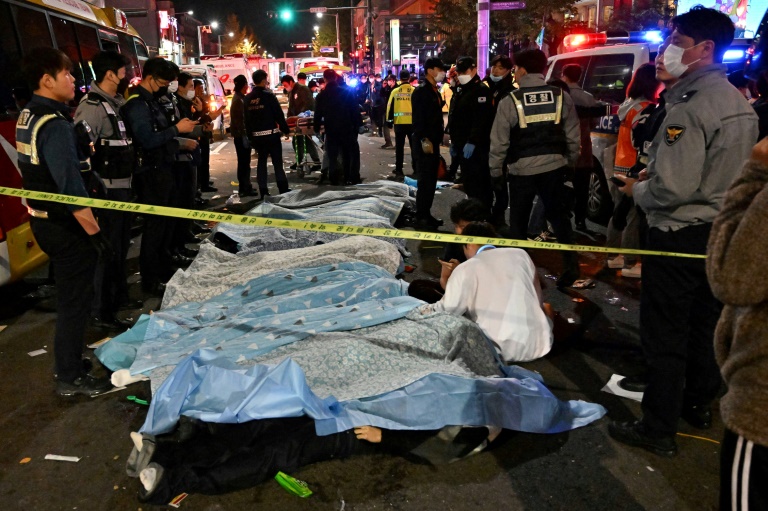
Photos captured by AFP showed scores of bodies on the pavement covered by bed sheets, and emergency workers loading more bodies on stretchers into ambulances.

– ‘Oh my God’ –

Twitter user @janelles_story shared a video that she said showed Itaewon shortly before the stampede in which hundreds of young people, many in elaborate Halloween costumes, are seen in a narrow street lined with bars and cafes.

The crowd appears in good spirits at first, but then a commotion begins and people start being pushed into one another. Screams and gasps are heard and a female voice cries out in English “Shit, shit!” followed by “Oh my God, oh my God!”

The interior ministry said the 20 foreigners killed included people from the United States, Uzbekistan, Austria, Norway, Vietnam, Kazakhstan, Iran, and Sri Lanka. 

The United States embassy in Seoul confirmed that two US nationals had died. Russia said three of its citizens were killed.

China also confirmed that four of its nationals had died, with President Xi Jinping sending “deep condolences” to Seoul.

President Joe Biden said the United States “stands with” South Korea after the tragedy, while Japan’s Prime Minister Fumio Kishida said he was “hugely shocked and deeply saddened”.

Brazil votes in white-knuckle Bolsonaro-Lula showdown

Brazil was on a knife-edge Sunday as voters chose between far-right incumbent Jair Bolsonaro and his leftist arch-rival, Luiz Inacio Lula da Silva, in a presidential election seen as too close to call.

Both candidates cast their ballots in the morning, expressing confidence in victory in the runoff election, after a dirty and divisive campaign that has deeply polarized the nation of 215 million people.

Some Brazilians voted with gusto, while others merely picked the candidate they least disliked.

“I think this has been the best government Brazil has ever had,” said Afro-Brazilian lawyer Eliane de Oliveira, 61, who voted for Bolsonaro in Rio de Janeiro’s Copacabana neighborhood, saying he was happy to have a government “that is not corrupt”, in a dig at the graft-tainted Lula.

Standing nearby, physical education teacher Gustavo Souza voted for Lula, who he hoped would “improve the lives of many people.”

Like many he is nervous about the outcome, reflecting fears that Bolsonaro would not accept the result after months of attacking the electoral system.

“I admit I am a little scared about the result today. People have become so radical. They will need some maturity… or it will turn into the third or fourth world war,” he said, laughing nervously.

– ‘Brazil will be victorious’-

Lula, 77, narrowly won the first-round election on October 2, and enters the finale the slight favorite with 52 percent of voter support, according to a final poll from the Datafolha institute Saturday.

However, Bolsonaro, 67, who scored 48 percent in the poll, performed better than expected last time around, and the result this time is anyone’s guess.

The president cast his ballot wearing a T-shirt in the yellow-and-green of the Brazilian flag — a symbol he has adopted as his own.

“God willing, we’ll be victorious later today. Or even better, Brazil will be victorious,” said the ex-army captain, grinning as he greeted supporters in Rio de Janeiro’s Vila Militar neighborhood.

Lula voted in Sao Bernardo do Campo, the southeastern city where he got his start as a union leader, saying he was “confident in the victory of democracy,” and that he would seek to “restore peace” in a divided nation if elected.

– Democracy, Amazon –

The electoral showdown caps months of mud-slinging and personal attacks, in a campaign plagued by disinformation.

Lula’s camp has called Bolsonaro a “cannibal,” “pedophile” and “little dictator.” In turn, the ex-president has repeatedly been derided as a “thief” and accused of making a pact with Satan.

Waiting at his polling station in Sao Paulo, psychologist Marcelo Silveira Curi, 35, said he disliked both candidates but was reluctantly voting for Lula.

“He’s not ideal, but he’s the option if you oppose this government,” he told AFP, criticizing “lots of economic and social reversals” under Bolsonaro.

The election has global ramifications: Conservationists believe the result could seal the fate of the stricken Amazon rainforest, pushed to the brink by fires and deforestation that have surged under Bolsonaro.

However, for Brazilians, issues of poverty, hunger, corruption and traditional values are top of mind.

– Will Bolsonaro cry foul? –

One of the main questions hanging over the poll has been if Bolsonaro — often dubbed the “Tropical Trump” — will accept a loss, after saying the very voting system that brought him to power was riddled with fraud.

On Friday night he pledged to respect the election, though possible accusations of rigging and a backlash from his supporters loom large.

Bolsonaro came under fire for his disastrous handling of the Covid-19 pandemic, which left more than 680,000 dead in Brazil, as well as his vitriolic style and disdain for political correctness.

However, in recent months, falling unemployment figures, slowing inflation and a recovering economy have given him a boost.

His core supporters — the business sector, anti-corruption voters and the powerful “Bibles, bullets and beef” coalition — love his gloves-off style and focus on conservative values.

– Comeback kid –

Lula was the country’s most popular president when he left office, helping to lift millions out of poverty with his social welfare programs.

But he then became mired in a massive corruption scandal and was jailed for 18 months, before his convictions were thrown out last year. The Supreme Court found the lead judge was biased, but Lula was not exonerated.

If he wins, he faces a hostile Congress dominated by Bolsonaro lawmakers and allies.

Brazil’s 156 million voters will cast their ballots until 5:00 pm (2000 GMT). The result of the electronic vote is expected in a matter of hours.

'Horrible scene': Somalis in desparate search for missing relatives after blasts

Anguished families in Somalia on Sunday desperately searched under debris and into body bags for loved ones after two simultaneous bombings tore through a busy intersection in the capital Mogadishu.

At least 100 civilians lost their lives and 300 others were wounded in Saturday’s attack claimed by Al-Qaeda-linked Al-Shabaab jihadists, the deadliest assault in the troubled nation in five years. 

President Hassan Sheikh Mohamud said the death toll was expected to rise.

Abdiasis Abdi, a 22-year-old student, spent hours into the night looking for his sister who last said she lived in Zobe, a busy commercial hub with restaurants, pharmacies and banks hit by the car bombs.

“We found her this morning with only some of her clothes recognisable,” Abdi said. Her body had been completely charred.

“I have never seen a horrible scene like that.”

The attack has inundated first responders and hospitals in the Horn of Africa nation, which has one of the world’s weakest health systems after decades of conflict.

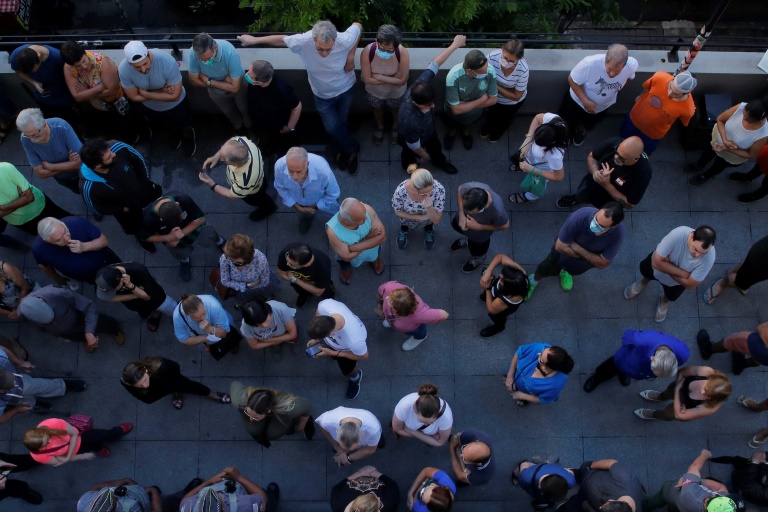
The government put out an appeal for blood donations with dozens of people gathered outside hospitals in the capital Mogadishu, seeking news of family members. 

Mohamed Ganey described seeing victims “scattered” on hospital floors as they looked for his missing sister-in-law. But the joy of finding her did not last long.

“Unfortunately, she died from the injuries just a few minutes after we found her.

“Everybody is shocked. The only question people have in common today is why kill so many innocent people?”

Police officer Adan Mohamed who was among the first to arrive at the scene after the second car bomb went off sending shrapnel flying and plumes of smoke and dust into the air, said he could not contain his emotion.

“I could not sleep last night because of the horrible scene,” he told AFP, recounting how his colleagues found a baby whose mother had been killed in the blast. 

“I cried again and again after I saw her face with blood stains presumably from her mother’s body,” he said. 

“She could not even cry because of the horrible situation. All she could do was stare and blink her eyes.”

– ‘Waiting to get killed’-

Police spokesman Sadik Dudishe on Saturday said the “ruthless terrorists” had killed mothers some of whom had “children trapped on their backs.”

The attack took place at the same busy junction where a truck packed with explosives blew up on October 14, 2017, killing 512 people and injuring more than 290, the deadliest attack in the troubled country.

Witnesses said the road was busy with rows of tuk-tuks and other vehicles when the first blast hit.

“Rescuers, security forces and people seeking their relatives immediately rushed to the scene and the second blast went off,” Sumayo Ali who survived the attack said.

Shop owner Mohamed Jama, who was with four other men when he heard a loud explosion, said he crawled through broken glass to safety.

“Outside the shop, dead bodies and injuries were everywhere, some injured were screaming, that’s what I can remember now,” he told AFP from his hospital bed.

On Sunday morning, the area surrounding the intersection was quiet, patrolled by a handful of security officers as emergency workers  cleared the rubble and removed more bodies. 

Nearby buildings sustained heavy damage with their windows shattered and walls collapsed.

International condemnation of the attack has poured in, including from the United Nations, African Union and Turkey.

Pope Francis offered condolences. “Let us pray for the victims of the attack in Mogadishu in which more than 100 people lost their lives, among whom many children,” he said, following the traditional Angelus prayer in Saint Peter’s Square.  

For Hussein Jeeri, who lost his friend at the same intersection five years ago, tragedy stuck again on Saturday as his sister was wounded.

“I think the streets in Mogadishu are like walking on a sharp sword, we are all waiting to get killed or wounded like this one day.”

Annual tech gathering takes aim at crypto

One of the world’s biggest technology get-togethers kicks off in the Portuguese capital on Tuesday, with organisers saying a key aim is to ask tough questions about cryptocurrencies.

Around 100,000 people are expected to gather in Lisbon for the four-day Web Summit and related events, the first full-scale edition since 2019 following the disruption of the pandemic.

The conference attempts to bring together start-ups, investors, business leaders and agenda-broadening speakers –- linguist Noam Chomsky and heavyweight boxing champion Oleksandr Usyk are among this year’s lineup.

Several of the prime slots, though, are taken by cryptocurrency specialists led by Changpeng Zhao, boss of crypto exchange Binance.

And plenty of companies present — from start-ups to billion-dollar behemoths Yuga Labs and OpenSea — are promoting the technology that fans claim will be the future of the web, gaming and ultimately the entire financial system.

But crypto has so far been derided as a tool to generate investment bubbles, hide illicit wealth and enable scams.

Conference organiser Paddy Cosgrave told AFP there were “a lot of questions to be answered” about crypto, describing it as “largely smoke and mirrors”.

“We’ve done our best to persuade many of the leading lights in the space to come, and some of them will get a bit of a kicking on stage, we’ll see how that goes,” he added.

Crypto sceptics including actor Ben McKenzie (Gotham, The O.C.) have also been given slots.

Organisers said the event’s 70,000 tickets had sold out, with Cosgrave reckoning some 30,000 more people would be in Lisbon for side events.

– Whistleblower focus –

Zhao’s company is the dominant player in the crypto sector, but it has been repeatedly accused of trying to dodge regulatory scrutiny — claims the company has denied.

And it became embroiled in one of the biggest stories of the week, with a $500-million investment to back Elon Musk’s takeover of Twitter.

But the wider crypto sector is struggling with plunging values and flatlining interest from the public.

And the tech industry as a whole is also struggling with supply chain problems, trade disputes between the US and China, and economic volatility that has sent investors fleeing.

Cosgrave, though, played down any suggestion that conferences like his had a role in helping to stimulate investment or turn around the fortunes of the sector.

“It’s not really about the establishment or the dominant companies of today,” he said.

“It’s a gathering of companies that in the future may play some significant role.”

As usual, though, the Web Summit will host plenty of figures from the dominant companies — Amazon, Apple, Google and Meta will all be there.

But on a lower level than last year, when the conference played host to Facebook’s Nick Clegg and to whistleblower Frances Haugen, who accused their company of stoking hatred in return for clicks.

Cosgrave highlighted the event’s history of giving a platform to whistleblowers — this year Mark MacGann, who revealed details of Uber’s aggressive lobbying, will be giving a talk.

The organisers say more than 1,000 speakers will take part, giving talks on subjects from cybersecurity to artificial intelligence.

Brazil votes in down-to-wire Bolsonaro-Lula showdown

Brazilians voted Sunday in a white-knuckle presidential runoff election, choosing between wildly different visions of their future offered by far-right incumbent Jair Bolsonaro and his leftist arch-rival, Luiz Inacio Lula da Silva.

Lula, a charismatic former president tainted by graft charges, narrowly won a first-round election and enters the finale the slight favorite with 52 percent of voter support, according to a final poll from the Datafolha institute Saturday.

However, Bolsonaro, who scored 48 percent in the poll, performed better than expected four weeks ago, and many pundits see the election as too close to call.

Waiting in line to vote in Brasilia, Nadia Faraj said she had been up since 4:30 am worrying about the nation’s future.

“It’s a watershed moment for the country,” the 61-year-old Bolsonaro supporter told AFP.

“Brazil is teetering on the brink. We’ve spent years trying to rebuild the country,” she added, referring to a corruption scandal and economic crisis at the end of 13 years of rule by Lula’s Workers’ Party (PT) in 2016.

“We need Bolsonaro.”

The president himself was among the first to vote, casting his ballot wearing a T-shirt in the yellow-and-green of the Brazilian flag — a symbol he has adopted as his own.

“God willing, we’ll be victorious later today. Or even better, Brazil will be victorious,” said the ex-army captain, grinning as he greeted supporters in Rio de Janeiro’s Vila Militar neighborhood.

Near Rio’s Copacabana beach, physical education teacher Gustavo Souza voted for Lula, who he hoped would “improve the lives of many people.”

Like many, he is nervous about the outcome.

“I admit I am a little scared about the result today. People have become so radical. They will need some maturity… or it will turn into the third or fourth world war,” he said, laughing nervously.

– Democracy, Amazon –

The electoral showdown caps months of mud-slinging and personal attacks, in a dirty campaign plagued by disinformation that has deeply polarized the nation of 215 million people.

Lula’s camp has called Bolsonaro a “cannibal,” “pedophile” and “little dictator.” In turn, the ex-president has repeatedly been derided as a “thief” and accused of making a pact with Satan.

Both candidates have their die-hard supporters, but many will merely vote for the candidate they detest least — or spoil their ballots.

Waiting at his polling station in Sao Paulo, psychologist Marcelo Silveira Curi, 35, said he was voting for Lula with slight disgust.

“He’s not ideal, but he’s the option if you oppose this government,” he told AFP, criticizing “lots of economic and social reversals” under Bolsonaro.

The election has global ramifications: Conservationists believe the result could seal the fate of the stricken Amazon rainforest, pushed to the brink by fires and deforestation that have surged under Bolsonaro.

However, for Brazilians, issues of poverty, hunger, corruption and traditional values are top of mind.

Lula, Brazil’s president from 2003 to 2010, has called the election a choice between “democracy and barbarism, between peace and war.”

– Will Bolsonaro cry foul? –

One of the main questions hanging over the poll has been if Bolsonaro — often dubbed the “Tropical Trump” — will accept a loss, after saying the very voting system that brought him to power was riddled with fraud.

On Friday night he pledged to respect the election, though possible accusations of rigging and a backlash from his voters loom large.

Bolsonaro came under fire for his disastrous handling of the Covid-19 pandemic, which left more than 680,000 dead in Brazil, as well as his vitriolic style and disdain for political correctness.

However, in recent months, falling unemployment figures, slowing inflation and a recovering economy have given him a boost.

His core supporters — the business sector, anti-corruption voters and the powerful “Bibles, bullets and beef” coalition — love his gloves-off style and focus on conservative values. 

– Comeback kid –

Lula was the country’s most popular president when he left office, helping to lift millions out of poverty with his social welfare programs.

But he then became mired in a massive corruption scandal and was jailed for 18 months, before his convictions were thrown out last year. The Supreme Court found the lead judge was biased, but Lula was not exonerated.

A victory would be a spectacular comeback. However, the ex-metalworker would face a hostile Congress dominated by Bolsonaro lawmakers and allies.

Brazil’s 156 million voters will cast their ballots until 5:00 pm (2000 GMT). The result of the electronic vote is expected in a matter of hours.

More than 150 killed in Halloween stampede in Seoul

More than 150 people were killed in a stampede at a Halloween event in central Seoul, officials said Sunday, with South Korea’s president vowing a full investigation into one of the country’s worst-ever disasters.

The crowd surge and crush hit in the capital’s popular Itaewon district, where estimates suggest as many as 100,000 people — mostly in their teens and 20s — went to celebrate Halloween Saturday night, clogging the area’s narrow alleyways and winding streets.

President Yoon Suk-yeol declared a period of national mourning Sunday, telling the country in a televised address that “a tragedy and disaster occurred that should not have happened”.

He said the government “will thoroughly investigate the cause of the incident and make fundamental improvements to ensure the same accident does not occur again in the future”.

“My heart is heavy and it is difficult to contain my sorrow,” he added, before he visited the scene of the disaster and spoke to emergency workers.

Seoul mayor Oh Se-hoon, who rushed back to South Korea from a work trip in Europe, said his office would set up a memorial altar at Seoul Plaza so the public could pay their respects to the victims, starting Monday morning.

“Most of the casualties are young people like our sons and daughters, which makes it even more sad,” Oh said while visiting the site of the disaster.

Eyewitnesses described being trapped in a narrow, sloping alleyway, and scrambling to get out of the suffocating crowd as people piled on top of one another.

Seoul’s interior ministry told AFP that 153 people had died, including 20 foreigners, in the stampede, which occurred around 10:00 pm local time (1300 GMT). 

Most of the victims were young women in their 20s, it said, adding that 133 people were injured.

An official from Seoul’s defence ministry said three military personnel were among the dead, including one soldier.

Seoul authorities said they had also received 2,642 reports of missing people.

– ‘Unprecedentedly large’ –

Officials said Sunday they had no clear idea of what caused the crush, while eyewitnesses described scenes of chaos after a vast crowd panicked in a narrow alleyway.

Local shopkeepers told AFP that the number of people at the annual celebration was “unprecedentedly large” this year — the first event to be held without Covid-19 restrictions since the pandemic began.

“There were so many people just being pushed around and I got caught in the crowd and I couldn’t get out at first too,” 30-year-old Jeon Ga-eul told AFP.

As questions began to emerge over the lack of security at the event, interior minister Lee Sang-min told a briefing that the police force had been occupied on the other side of town.

“A considerable number had been deployed at Gwanghwamun where a large crowd was expected for a protest,” he said.

Police had also not expected such a large crowd at the Halloween event, he said.

Paramedics at the scene, quickly overwhelmed by the number of victims, were asking passers-by to administer first aid.

In an interview with local broadcaster YTN, Lee Beom-suk, a doctor who administered first aid to the victims described scenes of tragedy and chaos.

“So many victims’ faces were pale. I could not catch their pulse or breath and many of them had a bloody nose. When I tried CPR, I also pumped blood out of their mouths.”

AFP photos showed scores of bodies on the pavement covered by bed sheets, and emergency workers dressed in orange vests loading even more bodies on stretchers into ambulances.

– ‘Oh my god’ –

Twitter user @janelles_story shared a video that she said showed Itaewon shortly before the stampede, in which hundreds of young people, many in elaborate Halloween costumes, are seen in a narrow street lined with bars and cafes.

The crowd appears in good spirits at first, but then a commotion begins and people start being pushed into one another. Screams and gasps are heard and a female voice cries out in English “Shit, shit!” followed by “Oh my god, oh my god!”

The interior ministry said the 20 foreigners killed included people from the United States, Uzbekistan, Austria, Norway, Vietnam, Kazakhstan, Iran, and Sri Lanka. Russia said three of its nationals had died.

China also confirmed that four of its nationals had died, with President Xi Jinping sending his country’s “deep condolences for the victims” to Seoul.

Seoul’s staunch ally, US President Joe Biden, said America “stands with” South Korea after the tragedy, while Japan’s Prime Minister Fumio Kishida said he was “hugely shocked and deeply saddened” by the disaster.

Close Bitnami banner
Bitnami