World

Ukrainians watch war change course on edge of Kherson

The bursts of Ukrainian fire flying over his head at the Russians in their southern stronghold of Kherson down the road gave Oleksandr Prikhodko reason to hope. 

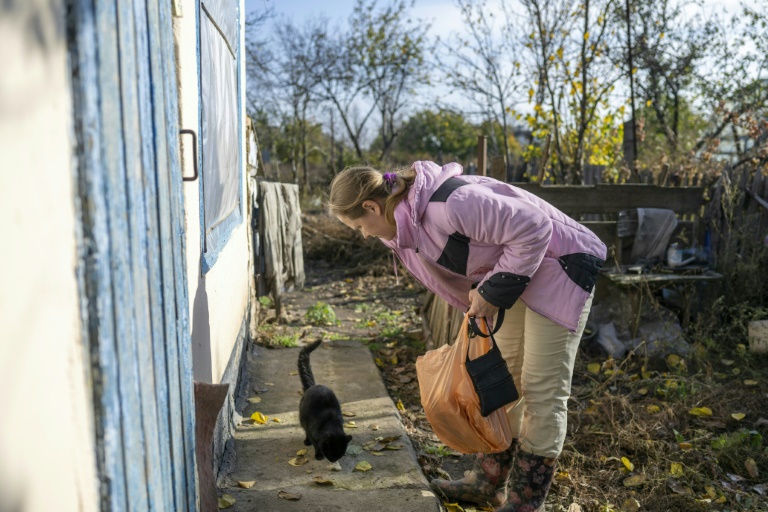
The energetic 42-year-old was standing in the soot-covered ruins of the family store he had built on the edge of land Russia suddenly claims as its own.

The Russians smashed his life’s work to smithereens during their second attempt to seize the nearby Ukrainian riverside port of Mykolaiv in July.

The Ukrainians have since launched a stirring counterassault that has turned the road between Mykolaiv and Kherson into one of the central axes of the war.

Prikhodko grew up along that road in the one-factory village of Kotlyareve.

The Russians blew up the factory as well.

“When you hear news about our successes, there is huge psychological relief,” Prikhodko said between sharp bangs of outgoing rocket fire.

“Even tiny things such as seeing a military car drive out to the front and then safely come back makes you feel better,” he said. 

“Our lives depend on our soldiers. And they have to somehow understand that we know that.”

– Methodical approach –

Ukraine’s counteroffensive began in early September across northern regions that the seemingly stunned Russians ended up conceding without barely a fight.

Neither side — nor the villagers in Kotlyareve — expect the same in Kherson.

The city and its eponymous region offer a gateway to Kremlin-annexed Crimea and the commercially important Sea of Azov.

Its fall would leave Vladimir Putin with almost nothing to show from a campaign that has turned the Kremlin leader into a pariah and thrown Russia into Soviet-era isolation.

Ukraine’s battle for Kherson began with a methodical assault by long-range missiles that Washington agreed to start supplying in late May.

The Ukrainians successfully targeted weapons silos and supply routes that Russia used to arm its troops in Kherson.

The idea was to limit the Russians to whatever weapons they had on hand and prevent them from getting more.

And then they pounced.

– ‘Like a rollercoaster’ –

The sounds of war echoing around Kotlyareve suggest Ukraine’s strategy is bearing fruit.

The Russian are responding to the Ukrainian barrages with sporadic salvos of fire that barely register with villagers steeled by eight months of war.

“They are shooting a lot less at us now,” said local factory driver Viktor Romanov.

The 44-year-old and his wife Iryna were making their weekly return visit home to feed their abandoned pets.

But they still prefer to wait out the war in Mykolaiv — both because it feels safer and because the city is more likely to have stable supplies of gas and lights.

“We have been hopeful before and then watched bombs fall on our heads,” Iryna said.

“You feel like you’re on a rollercoaster — your mood swings up and down,” she said of her trust in Ukraine’s ability to beat back the Russians.

– ‘Completely cut off’ –

A new wave of weekend strikes on Russia’s Black Sea Fleet base in Crimea appears to be part of Ukraine’s more confident and muscular approach on its southern front.

Kherson native Oleksiy Vaselenko — a Russian speaker who fought against Moscow’s proxy forces in eastern Ukraine during a lower-scale conflict in 2014 — was worried.

The 32-year-old worked at the same destroyed Kotlyareve factory until its destruction and kept up with his relatives in Kherson the entire time.

He does so in complete secrecy — and at immense risk to his loved ones living under a Kremlin-imposed state of martial law.

“Everyone I know there wants to come back to Ukraine. They are really suffering,” the factory worker said.

He said an apparent Ukrainian attack that disable Russia’s new bridge to Crimea earlier this month also severed supplies to Kremlin-controlled parts of Kherson.

“They feel completely cut off,” he said with a sad shake of the head.

“Somehow, I think that if Ukraine had the type of Western support in 2014 we do now, none of this would have happened.”
More than 150 killed in Halloween stampede in Seoul

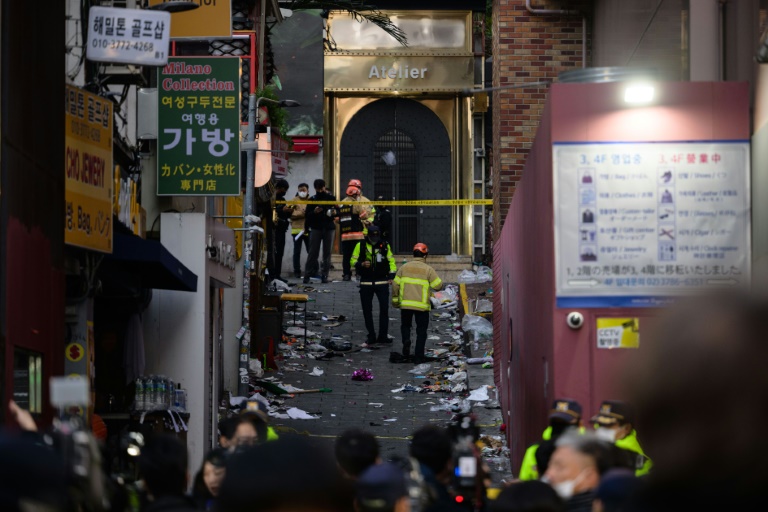
More than 150 people were killed in a stampede at a Halloween event in central Seoul, officials said Sunday, with South Korea’s president vowing a full investigation into one of the country’s worst-ever disasters.

The crowd surge and crush hit in the capital’s popular Itaewon district, where police estimate as many as 100,000 people — mostly in their teens and 20s — went to celebrate Halloween Saturday night, clogging the area’s narrow alleyways and winding streets.

President Yoon Suk-yeol declared a period of national mourning Sunday, telling the country in a televised address that “a tragedy and disaster occurred that should not have happened”.

He said the government “will thoroughly investigate the cause of the incident and make fundamental improvements to ensure the same accident does not occur again in the future”.

“My heart is heavy and it is difficult to contain my sorrow,” he added, before he visited the scene of the disaster and spoke to emergency workers.

Eyewitnesses described being trapped in a narrow, sloping alleyway, and scrambling to get out of the suffocating crowd as people piled on top of one another.

Seoul’s interior ministry told AFP that 153 people had died, including 20 foreigners, in the stampede, which occurred around 10:00 pm (1300 GMT). 

Most of the victims were young women in their 20s, it said, adding that 134 people were injured. 

“The high number of casualties was the result of many being trampled during the Halloween event,” fire official Choi Seong-beom told reporters at the scene, adding that the death toll could climb.

Seoul authorities said they had also received 2,642 reports for missing people.

– ‘Unprecedentedly large’ –

Officials said Sunday they had no clear idea of what caused the crush, while eyewitnesses described scenes of chaos as a vast crowd panicked in a narrow alleyway.

Local shopkeepers told AFP that the number of people at the annual celebration was “unprecedentedly large” this year — the first event to be held without Covid-19 restrictions since the pandemic began.

“There were so many people just being pushed around and I got caught in the crowd and I couldn’t get out at first too,” 30-year-old Jeon Ga-eul told AFP.

As questions began to emerge over the lack of security at the event, interior minister Lee Sang-min told a briefing that the police force had been occupied on the other side of town.

“I am not certain about the exact number of police personnel deployed (to Itaewon) but a considerable number had been deployed at Gwanghwamun where a large crowd was expected for a protest,” he said.

Police had also not expected such a large crowd at the Halloween event, he said. 

“The expected size of the crowd in Itaewon did not deviate much from the previous years, so I understand that the personnel were deployed at a similar scale as before.”

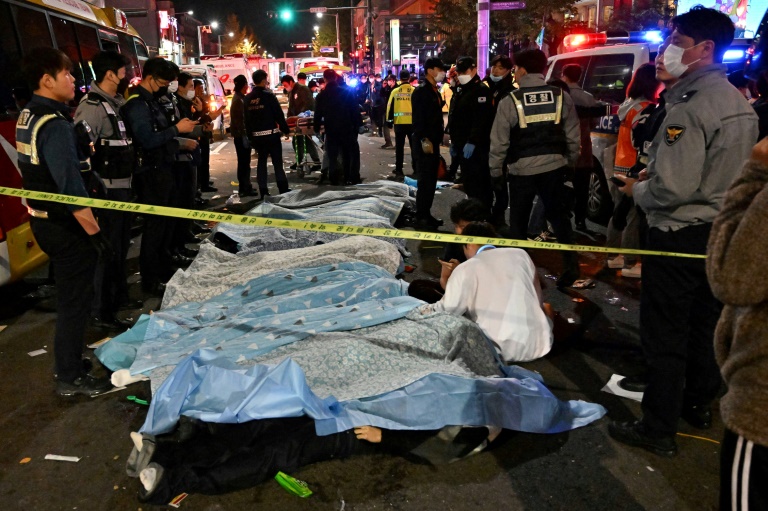
Paramedics at the scene, quickly overwhelmed by the number of victims, were asking passers-by to administer first aid.

In an interview with local broadcaster YTN, Lee Beom-suk, a doctor who administered first aid to the victims described scenes of tragedy and chaos.

“So many victims’ faces were pale. I could not catch their pulse or breath and many of them had a bloody nose. When I tried CPR, I also pumped blood out of their mouths.”

AFP photos showed scores of bodies on the pavement covered by bed sheets, and emergency workers dressed in orange vests loading even more bodies on stretchers into ambulances.

– ‘Oh my god’ –

Twitter user @janelles_story shared a video that she said showed Itaewon shortly before the stampede, in which hundreds of young people, many in elaborate Halloween costumes, are seen in a narrow street lined with bars and cafes.

The crowd appears in good spirits at first, but then a commotion begins and people start being pushed into one another. Screams and gasps are heard and a female voice cries out in English “Shit, shit!” followed by “Oh my god, oh my god!”

The interior ministry said the 20 foreigners killed included people from the United States, Uzbekistan, Austria, Norway, Vietnam, Kazakhstan, Iran, and Sri Lanka. Russia said three of its nationals had died.

China also confirmed that four of its nationals had died, with President Xi Jinping sending his country’s “deep condolences for the victims” to Seoul.

Seoul’s staunch ally, US President Joe Biden, said America “stands with” South Korea after the tragedy, while Japan’s Prime Minister Fumio Kishida said he was “hugely shocked and deeply saddened” by the disaster.

'Lot of progress' in India trade talks: UK foreign minister

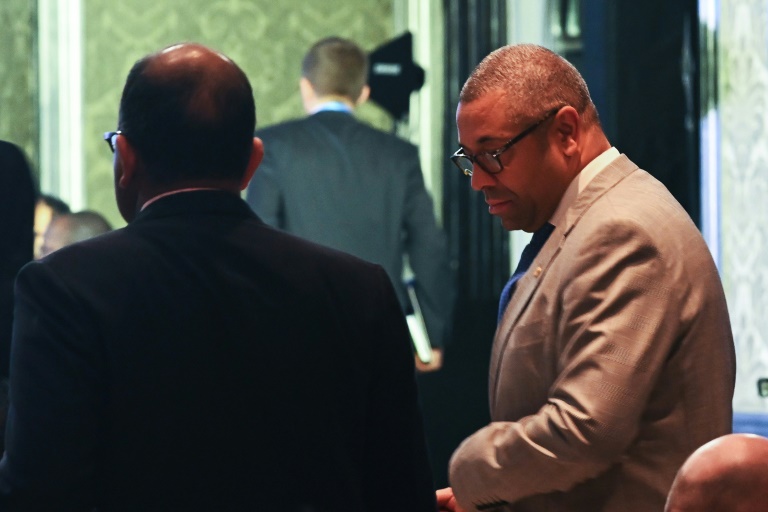
Britain’s foreign minister has insisted during a visit to India that “a lot of progress” has been made in talks on a post-Brexit free-trade deal despite negotiators missing a recent deadline.

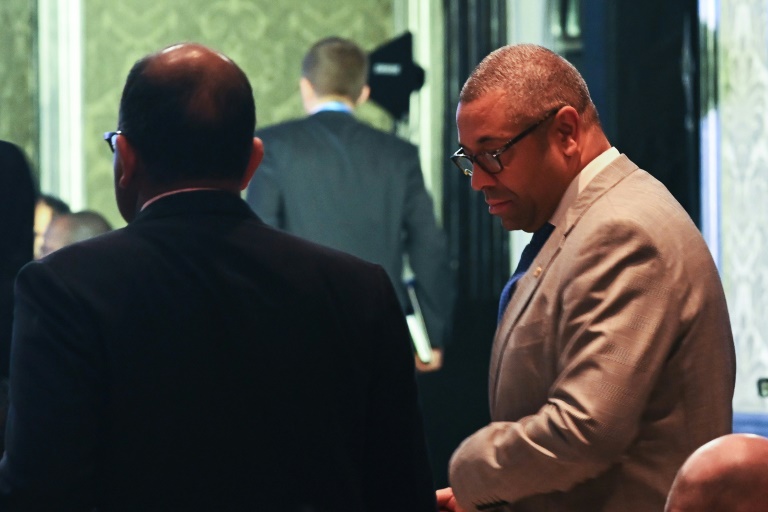
“We have made a lot of progress in the negotiations, and we continue to work for an agreement that works for both countries,” James Cleverly said in a Times of India interview published Sunday.

“We have been very, very explicit that our partnership with India is one that matters to us and one we want to enhance and develop,” he was quoted as telling the paper during the two-day visit.

India and its former colonial ruler have been negotiating for around 18 months on a trade deal that would be an important milestone for Britain as it seeks alternative markets following its exit from the European Union.

In exchange for lowering tariffs on British imports like whisky, India wants more work and study visas for its nationals in line with similar recent deals struck between Britain and Australia and New Zealand.

But a target date for a deal of the Indian religious festival of Diwali, which began on October 24, was missed with reports saying the talks had snagged over fears among Britain’s ruling Conservatives of more immigration.

The Indian government was also irked by comments from Suella Braverman, Britain’s recently reinstated right-wing interior minister, that Indians were the largest group of people who overstayed British visas.

However, Cleverly told the Times that he saw it “as a very positive thing that so many Indians want to come and study in the UK, that Indian businessmen want to do business in the UK. It’s a cause for celebration.”

But he added: “Of course, it does mean that we must ensure our processes are right.”

Cleverly refused to be drawn on expectations that the appointment of Rishi Sunak, who is of Indian heritage, as prime minister could help boost ties.

“That said, it’s lovely to see how much excitement and enthusiasm there is about the British PM here in India,” he told the paper.

'Lot of progress' in India trade talks: UK foreign minister

Britain’s foreign minister has insisted during a visit to India that “a lot of progress” has been made in talks on a post-Brexit free-trade deal despite negotiators missing a recent deadline.

“We have made a lot of progress in the negotiations, and we continue to work for an agreement that works for both countries,” James Cleverly said in a Times of India interview published Sunday.

“We have been very, very explicit that our partnership with India is one that matters to us and one we want to enhance and develop,” he was quoted as telling the paper during the two-day visit.

India and its former colonial ruler have been negotiating for around 18 months on a trade deal that would be an important milestone for Britain as it seeks alternative markets following its exit from the European Union.

In exchange for lowering tariffs on British imports like whisky, India wants more work and study visas for its nationals in line with similar recent deals struck between Britain and Australia and New Zealand.

But a target date for a deal of the Indian religious festival of Diwali, which began on October 24, was missed with reports saying the talks had snagged over fears among Britain’s ruling Conservatives of more immigration.

The Indian government was also irked by comments from Suella Braverman, Britain’s recently reinstated right-wing interior minister, that Indians were the largest group of people who overstayed British visas.

However, Cleverly told the Times that he saw it “as a very positive thing that so many Indians want to come and study in the UK, that Indian businessmen want to do business in the UK. It’s a cause for celebration.”

But he added: “Of course, it does mean that we must ensure our processes are right.”

Cleverly refused to be drawn on expectations that the appointment of Rishi Sunak, who is of Indian heritage, as prime minister could help boost ties.

“That said, it’s lovely to see how much excitement and enthusiasm there is about the British PM here in India,” he told the paper.

'There were bodies everywhere': US soldiers survive S. Korea crush

For hours, they pulled body after body out of the crushed tangles of limbs that filled the narrow Itaewon alleyway at the epicentre of South Korea’s worst ever stampede. But it was often too late.

Three off-duty American soldiers stationed in South Korea told AFP how they found themselves caught up in the crowd surge and crush that killed 151 people and injured scores more, describing scenes of chaos, suffering and death as they struggled to help.

An estimated 100,000 people attended the event, which local vendors said was “unprecedented”, but the overstretched police force, also dealing with a protest across town, only planned to deploy some 200 officers.

The three US soldiers told AFP they were part of the crowd coming down the narrow, steep alleyway that became a death trap, but they were able to escape onto a ledge-like area at the side.

But just after they managed to leap out of the crowd “it started happening — everybody just fell on top of each other like dominoes,” Jarmil Taylor, 40, told AFP.

People at the top of the alleyway were trying to force their way down, even though the street was already rammed full — and then people began to fall.

“There were people on top of people — it was layers of people. They didn’t have enough people there to help them at once,” Taylor, visibly dazed and tired, told AFP Sunday at the scene.

“People in the pile were panicking which made the situation worse. There were sounds everywhere that made it impossible — screaming people just drowned out all the sounds,” he added.

He and his friends would try to pull victims out of the crush and carry them to safety so that emergency responders could perform CPR, he said.

“We were picking a lot of people and taking them into the nearby clubs since they had finally opened them up. The clubs’ floors was filled with people laid on the ground.”

– ‘It just fell apart’ –

Washington stations some 27,000 US troops in South Korea to help protect it against the nuclear-armed North, and Taylor and his friends are based at Camp Casey in Gyeonggi.

On their week off, they decided to go to the festivities at Itaewon, but said that when they found themselves in the huge crowd, they realised something was wrong. 

“We were getting nervous too, we were in the middle of it and that’s why we got off to the side, and that’s when it just fell apart,” said Dane Beathard, 32.

People were crushed so tightly into the alleyway that emergency workers could not get them out of the packed crowd, he said.

“We helped pull people out all night … It was a long time for people stuck in there not to breathe,” Beathard said.

“All of the people crushed were in the front, where they collapsed into a pile,” he said, adding that at the worst points it was “a fifteen foot layer of people”. 

Authorities said the majority of victims were young women in their 20s.

“There were a lot of women in the crowd who got crushed,” said Jerome Augusta, 34.

“I think because they were smaller their diaphragms were crushed. And because they were panicking, which made it more chaotic,” he said.

Initially there were barely any police or emergency responders at the scene, the trio said, and the scale of the crowd meant that the people at the back had no idea that disaster was unfurling right in front of them. 

“We were screaming at them to back up, but it was too little too late,” Augusta said.

The soldiers stayed on the edge of the crush all night, desperately trying to pull people out of the piles of bodies, but said that by the time they got to them, it was often too late.

“We are not small guys but we were crushed too before we got out,” Taylor said, adding that the disaster had struck so quickly they had not managed to process what was going on.

“What you’ve got to understand is the people stuck in the front they were all on the ground — crushed. So you couldn’t push forward and trample everyone in front, so people piled up as they fell,” he said.

The trio said they felt lucky to have survived. 

“When we left there were bodies everywhere, everywhere,” the three of them told AFP.

Death toll from Somalia twin bombings climbs to 100

The number of people killed in twin car bombings in the Somali capital Mogadishu, claimed by Al-Shabaab Islamists, has risen to 100, President Hassan Sheikh Mohamud said on Sunday.

“So far, the number of people who died has reached 100 and 300 are wounded, and the number for both the death and wounded continues to increase,” he said after visiting the blast location.

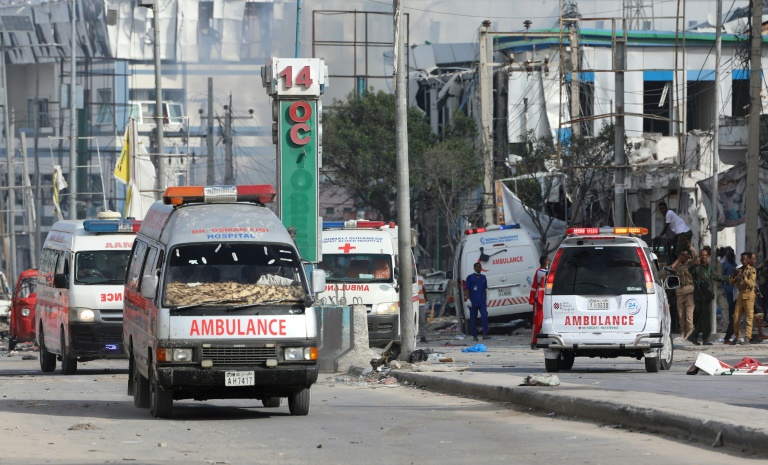
Two cars packed with explosives blew up minutes apart near the busy Zobe intersection, followed by gunfire in an attack targeting Somalia’s education ministry.

The afternoon explosions tore through walls, shattered windows of nearby buildings, sending shrapnel flying and plumes of smoke and dust into the air.

The victims included women, children and the elderly, police spokesman Sadik Dudishe said. 

“The ruthless terrorists killed mothers. Some of them died with their children trapped on their backs,” he said on Saturday, adding that the attackers had been stopped from killing more “innocent civilians and students.”

The attack took place at the same busy junction where a truck packed with explosives blew up on October 14, 2017, killing 512 people and injuring more than 290, the deadliest attack in the troubled country.

Mohamud described the incident as “historic”, saying “it is the same place, and the same innocent people involved.”

“This is not right. God willing, they will not be having an ability to do another Zobe incident,” he said, referring to the Islamist group Al-Shabaab.

Al-Qaeda-linked Al-Shabaab claimed responsibility for the attack in a statement, saying its fighters were targeting the ministry of education.

The bloody siege drew international condemnation from Somalia’s allies, including the United Nations, Turkey as well as the African Union force tasked with helping Somali forces take over primary responsibility for security by the end of 2024.

The UN mission in Somalia UNSOM vowed to stand “resolutely with all Somalis against terrorism.”

“These attacks underline the urgency and critical importance of the ongoing military offensive to further degrade Al-Shabaab,” AU Transition Mission in Somalia (ATMIS), which replaced the previous AMISOM peacekeeping force, said on Twitter late Saturday. 

– ‘All-out war’ –

Al-Shabaab have been seeking to overthrow the fragile foreign-backed government in Mogadishu for about 15 years.

Its fighters were driven out of the capital in 2011 by an African Union force but the group still controls swathes of countryside and continues to wage deadly strikes on civilian and military targets.

In August, the group launched a 30-hour gun and bomb attack on the popular Hayat hotel in Mogadishu, killing 21 people and wounding 117.

Mohamud, who was elected in May, vowed after the August siege to wage “all-out war” on the Islamists.

In September, he urged citizens to stay away from areas controlled by jihadists, saying the armed forces and tribal militia were ratcheting up offensives against them.

Al-Shabaab remains a potent force despite multinational efforts to degrade its leadership.

The group last week claimed responsibility for an attack on a hotel in the port city of Kismayo that killed nine people and wounded 47 others. 

Somalia has been mired in chaos since the fall of president Siad Barre’s military regime in 1991.

His ouster was followed by a civil war and the ascendancy of Al-Shabaab.

As well as the insurgency, Somalia — like its neighbours in the Horn of Africa — is in the grip of the worst drought in more than 40 years. Four failed rainy seasons have wiped out livestock and crops.

The conflict-wracked nation is considered one of the most vulnerable to climate change but is particularly ill-equipped to cope with the crisis as it battles the deadly Islamist insurgency.

Ukraine grain exports halted after Russia suspends deal participation

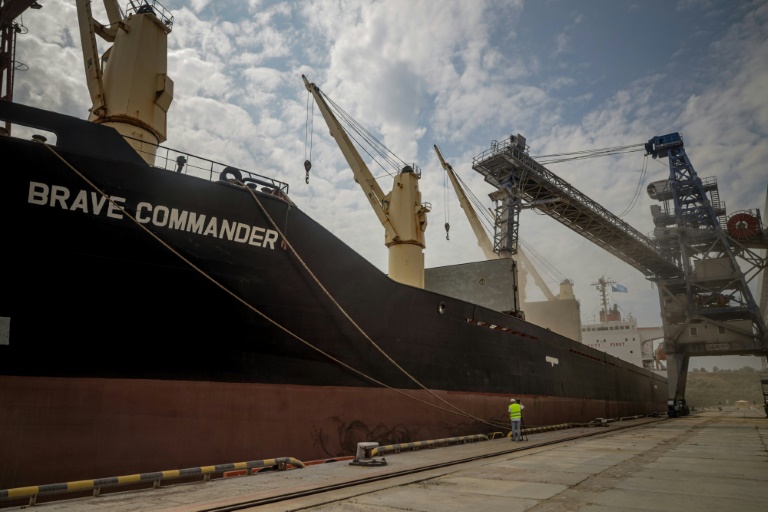
Ukraine’s maritime grain exports were halted Sunday after Russia suspended its participation in a landmark agreement that allowed the vital shipments, blaming drone attacks on its ships in Crimea.

The July deal to unlock grain exports signed between Russia and Ukraine and brokered by Turkey and the UN, is critical to easing the global food crisis caused by the conflict.

The agreement had already allowed more than nine million tonnes of Ukrainian grain to be exported and was due to be renewed on November 19.

On Saturday, Russia said it was halting its participation after its army accused Kyiv of a “massive” drone attack on its Black Sea fleet, which Ukraine labelled a “false pretext”.

US President Joe Biden called the move “purely outrageous” while Secretary of State Antony Blinken said Moscow was “weaponising food”. 

The centre coordinating the logistics of the deal said in a statement that no traffic was planned for Sunday.

“A joint agreement has not been reached at the JCC for the movement of inbound and outbound vessels on 30 October,” it said. “There are more than ten vessels both outbound and inbound waiting to enter the corridor.”

Ukraine and the UN have urged that the agreement remains in force.

“I call on all states to demand that Russia stop its hunger games and recommit to fulfilling its obligations,” Ukrainian Foreign Minister Dmytro Kuleba said on Twitter. 

Ukrainian President Volodymyr Zelensky called the Russian move “an absolutely transparent intention of Russia to return the threat of large-scale famine to Africa and Asia”.

“Just today, more than two million tons of food are in the sea. This means that access to food has actually worsened for more than seven million consumers,” he said in his nightly address.

Stephane Dujarric, spokesman for the UN secretary-general, said: “It is vital that all parties refrain from any action that would imperil the Black Sea Grain Initiative which is a critical humanitarian effort”.

– ‘Peddling false claims’ –

Sevastopol in Moscow-annexed Crimea has been targeted several times in recent months and serves as the headquarters for the Black Sea fleet and a logistical hub for operations in Ukraine.

The Russian army claimed to have “destroyed” nine aerial drones and seven maritime ones in an attack on the port early Saturday. 

“In light of the terrorist act carried out by the Kyiv regime with the participation of British experts against ships of the Black Sea fleet and civilian vessels involved in the security of grain corridors, Russia suspends its participation in the implementation of the agreement on the export of agricultural products from Ukrainian ports,” the Russian defence ministry said on Telegram.

Moscow’s forces alleged British “specialists”, whom they said were based in the southern Ukrainian city of Ochakiv, had helped prepare and train Kyiv to carry out the strike. 

In a further singling out of the UK — which Moscow sees as one of the most unfriendly Western countries — Russia said the same British unit was involved in explosions on the Nord Stream gas pipelines last month.

Britain strongly rebutted both claims, saying “the Russian Ministry of Defence is resorting to peddling false claims of an epic scale”.

Russia’s foreign ministry spokeswoman Maria Zakharova said Saturday Moscow would raise the blasts and the alleged drone attack at the UN Security Council.

Moscow’s military said ships targeted at their Crimean base were involved in the grain deal.

The United Nations Coordinator for the Black Sea Grain Initiative, Amir Abdulla, reported that Russia had notified him earlier Saturday of “its concerns about the safety of movements of merchant vessels” under the agreement.

Russia had recently criticised the deal, saying its own grain exports have suffered due to Western sanctions. 

– ‘Massive’ attack –

Mikhail Razvozhayev, the Moscow-installed governor of Sevastopol, said Saturday’s drone attack was the “most massive” the peninsula had seen. 

City authorities said the harbour was “temporarily” closed to boats and ferries and urged people “not to panic”.

Attacks on Crimea, annexed by Moscow in 2014, have increased in recent weeks, as Kyiv presses a counter-offensive in the south to retake territory held by Moscow for months. 

Moscow-installed authorities in Kherson, just north of Crimea, have vowed to turn the city into a fortress, preparing for an inevitable assault. 

In early October, Moscow’s bridge linking Crimea to the Russian mainland — personally inaugurated by President Vladimir Putin in 2018 — was damaged by a blast that Putin blamed on Ukraine. 

The Russian fleet stationed in the port had also been attacked by a drone in August.  

Russia’s allegations Saturday came as the Ukrainian army reported fighting in the Lugansk and Donetsk regions in the east, including near Bakhmut — the only area where Moscow’s forces have advanced in recent weeks.  

Pro-Russian separatists fighting alongside Moscow also announced a new prisoner exchange with Kyiv, saying 50 will return home from each side. 

Annual tech gathering takes aim at crypto

One of the world’s biggest technology get-togethers kicks off in the Portuguese capital on Tuesday, with organisers saying a key aim is to ask tough questions about cryptocurrencies.

More than 100,000 people are expected to gather in Lisbon for the four-day Web Summit, the first full-scale edition since 2019 following the disruption of the pandemic.

The conference attempts to bring together start-ups, investors, business leaders and agenda-broadening speakers –- linguist Noam Chomsky and heavyweight boxing champion Oleksandr Usyk are among this year’s intake.

Several of the prime slots, though, are taken by cryptocurrency specialists led by Changpeng Zhao, boss of crypto exchange Binance.

And plenty of companies present — from start-ups to billion-dollar behemoths Yuga Labs and OpenSea — are promoting the technology that fans claim will be the future of the web, gaming and ultimately the entire financial system.

But crypto has so far been used largely as a tool to generate investment bubbles, hide illicit wealth and enable scams.

Conference organiser Paddy Cosgrave told AFP there were “a lot of questions to be answered” about crypto, describing it as “largely smoke and mirrors”.

“We’ve done our best to persuade many of the leading lights in the space to come, and some of them will get a bit of a kicking on stage, we’ll see how that goes,” he added.

Crypto sceptics including actor Ben McKenzie (Gotham, The O.C.) have also been given slots.

– Whistleblower focus –

Zhao’s company is the dominant player in the crypto sector, but it has been repeatedly accused of trying to dodge regulatory scrutiny — claims the company has denied.

And it became embroiled in one of the biggest stories of the week, with a $500-million investment to back Elon Musk’s takeover of Twitter.

But the wider crypto sector is struggling with plunging values and flatlining interest from the public.

And the tech industry as a whole is also struggling with supply chain problems, trade disputes between the US and China, and economic volatility that has sent investors fleeing.

Cosgrave, though, played down any suggestion that conferences like his had a role in helping to stimulate investment or turn around the fortunes of the sector.

“It’s not really about the establishment or the dominant companies of today,” he said.

“It’s a gathering of companies that in the future may play some significant role.”

As usual, though, the Web Summit will host plenty of figures from the dominant companies — officials from Amazon, Apple, Google and Meta will all be there.

But on a lower level than last year, when the conference played host to Facebook’s Nick Clegg and to whistleblower Frances Haughen, who accused his company of stoking hatred in return for clicks.

Cosgrave highlighted the event’s history of giving a platform to whistleblowers — this year Mark MacGann, who revealed details of Uber’s aggressive lobbying, will be giving a talk.

The organisers say more than 1,000 speakers will take part, giving talks on subjects from cybersecurity to artificial intelligence.

Scottish blueberry farmer donates 'unviable' crop to charity

A Scottish farmer is giving away his entire crop of blueberries, worth £2 million, to charity, saying cheap imports and high labour costs have made harvesting the fruit economically unviable.

Peter Thomson has been growing blueberries at his farm in Blairgowrie, northeast Scotland, for more than four decades, producing 300 tonnes of fruit per year.

But now, he said, growers in Peru and South Africa can sell their berries in the UK at a far lower price, while a shortage of pickers caused by Brexit has made the harvest unviable.

“They’ve started planting huge areas of blueberries in the subtropics like Peru and South Africa,” said Thomson, who started growing blueberries in 1976.

“Their costs of production are so low that we can’t compete.”

Normally, said Thomson, 200 workers would have picked around 300 tonnes of blueberries this year with 50 more working in the packhouse.

In 2014, the price paid to Scottish farmers for blueberries was £17.50 per kilo, he said. Today however, supermarkets pay less than £7.

Labour costs meanwhile have risen from £7 an hour five years ago to £10.10 today, even before state pension contributions and holiday pay are taken into account.

This meant that the value of crop of berries, which would once have been worth £3 million or more, fell to £2 million this year.

Retailers are unwilling to pay a premium for Scottish produce as shoppers target bargains during the cost-of-living squeeze, Thomson said.

– The Brexit factor –

The cheaper imports started last year after countries including Peru and South Africa, where pickers are paid substantially less, started using a new cultivar of the blueberry plant. 

The sweet juicy berries grow densely on bushes with scarlet leaves that are planted in rows.

Blueberries usually require a frost before they flower, which meant farmers in Scotland had the market to themselves in September and October and could command a higher price.

The new cultivar, however, does not need a frost to thrive.

The new blueberry variety is also popular with supermarkets as the fruit are larger and firmer and can be shipped — rather than airfreighted — to UK supermarkets over a number of weeks without spoiling.

Another economic impact has come from Brexit, which has pushed up the price of labour and made it difficult to find skilled pickers.

Before Brexit, said Thomson, the farm’s village of caravans was filled with skilled European pickers, who were experienced and harvested the berries at a faster pace. 

Today the caravans stand empty.

“Brexit has had the consequence of making our labour more expensive,” Thomson said.

“We have to get labour now from places like Turkmenistan and Kyrgyzstan, Nepal, and it comes from so far that it is expensive.”

– ‘It is devastating’ –

Thomson said he had invited the public to fill up buckets of blueberries in exchange for a donation to a cancer charity. A portion of the berries is also being given to food banks.

Hundreds of local residents have responded to Thomson’s invitation to pick for charity, many of them arriving at the farm with buckets and boxes.

Local resident Amanda Taylor, who was one of those picking berries at the farm, said it was devastating to see the crops rotting in a field when so many cannot afford food.

“It’s quite an emotional thing actually, that we’re having to fly produce from Peru when I have this on my doorstep,” she said.

Pauline Cropper, who is volunteering to organise pickers at the farm, said people were finding it difficult to afford their shopping bills and were picking the cheapest options available. 

“Meanwhile, the berries here are sitting on the bushes and going to waste — they’re falling off the bushes, there’s so many of them, because it’s not viable for the local farmer to pay a decent wage,” she said.

Thomson said his plants could have kept producing berries for another 50 years, but continuing to prune and maintain them was too costly. 

“It is devastating for us, but it doesn’t make economic sense to take the fruit to the shops,” he said.

“We have no realistic prospect of making money unless the supermarkets are prepared to pay (more) for Scottish blueberries.”

He plans to continue farming his other crop, cherries, but may build houses on some of his land.

Tropical storm batters Philippines capital before exit

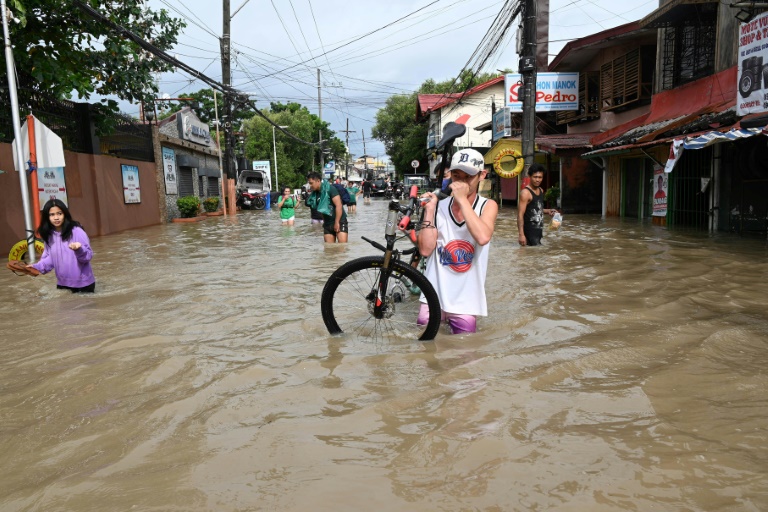
Emergency workers scrambled to rescue residents trapped by floods in and around the Philippine capital on Sunday as Tropical Storm Nalgae swept out of the country after killing at least 48 people.

Several neighbourhoods in towns and cities just outside Manila remained under water after the storm raked across the main island of Luzon overnight, cutting power supplies and inflicting damage.

The death toll from the storm rose to 48, the national disaster agency said on Sunday, most of them from a series of flash floods and landslides that destroyed villages on the southern island of Mindanao on Friday.

In the Manila suburb of Paranaque, rescuers swam through three-metre (10-foot) floodwaters overnight to reach 60 people including children marooned on an upper floor of a building, a local official said.

“They were shouting and crying in panic because they really have no way out” after floodwaters rose as they attended a party, village chief Noel Japlos told AFP.

“We did not expect the water to go this high. If we weren’t able to rescue them all, some of them could have died,” he added.

Video footage taken by the rescue team showed emergency workers in life vests using a rope to lead them out of the building while children were put on improvised floats.

In nearby Kawit town, a corpse in a white coffin floated on a flooded street, an AFP photographer saw.

Residents said a flash flood overnight likely carried it off from a nearby cemetery.

Kawit residents emerging from receding floods were cleaning up and trying to dry their wet belongings.

“It’s so difficult because we can’t move around due to the flood and we have a two-month-old baby who can’t sleep because there’s no electricity,” Andinor Cairme, a street sweeper, told AFP.

The storm slightly weakened as it roared out into the South China Sea, the state forecaster said. 

Port operations have also slowly resumed as thousands of stranded passengers travel in time for the All Saints’ Day holiday on Tuesday, when millions of Filipinos visit the graves of relatives.

The civil defence office said 22 people were missing and 40 were injured with bridges, roads and crops also destroyed.

An average of 20 typhoons and storms hit the Philippines annually, killing hundreds each year and leaving vast areas of the country in perpetual poverty.

Close Bitnami banner
Bitnami