World

More than 150 killed in Halloween stampede in Seoul

More than 150 people were killed in a stampede at a Halloween event in central Seoul, officials said Sunday, with South Korea’s president vowing a full investigation into one of the country’s worst disasters.

The crowd surge and crush hit in the capital’s popular Itaewon district, where police estimate as many as 100,000 people — mostly in their teens and 20s — went to celebrate Halloween Saturday night, clogging the area’s narrow alleyways and winding streets.

President Yoon Suk-yeol declared a period of national mourning Sunday, telling the country in a televised address that “a tragedy and disaster occurred that should not have happened”.

He said the government “will thoroughly investigate the cause of the incident and make fundamental improvements to ensure the same accident does not occur again in the future”.

“My heart is heavy and it is difficult to contain my sorrow,” he added, before he visited the scene of the disaster and spoke to emergency workers.

Eyewitnesses described being trapped in a narrow, sloping alleyway, and scrambling to get out of the suffocating crowd as people piled on top of one another.

The fire department said at least 151 people, including 19 foreigners, were killed in the stampede, which occurred around 10:00 pm (1300 GMT). 

Most of the victims were young women in their 20s, it said, adding that 89 people were injured. 

The Interior Ministry said most victims had now been identified.

“The high number of casualties was the result of many being trampled during the Halloween event,” fire official Choi Seong-beom told reporters at the scene, adding that the death toll could climb.

Seoul authorities said they had also received 355 reports of missing people by early Sunday.

– ‘Unprecedentedly large’ –

Officials said Sunday they had no clear idea of what caused the crush, while eyewitnesses described scenes of chaos as a vast crowd panicked in a narrow alleyway.

Local shopkeepers told AFP that the number of people at the annual celebration was “unprecedentedly large” this year — the first event to be held without Covid-19 restrictions since the pandemic began.

“There were so many people just being pushed around and I got caught in the crowd and I couldn’t get out at first too,” 30-year-old Jeon Ga-eul told AFP.

As questions began to emerge over the lack of security at the event, Interior Minister Lee Sang-min told a briefing that the police force had been occupied on the other side of town.

“I am not certain about the exact number of police personnel deployed (to Itaewon) but a considerable number had been deployed at Gwanghwamun where a large crowd was expected for a protest,” he said.

Police had also not expected such a large crowd at the Halloween event, he said. 

“The expected size of the crowd in Itaewon did not deviate much from the previous years, so I understand that the personnel were deployed at a similar scale as before.”

Paramedics at the scene, quickly overwhelmed by the number of victims, were asking passers-by to administer first aid.

In an interview with local broadcaster YTN, Lee Beom-suk, a doctor who administered first aid to the victims described scenes of tragedy and chaos.

“So many victims’ faces were pale. I could not catch their pulse or breath and many of them had a bloody nose. When I tried CPR, I also pumped blood out of their mouths.”

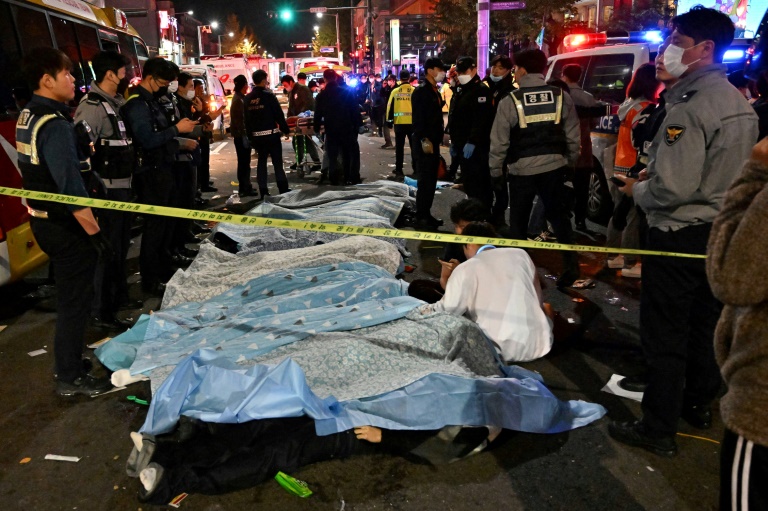
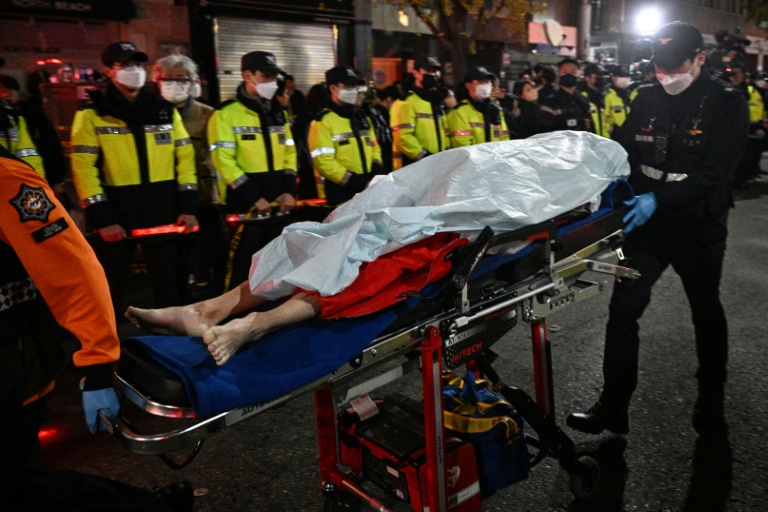
AFP photos showed scores of bodies on the pavement covered by bed sheets, and emergency workers dressed in orange vests loading even more bodies on stretchers into ambulances.

– ‘Oh my god’ –

Twitter user @janelles_story shared a video that she said showed Itaewon shortly before the stampede, in which hundreds of young people, many in elaborate Halloween costumes, are seen in a narrow street lined with bars and cafes.

The crowd appears in good spirits at first, but then a commotion begins and people start being pushed into one another. Screams and gasps are heard and a female voice cries out in English “Shit, shit!” followed by “Oh my god, oh my god!”

The 19 foreigners killed included victims from Iran, Uzbekistan, China and Norway, Yonhap reported. Russia’s Tass news agency said two of the victims were Russian.

The Chinese Embassy in Seoul confirmed on its official WeChat account that three Chinese citizens had died in the stampede.

Seoul’s staunch ally, US President Joe Biden, said America “stands with” South Korea after the tragedy, while Japan’s Prime Minister Fumio Kishida said he was “hugely shocked and deeply saddened” by the disaster.
Death toll from Somalia twin bombings climbs to 100

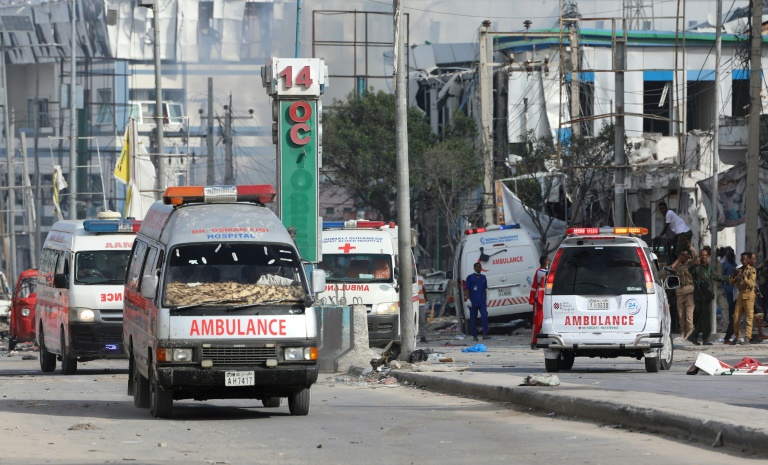
The number of people killed in an attack on Saturday at a busy intersection in the Somali capital Mogadishu has risen to 100, President Hassan Sheikh Mohamud said on Sunday.

“So far, people who died have reached 100 and 300 are wounded, and the number for both the death and wounded continues to increase,” he said after visiting the bombing location.

Two cars packed with explosives were detonated minutes apart near the busy Zobe junction, followed by gunfire in an attack targeting Somalia’s education ministry.

The afternoon explosions shattered windows of nearby buildings, sending shrapnel flying and plumes of smoke and dust into the air.

The attack took place at the same busy junction where a truck packed with explosives blew up on October 14, 2017, killing 512 people and injuring more than 290.

Mohamud described the incident as “history”, saying “it is the same place, and the same innocent people involved.”

“This is not right. God willing, they will not be having an ability to do another Zobe incident,” he said, referring to the Islamist group Al-Shabaab.

– ‘All-out war’ –

The jihadists have been seeking to overthrow the fragile foreign-backed government in Mogadishu for about 15 years.

Its fighters were driven out of the capital in 2011 by an African Union force but the group still controls swathes of countryside and continues to wage deadly strikes on civilian and military targets.

In August, the group launched a 30-hour gun and bomb attack on the popular Hayat hotel in Mogadishu, killing 21 people and wounding 117.

Mohamud, who was elected in May, vowed after the August siege to wage “all-out war” on the Islamists.

In September, he urged citizens to stay away from areas controlled by jihadists, saying the armed forces and tribal militia were ratcheting up offensives against them.

Al-Shabaab remains a potent force despite multinational efforts to degrade its leadership.

The group last week claimed responsibility for an attack on a hotel in the port city of Kismayo that killed nine people and wounded 47 others. 

Somalia — like its neighbours in the Horn of Africa — is in the grip of the worst drought in more than 40 years. Four failed rainy seasons have wiped out livestock and crops.

The conflict-wracked nation is considered one of the most vulnerable to climate change but is particularly ill-equipped to cope with the crisis as it battles the deadly Islamist insurgency.

Scenes of horror in Seoul after Halloween stampede

Party-goers in costumes fleeing in panic, desperate attempts at first aid on the sidewalks, scores of bodies lined up under makeshift shrouds: in Seoul’s lively Itaewon district, a Halloween festival turned to tragedy Saturday.

More than 150 people — mostly in their teens and 20s — were killed in a crowd surge and stampede, the cause of which is still unclear, in this popular, cosmopolitan district of the South Korean capital, located close to a former US military base and renowned for its bars and clubs.

Tens of thousands of people, many wearing elaborate Halloween costumes, had descended upon the district Saturday night, for the first major Halloween celebration since South Korea lifted most Covid-19 restrictions.

“My friend said: something terrible is happening outside,” said Jeon Ga-eul, 30, who was having a drink at a bar at the moment the stampede hit.

“I said: what are you talking about? And then I went outside to see and there were people doing CPR in the street.” 

The district, which was immortalised by the popular 2020 K-Drama hit Itaewon Class, is a warren of steeply sloping, twisted alleyways on either side of the main road.

The crowd was exceptionally dense on Saturday night, eyewitnesses told AFP, with Jeon saying that even ahead of the disaster, he had felt unsafe.

“There were so many people just being pushed around and I got caught in the crowd and I couldn’t get out at first too,” he said.

The fire department said the dead included 97 women and 54 men, and eye-witnesses told the Yonhap News Agency that smaller people had struggled more in the crowds.

“A short person like me could not even breathe,” a female eye-witness said, adding that she had survived as she was at the edge of the alleyway while “people in the middle suffered the most.”

– Bystanders help –

The stampede took place in a narrow, sloping alley near the Hamilton Hotel in Itaewon.

One eye-witness described on Twitter the panic that started when people “kept pushing down” into the already crowded alleyway. 

This resulted in “other people screaming and falling down like dominoes,” the Twitter user with the handle “jkaesthet1c” wrote.

“I thought I would be crushed to death too as people kept pushing without realising there were people falling down at the start of the stampede,” they added.

Some survivors claimed that nearby stores and establishments on the alleyway had blocked people from coming in to escape the crush.

“It looks like the casualties were more severe as people attempted to escape to nearby stores but were kicked out back to the street because business hours were over,” one survivor told Yonhap.

Faced with a huge number of victims, the first emergency responders were asking passers-by to administer first aid and perform CPR on victims in the streets, just next to the chaos.

The bodies of people who had been crushed or trampled to death lay in rows, covered with blankets or makeshift shrouds.

Dazed passers-by sat on the sidewalk, checking their phones. Others comforted themselves, hugging each other.

Early Sunday, police investigators had sealed off and were examining the debris-strewn alleyways, where bits of disgarded Halloween costumes and garbage were still strewn over the paving stones.

South Korea’s President Yoon Suk-yeol, who declared a period of national morning in a televised address, visited the site of the accident and spoke to police and other officials.

“It’s always crowded, but nothing like this has ever happened before,” Ju Young Possamai, 24, a bartender in the Itaewon district told AFP.

“I’ve been to a lot of Halloween parties in Korea,” he said, adding: “I never thought that something like this could happen in Korea, especially in Itaewon.”

US retailers battle high costs clearing Christmas stockpiles

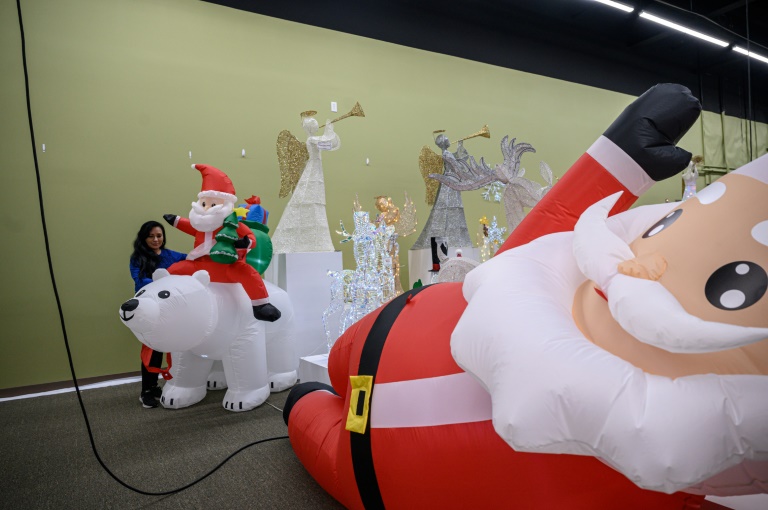
US retailers are hustling to sell their stockpiles of Christmas decorations as the festive season approaches, after tangled supply chains caused many shipments to arrive only after the holidays last year.

As major economies bounced back from the pandemic, companies had struggled to keep up with soaring demand, with manufacturing hit by factory shutdowns during virus outbreaks.

The situation was worsened by a shortage of shipping containers, along with delays at ports from a lack of workers to unload products and transport them to retailers.

It was “very difficult with supply” last year, especially to procure enough Christmas trees and products for customers, said Chris Butler, CEO of decorations seller National Tree.

“This year is a little bit of the opposite,” he told AFP.

“Every retailer, every manufacturer has a lot of trees, has a lot of garlands because everything came late,” he added.

Due to supply chain problems, retailers said part of their festive decorations arrived only in January or February.

“We went from ‘we don’t have enough’ to now ‘we have too much,'” said James Zahn, editor-in-chief at trade publication The Toy Book.

– Reduced spending –

But with soaring consumer prices weighing on household budgets, business executives have expressed concern that customers may tighten their purse strings.

“Consumers might not spend as much,” Butler said.

Inflation rose 8.2 percent from a year ago in September, and the elevated figure triggered concerns that price pressures have become more ingrained.

The Federal Reserve is now walking a tightrope trying to wrestle cost increases down without triggering a recession in the world’s biggest economy.

For toy makers such as Hasbro, which distributes Monopoly, Nerf guns and Transformers action figures, all this means adapting to parents’ reduced purchasing power.

Customers have “become increasingly price-sensitive as the year has progressed,” Hasbro CEO Chris Cocks told an earnings call this month, adding that promotions “will be key in the quarters ahead.”

Similarly, Mattel, the seller of Barbie dolls and Fisher-Price toys, said this week that it would have more discounts as the holidays approach.

“Instead of shippers ramping up activity to prepare for the holiday season, September brought a change of fortune as shipping volumes slowed and shipping prices declined,” said Oren Klachkin, lead US economist at Oxford Economics, in a recent note.

He cited weaker consumer demand and overstocked sellers, factors which experts say could result in steep discounting that cuts profit margins.

– Higher costs –

Some toys have become about 15 percent more expensive due to inflation, said Zahn of The Toy Book.

“That is going to make a difference for families that are already feeling a pinch when groceries and fuel are more expensive,” he said.

Even including storage costs and interest, goods that arrived too late for last year’s holiday season were “still a little cheaper” than those added to inventory this year, Costco chief financial officer Richard Galanti told a recent earnings call.

Merchants like clothing chain Express are opting to sell their products this year in factory outlets instead of clearing them out at lower margins, said chief financial officer Jason Judd at a September conference.

“Santa, snowmen and Christmas trees haven’t changed a lot,” said Jill Timm, chief financial officer at department store chain Kohl’s in a recent conference.

“They’re still going to sell,” he said.

Croatia prepares for euro switch amid soaring inflation

With inflation mounting and precarious geopolitical headwinds rattling Europe, Croatia hopes that its upcoming switch to the euro will bring some semblance of protection to the Balkan country in an uncertain world.

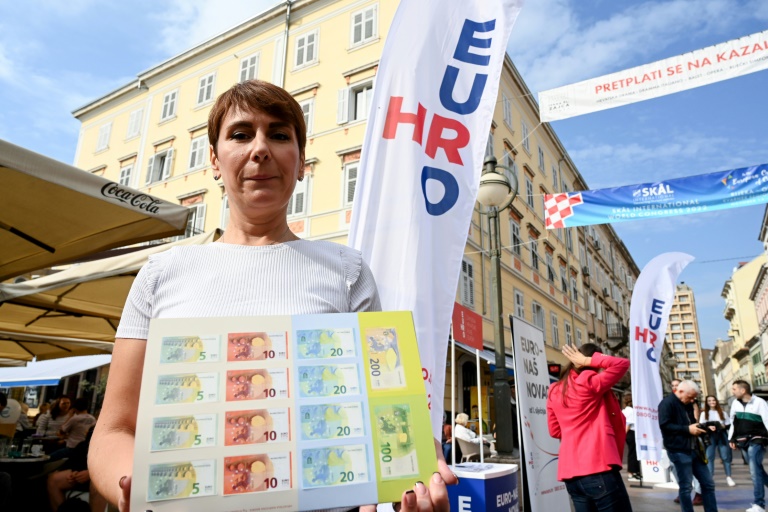
On January 1, Croatia will bid farewell to its currency — the kuna — to become the 20th member of the eurozone.

The former Yugoslav Republic, which joined the European Union nearly a decade ago, posted an annual inflation rate of almost 13 percent in September, compared to 10 percent in the eurozone.

In the build-up to the changeover, authorities have been constantly hammering home the advantages of adopting the euro for the country’s 3.9 million inhabitants.

“The euro brings resilience,” Ana Sabic of the Croatian National Bank told AFP, arguing that Zagreb will, if needed, have access to more favourable borrowing conditions amid economic hard times.

Since July, the European Central Bank has embarked on a policy of monetary tightening as it attempts to rein in galloping inflation caused by soaring energy and food prices triggered by the Russian war in Ukraine.

Analysts continue to argue that eastern European countries in the EU with currencies outside of the eurozone, such as Poland or Hungary, have been even more vulnerable to surging inflation. 

“It is actually an ideal moment for the euro switch,” said Goran Saravanja, the chief economist with the Croatian Chamber of Commerce.

“When major uncertainty dominates the global economy, for a small and open economy like Croatia it’s always better to be a part of a larger association like the eurozone,” he added.

Croatia’s main trading partners are in the eurozone, while the tourism sector — which accounts for 20 percent of its GDP — caters to large numbers of European visitors.

And Croatians have already adopted the euro to a large extent, with about 80 percent of bank deposits denominated in euros.

They have long valued their most prized possessions such as cars and apartments in euros, displaying lack of confidence in local currency dating back to the former Yugoslavia which was gripped by high inflation before its breakup.

During the Yugoslav era and after Croatia’s independence in 1991, properties were mostly valued in the German mark until the introduction of the euro two decades ago.

– Hopes and fears –

“Life will be easier, we calculate everything in euros anyway,” said Roman, an economist from Zagreb who refused to give his surname.

Milan Batur, a retired pharmacist, dismissed concerns from those who fear some traders are taking advantage of the coming transition to the currency to round up prices.

“It’s other things, wars, shortages that cause prices to rise. We can’t blame everything on the euro,” said Batur.

However some still worry they will take a financial hit by the move. 

“The calendar may not be ideal, we could perhaps have postponed it a little because of the situation in the world,” Zdravka Antonic, a florist at a market in Zagreb, told AFP. 

“People are already worried about how this is all going to end and the euro just adds to the uncertainty.”

Since early September, the price of bouquets, like those of other goods and services, bears a double label — with a conversion rate set by Brussels at 7.53 kuna to one euro. 

The system will remain in effect throughout 2023.

“A country that has its own currency is more independent. But when we joined the EU, we also accepted the euro,” said Ana Brkic, a vegetable seller.

Conservative and right-wing opposition groups protested the adoption of the new currency, saying the kuna represented an important symbol of national identity and argued that the euro only benefited larger countries like Germany and France.  

But an attempt last year at triggering a nation-wide referendum to challenge the adoption of the euro failed to gain any traction in the end.

Some Croatians fear that once they have adopted the euro the stark reality of how much poorer they are than many of their EU neighbours will only sink in further.  

According to the latest Eurostat survey published in 2018, the average monthly salary in Croatia was just 1,179 euros compared to more than 2,300 euros in the EU.

An estimated 300,000 Croatian retirees receive a pension of barely 260 euros a month.

“It will spark the feeling of poverty and misery,” said Ana Knezevic, director of  the national Consumer Protection Association.

Croatia prepares for euro switch amid soaring inflation

With inflation mounting and precarious geopolitical headwinds rattling Europe, Croatia hopes that its upcoming switch to the euro will bring some semblance of protection to the Balkan country in an uncertain world.

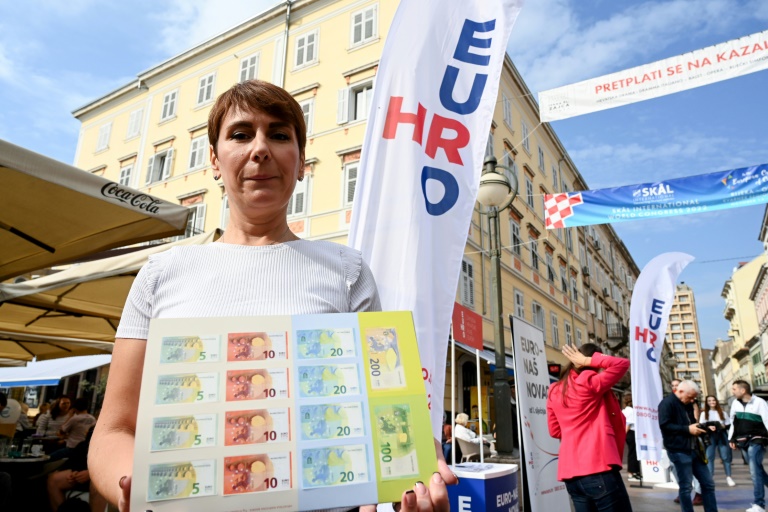
On January 1, Croatia will bid farewell to its currency — the kuna — to become the 20th member of the eurozone.

The former Yugoslav Republic, which joined the European Union nearly a decade ago, posted an annual inflation rate of almost 13 percent in September, compared to 10 percent in the eurozone.

In the build-up to the changeover, authorities have been constantly hammering home the advantages of adopting the euro for the country’s 3.9 million inhabitants.

“The euro brings resilience,” Ana Sabic of the Croatian National Bank told AFP, arguing that Zagreb will, if needed, have access to more favourable borrowing conditions amid economic hard times.

Since July, the European Central Bank has embarked on a policy of monetary tightening as it attempts to rein in galloping inflation caused by soaring energy and food prices triggered by the Russian war in Ukraine.

Analysts continue to argue that eastern European countries in the EU with currencies outside of the eurozone, such as Poland or Hungary, have been even more vulnerable to surging inflation. 

“It is actually an ideal moment for the euro switch,” said Goran Saravanja, the chief economist with the Croatian Chamber of Commerce.

“When major uncertainty dominates the global economy, for a small and open economy like Croatia it’s always better to be a part of a larger association like the eurozone,” he added.

Croatia’s main trading partners are in the eurozone, while the tourism sector — which accounts for 20 percent of its GDP — caters to large numbers of European visitors.

And Croatians have already adopted the euro to a large extent, with about 80 percent of bank deposits denominated in euros.

They have long valued their most prized possessions such as cars and apartments in euros, displaying lack of confidence in local currency dating back to the former Yugoslavia which was gripped by high inflation before its breakup.

During the Yugoslav era and after Croatia’s independence in 1991, properties were mostly valued in the German mark until the introduction of the euro two decades ago.

– Hopes and fears –

“Life will be easier, we calculate everything in euros anyway,” said Roman, an economist from Zagreb who refused to give his surname.

Milan Batur, a retired pharmacist, dismissed concerns from those who fear some traders are taking advantage of the coming transition to the currency to round up prices.

“It’s other things, wars, shortages that cause prices to rise. We can’t blame everything on the euro,” said Batur.

However some still worry they will take a financial hit by the move. 

“The calendar may not be ideal, we could perhaps have postponed it a little because of the situation in the world,” Zdravka Antonic, a florist at a market in Zagreb, told AFP. 

“People are already worried about how this is all going to end and the euro just adds to the uncertainty.”

Since early September, the price of bouquets, like those of other goods and services, bears a double label — with a conversion rate set by Brussels at 7.53 kuna to one euro. 

The system will remain in effect throughout 2023.

“A country that has its own currency is more independent. But when we joined the EU, we also accepted the euro,” said Ana Brkic, a vegetable seller.

Conservative and right-wing opposition groups protested the adoption of the new currency, saying the kuna represented an important symbol of national identity and argued that the euro only benefited larger countries like Germany and France.  

But an attempt last year at triggering a nation-wide referendum to challenge the adoption of the euro failed to gain any traction in the end.

Some Croatians fear that once they have adopted the euro the stark reality of how much poorer they are than many of their EU neighbours will only sink in further.  

According to the latest Eurostat survey published in 2018, the average monthly salary in Croatia was just 1,179 euros compared to more than 2,300 euros in the EU.

An estimated 300,000 Croatian retirees receive a pension of barely 260 euros a month.

“It will spark the feeling of poverty and misery,” said Ana Knezevic, director of  the national Consumer Protection Association.

Brazil on tenterhooks in Bolsonaro, Lula election showdown

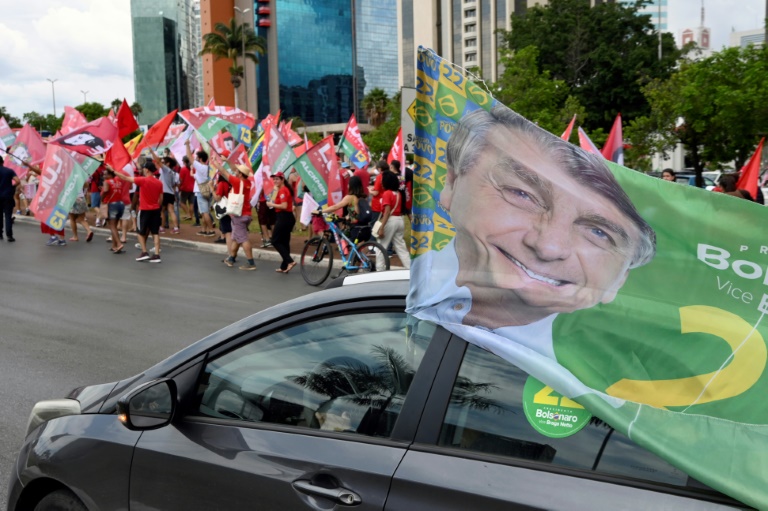
Brazilians will vote Sunday in a white-knuckle presidential race, choosing between wildly different visions of their future offered by incumbent Jair Bolsonaro and his rival Luiz Inacio Lula da Silva.

Lula, a charismatic former president tainted by graft charges, narrowly won a first-round election and enters the finale the slight favorite with 52 percent of voter support, according to a final poll from the Datafolha institute on Saturday.

However, Bolsonaro, who scored 48 percent in the poll, performed better than expected last time around and many pundits see the election as too close to call. 

“This is going to be a messy election… It’s much closer than anyone thought,” Brian Winter, editor-in-chief of Americas Quarterly told AFP.

The electoral showdown caps months of mud-slinging and personal attacks between the two men in a dirty campaign plagued by disinformation that has deeply polarized the nation of 215 million people.

Lula has called Bolsonaro a “cannibal,” “pedophile,” and “little dictator.” In turn, he has repeatedly been derided as a “thief” and accused of making a pact with Satan.

Both candidates have their die-hard supporters, but many will merely vote for the candidate they detest least — or spoil their ballots.

– Democracy, Amazon at stake –

Exhausted, and with nerves frayed after a bitterly divisive campaign, Brazilians are voting for two wildly different visions for their country, with everything at stake.

The election has global ramifications: Conservationists believe the result will seal the fate of the stricken Amazon rainforest, pushed to the brink by fires and deforestation under Bolsonaro.

However, for Brazilians, issues of poverty, hunger, corruption and traditional values are top of mind. 

An editorial in the Nature magazine this week slammed Bolsonaro’s “eye-popping” record as “disastrous for science, the environment, the people of Brazil — and the world.”

Despite the clamor from abroad, the Amazon was only briefly touched upon in debates.

Lula, Brazil’s president from 2003 to 2010, has told voters the election is a choice between “democracy and barbarism, between peace and war.”

– He with most votes, wins –

One of the main questions hanging over the poll has been if Bolsonaro — often dubbed the “Tropical Trump” — will accept a loss, after saying the very voting system that brought him to power was riddled with fraud.

On Friday night he pledged to respect the election, saying “whoever gets the most votes, wins,” though possible accusations of rigging and a backlash from his voters loom over the poll.

Bolsonaro came under fire for his disastrous handling of the Covid pandemic, which left more than 680,000 dead, as well as his vitriol and disdain for political correctness.

However in recent months, falling unemployment figures, slowing inflation and a faster-than-expected economic recovery from the pandemic have given him a boost.

His core supporters — the business sector, anti-corruption voters and the powerful “Bibles, bullets and beef” coalition — love his gloves-off style and focus on conservative values.

– The comeback kid –

Lula was the country’s most popular president when he left office, helping to lift millions out of poverty with his social welfare programs.

But he then became mired in a massive corruption scandal and was jailed for 18 months before his convictions were thrown out last year. The Supreme Court found the lead judge was biased, but Lula was not exonerated.

A victory would prove a spectacular comeback, however he faces being weakened by a hostile Congress dominated by Bolsonaro lawmakers and allies.

“It is not just the next four years which are at stake,” read an editorial in the Folha de Sao Paulo newspaper Saturday.

“It is the almost four years of democracy in Brazil, a model anywhere in the world” which is “under threat” from Bolsonaro. However, the paper notes that Lula is also “tainted” by corruption.

Polls open at 8:00am (1100GMT) local time for 156 million registered voters and will close at 17:00pm (2000GMT). The result of the electronic vote is expected in a matter of hours. 

Russia suspends participation in Ukraine grain deal

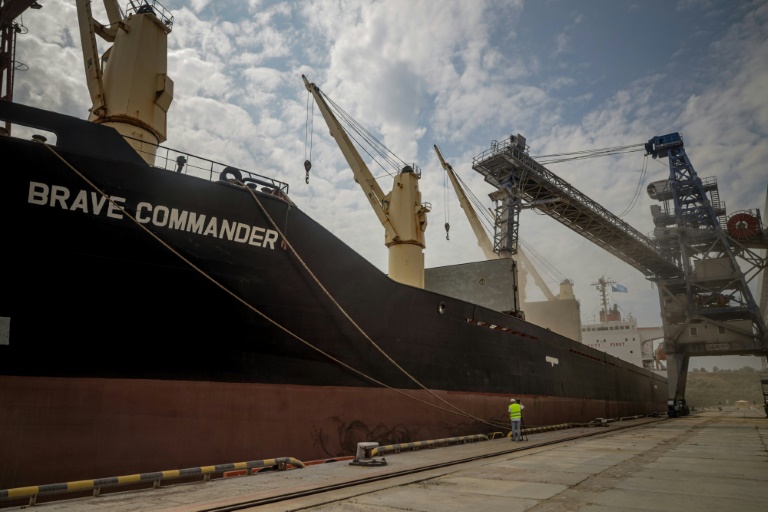
Moscow on Saturday suspended its participation in a landmark agreement that allowed vital grain exports from Ukraine, blaming drone attacks on Russian ships in Crimea.

Russia made the announcement after its army accused Kyiv earlier Saturday of a “massive” drone attack on its Black Sea fleet, which Ukraine labelled a “false pretext” and the UN urged the deal’s preservation.

US President Joe Biden called the move “purely outrageous” while Secretary of State Antony Blinken said Moscow was “weaponising food”.

The July deal to unlock grain exports signed between Russia and Ukraine and brokered by Turkey and the UN, is critical to easing the global food crisis caused by the conflict.

The agreement already allowed more than nine million tonnes of Ukrainian grain to be exported and was due to be renewed on November 19.

A Turkish security source told AFP that Ankara had not been “officially notified” of Russia’s suspension, while Ukraine and the UN pushed for the agreement to remain in force.

“I call on all states to demand that Russia stop its hunger games and recommit to fulfilling its obligations,” Ukrainian Foreign Minister Dmytro Kuleba said on Twitter. 

Ukrainian President Volodymyr Zelensky called the Russian move “an absolutely transparent intention of Russia to return the threat of large-scale famine to Africa and Asia”.

“Just today, more than two million tons of food are in the sea. This means that access to food has actually worsened for more than seven million consumers,” he said in his nightly address.

Stephane Dujarric, spokesman for the UN secretary-general, said: “It is vital that all parties refrain from any action that would imperil the Black Sea Grain Initiative which is a critical humanitarian effort”.

– ‘Peddling false claims’ –

Sevastopol in Moscow-annexed Crimea has been targeted several times in recent months and serves as the headquarters for the Black Sea fleet and a logistical hub for operations in Ukraine.

The Russian army claimed to have “destroyed” nine aerial drones and seven maritime ones, in an attack in the port early Saturday. 

“In light of the terrorist act carried out by the Kyiv regime with the participation of British experts against ships of the Black Sea fleet and civilian vessels involved in the security of grain corridors, Russia suspends its participation in the implementation of the agreement on the export of agricultural products from Ukrainian ports,” the Russian defence ministry said on Telegram.

Moscow’s forces alleged British “specialists”, whom they said were based in the southern Ukrainian city of Ochakiv, had helped prepare and train Kyiv to carry out the strike. 

In a further singling out of the UK — which Moscow sees as one of the most unfriendly Western countries — Russia said the same British unit was involved in explosions on the Nord Stream gas pipelines last month.

Britain strongly rebutted both claims, saying “the Russian Ministry of Defence is resorting to peddling false claims of an epic scale”.

Russia’s foreign ministry spokeswoman Maria Zakharova said Saturday Moscow would raise the blasts and the alleged drone attack at the UN Security Council.

The British defence ministry said this “invented story says more about arguments going on inside the Russian Government than it does about the West”.

Moscow’s military said ships targeted at their Crimean base were involved in the grain deal.

The United Nations Coordinator for the Black Sea Grain Initiative, Amir Abdulla, reported that Russia had notified him earlier Saturday of “its concerns about the safety of movements of merchant vessels” under the agreement.

Russia had recently criticised the deal, saying its own grain exports have suffered due to Western sanctions. 

– ‘Massive’ attack –

Mikhail Razvozhayev, the Moscow-installed governor of Sevastopol, said Saturday’s drone attack was the “most massive” the peninsula had seen. 

City authorities said the harbour was “temporarily” closed to boats and ferries and urged people “not to panic”.

Attacks on Crimea, annexed by Moscow in 2014, have increased in recent weeks, as Kyiv presses a counter-offensive in the south to retake territory held by Moscow for months. 

Moscow-installed authorities in Kherson, just north of Crimea, have vowed to turn the city into a fortress, preparing for an inevitable assault. 

On Thursday, Razvozhayev said a thermal power station had been attacked in Balaklava, in the Sevastopol area.

He claimed there was only minor damage and no casualties.  

In early October, Moscow’s bridge linking Crimea to the Russian mainland — personally inaugurated by President Vladimir Putin in 2018 — was damaged by a blast that Putin blamed on Ukraine. 

The Russian fleet stationed in the port had also been attacked by a drone in August.  

Russia’s allegations Saturday came as the Ukrainian army reported fighting in the Lugansk and Donetsk regions in the east, including near Bakhmut — the only area where Moscow’s forces have advanced in recent weeks.  

Pro-Russian separatists fighting alongside Moscow also announced a new prisoner exchange with Kyiv, saying 50 will return home from each side. 

Pelosi 'heartbroken and traumatized' over attack on husband

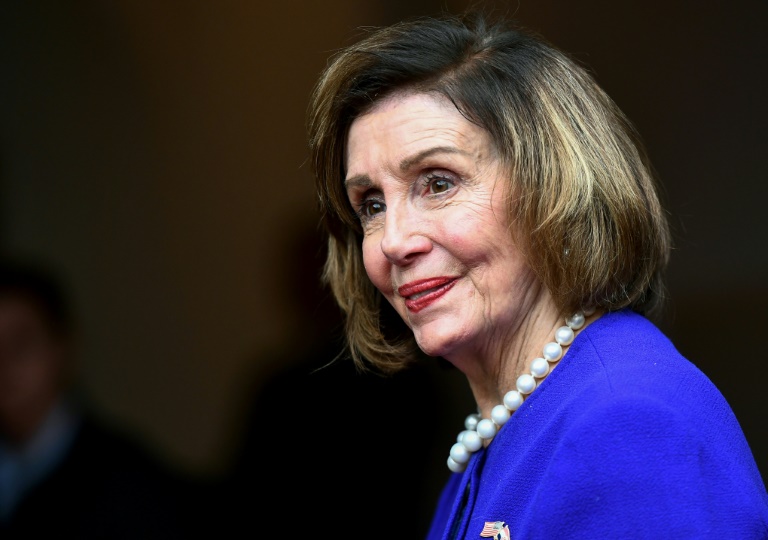
Speaker of the US House of Representatives Nancy Pelosi said Saturday she and her family were “heartbroken and traumatized” by the violent attack on her husband at their California home. 

An intruder had broken into the couple’s house in San Francisco early Friday morning and attacked the speaker’s husband Paul Pelosi with a hammer, fracturing his skull.

“Our children, our grandchildren and I are heartbroken and traumatized by the life-threatening attack on our Pop,” Pelosi said of the incident in a letter posted to Twitter Saturday evening. 

“We are grateful for the quick response of law enforcement and emergency services, and for the life-saving medical care he is receiving,” she said, in her first comment about the attack.

Paul Pelosi, 82 — who underwent surgery and is recovering in hospital — was at home alone, as his wife was working in Washington.

“His condition continues to improve,” Pelosi said in the letter. 

San Francisco police said officers found the assailant at the couple’s home just before 2:30 am (0930 GMT), where he and Paul Pelosi were scuffling over a hammer.

“The suspect pulled the hammer away from Mr. Pelosi and violently assaulted him with it,” San Francisco police chief Bill Scott told reporters, saying later that Paul Pelosi was hit at least once.

Police identified the assailant as 42-year-old David Depape, with Scott saying Depape would be charged with attempted homicide, assault with a deadly weapon, burglary and other felonies.

“This was not a random act,” Scott said. “This was intentional, and it is wrong.”

The suspect “demanded to confront me and brutally attacked my husband Paul,” Pelosi — who is second in line to the presidency — said in Saturday’s letter. 

– ‘This talk produces the violence’ –

US media, citing family sources, said the intruder told Paul Pelosi he was going to tie him up and wait for the speaker to get home.

Local media had earlier reported that the intruder shouted “Where’s Nancy?” during the assault, which came less than two weeks ahead of the midterm elections.

And speaking after voting in his home state of Delaware Saturday afternoon, President Joe Biden said he didn’t “know for certain, but it looks like this (assault) was intended for Nancy.”

He again denounced the attack, calling out increasingly polarizing political rhetoric.  

“You can’t condemn the violence unless you condemn those people who continue to argue the election was not real, that it’s being stolen — all the malarkey that’s been put out there to undermine democracy,” he said. 

“This talk produces the violence,” he added. 

The suspect, whom the Wall Street Journal reported broke in through a sliding-glass door, citing enforcement officers, had espoused extreme right-wing positions on social media, one of the officers told the newspaper.

Several Republicans also spoke out against the attack, including House minority whip Steve Scalise, who himself was shot at a congressional baseball practice in 2017 and said he was “disgusted” by Friday’s assault. 

With Twitter, Musk's influence enters uncharted territory

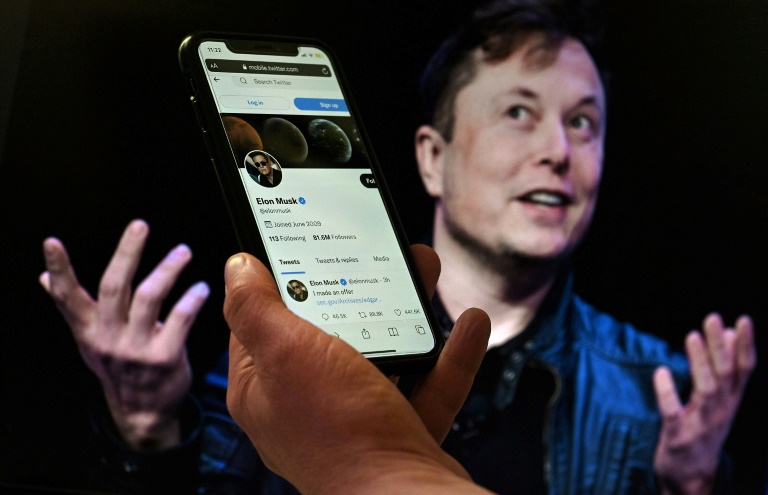
First, Elon Musk revolutionized the automobile industry, then he tackled space travel. By taking control of Twitter, the eccentric billionaire now wields a nearly untold level of influence.

In using his fortune to grab hold of such an important platform, experts say, he has even inserted himself squarely in today’s global political conversation.

“He is not just expressing views on an instrument of communication, he now owns it and sets the policy of how that instrument will be used,” Jeffrey Winters, a specialist in elites and oligarchs at Northwestern University, told AFP.  

The question now is what he will do with that power, starting with the topic on everyone’s mind: Whether or not Musk will allow former US president Donald Trump to return to the site. 

Without anyone to answer to, Musk “is going to change the constellation of political voices that are going to be expressed through Twitter,” Winters said. 

According to the professor, Musk represents a typical oligarch — a person whose fortune lends them social and political power not available to an average citizen — though Musk does not have any governments or militaries under his control.

– Oracle –

In the business world, Musk’s bona fides as an innovator are well-established. 

“He goes into directions that people just never go in, and he creates brand new products that proved to be highly effective and successful,” said Nicholas Colas, co-founder of DataTrek Research.

Musk did not invent the electric car, but with Tesla, “he showed it was possible in a big scalable way,” Colas explained. 

With SpaceX, Musk introduced internet satellites and reusable rockets, technologies that were “something that’s been promised but never really delivered until he came along,” Colas added. 

For Colas, Musk can in some ways be compared with inventors as prolific as Thomas Edison or iconic Apple founder Steve Jobs.

He has proven at least that he knows how to make money: Tesla is by far the highest-valued car company on the stock market and SpaceX is worth more than $125 billion. 

So when the richest man in the world gives his two cents on a business matter, such as his opinion on a company or on cryptocurrency, like an oracle — his fans listen. 

He can shake up the markets with just a few words. 

In 2021, when Musk edited his Twitter bio to simply say “#bitcoin,” the price of the virtual currency temporarily soared 20 percent. 

He could have stuck to his role as a businessman and adopted a low profile. According to Winters, that’s what most rich people do, fearing hostile reactions to their wealth. 

They employ lawyers and lobbyists to discreetly protect their interests, sometimes financing political campaigns. 

But “Elon Musk is unafraid to be very rich and very visible,” Winters said. 

– Red line? –

“The creation of Tesla as an iconic brand brought him to people’s attention and great wealth,” said Arizona State University communication and marketing specialist Mark Hass. 

“Then he just was willing to put himself out there continually on social media on issues that other CEOs would never publicly engage (with) the way he did,” he added. 

“He’s not afraid to say what is on his mind, regardless of who he insults, regardless of which regulator he angers,” said Hass. 

When Musk took to Twitter to propose a peace deal between Kyiv and Moscow, he probably viewed himself “as just giving his opinion like anyone else,” Winters said. 

“When you control the satellites that are important for Ukrainians’ ability to communicate, your opinion has massive ripple effects,” he explained. 

But in Washington, Musk still has less influence than other financial heavy-hitters such as JP Morgan’s Jamie Dimon or Goldman Sachs’ David Solomon, who “control the banking system,” Colas said. 

In buying Twitter — largely with his own money, but also with significant backing from investors who expect a return on their own risk — Musk has taken on a huge potential liability. 

“He can’t just flip a switch and make an anarchy there (at Twitter), because every big advertiser will back away,” Colas cautioned. 

“He likes to push things to the edge,” Hass said. And so far, “he’s never self-destructed.”

But in controlling Twitter, Musk has a more direct line to the public than ever before, and “I don’t know where his red line is,” Hass added. 

Close Bitnami banner
Bitnami