World

Hardline general vs pragmatic centrist: Brazil's VP duel

Like their bosses at the top of the ticket, the men vying to be Brazil’s next vice president are polar opposites.

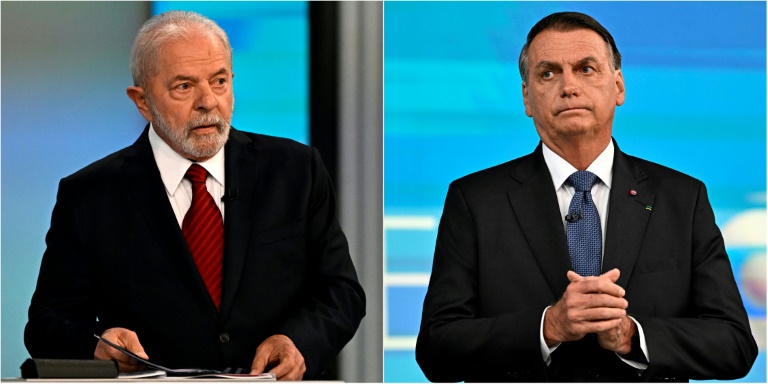
Here is a look at the running mates playing wingman to far-right incumbent Jair Bolsonaro and leftist challenger Luiz Inacio Lula da Silva in Sunday’s divisive runoff election.

– Faithful soldier –

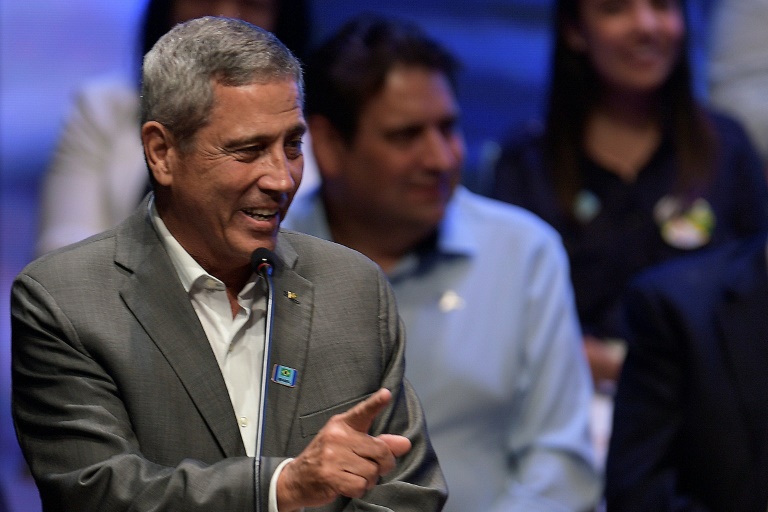
Like in the 2018 campaign that brought him to power, Bolsonaro, an ex-army captain who has cultivated close ties with the armed forces, tapped a military man as his running mate: General Walter Braga Netto.

But unlike current VP Hamilton Mourao, who has differed with his boss on policy — sometimes publicly — Braga Netto is seen as a hardline Bolsonaro supporter.

The 65-year-old army reserve general has held top jobs in Bolsonaro’s administration, serving first as chief of staff, then defense minister.

In the former post, he notably oversaw the government’s response to Covid-19 — slammed as disastrous by critics, after the pandemic claimed more than 680,000 lives in Brazil, second only to the United States.

Born in the southeastern city of Belo Horizonte, capital of the key battleground state of Minas Gerais, Braga Netto became a general in 2009 and was named security chief when Brazil hosted the 2016 Olympics in Rio de Janeiro.

Two years later, then-president Michel Temer ordered the military to take charge of security in Rio state amid a surge of violent crime — tapping Braga Netto to lead the operation.

The intervention, which lasted almost a year, produced mixed results: some violent crime statistics receded, but killings by police officers rose sharply.

Braga Netto triggered controversy in March 2021, just after Bolsonaro named him defense minister, when he said the 1964 coup that installed more than two decades of military dictatorship in Brazil should be “celebrated” for “pacifying” the country.

Clean-cut and gruff, he is running in his first election.

– Big-tent bet –

Ex-president Lula has meanwhile tapped a one-time enemy as his running mate: centrist veteran Geraldo Alckmin.

The business-friendly one-time-candidate  is Lula’s bet to win over voters wary of Bolsonaro’s warnings that his Workers’ Party represents “communism.”

The two are not exactly an obvious match: Alckmin ran against then-president Lula in Brazil’s 2006 election, losing in the runoff.

But they say they have teamed up to defeat a common enemy in Bolsonaro.

“People might think it’s strange,” Alckmin said in March.

“I ran against Lula in 2006. But we never put the very issue of democracy at risk.”

Alckmin rose to prominence as governor of Sao Paulo, Brazil’s biggest and wealthiest state, in the 2000s and 2010s. 

Known as a good administrator but a boring politician, the mild-mannered 69-year-old earned a reputation as a solid managerial type well-liked by the business and financial sectors.

But he had fallen into political oblivion, winning less than five percent of the vote in the first round of the 2018 presidential race, which brought Bolsonaro to power.

Born in Pindamonhangaba, a small city outside Sao Paulo, Alckmin grew up in a devout Catholic family.

He was a city councilman and mayor before winning a seat in Congress and eventually the governorship.

There appears to be little risk the charismatic Lula will be overshadowed by him.

Alckmin’s nickname is “xuxu popsicle” — a reference to chayote, a bland vegetable common in Brazil.

He has turned it into a joke on the campaign trail, quipping that “xuxu” with “lula” — the ex-president’s name means “squid” — is now a favorite national dish.
Danes go to the polls in thriller election

Like an episode of political drama “Borgen,” Denmark’s Prime Minister Mette Frederiksen is fighting to cling to power on Tuesday in a legislative election that could well crown an outsider.

In a political landscape split between 14 parties, polls suggest that neither of the two main blocs can garner a 90-seat majority in the 179-seat Folketing, the Danish parliament.

The left-wing “red bloc,” led by Frederiksen’s Social Democrats are polling at 49.1 percent, representing 85 seats, compared to 40.9 percent or 72 seats for the “blue” bloc of right-wing parties.

“It’s about winning the middle, because the ones who get the middle get the Prime Minister’s seat,” Kasper Hansen, a politics professor at the University of Copenhagen.

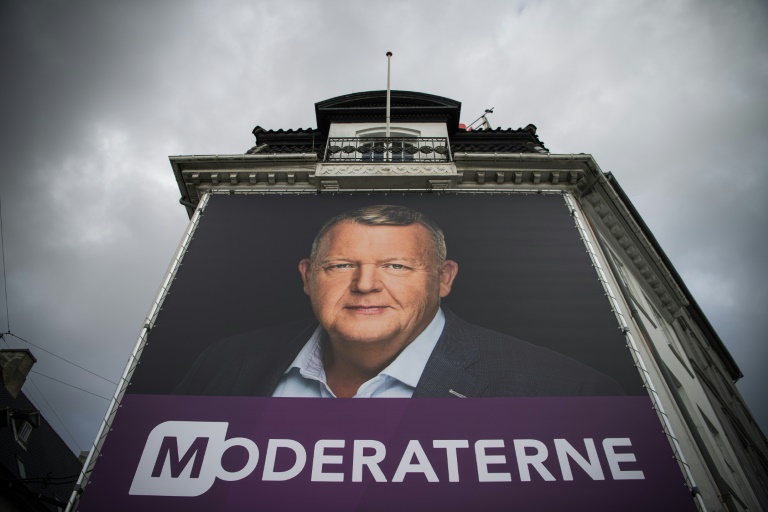
The new party occupying the political centre is the Moderates, founded by former Liberal Prime Minister Lars Lokke Rasmussen.

The polls indicate his party will win 10 percent of the votes or 18 seats, a fivefold increase since September — much to the surprise of political analysts.

And Rasmussen, who boasts solid political experience, has refused to pledge support for either bloc ahead of the election.

Party colleague Jakob Engel-Schmidt said they “are ready to work with the candidate who will facilitate the broadest cooperation around the centre to implement necessary reforms”.

And what the Moderates want to reform is healthcare and pensions.

– Tough negotiations –

In their efforts to attract the often less loyal centrist electorate, Frederiksen’s Social Democrats have announced that they want to govern across the traditional political dividing lines. They too have floated the Moderates’ idea of a coalition government gathered in the centre.

“This goes directly opposite to what she’s been saying before, and I think that’s because she senses that she might lose power otherwise,” Martin Agerup, director of the liberal think tank CEPOS, told AFP.

Led by two other prime minister candidates — conservative Soren Pape Poulsen and liberal Jakob Ellemann-Jensen, the right wing, have not extended the same hand.

Without a clear majority, there may have to be long negotiations before a government is formed after the election, which could ultimately favour Lokke Rasmussen.

“He’s a ferocious guy in negotiations,” Agerup said.

“He can basically operate until somebody will get scared enough to point to him and say: ‘Look, yes, you could be Prime Minister'”.

It’s a situation almost out of the hit political drama series “Borgen”, named after the seat of legislative and executive power in Denmark, in which the leader of an imaginary centrist party subtly manoeuvres her way to becoming prime minister.

– Split populist right –

But outside the fiction, the Social Democrats, the largest party in the country’s political force, are trying to “play the card that they are the right party during uncertain times,” according to Rune Stubager, a professor of political science at Aarhus University.

Their handling of the Covid-19 pandemic was largely hailed, despite a stumble when they ordered an emergency cull country’s huge mink herd over fears of a mutated strand of the novel coronavirus. That turned out to be illegal.

With an economy in turmoil they have since introduced measures to help Danes cope with soaring prices.

They are proposing a carbon tax on agriculture and a pay rise in the public sector, while their allies have campaigned mainly on protecting biodiversity and support for children and the vulnerable.

The current government is negotiating with Rwanda to set up a centre to house asylum seekers, while their requests are being investigated.

Across the political landscape there is a strong consensus on maintaining a restrictive migration policy, meaning the issue is rarely up for debate.

“There’s a clear consensus in Parliament for strict immigration policies,” Hansen said.

The populist anti-immigration right is expected to win more seats this election, but it is split into three different parties who together receive 15.5 percent votes in polls.

“We have to protect our society too and that means we cannot just open our borders, “Bjarke Rubow Jensen a 35-year-old anthropologist and Social Democrat supporter, summed up the Danish mindset to AFP.

Tourist influx raises fears for Mexico's wine heartland

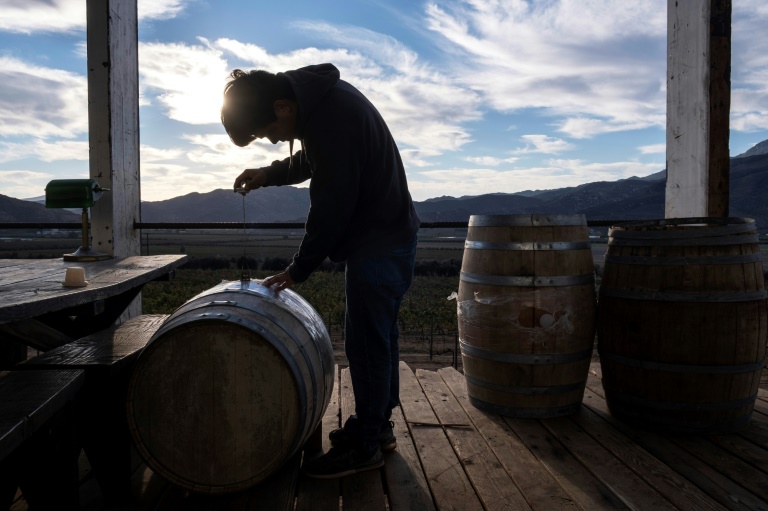
When Pau Pijoan began winemaking in Mexico’s Guadalupe Valley it was home to little more than a dozen producers. Two decades later, he fears it is becoming a victim of its own success.

The growing popularity of Mexico’s wine heartland in Baja California has brought an influx of tourists — and with them a proliferation of hotels, restaurants and other development.

“When I bought land, there were 15 to 18 wine producers. Today, there are more than 200,” said Pijoan, a veterinarian by trade.

“We are responsible for this brutal and disorderly growth typical of Mexico,” he said.

Mexico, better known for its tequila and mezcal spirits, is ranked 35th among world wine producers, according to the International Organisation of Vine and Wine (OIV).

The Guadalupe Valley produces around three-quarters of the country’s wine, but vintners fear for the future of their picturesque corner of northwestern Mexico due to tourism and climate change.

They have launched a campaign called “Let’s save the valley,” warning that discos, mass concerts and other leisure activities threaten the vines that bear grape varieties including Cabernet Sauvignon, Merlot and Chardonnay.

“Between 2014 and 2019, we lost 18 percent of agricultural land. If we continue on this trend, in 2037 there will be no more arable land,” they said.

Guadalupe Valley must not become a new Tulum, they added, referring to a once-sleepy fishing village in the Yucatan peninsula that has become a tourist magnet.

“Something very curious is happening in the valley: an agricultural activity is combining with a tourist activity, which does not always happen,” said Keiko Nishikawa, spokeswoman for the Santo Tomas vineyard.

“How can we balance this? Obviously we wineries are jointly responsible for what is happening,” she added.

Some restaurants and nightlife venues in the region “offer everything except local wine,” Nishikawa said.

– Industry challenges –

The warnings come as Mexico prepares to host the 43rd World Congress of Vine and Wine, as well as the OIV’s general assembly, starting on Monday.

Ahead of the week-long gathering in Baja California, the organizers symbolically announced that Ukraine would become the 49th member country.

The fallout of the Russian invasion is weighing on the global wine market, after the pandemic saw a boom in online sales.

“Supplies — like bottle tops — arrive later and are more expensive,” as is electricity, said OIV director general Pau Roca.

Even so he feels a “certain optimism” about the industry’s future.

“We are emerging from the crises quite quickly, much more than from the 2008 economic crisis, which was long,” Roca said.

The OIV hopes new technologies will enable producers to cope with economic and climatic challenges. 

Winegrowers have a large amount of data “generated by the sensors in vineyards,” Roca said.

But “we’re not able to integrate them into our decision-making. Artificial intelligence can help us,” he added.

In Argentina, the National University of Cuyo is working on a program “to improve the prognosis of crops” using machine learning, a type of artificial intelligence.

In the Guadalupe Valley, the prospect of worsening water scarcity is among the concerns of locals and winemakers.

“It’s fine that everyone wants to build their own house, but they should also take care of the water because we’ve almost run out,” said 38-year-old resident Luisa Guerrero.

US Fed set for further steep rate hike as recession fears loom

The US Federal Reserve is pegged to make a fourth straight steep hike in the key interest rate this week as it battles surging costs, with its aggressive stance fueling expectations of a recession.

American households have been squeezed by soaring consumer prices, propelling economic issues to the top spot among voter concerns in upcoming midterm elections. Fed officials walk a tightrope to try and rein in prices while avoiding a downturn.

To raise borrowing costs and cool demand, the US central bank has already cranked up the benchmark lending rate five times this year, including three straight 0.75 percentage point raises.

But with persistently high inflation and a tight labor market supporting wages and spending, analysts say another 0.75 point hike is almost certain at central bankers’ next policy meeting.

The policy-setting Federal Open Market Committee (FOMC) starts its two-day policy meeting on Tuesday, and all eyes are on signals that it may be ready to slow its campaign in the months ahead.

There will be a focus on whether the committee is confident of being “on track” toward a policy stance restrictive enough to manage inflation risks, a Barclays analysis said.

Many economists expect the Fed to raise rates again by another half point in December.

Federal Reserve Chair Jerome Powell has made it clear that there is no “painless way” to cool the economy and avoid a repeat of the last time US inflation got out of control in the 1970s and early 1980s.

It took tough action and a recession to bring prices down and the Fed is unwilling to give up its hard-won, inflation-fighting credibility.

“We’ve been told time and again that the Fed would continue to raise rates aggressively until it sees ‘compelling’ evidence that inflation is slowing down,” said Nancy Vanden Houten, US economist at Oxford Economics.

“I don’t think the data so far meets that standard,” she told AFP.

The Fed’s actions have rippled through the economy, with mortgage rates hitting their highest in decades recently and home sales sliding.

Further Fed hikes are also expected to dampen consumer and business spending, making it more attractive to save rather than spend.

Analysts warn that the economy could enter a recession in 2023 on the effects of the Fed’s rate hikes, inflation and a global slowdown in growth.

– Policy divide –

Some Fed officials have expressed worries about tightening policy too much, wanting to consider a slower pace of rate hikes or even a pause to assess the impact of current moves, said Vanden Houten.

In October, San Francisco Fed President Mary Daly told an event that policymakers should start planning for a reduction in size of rate hikes, even if it is not yet the time to step back, while Chicago Fed President Charles Evans noted separately that “overshooting is costly.”

He added that there is uncertainty over how restrictive policy must become.

While St. Louis Fed President James Bullard, who has advocated for front-loading of policy hikes, referred to a possible pause next year, others have repeated their intentions to keep raising rates until there are signs that inflation is being contained.

“This divide reflects positioning for a debate about the course of policy in coming months,” said Barclays analysts.

The central bank’s benchmark rate is currently at a target range of 3 percent to 3.25 percent.

Even with gas prices coming down, consumer prices are not letting up — with a core measure that strips out the volatile food and energy segments surging to a 40-year high in September.

Policymakers are not just concerned about high inflation, but that a mindset of continued rising prices will set in — leading to a dangerous spiral and a phenomenon called stagflation.

That fear has driven the Fed to front-load its rate hikes rather than pursue the more customary course of small, gradual steps over a longer period. 

Rare trip for bread saves retiree's life in Bakhmut

It was a rare outing for Lioudmila Kharchenko when she left her apartment on Saturday morning in the eastern Ukrainian town of Bakhmut in search of bread.

But when she returned an hour later, she discovered her ruined home and a missile head at the foot of her velvet sofa in the living room.

The 63-year-old rarely goes outside after finding herself in the middle of a terrifying battle tearing the small town apart. But on that day she had prepared for the trip with a bit of lipstick and brought her shopping bags.

The daily confrontation between Ukrainian and Russian troops and artillery fire since the start of August is one of the longest active battles over a Ukrainian city or town since the start of the war.

“I received a call telling me there was distribution of bread. I went there,” the retired woman says.

After arriving, her neighbours told Kharchenko that her building had been hit.

“I ran to the house, hoping that they were wrong. But I went and I saw the disaster,” she adds, aware that the trip had saved her life.

Next to a small wooden chest of drawers miraculously intact in her hallway, including a violet flower still in the vase, Kharchenko puts her hand to her mouth and chokes back a sob.

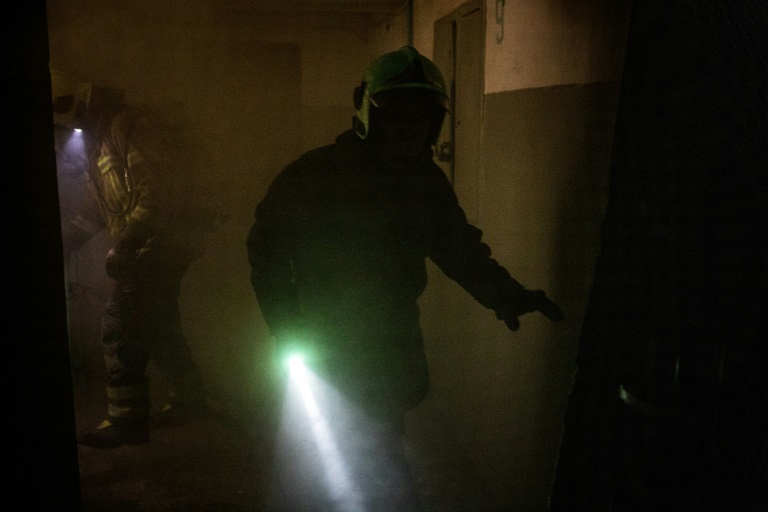
Firefighters arrived 20 minutes after the missile hit, at about 11:00 am, and extinguished the fire that blackened the small two-room apartment on the ninth and top floor of the building in northern Bakhmut.

– ‘Paid in blood’ –

Once the smoke disappears through the hole in the building left by the missile, there is a clear view of the blue sky.

The Smerch missile head, more than a metre and a half long and camouflage green, rests on the burnt carpet.

Another cylinder of the same size, which could be from a multiple rocket launcher, is standing upright at the other end of the living room.

A firefighter sprays water on the weapon before carrying the metal tube at arm’s length.

The explosion also knocked the retiree’s frames off the walls. One picture of Kharchenko and her husband in a gold frame fell and landed just above the missile.

Kharchenko takes a few steps into the room, and raises her eyes, clouded with tears, towards the hole in the ceiling and where the roof is in shreds.

“This apartment was paid for with blood and sweat,” Kharchenko says, before composing herself and gathering some of her belongings to take with her to stay at her son’s home in another area of Bakhmut.

“Thank you very much for putting out the fire, don’t bother with the rubble, I will do it myself,” she says.

According to local officials, nearly half of Bakhmut’s 70,000 residents refused to leave, despite the daily battles and artillery fire.

Lula lead narrows on eve of tense Brazil runoff: poll

Leftist challenger Luiz Inacio Lula da Silva’s lead over far-right incumbent Jair Bolsonaro narrowed slightly on the eve of Brazil’s polarizing presidential runoff, according to a poll published late Saturday.

Lula has 52 percent voter support to 48 percent for Bolsonaro, according to the poll from the Datafolha institute — down from a six-point gap (53 percent to 47 percent) on Thursday.

The figures exclude voters who plan to cast blank or spoiled ballots — four percent of respondents, Datafolha estimates. Undecided voters represented just two percent.

The margin of error for the poll, which was based on interviews with 8,308 people on Friday and Saturday, was plus or minus two percentage points.

According to Datafolha, only half of those polled watched an insult-filled final debate between the rivals on Friday night, 19 percent of them until the end.

The poll indicated that 37 percent thought Lula had come out on top during the debate, while 29 percent thought Bolsonaro had performed best.

Lula, the charismatic but tarnished ex-president who led Brazil from 2003 to 2010, won the first round of the election on October 2 with 48 percent of the vote, to 43 percent for former army captain Bolsonaro.

Bolsonaro and his allies have attacked polling firms, accusing them of bias.

He outperformed pollsters’ expectations in the first round, triumphantly boasting afterward: “We beat the lie.”

Lula, 77, leads among women (51 percent), the poor and working-class (57 percent), and Catholics (56 percent), according to Datafolha.

Bolsonaro, 67, leads among evangelical Christians (65 percent) and wealthier voters (52 percent).

In Brazil, a dirty vote campaign ends with colorful rallies

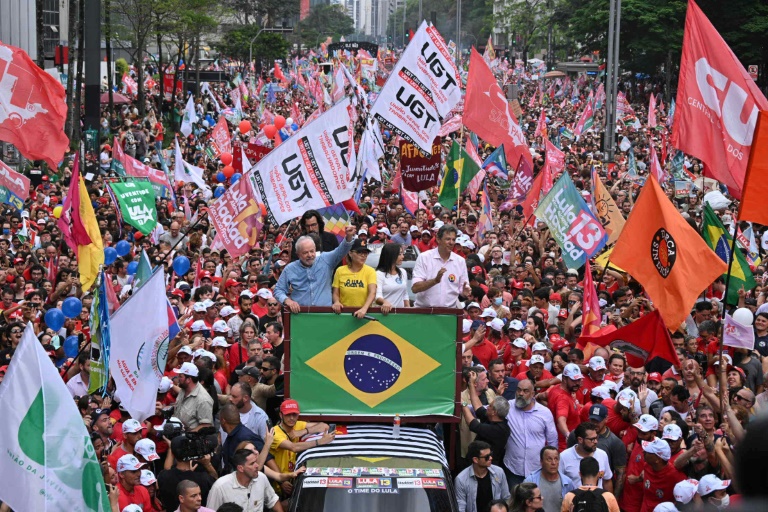
Thousands of cheering supporters poured into the streets of Brazil Saturday for final rallies on the eve of a knife-edge electoral showdown between Jair Bolsonaro and rival Luiz Inacio Lula da Silva that is seen as too close to call.

“I think we will win,” the charismatic but graft-tainted former president Lula said in Sao Paulo, vowing to “return this country to normalcy”, before a final rally in which a sea of thousands of red-clad, flag-waving supporters cheered and sang “Get out Jair!”

Earlier, thousands in the bright yellow and green colors of Brazil chanted “legend, legend,” as Brazil’s far-right President Jair Bolsonaro held a motorcycle rally in the southeastern city of Belo Horizonte.

He also declared himself “confident of victory”.

Lula’s slight lead narrowed on the eve of the vote, with 52 percent voter support to Bolsonaro’s 48 percent, according to a poll published Saturday by the Datafolha institute. Their previous poll Thursday gave him 53 percent to 47 percent.

The margin of error is around two percent. Bolsonaro performed better than expected in the first round of voting and the final outcome is highly uncertain.

Exhausted, and with nerves frayed after a bitterly divisive campaign, the nation of 215 million people are voting for two wildly different visions for Brazil, with everything at stake.

The election has global ramifications: Conservationists believe the result will seal the fate of the stricken Amazon rainforest, pushed to the brink by fires and deforestation under Bolsonaro.

However, for Brazilians, issues of poverty, hunger, corruption and traditional values are top of mind. 

– God, family, freedom –

Bolsonaro is seeking reelection after a first term in which he was accused of mishandling the pandemic, which left more than 685,000 dead in Brazil, and dismantling environmental protections. 

His tenure was marked by vitriolic attacks on his perceived rivals, ranging from the judiciary to women and foreign leaders.

His wife, Michelle, earlier led a motorcade through the capital Brasilia at an event dubbed “Women for Bolsonaro.” 

The first lady has been hard at work trying to win votes from women, one of the many groups that have been on the receiving end of controversial comments from her husband.

In campaign ads, Bolsonaro has apologized for his occasional “slightly aggressive” tone, and he has boasted of reduced crime rates, a drop in unemployment figures and curbed inflation.

His hardline conservative fans love his focus on “God, country, family and freedom.”

“I am sure he will win,” said small business owner Fabricia Alves, 36, in Belo Horizonte.

She said she supports the incumbent because she has seen the economy picking up after the Covid-19 pandemic, and “for the values” she sees as key.  

“I am against abortion and gender ideology, which is what the other party wants to impose on our country.”

Lula reiterated on Friday that he was anti-abortion — a delicate issue in socially conservative Brazil — during a final debate that featured mutual accusations of lying, corruption and disastrous management.

– ‘Democracy and barbarism’ –

The run-off campaign has been a dirty, gloves-off battle for every last vote between two men adored and hated in almost equal measure. 

Lula, Brazil’s president from 2003 to 2010, has told voters the election is a choice between “democracy and barbarism, between peace and war.” 

He was the country’s most popular president when he left office, helping to lift millions out of poverty with his social welfare programs.

But he then became mired in a massive corruption scandal and was jailed for 18 months before his convictions were thrown out last year. The Supreme Court found the lead judge was biased, but Lula was never exonerated.

A victory would prove a spectacular comeback, however he faces being weakened by a hostile Congress dominated by Bolsonaro lawmakers and allies.

Bolsonaro on Friday night made one of his clearest pledges yet to respect the election result if he loses, after a campaign in which he has repeatedly attacked the voting system as fraudulent and said he would not accept the results of an “abnormal” vote.

“There isn’t the slightest doubt: whoever gets the most votes, wins. That’s democracy,” said the hardline conservative.

Both candidates have fervent support, but many will merely vote for the candidate they least detest — or spoil their ballots.

At least 120 killed in Halloween crush in Seoul

At least 120 people were killed Saturday and some 100 were injured in a stampede in central Seoul when thousands crowded into narrow streets to celebrate Halloween, officials said.

Fire Department official Choi Seong-beom said the stampede took place around 10 pm (1300 GMT) and many of the victims were trampled to death.

“The high number of casualties was the result of many being trampled during the Halloween event,” Choi said, adding that the death toll could climb.

The Yonhap news agency quoted an unidentified witness as saying he saw victims crushed to death.

“People were layered on top of others like a tomb. Some were gradually losing their consciousness while some looked dead by that point,” the witness said, according to Yonhap.

Choi added that 74 bodies were sent to local hospitals and 46 were put in a nearby gym.

Officials had said earlier that 50 people were in cardiac arrest and that more than 140 ambulances were dispatched to the scene to aid the victims.

The stampede took place near the Hamilton Hotel in the vibrant district of Itaewon and a large number of people were believed to have entered a narrow alley near the hotel, the Yonhap news agency reported.

President Yoon Suk-yeol ordered officials to dispatch first aid teams and to swiftly secure hospital beds for those affected, the presidential office said. 

Meanwhile, Seoul Mayor Oh Se-hoon, who was on a visit to Europe, decided to return home in the wake of the accident, Yonhap reported, citing city officials.

– Emergency first aid –

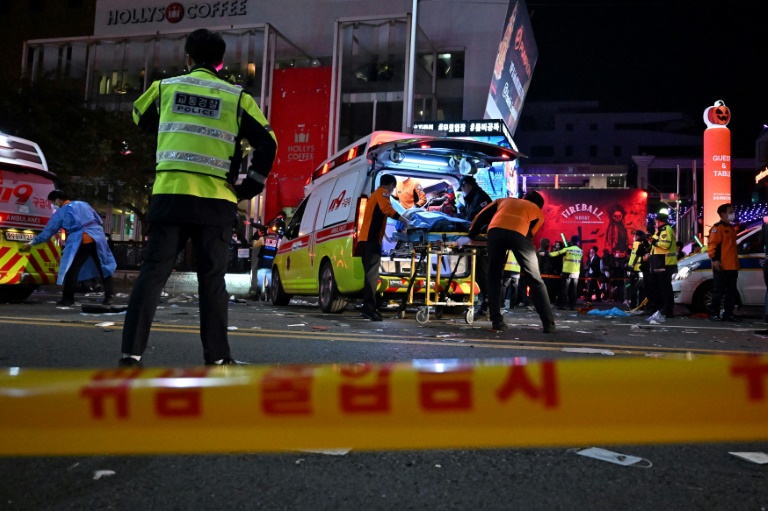
Video footage from the scene of the crush showed people performing emergency first aid on several victims who appeared to be prone on the pavement, while rescue workers rushed to help others. 

Yellow-jacketed policemen formed a cordon around the site of the crush, with rescue officials loading victims — some of whom were covered with blankets — into ambulances.

Around two dozen people were entirely covered by makeshift blankets on the roadside.

Emergency workers carried them off on wheeled stretchers to waiting ambulances.

This year’s Halloween is the first celebration of the event at which South Koreans have not been mandated to wear face masks outdoors since the pandemic broke out in 2020.

Bolsonaro feted at final rally ahead of cliffhanger Brazil vote

Thousands of cheering supporters chanted “legend, legend,” as Brazil’s far-right President Jair Bolsonaro held a motorcycle rally Saturday in a final race for votes on the eve of divisive election seen as too close to call.

His graft-tarnished leftist rival Luiz Inacio Lula da Silva, 77, was gearing up for his final rally in economic powerhouse Sao Paulo, hoping his slight lead in the polls will score him a spectacular comeback and third term at the helm of Latin America’s largest economy.

The 67-year-old Bolsonaro whizzed through Belo Horizonte, capital of the crucial state Minas Gerais, on the back of a motorcycle during one of his trademark biker rallies, after assuring voters he was “confident of victory.”

Bolsonaro on Friday night made one of his clearest pledges yet to respect the election result if he loses, after a campaign in which he has repeatedly attacked the voting system as fraudulent and said he would not accept the results of an “abnormal” vote.

“There isn’t the slightest doubt: whoever gets the most votes, wins. That’s democracy,” said the hardline conservative.

“I am sure he will win,” said small business owner Fabricia Alves, 36, in Belo Horizonte.

She said he supports the incumbent because he has seen the economy picking up after the Covid-19 pandemic, and “for the values” he sees as key.  

“I am against abortion and gender ideology, which is what the other party wants to impose on our country.”

Lula reiterated on Friday that he was anti-abortion — a delicate issue in socially conservative Brazil — during a final debate between the bitter rivals that featured mutual accusations of lying, corruption and disastrous management.

The run-off campaign has been a dirty, gloves-off battle for every last vote between two men adored and hated in almost equal measure. 

– God, family, freedom –

Bolsonaro is seeking reelection after a first term in which he was accused of mishandling the pandemic, which left more than 685,000 dead in Brazil.

His tenure was marked by vitriolic attacks on his perceived rivals, ranging from the judiciary to women and foreign leaders.

His wife, Michelle, earlier led a motorcade through the capital Brasilia at an event dubbed “Women for Bolsonaro.” 

The first lady has been hard at work trying to win votes from women, one of the many groups that have been on the receiving end of controversial comments from her husband.

In campaign ads, Bolsonaro has apologized for his occasional “slightly aggressive” tone, and he has boasted of reduced crime rates, a drop in unemployment figures and curbed inflation.

His hardline conservative fans love his focus on “God, country, family and freedom.”

On Saturday, Brazil’s electoral authorities dispatched electronic ballot boxes across the country, from cities to remote Indigenous areas in the Amazon, reported Globo News.

“We are absolutely certain that Sunday will be a day celebrating democracy. I am sure that all 156 million Brazilians will respect the result of the election,” Top electoral judge Alexandre de Moraes told Brazil’s biggest network.

Lula, Brazil’s president from 2003 to 2010, has told voters the election is a choice between “democracy and barbarism, between peace and war.” 

He was the country’s most popular president when he left office, helping to lift millions out of poverty with his social welfare programs.

But he then became mired in a massive corruption scandal and was jailed for 18 months before his convictions were thrown out last year. The Supreme Court found the lead judge was biased, but Lula was never exonerated.

The polarizing election has frayed nerves in the country of 215 million people, which is facing pressing issues, including hunger and economic recovery from the pandemic.

However, critical policy issues such as the economy, corruption and the fires and deforestation in the Amazon have taken a backseat to personal attacks.

– Fight for undecided voters –

Bolsonaro outperformed pollsters’ predictions in the first-round vote on October 2 to finish just five points shy of Lula — 48 percent to 43 percent.

Lula now has 53 percent voter support to Bolsonaro’s 47 percent, according to a poll published Thursday by the Datafolha institute, which will release a final poll Saturday night.

Both candidates have gone all-out to win over the five percent of voters who plan to spoil their ballots, and another two percent that are undecided.

Both candidates have fervent support, but many will merely vote for the candidate they least detest — or spoil their ballots.

“It’s not about the political agenda that I usually identify with. I am prioritizing getting rid of one candidate rather than electing another,” Rio de Janeiro artist Karla Koehler, 35, told AFP.

Russia suspends participation in Ukraine grain deal

Russia on Saturday suspended its participation in a landmark agreement that allowed vital grain exports from Ukraine, blaming drone attacks on Russian ships in Crimea.

Russia made the announcement after its army accused Kyiv earlier Saturday of a “massive” drone attack on its Black Sea fleet, which Ukraine labelled a “false pretext” and the UN urged the deal’s preservation.

The Turkey and UN-brokered deal to unlock grain exports signed between Russia and Ukraine in July is critical to easing the global food crisis caused by the conflict.

The agreement already allowed more than nine million tonnes of Ukrainian grain to be exported and was due to be renewed on November 19.

A Turkish security source told AFP that Ankara had not been “officially notified” of Russia’s suspension, while Ukraine and the UN pushed for the agreement to remain in force.

“I call on all states to demand that Russia stop its hunger games and recommit to fulfilling its obligations,” Ukrainian Foreign Minister Dmytro Kuleba said on Twitter. 

Stephane Dujarric, spokesman for the UN secretary-general, said: “It is vital that all parties refrain from any action that would imperil the Black Sea Grain Initiative which is a critical humanitarian effort.”

– ‘Peddling false claims’ –

Sevastopol in Moscow-annexed Crimea has been targeted several times in recent months and serves as the headquarters for the Black Sea fleet and a logistical hub for operations in Ukraine.

The Russian army claimed to have “destroyed” nine aerial drones and seven maritime ones, in an attack in the port early Saturday. 

“In light of the terrorist act carried out by the Kyiv regime with the participation of British experts against ships of the Black Sea fleet and civilian vessels involved in the security of grain corridors, Russia suspends its participation in the implementation of the agreement on the export of agricultural products from Ukrainian ports,” the Russian defence ministry said on Telegram.

Moscow’s forces alleged British “specialists”, whom they said were based in the southern Ukrainian city of Ochakiv, had helped prepare and train Kyiv to carry out the strike. 

In a further singling out of the UK — which Moscow sees as one of the most unfriendly Western countries — Russia said the same British unit was involved in explosions on the Nord Stream gas pipelines last month.

Britain strongly rebutted both claims, saying “the Russian Ministry of Defence is resorting to peddling false claims of an epic scale.”

Russia’s foreign ministry spokeswoman Maria Zakharova said Saturday Moscow would raise the blasts and the alleged drone attack at the UN Security Council.

The British defence ministry said this “invented story says more about arguments going on inside the Russian Government than it does about the West”.

Moscow’s military said ships targeted at their Crimean base were involved in the grain deal.

Russia had recently criticised the deal, saying its own grain exports have suffered due to Western sanctions. 

– ‘Massive’ attack –

Mikhail Razvozhayev, the Moscow-installed governor of Sevastopol, said Saturday’s drone attack was the “most massive” the peninsula had seen. 

The city’s services were on “alert”, but he claimed no “civilian infrastructure” had been damaged. 

City authorities said the harbour was “temporarily” closed to boats and ferries and urged people “not to panic”.

Attacks on Crimea, annexed by Moscow in 2014, have increased in recent weeks, as Kyiv presses a counter-offensive in the south to retake territory held by Moscow for months. 

Moscow-installed authorities in Kherson, just north of Crimea, have vowed to turn the city into a fortress, preparing for an inevitable assault. 

On Thursday, Razvozhayev said a thermal power station had been attacked in Balaklava, in the Sevastopol area. 

He claimed there was only minor damage and no casualties.  

In early October, Moscow’s bridge linking Crimea to the Russian mainland — personally inaugurated by President Vladimir Putin in 2018 — was damaged by a blast that Putin blamed on Ukraine. 

The Russian fleet stationed in the port had also been attacked by a drone in August.  

Russia’s allegations Saturday came as the Ukrainian army reported fighting in the Lugansk and Donetsk regions in the east, including near Bakhmut — the only area where Moscow’s forces have advanced in recent weeks.  

Pro-Russian separatists fighting alongside Moscow also announced a new prisoner exchange with Kyiv, saying 50 will return home from each side. 

Both sides were gearing up for the battle for the city of Kherson, the regional capital that fell to Moscow’s forces in the first days of their offensive.  

Close Bitnami banner
Bitnami