World

Taiwan holds first LGBTQ Pride march in two years

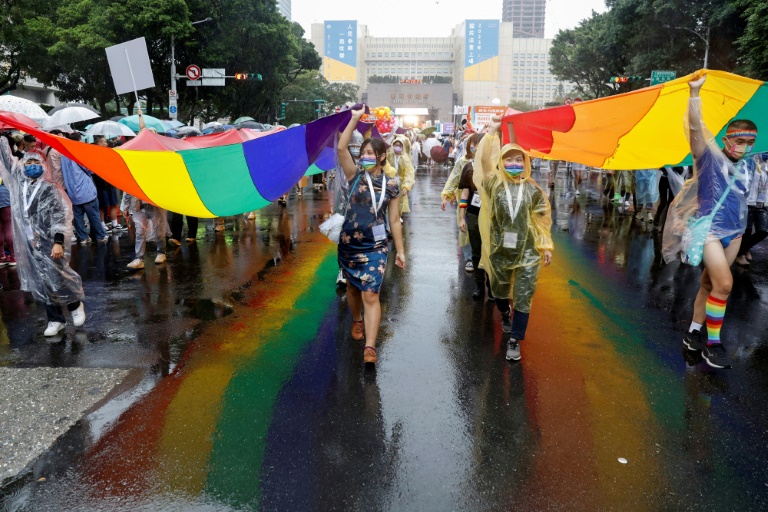
Tens of thousands braved downpours in Taiwan on Saturday to celebrate as the island staged its first LGBTQ Pride rally since fully reopening its border.

Taiwan is at the vanguard of the burgeoning LGBTQ rights movement in Asia and became the first place in the region to legalise marriage equality in 2019.

Its capital Taipei hosts one of Asia’s largest Pride marches annually — except for last year, when a surge in Covid cases forced the event online.

The festivity was back in full swing on Saturday as marchers donned eye-catching costumes and draped themselves in rainbow flags in Taiwan’s 20th Pride march, with organisers estimating the turnout was 120,000.

“I’m so very excited to be a part of the first physical parade in two years,” said 40-year-old service industry worker Wolf Yang, sporting a gold bodysuit with a matching sequined headpiece and nose ring.

Max, a 35-year-old French national, joined the march for the first time since moving to Taiwan last year, along with several friends who flew in from Japan and South Korea.

“I think Taiwan needs to be proud of that. It’s a great thing to recognise gay marriage. Asia and the world need to be proud of it.”

A record crowd of 200,000 joined the 2019 Pride march to celebrate after Taiwan legalised same-sex marriages that year.

At least 7,000 same-sex couples have wed since then, although the law still contains restrictions that heterosexual couples do not face.

Under the current rules, Taiwanese nationals can only marry those from roughly 30 countries and territories where same-sex marriage is also legal.

College student Virginia Li, 22, said she joined the parade with about 20 friends from eastern Hualien city to support gay rights.

“Taiwan is much more friendly to the gay community than many countries… I am proud of the progress that has been made.”

Brazil rivals stage final rallies ahead of cliffhanger vote

Brazil’s presidential candidates will hold their final rallies Saturday in a scramble for votes on the eve of a white-knuckle election that has deeply polarized Latin America’s largest economy.

The charismatic leftist Luiz Inacio Lula da Silva, tarnished by graft allegations, remains a hair’s breadth ahead in the polls after a narrow first-round victory. 

But many see the race against far-right incumbent Jair Bolsonaro as too close to call.

The run-off campaign has been a dirty, gloves-off battle for every last vote between two men adored and hated in almost equal measure. 

Critical policy issues such as the economy, corruption, and the stricken Amazon have taken a backseat to personal attacks. 

Bolsonaro has been accused of “cannibalism” or “pedophilia” over controversial remarks, while Lula has been derided as a “lawless bandit” who has made a pact with Satan.

The rivals held a final mudslinging bout Friday night in their last debate, which featured mutual accusations of lying, corruption and disastrous management.

“Stop lying, Lula,” said Bolsonaro. “Do I have to perform an exorcism on you to get you to stop lying?”

“Brazilians know who the liar is,” Lula fired back.

– Mired in uncertainty –

Bolsonaro outperformed pollsters’ predictions in the first-round vote on October 2 to finish just five points shy of Lula, 48 percent to 43 percent.

Lula now has 53 percent voter support to Bolsonaro’s 47 percent, according to a poll published Thursday by the Datafolha institute, which will release a final poll Saturday night.

Both candidates have gone all-out to win over the five percent of voters who plan to spoil their ballots, and another two percent that are undecided.

The run-off is mired in “uncertainty,” said a statement from the Hold consultancy in Brasilia on Friday.

Despite Lula’s “slight advantage, potential changes in stance by the voter could favor” Bolsonaro, it said. “Abstention rates will also have an influence on the final result.”

On Saturday, Bolsonaro will fire up supporters at a motorcycle rally in Belo Horizonte, the capital of the state with the country’s second-highest population: Minas Gerais. 

Both candidates have devoted outsized attention to the state. Since 1989, no president has won an election without a victory in Minas Gerais.

Lula will make his final appearance in Sao Paulo, Brazil’s economic powerhouse, where he got his start as a metalworker at the age of 14 before becoming a unionist.

The dogfight has frayed nerves in the country of 215 million people, which is facing pressing issues including hunger and economic recovery from the Covid pandemic, which left more than 685,000 dead in Brazil.

– Two visions for Brazil –

Bolsonaro, 67, is seeking re-election after a first term in which he was accused of mishandling the pandemic. 

His tenure was marked by vitriolic attacks on his perceived rivals, ranging from the judiciary to women and foreign leaders.

Bolsonaro is often dubbed the “Tropical Trump”, in reference to the equally divisive former US leader who on Friday called on Brazil to vote for “one of the great presidents of any country in the world.”

In campaign ads, Bolsonaro apologized for his occasional “slightly aggressive” tone, and he has boasted of reduced crime rates, a drop in unemployment figures, and curbed inflation.

His hardline conservative fans love his focus on “God, country, family and freedom.”

Lula, Brazil’s president from 2003 to 2010, is seeking a spectacular comeback, telling voters they are choosing between “democracy and barbarism, between peace and war.” 

He was the country’s most popular president when he left office, helping to lift millions out of poverty with his social welfare programs.

But he then became mired in a massive corruption scandal and was jailed for 18 months before his convictions were thrown out last year. The Supreme Court found the lead judge was biased, but Lula was never exonerated.

Both candidates have fervent support, but many of Brazil’s 156 million voters will merely vote for the candidate they least detest — or spoil their ballots.

“It’s not about the political agenda that I usually identify with. I am prioritizing getting rid of one candidate rather than electing another,” Rio de Janeiro artist Karla Koehler, 35, told AFP.

Artillery battles engulf Ukraine's southern front

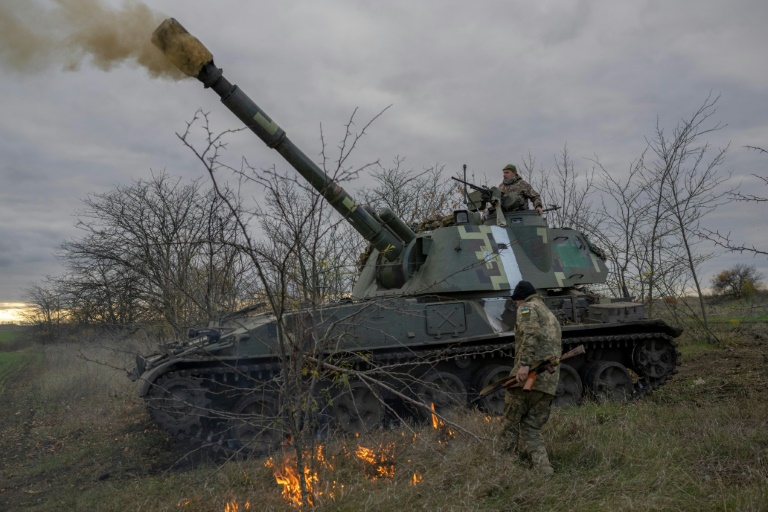
The thrill of a precise artillery strike was fading as the Ukrainian defenders of the last village before the invading Russians cowered for safety in the shattered remains of a school. 

Puffs of smoke revealed where the Russians had suffered their latest losses along the flat and almost completely lifeless terrain of Ukraine’s southern front.

A drone gliding somewhere above the darkening horizon beamed back images suggesting that two Russians had been killed in one of the artillery strikes.

The news created a brief stir of excitement among the middle-aged men in the huge howitzer the Ukrainians had briefly wheeled out into an open field.

But a day of heavy return fire on what remained of the frontline village of Kobzartsi threatened to get substantially worse as the sun set.

Two paramedics stationed with the unit exchanged knowing glances and took a few steps further back into the protective ruins of the next-door gym.

“They don’t let us forget that they are still there,” 24-year-old welder-turned-medic Andriy said of the Russians stationed on the opposite side of the field.

“It can get bad out here,” his slightly older partner Oleksiy agreed.

Both men and others serving with Ukraine’s armed forces hide their full identities out of military security considerations.

“But we know that their side is suffering much more than we are,” Oleksiy said with a hint of a smile.

– Digging in –

Such confidence could prove vital as Ukraine tries to keep a rousing northern counteroffensive from stalling in the treacherous steppes of the south.

Ukraine’s ultimate goal is Kherson — a gateway city to both Kremlin-annexed Crimea and the Sea of Azov shoreline, which fell under full Russian control during the war.

Military analysts believe the Ukrainians have about six weeks before the winter freeze makes any further advances much more difficult to pull off. 

But the Russians are digging in.

An aide to Ukrainian President Volodymyr Zelensky said Moscow had sent in further reinforcements and now had 30 battalion tactical groups around Kherson.

Each such fully-equipped unit has up to 800 soldiers and controls a specific section of the front.

“That is a massive military force that will be very difficult to break down,” presidential aide Oleksiy Arestovych cautioned this week.

– ‘Always hiding’ –

The artillery battles in areas just north of Kherson are being waged by tanks and other big guns across opens fields filled with almost nothing but ruins.

The settlement of Kobzartsi is one of many on the battle map of Ukraine that scarcely exists anymore.

Its two main streets are lined with the skeletal remnants of country cottages and heaps of rubble where bigger buildings once stood.

The soldiers said a few dozen locals still hide out in their cellars.

But few spend time above ground because of both the shelling and the danger of unexploded ordinances scattered across roads and vegetable plots.

“They are almost always hiding,” medic Oleksiy said.

“We try to help and some volunteer groups sometimes deliver supplies. But you can only do so much.”

– ‘Trying our best’ –

The artillery unit’s commander is a 47-year-old with chiselled features who named his dog Javelina and took the nom-de-guerre Anaconda.

The dog’s name honours the US anti-tank missile that played a crucial role in repelling Russia’s assault on Kyiv in the first month of war.

But Anaconda admits that he did not really know how to use any modern weapons when he was called up from his job in the customs service when Russia invaded on February 24.

“You feel bad when you fire something and miss. You get really down on yourself,” Anaconda said with a self-depreciating laugh.

“But we really are trying our best. We are learning as we go. We are getting better every day.”

Tropical storm lashes Philippines, at least 45 dead

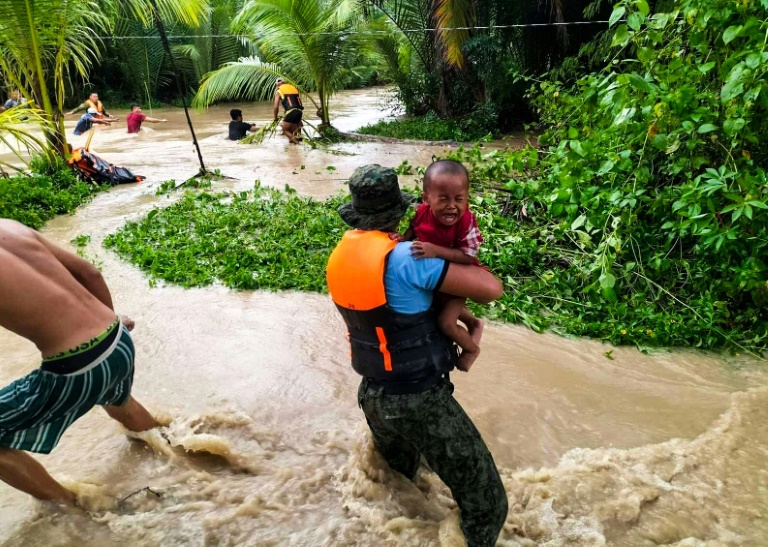
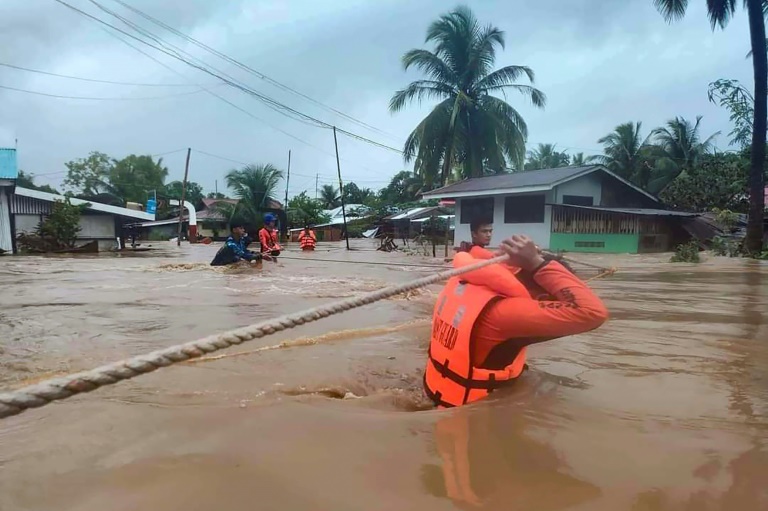
Severe Tropical Storm Nalgae whipped the Philippines on Saturday after unleashing flash floods and landslides that officials said left at least 45 people dead.

Nalgae pounded the archipelago nation’s main island of Luzon with maximum winds of 95 kilometres (59 miles) an hour after making landfall on the sparsely populated Catanduanes island before dawn.

The destruction began well before, with heavy rain inundating mostly rural areas on the southern island of Mindanao on Thursday, followed by deadly landslides and flooding on Friday.

A sharply revised official toll on Saturday put the number of deaths on Mindanao at 40, with five others killed elsewhere in the country.

At the vanished southern village of Kusiong, home to between 80 and 100 people, bulldozers and backhoes churned up a thick layer of grey limestone rock and brown mud the size of 10 football fields as anxious relatives waited for news.

Parts of a denuded mountain nearby had collapsed on the hamlet early Friday and the bodies of 14 members of the Teduray tribe have been pulled out since — with many still missing.

In recent years, flash floods with mud and debris from largely deforested mountainsides have been among the deadliest hazards posed by typhoons in the Philippines.

“It could be more than a hundred,” Lester Sinsuat, the mayor of Datu Odin Sinsuat town, told AFP when asked how many are feared dead.

Rescuers abruptly ran away from the site during a brief and sudden downpour, fearing another landslide. They later returned to their grim task.

“Today we resumed our work, but this is already a retrieval operation because the village has been buried under rock and mud for more than a day,” regional civil defence chief Naguib Sinarimbo told AFP, declining to say how many were feared dead.

An AFP team saw three other bodies pulled out from the rubble on Saturday.

– ‘Why did we fail to evacuate them?’ –

President Ferdinand Marcos Jr rebuked civil defence and local officials at a televised meeting Saturday over the high number of casualties in Mindanao.

“It will be important for us to look back and see why this happened. Why did we fail to evacuate them? Why do we have such a high casualty (figure)?” the president asked.

Mindanao is rarely hit by the 20 or so typhoons that strike the Philippines each year, but those that do tend to be deadlier than those that hit Luzon or the smaller central islands.

The storm also caused flooding elsewhere in the country.

Photos released by the coastguard showed rescuers using an old refrigerator as an improvised boat to pull children from a flooded community on the central island of Leyte.

The state weather service said the eye of Nalgae passed just off Luzon’s south coast at 2:00 pm (0600 GMT), with the capital Manila, a sprawling metropolis of more than 13 million people, likely to be hit next.

The storm struck at the beginning of a long weekend in the Philippines, when millions return to their hometowns to visit the graves of their dead relatives.

“If it’s not necessary or important, we should avoid going out today because it is dangerous and could bring you harm,” national civil defence director Rafaelito Alejandro said, adding that 5,000 rescue teams were on standby.

More than 7,000 people were evacuated ahead of the storm’s landfall, the civil defence office said.

The coast guard has also suspended ferry services through most of the country due to rough seas, stranding hundreds of vessels and thousands of passengers at ports.

The civil aviation office, meanwhile, said it has shelved more than 100 flights.

Storms kill hundreds of people in the Philippines and keep vast regions in perpetual poverty, where residents also have to reckon with frequent earthquakes, volcanic eruptions, and in some areas armed insurgencies.

Scientists have warned that such storms, which also kill livestock and destroy key infrastructure, are becoming more powerful as the world gets warmer because of climate change.

Tropical storm slams into Philippines, at least 45 dead

Severe Tropical Storm Nalgae slammed into the Philippines on Saturday, after unleashing flash floods and landslides that left at least 45 people dead according to a sharply revised official tally.

Nalgae pounded the archipelago nation’s main island of Luzon with maximum winds of 95 kilometres (59 miles) an hour after making landfall on the sparsely populated Catanduanes island before dawn.

The destruction began well ahead of landfall, with heavy rain inundating mostly rural areas on Mindanao island in the south on Thursday followed by deadly landslides and flooding on Friday.

But the government revised its official death toll downward from 72 to 45 in the afternoon.

Officials said some deaths had been erroneously tallied twice from the Mindanao events, which accounted for 40 deaths. The storm also killed five others elsewhere in the country.

In recent years, flash floods with mud and debris from largely deforested mountainsides have been among the deadliest hazards posed by typhoons in the Philippines.

Rescue workers are focusing on the village of Kusiong, home to between 80 and 100 people, which was buried after part of a denuded mountain nearby collapsed.

“Yesterday we were focused on rescue and recovered 11 bodies,” regional civil defence chief Naguib Sinarimbo told AFP.

“Today we resumed our work, but this is already a retrieval operation because the village has been buried under rock and mud for more than a day,” he added, declining to say how many are feared dead.

The storm also caused flooding elsewhere in the country.

Photos released by the coastguard showed rescuers using an old refrigerator as an improvised boat to pull children from a flooded community on the central island of Leyte.

The state weather service said the eye of Nalgae passed the small island of Marinduque in mid-morning and could hit Manila, a sprawling metropolis of more than 13 million people, later Saturday.

“Widespread flooding and rain-induced landslides are expected,” while there was “minimal to moderate risk of storm surge” or huge waves hitting coastal areas, it added.

“Based on our projections, this one is really strong, so we really prepared for it,” national civil defence director Rafaelito Alejandro said, adding that 5,000 rescue teams were on standby.

He urged residents in the storm’s path to stay at home before the storm exits into the South China Sea early Sunday.

“If it’s not necessary or important, we should avoid going out today because it is dangerous and could bring you harm,” Alejandro said.

More than 7,000 people were evacuated ahead of the storm’s landfall, the civil defence office said.

The coast guard has also suspended ferry services through most of the archipelago nation due to rough seas, stranding hundreds of vessels and thousands of passengers at ports.

The civil aviation office, meanwhile, said it has shelved more than 100 flights so far.

The storm struck at the beginning of a long weekend in the Philippines, when millions return to their hometowns to visit the graves of their dead relatives.

The Philippines is hit by an average of 20 major storms each year that kill hundreds of people and keep vast regions in perpetual poverty.

Scientists have warned that such storms, which also kill livestock and destroy key infrastructure, are becoming more powerful as the world gets warmer because of climate change.

Xi invokes Mao in visit to cradle of Communist revolution

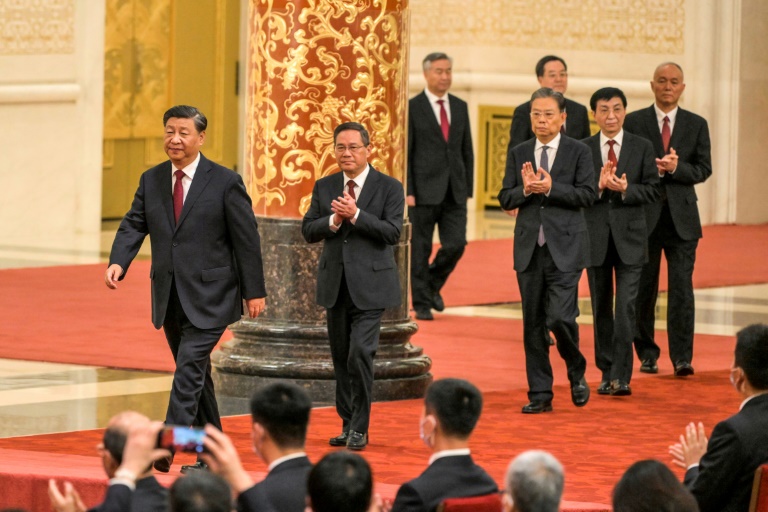
Dressed in matching navy windbreakers and flanking President Xi Jinping, China’s freshly appointed top leadership this week made their first group outing to the Communist Party’s “holy land”.

Xi’s choice to visit Yan’an — a site inextricably linked with Communist China’s founder Mao Zedong — was an important, deliberate indication of the themes of his next five years at the helm, analysts said. 

Xi has centralised and personalised power more than any Chinese leader since Mao, culminating in his being anointed with a historic third term following last weekend’s Communist Party (CCP) Congress. 

The new Politburo Standing Committee he shepherded around the popular “Red tourism” destination on Thursday consists solely of his loyal allies.

“The signal with the visit to Yan’an is one of celebrating a parallel (with Mao) and brooking no opposition,” wrote Manoj Kewalramani from the Takshashila Institution in Bengaluru, India.

A 16-minute news segment about the visit on state broadcaster CCTV showed several portraits of Mao, and a report by the official Xinhua news agency mentioned the former leader’s name 14 times.  

The itinerary included visits to Mao’s former residence, as well as a hall where a pivotal CCP meeting in 1945 confirmed him as chairman, apparently showcasing Xi’s deep interest in party history and its influence on his rhetoric and policies.

But it also harked back to an era when the CCP relied on mass “struggle” to win a bloody civil war, which observers believe has parallels with how Beijing views the current geopolitical climate.

“Among the signals Xi appears to be sending… is prepare for difficult times ahead, and prepare for struggle,” analyst Bill Bishop wrote in his Sinocism newsletter.

Xi took the 2012 standing committee to an exhibition about national rejuvenation in Beijing, and the 2017 one to the site of the first CCP Congress in Shanghai. 

“The first travels after each Party Congress seems to be about ‘remember the original mission’,” tweeted the Australian National University’s Wen-Ti Sung. 

According to state media, Xi on Thursday vowed that his new standing committee would “inherit and carry forward the fine revolutionary traditions formed by the party during the Yan’an period”.

– Cradle of the revolution –

Yan’an is revered in Communist Party lore as the cradle of the movement. 

Nestled in the remote, arid mountains of northwest China, it was where party members hunkered down after the Long March, a gruelling year-long expedition by foot across the country to escape encirclement by Nationalist troops during the Chinese Civil War. 

Tens of thousands died en route, and by the time the survivors arrived in Yan’an, they were a severely weakened force.

Mao and his allies, including Xi’s father, lived alongside local peasants in caves as they planned military campaigns.

The CCP’s eventual victory over the Nationalists saw the Yan’an period codified as a shining example of the Party’s ability to overcome adversity.

Yan’an is also firmly linked to Mao and his consolidation of power.

More than 10,000 people, including intellectuals and artists, were killed during the Yan’an Rectification — a mass campaign of brainwashing and purges that established Mao as the undisputed leader.

But on Thursday, Xi said that “through the Yan’an Rectification Movement, the whole Party united under the banner of Mao Zedong and achieved unprecedented unity”, according to CCTV.

“A firm and correct political orientation is the essence of the Yan’an Spirit.”

One of the hallmarks of Xi’s tenure has been a focus on intra-party discipline, most obviously through a long-running anti-corruption campaign. 

Critics say that drive is a thinly veiled political tool that has eliminated many of his rivals.

– Historical legitimacy – 

Xi tends to think of himself as an “heir of the revolution”, according to sinologist Alfred L. Chan. 

In speeches, he has sought to draw a direct line between the past and present, using history as a source of legitimacy for both the party and himself.

On Thursday, for example, he referred to his personal connections to Yan’an. 

During the height of the Cultural Revolution, 15-year-old Xi was sent to the village of Liangjiahe, where he also slept in caves and was shocked at the harshness of manual labour.

He often cites this period as a formative life experience that gave him grit and determination, as well as an insight into the lives of ordinary working-class Chinese.

And it is another way in which Xi attempts to mould his public persona and life story in the vein of Mao, analysts say.

“Xi wants to go back to the orthodoxy of communism in China like Mao,” said Alfred Wu, a Chinese politics expert at the National University of Singapore.

Facing uncertain future, Ukrainians struggle to adapt in Germany

In her previous life in southern Ukraine, Tetiana Chepeliova was an accountant. 

In Berlin, she is unemployed, like the 16 other Ukrainian women with whom she is learning German in a course aimed at helping them integrate into society.

The 47-year-old is one of more than a million Ukrainians who have fled to Germany since Russia’s invasion in February. Among the European Union countries, only Poland has welcomed more.

The influx has put huge pressure on local authorities with Interior Minister Nancy Faeser recently describing the situation as “tense”. 

But unlike in 2015, when huge protests stoked by the far-right erupted over the arrival of Syrians and Iraqis fleeing war, this time there have been few dissenting voices over the influx.

Instead, a key challenge is turning out to be the “major uncertainty” faced by the Ukrainians, said Benjamin Beckmann, who oversees integration programmes at Germany’s federal office for migration and refugees.

For many of them — mostly women and children — it remains an open question whether or not they will return to their homeland once the war is over, he added.

– Qualifications not recognised –

At a language school in a residential district of the German capital, Chepeliova is among a group of Ukrainians learning to navigate the German language.

When AFP visited, she was learning basic terms to express herself during a visit to the doctor.

The courses consist of three hours of classes a day, offered free to Ukrainians for nine months.

“The are extremely motivated,” said teacher Petra Schulte.

But Schulte also senses the frustration of her class, which has just one male student. They include a mechanical engineer, a dentist, a doctor, nurses, and a piano teacher.

“They have worked for years… and suddenly, their qualifications are not recognised, and they cannot practise” their professions, the teacher said.

Chepeliova fled the southern city of Kherson after it fell to the Russians in March. Today, she sees her future in Germany: “It is the best place for me. The country is super welcoming towards Ukrainians.”

Her 12-year-old son found German school difficult at first but “after spending a weekend with his class, it is as if a wall fell — he was no longer frightened of speaking German”.

Other women however want eventually to return to Ukraine, where they have left loved ones behind.

“None of them seem happy in the role of housewife,” observed Schulte, 63.

She even questioned sometimes why she was teaching them when they might end up returning home, she admitted.

For now, while the Ukrainians weigh up their future in Europe’s biggest economy, Schulte and others like her can only support them in their journey to adapt in Germany.

“The will to help has not weakened,” she said. 

Viagra, exorcism and lies: Brazil's testy final election debate

The word “liar” rang out dozens of times Friday night in a bitter final debate that also featured mentions of exorcism and Viagra, as Brazil’s presidential rivals made a last-ditch bid for votes two days before a run-off election.

Far-right incumbent Jair Bolsonaro and leftist ex-president Luiz Inacio Lula da Silva slung insults as debate on topics such as the economy, corruption, the Amazon rainforest, abortion and foreign policy deteriorated into attack and accusation.

“Brazilians know who the liar is,” said Lula, as the two locked horns over minimum wages and the leftist’s history of corruption allegations.

“Stop lying Lula, stop lying. It’s getting ugly,” said Bolsonaro.

The debate was the second head-to-head confrontation between the two men, and the grand finale of a brutal campaign marked by months of mudslinging, negative ads and a flood of disinformation on social media. 

Although Lula holds a small lead in the polls, pundits say it is too close to call, and the rivals are battling for every vote.

“It was an anti-debate, there was nothing that will change the state of play,” said Octavio Guedes, a commentator with Globo News. The debate was broadcast live on TV Globo, Brazil’s biggest network.

Popular but tarnished ex-president Lula (2003-2010) entered the debate leading the polarizing, hardline conservative Bolsonaro 53 percent to 47 percent, according to a poll published Thursday by the Datafolha institute.

– ‘Insane behavior’ –

Bolsonaro once again attacked Lula over corruption, which remains the leftist’s Achilles’ heel with many voters.

Lula was the country’s most popular president when he left office in 2010, helping lift millions out of poverty with his social programs.

But he then became mired in a massive corruption scandal and was jailed for 18 months before his convictions were thrown out last year. The Supreme Court found the lead judge was biased, though Lula was never exonerated.

“With me you will have safety, you will have honesty. There won’t be theft. Do you want me to give more examples of corruption Lula? Or can we move on,” said Bolsonaro.

Bolsonaro then insinuated that Lula, beloved by the poor for his common touch, had links to drug traffickers because he visited one of Brazil’s sprawling favelas on October 12.

Lula retorted he was “the only president with the courage to enter a favela,” praising residents who are “extraordinarily hardworking, people who want to study.”

Lula at another point called Bolsonaro “unhinged” and slammed the “insane behavior” of his government over the past four years.

– Global isolation –

Bolsonaro, 67, is seeking reelection after a first term marked by his widely criticized response to Covid-19 and vitriolic attacks on perceived enemies, including the Supreme Court, women and foreign leaders.

“You isolated Brazil. Today Brazil is more isolated than Cuba. You don’t have a relationship with anyone. No one wants to receive you. No one comes here,” said Lula, 77.

Bolsonaro laughed off the accusation.

“We have a lot going on. The Arab world welcomes me with open arms. I spoke to (US President Joe) Biden a while back. I talk to everyone. Stop lying, Lula.”

Bolsonaro boasted of decreasing employment and inflation when Lula came for him on economic issues.

“Lies Lula! Do I have to perform an exorcism on you to get you to stop lying?”

Bolsonaro’s hardline conservative fans love his focus on “God, country, family and freedom.”

He repeated accusations that Lula was an “abortionist” who wants to legalize drugs. Lula reiterated that he was, in fact, anti-abortion — a delicate issue in socially conservative Brazil.

In another section of the debate, Lula asked Bolsonaro to explain the army’s purchase of 35,000 Viagra pills — used to treat erectile dysfunction and, Bolsonaro recalled, prostate issues.

“Do you use Viagra?” Bolsonaro asked.

Lula did not reply.

– ‘The whole system is against me’ –

Bolsonaro, who has repeatedly alleged Brazil’s electoral system is plagued by fraud, renewed his accusations of a conspiracy against him.

“The whole system is against me,” he said.

However, in a brief post-debate interview with Globo, he gave one of his clearest pledges yet to respect the election result if he loses.

“There isn’t the slightest doubt: whoever gets the most votes wins. That’s democracy,” he said.

Bolsonaro has previously faced criticism for saying he will respect the outcome if there is “nothing abnormal.”

The topic of deforestation in the Amazon briefly came up at the end of the debate, where the rivals bickered over who was most at fault.

Bolsonaro, Lula on the attack in final debate for Brazil vote

Far-right incumbent Jair Bolsonaro and leftist ex-president Luiz Inacio Lula da Silva repeatedly slammed each other as liars in a final debate Friday night that touched on the economy, corruption and foreign policy only two days before Brazil’s run-off elections.

“Brazilians know who the liar is,” said Lula, as the two locked horns over minimum wages and the leftist’s history of corruption allegations, sticking to the personal attacks and themes seen throughout the campaigns.

“Stop lying Lula, stop lying. It’s getting ugly,” said Bolsonaro. 

The bitter rivals are taking part in their second head-to-head debate — the grand finale of a brutal campaign marked by months of mudslinging, negative ads and a flood of disinformation on social media.

Although Lula holds a small lead in the polls, pundits say the race could still go either way — making the debate a high-stakes final showdown as the rivals battle for every last vote.

“The only thing that could change (the situation) at this point is the debate,” said political scientist Felipe Nunes, director of polling firm Quaest.

“Any slip-up, any tone-deaf remark, could end up being decisive in the final result,” he told AFP ahead of the clash.

The debate is being broadcast live on TV Globo, Brazil’s biggest network.

Lula, the popular but tarnished ex-president who led Brazil from 2003 to 2010, entered the debate leading the polarizing, hardline conservative Bolsonaro 53 percent to 47 percent, according to a poll published Thursday by the Datafolha institute.

– ‘Insane behavior’ –

Bolsonaro once again attacked Lula over his history of corruption allegations, which remains the leftist’s Achilles’ heel with many voters.

Lula was the country’s most popular president when he left office in 2010, helping lift millions out of poverty with his social welfare programs.

But he then became mired in a massive corruption scandal and was jailed for 18 months before his convictions were thrown out last year. The Supreme Court found the lead judge was biased, though Lula was never exonerated.

“With me you will have safety, you will have honesty. There won’t be theft. Do you want me to give more examples of corruption Lula? Or can we move on,” said Bolsonaro.

Lula at one point called Bolsonaro “unhinged” and slammed the “insane behavior” of his government over the past four years.

Bolsonaro, 67, is seeking re-election after a first term in which he was accused of mishandling the pandemic. It was marked by vitriolic attacks on his perceived rivals, ranging from the judiciary to women and foreign leaders.

“You isolated Brazil. Today Brazil is more isolated than Cuba. You don’t have a relationship with anyone. No one wants to receive you. No one comes here,” said Lula, 77.

Bolsonaro laughed off the accusation.

“We have a lot going on. The Arab world welcomes me with open arms. I spoke to (US President Joe) Biden a while back. I talk to everyone. Stop lying, Lula.”

Bolsonaro boasted of decreasing employment and inflation when Lula came for him on economic issues.

“Lies Lula! Do I have to perform an exorcism on you to get you to stop lying?”

Bolsonaro’s hardline conservative fans love his focus on “God, country, family and freedom.”

He repeated accusations that Lula was an “abortionist” who wants to legalize drugs. Lula reiterated that he was in fact anti-abortion — a delicate issue in socially conservative Brazil.

– ‘The whole system is against me’ –

Bolsonaro also referred to his renewed attacks on the electoral system, which he has said is plagued by fraud, warning he will accept defeat only if there is “nothing abnormal” in the election.

Many fear a Brazilian rerun of the Capitol riot that rocked the United States after the 2020 election loss of Bolsonaro’s political role model, Donald Trump.

Bolsonaro’s campaign has already alleged “electoral fraud” before the vote, claiming 150,000 of Bolsonaro’s publicly funded campaign ad spots were blocked from the radio.

Top electoral judge Alexandre de Moraes threw the case out Wednesday, ruling it unfounded.

“The whole system is against me,” Bolsonaro said during the debate, as he accused Lula of having friends in the superior elections court known as the TSE who keep ruling against him.

While Lula remains ahead in the polls, Bolsonaro’s strong support means many see the race as too close to call.

Tropical storm slams into Philippines, death toll rises to 72

Severe Tropical Storm Nalgae slammed into the Philippines on Saturday, after unleashing flash floods and landslides that left at least 72 people dead, officials said.

Nalgae pounded the archipelago nation’s main island of Luzon with maximum winds of 95 kilometres (59 miles) an hour after making landfall on the sparsely populated Catanduanes island before dawn.

Heavy rains triggered by the approaching storm began Thursday in the southern Philippines, the state weather service said, inundating mostly rural areas on Mindanao island.

That was followed by landslides and flooding, with fast-moving, debris-laden waters sweeping away entire families in some areas and damaging nearly 500 houses.

By Saturday morning, the death toll had risen to 72, said the country’s civil defence director, Rafaelito Alejandro.

At least 14 people were still missing and 33 were injured, he added.

In recent years, flash floods with mud and debris from largely deforested mountainsides have been among the deadliest hazards posed by typhoons in the Philippines.

Rescuers are focusing on the village of Kusiong, where dozens of bodies were recovered Friday after the floods hit.

Flooding was also reported in several areas of the central Philippines, though there were no deaths reported there.

Photos released by the coastguard showed rescuers using an old refrigerator as an improvised boat to pull children from a flooded community on the central island of Leyte.

The state weather service said Nalgae could hit the capital Manila, a sprawling metropolis of more than 13 million people, bringing “intense with at times torrential rains”.

“Widespread flooding and rain-induced landslides are expected,” while there was “minimal to moderate risk of storm surge” or huge waves hitting coastal areas, it added.

“Based on our projections, this one is really strong, so we really prepared for it,” Alejandro said, adding that 5,000 rescue teams were on standby.

He urged residents in the storm’s path to stay at home before the storm exits into the South China Sea early Sunday.

“If it’s not necessary or important, we should avoid going out today because it is dangerous and could bring you harm,” Alejandro said.

More than 7,000 people were evacuated ahead of the storm’s landfall, the civil defence office said.

The coast guard has also suspended ferry services through most of the archipelago nation due to rough seas, stranding hundreds of vessels and thousands of passengers at ports.

The civil aviation office said it has shelved more than 100 flights so far.

The storm struck at the beginning of a long weekend in the Philippines, when millions return to their hometowns to visit the graves of their relatives.

The Philippines is hit by an average of 20 major storms each year that kill hundreds of people and keep vast regions in perpetual poverty.

Scientists have warned that such storms, which also kill livestock and destroy key infrastructure, are becoming more powerful as the world gets warmer because of climate change.

Close Bitnami banner
Bitnami