World

N. Korea fires ballistic missiles ahead of major US-S. Korea air drills

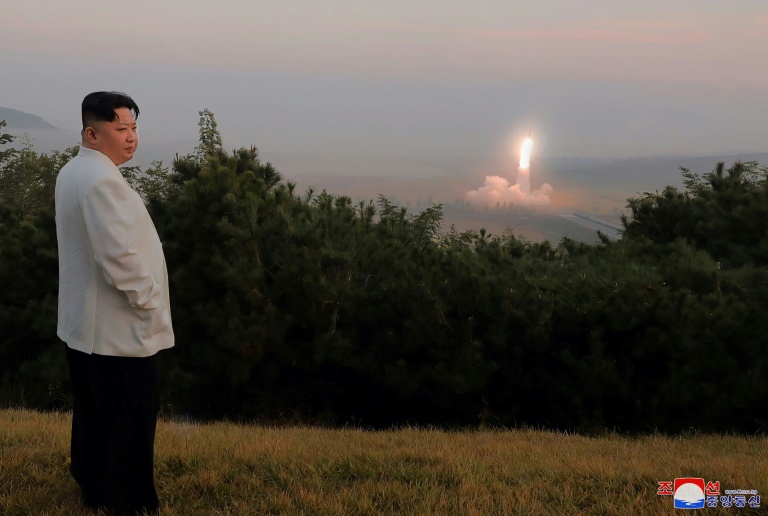
North Korea fired two short-range ballistic missiles on Friday, the South’s military said, the latest in a blitz of launches that Washington and Seoul have warned could culminate in another nuclear test.

The launch comes as the South wraps up 12 days of amphibious naval military exercises, involving key security ally America, and ahead of the Monday start of major combined air drills that will involve more than 200 US and South Korean fighter jets.

Such exercises infuriate Pyongyang, which sees them as rehearsals for invasion and has repeatedly justified its blitz of missile launches as necessary “countermeasures” to what it deems US aggression.

South Korea’s military said it had “detected two ballistic missiles fired from the Tongchon area in Kangwon between 1159 (0259 GMT) and 1218,” it said, referring to a province on North Korea’s east coast.

“Our military has increased monitoring and surveillance and is maintaining a full readiness posture in close coordination with the US,” Seoul’s Joint Chiefs of Staff said in a statement.

The missiles flew approximately 230 kilometres (143 miles) at an altitude of 24 kilometres and speeds of Mach 5, the statement said, calling the launch “a serious provocation” that violated UN sanctions. 

The US military’s Indo-Pacific Command also condemned the launch, saying it highlighted “the destabilising impact” of North Korea’s banned weapons programmes.

With talks long-stalled, tensions on the peninsula are at their highest point in years, with North Korean leader Kim Jong Un last month declaring his country an “irreversible” nuclear power, effectively ending negotiations over his banned weapons programmes.

Officials in Washington and Seoul have been warning for months that Kim is ready to conduct another nuclear test, which would be the country’s seventh — and the first since 2017.

On Tuesday, South Korean President Yoon Suk-yeol said it appeared Pyongyang had “already completed preparations for a seventh nuclear test”, he told parliament.

On Wednesday, the United States, Japan and South Korea vowed such a test would warrant an “unprecedentedly strong response”.

North Korea has this month fired multiple artillery barrages into a maritime “buffer zone” that was set up in 2018 as a way of reducing tensions with the South during a period of ill-fated diplomacy.

It also announced it had staged what it called “tactical nuclear drills” that simulated showering the South with nuke-capable missiles.

And on Monday, a North Korean ship reportedly crossed the two countries’ flashpoint maritime border, prompting an exchange of warning shots.

North Korean state media has also recently carried a rare series of statements from the country’s military condemning the “enemy’s war drills” and calling for them to stop.

– ‘Provocations’ –

The Friday launch is Pyongyang’s effort to push back against both the “Hoguk” amphibious drills and “Vigilant Storm” air drills, said Hong Min of the Korea Institute for National Unification. 

“The North knows it cannot compete with the combined US-South Korea air capabilities so instead it intends to show it has the capacity to strike their air command centre with their missiles,” he told AFP.

“The North has always dreaded and been sensitive to the Vigilant Storm exercise involving a large joint fleet of fighter jets, and views it as a very aggressive posture,” he added.

North Korea’s latest launch is part of a dramatic increase this year in what Seoul calls “provocations”, including Pyongyang conducting its longest-ever missile launch by distance, which overflew Japan and prompted rare evacuation warnings.

In response, Seoul has conducted live-fire drills, and the US redeployed a nuclear-powered aircraft carrier to the region to conduct large-scale trilateral drills also involving Tokyo.

Analysts say Pyongyang’s confidence that gridlock at the United Nations will protect it from further sanctions has emboldened it to step up its weapons testing.

The Security Council has been divided on responding to Pyongyang’s nuclear ambitions for months, with Russia and China on the sympathetic side and the rest of the council pushing for punishment.

Kim has made developing tactical nukes — smaller, battlefield-ready weapons — a priority, and Seoul recently warned Pyongyang could be preparing to conduct multiple consecutive nuclear tests as part of this drive.
T-rex in Singapore as experts decry 'harmful' auctions

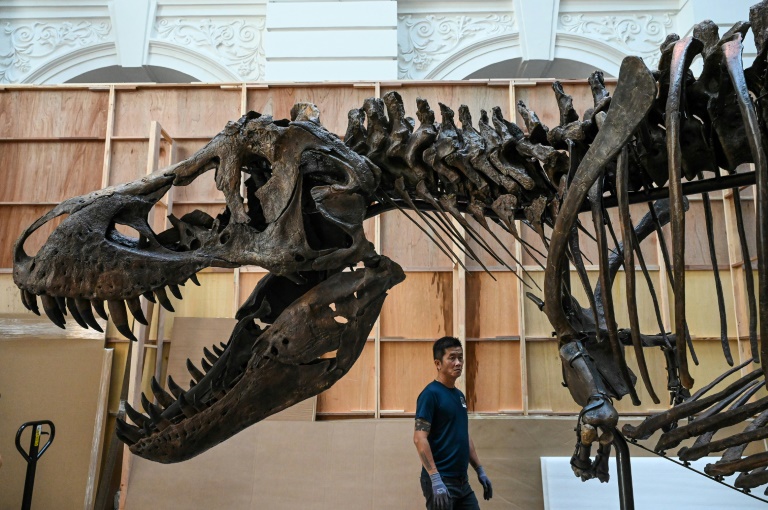
Dinosaur fans got a glimpse of a Tyrannosaurus rex skeleton as it went on display in Singapore Friday before an auction next month, as experts slammed the big-money bone trade as “harmful to science”.

The 1,400-kilo frame, composed of about 80 bones, will be the first T-rex skeleton auctioned in Asia, according to Christie’s, which has not given an estimate for the lot.

Dubbed Shen, meaning god-like, it will be on display for three days before being shipped to Hong Kong to be sold in November.

“None of the 20 T-Rex that exist in the world is owned by either an Asian institution or an Asian collector,” said Francis Belin, president of Christie’s Asia Pacific.

“We really wish that Shen will find a new home amongst our Asian collectors here.”

The adult dino, which stands 4.6 metres tall and 12 metres long, is thought to be male. It was excavated from private land in the Hells Creek Formation in Montana in the United States in 2020.

“I’ve never seen a real-life fossil before… It makes me feel in awe because it’s quite majestic,” said Lauren Lim, 33, who went to view the exhibit.

— ‘Bad news for science’ —

Shen — which lived during the Cretaceous period about 67 million years ago — is not the only dino auctioned in recent years.

In July, the first skeleton of a Gorgosaurus went under the hammer for $6.1 million in New York. Another T-rex, “Stan”, was sold for $31.8 million by Christie’s in 2020.

But the trend for prehistoric auction lots has some experts concerned.

“It’s a sad thing that dinosaurs are becoming collectible toys for the oligarch class, and I can only hope this fad ends soon,” said Steve Brusatte, a paleontologist at the University of Edinburgh.

He told AFP the trend was “bad news for science”, and the remains belonged in museums.

Thomas Carr, a paleontologist from the US, described such sales as being “unquestionably harmful to science” even if the skeletons had been studied before being sold.

“A secure, permanent collection ensures that the observations that a scientist makes of a fossil can be tested and replicated — and a commercially held fossil has no such assurance,” Carr said.

Belin, of Christie’s, said he hoped a public institution would buy Shen, and added that the whole skeleton had been fully researched, recorded in 3D and “all the elements of the skeleton will be made available for the public to research”.

“We strongly hope that the new owner, whether it’s an institution or private, will ensure that it’s being seen by the public,” Belin said.

Forgotten Uyghurs locked up in Thailand face 'hell on earth'

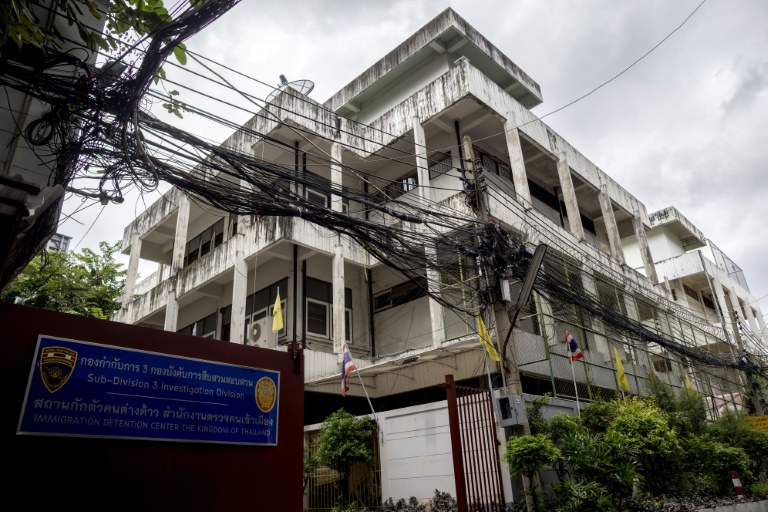
Almost a decade after fleeing China, more than 50 Uyghurs are languishing in Thai detention facilities, living in constant fear of being sent back.

China has been accused of grave human rights abuses in Xinjiang against the Uyghurs dating back to at least the 1990s, with the United States branding Beijing’s treatment of the mostly Muslim minority a “genocide”.

A damning UN report released in August detailed violations including torture and forced labour and “large-scale” arbitrary detention in what Beijing calls vocational training centres.

Many Uyghurs have fled China over the years, with some travelling through Myanmar to Thailand, but dozens have ended up stuck in detention there — the apparent victims of what observers say is the kingdom’s desire to avoid angering either Beijing or Washington.

The group of Uyghurs, arrested in 2013 and 2014, are currently being held in immigration centres around Thailand while authorities ponder their fate.

Neither their precise location nor their exact number is clear — a group of Thai rights organisations says there are 52, but a senator working on the case says 59.

Immigration authorities have not responded to AFP requests for information.

Abdullah Sami, a 35-year-old Uyghur from Xinjiang who fled China through Thailand and now lives in Austria, has been in contact with some of the detainees.

“The situation is terrible,” he told AFP.

“They live with the fear that if they are ever sent back to China, they would suffer persecution there.”

It is not an idle fear — in 2015 the Thai government forcibly deported 109 Uyghurs to China, in defiance of US pleas to protect them.

That move drew stern condemnation from Washington and the UN, which said it was a violation of international law.

It also sparked violent protests in Turkey — where nationalist hardliners see Uyghurs as part of a global Turkic-speaking family — forcing the temporary closure of Thailand’s embassy and consulate.

A month later, a bomb attack at a Bangkok shrine killed 20 people, most of them ethnic Chinese tourists. The trial of two Chinese Uyghur men accused of the attack resumes next week after long delays.

– ‘Security risk’ –  

Around the same time, in mid-2015, Thailand sent a further 170 Uyghur women and children to Turkey.

But some Uyghurs remained, and in July three men made headlines in Thai media after they escaped from a southern immigration centre, with one believed to still be at large.

But details about those still in detention remain murky, with no concrete information available on who they are.

“It is clear that the Uyghurs are considered a special security issue,” said Chalida Tajaroensuk, head of human rights association People’s Empowerment Foundation, which has led recent calls to free the detainees.

The group are believed to have been shuffled from immigration centre to immigration centre for the past eight years.

“Nobody has an answer on how long they will stay there,” Chalida said.

– Diplomatic balance – 

“What’s a life, in this kind of prison cell for almost 10 years?” asked Thai senator Zakee Phithakkumpol, one of the leaders of the Islamic Central Council, which represents the kingdom’s eight million Muslims.

Support for the detainees has stepped up in recent months, with eight Thai human rights organisations urging authorities in July not to send them to China.

The renewed attention comes as Thailand prepares to host the Asia-Pacific Economic Cooperation (APEC) summit next month, with China and the United States both increasingly vying for influence in Southeast Asia.

Thailand’s junta cosied up to Beijing after seizing power in 2014, but in recent years it has sought to tread a path between China and the United States, the kingdom’s oldest ally.

“Lately, Bangkok has been rebalancing its relations between Washington and Beijing, rather moving closer to the United States,” political professor Thitinan Pongsudhirak at Chulalongkorn University told AFP.

The massive diplomatic and security fallout from the 2015 deportation may also contribute to the government’s hesitancy, but it is keeping mum about its next moves.

Contacted by AFP, a ministry of foreign affairs spokesperson said the position of the kingdom “remained the same”, without giving further details.

Sami, who was in communication with a number of the men held, says their fears will not have changed.

Every time they spoke, he said, “I tell them with sorrow that there is no news, there is nothing about them.”

Phil Robertson, Asia deputy director at Human Rights Watch, said the Uyghurs’ treatment was “absolutely shocking” and Thailand should release them immediately.

“Thai Immigration is acting like it will hold these men indefinitely, for the rest of their lives if need be, to avoid offending China,” Robertson told AFP.

“If there is a hell on earth, Thailand has created it for these Uyghur detainees.”

North Korea fires two ballistic missiles: South's military

North Korea fired two short-range ballistic missiles on Friday, the South’s military said, the latest in a blitz of launches that Washington and Seoul have warned could culminate in Kim Jong Un conducting another nuclear test.

The launch comes as South Korea and the US conclude 12 days of amphibious naval joint military drills, and just ahead of the Monday start of major combined air drills that will involve more than 200 US and South Korean fighter jets.

Such drills infuriate Pyongyang, which sees them as rehearsals for invasion and has repeatedly justified its blitz of missile launches as necessary “countermeasures” to what it deems US aggression.

South Korea’s military said it had “detected two ballistic missiles fired from the Tongchon area in Gangwon between 1159 (0259 GMT) and 1218,” it said, referring to a province on North Korea’s east coast.

“Our military has increased monitoring and surveillance and is maintaining a full readiness posture in close coordination with the US,” Seoul’s Joint Chiefs of Staff said in a statement.

With talks long-stalled, tensions on the peninsula are at their highest point in years, with North Korean leader Kim Jong Un last month declaring his country an “irreversible” nuclear power, effectively ending negotiations over his banned weapons programmes.

Officials in Washington and Seoul have been warning for months that Kim is ready to conduct another nuclear test, which would be the country’s seventh — and the first since 2017.

On Tuesday, South Korean President Yoon Suk-yeol said it appeared Pyongyang had “already completed preparations for a seventh nuclear test”, he told parliament.

On Wednesday, the United States, Japan and South Korea said that a North Korean nuclear test would warrant an “unprecedentedly strong response”, vowing unity between the regional security allies.

North Korea has this month fired multiple artillery barrages into a maritime “buffer zone” that was set up in 2018 as a way of reducing tensions with the South during a period of ill-fated diplomacy.

It also announced it had staged what it called “tactical nuclear drills” that simulated showering the South with nuke-capable missiles.

And on Monday, a North Korean ship reportedly crossed the two countries’ flashpoint maritime border, prompting an exchange of warning shots.

North Korean state media has also recently carried a rare series of statements from the country’s military condemning the “enemy’s war drills” and calling for them to stop.

– ‘Provocations’ –

It is all part of a dramatic increase this year in what Seoul calls “provocations” by the North, including conducting its longest-ever missile launch by distance, which overflew Japan and prompted rare evacuation warnings.

In response, Seoul has conducted live-fire drills, and the US re-deployed a nuclear-powered aircraft carrier to the region to conduct large-scale trilateral drills also involving Tokyo.

Analysts say Pyongyang’s confidence that gridlock at the United Nations will protect it from further sanctions has emboldened it to step up its weapons testing.

At a recent UN Security Council meeting to discuss Pyongyang’s launch over Japan, North Korea’s longtime ally and economic benefactor China blamed Washington for provoking the spate of missile tests.

The Security Council has been divided on responding to Pyongyang’s nuclear ambitions for months, with Russia and China on the sympathetic side and the rest of the council pushing for punishment.

Kim has made developing tactical nukes — smaller, battlefield-ready weapons — a priority, and Seoul recently warned the North could be preparing to conduct multiple consecutive nuclear tests as part of this drive.
Elon Musk takes control of Twitter, fires executives

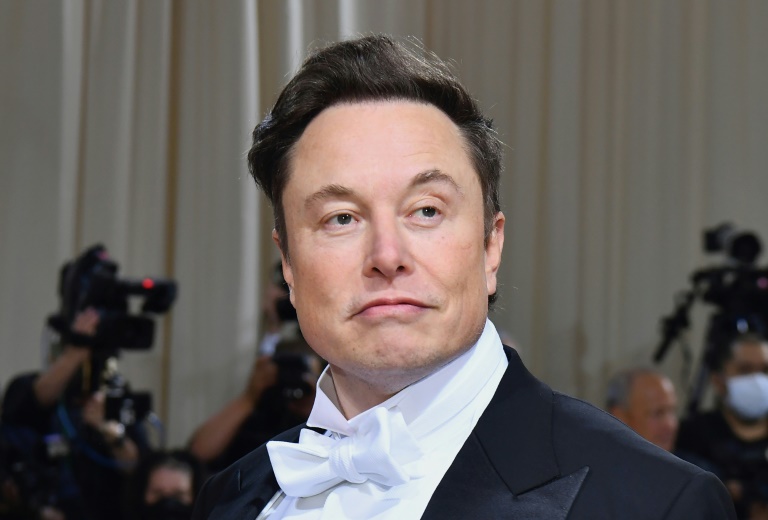
Elon Musk took control of Twitter and fired its top executives late Thursday in a deal that puts one of the leading platforms for global discourse in the hands of the world’s richest man.

Following the takeover, Musk tweeted that the “the bird is freed,” referencing the company’s iconic avian logo.

He wasted no time sacking chief executive Parag Agrawal, as well as the company’s chief financial officer and its head of safety, the Washington Post and CNBC reported citing unnamed sources.

Agrawal previously went to court to hold the Tesla chief to the terms of a deal he had tried to escape.

The takeover came hours before the court-appointed deadline for Musk to seal his on-again, off-again deal to purchase the social media network.

Musk tweeted earlier in the day that he was buying Twitter “because it is important to the future of civilization to have a common digital town square, where a wide range of beliefs can be debated in a healthy manner.”

Twitter did not immediately reply to a request for comment on the departure of its top executives, but the platform’s co-founder Biz Stone thanked the trio — Agrawal, Ned Segal and Vijaya Gadde — for their “collective contribution to Twitter.”

“Massive talents, all, and beautiful humans each.”

– ‘Chief Twit’ –

The closure of the deal marks the culmination of a long and drawn out back-and-forth between the billionaire and the social network.

Musk tried to step back from the Twitter deal soon after his unsolicited offer was accepted in April, and said in July he was canceling the contract because he was misled by Twitter over the number of fake “bot” accounts — allegations rejected by the company.

Twitter, in turn, sought to prove Musk was contriving excuses to walk away simply because he changed his mind.

After Musk sought to terminate the sale, Twitter filed a lawsuit to hold Musk to the agreement.

With a trial looming, the unpredictable billionaire capitulated and revived his takeover plan.

Musk signaled the deal was on track this week by changing his Twitter profile to “Chief Twit” and posting a video of himself walking into the company’s California headquarters carrying a sink.

“Let that sink in!” he quipped.

He even shared a picture of himself socializing at a coffee bar at Twitter headquarters earlier in the day Thursday.

Musk said during a recent Tesla earnings call that he was “excited” about the Twitter deal even though he and investors are “overpaying.”

– Twitter free-for-all? –

Some employees who would prefer not to work for Musk have already left, said a worker who asked to remain anonymous in order to speak more freely.

“But a portion of people, including me, are willing to give him the benefit of the doubt for now,” the employee said.

The idea of Musk running Twitter has alarmed activists who fear a surge in harassment and misinformation, with Musk himself known for trolling other Twitter users.

But Musk said he realizes Twitter “cannot become a free-for-all hellscape where anything can be said with no consequences.”

Musk has vowed to dial content moderation back to a bare minimum, and is expected to clear the way for former US president Donald Trump to return to the platform.

The then-president was blocked due to concerns he would ignite more violence like the deadly attack on the Capitol in Washington to overturn his election loss.

Far-right users were quick to rejoice on the network, posting comments such as “masks don’t work” and other taunts, under the belief that moderation rules will now be relaxed.

“Free speech will always prevail,” tweeted Republican Senator Marsha Blackburn of Tennessee, prompting replies including “says the party that bans books.”

Elon Musk takes control of Twitter, fires executives

Elon Musk took control of Twitter and fired its top executives late Thursday in a deal that puts one of the leading platforms for global discourse in the hands of the world’s richest man.

Following the takeover, Musk tweeted that the “the bird is freed,” referencing the company’s iconic avian logo.

He wasted no time sacking chief executive Parag Agrawal, as well as the company’s chief financial officer and its head of safety, the Washington Post and CNBC reported citing unnamed sources.

Agrawal previously went to court to hold the Tesla chief to the terms of a deal he had tried to escape.

The takeover came hours before the court-appointed deadline for Musk to seal his on-again, off-again deal to purchase the social media network.

Musk tweeted earlier in the day that he was buying Twitter “because it is important to the future of civilization to have a common digital town square, where a wide range of beliefs can be debated in a healthy manner.”

Twitter did not immediately reply to a request for comment on the departure of its top executives, but the platform’s co-founder Biz Stone thanked the trio — Agrawal, Ned Segal and Vijaya Gadde — for their “collective contribution to Twitter.”

“Massive talents, all, and beautiful humans each.”

– ‘Chief Twit’ –

The closure of the deal marks the culmination of a long and drawn out back-and-forth between the billionaire and the social network.

Musk tried to step back from the Twitter deal soon after his unsolicited offer was accepted in April, and said in July he was canceling the contract because he was misled by Twitter over the number of fake “bot” accounts — allegations rejected by the company.

Twitter, in turn, sought to prove Musk was contriving excuses to walk away simply because he changed his mind.

After Musk sought to terminate the sale, Twitter filed a lawsuit to hold Musk to the agreement.

With a trial looming, the unpredictable billionaire capitulated and revived his takeover plan.

Musk signaled the deal was on track this week by changing his Twitter profile to “Chief Twit” and posting a video of himself walking into the company’s California headquarters carrying a sink.

“Let that sink in!” he quipped.

He even shared a picture of himself socializing at a coffee bar at Twitter headquarters earlier in the day Thursday.

Musk said during a recent Tesla earnings call that he was “excited” about the Twitter deal even though he and investors are “overpaying.”

– Twitter free-for-all? –

Some employees who would prefer not to work for Musk have already left, said a worker who asked to remain anonymous in order to speak more freely.

“But a portion of people, including me, are willing to give him the benefit of the doubt for now,” the employee said.

The idea of Musk running Twitter has alarmed activists who fear a surge in harassment and misinformation, with Musk himself known for trolling other Twitter users.

But Musk said he realizes Twitter “cannot become a free-for-all hellscape where anything can be said with no consequences.”

Musk has vowed to dial content moderation back to a bare minimum, and is expected to clear the way for former US president Donald Trump to return to the platform.

The then-president was blocked due to concerns he would ignite more violence like the deadly attack on the Capitol in Washington to overturn his election loss.

Far-right users were quick to rejoice on the network, posting comments such as “masks don’t work” and other taunts, under the belief that moderation rules will now be relaxed.

“Free speech will always prevail,” tweeted Republican Senator Marsha Blackburn of Tennessee, prompting replies including “says the party that bans books.”

Japan to unveil huge package to address inflation

Japan is expected Friday to announce a huge stimulus package to cushion the economy from the impact of a weak yen and inflation, though the central bank refused to budge from the ultra-loose policy that has hammered the currency.

Ahead of cabinet approval for the relief measures, Prime Minister Fumio Kishida said the government would “seek swift approval” of an extra budget worth 29.1 trillion yen (around $200 billion).

Prices are rising in Japan at their fastest rate in eight years, although the three-percent inflation rate remains well below the sky-high levels seen in the United States and elsewhere.

The yen has also lost more than a fifth of its value against the dollar this year, prompting authorities to intervene to prop up the currency.

The spending package is expected to include measures to encourage wage growth and support households with energy bills, which have spiked since Russia’s invasion of Ukraine.

Local media including the Nikkei business daily said total fiscal spending on the measures could be as high as 39 trillion yen, a figure that could rise to 71.6 trillion yen when private-sector investments that ministers hope will also be made are taken into account.

Japan — which has one of the world’s highest debt-to-GDP ratios — has already injected hundreds of billions of dollars into its economy over the past two years to support recovery from the Covid-19 pandemic.

But this year the yen has been driven sharply lower by the widening gap between the monetary policies of the US and Japanese central banks, with the BoJ keeping rates ultra low to encourage sustainable growth, while the Federal Reserve is ramping them up.

On Friday, following a two-day policy meeting, the Bank of Japan said it would continue to keep its easy policy, defying growing pressure to tweak its strategy as the yen declines.

Ahead of the BoJ meeting, UBS economists Masamichi Adachi and Go Kurihara said that a mix of continued easing by the bank and the government’s stimulus measures would be “optimal”.

That is because Japan’s inflation is not demand-driven, but largely down to soaring energy costs, they explained in a commentary.

“An alternative mix, especially with tightening monetary policy to counter (the yen’s) depreciation and higher (consumer price) inflation under the current circumstances, would have a worse outcome for the economy, especially with market turmoil not only in Japan, but also in other markets,” the pair said.

This view was echoed by Yoshiki Shinke, chief economist at Dai-ichi Life Research Institute.

“It’s understandable that the government is announcing new stimulus now, because Japan’s economy faces weak demand due to price rises,” he told AFP.

This is “in contrast to the United States, where demand is strong, with the Fed trying to cool down inflation”, he said.

“It’s impossible that Japan would hike rates to curb inflation, for this reason,” Shinke explained.

YouTube to certify health care providers' accounts

Doctors, nurses and other health care professionals can apply to have their YouTube channels certified, the video sharing platform said Thursday, in a push to limit misinformation on the site.

The change will allow viewers to more easily access videos containing “high-quality health information,” YouTube said.

“This is a big step towards helping people more easily find and connect with content that comes from the extraordinary community of healthcare professionals on YouTube,” it added.

In addition to doctors and nurses, mental health professionals and healthcare information providers may also apply for the YouTube verification that allows their videos to be spotted easily by users.

“This new step will allow us to expand to include high quality information from a wider group of healthcare channels,” the company said.

Some 90 percent of Americans use social media to search for health information, according to the National Academy of Medicine.

YouTube faced criticism last year for hosting videos that criticized Covid-19 vaccines or contradicted health guidance from the World Health Organization or the Centers for Disease Control and Prevention.

In response, in September 2021, it banned misleading and inaccurate content about vaccines. 

It also launched a limited program that allowed videos by public health departments, hospitals and governments, among other entities, to have labels letting users know they are authoritative.

It is that program that is now being broadened.

To access the program, healthcare professionals must offer proof of their professional licenses, follow best practices for sharing science-based health information and have a channel in good standing on YouTube, the company said.

YouTube, headquartered in San Bruno, California, has a reach of some two billion monthly active users.

North Korea fires 'unspecified ballistic missile': South's military

North Korea has fired an “unspecified ballistic missile”, the South’s military said Friday, the latest in a blitz of launches by Pyongyang, as Seoul warns Kim Jong Un may be close to conducting another nuclear test.

“North Korea fires unspecified ballistic missile towards the East Sea,” Seoul’s Joint Chiefs of Staff said, referring to the body of water also known as the Sea of Japan.

The JCS statement did not give further details.

With talks long-stalled, tensions on the peninsula are at their highest point in years, with North Korean leader Kim Jong Un last month declaring his country an “irreversible” nuclear power, effectively ending negotiations over his banned weapons programmes.

On Tuesday, South Korean President Yoon Suk-yeol said the North was poised to conduct another nuclear test, which would be its seventh.

“It appears they have already completed preparations for a seventh nuclear test,” he told parliament Tuesday during a budget speech.

On Wednesday, the United States, Japan and South Korea said that a North Korean nuclear test would warrant an “unprecedentedly strong response”, vowing unity between the regional security allies.

This month, North Korea has fired multiple artillery barrages into a maritime “buffer zone” that was set up in 2018 as a way of reducing tensions with the South during a period of ill-fated diplomacy.

It also announced it had staged what it called “tactical nuclear drills” that simulated showering the South with nuke-tipped missiles.

– ‘Provocations’ –

The moves are part of a dramatic increase this year in what Seoul calls “provocations” by the North, including conducting its longest-ever missile launch by distance, which overflew Japan and prompted rare evacuation warnings.

Seoul has also recently conducted live-fire drills, and the US re-deployed a nuclear-powered aircraft carrier to the region to conduct large-scale trilateral drills also involving Tokyo.

Such drills infuriate Pyongyang, which sees them as rehearsals for invasion and justifies its blitz of missile launches as necessary “countermeasures”.

Seoul and Washington have repeatedly warned that Pyongyang could be close to testing an atomic bomb for the first time since 2017, after a flurry of ballistic missile launches.

Kim has made developing tactical nukes — smaller, battlefield-ready weapons — a priority, and Seoul recently warned the North could be preparing to conduct multiple consecutive nuclear tests as part of this drive.
Analysts say Pyongyang’s confidence that gridlock at the United Nations will protect it from further sanctions has emboldened it to continue its weapons testing.

At a recent UN Security Council meeting to discuss Pyongyang’s launch over Japan, North Korea’s longtime ally and economic benefactor China blamed Washington for provoking the spate of missile tests.

The Security Council has been divided on responding to Pyongyang’s nuclear ambitions for months, with Russia and China on the sympathetic side and the rest of the council pushing for punishment.

Elon Musk takes control of Twitter, fires executives

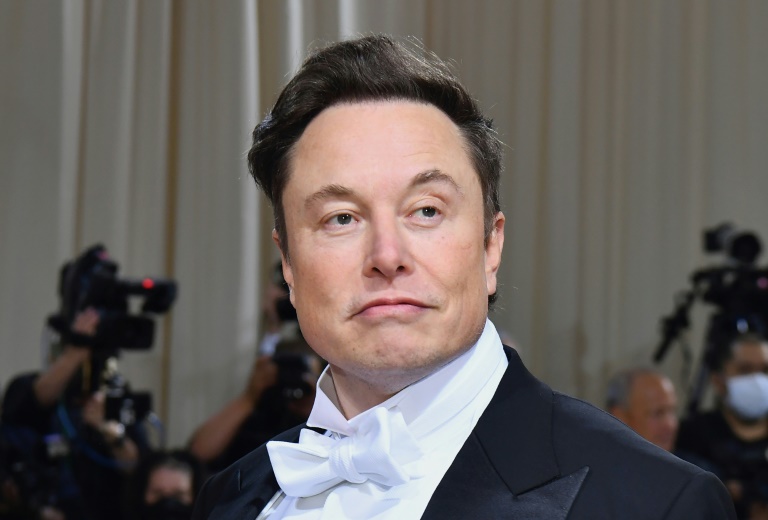
Elon Musk took control of Twitter and fired its top executives late Thursday in a deal that puts one of the leading platforms for global discourse in the hands of the world’s richest man.

Musk sacked chief executive Parag Agrawal, as well as the company’s chief financial officer and its head of safety, the Washington Post and CNBC reported citing unnamed sources.

Agrawal previously went to court to hold the Tesla chief to the terms of a takeover deal he had tried to escape.

The reports came hours before the court-appointed deadline for Musk to seal his on-again, off-again deal to purchase the social media network.

Musk tweeted earlier in the day that he was buying Twitter “because it is important to the future of civilization to have a common digital town square, where a wide range of beliefs can be debated in a healthy manner.”

Twitter did not immediately reply to a request for comment on the departure of its top executives, but the platform’s co-founder Biz Stone thanked the trio — Agrawal, Ned Segal and Vijaya Gadde — for their “collective contribution to Twitter.”

“Massive talents, all, and beautiful humans each.”

– ‘Chief Twit’ –

The closure of the deal marks the culmination of a long and drawn out back-and-forth between the billionaire and the social network.

Musk tried to step back from the Twitter deal soon after his unsolicited offer was accepted in April, and said in July he was canceling the contract because he was misled by Twitter over the number of fake “bot” accounts — allegations rejected by the company.

Twitter, in turn, sought to prove Musk was contriving excuses to walk away simply because he changed his mind.

After Musk sought to terminate the sale, Twitter filed a lawsuit to hold Musk to the agreement.

With a trial looming, the unpredictable billionaire capitulated and revived his takeover plan.

Musk signaled the deal was on track this week by changing his Twitter profile to “Chief Twit” and posting a video of himself walking into the company’s California headquarters carrying a sink.

“Let that sink in!” he quipped.

He even shared a picture of himself socializing at a coffee bar at Twitter headquarters earlier in the day Thursday.

Musk said during a recent Tesla earnings call that he was “excited” about the Twitter deal even though he and investors are “overpaying.”

– Twitter free-for-all? –

Some employees who would prefer not to work for Musk have already left, said a worker who asked to remain anonymous in order to speak more freely.

“But a portion of people, including me, are willing to give him the benefit of the doubt for now,” the employee said.

The idea of Musk running Twitter has alarmed activists who fear a surge in harassment and misinformation, with Musk himself known for trolling other Twitter users.

But Musk said he realizes Twitter “cannot become a free-for-all hellscape where anything can be said with no consequences.”

Musk has vowed to dial content moderation back to a bare minimum, and is expected to clear the way for former US president Donald Trump to return to the platform.

The then-president was blocked due to concerns he would ignite more violence like the deadly attack on the Capitol in Washington to overturn his election loss.

Far-right users were quick to rejoice on the network, posting comments such as “masks don’t work” and other taunts, under the belief that moderation rules will now be relaxed.

“Free speech will always prevail,” tweeted Republican Senator Marsha Blackburn of Tennessee, prompting replies including “says the party that bans books.”

Close Bitnami banner
Bitnami