World

Adidas cuts ties with Kanye West over anti-Semitic remarks

German sportswear giant Adidas said Tuesday it was ending its partnership with Kanye West after a series of anti-Semitic outbursts by the controversial rapper.

Recent comments by West — known formally as Ye — were “unacceptable, hateful and dangerous”, Adidas said in a statement. 

“After a thorough review, the company has taken the decision to terminate the partnership with Ye immediately.”

Adidas said it would “end production” of the highly-successful “Yeezy” line designed together with West and “stop all payments to Ye and his companies”.

The abrupt end to the collaboration between the sportswear brand and rapper would slash Adidas’s net income in 2022 by “up to 250 million euros ($246 million)”, it estimated.

Adidas is the latest brand to part ways with West following his recent outbursts. Paris-based fashion house Balenciaga ended ties with the rapper last week, saying it “no longer (has) any relationship nor any plans for future projects related to this artist.”

On Monday, one of Hollywood’s biggest talent agencies, CAA, also said it was dropping West, while film and TV producer MRC said it was shelving an already-finished documentary about the artist.

– T-shirt statement –

Adidas began a review of its relationship with West earlier this month after he appeared at a fashion show in Paris wearing a shirt with the slogan “White Lives Matter.”

The phrase is a dog whistle to right-wing groups in the United States and a reaction to the Black Lives Matter movement.

Days later he was locked out of Twitter and Instagram for threatening to “Go death con 3 on JEWISH PEOPLE.”

Comments made by West “violate the company’s values of diversity and inclusion, mutual respect and fairness”, Adidas said Tuesday.

The artist was associated with Nike for years but broke away in 2013, lending his name to Adidas as they launched their first Yeezy shoe together in 2015 — a partnership that went on to make him a billionaire. 

Along with Beyonce, Stella McCartney and Pharrell Williams, West’s has been one of the top names used by Adidas to boost sales, especially online.

– Inflammatory remarks –

Adidas had come under increasing pressure from rights campaigners and entertainment world figures to stop working with West.

, told the RND media group before Adidas’s announcement that West’s words could “not be tolerated”, urging the company to end its commercial relationship with the rapper.

Ari Emanuel, CEO of entertainment agency Endeavor, similarly called on all companies to cut ties with West.

“Those who continue to do business with West are giving his misguided hate an audience,” Emanuel wrote in the Financial Times. “There should be no tolerance anywhere for West’s anti-Semitism.”

West’s ex-wife Kim Kardashian appeared to be joining the pile-on, though her tweet did not mention the father of her children by name.

“Hate speech is never OK or excusable,” she wrote on Twitter and Instagram on Monday.

“I stand together with the Jewish community and call on the terrible violence and hateful rhetoric towards them to come to an immediate end.”
Sunak appointed crisis-hit UK's first PM of colour

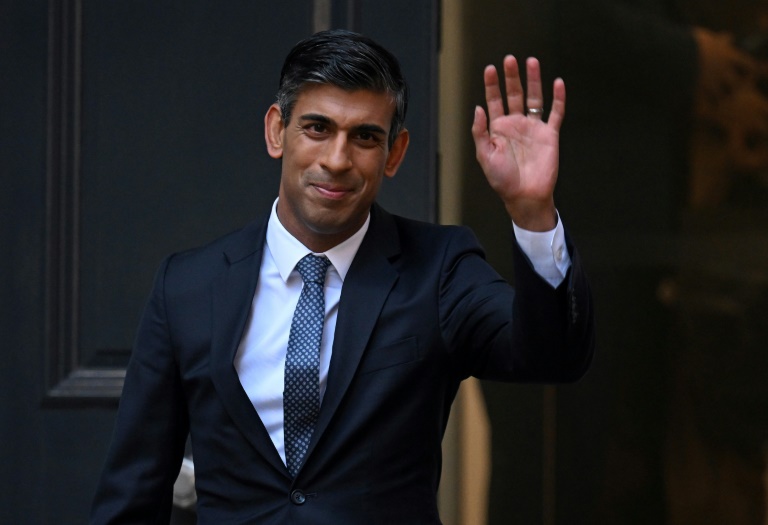
Rishi Sunak on Tuesday became Britain’s third prime minister this year and the first person of colour to lead the former imperial power, vowing to mend the “mistakes” of Liz Truss’s calamitous 49-day tenure.

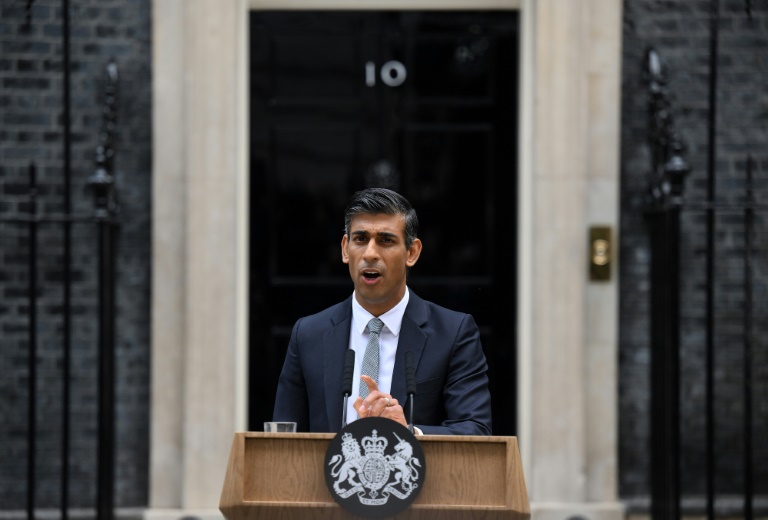
Sunak addressed the nation outside 10 Downing Street after his appointment by King Charles III, capping the latest extraordinary twist in UK politics following Boris Johnson’s demise in July.

“I will unite our country — not with words, but with action,” the former finance minister said, pledging also unstinting support for Ukraine even while warning of “difficult” budget choices ahead.

Sunak said a disastrous budget that felled Truss was motivated by a well-intentioned desire to kick-start growth, but its tax-cutting measures were “mistakes nonetheless”. 

“And I have been elected as leader of my party and your prime minister in part to fix them,” he said.

“And that work begins immediately. I will place economic stability and confidence at the heart of this government’s agenda.”

Departing Downing Street shortly before, Truss wished Sunak “every success” — and said she remained “more convinced than ever” that Britain needed to be “bold” in confronting the challenges it faced.

Sunak became the ruling Conservatives’ new leader on Monday after triumphing over rival contender Penny Mordaunt, who failed to secure enough nominations from Tory MPs.

It had become a two-way fight after Johnson dramatically aborted a comeback attempt late Sunday, having failed to persuade Sunak to share power. 

Breaking his silence, Johnson offered his “full and wholehearted support” to Sunak — having blamed his ex-minister for toppling him in July.

Sunak, a Hindu, is the first British-Indian prime minister and, at 42, the youngest leader in more than two centuries. 

US President Joe Biden called the choice “groundbreaking”, and vowed to reach out to Sunak shortly.

Sunak took power in a morning audience with Charles — who anointed his first prime minister since ascending the throne following the death of his mother Queen Elizabeth II.

– ‘Unite or die’ –

Britain’s Conservative-supporting media hailed Sunak’s appointment.

“The force is with you, Rishi,” ran The Sun’s headline, in a reference to Sunak’s love of “Star Wars” films. The Daily Mail called it “a new dawn for Britain”.

But the left-leaning Guardian highlighted Sunak’s warning to Conservative MPs that the party must “unite or die”.

Truss left office as the shortest-serving premier in history, after a disastrous tax-slashing budget sparked economic and political turmoil.

The 47-year-old announced her resignation last Thursday, admitting she could not deliver her mandate from Conservative members — who had chosen her over Sunak in the summer to replace Johnson.

Sunak has now staged a stunning turnaround in political fortunes, and vowed to do the same for Britain as it confronts decades-high inflation, surging borrowing costs and imminent recession. 

He also faces the uphill task of uniting a party riven with divisions and infighting.

Iain Duncan Smith, a former Conservative leader, said MPs now understood the “existential threat” facing the Tories, and that they needed to unite or accept being “out of power for a long time”.

– ‘Difficult decisions’ –

After delivering the now all-too-familiar new leader’s speech, Sunak started appointing his top team before facing his first session of “Prime Minister’s Questions” in parliament on Wednesday.

Finance minister Jeremy Hunt — appointed by Truss just 11 days ago in a bid to salvage her premiership — could remain in the role after stabilising the markets.

He endorsed Sunak on Sunday, writing in the Telegraph that he was a leader “willing to make the choices necessary for our long-term prosperity”.

After reversing almost all of Truss’s various tax cuts, Hunt has warned “difficult decisions” loom over public spending.

Whoever heads the Treasury is set to unveil the government’s much-anticipated fiscal plans on October 31.

Sunak must also decide whether to appoint to his cabinet senior MPs who did not support him, such as Mordaunt, in a bid to unify his fractured party. 

One unlikely to get a seat around the table is former boss Johnson, who was driven out in July partly thanks to Sunak’s resignation.

On Sunday he announced he would not go forward with his audacious leadership bid.

– ‘No mandate’ –

Sunak, a wealthy descendant of immigrants from India and East Africa, is also facing calls for a general election after becoming the latest leader who lacks a direct mandate from the electorate.

Pollster Ipsos said Monday that 62 percent of voters want a vote by the end of the year.

“He has no mandate, no answers and no ideas,” Labour’s deputy leader Angela Rayner tweeted.

Ed Davey, leader of the Liberal Democrats, said young people would be “inspired” by the appointment of the first British-Asian leader — but also insisted it was time for a general election.

“Given the Conservatives have trashed the economy… I guess one’s not surprised that they’re scared of the British public,” he told Times Radio.

Zelensky asks donors for $38 bn as Russia shells Bakhmut

Ukrainian President Volodymyr Zelensky on Tuesday asked the international community to cover an expected budget deficit of $38 billion next year for his war-torn country, with Moscow’s invasion also badly hitting the economy.

Fatal Russian shelling meanwhile was pummelling the eastern Donbas city of Bakhmut, where AFP journalists saw smoke rising from fierce battles between Moscow’s forces and Ukraine’s army trying to keep them at bay.

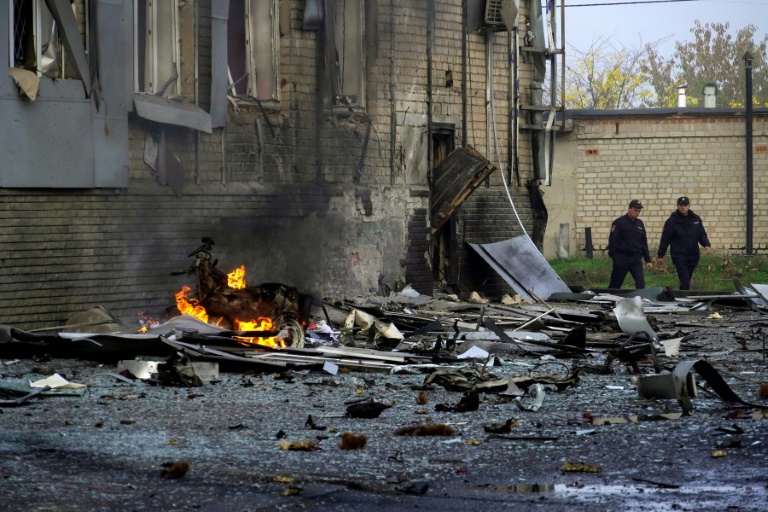
And pro-Russian authorities in the southern Ukraine city of Melitopol, now controlled by Moscow’s forces, said a car bomb had exploded near the offices of a local media outlet injuring five people.

At an international reconstruction conference for Ukraine in Berlin, Zelensky urged European leaders to offer greater financial support for his country more than eight months after Vladimir Putin sent Russian troops into Ukraine.

“At this very conference we need to make a decision on assistance to cover next year’s budget deficit for Ukraine,” Zelensky said via video-link. “It’s a very significant amount of money, a $38 billion deficit,” he added.

German Chancellor Olaf Scholz meanwhile said that rebuilding Ukraine would be a “generational task” that must start immediately, even as Russia’s invasion rages on.

“What is at stake here is nothing less than creating a new Marshall Plan for the 21st century — a generational task that must begin now,” Scholz said.

– ‘I’m in shock’ –

Russian forces, after being pushed back from Kyiv early in the invasion and the northeastern Kharkiv region, have set their sight on wresting territory in Donbas, an eastern industrial zone.

In Bakhmut, a town Russians have been eyeing for weeks, an AFP journalist saw smoke rising despite heavy rain and a Ukrainian missile shooting down a Russian drone.

A 28-year-old soldier, who declined to give his name to AFP over security concerns, claimed Ukraine’s forces had made gains in the region overnight, but declined to give further details.

Seven civilians were killed and three injured the wine-making and salt-mining town a day earlier, the regional governor said Tuesday.

Three bodies of civilians killed earlier were also discovered in two places in the region, which has been at the centre of intense fighting with the Russian army for months, said Governor Pavlo Kyrylenko. 

In a residential area of the Bakhmut, AFP journalists saw blood stains on the ground in the wake of what residents said was a fatal attack the day before.

“I found a body here without a head. I’m in shock,” said 58-year-old Sergii, adding: “It was a man. He was just walking on the street”.

Donetsk, the eastern region where Bakhmut is located, is one of the four Ukrainian regions that Russian President Vladimir Putin claims to have annexed, and where martial law has been imposed.

Ukrainian forces have however been largely holding back Moscow’s weeks-long push for Bakhmut and in the southern Kherson region are moving closer towards its main city there.

The Russian-backed authorities there said Tuesday that more than 22,000 residents had fled from the town and nearby settlements over to the left bank of the Dnipro river following calls to evade Ukraine’s advance.

– Car blast in Russian-held city –

On the road to Kherson from Ukraine-controlled territory, two old friends who worked as truck drivers before the war were sitting in a trench. 

“We go up this road under fire and come back down this road under fire,” one of the men, a 51-year-old grumbled with a mischievous twinkle in his eye.

The wilted sunflower fields around him offered nowhere to hide from the Russian bombs and missiles that the men were expecting to start falling any minute.

A 25-mile (40-kilometre) road running from government-held Mykolaiv to Russian-occupied Kherson will form the backbone of Ukraine’s push to regain access to the Sea of Azov and cut Russia’s land link with Crimea.

Further east, in Melitopol, Russian backed-authorities said the car bomb had left five injured near the offices of the ZaMedia group, with images showing a grey building block with windows ripped off and burning debris on the ground.

There was no confirmation or denial from Kyiv its forces were responsible for the explosion.

The exiled Ukrainian authorities in Melitopol said on social media that: “This is what the heating in the buildings of collaborators and propagandists should look like! And it will become hotter”.

Officials in Kyiv have taken to social media to hint at official Ukrainian backing for previous attacks in Moscow-controlled regions, including a blast earlier this month on the only bridge connecting Russia with the annexed Crimean peninsula.

'Full circle': Sunak's roots a point of pride for Indians

Many Indians are delighting in the elevation of Rishi Sunak — a practising Hindu with Punjabi roots — as British prime minister, in a milestone year for the subcontinental country’s relationship with its former colonial ruler.

Sunak took charge Tuesday as Britain’s third premier this year with his Conservative Party floundering in the polls and daunting challenges ahead. 

The 42-year-old was born and raised in Southampton, but his appointment as his country’s first prime minister of colour has been cheered by Indians who still consider him a son of the soil. 

“I am extremely happy,” Krishna Kumar, an Indian IT worker, told AFP in the capital New Delhi. 

“Great Britain is a country which ruled India for more than 300 years — now a person of Indian origin is going to rule UK.”

Sunak’s parents were born into the Indian diaspora in east Africa, and trace their heritage back to pre-independence Punjab in northern British India.

He is married to Indian-born Akshata Murty, whose father co-founded IT giant Infosys.

India celebrated 75 years since the end of British rule in August, just weeks before becoming the world’s fifth-largest economy when its GDP overtook the United Kingdom’s, according to IMF figures.

Colonial subjects would never have imagined such a “big development” as a man of Indian heritage taking charge of Britain, said Basavaraj Bommai, the chief minister of southern Karnataka state.

“The wheel of fortune has turned completely,” he told reporters on Monday.

Sunak’s ascent has been the subject of wall-to-wall television coverage in India, animating discussion during the usually lethargic Diwali holiday season. 

“Indian son rises over the Empire — History comes full circle in Britain,” read a news banner splashed on broadcaster NDTV. 

Sunak takes charge of the UK as his Indian counterpart, Narendra Modi, is accelerating efforts to scrap symbolic vestiges of the colonial years.

The ruling Bharatiya Janata Party (BJP) espouses a muscular Hindu nationalism that champions historical figures who opposed foreign domination and influence.

In September, Modi inaugurated a statue of Subhas Chandra Bose, an independence hero venerated for taking up arms against the British, but controversial for his collaboration with Nazi Germany’s war machine.

The unveiling ceremony took place just hours before Britain announced the death of Queen Elizabeth II, and the statue itself replaces one of Britain’s King George V torn down nearly half a century ago.

The same month, Modi unveiled a new naval ensign that removed the prominent St George’s cross — the national emblem of England — from the existing flag.

– ‘Position of strength’ –

Modi congratulated Sunak on Monday and said he looked forward to the opportunity to “transform our historic ties into a modern partnership”.

Sunak’s first order of business with India will be to finalise a delayed free trade deal, a pact that both countries had hoped to sign before Monday’s Diwali festivities. 

The agreement is important for Britain as it seeks alternative markets after leaving the European Union, but talks have reportedly snagged over fears among Conservatives that it would lead to an increase in immigration.

Sunak’s appointment could be an added hindrance to the deal, said Harsh V Pant, a professor at King’s College London’s India Institute.

“Being a person of Indian origin, he’d not like to be seen as being soft on India. He will have to negotiate from a position of strength,” Pant told AFP. 

His ability to push the deal over the objections of his party’s rank and file would be an “important benchmark” for the success of his premiership, Pant added. 

The new leader already faces the uphill task of uniting a party riven with divisions and infighting — and still reeling from the brief but calamitous tenure of his predecessor Liz Truss. 

Despite Indians hailing Sunak’s appointment as a historic moment for both countries, the political and economic instability he inherits has muted expectations for his tenure. 

“This is the third prime minister in a year,” Himanshu Singh, an engineer, told AFP. 

“So we don’t know how many hours, or how many days or how many weeks he’s going to be there.”

New PM Meloni says Italy committed to Europe

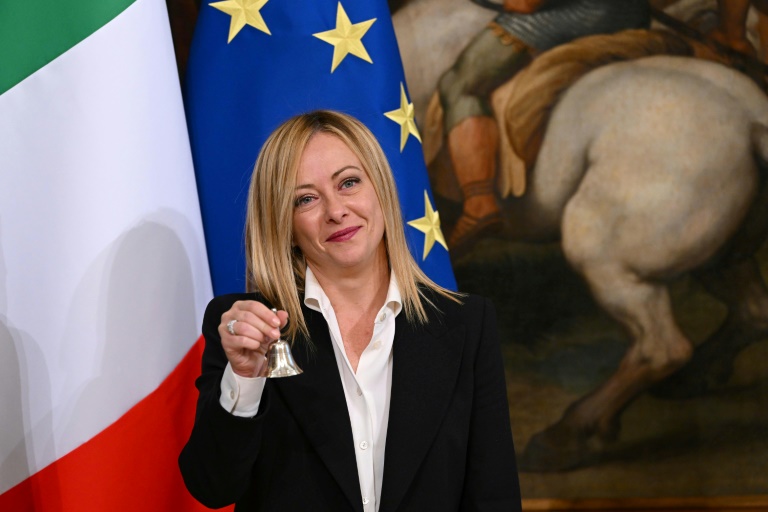
Italian Prime Minister Giorgia Meloni confirmed her government’s support for the European Union, NATO and Ukraine on Tuesday in her first address to parliament, one month after her far-right party won a historic election victory.

The 45-year-old, who was sworn in as Italy’s first woman premier on Saturday, also rejected any links with her country’s fascist past, saying she had “never felt sympathy or closeness to undemocratic regimes… including fascism”.

The prospect of a Eurosceptic, populist government leading the eurozone’s third largest economy has sparked concern among Italy’s allies, particularly in the European Union.

“Italy is fully part of Europe and the Western world,” Meloni told the lower house of parliament, adding that it would “continue to be a reliable partner of NATO in supporting Ukraine”.

The last government under Mario Draghi was one of the strongest EU supporters of sanctions on Russia over its invasion of Ukraine, and also sent weapons to Kyiv.

Meloni supported that policy, despite being in opposition — and despite Italy’s heavy dependence at the time on Russian gas.

But one of her coalition partners, former premier Silvio Berlusconi, was recorded last week defending his old friend, Russian President Vladimir Putin.

Meloni said she would not give in to “Putin’s blackmail on energy”.

Like much of Europe, Italy is battling soaring inflation, fuelled by sky-high energy bills, which risks pushing the country into recession next year.

Meloni said she would strengthen existing measures to help businesses and households cope with rising prices, but warned this would have an effect on spending elsewhere.

After her speech, lawmakers will on Tuesday evening hold a vote of confidence in Meloni’s government, the most right-wing in Rome since World War II.

The vote, followed by another in the Senate Wednesday, is largely procedural, as her coalition has a comfortable majority in parliament.

– Recovery plan –

Before the election Meloni’s coalition, which also includes Matteo Salvini’s far-right League, agreed an expensive programme of tax cuts and spending promises.

But she has emphasised fiscal prudence, wary of Italy’s mammoth debt worth 150 percent of gross domestic product.

She named as economy minister Giancarlo Giorgetti, a relatively moderate member of the League who was economic development minister under Draghi.

Roberto Cingolani, who served as energy minister in the last government, will also stay on as an adviser as Italy weans itself off Russian gas and seeks to boost the use of renewables.

However, even before she spoke to Salvini — her new deputy prime minister and minister for infrastructure — he set out his own costly plan for government.

In a series of tweets late Monday, the League leader vowed action to lower the pension age, extend a flat tax and finally build a long discussed bridge between mainland Italy and Sicily, which he said would create 100,000 jobs.

Key to Italy’s future growth is almost 200 billion euros ($197 billion) in grants and loans from the EU’s post-pandemic recovery fund, which depend on Rome implementing major reforms from criminal justice to public administration.

Meloni said it was an opportunity to make a “real change” but said she would seek “adjustments” to the plan to take into account the rising cost of energy and raw materials.

Analysts say there is little room for manoeuvre, with the funds already being disbursed and Brussels unwilling to re-open negotiations.

Meloni had what she called a “fruitful” first meeting with French President Emmanuel Macron on Sunday in Rome, and spoke on the telephone Saturday with European Commission President Ursula von der Leyen. 

Meloni’s Brothers of Italy party won a historic 26 percent of the vote in September 25 elections, with a promise to defend Italy’s borders, traditional values and national interests abroad.

Salvini’s League party won nine percent in the elections while Berlusconi’s right-wing Forza Italia won eight percent.

Rebuilding Ukraine a 'generational task' that begins now: Scholz

German Chancellor Olaf Scholz said on Tuesday that rebuilding Ukraine was a “generational task” that must start immediately, even as Russia’s invasion rages on.

Scholz as current head of the G7 club of wealthy nations said Ukraine could count on the support of the international community for decades to come as it seeks to repair and upgrade essential infrastructure.

“What is at stake here is nothing less than creating a new Marshall Plan for the 21st century — a generational task that must begin now,” Scholz said as he opened an international reconstruction conference for Ukraine in Berlin.

Rebuilding Ukraine marks a “challenge for generations”, Scholz said, but one that also provided a chance to modernise its roads, bridges, schools, hospitals and transport links.

The task is “one that will require the combined strength of the entire international community but it is also an opportunity for generations to come if we get it right”, he said.

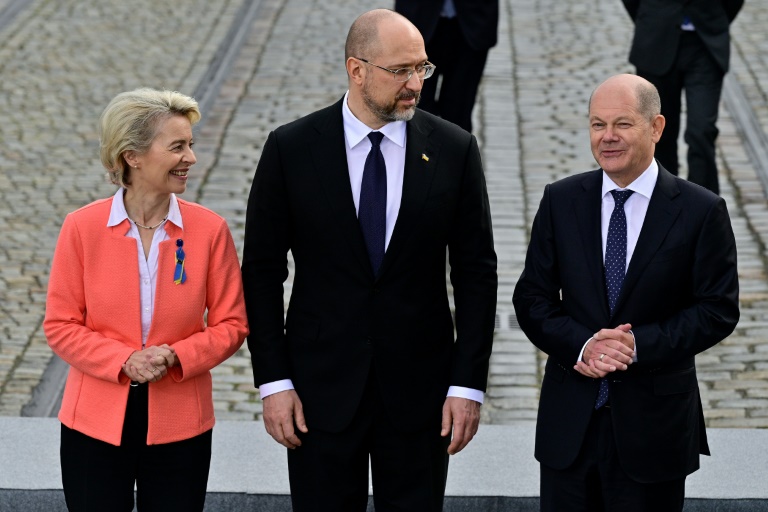
Speaking at the same event, European Commission chief Ursula von der Leyen called the scale of destruction in the war-ravaged country “staggering”, with the World Bank estimating the toll of the damage at 350 billion euros ($345 billion). 

“This is for sure more than one country or one union can provide alone,” she said. “We need all hands on deck.”

– ‘To be or not to be’ –

Ukrainian President Volodymyr Zelensky was also addressing the one-day conference, which brought together international organisations and private sector representatives as well as political leaders.

He appealed to international supporters to cover his country’s $38-billion budget hole for 2023, saying such assistance was essential if Ukraine is to get back on its feet.

“At this very conference we need to make a decision on assistance to cover the next year’s budget deficit for Ukraine,” he said, speaking to the event via video link.

“It’s a very significant amount of money.”

His prime minister Denys Shmyhal said funding was urgently needed “to help us survive this winter to save the people from humanitarian catastrophe”.

He said alleviating the crisis would also “save the European continent from the migration wave, from the immigration tsunami” that has already seen millions of Ukrainians fleeing to the EU.

Polish Prime Minister Mateusz Morawiecki urged Europe to stand strong against Russia as the war grinds on, warning against attempts to seek an end to the fighting at any cost.

“The policy of appeasing Russia is bankrupt and everyone who is still trying to enact it drags Europe down,” he said.

He insisted Europe was “much stronger than Russia” but the fact that Russian President Vladimir Putin remained unvanquished “only proves that (Europe) is to some extent or it was a paper tiger”.

“If we do not win the war with Russia we risk more than just losing Ukraine and its security — we risk marginalising the entire continent,” he warned.

Quoting Shakespeare, Morawiecki said it was a moment of truth for Europe to stand up for its purpose and values. 

“The world only deals with strong players — Europe must prove its strength. It is our ‘to be or not to be’ moment,” he said.

Rebuilding Ukraine a 'generational task' that begins now: Scholz

German Chancellor Olaf Scholz said on Tuesday that rebuilding Ukraine was a “generational task” that must start immediately, even as Russia’s invasion rages on.

Scholz as current head of the G7 club of wealthy nations said Ukraine could count on the support of the international community for decades to come as it seeks to repair and upgrade essential infrastructure.

“What is at stake here is nothing less than creating a new Marshall Plan for the 21st century — a generational task that must begin now,” Scholz said as he opened an international reconstruction conference for Ukraine in Berlin.

Rebuilding Ukraine marks a “challenge for generations”, Scholz said, but one that also provided a chance to modernise its roads, bridges, schools, hospitals and transport links.

The task is “one that will require the combined strength of the entire international community but it is also an opportunity for generations to come if we get it right”, he said.

Speaking at the same event, European Commission chief Ursula von der Leyen called the scale of destruction in the war-ravaged country “staggering”, with the World Bank estimating the toll of the damage at 350 billion euros ($345 billion). 

“This is for sure more than one country or one union can provide alone,” she said. “We need all hands on deck.”

– ‘To be or not to be’ –

Ukrainian President Volodymyr Zelensky was also addressing the one-day conference, which brought together international organisations and private sector representatives as well as political leaders.

He appealed to international supporters to cover his country’s $38-billion budget hole for 2023, saying such assistance was essential if Ukraine is to get back on its feet.

“At this very conference we need to make a decision on assistance to cover the next year’s budget deficit for Ukraine,” he said, speaking to the event via video link.

“It’s a very significant amount of money.”

His prime minister Denys Shmyhal said funding was urgently needed “to help us survive this winter to save the people from humanitarian catastrophe”.

He said alleviating the crisis would also “save the European continent from the migration wave, from the immigration tsunami” that has already seen millions of Ukrainians fleeing to the EU.

Polish Prime Minister Mateusz Morawiecki urged Europe to stand strong against Russia as the war grinds on, warning against attempts to seek an end to the fighting at any cost.

“The policy of appeasing Russia is bankrupt and everyone who is still trying to enact it drags Europe down,” he said.

He insisted Europe was “much stronger than Russia” but the fact that Russian President Vladimir Putin remained unvanquished “only proves that (Europe) is to some extent or it was a paper tiger”.

“If we do not win the war with Russia we risk more than just losing Ukraine and its security — we risk marginalising the entire continent,” he warned.

Quoting Shakespeare, Morawiecki said it was a moment of truth for Europe to stand up for its purpose and values. 

“The world only deals with strong players — Europe must prove its strength. It is our ‘to be or not to be’ moment,” he said.

Meta says WhatsApp outage resolved

US tech giant Meta on Tuesday said it had resolved a major WhatsApp outage that prevented many of the billions of users of its popular service from connecting or sending messages.

Problems with the instant messaging app were reported by monitoring site Downdetector and user complaints on social media on Tuesday morning.

Downdetector said thousands of WhatsApp users had been reporting problems since 0717 GMT, with a sharp spike appearing on its dedicated chart covering the past 24 hours.

WhatsApp’s parent company Meta said it was working to restore the service “as quickly as possible” before resolving the problem later on Tuesday.

“We know people had trouble sending messages on WhatsApp today. We’ve fixed the issue and apologise for any inconvenience,” a Meta spokesman told AFP.

Social media users said they had been unable to connect to the app or send any messages, although some reported a restoration of the service at around 0850 GMT.

The hashtag #whatsappdown was one of the most trending on Twitter across the world on Tuesday, while millions of messages on Meta-owned photo-sharing platform Instagram also flagged the outage.

Some Twitter users tried to find a funny side to the technical trouble, joking that Twitter would seek to exploit the situation and gain a flurry of new connections in the coming hours. 

The origin of the outage is unclear.

– Meta outages –

Meta — formerly known as Facebook — suffered an unprecedented outage last year affecting its leading social media platforms including Facebook, Instagram, WhatsApp and Messenger.

The duration and scale of the disruption to the four services used by billions of people led to a major incident that Downdetector described as one of the largest ever observed.

At the time, Facebook acknowledged that the incident was due to an error on their part and was not a technical problem.

WhatsApp, a free messaging service, crossed the threshold of two billion users worldwide in February 2020 and is one of the most popular apps.

Facebook renamed itself Meta a year ago, to signal its pivot to building its vision for an interactive virtual and augmented reality world that it sees as the future.

But Meta has been undergoing a difficult period financially due to dropping advertising revenues and fierce competition from other platforms such as TikTok, whose popularity has exploded among social media users.

Meta says WhatsApp outage resolved

US tech giant Meta on Tuesday said it had resolved a major WhatsApp outage that prevented many of the billions of users of its popular service from connecting or sending messages.

Problems with the instant messaging app were reported by monitoring site Downdetector and user complaints on social media on Tuesday morning.

Downdetector said thousands of WhatsApp users had been reporting problems since 0717 GMT, with a sharp spike appearing on its dedicated chart covering the past 24 hours.

WhatsApp’s parent company Meta said it was working to restore the service “as quickly as possible” before resolving the problem later on Tuesday.

“We know people had trouble sending messages on WhatsApp today. We’ve fixed the issue and apologise for any inconvenience,” a Meta spokesman told AFP.

Social media users said they had been unable to connect to the app or send any messages, although some reported a restoration of the service at around 0850 GMT.

The hashtag #whatsappdown was one of the most trending on Twitter across the world on Tuesday, while millions of messages on Meta-owned photo-sharing platform Instagram also flagged the outage.

Some Twitter users tried to find a funny side to the technical trouble, joking that Twitter would seek to exploit the situation and gain a flurry of new connections in the coming hours. 

The origin of the outage is unclear.

– Meta outages –

Meta — formerly known as Facebook — suffered an unprecedented outage last year affecting its leading social media platforms including Facebook, Instagram, WhatsApp and Messenger.

The duration and scale of the disruption to the four services used by billions of people led to a major incident that Downdetector described as one of the largest ever observed.

At the time, Facebook acknowledged that the incident was due to an error on their part and was not a technical problem.

WhatsApp, a free messaging service, crossed the threshold of two billion users worldwide in February 2020 and is one of the most popular apps.

Facebook renamed itself Meta a year ago, to signal its pivot to building its vision for an interactive virtual and augmented reality world that it sees as the future.

But Meta has been undergoing a difficult period financially due to dropping advertising revenues and fierce competition from other platforms such as TikTok, whose popularity has exploded among social media users.

Children among 11 killed in fire at Uganda blind school

Eleven people, mostly children, have perished in a blaze that tore through a dormitory at a school for the blind in Uganda in the early hours of Tuesday as pupils were sleeping.

“The cause of the fire is currently unknown but so far 11 deaths as a result of the fire have been confirmed while six are in critical conditions and admitted (to hospital),” the Uganda Police Force said on Twitter.

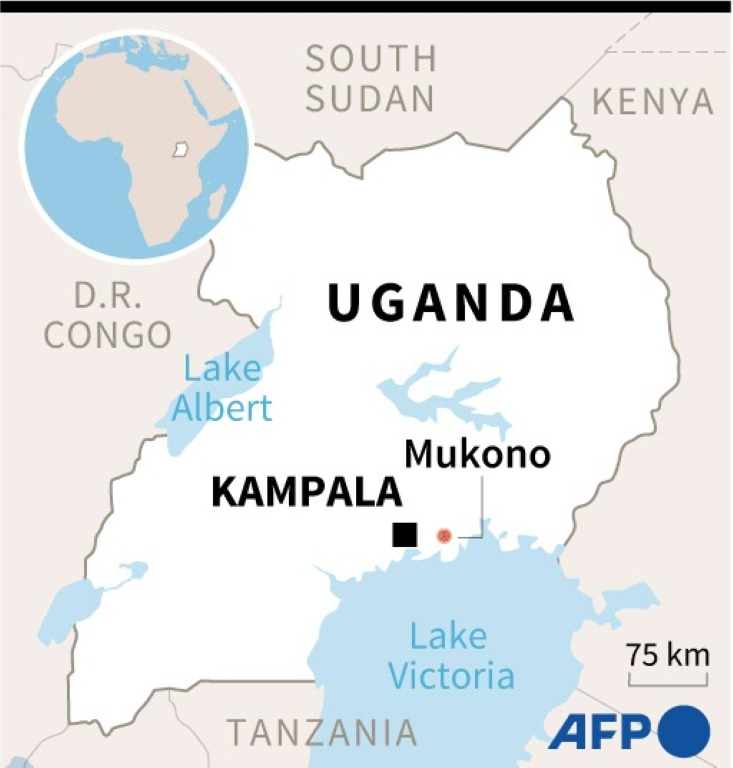
The disaster occurred at about 1 am (2200 GMT Monday) at the Salama School for the Blind in the Mukono district, east of the capital Kampala.

Police said an investigation had been launched into the cause of the inferno and more details would be released later.

“Most of the dead are children at the school and our sympathies go to the parents,” Internal Affairs Minister General Kahinda Otafiire told AFP. 

He said the school has been cordoned off as a “crime scene” and vowed that there would be a full investigation.

“As government we shall go to the root cause of the fire and if there are any culprits they will be apprehended and the law will take its course,” he added.

The school’s headmaster Francis Kirube, who is also blind, told AFP the flames swept through the dormitory as the pupils slept.

Images broadcast on Ugandan television showed a charred but still largely intact building where the fire broke out, its window frames and door blackened and the corrugated roof damaged.  

Forensic teams were seen in white protective gear at the school, while grieving parents gathered nearby.

– ‘He is gone’ –

Richard Muhimba, the distraught father of one of the dead children, told AFP: “No words can explain the pain I am going through. 

“I visited my child on Saturday, he was in good health and in less than three days he is gone… Please give me time to go through this pain,” said Muhimba, before hanging up.

A friend told AFP that the child was aged 15 and that Muhimba was a father of five. 

Salama was built in April 1999 by the local government in Mukono and caters for children and young adults between the ages of six to 25.

Princess Anne, the sister of King Charles III, had been due to visit the school during her trip this week to Uganda, which marked its 60th anniversary of independence from Britain earlier this month.

The East African nation has suffered a string of deadly school fires in recent years.

In November 2018, 11 boys perished and another 20 suffered severe burns in a suspected arson attack at a boarding school in southern Uganda.

In April 2008, 18 schoolgirls burned to death along with one adult when a fire engulfed their dormitory at a junior school near the Ugandan capital. 

In March 2006, at least 13 children were killed and several hurt when fire razed an Islamic school in western Uganda. In July the same year, six children died in a similar fire in the east.

Close Bitnami banner
Bitnami